The Largest Railway Station In The World
My journey took me to Leipzig Hauptbahnhof. Wikipedia says this about the station.
Leipzig Hauptbahnhof is the central railway terminus in Leipzig, Saxony. At 83,460 square metres, it is the world’s largest railway station measured by floor area. It has 19 overground platforms housed in six iron train sheds, a multi-level concourse with towering stone arches, and a 293-metre long facade. Two Leipzig City Tunnel underground platforms were inaugurated in December 2013. The station also functions as a large shopping centre.
Train services are operated by Deutsche Bahn, S-Bahn Mitteldeutschland, Erfurter Bahn and Mitteldeutsche Regiobahn. As of 2008, Leipzig Hauptbahnhof handled an average of 120,000 passengers per day.
The station is probably bigger physically than Kings Cross and St. Pancras International combined, although together they handled 153,000 passengers per day last year. This Google Map shows the station and the centre of Leipzig.

Leipzig
Note the size of the station and the number of platforms. And there are two more underneath on the Leipzig City Tunnel.
I found it an easy walk between the station and the centre.
These pictures show the station.




















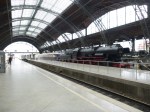



Note how like St. Pancras, there is a shopping mall underneath the platform level. I bought some excellent strawberries there. They were smaller and flavourful, unlike the tasteless, large Elsan variety we get offered in Supermarkets all the time.
From Dresden To Leipzig
This was not the most stimulating of journeys, as there was nothing worth photographing.












The train was fairly full.
There was also a bit of a problem at Leipzig, where the passengers had to manhandle and womanhandle a guy in an electric wheelchair out of the train. Obviously, Deutsche Bahn have a different attitude to wheelchair passengers compared to most UK rail companies.
The Bombing Of Dresden
I could not leave Dresden without commenting on the Bombing of Dresden by the Allies in World War II.
Some feel it was a war crime and many say it was justified. This is the first paragraph in the Wikipedia section describing the background to the bombing.
Early in 1945, after the German offensive known as the Battle of the Bulge had been exhausted — including the disastrous attack by the Luftwaffe on New Year’s Day involving elements of eleven combat wings of the Luftwaffe’s day fighter force — and after the Red Army had launched their Silesian Offensives into pre-war German territory, theGerman army was retreating on all fronts, but still resisting strongly. On 8 February 1945, the Red Army crossed the Oder River, with positions just 70 km from Berlin. As theEastern and Western Fronts were getting closer, the Western Allies started to consider how they might aid the Soviets with the use of the strategic bomber force. They planned to bomb Berlin and several other eastern cities in conjunction with the Soviet advance—to cause confusion among German troops and refugees, and hamper German reinforcement from the west.
It is a sensible argument, but I feel that decisions earlier in the War meant that to cause the required confusion, they had no alternative.
Churchill and others were also worried about what the Russians would do with the territory they captured. And he was right, as their colonisation and subjugation of Eastern Europe happened and it was something of which no-one can be proud.
In some ways it’s a pity that the German leaders in 1944, didn’t know how close we were to perfecting the atom bomb. But if they had,would the likes of Hitler ever surrendered? I doubt it! When you’re dealing with the really mad, all logic goes out of the window.
So could there have been an alternative to the bombing of Dresden and Leipzig?
What my father had been involved with in the war, I know not! But he was a passionate believer in the abilities of the de Havilland Mosquito. My father was well-connected in some way to John Grimston, who later became the 6th Earl of Veralem. In the 1950s and 1960s, Grimston’s company, Enfield Rolling Mills, was my father’s biggest customer. I know he was well-connected because when I needed a vacation job, my father rang the Earl and called in a favour, which got me three months extremely useful work in the Electronics Laboratory. My father did move in some unusual circles before and during the war. At one time, he was even working at the League of Nations in Geneva.
I have just read the section in Wikipedia about the Inception of the Mosquito. To say it was a struggle to get de Havilland’s wooden design accepted and then built would be an understatement. My father and others have said that there was scepticism in the Air Ministry about sending out crews to bomb Germany in a bomber with no defensive armament, which was built out of ply and balsa wood and stuck together with glue.
You have to remember that together the RAF and the USAAF lost hundreds of thousands of crew bombing Germany with four-engine heavy bombers. So was it the right policy?
One of my late friends, was a Mosquito pilot, who flew the aircraft in the RAF in the late 1940s. Several times we discussed the bombing of Germany in the 1970s. He had flown many types of aircraft, but in his view nothing compared with the amazing Mossie. The only flying problem, was an engine failure on take-off, which as a pilot with several hundred hours on a Cessna 340A, I know is a serious problem on any piston-engined twin. Luckily it never happened to either of us!
It is useful to compare the performance of a Mosquito to a B-17 Flying Fortress.
The following words are taken from the Bomber section in Wikipedia for the Mosquito.
In April 1943 it was decided to convert a B Mk IV to carry a 4,000 lb (1,812 kg), thin-cased high explosive bomb (nicknamed “Cookie”). The conversion, including modified bomb bay suspension arrangements, bulged bomb bay doors and fairings, was relatively straightforward, and 54 B.IVs were subsequently modified and distributed to squadrons of RAF Bomber Command’s Light Night Striking Force. 27 B Mk IVs were later converted for special operations with the Highball anti-shipping weapon, and were used by 618 Squadron, formed in April 1943 specifically to use this weapon. A B Mk IV, DK290 was initially used as a trials aircraft for the bomb, followed byDZ471,530 and 533.[108] The B Mk IV had a maximum speed of 380 mph (610 km/h), a cruising speed of 265 mph (426 km/h), ceiling of 34,000 ft (10,000 m), a range of 2,040 nmi (3,780 km), and a climb rate of 2,500 ft per minute (762 m)
And the Flying Fortress had a maximum speed of 287 mph, a cruise speed of 182 mph and a range of 1,738 miles with a 6,000 bomb load. In addition it needed a crew of ten, as against the Mosquito’s crew of just two.
I have seen statistics that Mosquito bombers could sometimes do two trips to Germany in one night with different crews and that they had the highest safe return rate of any Allied bombers.
So why did we not use Mosquitos to bomb Germany?
The statistics and according to my friend, the crews, were in favour, it’s just that those that made the decisions weren’t!
If we had been using a substantial number of Mosquitos, then a totally different strategy would have evolved, as the Allied Air Forces wouldn’t have lost so many experienced crew and the number of bombing raids would have increased and would have been of a much higher accuracy.
A serious mathematical analysis may or may not have been done since the war, but if it has been, it could have given surprising results.
This strategy could have meant that the destruction of Dresden and Leipzig might not have happened. If nothing else Mosquitos could almost have reached the German lines on the Eastern Front to support the Russians, from bases in South Eastern England.
As an aside here, after having visited Dresden, I have seen how the historic centre is all along the River Elbe, with the railway, which surely was an important target to disrupt traffic and cause confusion behind German lines, slightly further away from the river. As any pilot, who has flown at night by the light of the moon as I have, will tell you, rivers stand out like nothing else and it would have been very easy to find the historic centre of the city to drop bombs.
So I feel strongly, that the crude, misplaced philosophy of four-engined heavy bombers contributed to the destruction of Dresden. There were raids for which these bombers were ideal, like the destruction of dams, U-boat pens and V-missile sites, but carpet-bombing cities was not one of them!
To sum up, I have also heard arguments from former Mosquito pilots like my friend, and others, that properly used Mosquitos could have shortened the war by several months.
 The Anonymous Widower