Could The Hall Farm Curve Be Built Without Electrification?
The Hall Farm Curve was a five-hundred metre curve that used to connect the Chingford Branch Line to the Lea Valley Line, thus enabling direct services between Stratford to Chingford via the new Lea Bridge, James Street and Walthamstow Central stations.
This map from carto.metro.free.fr shows the lines in the area around Coppermill Junction.

Coppermill Junction
It is a much-needed route, as anybody who has taken the bus between Walthamstow and Stratford can testify.
I have heard rumours that it will be rebuilt, but nothing has been published yet.
The last rumour said it would be a single-track bi-directional line, as I wrote in Rumours Of Curves In Walthamstow
If this were to be built, there would need to be appropriate cross-overs, so that the trains could go on the right lines to and from Chingford and Stratford.
As in a few years time, the Stratford-Chingford service would be likely to be run by Aventras and no other electric train would be likely to use the curve, would it not be possible to not electrify the curve.
In Bombardier’s Plug-and-Play Train, I showed that all Aventras will have a certain amount of onboard energy storage to handle regenerative braking and enable short movements using stored energy.
So could the Aventras use their onboard energy storage to navigate the curve? The pantograph could be raised and lowered appropriately in Lea Bridge and St. James Street stations.
Conclusion
Building the Hall Farm Curve without electrification is possible, if Aventras use the line exclusively for passenger services.
Related Posts
Improving The Chingford Branch Line
Could Electrification Be Removed From The Chingford Branch Line?
Could Reversing Sidings Be Used On The Chingford Branch Line?
Crossrail 2 And The Chingford Branch Line
New Stations On The Chingford Branch Line
Will Walthamstow Central Station On The Victoria Line Be Expanded?
Slow Progress On The Gospel Oak To Barking Line
I have observed the electrification of the Gospel Oak to Barking Line since December 2015 and to say it has been painfully slow would be an understatement.
In the September 2016 edition of Modern Railways, there is a long article called Wiring The Goblin.
It talks of a lot of problems, which are resulting in a lot of lowering and rebuilding of the track bed.
Reading between the lines, I suspect that some parts of the line weren’t designed and built very well in the first place and that decades of neglect haven’t helped.
The Victorian builders of lines like these were good at some things, but they were probably driven more by getting a line open to carry goods and passengers, than by creating infrastructure, that would last a couple of hundred years.
But it does seem that the engineers are doing their best to rebuild the line in an affordable manner. This extract gives an overview of the track lowering.
Early plans for the electrification envisaged 10 track lowering sites along the route, but value engineering has seen this reduced to four main sites.
The term value engineering is used more than once in the article.
The nature of some of the work is illustrated by this description.
But the most challengin section, and the one which drives the requirement for engineering access, is a 1,750-metre stretch between Blackhorse Road station and Yunus Khan Close (a short distance south of Walthamstow Queens Road station). In just over a mile there are 17 over-line structures, with track lowering reqired by as much as 500mm. at some locations.
The Bridges of Walthamstow describes a walk I took along the route a few months ago.
To some working on the project, it must feel like digging a tunnel close to or on the surface, through the foundations of Victorian houses.
Intriguingly, my Google Alerts on the line, don’t seem to have dug up any complaints in Walthamstow, unlike they did at the Gospel Oak end of the line.
Make what you want of that!
Slab track is used selectively, but not as much as originally envisaged. I do wonder, if slab track has improved in recent years as more difficult projects like the Borders Railway and the tunnels at Glasgow Queen Street station seem to use it.
I particularly like the care that has gone into the planning of the work, which has been deliberately organised so that one track is always open for engineering trains.
The system, also used 4D modelling to avoid conflicts and get everything right. Strangely, this is the first instance of using this relatively new technique on a heavy rail project in the UK.
Little is said about the electrification, except that it is the same as used on the Northern Hub project between Liverpool and Manchester.
I have been unable to find out, if the overhead electrification can accept the return currents for the regenerative braking on the Class 710 trains.
However, in Will London Overground Fit On-board Energy Storage To Class 378 Trains?, I asked the question of the title after finding an article, where Bombardier stated that Class 378 trains could be fitted with onboard energy storage Some of the third rail lines used by these trains can probably handle regenerative braking, so I have to assume that .lines with overhead wires like the North London Line can’t.
The following must be taken into account.
- As the North London Line and the GOBlin are linked at Gospel Oak, it makes me think there is a strong possibility, that the GOBlin will not be wired to accept the return currents from regenerative braking.
- Only be the Class 710 trains that could use regenerative braking on the GOBlin, as there are few electric locomotives in the UK with regenerative braking. Only the Class 88 and Class 92 locomotives have it fitted.
- The Class 710 trains for the GOBlin are dual-voltage trains. I suspect, so that services can be extended into third-rail territory if needed.
- The AC-only Class 710 trains will run on lines like Romford to Upminster and the Chingford Branch, where it is unlikely that the wiring can work with regenerative braking.
Whether the Class 710 trains have onboard energy storage actually fitted, will be one for the accountants.
In the last section of the article, the extension to Barking Riverside is discussed. The following is said.
- The extension will be slab track throughout.
- Construction could begin in late 2017.
- Services could start in 2021.
I discussed this extension in In The Land Of The Giants.
There is a very challenging viaduct, that will thread the line through the area, and the slab track would make accurate positioning to avoid the masses of high-voltage electricity cables and the other obstacles in the area a lot simpler. The viaduct with its slab track could also be built in pieces in a factory and assembled on site, to give a better finish and quality to the work.
Perhaps too, if the 2.2 km. length of new railway, were to be built on single track viaducts, without electrification, it would reduce complexity, visual impact, noise, construction time and cost.
But this would require the Class 710 trains to be fitted with onboard energy storage.
Intriguingly, TfL’s main online document about the Barking Riverside Extension appears to have been carefully written and only mention overhead wires once, talking consistently about four car electric trains and a fully-electrified line.
As contracts for the extension must be awarded soon for a late 2017 construction start, I think we’ll see a design for the extension, that could be with or without wires.
No mention is made in the article about extending the line four kilometres under the Thames to Thamesmead and Abbey Wood.
The Google Map shows the route from Barking Riverside to Abbey Wood.
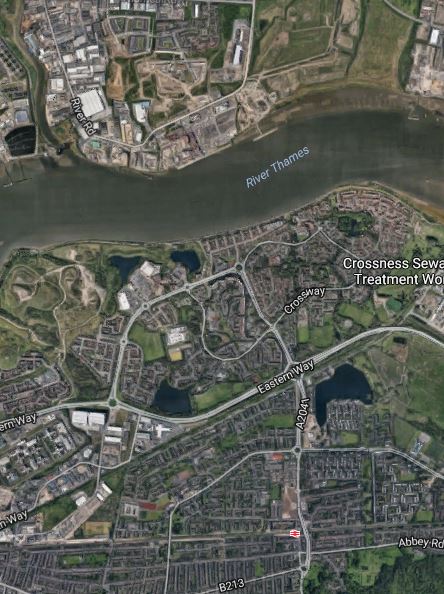
Barking Riverside To Abbey Wood
Barking Riverside station will be built in the South-West corner of the largest green space at the top of the map, above the word Thames.
Abbey Wood station is virtually due South from there towards the bottom of the map.
If this tunnel is ever built could it be in tunnels or even just a single tunnel without wires?
One problem with an extension to Abbey Wood could be somewhere suitable to put the station.
The traditional solution would be a blind tunnel or tunnels as on the Victoria Line, but could the line end in a loop extra stations at Thamesmead and the incomparable Crossness.
What better way is there to attract visitors to the area, than to put Bazalgette’s Cathedral of Sewage on the London rail map?
The GOBlin extension to Abbey Wood is certainly a rail route, where good engineering could be mixed with large doses of imagination.
A Hundred Days To A New Rail Link
The title of this article in the Oxford Mail says it all.
New rail link between central Oxford and London Marylebone ‘complete in 100 days’
It will hopefully all be complete for the first train between Oxford and Marylebone on December 12th.
I think people will look back in a few years and see this date as extremely significant in the development of new rail services.
If it is as successful, as Chiltern hope it will be, I think we’ll see other companies start to develop new routes. Some which probably include.
- The East West Rail Link between Oxford and Cambridge via Milton Keynes and Bedford.
- Marylebone to Milton Keynes
- Bristol Metro
- Routes from Cambridge and Cambridge North station
- Routes from Old Oak Common in London
- Gospel Oak to Barking Line Extensions
- Cardiff Metro
- Merseyrail Extensions
- Teesside Metro
- Oxford Branch Lines
I have left out any extensions to the two vast railways lines in London and the South East; Crossrail and Thameslink.
December 12th, 2016 could be the dawn of a new Railway Age.
 The Anonymous Widower