Slow Line Traffic Into Paddington
I was thinking today, as I came back from my trip from Paddington, that I described in A Low Key Launch Of New Electric Trains, that when all of the new trains are running on Crossrail and the GWR, the slow lines will be very busy.
According to Wikipedia, Crossrail will be running.
- 4tph Abbey Wood – Heathrow Terminal 4
- 2tph Abbey Wood – West Drayton – Peak Hours Only
- 2tph Shenfield – Reading
- 2tph Shenfield – Maidenhead
In addition there will be non Crossrail services on the line.
- 4 tph Heathrow Express
- 2 tph Paddington Main Line – Bedwyn
- 2 tph Paddington Main Line – Oxford
- 2 tph Paddington Main Line – Hayes and Harlington
So that gives eighteen services an hour, with probably all except the Heathrow Express on the slow lines.
As the Shenfield Branch of Crossrail is going to handle 16 tph, 14 tph would seem to be within the capacity of the slow lines to Reading, even leaving some space for freight.
I do wonder that as GWR has ordered forty-five Class 387 trains, which in view of today will probably be run mainly as eight-car trains, for where they are going to add services to the network.
So how many trains will they need for current services?
- 2 tph to Hayes and Harlington – Under half an hour, so 2 trains, or 4 if running as a pair.
- 2 tph to Oxford (stopping) – Two hours, so 8 trains or 16 if running as a pair.
- 2 tph to Bedwyn – 90 minutes, so 6 trains or 12 if running as a pair.
Oxford and Bedwyn will also be served by fast Class 800 long distance trains.
This gives a total of 32 Class 387 trains.
So what happens to the other thirteen trains?
There has been talk of giving some of the trains an IPEMU-capability, which I reported in Rumours Of Battery Powered Trains to run the branch lines to Henley, Marlow and Windsor and the Reading to Gatwick service.
I just wonder, if the Electrostar might have made a good demonstrator for the IPEMU technology, but that an IPEMU based on an Aventra is so much better, that there is little point in creating an Electrostar IPEMU.
Or are Bombardier wanting to get the Aventra fully designed in all its variants before they tackle creating an Electrostar IPEMU?
So how many trains with an IPEMU-capability would be needed for the branch lines and Reading to Gatwick?
- Gatwick to Reading takes 90 minutes, so 6 trains could provide 2 tph.
- 4 tph on the Greenford Branch, would need 2 trains charging at West Ealing.
- 2 tph on the Henley Branch, would need 1 train charging at Twyford.
- 2 tph on the Marlow Branch would need 2 trains charging at Maidenhead. – By a bit of fiddling, the trains might pass at Bourne End or there could be a passing loop.
- 2 tph on the Windsor Branch, would need 1 train charging at Slough.
This adds up to the missing thirteen trains, if you add in a spare. In Modern Railways for June 2016, one paragraph in a larger article gives some news about the progress of Bombardier’s IPEMU technology. This is said.
Industry sources confirm that options for some of the GWR order to be produced as independently powered EMU (IPEMU) variants fitted with batteries for operation away from electrified routes are still being explored. This would enable GWR services to Gatwick Airport and on some of the Thames Valley branches to be worked by ‘387s’ prior to electrification. Any decision to look seriously at this proposal will depend on final electrification timescales being confirmed by Network Rail.
Ordering the number of trains they have means that GWR can offer a workable solution on all routes in the Thames Valley, depending on what Network Rail deign to deliver and if Bombardier come up with an affordable IPEMU solution.
- No electrification, no IPEMU – Use refurbished diesel multiple units.
- Electrification – Use Class 387 trains as electric multiple units.
- No electrification, IPEMU – Use Classs 387 trains in IPEMU mode.
Obviously, if Network Rail decide to electrify any part of the network later, the trains can be driven and controlled accordingly.
I’m also sure, there will be routes in the Bristol area, where a Class 387 train with an IPEMU-capability could be very useful.
How Big Would Batteries Need To Be On A Train For Regenerative Braking?
Let’s assume that we have a Class 710 train, trundling around North East London at up to 120 kph.
To calculate the kinetic energy in the train, which will have to be transferred to the battery, we need the mass of the train and its velocity.
I’ll start with the velocity of the train.
As it approached a station, it will be at whatever is the appropriate line speed, which to make things easy I’ll assume is 100 kph or just under 28 metres per second.
In most cases after stopping and discharging and loading a few passengers, it will probably return to a similar line-speed to go to the following station.
The mass of each car of an Aventra, is found at several places on the Internet, including this entry in Wikipedia which gives it as 30-35 tonnes. So the four-car Class 710 train could have a mass of 130 tonnes. Add 100 passengers at an average of 80 kg. each and this would make the mass 138 tonnes
Applying the standard formula gives a kinetic energy of 53240741 joules or in common-or-garden units 14.8 kilowatt hours. So the energy of an Aventra going at 100 kph could power a one bar electric fire for fifteen hours.
To get a better handle on how much energy is involved let’s look at these specifications for a Nissan Leaf car.
Nissan talks about 24 and 30 kWh versions of the car, So if this is the battery size, then one of Nissan’s batteries could store all the braking energy of a four-car Class 710 train.
Even a fully-loaded Class 345 train would only need a 50kWh battery.
Assuming of course, I’ve got the maths correct.
I have a feeling that using batteries to handle regenerative braking on a train could be a very affordable proposition.
As time goes on, with the development of energy storage technology, the concept can only get more affordable.
A Low Key Launch Of New Electric Trains
This morning at 07:15, I was on the first Class 387 train out of Paddington for Hayes and Hsrlington.
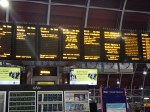
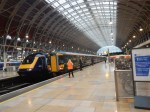

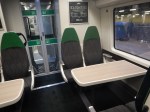


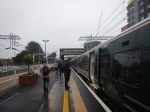

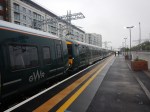


It was a new train of eight coaches, complete with that smell that all new vehicles have for a few weeks.
At the moment GWR only have four Class 387 trains in service, which should be enough for a two trains per hour (tph) shuttle with eight coaches in each service.
But because the new bay platform for the Greenford Branch has not been completed yet at West Ealing station, there are only a few services a day.
This page on the GWR web site gives more details and says this about services in 2017.
From January, all Greenford trains will terminate at West Ealing; as we increase our electric service between Hayes & Harlington and London Paddington to every 30 minutes.
From May, these trains will start running to and from Maidenhead, as we replace our existing diesel fleet.
Does this mean that from January 2017, the Greenford branch will be served by a four tph shuttle? Or will that be later?
 The Anonymous Widower