HS2 Potential To Northern Connectivity Not To Be Underestimated, Says Percy
This is the title of an article in Rail Technology Magazine.
Rail and road connectivity is not a simple matter.
Although there is a need for East-West routes across the North, there is also the need for better High Speed Rail connections between pairs of cities like.
- Newcastle and Leeds
- Leeds and Nottingham
- Sheffield and Nottingham
- Birmingham and Manchester
- Leeds and Sheffield
- Birmingham and Leeds.
- Birmingham and Preston
All these connections will be provided by HS2.
Of the other major links that are needed.
- Manchester and Sheffield
- Manchester and Leeds
- Blackpool and Leeds
- Leeds and Hull
- Liverpool and Manchester
The first three are very difficult because of the terrain.
Because Leeds has good High Speed Rail connectivity to the cities East of the Pennines via HS2, the Leeds-Manchester route is probably the most important.
As High Speed Rail is a long term project, it will tend to grow, where the returns and needs are greatest.
West Anglia Route Improvement – Level Crossing Issues
There are major level crossings on the section of the West Anglia Main Line between between Tottenham Hale and Broxbourne stations.
They will all need to be closed when the line is four-tracked.
Why Will The Level Crossings Need To Be Closed?
When the line is four-tracked, there will effectively be two fast lines and two slow lines.
- Each slow line will when Crossrail 2 opens have between ten and fifteen trains per hour (tpi) all day and possibly even at night.
- Each fast line will have at least eight to ten trains per hour, based on what Greater Anglia do now and what they have said they’ll do in the future.
- There will also be the occasional freight or engineering train.
So that means something between 36 and 50 trains will go through each of these level crossings in every hour.
So if you take the lowest figure and assume each train needs the crossing to be closed for an average of a minute, the crossings will be closed for about forty minutes of every hour.
Note the following.
- As these crossings are by stations, trains could be delayed by say a wheelchair passenger needing to be assisted, which would increase the average time of the closures.
- Very precise driving will be needed to meet the times when the crossings are open to trains.
- What happens if say a train fails and everything is delayed?
- What happens if an HGV with a dodgy sat-nav blocks a crossing?
So the mathematics say that keeping the crossings open is as near to impossible as you can get.
What Do Crossrail 2 Say?
This Crossrail 2 factsheet, which is entitled Services between Enfield Lock and Tottenham Hale, says this about the level crossings.
The proposed increase to the frequency of train services
will make it impractical to retain the existing level crossings
on the Broxbourne branch. We would seek to remove these
crossings to increase safety, reduce risk to both users and
rail passengers and help improve local road connectivity.When our plans are further developed we will carry out
further consultation in the local areas about the potential
impacts of closing any level crossings. However, we would
welcome early input from the local community as part
of this consultation.
The Local Alternative
The Southernmost three of these crossings; Enfield Lock, Brimsdown and Northumberland Park, are close to the A1055 which is variously called Meridian Way or Mollison Avenue, which was built to serve the various industrial and residential sites between Tottenham Hale and Waltham Cross.
This road should obviously be improved, but look at this Google Map of the Northern End of the road.
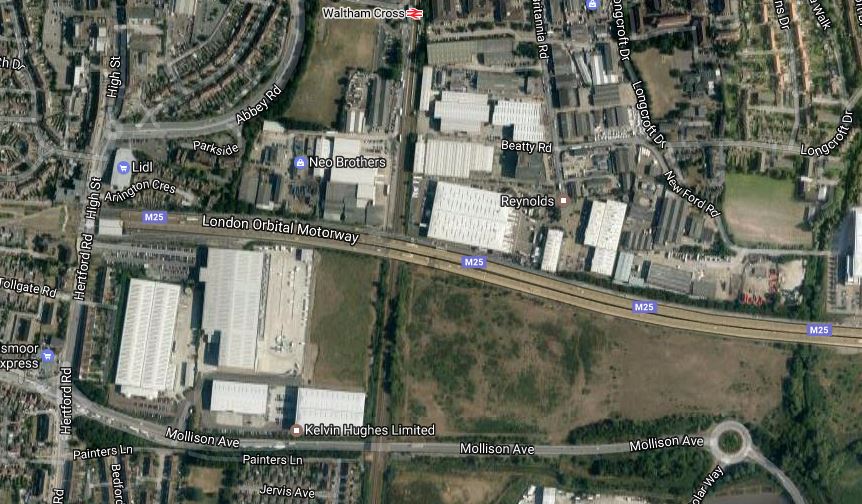
Note the West Anglia Main Line crossing the map, in a North-South direction. Waltham Cross station is on the other side of the M25.
Surely this could be a site for a new Park-and-Ride station for Crossrail 2!
But it doesn’t have to wait for Crossrail 2.
Meridian Water
The Meridian Water development will be both a problem and a solution, in Network Rail’s desire and need to close the level crossings.
Angel Road station is being developed and renamed Meridian Water, but how many people in the new development will want to drive from the development to their place of work?
An Alternative Solution To Closing The Crossings
The only alternative would be to reduce the number of trains on the line and thus reduce the need to four-track the railway.
This would mean that an extra lane would need to be added to the M11.
Conclusion
These crossings are exceedingly busy and there’ll probably be a fight to close them.
The level crossings should have been dealt with years ago. I used to use Brimsdown level crossing twice a day in the 1960s on a bicycle and it was a nightmare then.
 The Anonymous Widower