MML Wires Could Reach Market Harborough
The title of this post is the same as that of an article in the June 2018 Edition of Modern Railways.
It appears that Network Rail have a problem.
- Electrification of the Midland Main Line (MML) is to run as far as Kettering and Corby stations.
- The power feed is to be located at Braybrooke, which is just South of Market Harborough station.
So Network Rail are now looking for a twelve mile long extension lead.
A Network Rail spokesman, says they are looking at various options, including an underground cable or extending the Overhead Line Equipment.
Extending The Electrification To Market Harborough
There must be a scenario, where extending the electrification as far as Market Harborough, is a feasible and cost-effective engineering solution.
Consider, the MML between Market Harborough station and Glendon Junction, where the Corby Branch Line joins.
- The distance is less than twelve miles.
- There are no stations, which can be a pain to electrify.
- The track through Market Harborough station is being re-aligned, so the station should be easy to electrify.
- Glendon Junction is the only junction.
- The electrification will reach as far as Glendon Junction from St. Pancras.
- The route is is a double-track railway, which appears to be over fairly level terrain.
- There appears to be wide margins on either side of the railway.
- There are about half-a-dozen bridges over the railway, some of which could have been fairly recently built or rebuilt.
I doubt, it would be one of the most difficult of electrification projects.
I also suspect, that after their electrification fiascoes of the last few years, Network Rail might have learned enough to do this at an affordable cost.
For example, if the bridges are a problem, they might be able to use the technique I described in Novel Solution Cuts Cardiff Bridge Wiring Cost.
East Midlands Trains Services To And From London
If you look at the current long distance service of East Midlands Trains, there are the following four services between St. Pancras and Derby, Nottingham and Sheffield stations.
- Nottingham (stopping) – Stops at Luton Airport Parkway, Bedford, Wellingborough, Kettering, Market Harborough, Leicester, Loughborough and Beeston.
- Sheffield (semi-fast) – Stops at Leicester, Loughborough, East Midlands Parkway, Long Eaton, Derby and Chesterfield
- Nottingham (fast) – Stops at Market Harborough, Leicester and East Midlands Parkway
- Sheffield (fast) – Stops at Leicester, Derby and Chesterfield.
Note.
- Market Harborough, Leicester, Loughborough, East Midlands Psrkway, Derby, Nottingham, Chesterfield and Sheffield stations, all get at least two trains per hour (tph) to and from London.
- Include the Corby service and Bedford, Wellingborough and Kettering have two tph to and from London.
- All trains stop at Leicester station, which gives the city four tph to and from London.
- Market Harborough to Leicester is only sixteen miles.
Bi-Mode Trains
From 2021, it is expected that these services will be run by 125 mph bi-mode trains.
So how will electrification help these bi-mode trains?
Class 802 Trains
Suppose the services were to be run by a Class 802 train, which can do at least 125 mph using electric power.
An article on Christian Wolmar’s web site, is entitled Bombardier’s Survival Was The Right Kind Of Politics.
This is said.
The Hitachi bi-mode trains can only go 110 mph when using diesel.
The article was written a year ago, so this figure may be higher now!
So a Hitachi bi-mode will be able to go to the end of the electrification at either Glendon Junction or Market Harborough, as fast as the track allows and then at 110 mph on diesel.
Currently, services between St. Pancras and London take around seventy to eighty minutes.
What difference would the planned electrification to Glendon Junction make to this time?
Consider.
- Electrification to Glendon Junction or Market Harborough station could save more time, through faster running.
- Electrification to Market Harborough would mean only sixteen miles to Leicester would be on diesel.
- Electrification at Market Harborough station would cut time for those services stopping at the station.
- Track improvement could allow more 125 mph running using electric power.
- Modern in-cab digital signalling might allow sections of even faster running under electric power.
- Modern trains should save time at stations.
I’m certain that the right combination of improvements to track, stations and trains, will mean all services between St. Pancras and Leicester would be around an hour with Class 802 trains.
Bombardier’s Proposed 125 mph Aventra Bi-Mode
Bmbardier have announced a 125 mph bi-mode Aventra, which I wrote about in Bombardier Bi-Mode Aventra To Feature Battery Power.
I said this about the train.
- Development has already started.
- Battery power could be used for Last-Mile applications.
- The bi-mode would have a maximum speed of 125 mph under both electric and diesel power.
- Bombardier’s spokesman said that the ambience will be better, than other bi-modes.
This train with its faster speed on diesel would certainly achieve a time between St. Pancras and Leicester of under an hour.
I also think that this time will be achieved, whether or not, the wires are extended to Market Harborough.
Improving The Track
Many politicians, union leaders and environmentalists, see electrification as the main answer to better train services.
But before you can electrify a route, the track must be in a state, so that trains can run at a high speed, with long gentle curves and as few junctions as possible.
In the Wikipedia entry for Market Harborough station, there is a section called Future. This is said.
Market Harborough station is located on a large curve on the Midland Main Line, as a result of this line speeds through the station have always been relatively slow, at around 60 mph (100 km/h). The track layout is set to change significantly over the next couple of years as Network Rail engineers set about straightening the line, as part of their overall plan to increase overall line speeds.
How many other sections between Glendon Junction and Leicester could benefit from this type of improvement?
Should Market Harborough To Leicester Be Electrified?
As Market Harborough and Leicester stations are only about sixteen miles apart, surely it would be sensible to electrify this section, if Glendon Junction to Market Harborough is electrified?
I have flown my helicopter from Market Harborough to Leicester and the whole route has the following characteristics.
- Double-track
- Fairly level
- Wide margins.
- Market Harborough is the only station.
- There are junctions South of Leicester.
It would be fairly easy to electrify, but for one thing.
Although, there are only half-a-dozen bridges South of Market Harborough, it would appear there to be up to twenty bridges on the Northern section, some of which look like they would need serious work to get the wires underneath.
I have a feeling that electrifying between Market Harborough and Leicester would cause massive disruption to road traffic, if some bridges needed to be demolished and rebuilt.
A bi-mode travelling at upwards of 110 mph would probably achieve the same times on this section, without the disruption of installing the electrification.
Could Discontinuous Electrification Be Used Between Market Harborough And Leicester?
This is an additional section, that has been added after the announcement of March 5th 2019, that stated that the Midland Main Line would be electrified as far as Market Harborough.
Discontinuous electrification is to be used on the South Wales Metro and the difficult section, South of Leicester, which has lots of road bridges, might be a section, where the technique could be used to advantage.
Conclusion
I think that electrification between Glendon Junction and Market Harborough station will happen.
- The section wouldn’t be the most difficult to electrify.
- As there needs to be an electrical connection between Market Harborough and Glendon Junction, electrification of that section of the railway, might be a cost-effective solution to provide the connection.
- Electrification of Market Harborough station would cut the time to make a call at the station.
- It would offer enough time reduction on the Midland Main Line, that to give Leicester a four tph service to and from St. Pancras, with a journey time of under an hour, using existing train designs.
However, electrifying from Market Harborough to Leicester would be more difficult and I can’t see it offering any substantial benefits over a modern bi-mode train.
Some Class 700 Trains Now Have Tables
I took this picture yesterday, on a Class 700 train.
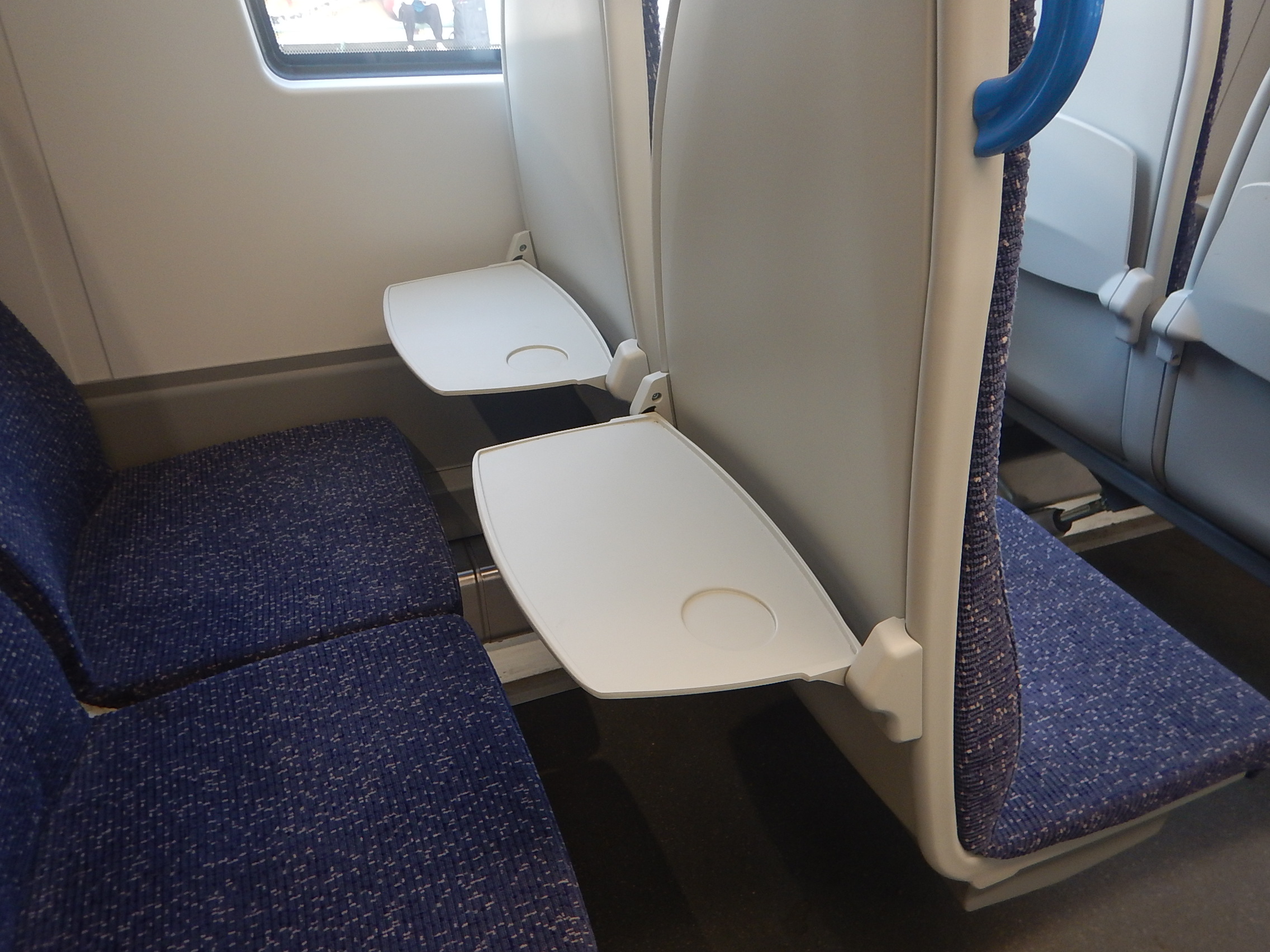
But they still have hard seats, no wi-fi and no power sockets.
The New London Rail Maps Are Out, And They Are Horrible
The title of this post, is the same as that on this article from CityMetric.
I haven’t seen the maps yet, so I won’t comment in detail.
But read the article!
Could it be that London’s rail maps are now getting so complicated, there needs to be some very deep thought?
 The Anonymous Widower