Digital Signalling Implications For North London
As I write this post, two big digital signalling projects are ongoing.
Four Lines Modernisation
This project is described in this document on the TfL web site.
This video is from that document.
The TfL web site says this about the new signalling system.
Work to install a new signalling and control system began in summer 2016. This will eventually allow the trains to be driven automatically, with a train operator in the cab to open and close the doors. The train operator will be responsible for managing customer information and safety.
Similar technology introduced in recent years on the Jubilee and Northern lines improved performance. The new signalling system allows trains to be run closer together, meaning a more frequent service and shorter waiting times, allowing more people to be carried. This new technology will enable us to reduce delays and improve reliability.
The programme will allow us to operate 32 trains per hour, a 33% increase in peak-hour capacity. Installation work will require some line closures.
So it looks that by around 2023, there will be a lot more trains running on the Circle, District, Hammersmith & City and Metropolitan Lines.
The Four Lines Modernisation will have implications for other services.
North London Line
Between Gunnersbury and Richmond stations, the District Line and the North London Line share track, stations and signalling.
This map from carto.metro.free.fr shows the complexity of the tracks around Gunnersbury station.

Obviously, whatever signalling is installed, it must be capable of handling both District and North London Line trains at Gunnersbury Junction and to and from Richmond.
Metropolitan Line To Amersham
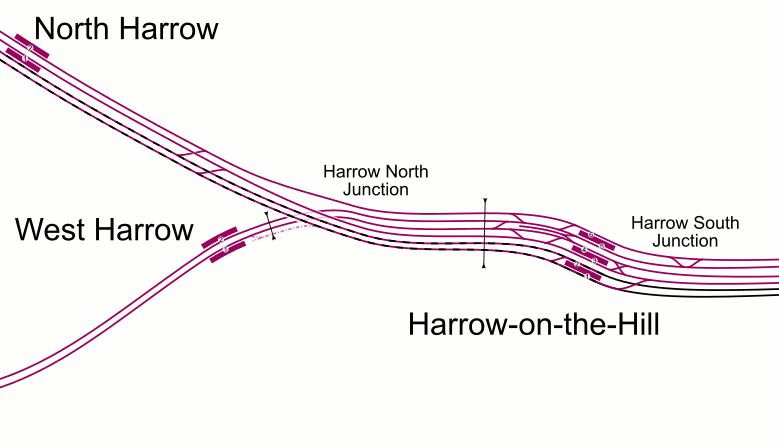
Between Harrow-on-the-Hill and Amersham stations, the Metropolitan Line and the London-Aylesbury Line, share track, stations and signalling.
This map from carto.metro.free.fr shows the lines at Harrow-on-the-Hill station.
and this one shows the layout at Amersham station.
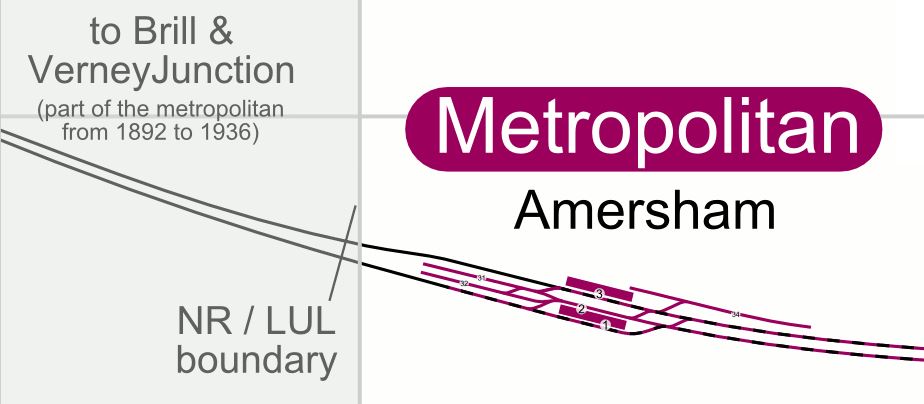
The solution for this section of track is detailed in the Wikipedia entry for the Metropolitan Line, where this is said.
Trackside signals with automatic train protection (ATP) will remain on the line north of Harrow-on-the-Hill, shared with Chiltern Railways DMUs
It is a solution, but will it last for ever?
And what about the Croxley Rail Link, if that is ever built?
Freight Trains Are Going Digital
This page on the Network Rail web site is entitled Freight Trains In Britain To Be Upgraded With Delay-Busting Digital Technology In Multi-Million Pound Deal.
The article says that all 750 freight locomotives will be upgraded.
This project must have implications for the freight services that run across North London on the Gospel Oak to Barking Line and North London Line, especially if these lines were in the future to be digitally signalled.
A Digitally-Signalled Bakerloo Line
At some tie in the next few years a decision will be made about what to do with the Bakerloo Line.
- It will be extended to Lewisham.
- It will receive new trains.
- It will be left as it is.
Options one and two would probably involve new digital signalling.
Addition of digital signalling to the Bakerloo Line would mean implications for the Watford DC Line, with which the Bakerloo Line shares the track between Queens Park and Harrow & Wealdstone stations.
Conclusion
I am drawn to the conclusion, that digital signalling in North London could bring capacity benefits.
 The Anonymous Widower
[…] In Digital Signalling Implications For North London, I indicated that there may be benefits in equipping the North London Line with digital signalling. […]
Pingback by A North London Line With Digital Signalling « The Anonymous Widower | September 30, 2018 |