Sheffield Region Transport Plan 2019 – Doncaster Sheffield Airport
Sheffield’s plans for Doncaster Sheffield Airport are ambitious.
This is said in the report.
The airport’s proximity to the ECML offers a deliverable short term solution to accelerate the growth hub’s
impact.Doncaster Council, the SCR and the airport’s owner the Peel Group are working alongside Network Rail and TfN to progress delivery of a new ECML station at the airport’s site, through just 4.5 miles of new track off the mainline and rejoining via the existing Doncaster – Lincoln Line running adjacent to the top of the runway.
This Google Map shows the Airport and its relationship to Doncaster.
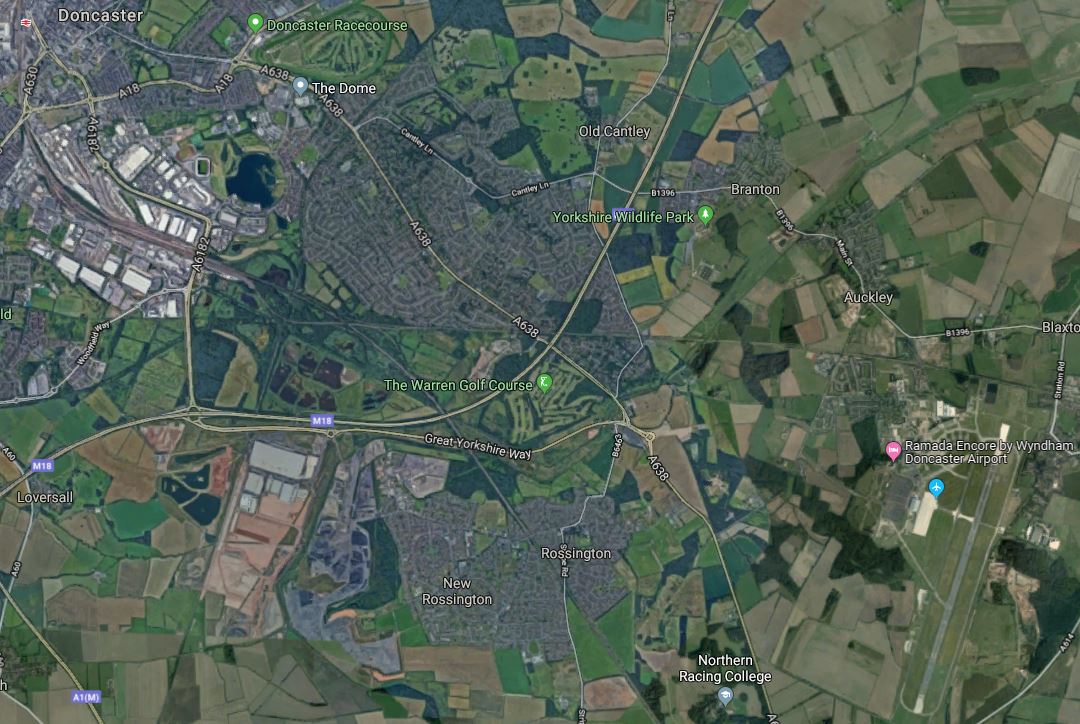
Doncaster is in the North-West corner of the map and the Airport is in the South-East corner.
The Airport has one very long North South runway, which was a designated emergency field for the Space Shuttle, although it was never used.
This Google Map shows the Northern end of the runway and the Doncaster-Lincoln Line running East-West across the runway.
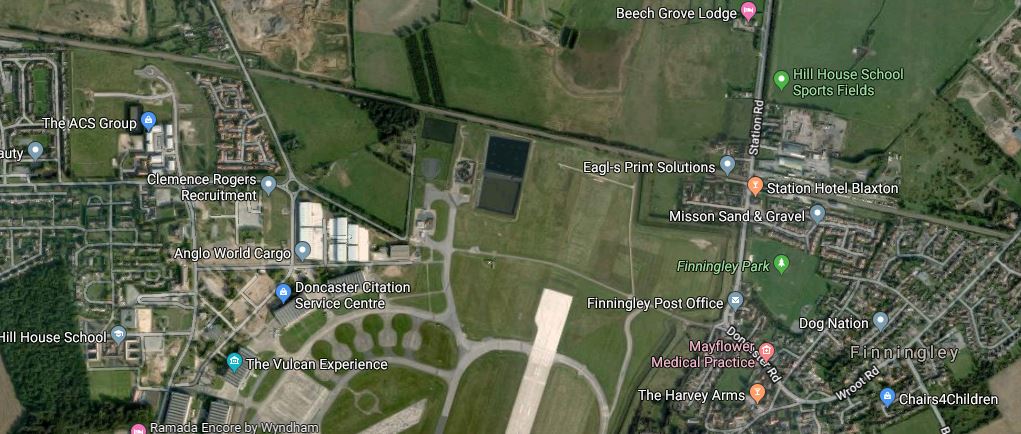
And this Google Map, shows the relationship between the East Coast Main Line (ECML) and the Airport.
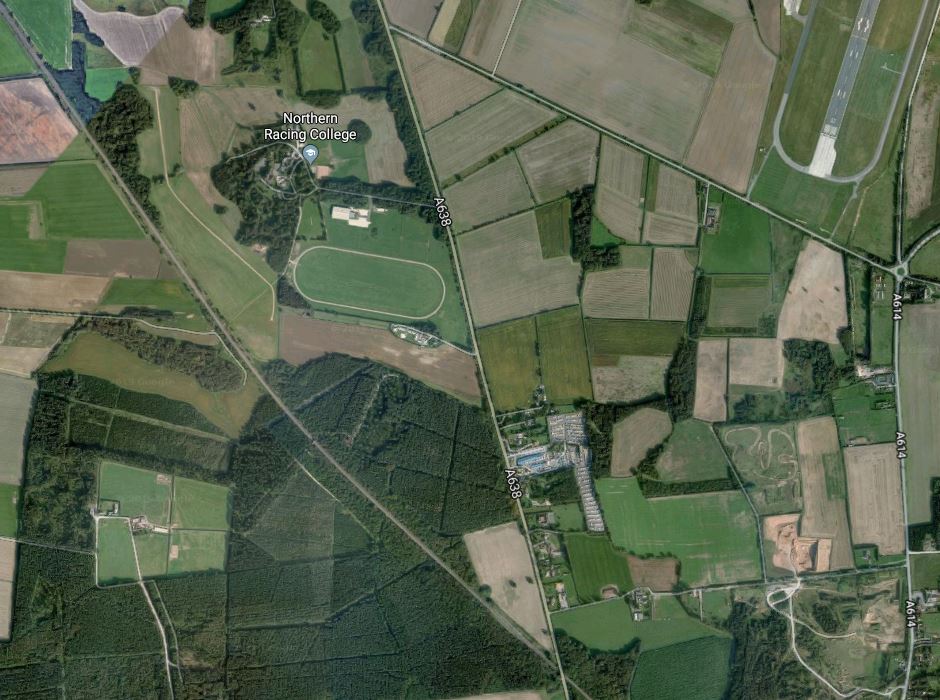
The ECML runs diagonally across the Western side of this map, passing to the West of the Northern Racing School, with its oval track.
Looking at the map of the area, I feel that a loop from the ECML could have the following route from South to North.
- Leave the ECML to the South of the Northern Racing School.
- Pass through the Airport parallel to the runway.
- Stop at a station connected to the terminal.
- At the North of the Airport connect to the Doncaster-Lincoln Line.
I think the design could give a lot of scope for services to the Airport.
- Up to four trains per hour between Doncaster and the South.
- Up to four tram-trains per hour to and from Sheffield, via Doncaster and Rotherham.
- Several freight service per hour.
I have clipped this map of services from the report on Sheffield’s plans.
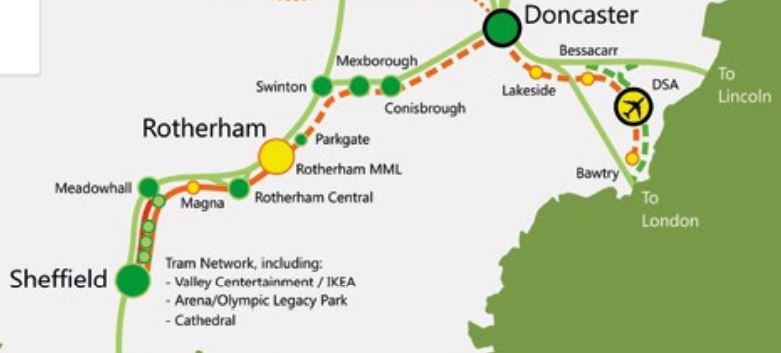
Some points to note.
New Tram-Train Stops
The tram-train extension from Rotherham Parkgate to Doncaster Sheffield Airport via Doncaster has new stations at Lakeside, Bessacarr and terminates at a new station at Bawtry.
Bi-Directional Connection To The Doncaster-Lincoln Line
This is a sensible idea.
- It gives a direct passenger route to and from most of Lincolnshire.
- If the Airport develops a substantial air-freight business, it connects the airport to the freight route between Peterborough and Doncaster, that has recently been created to take freight trains from the ECML.
There is also plenty of space in the flat lands South of the Humber.
Electrification
This is one line that will be electrified, so that the Class 800 trains can use the loop efficiently.
Electrification would also be used by the tram-trains.
The Tram-Trains Don’t Use The East Coast Main Line
Consider.
- Only when they are threading their way through South of Doncaster, will the tram-trains affect the express trains on the ECML.
- The tram-trains may need to reverse at Doncaster.
But I suspect, Network Rail have a cunning plan to run everything efficiently.
Times To And From London And The South
A fast time between Kings Cross and Doncaster-Sheffield Airport is important, if the Airport is to tempt travellers along the ECML to use the Airport.
I reckon, that the following times will be possible.
- London and DSA – 90 minutes
- Peterborough and DSA – 50 minutes
Note that the second time is under half the time it takes to get from Peterborough to Heathrow or Gatwick.
Conclusion
Developing Doncaster Sheffield Airport seems like an excellent idea to me.
Sheffield Region Transport Plan 2019 – Tram-Trains Between Sheffield And Doncaster-Sheffield Airport
The Sheffield plans, state this as a medium to long-term priority.
Regional tram-train services to be maximised through Rotherham Central, with direct fast services to Doncaster, DSA and Sheffield.
The tram-train route between Sheffield and Doncaster, would probably be as follows.
- Tinsley Meadowhall South
- Magna
- Rortherham Central
- Rotherham Parkgate
- Swinton
- Mexborough
- Conisbrough
- Doncaster
The distance between Rotherham Parkgate and Doncaster is under twelve miles and has full electrification at both ends.
The Class 399 tram-trains being built with a battery capability for the South Wales Metro to be delivered in 2023, should be able to reach Doncaster.
But there are probably other good reasons to fully electrify between Doncaster and Sheffield, via Meadowhall, Rotherham Central and Rotherham Parkgate.
The major work would probably be to update Rotherham Parkgate to a through station with two platforms and a step-free footbridge.
Currently, trains take twenty-three minutes between Rotherham Central and Doncaster. This is a time, that the tram-trains would probably match.
Onward To Doncaster Sheffield Airport
I have clipped this map of services from the report on Sheffield’s plans.
The tram-train route to the Airport is clearly marked in a broken orange line.
- The tram-train uses a loop from the East Coast Main Line.
- It shares the loop with expresses between London and Doncaster, that call at the Airport.
- The tram-train extension from Doncaster to Doncaster Sheffield Airport has new stations at Lakeside, Bessacarr and terminates at a new station at Bawtry.
It looks a well-thought out plan.
Sheffield Region Transport Plan 2019 – Renewal Of Supertram Network
Sheffield’s plan has renewal of the Supertram network as a short term priority.
The Sheffield Supertram is twenty-five years old and when you consider, many UK urban railway and tram systems of the same vintage have been substantially updated with new rolling stock and new routes.
The plan lists three things that must be done.
Network Rerailing
This has already been done over part of the network to allow the Class 399 tram-trains to operate on the Supertram network.
So I suspect that the rest of the network needs to be re-railed.
Certainly, the Class 399 tram-trains, which are cousins of the tram-trains working in Karlsruhe don’t seem to have had any serious problems, that have surfaced in the media.
New Vehicles
New trams are needed, mainly because the original trains are twenty-five years old.
But will these new trams, be trams or tram-trains?
That question has already been answered, as Sheffield uses some Class 399 tram-trains as capacity enhancers on some normal tram routes.
The Class 399 tram-trains that have been ordered for the South Wales Metro are being delivered with a battery capability.
So if Class 399 tram-trains or something similar, should they have a battery capability?
Undoubtedly, as Birmingham are showing, the ability to extend a route without wires is extremely useful and cost-saving.
I also suspect that Cardiff, Karlsruhe and Sheffield will share similar vehicles, as the latter two cities do now.
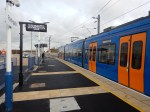
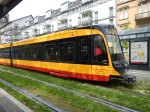
The only differences are the German version runs on 15 KVAC as opposed to the UK’s 25 KVAC, some changed body panels, boarding heights, door number and position, colour schemes and couplers.
Sheffield and Cardiff will be using a standard European tram-train, adapted to our working practices and track standards.
Extending The Network
Suppose Sheffield choose as the tram replacement, a vehicle with the following characteristics.
- Tram-train.
- Able to use 25 VAC and 750 VDC overhead wires.
- Able to use battery power.
- Regenerative braking to battery.
- Enhanced performance, as the original vehicles struggle on the hills, according to drivers to whom I’ve spoken. But the 399s are much better!
- Extra capacity.
- 75 mph operating speed
Sheffield would be able to develop several new routes.
I am particularly curious, as to whether a tram-train with a battery capability delivered in say 2025, will have the capability of handling a route like the Penistone Line.
It should be noted, that if Sheffield were Karlsruhe, there would be tram-trains to Doncaster, Doncaster-Sheffield Airport, Huddersfield, Retford and Worksop.
But the German city is at the centre of a network of electrified lines.
Conclusion
Sheffield will be the next city in the UK, after Cardiff, that will have a wide-spread battery-electric tram-train network.
 The Anonymous Widower