Could Extra Passenger-Handling Capacity Be Added At St. Pancras International Station?
This article in Railway Gazette International, which is entitled Start-Up Announces Amsterdam To London And Paris High Speed Train Ambitions, has this opening paragraph.
A proposal to launch high speed train services from Amsterdam to London and from Groningen to Paris has been announced by Dutch start-up Heuro, while Virgin founder Sir Richard Branson is also reported to be looking at competing with Eurostar on cross-Channel routes.
This other paragraph also gives more details of Branson’s plans.
Heuro’s announcement comes after Spanish start-up Evolyn announced plans in October for a Paris – London service, while on November 11 British newspaper The Daily Telegraph reported that Sir Richard Branson and Phil Whittingham, former head of Virgin Trains and Avanti West Coast, were also drawing up plans to compete with Eurostar and had held discussions with infrastructure managers.
As in the past, German and Italian rail companies have expressed interest in running services to London, I don’t think it will be long before capacity at St. Pancras International will need to be increased.
There are six International platforms at St. Pancras International station and as it generally accepted that one well-managed platform can handle four trains per hour (tph), this means that the station has a theoretical limit of twenty-four tph.
Currently, services into St. Pancras International include.
- Up to 19 trains per day between London and Paris.
- Up to 10 trains per day between London and Brussels.
- One train per day between London and Amsterdam.
If we assume that trains can leave between 05:00 and 20:00, that is only about two trains per hour (tph).
There would appear to be plenty of space for the proposed 16 trains per day, that Heuro have said they will run.
My worry is will Customs and Immigration be able to handle all the extra passengers?
This Google Map shows King’s Cross and St. Pancras International stations.
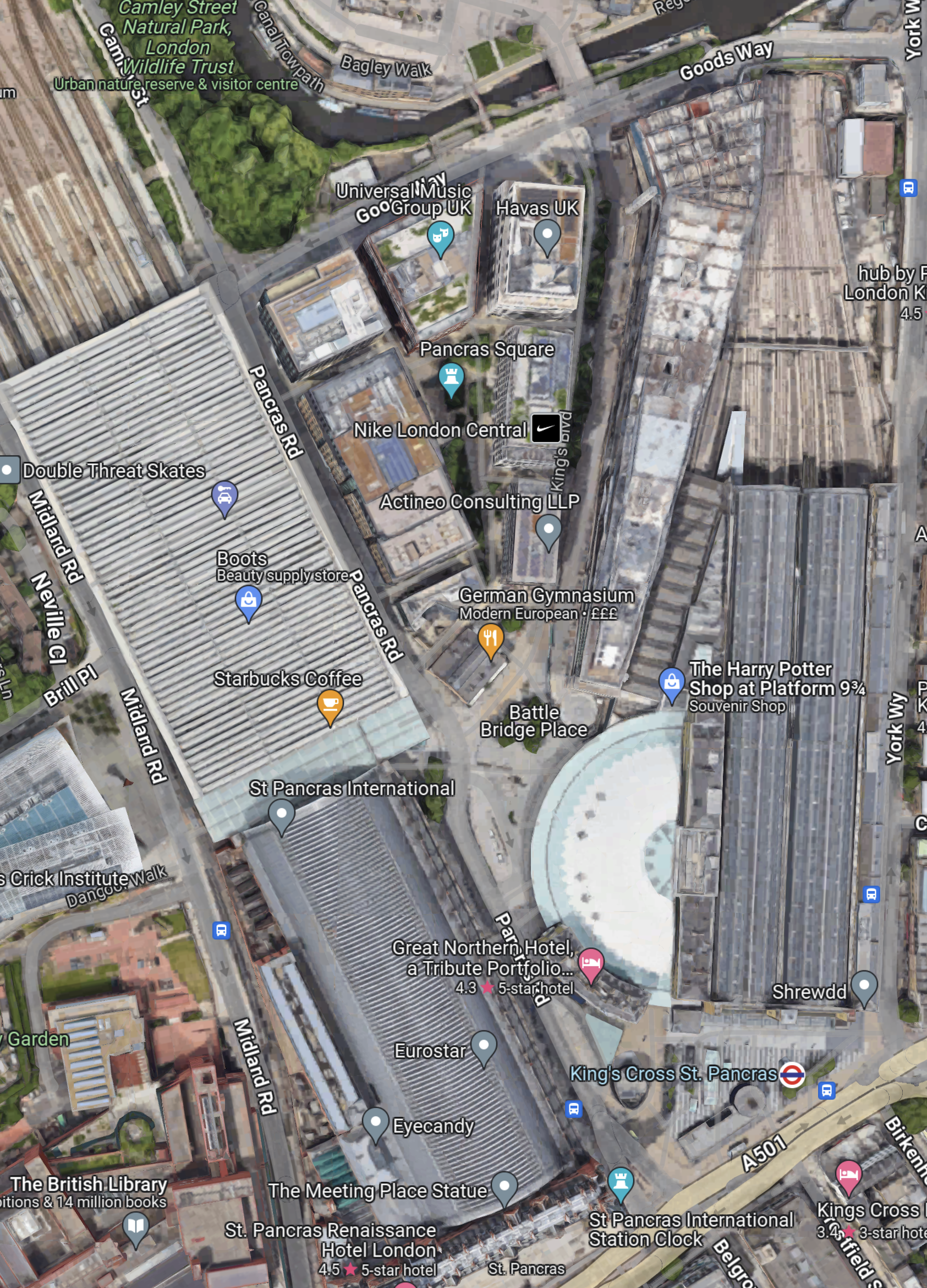
Note.
- St. Pancras International is the station on the left of the V.
- King’s Cross is the station on the right of the V.
- The new corrugated roof covers the Northern ends of the trains in the platforms at St. Pancras.
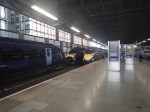
These pictures show the Northern end of the International and domestic HighSpeed platforms.

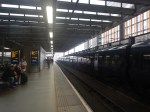






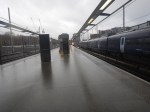

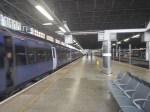




Note.
The pictures taken on the platforms were taken from the Southeastern HighSpeed platforms.
The Continental trains appear to be wholly in the dry either under the classic or the new roof.
The noses of the Continental trains appear to peek out from under the new roof by a few inches.
The air space above the platforms to the North of the new roof appears to be unobstructed.
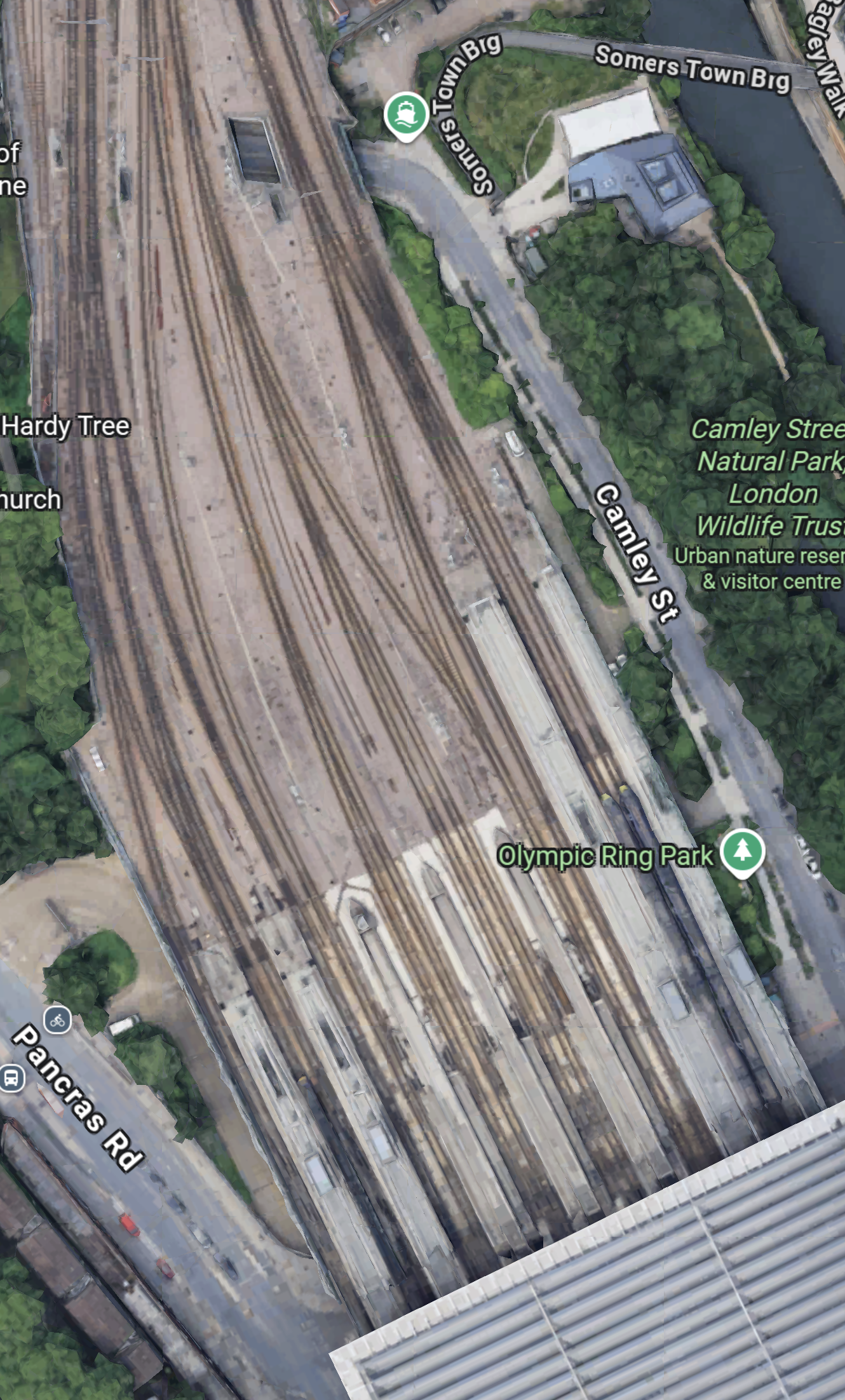
This Google Map shows the Northern ends of the platforms at St. Pancras.
Note.
- The new roof is in the bottom-right of the picture.
- The platforms are numbered 1-13 from left to right.
- Platforms 1-4 are for East Midlands services, which are arranged in a 1-2-1 formation.
- Platforms 5-10 are for Continental services, which are arranged in a 1-2-2-1 formation.
- Platforms 11-13 are for Southeastern HighSpeed services, which are arranges in a 1-1-1 formation.
- Any trains in the station seem to be mainly under cover, although I think a couple of noses are just about visible.
- I am fairly certain, if more passenger-handling capacity were to be needed in the distant future, it could be built above the platforms.
I’ve never seen it said, but did the architects and structural engineers leave this space for future expansion of the station?
- The foundations could have even been designed to support a future vertical extension.
- But at least there is nothing of importance in the space above the exposed Northern ends of the station except a few pigeons.
- With two passenger-handling areas, one could be for departures and the other for arrivals.
- Escalators and lifts could give access to the three wide island platforms for Continental traffic.
Was this station designed to be expanded if required?
I also believe that that much of the work to add any new floors above the platforms could be carried out whilst train services were still running.
Alistair Lansley
According to his Wikipedia entry, the architect of the station was Alistair Lansley, who is not a well-known name or a celebrity architect, but an architect from British Rail’s Architect’s Department, who was also lead architect for Stratford and Ebbsfleet International stations.
So did he leave a space for the extension, that he knew from former experience would be needed?
 The Anonymous Widower
Building above the flat roof makes good sense and probabbly the only way additional space for passengers, customs & immigration could be added. As you say, the platform capacity isn’t the main problem at St P. The building work would be disruptive, of course (a pity it wasn’t done during the near total closedown during Covid!). There might be planning objections about the higher structure detracting from a major listed building.
Comment by balhamist | November 21, 2023 |
I think they can muddle through, by encouraging the use of Ebbsfleet. I also suspect that if St. Pancras gets crowded then passengers will drive to Ebbsfleet. Some will drive anyway.
I think more eateries are needed so, that passengers between say Edinburgh and Paris can time it to have a good lunch in London before taking the second leg.
U wouldn’t be surprised to see the owner of National Express develop a bus station, so that routes like Paris and Manchester can be cheap.
Comment by AnonW | November 21, 2023 |
Driving to Ebbsfleet would really undermine international rail’s much-vaunted environmental credentials. Ebbsfleet is potentially convenient for a small percentage of Eurostar’s customers in the immediate area (if they can find a train that stops there when they want to travel), but anyone needing to drive further might as well just stay in their cars and carry on the whole way. Eurostar and its wannabe emulators need to tap in to the north-of-London market rather than Kent. And, yes, if rail can’t satisfy demand, the coach companies will pick up the extra business.
Comment by balhamist | November 22, 2023
Perhaps Stratford International’s time will finally come?
Comment by tops | November 22, 2023 |
Has Stratford International’s hour has finally come?!
Comment by tops | November 22, 2023 |
It seems “HS1 is seeking a consultant to explore capacity enlargement options for St Pancras” https://www.architectsjournal.co.uk/competitions/st-pancras-international-london
Comment by Peter Robins | March 13, 2024 |
Thanks!
Comment by AnonW | March 13, 2024 |
This study has now concluded that capacity can be significantly increased in the long term, with some increase possible in the next 3-4 years. https://www.railwaygazette.com/uk/study-finds-international-passenger-capacity-at-london-st-pancras-could-be-doubled/68004.article
Comment by Peter Robins | December 12, 2024 |
and Eurolink and London St. Pancras Highspeed, as HS1 now calls itself, have just announced an MoU to “grow international rail connectivity between the UK and Europe”. https://stpancras-highspeed.com/news/london-st-pancras-highspeed-and-eurotunnel-deepen-cooperation-with-strategic-partnership-to-boost-international-high-speed-rail-services/ Coupled with ORR decreasing the charges for using HS1 track, things do seem to be moving towards a better link with the Chunnel and operator competition.
Comment by Peter Robins | February 20, 2025 |
A consortium has now been appointed to move the redesign forward, with 3 phases https://www.railwaygazette.com/uk/agreement-to-more-than-double-international-passenger-capacity-at-london-st-pancras-station/69111.article
Comment by Peter Robins | July 7, 2025 |
Meanwhile, there’s more on Virgin’s plans at https://www.railwaygazette.com/passenger/virgin-sets-out-details-of-plans-to-launch-channel-tunnel-train-services-in-2030/69412.article
Comment by Peter Robins | August 19, 2025 |