Vital Bridge Replacement Means No Trains On Liverpool Street – Chingford line For 16 Consecutive Days This Summer
The title of this post, is the same as that of this press release from Network Rail.
These four paragraphs outline the project to replace the bridge.
Trains will not be able to run for 16 straight days while Network Rail delivers a critical stage of a bridge replacement project between Saturday 20 July and Sunday 4 August.
The 150-year-old bridge over the railway is located to the south of Hackney Downs Park and carries the junction of Downs Park Road and Bodney Road. It backs directly onto a tunnel, which emerges further down the line towards Clapton.
The bridge is monitored closely to check it is safe, but its cast iron girders are in poor condition, and they are continuing to deteriorate. A replacement structure is needed to avoid an unplanned closure and keep passengers and road users moving in future.
Over the 16 consecutive days, engineers from Network Rail’s contractor, Murphy, will demolish the old bridge and start building the new one.
This Google Map shows Hackney Downs station and the location of the bridge to be replaced.

Note.
- Hackney Downs station at the bottom of the map.
- The tracks to Enfield Town and Cheshunt stations going to the North-West corner of the map.
- The tracks to Walthamstow and Chingford stations going to the North-East.
- Mossbourne Academy is between the two tracks.
- The bridge to be replaced is where the tacks to Chingford disappear into a tunnel.
This 3D Google Map shows the bridge in more detail.
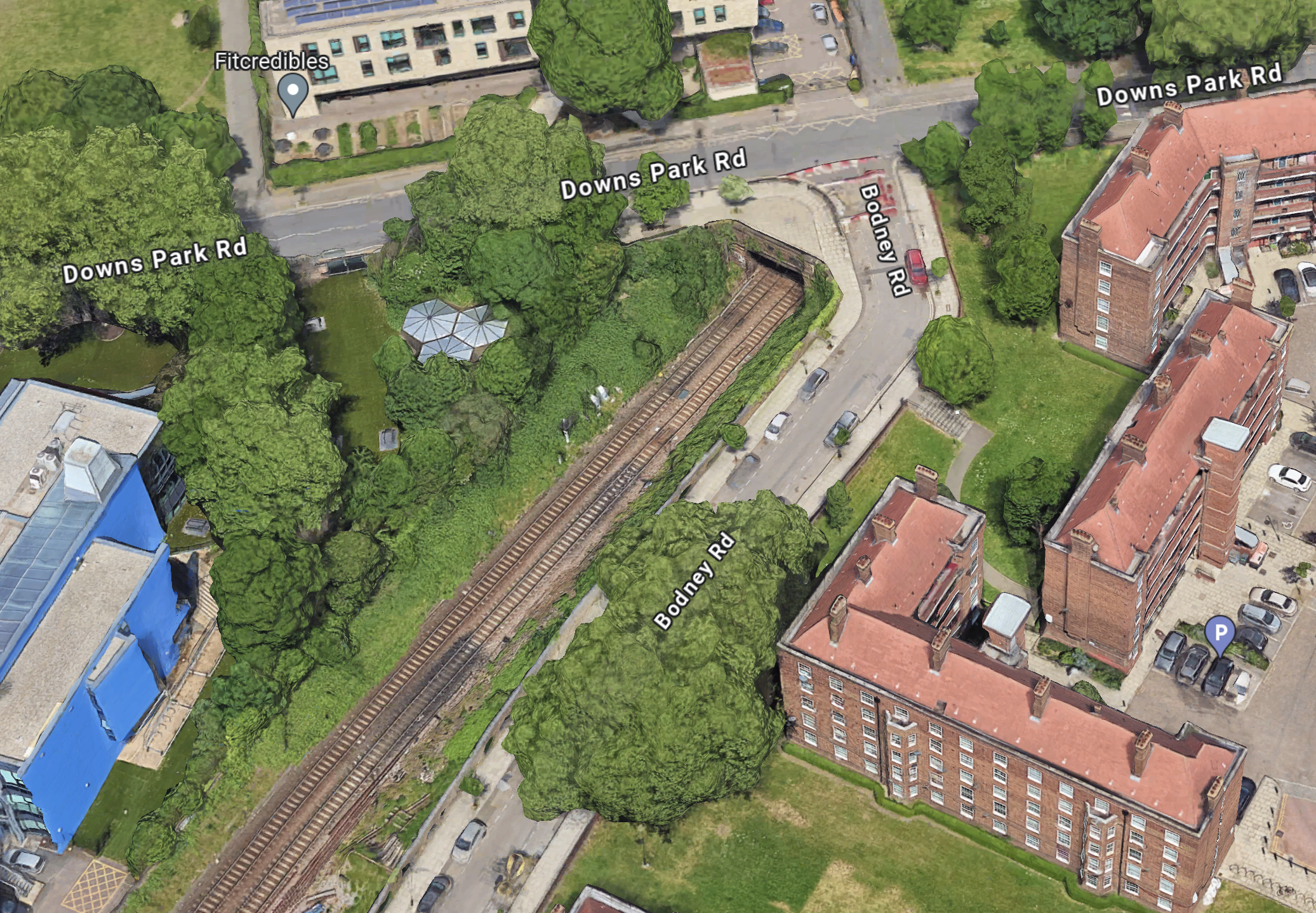
Note.
Downs Park Road running across the top of the map.
Bodney Road running down the side of the railway.
The blue building is Mossbourne Academy.
This Network Rail image shows the current bridge.

It certainly looks like it’s seen better days.
This Network Rail visualisation shows the how the new bridge will probably look from above.

It looks like the landscaping will be fairly simple.
I have some further thoughts.
The Disruption
Sixteen days is a long closure, but rebuilding the bridge before it possibly falls down, is probably prudent.
So make sure you read the full press release from Network Rail.
Hopefully, it will all go well!
Further Works
Hackney Downs and Clapton stations opened in 1872, so the bridge and the tunnel must be at least 150 years old.
So I wouldn’t be surprised, that when Network Rail do a full underground survey, they find other problems.
Rectification could delay the reopening.
Conclusion
It looks to be a well-prepared project.
But I do have my reservations about Network Rail finding something nasty.
Those naughty Victorians would cut corners and bodge things and then not write it down.
This Hydrogen Engine From Kia And Hyundai Heralds A New Dawn In Automotive – Everything Will Change – Lagrada
The title of this post, is the same as that of this article on Hydrogen Central.
These are the first two paragraphs.
Hyundai and Kia recently unveiled in Korea a zero-emission hydrogen engine that could disrupt the EV market. Both automakers are at the forefront of the development of hydrogen technology, focusing on both fuel cell systems and investigating the possibilities of sophisticated hydrogen engines.
The future of sustainable mobility is being shaped by Hyundai and Kia’s continuous research and dedication to hydrogen as a clean transportation solution. An increasing number of manufacturers are developing hydrogen engines as an alternative to electric cars and vehicles that use polluting combustion engines.
These three paragraphs outline more details of the engine.
What’s more remarkable about this new hydrogen engine presented in Korea is that it solves all the problems of durability and large-scale viability that hydrogen engines have presented until now.
The project team successfully ensured that the Hyundai-Kia hydrogen engine, designed to burn hydrogen, could sustain high thermal efficiency throughout its operation by infusing hydrogen into the combustion chamber at a pressure of 30 bar.
Although the device’s performance was enhanced by the use of a turbocharger, it was found that the enhanced performance and lower pollution emissions of this kind of “direct injection” eliminated the problems that most automakers have with hydrogen engines. As the emissions of carbon dioxide and fine particles were reduced by 99% and 90%, the Hyundai-Kia hydrogen engine would be considered to have zero emissions.
Thirty years ago, I was involved with a company called DMW.
- The company’s first product was an aerosol valve, that instead of using CFCs or HCFCs as a propellent used nitrogen. The patent was sold to Johnson and Johnson, after being shown during the discussions, that led to the Montreal Protocol and the phase out of CFCs.
- This led to a deal with Glaxo to investigate if DMW’s technology could be used in a metred-dose-inhaler for asthma drugs.
- The successful idea was eventual sold to Boehringer Ingelheim and is now marketed as Respimat.
I can compare the Hyundai-Kia hydrogen injector and the Respimat inhaler
- Hyundai-Kia appear to be using a high pressure of 30 bar to sustain high-thermal efficiency.
- I know that the Respimat inhaler uses high pressure to obtain a fine mist of the drug.
It sounds to me, that both companies are using the same properties of applying high pressure to a small hole, to disperse one fluid in another.
 The Anonymous Widower