H2ercules
H2ercules is a project that will create the German hydrogen network.
The H2ercules web site, introduces the project with these two paragraphs.
A faster ramp-up of the hydrogen economy in Germany is more important than ever in order to drive forward the decarbonisation programme, put the German energy system on a more robust footing, and thus contribute towards a green security of supply. What this needs is a geographical realignment of the infrastructure for energy in gas form: Instead of flowing from the east of Germany to the west and south of the country, the gas – natural gas now, hydrogen in the future – will have to make its way in future from generation locations in the north-west to centres of consumption located mainly in the west and south. That also means that new sources will have to be connected, and gaps in existing pipeline networks will have to be closed. To speed up this vital process, OGE and RWE have developed the national infrastructure project “H2ercules”, which is intended to supply consumers in Germany’s south and west with domestically produced green hydrogen from the north of the country, in addition to imported sources. This will involve connecting up the electrolyser capacities that are currently being planned and developing more besides. RWE wants to create up to 1 GW of additional electrolyser capacity as part of the H2ercules project. For the connection component, OGE is planning to put 1,500 km of pipelines in place. For the most part, this will mean converting pipelines from the existing natural gas network to hydrogen, supplemented by newly constructed facilities. Converting natural gas pipelines is not only the more cost-efficient solution, but it also allows for a faster schedule. The system is expected to be supplemented by the planned hydrogen storages of RWE.
The current plan is to complete the project in three stages between 2026 and 2030, in order to connect industries to the hydrogen supply as soon as possible. The aim of this collaboration across multiple value levels is to resolve the chicken-and-egg problem on a super-sized scale and also smooth the way forward for other projects.
Note.
There will be a lot of conversion of the existing natural gas network to hydrogen.
RWE wants to create up to 1 GW of additional electrolyser capacity as part of the H2ercules project.
The second paragraph indicates to me, that they want to move fast.
This map from the H2ercules web site, indicate the proposed size of the network in 2030.

These three paragraphs describe how H2ercules will be developed.
OGE and RWE are both strong companies that aim to combine forces as part of the H2ercules project in order to overcome this Herculean task. While the task for OGE will be to convert the required gas pipelines to hydrogen and construct new pipelines, RWE will expand its electrolyser capacity and import green hydrogen in addition. Gas-fired power stations with a capacity of at least 2 GW will be converted to hydrogen, and new H2 -storages as well as H2-storages repurposed from gas storages on the Dutch border will be connected to the hydrogen supply system.
H2ercules also opens up new opportunities to connect Germany’s future centres of hydrogen consumption to key import routes, first via pipelines from Belgium and the Netherlands, and later via Norway and also from southern and eastern Europe, with the added prospects of import terminals for green molecules in Germany’s north. The project is thus contributing significantly to the creation of a European hydrogen market.
The first additional companies and organisations have already indicated their interest in this project, and it is expected that in the future smaller businesses will benefit in addition to large-scale customers, as the entire industry is guided towards a decarbonised future.
These are my thoughts.
Why Is It Called H2ercules?
I suspect, it’s nothing more, than the Germans wanted a recognisable and catchy name.
- Name selection is not helped by the German for hydrogen, which is wasserstoff.
- Hercules is Herkules in German, which doesn’t really help.
- Projekt Wasserstoff isn’t as memorable as H2ercules, which at least isn’t English.
It looks to me, that the Germans have come up with a good acceptable compromise.
The Wilhemshaven Hydrogen Import Terminal
German energy company; Uniper is building a hydrogen import terminal at Wilhemshaven to feed H2ercules and German industry with hydrogen from places like Australia, Namibia and the Middle East. I wrote about this hydrogen import terminal in Uniper To Make Wilhelmshaven German Hub For Green Hydrogen; Green Ammonia Import Terminal.
Wilhelmshaven and Great Yarmouth are 272 miles or 438 kilometres apart, so a pipeline or a tanker link would be feasible to export hydrogen from Notfolk to Germany.
I suspect RWE will build a giant offshore electrolyser close to the Norfolk wind farms and the hydrogen will be exported by tanker or pipeline to Germany or to anybody else who pays the right price.
RWE’s Norfolk Wind Farms
What is interesting me, is what Germany company; RWE is up to. Note they are one of the largest UK electricity producers.
In December 2023, they probably paid a low price, for the rights for 3 x 1.4 GW wind farms about 50 km off North-East Norfolk from in-trouble Swedish company; Vattenfall and have signed contracts to build them fairly fast.
In March 2024, I wrote about the purchase in RWE And Vattenfall Complete Multi-Gigawatt Offshore Wind Transaction In UK.
This map from RWE shows the three wind farms, with respect to the Norfolk coast.
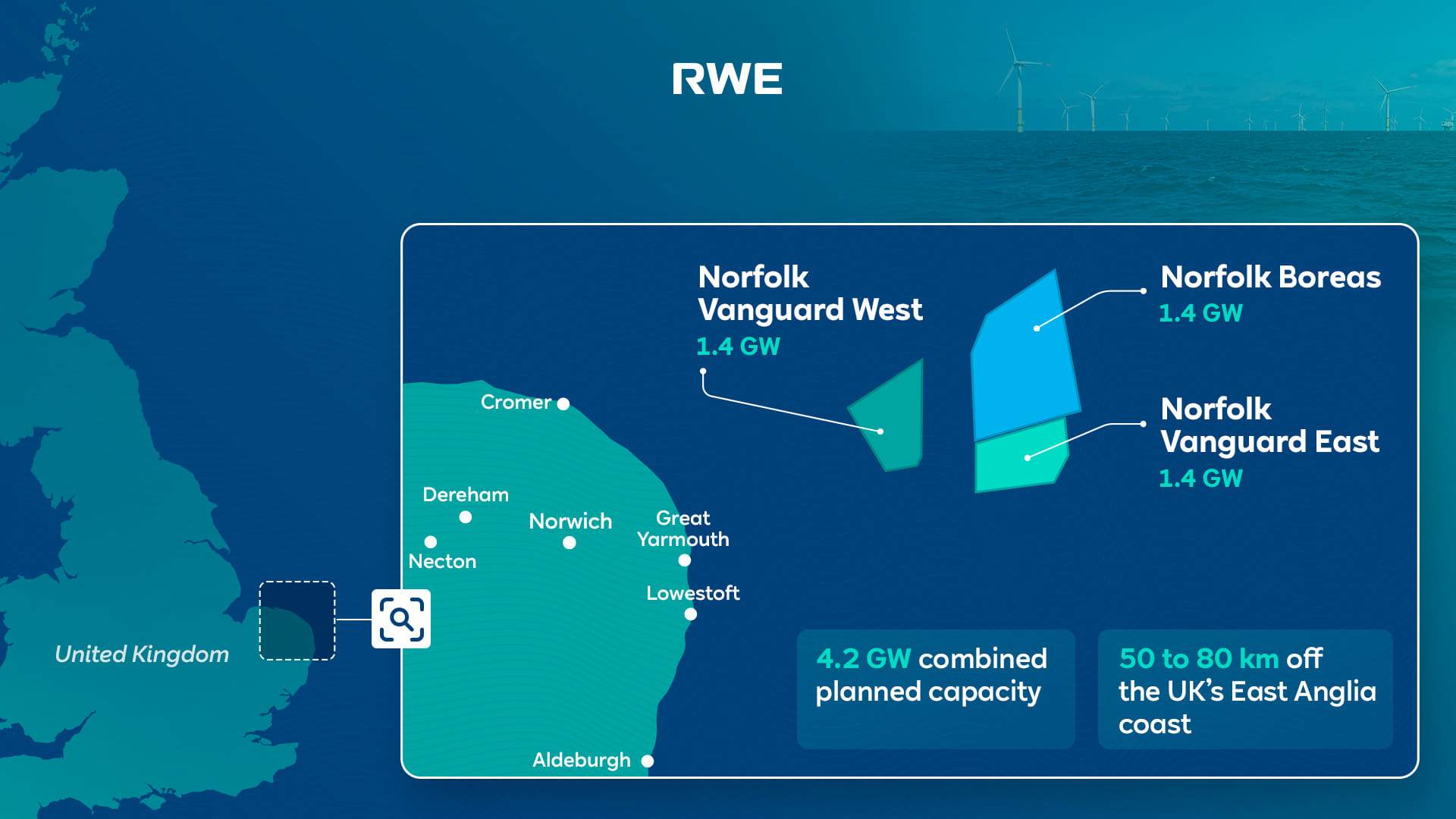
Could it be, that RWE intend to build a giant offshore electrolyser to the East of Great Yarmouth?
- The planning permission for an electrolyser, which is eighty kilometres offshore, would be far easier, than for one onshore.
- The hydrogen pipeline between Norfolk and Germany would be less than 400 kilometres.
- Hydrogen could also be brought ashore in Norfolk, if the price was right.
- The Bacton gas terminal is only a few miles North of Great Yarmouth.
But the big advantage, is that the only onshore construction could be restricted to the Bacton gas terminal.
Adding More Wind Farms To The Electrolyser
Looking at the RWE map, the following should be noted.
South of Norfolk Vanguard East, there is the East Anglian Array wind farm, which by the end of 2026, will consist of these wind farms.
- East Anglia One – 714 MW – 2020
- East Anglia One North – 800 MW – 2026
- East Anglia Two – 900 MW – 2026
- East Anglia Three – 1372 MW – 2026
Note.
- The date is the commissioning date.
- There is a total capacity of 3786 MW
- All wind farms are owned by Iberdrola.
- There may be space to add other sections to the East Anglian Array.
I doubt, it would be difficult for some of Iberdrola’s megawatts to be used to generate hydrogen for Germany.
To the East of Norfolk Boreas and Norfolk Vanguard East, it’s Dutch waters, so I doubt the Norfolk cluster can expand to the East.
But looking at this map of wind farms, I suspect that around 4-5 GW of new wind farms could be squeezed in to the North-West of the the Norfolk Cluster and South of the Hornsea wind farms.
The 1.5 GW Outer Dowsing wind farm, which is being planned, will be in this area.
I can certainly see 8-10 GW of green electricity capacity being available to electrolysers to the North-East of Great Yarmouth.
Conclusion
UK offshore electricity could be the power behind H2ercules.
- The hydrogen could be sent to Germany by pipeline or tanker ship, as the distance is under 400 kilometers to the Wilhelmshaven hydrogen hub.
- Extra electrolysers and wind farms could be added as needed.
- The hydrogen won’t need to be shipped halfway round the world.
The cash flow won’t hurt the UK.
.
Highland Council Greenlights West Of Orkney Windfarm Onshore Plans
The title of this post, is the same as that of this article on offshoreWIND.biz.
This is the sub-heading.
The Highland Council has approved the onshore plans of the 2 GW West of Orkney Windfarm project, being developed by TotalEnergies, Corio Generation, and Renewable Infrastructure Development Group (RIDG) in Scotland.
These are the first three paragraphs.
The onshore application for planning permission in principle was approved on 4 June and outlines the underground cables and electrical infrastructure required to connect the offshore wind farm to the national transmission network.
Last year, the project became the first ScotWind proposal to submit both its offshore consent application to Scottish Ministers and its onshore planning application to The Highland Council.
The onshore application provides information on proposed cable landfalls on the north Caithness coast, the project’s substation at Spittal in Caithness, and the underground cables which will extend around 25 kilometres and connect to the substation.
According to the project page of the West of Orkney wind farm web site, the target for commissioning of the wind farm is 2029.
This wind farm appears to be making a play to be the first of the ScotWind Leasing developments to be commissioned.
I have some thoughts.
Converting The Flotta Oil Terminal To The Flotta Hydrogen Hub
This first paragraph of the Wikipedia entry for the Flotta Oil Terminal, describes it like this.
The Flotta oil terminal is a major crude oil reception, processing, storage and export facility on the island of Flotta, in the south of Scapa Flow in the Orkney Islands. It receives and processes crude oil delivered by a subsea pipeline from the Piper, Claymore, Tartan and Golden Eagle platforms and associated fields. The terminal includes facilities for exporting stabilised crude oil (and formerly liquefied petroleum gases) by tanker.
It is now proposed to add the Flotta Hydrogen Hub to the Flotta Oil Terminal.
This document on the Repsol web site, describes the Flotta Oil Terminal.
- This page is the Flotta Hydrogen Hub web site.
- This page discusses, what will be done with the green hydrogen produced by electrolysis.
- The green hydrogen page, has an excellent map of the hydrogen and electricity flows to and from the Flotta Hydrogen Hub.
The Flotta Oil Terminal will be developed into a major hydrogen production and distribution facility.
 The Anonymous Widower