First Bus To Launch 1MW BESS Unit In Hampshire, Aberdeen To Follow
The title of this post, is the same as that of this article on Solar Power Portal.
This is the sub-heading.
Bus operator First Bus has launched its largest energy storage facility yet in Hampshire.
These four paragraphs add more detail.
Located at the company’s Hoeford bus depot, the 1MW battery storage unit, with a 2-hour duration, will begin operations next month.
This will be followed by a bigger battery storage unit with 2MW/4MWh capacity at its depot in Aberdeen, which will begin work by the end of the year.
The FirstGroup division said that it will explore opportunities to build more battery sites across the UK in the future.
The new battery storage facilities will be used to store surplus electricity that will be distributed back to the grid during peak demand and help maintain power supplies. It will also be used to power the company’s more than 1,200 electric bus fleet.
Note.
- Hoeford’s 1MW/2MWh and Aberdeen’s 2MW/4MWh are big batteries.
- They will be installed, where there is a predictable need.
- Google AI says that the First Bus UK News “About Us” page lists 65 depots and outstations.
- I suspect some clever data analysis is being used to optimise the size of a battery to the route structure and number of buses at a depot.
The batteries appear to come from a company called Palmer Energy Technology, who are backed by Barclays, First Bus and the University of Oxford.
This is the Palmer Energy Technology web site, which has these two paragraphs.
Palmer Energy designs and manufactures Battery Energy Storage Systems that apply automotive‑grade principles to stationary applications. PETL specifies premium cells, uses liquid cooling as standard and focuses on intelligent control to drive down operating costs for customers in transport, industry and the grid.
Through our 100% ownership of Brill Power, a University of Oxford spin out, we incorporate Brill Power’s patented active loading BMS technology in all our BESS to increase the lifetime of systems, improve safety and remove geopolitical risks by storing all data on UK servers.
These are my further thoughts.
Electric Bus Charging Puts A Strain On The Grid
A couple of years ago, I had a drink with three bus depot managers in London. They said that some depots were having difficulty getting sufficient power from the grid.
This Google Map shows Hoeford Depot where the first battery has been installed.
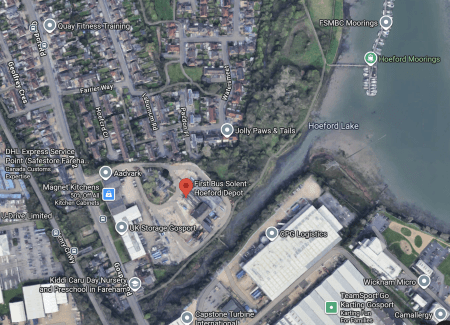
Note.
- Hoeford Depot is by the water at Fareham.
- The depot is indicated by the red arrow.
- The depot is surrounded by houses and other businesses.
As an electrical engineer, I would expect that a battery of the right size could sort out any charging problems.
Bus Garage Batteries Could Mop Up Surplus Electricity
Consider.
- I would expect bus garages have a predictable pattern for energy use.
- Buses will often be charged at night, when solar power is low.
- Do bus garages get a cheaper electricity rate at night?
- There will be times, when bus garages can accept excess energy from the grid and store it until they need it.
- This will mean that wind turbines won’t have to be turned off so often.
Palmer’s batteries installed in a bus garage seem to be a simple way to increase renewable energy efficiency and possibly reduce the cost of battery charging.
Would A Bank Finance The Batteries?
I am not a banker or an accountant, but I have worked with some of the very best. One banker, who sadly has now passed on, would have surely backed this company if the technology and the forecasts stacked up, just as he backed the company, that I helped to start.
It does look as if Barclays are backing the company.
 The Anonymous Widower
[…] First Bus To Launch 1MW BESS Unit In Hampshire, Aberdeen To Follow, I talk about a specialist battery to charge […]
Pingback by How Much Electricity Do You Need To Charge A Garage Full Of Electric Buses? « The Anonymous Widower | March 3, 2026 |