Dagenham Dock Railway Station
After visiting the Land Of The Giants, my EL2 bus went through the industrial area to Dagenham Dock station.


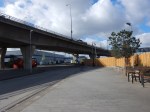


A few points.
- The area is rather bleak.
- From the station I caught one of the two trains per hour into London.
- Dagenham Dock and the other two stations of Renwick Road and Barking Riverside will need to have a decent bus connection.
It certainly needs substantial improvement.
In The Land Of The Giants
In Defining The GOBlin Extension To Barking Riverside, I traced how the extension will get to the new station. This is a map from the TfL report, which shows the route of the extension.

Barking Riverside Extension
And this is an image of the viaduct that takes the extension over Choats Road.
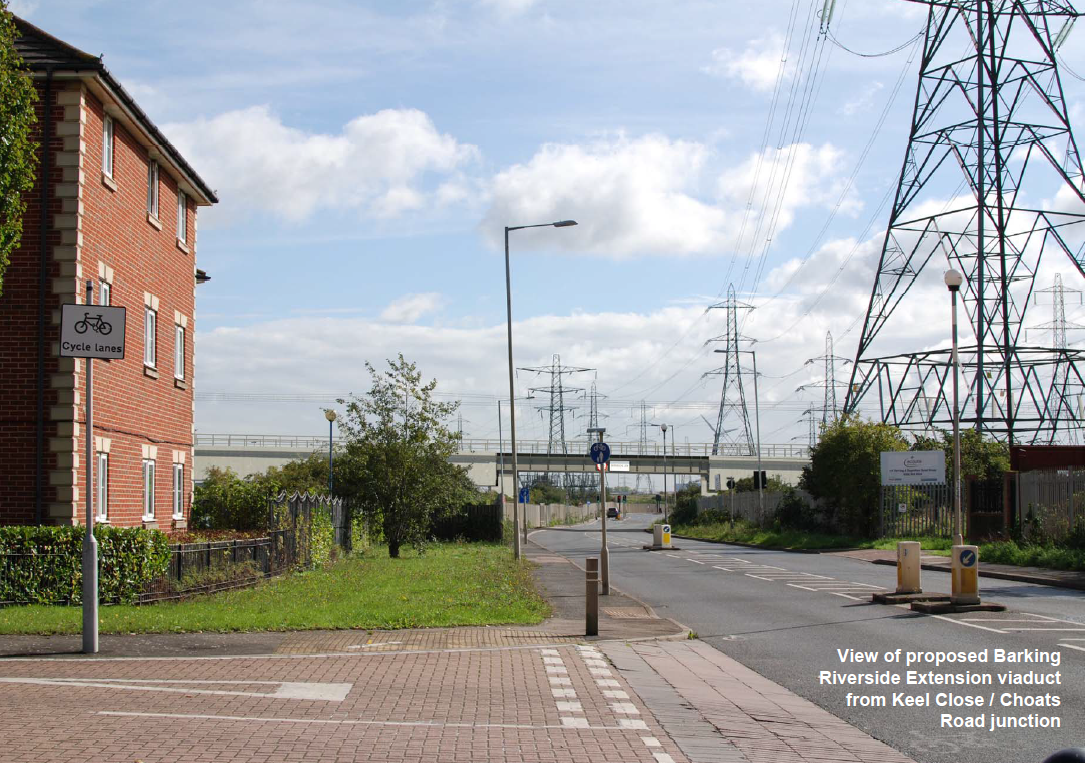
Proposed Viaduct Over Choats Road
Today, I went to Barking station and took an EL2 bus to Dagenham Dock station.
I took these pictures as the bus went along Choats Road.


The area is certainly one with some of the largest electricity pylons.
Even so, you can understand why the TfL report says this about the viaduct.
After passing under Renwick Road, the alignment would climb on a viaduct curving south towards Barking Riverside, crossing the Freight Terminal, westbound Tilbury lines and Choats Road. The viaduct would then descend to pass under the existing high voltage power line south of Choats Road, before again rising and continuing towards a station at Barking Riverside.
This Google map certainly shows there is a lot of space.
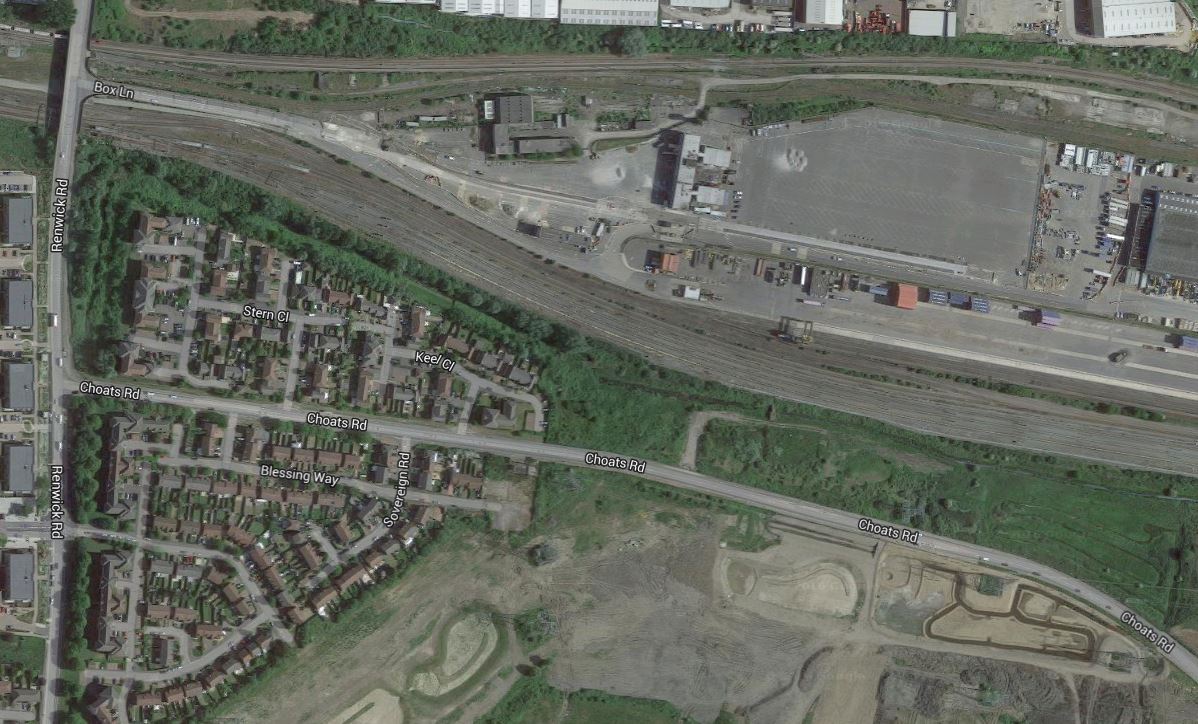
In The Land Of The Giants
It will be interesting to see what the final layout will be.
- The viaduct that crosses Choats Road must be high enough to allow double-deck buses and other high vehicles to pass underneath.
- The TfL route map appears to show that the viaduct follows roughly the line of the pylons to the site of Barking Riverside station.
- Vertical separation of overhead wires on the viaduct and the power lines could be a problem!
- The rail line can’t go too close to the houses.
If the branch were to be built without electrification and services were to be run using the Aventras fitted with on-board energy storage, it would ease the design of the viaduct.
Will London Overground Fit On-board Energy Storage To Class 378 Trains?
This may seem to be a ridiculous idea, as why would the Class 378 trains on the London Overground need the ability to use battery power?
But I have just read this article in Rail Technology Magazine entitled Bombardier enters key analysis phase of IPEMU and it is a detailed article on everything Bombardier are doing to convert the prototype IPEMU into a real train, that can be sold to demanding customers.
- Four different types of battery are being evaluated in Mannheim.
- A simulated five-year test is being performed.
- Bombardier are taking a serious look at the branch-line market.
- Bombardier are evaluating the retrofit market with particular reference to the Class 387 and Class 378 trains.
This is all very sound stuff and in some ways it makes a change to fully-develop the product before launch rather than expect train operators and passengers to find the problems.
One thing that is surprising, is that Class 378 trains are being looked at for the retrofit of on-board energy storage. Marc Phillips of Bombardier is quoted as saying this in the article.
All Electrostars to some degree can be retrofitted with batteries. We are talking the newer generation EMU as well as the older generation. So, the 387s and 378s are the ones where we have re-gen braking where we can top-up the batteries and use the braking energy to charge the batteries. That gives us the best cost-benefit over operational life.
So it would seem that the Class 378 trains of the London Overground are candidates for fitting with batteries. As the trains handle their routes with ease and there doesn’t appear to be any lines without electrification, where anybody has speculated they might run, the only reason to fit them with batteries would be to capture and reuse all that braking energy.
It is an interesting proposition where the decision to fit batteries will depend totally on the accountants.
Obviously, there will be a cost to fit batteries, but as they wouldn’t need to propel the train for large distances, where there is no electrification, the specification could be quite relaxed.
- The capacity would have to be sufficient to hold the maximum braking energy of a full train.
- The battery technology would have to be able to handle the demanding stop/start regime of London Overground services.
- The system must be easy to fit to the existing trains.
- The battery capacity should probably be sufficient to move a stalled train into the nearest station.
A worst case scenario for moving a stalled train, would be hauling a train out of the Thames Tunnel after a failure of the power to the third-rail.
I have a feeling that traditional battery storage is not the best way to handle this application, as it is one that could be met by a larger version of the KERS system used in Formula One. KERS has already been applied successfully to buses, and I wrote about that in Could IPEMU Trains Use KERS?
You can do a simple calculation, which gives the kinetic energy of a hundred and sixty tonnes Class 378 moving at twenty metres per second, which is about two thirds of maximum speed and probably a typical service speed. The kinetic energy of such a train is 3.2 Mega Joules or 0.89 kWh. As an aside, I pay 10.73p for each kWh.
If a train has regenerative braking as Class 378 trains do, this energy can be returned through the overhead wires or third rail and used by other trains on the rail network, if the lines are setup to receive the energy. But it relies on another train being able to pick up the electricity and there are inevitable loses in the complicated transfer of the electricity.
On the other hand, if the train has on-board energy storage, it can store the energy and use it when it starts again at the station. This is a more efficient process.
It should also be noted that over the last year, all fifty-seven four car Class 378 trains have been upgraded to five cars. Does the fifth car have the wiring to incorporate an energy storage device? I would be surprised if it didn’t and that the train software is now capable of being upgraded to incorporate on-board energy storage.
I have no idea how much electricity would be saved by regenerative braking on the London Overground, but various applications of regenerative braking technology talk of electricity savings of between ten and twenty percent.
I think it is only a matter of time before the technology is proven to be sufficiently reliable and the numbers add up correctly for the Class 378 trains to be fitted with on-board energy storage.
Glasgow Subway Orders New Trains From Stadler
This article in Global Rail News is entitled New trains for Glasgow Subway. This is said.
Stadler Bussnang AG and Ansaldo STS have won the contract to supply Glasgow Subway with its first new trains for almost 40 years.
Strathclyde Partnership for Transport (SPT) has today (March 4) released images of the new driverless trains, having awarded the £200 million contract.
Stadler is a Swiss manufacturer of rail vehicles, that is not very well known in the UK. Although, some of their products have been sold to run here.
- Six Variobahn trams run on London Tramlink.
- Thirty-two Class 68 diesel locomotives have been delivered or are on order from Vossloh, which since 2015 has been a subsidiary of Stadler. Six are used by Chiltern Railways.
- Ten Class 88 electro-diesel locomotives have also been ordered from Vossloh.
The trams are very much a standard product, but the locomotives are unusual in that they have been specially built for the UK’s restrictive loading gauge. Wikipedia says this about the company.
Stadler Rail is also focused on niche products and is one of the last European manufacturers of rack railway rolling stock.
Look at the products they make and quite a few are not mainstream.
So as the Glasgow subway is small and to an unusual gauge and size, it is not very surprising that Stadler are involved in producing the new trains.
I don’t think that this will be the last order we’ll see for Stadler products in the UK.
This article from the Railway Gazette is entitled Stadler Rail switches its focus from east to west. This is said.
Swiss rolling stock manufacturer Stadler Rail has announced plans to shift the focus of its growth plans away from the CIS and Middle East markets and towards the UK and the USA.
On June 19 Stadler said the Swiss national bank’s decision to uncouple the franc from the euro in January had brought a sudden 20% increase in the price of its products, which was ‘negatively impacting’ the company. Meanwhile, planned expansion into the CIS market has been ‘halted’ by the weak rouble and sanctions on Russia. Stadler has also ‘fallen well behind expectations’ in the Arab market.
With all the new rail franchises starting in the next few years, I think we’ll see some orders. Certainly with all its expansion plans Tramlink will need a few more trams and if the Class 68/88 locomotives are successful, then other companies might purchase some more.
One very large niche order are new cars for the Docklands Light Railway.
But I also think we’ll see a few Stadler Flirts in the UK, as they seem to be selling well.
Defining The GOBlin Extension To Barking Riverside
Transport for London have published the results of their consultation on proposals to extend the for Gospel Oak to Barking Line (GOBlin) from Barking station to Barking Riverside.
To see the full report visit tfl.gov.uk/barking-riverside.
The main points are summarised in the next few sections.
Class 710 Trains
After the electrification of the GOBlin, services will be run using Class 710 trains, which although the line will be fully-electrified using overhead 25kVAC, will be the dual-voltage variant able to run on 750 VDC.
I would assume that this is so that the trains can go past Gospel Oak station to access parts of the North London Line and West London Line that have third-rail electrification and are shared with both London Underground and Southern Electric trains.
Bombardier have also told me, that all Aventra trains are wired so that an on-board energy storage capability can be installed.
When I rode the prototype for this IPEMU technology in public service between Manningtree and Harwich, it felt exactly like a standard Class 379 train and one of Bombardier’s engineers told me the battery range was upwards of fifty miles with a similar performance to the standard train.
In the remainder of this post, I will use Aventra IPEMU (Independently Powered Electric Multiple Unit) to indicate an Aventra Class 710 train with an on-board energy storage capability.
Because prospective routes for Aventra like the East London Line and Merseyrail run in longish tunnels, I would think it very likely that Aventras will be certified for tunnels like the Thames Tunnel or those under Liverpool.
Transport for London have certainly ordered a train, that doesn’t limit development of new routes linked to the GOBlin.
Lines At Barking Station
This map from carto.metro.free.fr shows the rail lines around Barking station.
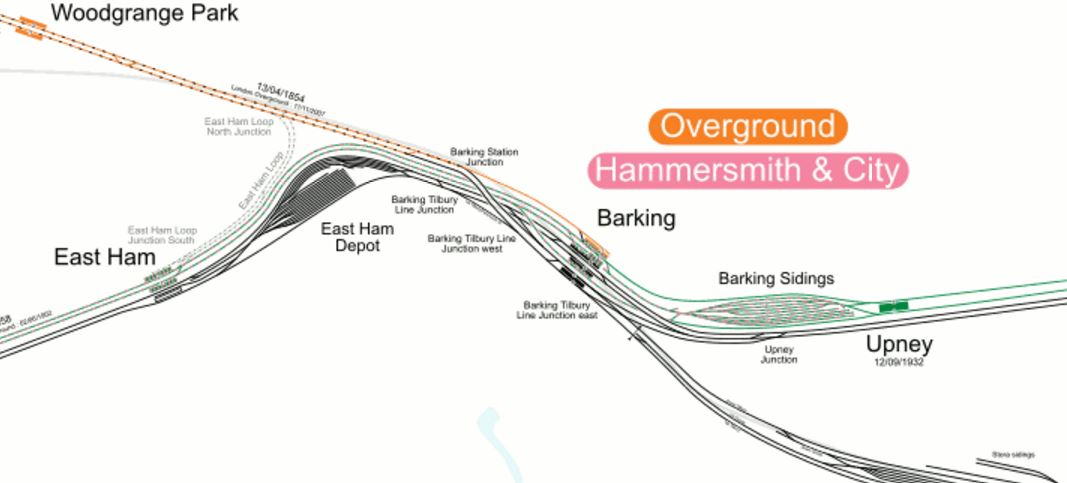
Lines At Barking
The lines radiating from the station are as follows, taking them in a clockwise direction from the South West.
- District and Metropolitan Line services of the London Underground and c2c services to Fenchurch Street pass through East Ham station.
- GOBlin services to the West, freight trains crossing London and the occasional c2c service to Liverpool Street pass through Woodgrange Park station.
- District Line services to Upminster and the East and c2c services via Basildon take the lines through Upney station.
- c2c services via Rainham, freight trains crossing London and the proposed Barking Riverside service take the lines going vaguely to the South East.
Three platforms will be used at Barking station for GOBlin services, which come into the station from Woodgrange Park in the West and from Barking Riverside in the South East.
- Platform 1 which is the current terminus of the GOBlin will be retained and would remain available to Overground trains at Barking Station to aid service recovery during periods of disruption.
- Platform 7 which is currently used by eastbound c2c trains via Rainham, will also be used by GOBlin trains going to Barking Riverside.
- Platform 8 which is currently used by c2c trains from Rainham to Fenchurch Street, will also be used by GOBlin trains coming from Barking Riverside.
As can be seen on the map, there is a double-track flyover to connect Platforms 7 and 8, which are the two southernmost platforms to the GOBlin to the west.
The only platform and its associated connecting lines that doesn’t have any electrification is platform 1.
Changing Trains At Barking Station
The GOBlin services and c2c services via Rainham will share the island platform 7 and 8 at Barking, which could mean some easier step-free journeys for some passengers.
Plans exist for redevelopment at Barking station and I wonder if architects and planners can come up with a better layout for the station, that will become increasingly important as an interchange. Especially as the station is shared by three ambitious operators; London Overground, London Underground and c2c. All these operators have expansion and/or improvement plans for services through Barking.
Electrification of Platform 1 At Barking Station
No electrification work has happened on this platform until now and the platform could be electrified in the normal manner.
However, it may be more affordable to fit all the Class 710 trains with an IPEMU capability and run them in and out of the platform using the on-board energy storage.
The platform could also be electrified using London Underground’s system to create another bay platform for the District and Metropolitan Lines, if that was to be needed. This would not stop the platform being used by the dual-voltage Class 710 trains,
Obviously, the route planners and the accountants will decide.
Renwick Road Station
This map shows the layout of the extension.
Barking Riverside Extension
Note now the new line curves away south after passing under Renwick Road. This Google Map shows the area.
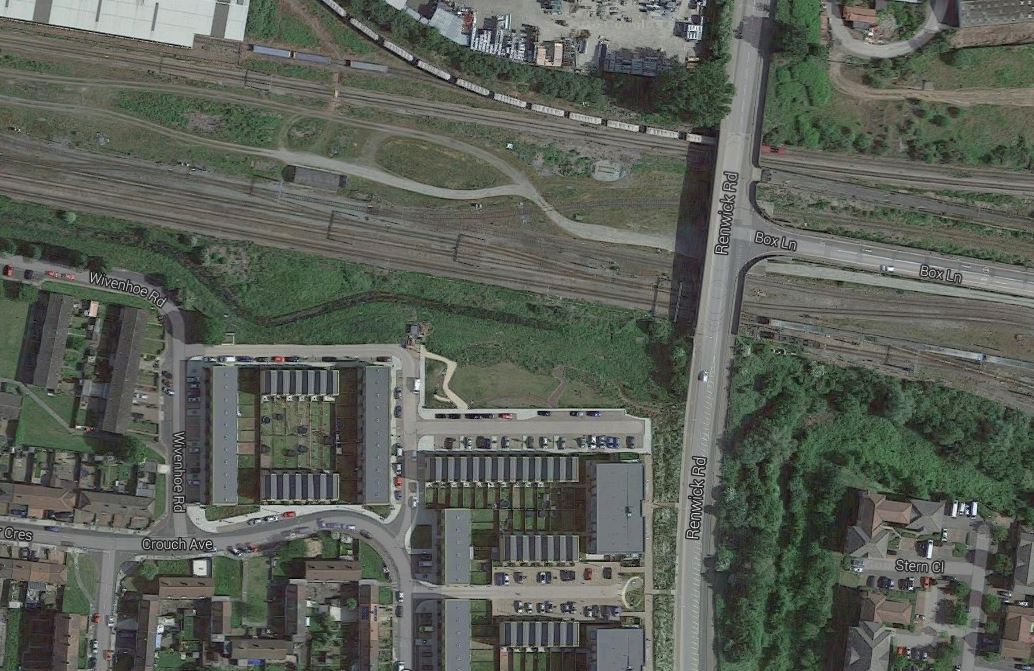
Renwick Road Area
One recommendation of the consultation is to install passive provision for a new station at Renwick Road, which eventually would make the extension a two-station branch.
The station is proposed to be a simple island platform design and TfL’s maps show it on the Western side of Renwick Road. There would appear to be plenty of space.
Barking To Renwick Road
On creating the required two lines between Barking and Renwick Road, the report doesn’t indicate, it’s anything other than a simple construction project.
Renwick Road to Barking Riverside
The line is proposed to curve off and over the rail lines and roads on a double-track viaduct, which is shown in blue on TfL’s map. The TfL report says this.
After passing under Renwick Road, the alignment would climb on a viaduct curving south towards Barking Riverside, crossing the Freight Terminal, westbound Tilbury lines and Choats Road. The viaduct would then descend to pass under the existing high voltage power line south of Choats Road, before again rising and continuing towards a station at Barking Riverside.
So it looks that the viaduct goes all the way to Barking Riverside station.
Barking Riverside Station
The proposed layout of the station is described in the TfL report.
The station would be designed to fit the look and feel expected of stations on the London Overground network, and would include the provision of step free access from street to platform and platform to train. Other features of the station would include: a ground floor ticket hall, CCTV, help points, customer information systems and secure cycle parking.
The platform level would be on the upper floor as an extension of the viaduct structure. The station ticket hall would provide direct access to Renwick Road and the separation between the railway infrastructure and ground floor ticket hall would allow additional uses to be made of the space, such as: cash machines, cafe and retail opportunities. The station design would include cladding for weather protection, including a canopy to part of the platform to allow sheltered access to trains.
So it would appear the trains are on the upper floor above the station facilities, shops and cafes.
I think this is to ensure that once the trains have passed over the Tilbury Line to Rainham and the freight tunnel, they run fairly level into Barking Riverside station. It could also mean that if the line is extended to Abbey Wood station under the Thames, the track layout to achieve this is not too complicated.
This Google Map shows the location of the station in Barking Riverside.
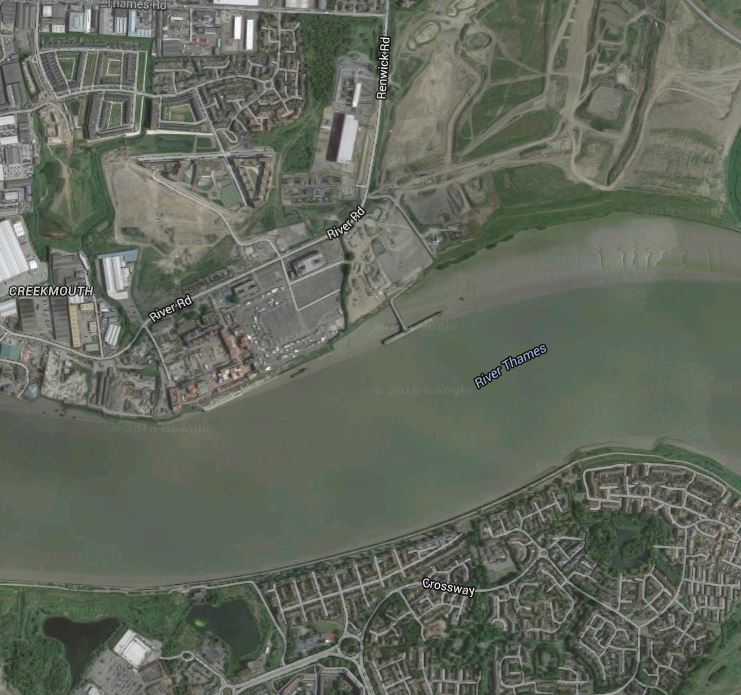
Barking Riverside Station And The Thames
Note.
- TfL’s map shows the station is alongside Renwick Road, where it joins River Road.
- It is perhaps a couple of hundred metres from the river.
- The housing area of Thamesmead is opposite.
- Trains could take a straight route to a possible Thames tunnel.
I think it all shows that the design of the station has been thought over long and hard.
Electrification Of The Barking Riverside Extension
The total length of the extension from Barking to Barking Riverside is 4 km., with just 1.5 km. of new line.
As with Platform 1 at Barking station, the Class 710 trains give the option of not-electrifying all or part of the extension.
Consider.
- The performance of an Aventra IPEMU running on on-board energy storage, that had been charged before Renwick Road is such, that I believe it could easily handle the extension with a full train of passengers.
- The viaduct can be built with provision for future electrification.
- As mentioned in the TfL report, the line has to be carefully profiled to avoid existing power lines. An extension without electrification, would give extra clearance.
- The Barking Riverside station design is simplified, if it is not electrified.
- The area has overhead wires everywhere and a stylish viaduct without overhead wiring could have a less negative visual impact.
- Are IPEMU trains running using on-board energy storage quieter than those using overhead wires?
But not electrifying the line from Renwick Road to Barking Riverside would reduce the complication and cost of the extension.
Intriguingly, the full TfL report only mentions overhead wires once, talking consistently about four car electric trains and a fully-electrified line.
Nothing in the TfL report precludes the use of Aventra IPEMUs to Barking Riverside and whether this route is chosen will depend on design and environmental issues, and the accountants.
Under The Thames To Thamesmead And Abbey Wood
It is planned to incorporate passive provision, so that the line can be continued in a tunnel under the River Thames.
Barking Riverside station appears to have been designed with several features to aid this continuation.
- Trains could pass through the station on their way to or from the tunnel.
- The route from the station to the tunnel would probably not need any sharp curves.
- Barking, Barking Riverside and Renwick Road stations would probably be sufficient to handle passengers on the north side of the river.
- There appears to be nothing of any importance between the Barking Riverside station site and the Thames, so it should be easy to safeguard a route.
- Barking Riverside station is elevated, so this potential energy could help to propel a train under the river.
- A crude estimate says that from Barking Riverside station to the other side of the river is about two kilometres.
The engineers involved in the Barking Riverside extension have certainly made provision to extend the railway under the Thames.
This Google Map shows Thamesmead and the Thames.

Under The River
Note River Road and Barking Riverside on the north bank of the river, Abbey Wood station with Crossrail and the North Kent Line in the South and Crossness to the East.
I don’t know the Thamesmead area well at all, and from these maps, I can’t work out whether a surface railway could be run to Abbey Wood station from the southern tunnel entrance.
However, a tunnel all the way with intermediate stops would surely be possible.
- As London Underground have thought about extending the Jubilee Line to Thamesmead, I suspect that the area would be amenable to the right type of tunnel boring machine.
- The tunnel could be bored under the A2041 if a direct route were to be chosen.
- A trip from Barking to Abbey Wood and back is probably about twenty kilometres.
- Aventra IPEMUs could handle the route with ease.
- If Aventra IPEMUs used on-board energy storage in the tunnels, the tunnels could be built without electrification.
I believe that there is an affordable innovative solution to extending the Barking Riverside extension under the Thames.
I do question if an extension to Abbey Wood will be needed, as when Crossrail opens, it will be possible to travel from Barking to Abbey Wood with a single change at Whitechapel from the District/Metropolitan Lines to Crossrail.
Conclusion
As it should be, I think it is a well-thought plan.
As to whether the Class 710 trains will use a possible IPEMU capability, nothing is stated, but I believe the proposed design could be very IPEMU-friendly and using IPEMUs would be advantageous on cost, noise and visual grounds.
Their only downside is that they could get derided as battery trains.
I also have the feeling that if the extension does use the IPEMU capability of the trains, the extension will become a model for other extensions and branch lines all over the UK.
Does London Need To Get A Grip On Rail Connectivity?
This article in the Standard has a title of Old Oak Common regeneration scheme ‘risks being London’s worst cock-up in 50 years’. This is the first three paragraphs.
Boris Johnson’s flagship regeneration scheme at Old Oak Common is in danger of turning into London’s “worst cock-up in 50 years”, a leading government adviser warned today.
Urban planner Sir Terry Farrell said the £10 billion development, the biggest in Britain, is heading for disaster because of the rush to finish Crossrail.
He blamed politicians for ducking key decisions and said the Mayor was partly responsible for a shortsighted “pass the parcel” approach. Sir Terry said: “If a tenth of the energy he put into the Boris island airport idea had gone into Old Oak Common I feel sure it would have happened without a problem.”
Old Oak Common is going to be a major development of 25,000 homes and 55,000 jobs created over the next fifteen years. A major transport hub will be created at Old Oak Common station will be created, linking some or all of the following lines together.
- Bakerloo Line
- Central Line
- Crossrail
- Dudding Hill Line
- Great Western Main Line
- HS2
- North London Line
- Watford DC Line
- West Coast Main Line
- West London Line
This map shows the plans for Option C of TRfL’s Old Oak Common proposals.
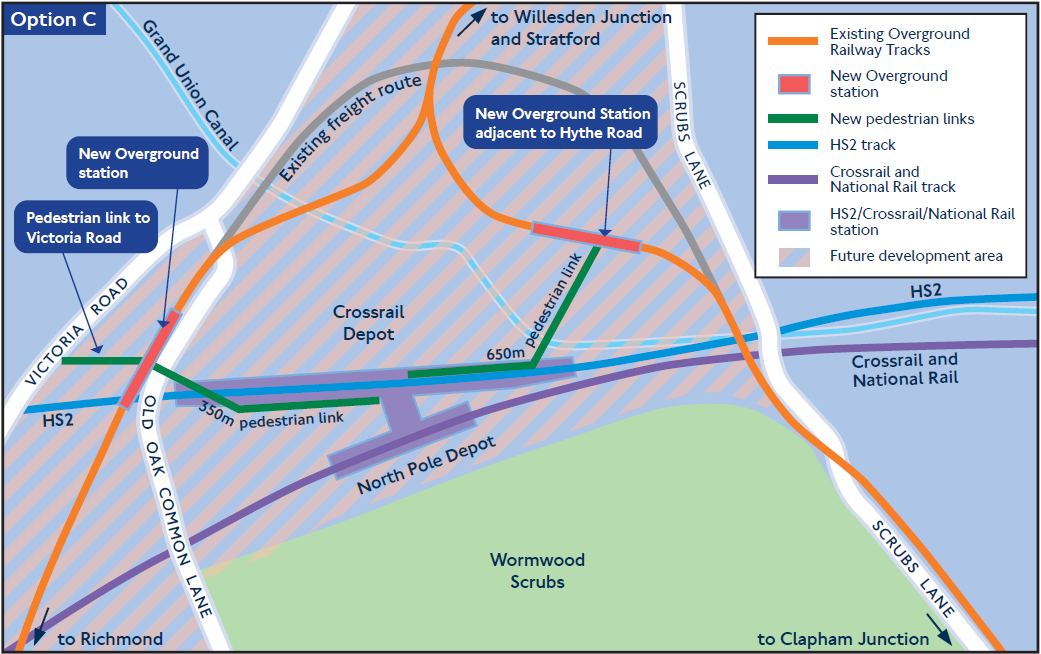
Option C Proposal At Old Oak Common
I wrote about this option in Should An Overground Station Be Built At Hythe Road?
Terry Farrell has said that there is no space between the rail lines to put the piling to support the homes, offices and other developments that will built over the top.
I also believe that the walking routes between the various stations will be far to long and tortuous.
The developers, Transport for London and the rail companies involved all seem to be planning their own parts in isolation.
It seems to echo what I documented in Searching For What Is Going To Happen On The East London Line After The Thameslink Programme Opens, where I was trying to find out how Thameslink will improve my journeys from Dalston Junction using the East London Line.
My correspondence on that issue, would seem to indicate that Thameslink and Transport for London don’t talk to each other and calmly go their own ways.
Someone needs to get a grip on all these big projects at a high level.
Heathrow Expansion Under Legal Threat
Heathrow Airport will look back on March 2016, as very much a mense horribilis.
After the cracks in the Class 332 trains, which led to to all sorts of problems with Heathrow Express, the airport can’t be pleased with this story on the BBC web site, entitled Heathrow third runway: Councils in legal threat over plan. This is said.
Four Tory councils have threatened to sue the government if plans for a third runway at Heathrow Airport go ahead.
Solicitors acting for Wandsworth, Hillingdon, Richmond and Windsor and Maidenhead councils have written to the prime minister saying expansion would be “irrational or otherwise unlawful”.
What is surprising about this story, is that only four councils are mentioned.
But the Councils involved, are the closest ones to the Airport and the ones likely to get the most complaints from residents. The Airport is actually in Hillingdon.
Given that the current Mayor of London and nearly all candidates for the Mayoral Election in May, are against the third runway, I would have thought a few other councils could jump on the bandwagon. And not just Tory ones!
Is there a Council in London and the South East that actually wants Heathrow to have a third runway?
According to Wikipedia, Slough is in favour.
In The Rise Of Gatwick Airport, I said this.
I am coming more to the conclusion, that despite the report of the Airports Commission, Heathrow Airport will never have a third runway, but Gatwick may get a second one, as they can start to plan, for when the deal to not build a second runway with Sussex County Council, runs out in 2019.
I think as time goes on, it will be even more unlikely that Heathrow will get another runway.
Heathrow’s only hope is that after this year’s elections and the Brexit vote, David Cameron decides to allow the runway, as it won’t affect him in 2020.
Is Trump Fit To Run A Whelk Stall?
This article on the BBC web site is entitled US election 2016: Mitt Romney warns Trump not fit to run country.
It is one of the most amazing political attacks, I’ve ever heard by someone on a member of their own party.
Even Margaret Thatcher and Tony Blair, never had an attack like Mitt Romney’s on Donald Trump, from someone who is supposedly of the same political persuasion.
Look at the Wikipedia entry for Trump University or Trump Entrepreneur Initiative as it is now called.
And what about Trump Shuttle, Trump Mortgage, Trump Ice etc.?
How Will Crossrail Fit Into Heathrow?
With all the unnecessary arguments going on about Crossrail and access to Heathrow Airport, that I wrote about in Heathrow Express And Crossrail, I thought it would be an idea to look at the layout of the rail lines at the airport. This rail map from carto.metro.free.fr, shows the lines as they are now.

Heathrow Rail Lines
Look at the Crossrail web site page for Heathrow and this is said.
Crossrail will provide four trains per hour in each direction between central London and Heathrow Airport (Terminals 2 & 3 and Terminal 4), replacing the two trains per hour Heathrow Connect. Crossrail services to and from the airport will call at local stations into central London.
To match the train service with passenger demand at particular stations, and to achieve shorter journey times for longer distance passengers, trains will not usually call at all stations.
The Heathrow Express will continue to operate as prior to the construction of Crossrail but we will replace the Heathrow Connect overground service with a more frequent service that stops at other stations on the way to Paddington.
So it would appear that Crossrail will use the two platforms at the Terminal Four station, as a terminus. Is that enough platforms?
Passengers for Terminal Five will have to change trains at Heathrow Central station.
It’s certainly not the best way to design a railway.
In a real world where passengers come first, Heathrow Express would be confined to history and two Crossrail trains per hour would go to each of Terminal Four and Terminal Five.
As I write this post, this article on Global Rail News has just been published. It has a title of Heathrow Express fleet out of service for “foreseeable future”.
So perhaps the trains are imposing a solution to the problem and leaving the paths open for a sensible Crossrail-only solution.
Many would pay serious money to be a fly on the wall at the meeting between Heathrow Airport, Transport for London, the Mayor of London, the Office of Rail Regulation and perhaps a couple of heavyweight government ministers, when the solution to Crossrail’s access to Heathrow is sorted.
The Piccadilly Line And Heathrow
I’ve just looked at the map again and it prompted me to look at the Piccadilly Line At Heathrow.
Note how the Piccadilly Line starts from Hatton Cross station calls at the single platform Terminal Four station and then curves in a single-track loop before it arrives at the station for Terminals 1, 2 and 3.
This must be the simplest way to create a the end of an Underground line, if you can just keep digging.
A few years earlier, a similar tunnel was dug in Liverpool to link the Wirral Line to the city centre, when Merseyrail was created.
Both tunnels are single unidirectional lines running clockwise.
A similar layout could be used to take the Victoria Line to Herne Hill, as I wrote about in Will The Victoria Line Go To Herne Hill?
The Piccadilly Line And Heathrow After Crossrail
Some might question if it is still necessary to have the Piccadilly Line run to Heathrow after Crossrail has been built.
But consider the following.
- The upgrade of the Piccadilly Line with new signalling and new trains, will bring an increase in capacity and faster times from Central London to the Airport.
- For large numbers of people living along the route of the Piccadilly Line or just one change away from it, it will still be the easiest way to get to Heathrow.
- The Piccadilly Line will be the only line other than Heathrow Express, that serves all five terminals.
- There will certainly be contactless ticketing to Heathrow, if you use the Piccadilly Line.
- If politics stop the use of Freedom Passes to Heathrow on Crossrail, it will probably be available on the Piccadilly Line.
I also think, that there is scope for sorting out the western ends of the Piccadilly Line to improve connectivity in the area.
Slough Borough Council have already proposed extending the Piccadilly Line from Terminal 5 to Slough.
If you look at the route of the Piccadilly Line westward from South Kensington station, the line seems to cross several important rail lines without any interchange.
As an example this is the area centred on the old Earls Court Exhibition Centre, which is now being developed as housing.
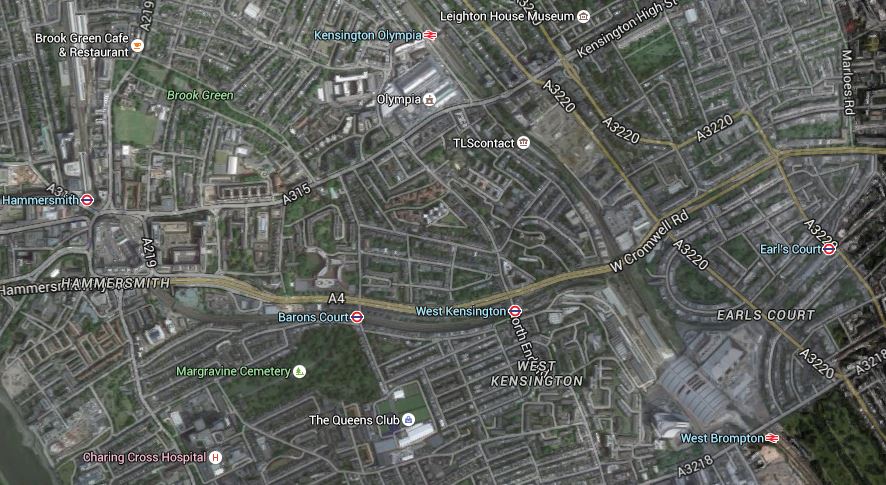
Around Earl’s Court
I think there’s scope for a better station at Earl’s Court on the Piccadilly Line, that connects with the West London Line.
Unless of course, the development is so upmarket, the residents wouldn’t be seen dead in trains. But developers have told me that in London, good stations improve marketability.
An improved station here would give good connections between Heathrow and South London and especially to Clapham Junction and East Croydon stations.
Other possibilities would be to connect the Piccadilly Line to the North London Line and a reinstated Brentford Branch.
I can’t believe that if Transport for London spend millions on new signalling and trains on the line, that they won’t do some other improvements.
 The Anonymous Widower