Zopa Rates Around the Election
Let’s assume that this election without a full outcome has put a lot of instability into the money markets. According to all the commentators it should. But then those traders in the City are in business to make money in the short-term and not place money for the greater good in the long-term.
So is there a real measure of what real people think about finance?
I lend money on Zopa, which is a peer-to-peer lending site. I’m not interested in short-term gains, but sensible and safe long-term growth. I get about 5.5% before tax taking everything into account. It’s also fun and a bit like gambling without the risk.
So how has Zopa performed over the last few weeks? And specifically what have their rates done?
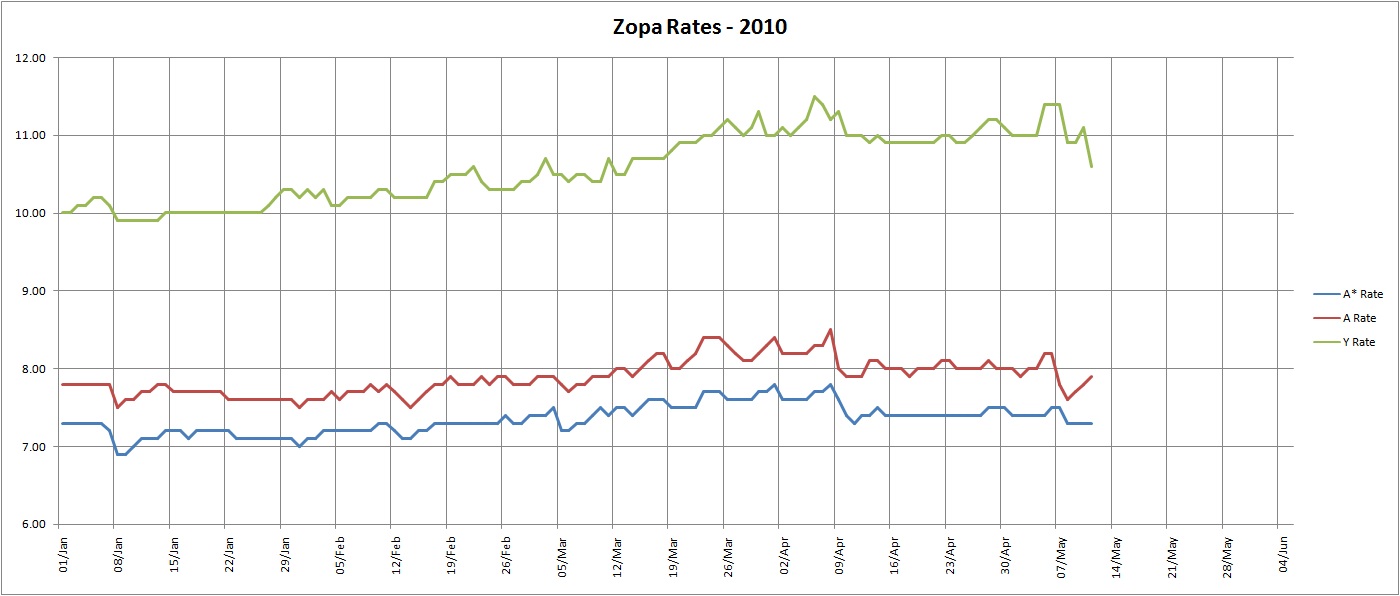
Zopa Rates 2010 – 11th May 2010
If you look at the rates, the pattern appears to be very similar to the last few months. There has been a slight upward trend of rates, with a squiggle around the turn of the month. The latter is because most Zopa loans pay around the beginning of the month and this affects the rate as most investors reinvest their returned payments.
So does this mean that most Zopa users have just been carrying on as normal and letting the lunatics in Westminster and the City get on with their high-profile nonsense?
I shall report on this in about seven days time, as I think it will still be nice and stable despite the politics.
Birmingham’s Sexist Employment Practices
That’s the only way to describe them.
The tribunal didn’t describe them as sexist, but felt they were a massive injustice. But then reports, I’ve heard have said that few if any women got the bonus and the best paid jobs went to those in favour with the union. That surely must be wrong, as trade unions look after all their members.
I though blame the managers. They must have known what was going on and didn’t take any action to correct it.
What I also find very strange is that some employees were earning a lot more than their managers. Surely the managers would have complained.
Cloud Cuckoo Politics
I listened to Chris Giles of the Financial Times last night on BBC Radio5’s Drive programme. He said that the various parties promises on the deficit don’t add up. They have promised saving in the order of ten billion or so, when documents from the Treasury show that we need to save around three times that much.
I’ve been in Newcastle over the weekend as you have seen and up there, they are worried about losing jobs when the new government cuts and cuts hard. After all large numbers of jobs in the North East are either directly with the government or strongly supported. Many too, are in-line for savage cuts because of new technology.
So would NuLabor tell the truth in the North East? No! But the Tories and the Lib Dems have nothing to lose there, so they would at least do the dirty deed after the election.
So what can be cut, what can be improved and how can we raise more revenue?
There are government programmes that can go like Trident, ID Cards, the two aircraft carriers, the Joint Strike Fighter and some other defence projects. Most though will not show up until about 2017.
I have one bitch on what can be improved in the NHS. Every time I go between my GP and Addenbrooke’s I have to tell the other doctor what the previous one, as the two doctors do not have access to the same database. How much does that cost the NHS? And how many other systems show a total lack of joined up thinking?
When we talk about efficiency savings, that is what we’re talking about and it will cost jobs in the NHS and agencies like the Police. But these will mainly be in back-office clerical areas. Well! They should be, but will government really bite the bullet.
Most taxes don’t raise more than about five billion.
So if you want to raise large amounts of taxes, then you increase the big ones like Income Tax, National Insurance, VAT, Corporation Tax and energy taxes.
Income Tax needs to be restructured with perhaps a 50% top rate and very much higher thresholds at the bottom. But I would allow tax relief on any salary you pay to others. So if you employed a nanny or a gardener, then this would be allowed. This may seem something for the well off, but it would also enable anybody to investigate ideas without having to go to the expense of setting up companies and finding loopholes in the tax system.
In other words you restructure Income Tax so that it is basically tax neutral for individuals but creates more jobs, which therefor will increase the tax take and also decrease the benefit take.
I’d also abolish National Insurance and combine it with Income Tax, as that is what it is, a secondary Income Tax.
At the same time, I’d also abolish Inheritance Tax and put three pence on the top rates of Income Tax. This would mean that a lot of rich people would move here and they would create employment. It would also have other employment benefits as people would do what was best at the time, rather than spend fortune avoiding Inheritance Tax.
I’m afraid VAT will probably have to go up. There is no other way to raise significant revenue. As VAT is generally only paid by consumers, as companies offset it, I would prefer that the tax rises were here, than before people got their money.
Corporation Tax is already high compared to other countries in Europe. If it is raised we are in danger of losing companies abroad. So raising it is a no-no, but lowering it may well raise more revenue as other companies would move here.
Now we come to energy taxes. They should be raised substantially. If coupled with increases in Income Tax thresholds they would publish the profligate. I would abolish Vehicle Excise Duty and just have a Vehicle Registration Fee for every time a vehicle changes hands.
Now, I am a control engineer by training and a lot of this is standard control theory, where you do something and you get lots of secondary effects. You just have to make sure that the secondary effects create jobs and thus raise Income Tax take and reduce benefits.
NuLabor has dug us into a big hole. We will only get out by being radical. Correct that; very radical.

Taking Risks
In this article in The Times yesterday Carl Mortished was arguing that we need more risk-takers. He ends with these two paragraphs.
The solution to our economic problems is not to tie everything down but to unwind the screws, loosen the bolts. We want true risk-takers, those people who centuries ago might finance a ship destined for a spice island. Someone truly prepared to risk the shirt on their backs, who fears that his “monstruosity” might bite off his own head.
Financial capital is now fleeing Britain, heading to the Far East. A long queue of companies is chasing the money, including our own Prudential, which is floating a business on the Chinese stock market. The true venturers are over there, not in Britain.
He is absolutely right.
So am I still taking risks?
Yes!
For a start I’m going round the world. Not much you’d think, but I’ve lost my wife and youngest son in recent years, five weeks ago I had a small stroke and the medics have said I’ve got a leaky heart valve and the heart rhythm is up the creek.
So take risks and enjoy life. Live the quiet life and you’ll never understand what it’s all about.
Zopa and the Election
I am an inveterate analyser of data. After all it’s what I’ve done since I was about seventeen and I successfully explained the shape of the response I got when a small ferrous inclusion in a copper wire passed through an electromagnetic coil.
That was forty-five years ago.
So can all the data I’ve got from Zopa be used to explain how people feel about the election and show how Zopa is affected by what is going to happen on May 6th?
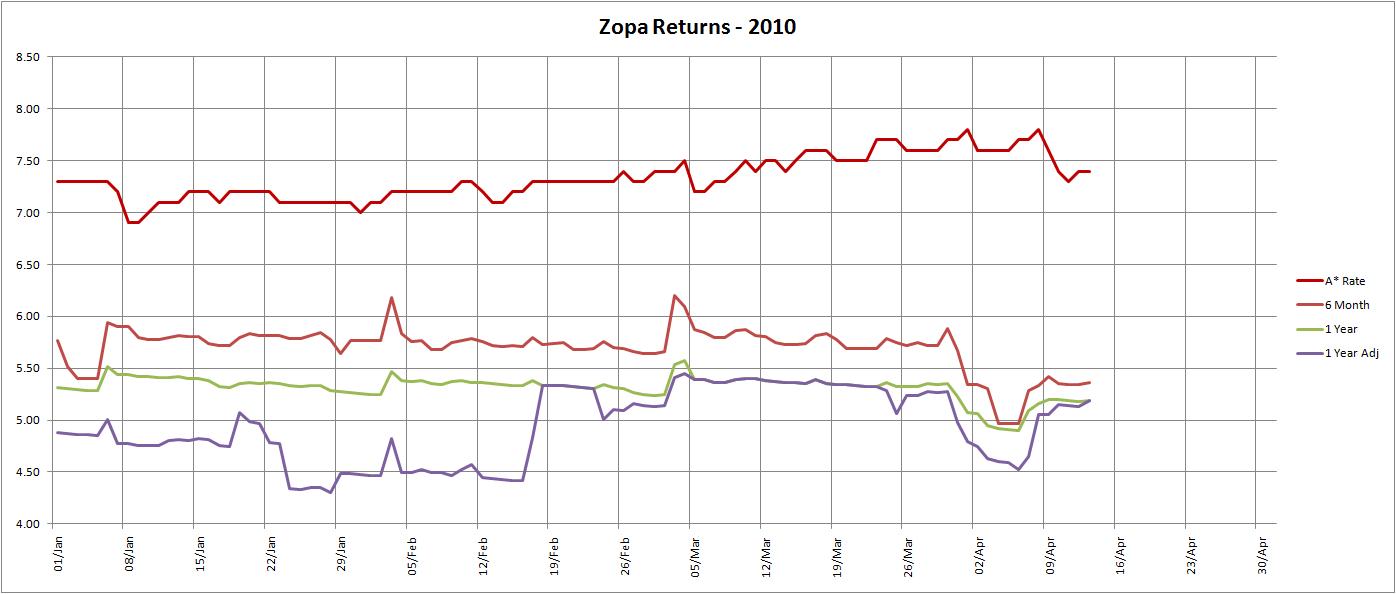
Here’s a graph of my returns since the start of the year.
Zopa Returns - 2010
The four lines on this graph are.
- The rate at which money is lent out in the A* Rate.
- The return on money in Zopa over the last six months. This takes account of any bad debts.
- The return on money over the last year. Bad debts as before.
- The return on money over the last year, adjusted for arrears. Bad debts are accounted for and if arrears are greater than a year ago, they are counted as bad debts.
Taking the last three it would appear that things have changed since the election was announced, as they have all dropped and then recovered slightly. This is solely due to an additional bad debt, caused by the death of the borrower. No system can take care of that very sad event.
Probably the best measure of the return is to look at it in the middle of the month. Today is the 13th, so the return on money over the last year is 5.42%, 5.35%, 5.38% and 5.18% for the last four months. So it has dropped 0.2% because of that bad debt. If that is eliminated then the return for April 13th would actually be 5.37%.
So the election has done what you’d expect and had no affect, as most deals were done whilst the date of the election was not known.
But look at the A* borrowing rate.
If you look at the graph, you’ll see that the rate often drops around the 5th to the 10th of each month. This is probably because most loans are paid around the turn of the month and the effect of that money being reinvested is to drop the loan rate slightly because of the supply of money being increased.
But this month it has dropped further than normal after creeping up slightly for the last month or so. Perhaps the rate has increased because of high demand for money.
Could this be that as reported retail sales have been high this month and people are borrowing at a rate they trust to finance it? Or are they worried about the new government increasing VAT?
But really there is no hard and fast evidence that Zopa is being seriously affected by the election.
I shall return to this as the elction approaches.
Harry Markopolos – 2
I bought the book from Waterstones yesterday and I have read the first few chapters on the train home from London.
Brilliant!
He spotted what Madoff was up to in 2000, but the SEC wouldn’t listen and took no action. He also alleges that others felt the same about Madoff, but were happy to take the money.
My respect for Harry grows.
Reading his book, just increases my distrust for financial advisers. I think it is why I like Zopa. There the money is under MY control and I live or fall by my decisions. I know nothing about stocks and shares, so I keep clear of them.
Harry Markopolos
Harry Markopolos is the sort of man I like.
In 2000, he was asked if he could find out how Bernard Madoff made such high returns. So he reverse-modelled Madoff’s results and concluded that he was either running a giant Ponzi scheme or he was illegally trading clients money.
He stuck at it and in 2005 to sent a document to SEC regulators stating.
Bernie Madoff is running the world’s largest unregistered hedge fund. He’s organized this business as “hedge fund of funds privately labeling their own hedge funds which Bernie Madoff secretly runs for them using a split-strike conversion strategy getting paid only trading commissions which are not disclosed.”
No action was taken and we all know now that he was right as in December 2008, Madoff confessed and he is now spending the rest of his life in jail.
Harry has just written a biography called No One Would Listen; A True Financial Thriller.
I shall be buying.
As to Madoff, he just proved that if something is too good to be true, it probably is. It’s just that when people do what Madoff did, no-one listens to the Harrys of this world.
The Banks Hidden Charges With Zopa
Not on Zopa!
Everything they do is detailed on your statement.
But take this week.
I wanted to put £500 into Zopa on Monday, so I did the transfer then. Only three days later has it turned up in my Zopa account. It used to be done straight from my debit card, but then one of the banks said that doing it that way, they didn’t get their pound of flesh.
So effectively they have my money for three days. At my rate of return on Zopa, that’s about forty-five pence.
Why?
I suppose they have to make their bonuses some way. My old mate, David, once told me that in the 1980s banks made a third of their profits on this sort of overnight money.
Has anything changed?
The Budget
Today we have the budget.
It is very much a waste of time, as the election is not even around the corner, but here in a few weeks.
But I have a more fundamental problem with budgets. If you run a business, you take financial decisions on a day-to-day basis and not at one fixed point in the year.
So is the system we have rather outdated in a modern world were a crisis can hit you overnight?
I don’t think we want to have budgets every month, but we need to have a system that on the one hand is more responsive to events and on the other takes the variations out of such things as fuel prices.
What would I do?
- I’d tax all energy heavily and use the money saved to take millions out of the tax system. It couldn’t be done overnight, but increased yearly it would have profound and positive effect on everybody’s lives.
- I’d also abolish Vehicle Excise Duty and replace it with a car transfer tax of say £30 or so to make sure all vehicles were very traceable.
- I’d also tax aircraft fuel. It is ridiculous that it is tax-free.
- I’d have a top tax rate of 50%, but anybody you employ for whatever purpose would be allowable against that tax. So if you have an idea, you could perhaps employ a student to do the leg work on it for say six months and then claim that against your tax. Childcare, gardening and all those other things would also be allowed.
- I’d abolish Inheritance Tax. I’ve had letters published in the Financial Times on that one. Two pence on Income Tax would raise the same and rich never pay Inheritance Tax anyway.
- I’d increase the tax on tobacco. Although, I doubt it would raise much money.
- I’d subsidise patents and IPR. The costs at present strangle innovation by individuals.
- But the biggest savings will come from getting rid of projects that no-one actually wants, like aircraft carriers, Joint Strike Fighter, Trident replacement, identity cards, bureacracy, extravagant pensions for civil servants etc. It is a long list!
I’ll add to this as the day goes on.
The aim though is to be tax neutral and perhaps even raise a bit more.
If you take high energy taxes, then this would raise more tax than you think, as there are large numbers of people who don’t pay tax and always seem to have large 4x4s. We’d be taxing the Black Economy which is a lot bigger than anybody thinks.
We should aim to have taxes that you can’t avoid or taxes that by avoiding them you create jobs and commercial activity.
 The Anonymous Widower