HMRC Fraud
There has been talk on the radio this morning and in the papers about various phishing attacks purporting to be tax refunds from HRMC.
Note that HMRC do not do refunds by e-mail, so any e-mails you get from them about refunds are fake and are designed to empty your bank account, after you have given them your bank details.
Here’s one I got earlier.
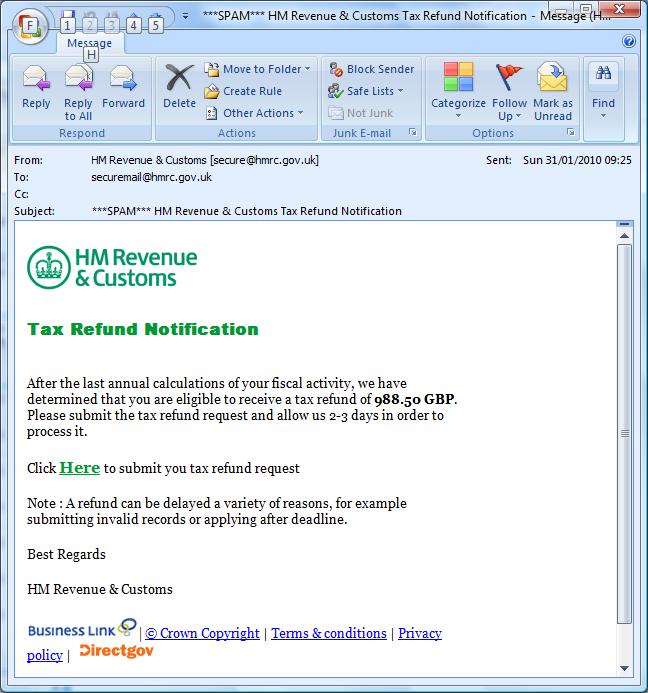
HMRC Spam E-Mail
These points should be noted.
- It is obviously spam, not least because my ISP has actually marked it as possible spam in the header.
- Bear in mind the fact too, that my accountant does my tax return and I think that HMRC don’t know my e-mail address.
- It is a good idea to learn how to read the Message Headers using your e-mail program. I use Outlook and this page in About.com tells you how to do it. In the headers for this e-mail, you can see there are lots of .br’s, which mean that at some point the e-mail has visited Brazil. Not the quickest route to Suffolk from the HMRC.
- They do show that the e-mail came to my standard e-mail address. Which means it wasn’t a genuine e-mail, as I use a special e-mail address for all financial transactions. Always use a different e-mail address for normal communications and financial transactions.
- The To: address in the e-mail is securemail@hmrc.gov.uk. Nearly all companies send important e-mails to the e-mail address you have given them.
- The value of the refund is shown as 988.50 GBP. I’m always suspicious of this, as the £ sign needed to show the value properly is not available on non-UK keyboards. About half of my genuine on line purchases use the £ sign and others use GBP. But phishing attacks nearly always use GBP.
- Click Here to submit you tax refund request. Note you instead of your. I know the HMRC can be stupid at times, but they don’t make spelling mistakes like this, as if they did, they would be a laughing stock in the tabloids.
- There are other grammatical errors and I don’t think the HMRC would use Best Regards.
You should always read these spam e-mails. That way, you will understand more and more what they look like and you won’t get caught out.
Reporting instructions for these sort of e-mails are on the HMRC web site.
Going Down?
The latest in the Portsmouth saga seems to make matters worse. According to the BBC, Peter Storrie and Avram Grant are not happy that players have been sold behind their backs.
I just think that Pompey are now at the end of the road. They face a winding up petition in the Courts on February 10th and I suspect that unless serious money turns up, they will end up in administration at best.
The point that no-one seems to say is that Pompey are favourites to go down and so the owners will lose a lot of money anyway. So would you put any more money into this type of sinking ship? Perhaps if you were a fool with money to burn. But no-one is that stupid are they? I suppose they could be if they bought a football club in the first place!
So it looks like there’ll be an extra place in Division 2 next year.
Will that be AFC Wimbledon? Now there’s a resurrection for you.
Banking Security
I don’t like internet banking. Well to be truthful, I like the concept, but some of the implementations of it are rather poor.
Take my bank. I need to enter my account reference, a password and then three numbers from a key code. I can remember these in most cases, but if I access the account from someone else’s computer, I need to have the account reference written down. But I do write it down in a way that no-one could ascertain.
Although it is a system that works, it is not the best. It is typical of many systems used to login to on-line banking.
I am a mentor on The Horse’s Mouth, which is a web site where people put ideas and others pass comments. It is an interesting concept and from what I read in the press, it is highly regarded.
In the last few days, the web site has put me in touch with a company called SafeTok.
It looks like it could be a solution to better Internet security.
But then I am not an expert in this field. But then I’m a consumer who knows what I don’t like.
Zesty Zopa
This appeared in the Daily Mail under the heading Zesty Zopa.
Who says there is no room for a new kind of banking?
The internet banking site Zopa, where lenders and borrowers decide among themselves at what rate they do business, is gathering momentum and had agreed 12,813 loans worth £63m as of January 1 this year.
It may sound like toy-town banking but it demonstrates how consumers, even bankers themselves, are determined to find ways of circumventing high street lenders.
This is typical of what newspapers, write about Zopa.
Just search Google News for Zopa and see what is written.
A Year of Zopa
I have now had a Zopa account since October 2008.
But it is now over a year since I started taking proper statistics of the lending, so that I can now put together proper results for the first time.
Overall Figures
As of the eighth of January 2010, I how have £39,473.90 invested in just nine hundred and fifteen separate contracts. This means that the average contract size is just over £43.
It should be noted that I generally lend in the two top Zopa markets, A and A*. This is because these markets have the lesser risks as people have a better credit rating. There are also two lower markets, B and C, that I ignore. I also lend a small amount in the youth or Y markets. All money is lent over three years.
Bad Debt
Bad debts are just two contracts, which total £278.13 or about 0.7% of the total. In terms of numbers is about 0.2% of the loans. Note that one contract is a Y and the other is an A.
So is that a figure that is in line with Zopa‘s predictions?
They predicted that debt for the type of lending I do, defaults would be of the order of two percent. There are two provisos to this.
- Loans between one and two years old are showing about a four to five percent level of default. Most of this was probably down to the credit crunch.
- Those issued recently are now checked to much tighter criteria and are showing lower predicted and actual levels of bad debt.
But both these levels are higher than I have encountered.
Let’s put it down to good luck.
Or did I just join Zopa at the right time with the worst of the bad lending bulge being just about in the past?
Arrears
Arrears are different to bad debt, in that they tend to be accounts that limp on. Sometimes they consistently pay a few days late and one or two I think will probably end up in bad debt.
The numbers of accounts in arrears vary between about two and seven. Interestingly the number grow at the beginning of the month and then decline until about the twenty-fifth. Some even if they do go bad will not be a problem, as I’ve only lent these people ten or twenty pounds or so. But others are more serious.
I have five in arrears at the moment.
- Y – £10 with just the last payment missing – 4 out of 5
- Y – £20 that just limps on a bit that has missed four payments, but they’ve all come in late – 3 out of 5
- Y – £100 that is a real limper but always manages the payment about ten days late – 3 out of 5
- A* – £120 with just the last payment missing – 4 out of 5
- A* – £30 that has limped and now appears to be going terminal – 1 out of 5
In total there is £211.34 in total outstanding on these loans, with total arrears of £12.06. So it would be unlikely that all this money will eventually be lost.
I suspect that the numbers will reduce as the month goes on. But I also expect others to be in arrears.
Returns
Working out a Zopa return is not easy, as money is going round and round, up and down and I have been adding about a thousand pounds a month to my lending.
According to my accountant the only fair measure is to take the amount of money earned a year ago and subtract it from today’s figure to get the yearly earnings. Dividing this by the average amount of money in the account over the year, should give a sensible answer.
This method also takes into account any monies in the holding account, bad debts and charges from Zopa.
As of today this yearly percentage is 5.44%. If I assume that all of the current arrears go bad, then this figure drops to 4.77%.
Is that a good rate of return in the current circumstances, where banks offer a lot less?
Strategy
When I started using Zopa, I didn’t have a strategy.
This was very wrong.
On the other hand, I had enough money to be able to afford any losses.
It is interesting that the two bad debts I have are one in A lending for £200 and another in Y lending for £100. Now, my limits are much lower.
As I said in this post, Zopa as a Lender, I started with the money from the sale of my late wife’s Porsche. But after testing Zopa for a few weeks, I started to be too aggressive in my lending, by allowing people to borrow too much. In some cases because two lending offers overlapped, I lent as much as £400 to some people.
Now, I have just two offers, one for A and A* borrowers and one for Y, with limits of £50 and £20 respectively. My average loan size is just over £40 now. I am not sure of the statistics but I believe that this makes it less likely I will suffer a major hit. Although, there are still some individuals with impeccable payment records, who owe me more than in an ideal world I would like.
So the strategy I now use is lend little and often and don’t be too aggressive in getting your money into the marketplace.
It also is essential that you check Zopa as often as possible, to make sure that your interest rates are up to date. I keep these at the highest level, that still gives a High rate of lending.
Marks and Spencer’s Financial Services Leaflets
They have just started a series of leaflets advertising their financial services, where they compare them to food.
The one for foreign currency says ‘Gluten-free. GM-free. Now try commission-free.’
I would never get my foreign currency from M & S, as I usually use a cash point abroad for convenience, but I find that now gluten-free is rather heartening.
The sooner gluten-free food becomes mainstream the better!
The RBS Dilemma
The Royal Bank of Scotland is now 70% owned by the taxpayer. Note the word taxpayer and that means you and me. Well, I suppose it might not mean you, as you might be in New York, New South Wales, New Zealand or New Caledonia.
But the dilemma will hit us all in the next few years as we struggle to get the economy under control.
In the red corner you have the public and the government, who for all sorts of reasons find million pound bonuses obscene. And in the blue corner you have the Banks, who say that they need to pay these bonuses to attract the best talent, so that they make higher profits in complex and difficult to understand markets.
This excellent article in The Times sums it all up well. The government wants to veto the bonuses and if they do, then the board of RBS will resign.
The Treasury signalled last night that it was prepared to veto a £1.5 billion bonus pool at Royal Bank of Scotland in a move that could trigger the resignation of the bank’s board.
RBS directors have been advised by the bank’s lawyers to resign if a Treasury bonus veto means they are unable to run the bank commercially and in the best interests of all shareholders.
People close to the Treasury signalled last night that Alistair Darling would throw out any bonus plan at RBS that was much higher than last year’s £1 billion. “We would not expect to see any significant increases in bonus payments. I think most people would see 50 per cent as a major increase,” one Treasury insider said.
RBS is expected to make £6 billion in profits this year from investment banking, implying a bonus pool 50 per cent higher than last year.
Is this blackmail? Yes! But is it sound business? Yes!
It’s actually more complex than you think.
Take total tax. Corporation tax on companies is lower than that for individuals. So am I right in thinking that high bonuses might actually return more money to the government? But that is a practical not an emotional response.
How true is RBS’s assertion that they need to pay the bonuses to get the right people to manage their investments? In my business life, I have often found that you have a lot more talent in a company than you think you have, but those in charge like to keep the minions down, as they see them as a threat. So perhaps, a little bit of intelligent management might improve matters. I don’t know! But I have worked with people at the highest level in a clearing bank and know that there is a lot of nonsense there. I suspect there still is!
Now let’s suppose that to get round the bonuses, RBS got some other company to manage their investments. I don’t know whether this is possible, but I suspect that it would probably cost them an arm and a leg to make the same six billion pounds. Probably one and a half billions of arms and legs. And most of that would probably never see a British tax authority again, so we, the tax payers, would lose.
So it’s difficult!
What we actually need is a change of culture.
Banks, no matter what we think, are a short-term business. For instance, a main board director of a major clearing bank, once told me that a third of their profits came from overnight money and the interest on money that had not been cleared. That’s why banks don’t transfer money instantly!
So how can we make things better?
Economists have talked of a transaction tax on banks, to move them away from short-term thinking, but that would only move the business to somewhere that doesn’t charge. So as with anything we need global standards and a level playing field.
So it will be a difficult and long uphill struggle to make the banks appear ethical in everybody’s eyes.
For my personal banking, I don’t use a bank, but a building society through the Internet and Zopa, the peer-to-peer lender. The former transfers my money efficiently and manages my credit cards. And the latter pays me around five percent on savings, with the ability to withdraw the money gradually if I need it. To get the same rate with a bank, I’d have to lock the money in for ever.
This is a model that many others will follow, leaving the global fruit machine to the so-called professionals. Unfortunately, banks will probably do their utmost to strangle innovative competitors like Zopa.
So we must educate everybody in the Internet and personal finance, so that they can make reasonable decisions for themselves. Many web sites do this very successfully.
But to return to the original dilemma.
Should the government limit bonuses for banks in which we have the major shareholding?
In my view they should not!
Why?
It will heap more bad publicity on the banks and hopefully push most of us to look for better and more ethical ways of handling our money.
Paying for the Care of the Elderly
I’m getting there fast and hopefully, I’ll have enough money to keep me in my old age, but others will not.
There is an article in today’s Times, which lays out whether the state or families should pay. It is a difficult question and judging by some of the comments, a large number of people find it unfair that they should pay extra, after they have contributed all their life.
In my view we have to radically change several things.
The first is that we will all have to work later. I have no intention of giving up on work at 65, as my father did and it killed him. But seriously many of us do jobs that we can continue to do on a full or part-time basis for a few more years. If I was Chancellor of the Exchequer, I would give a tax advantage to older workers, as the longer they work the greater the savings will be to the government’s coffers.
I would also abolish Inheritance Tax. I’ve had letters published about this in the Financial Times and know that it can be funded by perhaps two pence on Income Tax. This would give those who wanted to pass on their wealth much greater flexibility and many would move into much smaller well-equipped homes, that would allow them to stay self-sufficient for longer. I’ve been told that some stay in run-down large houses to minimise tax Inheritance Tax liabilities. That is wrong on many fronts.
Inheritance Tax will never be abolished though, because of the politics of envy. Unless of course someone does it in the EU, like Spain or Italy, and everybody rushes to the sun to avoid paying the tax.
We must also find some way to reward those who have looked after their finances. Many others have been profligate and have no assets when they can no longer cope. How this will be done is the difficult part, but perhaps we should give extra tax relief for pensions and savings. This could actually be paid for by making the systems a lot simpler, so that you didn’t have to use one of the armies of pointless intermediaries.
But it is not all gloom!
All of these elderly will be a big market for new products and services. Just take the StairSteady, which is an invention to help the elderly and infirm climb stairs. There are loads of things that need inventing.
In a few years time, a large proportion of the retired will be Internet-savvy. This in itself will enable local self-help groups to be created. New hand-help devices will also make things better.
We often tend to say that it will all get bad and even worse. But often we realise that the doom-mongers are wrong. As an example what happened to the Millennium Bug?
How Banks Treat Competitors
As you know I’m a great fan of Zopa. I started with a post called Peer-to-Peer Lending – Zopa in July and have posted several since. Just click the “Zopa” tag.
Have the banks found a way to stop this upstart competitor? This has just been posted on the Zopa web site.
What’s happened to debit cards?
You may know that in order for a business to receive debit card payments, a merchant services licence is required. When we started out, our business model was unique and something of an unknown; as such, RBS Worldpay (the body associated with our banking partner that grants the ability to receive debit card payments) declined our application for a merchant services licence. We felt that debit card funding would be a useful service to offer our lenders, and found an alternative solution with the support of a third party in the anticipation that it would be a short term arrangement.
Given Zopa’s growth – and thanks to all your fundings – this year we thought it an appropriate time to revisit the application for our own merchant licence, with a solid track record to prove both that our model is working and that debit card business is popular with very little risk of liability to the merchant services provider. Unfortunately, despite our best efforts RBS Worldpay refuse to accommodate Zopa’s model, and have openly shown no appetite to work with us in coming to an arrangement or indeed in understanding our business. Equally, our volumes are such that the short-term process is no longer sustainable so it’s become unavoidable for us to draw the debit card funding service to a close.
The transfer will now take two days as opposed to being virtually instantaneous.
Why is it that banks assume that they are special? They are no different to any other company and should live within the same rules. But they don’t!
A New Bank
Years ago, I worked as a consultant for a major bank writing a software system to calculate the cost of the various operations of the bank. What was interesting, is that a significant part of the cost of transactions such as clearing cheques, standing orders, direct debits etc., was the cost of the buildings and premises. In fact, when a new branch opened, because of the premises cost, it was a long time before that branch’s costs were down to the average level.
So the suggestion of one of the callers on Radio 5, that banks open branches in areas that are poorly served, although admirable will never happen. Or only after intense pressure and inducements.
But!
We live in a technological age, with nearly everyone having a mobile phone. Also about 50% of the population bank on-line and about 70% or more of the population have access to the Internet.
So any new bank must maximise this technology to provide a service to everyone.
Banks too, need to introduce more personal service and if customers can’t get to see the bank manager, then the managers should go to the customer. How many people have ever had a visit from a bank manager? I rarely have and I’ve dealt in seven figures sums with banks for many years.
Returning to my costings of a major bank. Small sub branches were an interesting way of providing service in areas away from the main branch. They have now been replaced by cash machines, but why do we not see such branches in places like supermarkets, hospitals and garages?
Whatever happens, a new bank must innovate and draw on the experience of the past; good and bad.
 The Anonymous Widower