Pudding Mill Lane Station – 20th August 2013
This set of pictures shows how fast Crossrail and the new Pudding Mill Lane station are progressing, when it is compared with pictures of just over a month ago.


The two tunnelling machines; Jessica and Ellie are soon to be on their way, or might have even left yet on their journey to Stepney Green.
The new station is looking like it will be one of the grandest on the Docklands Light Railway. According to this piece in Wikipedia, it will be completed this year.
As it will be one of the major stations for the Olympic Park and probably the closest to the stadium, I think we’ll start to see pressure to change the name or at least add a tag to Pudding Mill Lane like for West Ham United Stadium. After all there is a precedent at Gillespie Road station.
London Buses May Go Cashless
According to reports like this one on the BBC, it looks like London buses may go cashless.
There have been a few comments that the usual suspects are against this, as it may hurt the poor and the vulnerable, but I don’t think it will create too many problems after the first few months, especially if publicity and the technology was cranked up a bit.
I do remember though, a conversation on a Manchester bus, with an off-duty driver and union representative. He felt that their single-door buses where the low-life gathered around the driver and tried to steal his money were very inferior to two-door buses. he would have loved a cashless system.
I’ve just done a small calculation. There are six million riders on each weekday on London’s buses and working on a figure for today that one per cent of riders buy a ticket with cash, that means that 60,000 riders a day buy paper tickets. as there are 250 weekdays in a year, that means there are fifteen million tickets sold each year.
The cost of collecting the cash is given as £24 million a year, so it would almost appear that some of those without tickets could be issued with a free get-you-home ticket. Transport for London are saying they might bring in the Hong Kong system, where an expired card is good for one journey.
I do think though that if the decision was made to go cashless, as the no-cash day approached most people would do something about getting a ticket like Oyster.
i do suspect though that there will be a few objectors, who would not countenance any ticket like Oyster, that enabled them to be tracked,
Art At The Bus Stop
My local bus stop has got the treatment from Art Everywhere.
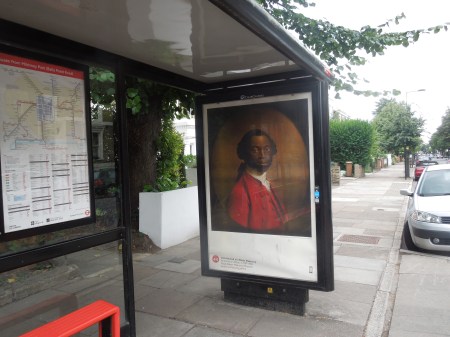
Art At The Bus Stop
I think, I’ll go and find the original some time next week.
Are These Trains The Key To Improved Rail Services in The UK?
I must admit I’ve been critical of the Hitachi Super Express Train to be built in the North East of England.
As an engineer, I don’t like the idea of an electro-diesel version, that lugs diesel engines around, so it can be self-propelled on non-electrified lines.
I also feel, that the last government wanted the project for overtly political reasons and hence the decision to build the trains in the North East.
But now the orders are being made for both the Class 800 and Class 801 trains, I’m warming to the project.
This is partly because, I have travelled into Kent several times by the Class 395 trains, which are to a similar design by Hitachi, as proposed for the Class 800 and Class 801. Although, they are probably less grand, as they are essentially commuter trains. But even these humbler trains have a top speed of 225 kph, which is the same as the Inter City 225 units on the East Coast Main Line.
If all of the improvements to the East Coast Main Line detailed here are implemented, then the line could be a 225 kph four-track line all the way from London to Newcastle.
The major problems then to adding capacity and obtaining that speed most of the way, are the slower 160 kph trains, that run from London to Cambridge and Peterborough and share the lines to the north of York and Doncaster. But if these units like the current Class 365 and Class 185 were replaced with another electrical multiple unit from the same 800/801 family capable of working at 225 kph, this problem would be alleviated.
If we look at the West Coast Main Line, the Class 390 Pendelions could travel on a lot of the line at 225 kph with improved signalling, but again they are held up by other slower services. in fact, there is talk of ordering more mini-Pendelinos to serve places like Holyhead, Chester, Blackpool and Shrewsbury.
Once the Great Western Main Line is fully electrified to Bristol and South Wales, it should be a 225 kph railway, virtually run by the 800/801 family of trains, with a few Inter City 125s, still working down to Devon and Cornwall. So I suspect we’ll see the Oxford, Cheltenham and Worcester services run by faster trains to reduce capacity constraints.
But all this does show again, how by running more 225 kph trains under better signalling systems, with probably more selective quadruple tracking can greatly increase the capacity on our railways.
It could be argued than one of the successes of the Inter City 125s, is that because there are so many they can be moved between operators and reconfigured easily for changing circumstances. If ever there was a chameleon train, it is these.
i suspect that if we had a large number of 800/801 trains or in fact any other type, then this would make them cheaper to purchase and support and probably more reliable. We have too many one route only classes of trains.
So what other lines could benefit from 225 kph trains, such as the 800/801 family?
Obviously, the East Midland Main Line is a candidate, especially as there have been plans to make a lot of the line capable of speeds of 200 kph. It would be an easier and earlier way to substantially speed up journey times to Sheffield. Dual voltage versions of the 800/801 family aren’t proposed, but the closely related Class 395 can run on overhead wires or third rail. So could we see a high-speed service from Sheffield to Brighton, through the Thameslink tunnels, stopping in Central London and Gatwick Airport?
The Great Eastern Main Line on the other hand is probably not a candidate, as it is only a 160 kph line, as like most East Anglian infrastructure, it was built on the cheap. But the line is crying out for new trains and I have heard that electrical multiple units would save time to Ipswich and Norwich.
The Trans Pennine Lines are a disgrace and at least are scheduled for electrification. As the trains using these lines often travel over the East and West Coast Main lines, faster trains are needed for some routes like Liverpool to Newcastle and Glasgow to Manchester.
I would also electrify the Chiltern Line to Birmingham and replace the third rail systems south of London to perhaps, Brighton, Portsmouth, Southampton and Bournemouth. For freight purposes this is being done partly already.
So I think we’ll see lots of the 800/801 family of high speed trains.
Do We Need A Rolling HS2?
The report today by the think tank, the Institute of Economic Affairs, which says that HS2 will cost a lot more than is currently budgetted for. It’s all reported here on the BBC.
They make a lot of good points in the report.
Extra infrastructure such as trams and trains, will be needed to link other areas to the route.
Extra tunnels and other infrastructure will be needed to buy off the opposition.
The BBC summarises it like this.
The report said HS2 “and the add-on transport schemes will be heavily loss-making in commercial terms – hence the requirement for massive taxpayer support”.
As someone, who is very familiar with project management, I’ve always felt that the logic of HS2 and the way it is being implemented could and will be improved.
If we look at the current rail network, it has problems that will eventually be solved or helped by HS2.
Euston station is not fit for purpose and should be redeveloped and/or relieved. I favour a second terminus of the West Coast Main Line at Old Oak Common, as I mused here.
There are very severe capacity problems on the northern part of the West Coast Min Line between Wigan and Glasgow. This is not part of the current HS2, so perhaps it should be done to make sure the Scots get their connections to the South improved.
The East Coast Main Line to Leeds and Newcastle, has a notorious bottleneck at the Digswell Viaduct and according to this report on the BBC web site, it could be removed for under half a billion.
One problem that HS2 doesn’t solve is the bad connections across the north of England from Liverpool to Leeds and Hull. This BBC report includes an estimate of a billion plus.
So should we just define the route for HS2 and then break it into a series of manageable projects, that are implemented over the years.
We might design large stretches for say 300 kph, but most of the upgraded network would have limits of around 200 to 250 kph. Effectively large sections of the East and West Coast Main Lines can now handle 225 kph and just need resignalling.
The new Class 800 and Class 801 trains will be built to a design speed of 225 kph.
In some ways these trains may be the key to the whole of the expansion of high-speed services. I suspect, we’ll see them on London to Sheffield and Norwich for a start.
Cash-For Crash By The Busload
This story must be the ultimate cash-for-crash story. Here’s the intro.
A bogus bus crash was staged in Sheffield so 26 passengers could make fake whiplash claims – all set up by organised conmen trying to defraud insurance firms, a court heard.
As I don’t have a car or car insurance, I’m glad that I don’t have to pay for these crooked claims.
Beware Of Angry Tweets
According to this article in the Daily Mail, an analysis of Twitter messages from rail passengers has shown that South West Trains are the least popular train company.
I took the company yesterday to Portsmouth Harbour in order to go to the Isle of Wight and I have no complaint about them, except that for First Clash passengers, they are the meanest. On a similar length journey to Ipswich, I may not get many perks, but at least I can get a free bottle of water or a coffee.
I know it’s not much, but it’s the thought that counts.
I wouldn’t choose the company, if there was an alternative, except that Waterloo is a better station for me than say Victoria.
Perhaps though companies should take more notice of what is said on sites like Twitter!
A Cruise To The Isle Of Wight
Until yesterday, I’d never been to the Isle of Wight.
I took the train from Waterloo to Portsmouth Harbour station, from where I walked to the catamaran for Ryde.





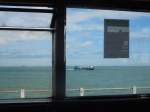
The pictures were taken on the way over.
The ferry was fairly busy with passengers. Unfortunately, you don’t seem to be able to get into the fresh air.
The fort incidentally, is one of the Palmerston Forts.
A Trip On The Island Line
The Island Line on the Isle of Wight, is a unique train line, as these pictures show.
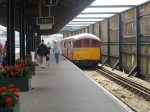



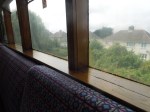
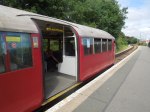
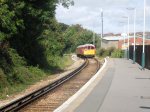

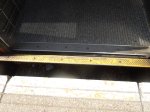
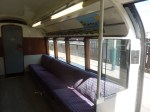
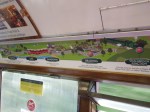
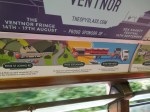
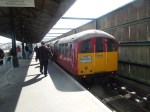
It was just like going back to my childhood and be transported in one of the old 1938 Stock, London Underground trains, that I can just about remember on the Piccadilly line in the 1950s and 1960s.
The Class 483, as they are now called, still have all the same noises and a lot of the wooden features, although the seats and a few other internal features had been updated.
I do wonder whether old London Underground trains, which generally have been immaculately maintained could be used on some of the far flung parts of the network to re-instate old lines.
One of the reasons, they ended up on the Isle of Wight, was that this line has gauge clearance problems and London’s redundant tube trains fit the space available. And of course, third-rail electric trains are easier to install than those with overhead wires.
There is a lot of talk about using new trams or tram-trains on some branch lines, but surely some retired tube trains, would be a lot more affordable and a tourist attraction as well. Over the next few years, there is going to be a lot of these trains, that will be replaced in London.
They deserve better than being scrapped!
All London Underground Ticket Offices To Close
This claim is being made by the trade unions in London and it’s reported here on the BBC.
Except for main line stations, you rarely see anybody at the ticket offices. But then they can be busy, as this post shows.
So just on my personal observation, there seems to be a need for some reorganisation of the ticket offices.
One of these could be making sure that passengers arrive in London with a ticket for the Underground.
Modern Railways this month also had an editorial about the rows that are about to happen, when trains in London go for driver-only operation.
I think there is going to be a lot of argument in the next few years.
But honestly, when was the last time you visited a ticket office on the Underground to buy a ticket?
I think I bought an Oystercard about four years ago. I’ve bought one since and that was from a machine.
 The Anonymous Widower