The London Pleasure Gardens
I said I would go and find the tent-like structure, I noticed yesterday on my trip back from Woolwich.
It turns out it’s the London Pleasure Gardens, as described here in Time Out.
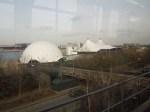
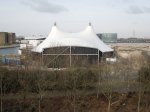
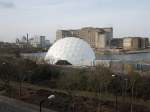
As you can see it looks all rather shut up, but then Time Out is now reporting the company has gone into administration.
Everything would appear to have been cancelled. The web site just shows a place page.
St. Mark’s Church, Silvertown
This picture shows, what I think is St. Mark’s Church, Silvertown.

St. Mark’s Church, Silvertown
It is just one of the many distinctive churches you can see from the DLR.
No visit to London is complete without a ride on London’s unique DLR. It may have been built on the cheap as a stopgap, but like Topsy it has grown and now is one of the stalwarts of London’s transport system. These are stations and local areas worth visiting.
Abbey Road for Abbey Mills and the Greenway. But not the recording studio!
Canary Wharf for the walks by the water and the shopping
Canning Town and East India for the River Lee and The East India Dock Basin
Greenwich for the Cutty Sark and Maritime Greenwich
Pontoon Dock for the Thames Barrier
Pudding Mill Lane for the Greenway and some of the best coffee in London
Royal Victoria for the Emirates Air Line
Woolwich Arsenal for the Royal Arsenal
What Is This Strange Building By The Millennium Mills?
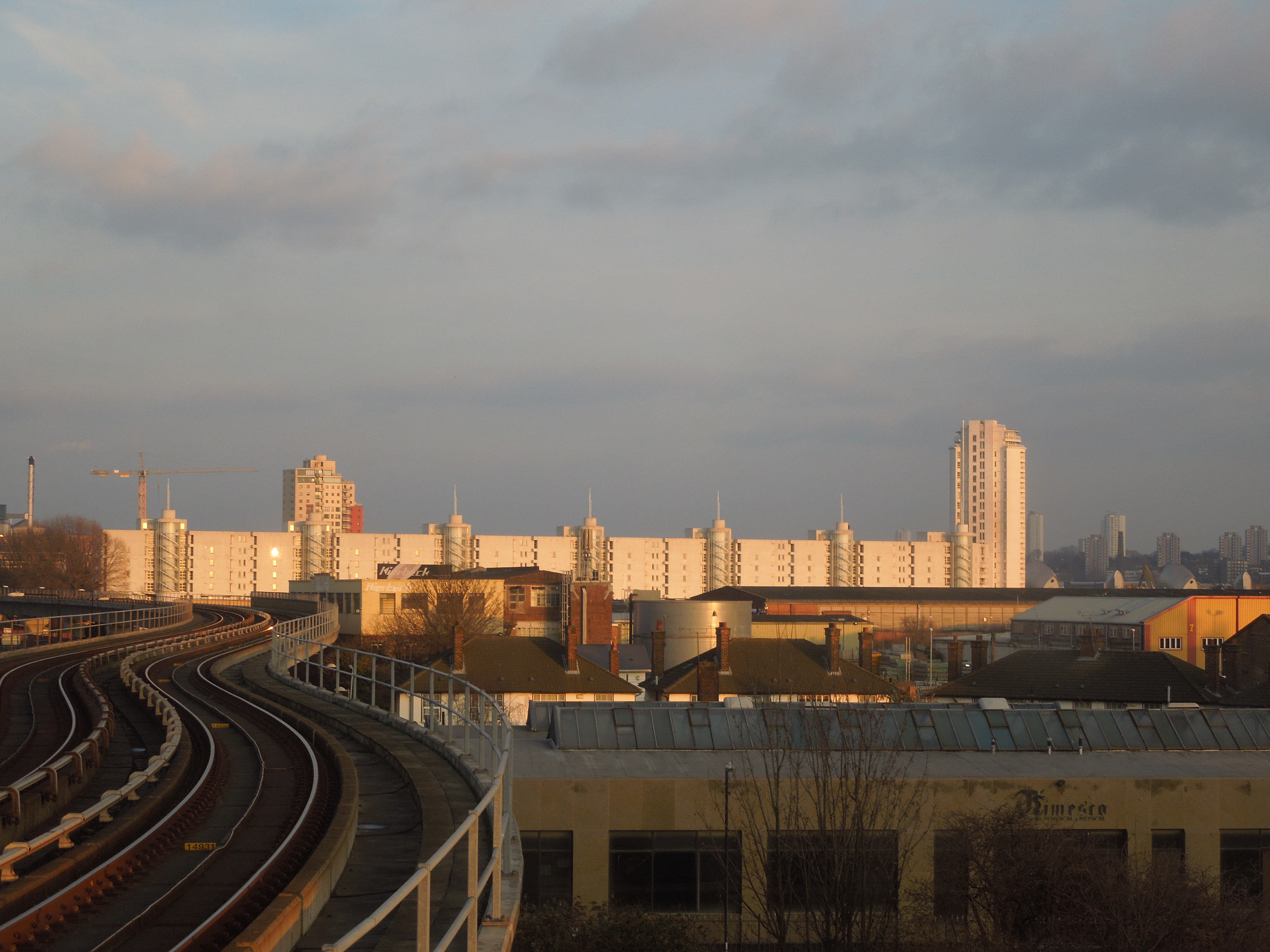
I passed this building whilst riding on the DLR back from Woolwich yesterday.
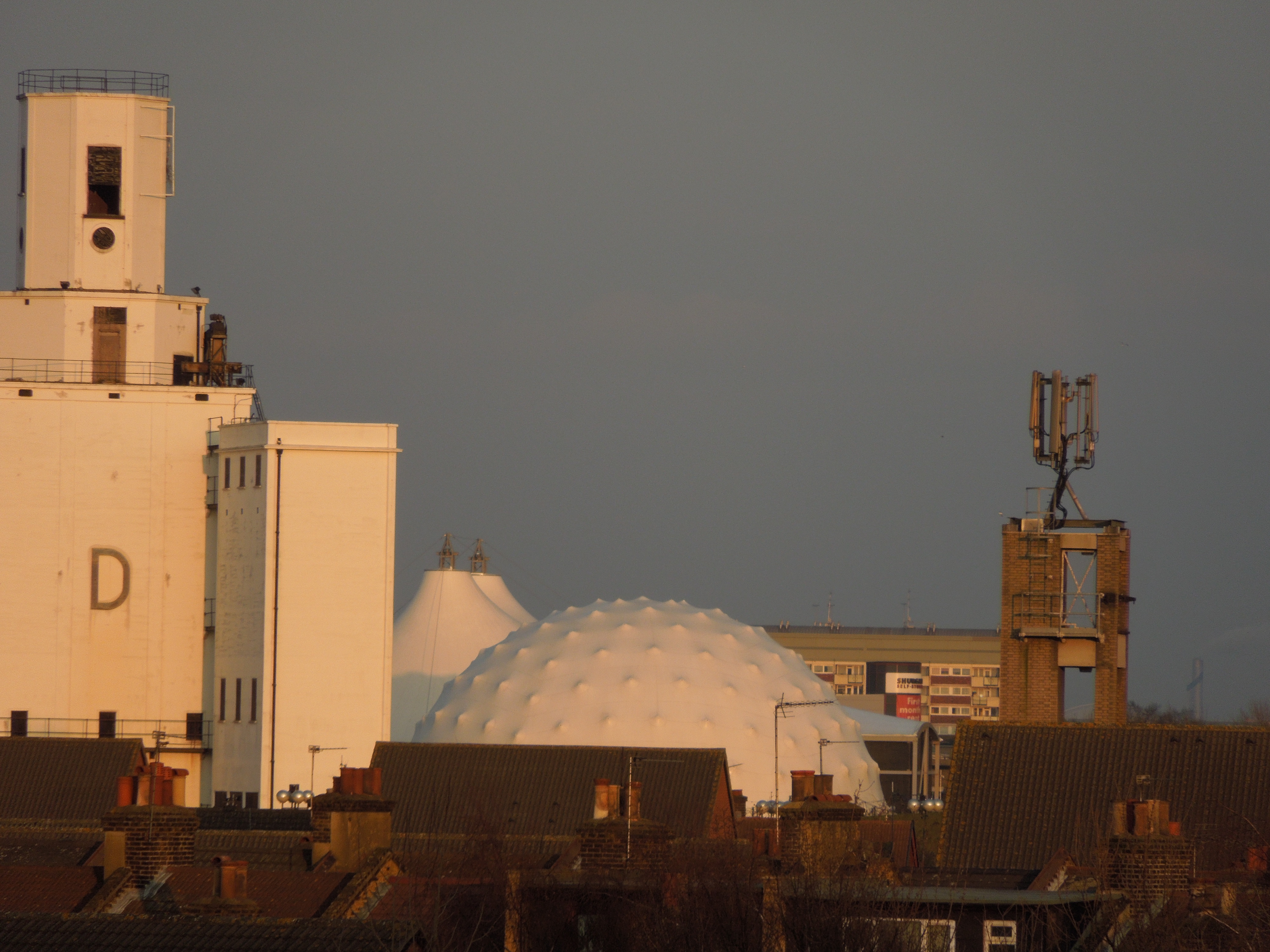
A Strange Building
I must go and find out what it is!
The white building on the left is Silo D by the Millennium Mills.
This blurb with this set of pictures says it is a circus tent.
I think I should go for an explore.
The Biggest Mistakes I’ve Made
These are some of the biggest mistakes I’ve made.
Not Selling Up And Returning To London Sooner
After C died in 2007, I had a phone call from an agent, who made me an offer, he thought I wouldn’t refuse for the house and stud.
Although C and I had talked about moving back to London, in a couple of years, I said that, I’d stay put.
I just wonder how my life would have turned out, if I’d accepted that offer.
Not Carrying Camera For A Large Part Of My Life
From probably the mid-1970s until perhaps the mid-1990s, I rarely had a camera with me and much of the things I did is unrecorded. C also had the habit of throwing away negatives, so a lot of the pictures I took, have now been lost.
Not Giving Up Driving Earlier
Admittedly, I had the stroke, but I actually regret not giving up driving earlier. I obviously couldn’t until I moved to London, but then you don’t realise what a tyranny and a chore driving is, until you abandon it. After all, with the money I save, I could afford a chauffeur-driven limousine when I need one. Although, these days, like in Blackburn, the bus is probably sufficient.
Not Cooking Enough When C Was Alive
I rarely cooked, when C was alive, as if she was busy and couldn’t find time, we would drive down the pub or go to the local Indian restaurant.
When she died, I learned to cook again quick enough and these days I thoroughly enjoy it, with one of my friends being very complimentary about my fish pie.
Not Pushing C To Take Longer Holidays
C was a barrister and I’ve never met one yet, who wasn’t a workaholic, who was always worried that if you took time off, your colleagues in Chambers would take your best work.
I never pushed her to take more holidays, despite the fact that some we took like flying round Australia and driving around South Africa were perhaps ten days too short.
In some ways she did take more holidays in the last couple of years of her life, so did she know that something was awry with her health.
Not Having More Children
This is very much a mistake with hindsight, after the death of our youngest son and now, I would never entertain being a father again.
After we sold out of Metier and Artemis, C and myself, seriously thought about having another child, as we were only around forty. We could have afforded it and C was fit and well. These days, that is an age, where people start families.
The only fly in the ointment was my vasectomy, which could probably have been reversed. After all, the doctor, who did it in Hackney Hospital in the 1970s, assured me, that it could be reversed.
We did think hard about it, as although C said, she didn’t want a girl, I probably did. Even if we never had a name for a girl and what she’d have been called, I know not.
We did flirt with the name Tyche or perhaps more correctly I did. Tyche is the Greek goddess of luck. Surprisingly, or perhaps not so, I’ve never seen the name used. But given the connotations, I think this is surprising.
Not Buying A Flat In Barrier Point
In about 2000 or so, C and I looked seriously at buying a buy-to-let flat in Barrier Point close to the Thames Barrier.
Barrier Point
In the end we didn’t, but it is one of the biggest regrets of my life.
I suspect, if we had, I’d have moved there soon after C died and some of my medical problems may have been caught earlier.
More Problems For Coal
I am not a great fan of coal as, I think it’s a dirty fuel, that is dangerous to mine and causes all sorts of problems like subsidence for the neighbours.
So this news of a large fire at Daw Mill Colliery in Warwickshire, that might spell the end of mining in the county, is just typical of the problems of this fuel.
I will not be sorry if this hastens the end of the UK coal industry. For everybody’s sake, we should have put together a comprehensive plan to shut the lot down perhaps half a century ago.
Doing Her Mending On The Bus
I’ve seen women knitting on the Tube, but I haven’t ever seen anybody doing their mending on a bus before.
That is until today, when I saw a young lady sorting out some errant hem with a needle and thread at the front of the top deck of a number 30 bus.
It’s funny though, but I’ve never seen anybody doing serious embroidery on a bus or train!
Should We Ditch The Penny?
There is an article on the BBC web site discussing small coins and whether we need them.
It makes a very valid point, and although I’m a large cash user, I can’t think of the last time, I purposely used a coin smaller than a five pence. I don’t even chuck them in as tips.
I just looked and I found that I’ve only one two pence, amongst a load of ones bigger than ten pence, in my coin pocket and I can’t think how it got there! So it probably shows how rare it is for you to get them in change these days.
If I go back a few years, some purchases like newspapers, were definitely ones that needed pennies, but now I buy my daily paper on subscription to get vouchers and the Standard is a free sheet. Buses too, would have needed a few coins, but now I use a card to get them free. Even if you’re under sixty, I suspect buses don’t need pennies.
So just what do we need pennies for?
I suppose there is the pub game of shove two pence or whatever it is these days.
I certainly wouldn’t miss them, if they ceased to be legal tender.
The Austin Maxi That Didn’t Get Into The Film
The Sunday Times yesterday told the true story of Argo yesterday and like so many other American films, the role of Brits, Canadians and New Zealanders have been cut out. It would appear from the paper that the British Ambassador in Iran at the time; John Graham, is not amused. It would appear that one of the heroes was the orange Austin Maxi, used to ferry the American diplomats about.
It may not be very sexy, but it’s true.
So I can cut Argo off my list of films to see, as I don’t watch films where the truth is bent for American self-gratification.
A Benefit Of Fracking
To many there isn’t one benefit from using fracking to extract gas from the ground. but here’s one even the most total opponent of the technique might concede.
Modern Railways this month states the following.
The major rail operators in the US are all reporting reduced profits as coal volumes plummeted by up to 20% in the last year. Here, the shift in generation mix is being driven principally by the exploitation of shale gas now being produced on a massive scale as a by-product of crude oil exploitation. although a frighteningly high proportion of this gas is just flared, sufficient is being used in power-generation to undermine the need for coal, and for rail freight.
I would suspect the facts are correct. So fracking is cutting the need to burn coal, thus reducing global warming, as burning gas creates less CO2.
1960s Architectural Failures
Yesterday, I went to or through four stations; Highbury and Islington, Euston, Manchester Piccadilly and Huddersfield.
Huddersfield is a Grade 1 Listed Building which means it is one of the finest buildings in the country. The others are three of the worst examples of how we designed and built stations in the 1960s.
So it got me thinking about what are the worst examples of 1960s architectural design, that I’ve seen. I’ll start with the three I’ve already named.
Euston station – I probably went to Liverpool a couple of times from Euston before the current station was built and I have vague memories of catching trains there during the building in perhaps 1965 to 1967. The design shows classic “Think Small” attitudes as it was deliberately built with foundations that couldn’t support development above. Only twenty or so years later, Liverpool Street station was remodelled, which shows how good design can be applied to old buildings. Since then St. Pancras and Kings Cross have been rebuilt using similar thought processes to those used so successfully at Liverpool Street. One does wonder what would have happened at Euston, if the rebuilding had been a few years later. Euston is now to be rebuilt for HS2 and I suspect they’ll get it right this time.
Euston has another big problem, that you don’t see on the surface. The Underground station is one of the worst in London, with no step-free access, innumerable staircases and escalators and a dingy cramped ticket hall. The only good thing about Euston station is that coming off a train, it’s easy to walk to a bus, as I did last night. But try taking a heavy case on the Underground.
In some ways, Euston’s problems with the Underground should have been solved, when they built the Victoria Line, which opened at around the same time as the new Euston station. It just showed how bad project planning was in those days. The fact that the Victoria line was built on the cheap didn’t help.
Highbury and Islington station – This suffers badly because of the decision to build the Victoria Line on the cheap. Again it is not step-free and it perhaps is one of the worst stations for disabled access in the Underground, as when you get down the escalator, you then have a tunnel and a staircase to get to the platforms. At least the Overground platforms have lifts to the surface. Since I have moved to the area, the station concourse has been opened up considerably and it is not dark and cramped like it was a couple of years ago. To be fair to Transport for London, I think they’ve achieved the improvement without using tons of money. But solving the problems of access to the underground platforms will be very expensive.
Manchester Piccadilly station – This suffers in that it doesn’t have enough platforms and lines. Additionally, of all the main stations in the country, it probably has some of the worst connections to other means of transport. It makes you wonder if it was designed as a cheap stop-gap solution to accept the new electric trains from London. They are spending a fortune on the Northern Hub, but will it get rid of all the hangovers from the 1960s and all the resulting layers of sticky tape? Only time will tell, but judging by the improvement of planning in recent years, it probably will. If you want to read about planning failures in the area, read this Wikipedia topic about the Ordsall Curve, which is a crucial part of the Northern Hub. It would appear that it had the go-ahead ( and money) in 1979.
So that’s dealt with yesterday’s examples, what others can be added to this list?
Kings Cross station – Although not specifically 1960s, but a few years later, this now virtually demolished extension was best described as a wart on the face of the Mona Lisa. The man who designed it, must have had the biggest conservation stopper of all time. I can’t wait until I see the new Kings Cross plaza in the autumn.
Various stations – There were a lot of stations built in the 1960s that I don’t like, although some are listed. I would start with a short list of Harlow Town, Stevenage, and Walthamstow Central. Railways have a lot to answer for, but some of their worst excesses were reserved for buildings like this signal box in Birmingham. Many reckon that Birmingham New Street station is another bad example, but at least the operation of the station seems to be pretty good. In fact the planned reconstruction of the station; Gateway Plus, is all about greater passenger comfort. So yet another 1960s monstrosity will bite the dust. Gateway Plus has this condemnation of 1960s thinking.
The current New Street station was built to cater for 650 trains and 60,000 passengers per day, which was roughly the same usage it experienced when it was first constructed. It was believed that demand for rail travel would decrease. However, it now caters for 1,350 trains and over 120,000 passengers – twice its design capacity. Passenger usage of New Street has increased by 50% since 2000.[2] It is predicted that passenger usage of the station will increase by 57% by 2020.
We do seem to have cut corners for decades and only now the chickens are coming home to roost.

