The Dafs Are Out
Or they certainly are in the Thames Barrier Park.

Daffodils in the Thames Barrier Park
This park is one of London’s hidden gens, in that it has beautiful modern gardens, the river, the barrier and of course the coffee.
The Best £1.85 Capuccino in London!
Possibly! No! Probably! Today I was cold and as I walked through the Thames Barrier Park back from the Thames Barrier to Pontoon Dock station, I had one in the cafe in the park. It was in a china mug too!

The Cafe in the Thames Barrier Park
I’ve not had one better, since I had one for a Euro in the backstreets of Naples over three years ago.
A Two Man-Hernia Job
In the 1960s, the amount of effort required to do a job with lifting used to be measured in man-hernias.
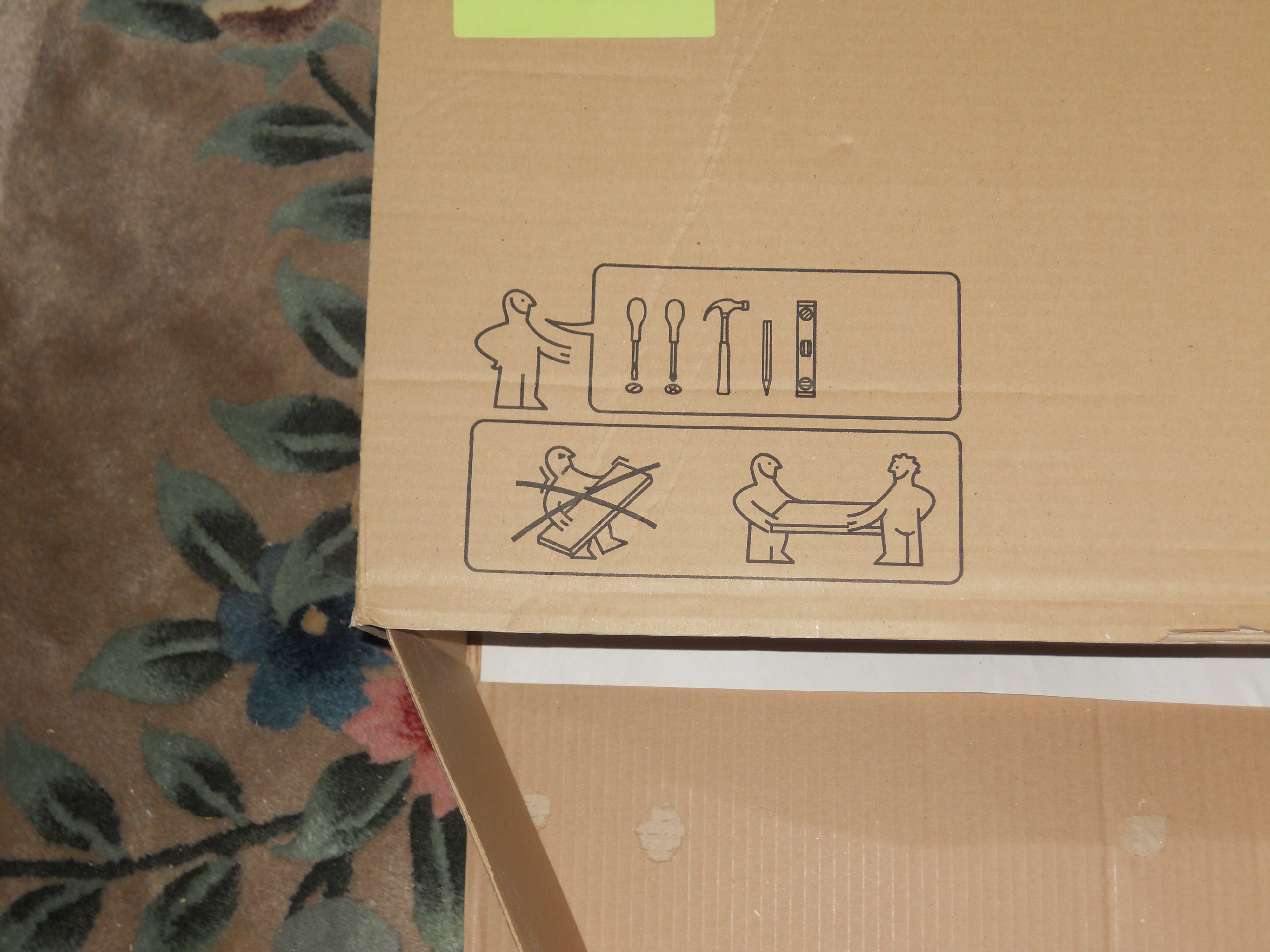
IKEA's Two-Man Hernia Label
This packaging on an IKEA bookcase, clearly identifies this as a two man-hernia job.
Shopping on the Bus
I tend to do one big shop a week early on Tuesday or Wednesday morning, as that means I can enjoy Waitrose in Upper Street, without queuing too long and then walk to an empty 38 or 56 bus to get me home.
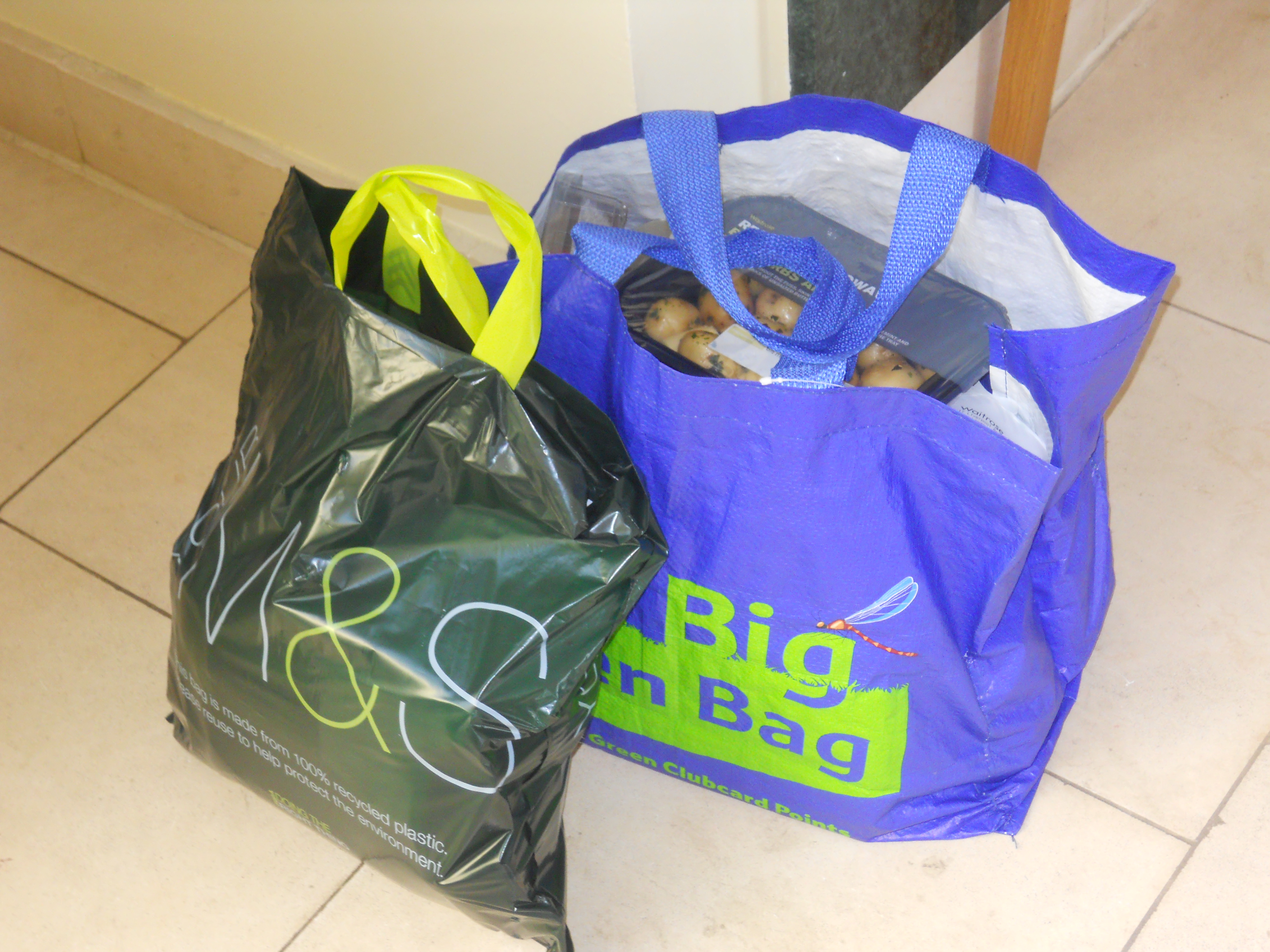
A Week's Shopping
The bags this week weighed 12.1 kilos between them, but as I only have to walk about 200 metres in total and then carry them upstairs, the exercise is probably good for me. I could order on line, but then I like to see what I buy first.
You’ll notice I use a Tesco long-life bag. It’s the easiest to carry, with large comfortable handles.
Rules For Success?
This is the notes and presentation for a talk I will be giving to students in the Engineering Department at Liverpool University on March 17th, 2011.
It is of course, St. Patrick ‘s Day, so in deference to Liverpool’s Irish history, I will endeavour to make this talk, less serious than it could be. After all, being succesful in life and/or business and technology is supposedly a serious business, but you need it to be fun as well. And the Irish and especially Liverpool Irish know about that!
The talk has two objectives.
For you, I’m trying to tell you what a great experience it can be to take the germ of an idea and create and nurture it, like one would a child. And hopefully make you think hard and long about yourself, your ambitions and how to create something that is worthwhile not only to yourself, your family, friends and country, but hopefully to the whole world.
For me, it’s more of ego trip or a voyage of self-rediscovery after suffering a stroke on holiday in Hong Kong. So I’ll perhaps apologise now, not for my brain, as it was always a few pence short of a shilling, but for my hands, my voice and my hearing.
You will notice that I have added a question mark to the title. You can question everything I say as much as you want and that is why it is there. No-one has the monopoly of what is right, least alone me. If I’d listened more to my doctors, I probably wouldn’t have had the second bad stroke.
To start the presentation, just click the link below.
Rules For Success? – About This Presentation
I should also say now, that this presentation is done in a WordPress blog. If that company can run a whole distributed organisation with participants all over the globe using their own product, then surely I can write a simple presentation. If you want to see how they do it, look here.
The reasons for doing it this way, instead of in something like PowerPoint are many and varied.
The first reason is that it’s so easy to create and edit. I could have been actually editing this presentation on the way up from London this morning.
You have no restriction as to content, so you can link to pictures, videos, documents and even program downloads.
Here’s an educational video for an example.
And of course you can access the presentation from anywhere in the world from any device with a web browser!
Rules For Success? – A Quote
I’m going to start with a quote.
The only thing that all successful people share is that they are robust, resilient and resourceful.
It comes from an opinion in The Times of March 2nd, 2011 entitled “We’ve disabled a generation through kindness.” It comes from one of their regular writers, Alice Thomson and she goes on to say how we’ve all been too kind to all our children, by mollycoddling them too much and not letting them use their intelligence.
Just a quick question, but how many of you came up to Liverpool for your first year on public transport with just a very large suitcase?
I’ll just add a bit more about Alice, so you can see where she’s coming from. One of her great great-grandfathers was J.J. Thomson, the discoverer of the electron and a grandfather was William Bragg, who won a Nobel Prize for Physics and headed the Royal Institution. So she has a rather unusual background for a journalist.
So now I’m going to tell you about my group of Electrical Engineering students at Liverpool and what some of us did later.
Rules For Success? – The Class of 1965
I started in this then new building in 1965 and there were just over a hundred of us. We weren’t a morbid lot, but in the first term quite a few had accidents, so we reckoned about one-in-eight of us wouldn’t last the three years.
Perhaps we did things that students don’t do now. One climbed the enormous crane on the Catholic Cathedral, which was being built at the time. Sadly he died in his first year in a mountaineering accident.
One of the students was Robin Saxby, who went on to be the CEO of ARM Holdings. And most of us have a device with one or more of that company’s chips in it.
I’m not sure, I do though, as I don’t use a smart phone, but a Nokia 6310i, which is now eight years old and still on the original battery.
The other you might have heard of was Cedric Sloan, who became the Colonel of the Royal Engineers.
A lot of us are still in contact and we think that on the whole, we didn’t do too badly. But that’s not for us to judge. It’s a question for the future!
Rules For Success? – About Me
I am a typical London mongrel and was born in 1947. I had a very good education at a grammar school, Minchenden, and then here in Liverpool.
But in some ways my parents and relatives taught me a lot more.
My father was a proper letterpress printer and he taught me everything about the industry, from how to design and layout pages and how to set lead type, to how to mend complicated printing machines. I actually think the precision and care needed in the industry in those days, made me into a very pedantic programmer.
My mother was the mathematician in the family and now would have probably gone to University to read that subject. She taught me many skills from mental arithmetic, to cooking and how to knit and repair and make clothes.
Her brother, who himself was no mean artist and engineer, taught me a lot of things. Like how to use machine tools.
I think that they all left me with a deep sense of curiosity and invention, which throughout my life has been the driving force behind everything I’ve done.
My father also taught me one important thing. If you need to perhaps consult an expert or approach someone important to what you want to do, then just do it. If they don’t reply or you can’t get access, then they weren’t the person to help.
In my case, when I was 16, I needed a job for the school holidays and he phoned the boss of his best customer and asked if they had anything for me. I got a job for eight weeks in the electronics laboratory and I can still remember many of the things I did then.
Everything you have ever done is important to being a success and especially a successful entrepreneur.
As a child I spent hours reading encyclopaedias. What do I do now, as I watch television? Check out things I see in Wikipedia and the wider web.
 The Anonymous Widower