The Impressive Coupling And Uncoupling Of Class 395 Trains
Class 395 trains seem to be fairly unique amongst trains running on the UK network, in that they can couple and uncouple automatically.
Under Design in the Wikipedia entry for the seven-year-old Class 395 train, this is said.
Each 6-car unit can work in multiple with another, creating 12-car trains. Coupling is automated and is designed to take less than 60 seconds.
This YouTube video, which is entitled Javelin Coupling, shows two trains coupling automatically.
And this YouTube video is called 395022 and 395009 Divide and Depart at Ashford International.
It is all very impressive.
- This is the gold standard, against which all train couplings and uncouplings should be judged.
- There is no trackside intervention by any staff.
- The trains have been doing this since 2009 in the UK.
I particularly liked how the doors appeared and faired around the coupling, as the first train in the second video drove away.
Now ASLEF Joins In!
I take the headline from this article on Rail News, which is entitled Southern dispute: now ASLEF joins in.
This Southern dispute and the related one in Scotland, appear that they may continue until 2017 at least.
I used to travel up to London in the 1990s with a driver-supervisor on the Central Line. We would discuss various technical subjects and the questions of efficient operation of trains and driver only operation came up.
Nothing he said, ever gave me any hint that driver only operation was anything but totally safe, if you have good communication with those on the platform. In fact, he did give the impression, that when problems did occur, it was because communication between driver and platform staff failed. I can remember him saying that with trainees, he always impressed on them, the dangers of not checking properly before starting when platforms are long and curved, as at Bank.
My view as someone, who has seen a lot of industrial automation at work in factories and industrial plants, is that the safest way to drive a train, is let the computer do the driving and the train driver should monitor what is happening.
Effectively, that is what has happened on the Victoria Line since 1967.
It’s about time that the UK’s trains joined the twentieth century, instead of clinging to the nineteenth.
Crossrail Trains Will Have Auto-Reverse
I am a control engineer and I have worked in industrial automation on and off since I was sixteen, when I had a summer job in the electronics laboratory at Enfield Rolling Mills at Brimsdown.
One of the problems of running a railway to a high frequency, is that when you get to the terminus, the driver has to get off the train, walk to the other end and then step-up into the other cab. So a couple of minutes or so is wasted. On some lines, where drivers change over, there are delays and extra costs. It is one of the reasons, why train lines sometimes have reversing loops, like the Piccadilly Line at Heathrow and the Wirral Line underneath Liverpool.
It is also why, there has been talk of extending the Victoria Line in a large loop to a single platform at a new station under Herne Hill. I wouldn’t be surprised if when they extend the Northern Line Extension to Clapham Junction or the Bakerloo Line to Lewisham, that they use loops with single platform stations. The layout has the following advantages.
- The driver stays in his seat and drives the train normally.
- Stations are more affordable as they only have one platform.
- Passengers always go to the same platform and get the first train.
- It might be possible to dig the reversing loop with a single tunnel boring machine.
It is such a simple concept, I can’t understand why it isn’t used more.
Crossrail has a different problem in that all branches, except Heathrow, end on the surface and the Class 345 trains are two hundred metres long. So running a train every two minutes or so, means that drivers have a lot to do in the turn-round including a 200 metre walk.
The Class 345 trains are designed to incorporate auto-reverse. This extract from this article in Rail Engineer, which is entitled, Signalling Crossrail, explains the concept.
A new facility called ‘auto reverse’ is being provided at Westbourne Park (no station) for turning the 14 trains per hour in the reversing sidings. The driver selects ‘auto reverse’ on leaving Paddington station and walks back through the train, obviating the need for drivers to ‘step-up’. By the time the train gets back to Paddington (about a mile) the driver should be in the other cab ready to form the next eastbound departure.
The facility has the capability to turn round a full 30 tph service. There is just time for the driver to walk back through the train whilst in the reversing siding but doing so on departure at Paddington gives that extra time that will also help recover from perturbation.
Essentially, the driver does his walk whilst the train is travelling to the reversing siding. It must have other advantages.
- The driver can check the train as he walks.
- Cleaners can get on at the actual terminus and then get off again with the usual rubbish.
- Someone who goes to sleep, just gets an extra ride into the reversing siding and out again.
It’s a very simple piece of automation, which as the extract says, enables a full 30 tph service and makes recovery from delays easier.
The only problem, I can see is that the drivers’ unions could insist that a driver is in the cab at all times.
It would appear that the system will be used by Crossrail at Abbey Wood and Paddington.
I also suspect that the driver will have a rudimentary train controller to stop the train in an emergency.
Squeezing Blood Out Of A Stone On The Northern Line
The Northern Line is not the most popular or glamorous line of the London Underground.
It is a line I try to avoid for various reasons.
- It’s often too crowded.
- I have buses, Victoria Line and the London Overground as alternatives. For example, I use Camden Road station instead of Camden Town station and walk.
- In recent months, stations I want to use have been renewing escalators.
- I also want to get to stations, that are on the Charing Cross branch of the line.
I also wonder, if I’m prejudiced against the Northern Line, as I spent so much of my formative years on the Piccadilly Line.
I have just read this article on London Reconnections, which is entitled Twin Peaks: Timetable Changes On The Northern Line.
I have extracted these points from the article.
- Until mid-2014, both central sections and both northern branches of the Northern Line in the peak hours were only able to handle twenty trains per hour (tph). This compares with 30 tph on the Jubilee Line, 33 tph for the Victoria Line and 34 tph for the Central Line.
- In June 2014, with the full introduction of automatic train operation (ATO), this was raised to 22 tph.
- Engineers were working hard to improve the track to allow better speeds and from December 2014, the train frequency in the peak was raised to 24 tph.
- The line is now running at 30 tph between Kennington and Morden.
- The Off Peak service at the start of 2014 was 15-16 tph and it is now 20 tph.
All of this frequency improvement has been attained because they have got ATO working well and they’ve done a good job to allow trains to run faster on much better track.
You could say it’s all down to quality engineering. With probably the input from someone, who understands scheduling.
The article has a section entitled As Good As It Can Get For The Moment?, where this is said.
No doubt the ATO system will continue to be refined but the dramatic time reductions already achieved are unlikely to be improved on much more. Unless more available trains or speed can be coaxed of the existing fleet it is hard to see how the peak timetable can be improved until new trains arrive.
So have we got to the limit of the current lines and the 1995 Stock trains?
If you read the article, you’ll see that Transport for London are talking about peak hour services of 30 tph with new trains after the reworking of track in Summer 2020.
But given the skilful way, the frequency of this line has been ramped up over the last couple of years, I suspect, there’s more blood to come from this particular stone!
The Technology That Enables The Aventra IPEMU
It is worth stating why it looks like the Aventra IPEMU looks so promising.
Steel Wheel On Steel Rail
The dynamics of this are well known and mean the following.
- There is a very low rolling resistance.
- As more weight is applied, the rolling resistance goes down.
- A fully loaded train might use less energy than an empty one.
You can’t ignore the laws of physics.
Aerodynamics
The air resistance of something like a train rises with the square of the speed.
But by careful aerodynamic design, you can reduce this energy loss substantially.
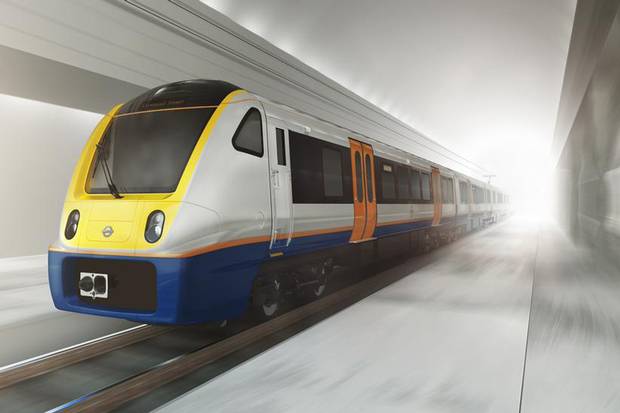
An Artist’s Impression Of A Proposed Aventra
The picture shows the clean lines of an Aventa
FLEXX-Eco Bogies
Boring but the design saves energy.
Low Energy Interiors
Air-conditioning and door and lighting systems have made great strides in recent years on reducing energy consumption.
Improved Energy Storage
The Class 379 Demonstrator used batteries, as nothing else was available. Better technology for this application like large capacitors and flywheels may be better suited to a train.
Because of the steel wheel on steel rail advantage weight is not a problem.
I think in a few years time, trains will use KERS. Like Formula 1, only bigger! It will be more affordable than batteries, as it’s purely electro-mechanical!
Regenerative Braking
Regenerative braking can save large amounts of energy, with Class 390 Pendolinos reportedly saving seventeen percent. But these trains give their generated energy to the overhead lines, whereas an Aventra IPEMU will keep the energy for itself in the storage device, if there is capacity.
From an electrical engineering point of view, I do wonder if energy storage is the best way to handle the electricity generated by regenerative braking, as otherwise it might have to be converted to transmit it back into the overhead wire or third rail.
I can see a time coming, when all electric trains have regenerative braking and energy storage!
Lightweight Construction
This only helps in the acceleration of the train, so it may not be as important as it would seem, because of the steel wheel on steel rail advantage.
Could it be that one of the reasons a High Speed Train rides so well, is that it is built out of steel and is strong and heavy?
Automated Systems
Things like pantograph deployment will be automatic, thus meaning when the train needs to add power and there is an overhead wire, this will be connected to power the train or top up the battery.
Automatic Train Control
But the biggest automation will be in the driving of the train. As on the Victoria Line the driver will tell the train to start and then it will go automatically to the next station. The train will collect information from the timetable, signals, GPS and sensors determining things like weather and passenger load and be driven accordingly.
Planes have been flown like this for many years.
Conclusion
The range of sixty miles quoted for the Demonstrator could be exceeded by a wide margin.
Should I Put A Camera In My Bathroom?
My bath, which is on the ground floor, takes about thirteen minutes to fill and usually I time it by the clock on the BBC Breakfast News.
I’ve had the odd overfilling problem, but normally it’s spot on!
I did think about putting a camera there so I could watch it fill from upstairs, where I normally sit, whilst it was filling.
But such a camera, might make guests think, I had a dark side!
On the other hand, it would certainly make filling a bath easier, but it wouldn’t be as good as the self-filling bath, I proposed earlier.
I wonder whether and if so where I can get an Internet enabled load cell?
It would be wonderful to click a button on my computer screen and then a few minutes later be told that my bath was full.
January 2015 Update – As the television is now working properly and I generally have a bath during BBC Breakfast, I now have a reliable clock in my bathroom.
The Self-Filling Bath
I am refitting my bathroom in the next few weeks, as the current bath is one of Gerry’s El Cheapo specials, which is actually dangerous to get in and out of. It also has taps that work on a hot-one way, cold the other basis. There’s a video here.
I’m fitting a whirlpool bath and whilst talking to the saleslady, I thought it would be nice to have an self-filling option. I was told she’d never seen one. On the other hand you can get taps that set the temperature.
I searched the Internet and haven’t found a system.
I wonder why not! It’s a dream for a farmer, a builder or someone who works outside in the cold, wet and filth. Imagine you’re just coming to the end of a hard working day and are walking home or just about to get in your vehicle to drive there. You bring up an app on your smart phone or send a text from your Nokia 6310i to tell the bath to get itself ready in fifteen minutes say. It then fills itself to your required level and temperature, a couple of minutes before you get home.
The logic for the self filling bath is overwhelming. Even in my situation here, I would love to be able to set it off and then perhaps finish a post on my blog or a bit of cooking, whilst it was filling. After all,most of us just hang around in the bathroom, whilst waiting for the water to get to the required level and temperature.
It’s not that the technology is at all difficult. In my view, you wouldn’t actually measure the depth of water directly, but probably by weighing the bath with a simple load cell.
It’s just straightforward automation, that’s been around for years.
What I can’t understand, is why it is not commonplace? But then there are other simple pieces of automation that aren’t either.
 The Anonymous Widower