Solar Farms And Biodiversity
The title of this post, is the same as that of this article on Solar Power Portal.
This is the sub-heading.
A number of academics around the UK are researching the impact of solar farms on biodiversity, and major studies have all drawn the same conclusion: when well-managed, solar farms are not harmful to biodiversity and can actively support the growth of nature in an area.
Research at the Universities of Cambridge, Exeter, Keele and Lancaster is covered in the article.
This is the second post, I’ve written with the same title of Solar Farms And Biodiversity. in the other post, I talk about hares, which were not talked about in today’s post.
On this page on the lightsource bp web site, this is said about brown hares at Wilburton Solar Farm.
According to the Hare Preservation Trust, the population of the Brown Hare in the UK has declined by more than 80% over the last 100 years, and in some areas may even be locally extinct. But at Wilburton Solar Farm, the Brown Hare is thriving. Before the installation of the solar farm, the local gamekeeper had only observed three or four Brown Hares on site, but since the solar farm has been established, he has regularly seen more than 50.
From my observations of hares over the years, I suspect that solar farms could be an ideal habitat for hares.
Exagen Given Green light for new 500MW / 1GWh Battery Storage Project In Leicestershire
The title of this post is the same as that of this article on PV Magazine.
This is the outline of the project, which will be called the Normanton Energy Reserve.
The new 500MW / 1GWh battery site will be capable of powering 235,000 homes for two hours, equivalent to 80% of the homes in Leicestershire.
Approximately 45% of the 19-acre site will be set aside to improve biodiversity by extending Normanton Millennium Wood and creating wildflower meadows. The project will deliver more than 25% biodiversity net gain.
Exagen will establish a circa £4M community fund to spend on improvements in the local area, with residents consulted on how the fund is used.
Note.
- A 500MW / 1GWh battery is not small.
- The size probably makes it a good backup for Leicestershire.
- Nineteen acres is a 277 metre square.
- Any biodiversity net gain is worthwhile.
- A £4M community fund is not to be sneezed at.
It all sounds very good.
Normanton Wood has a web site, where this is said on the home page.
Normanton Wood is one of The Woodland Trust’s ‘Woods on Your Doorstep’ woodlands created to commemorate the Millennium. It lies near Earl Shilton Leicestershire and was planted by members of the local community.
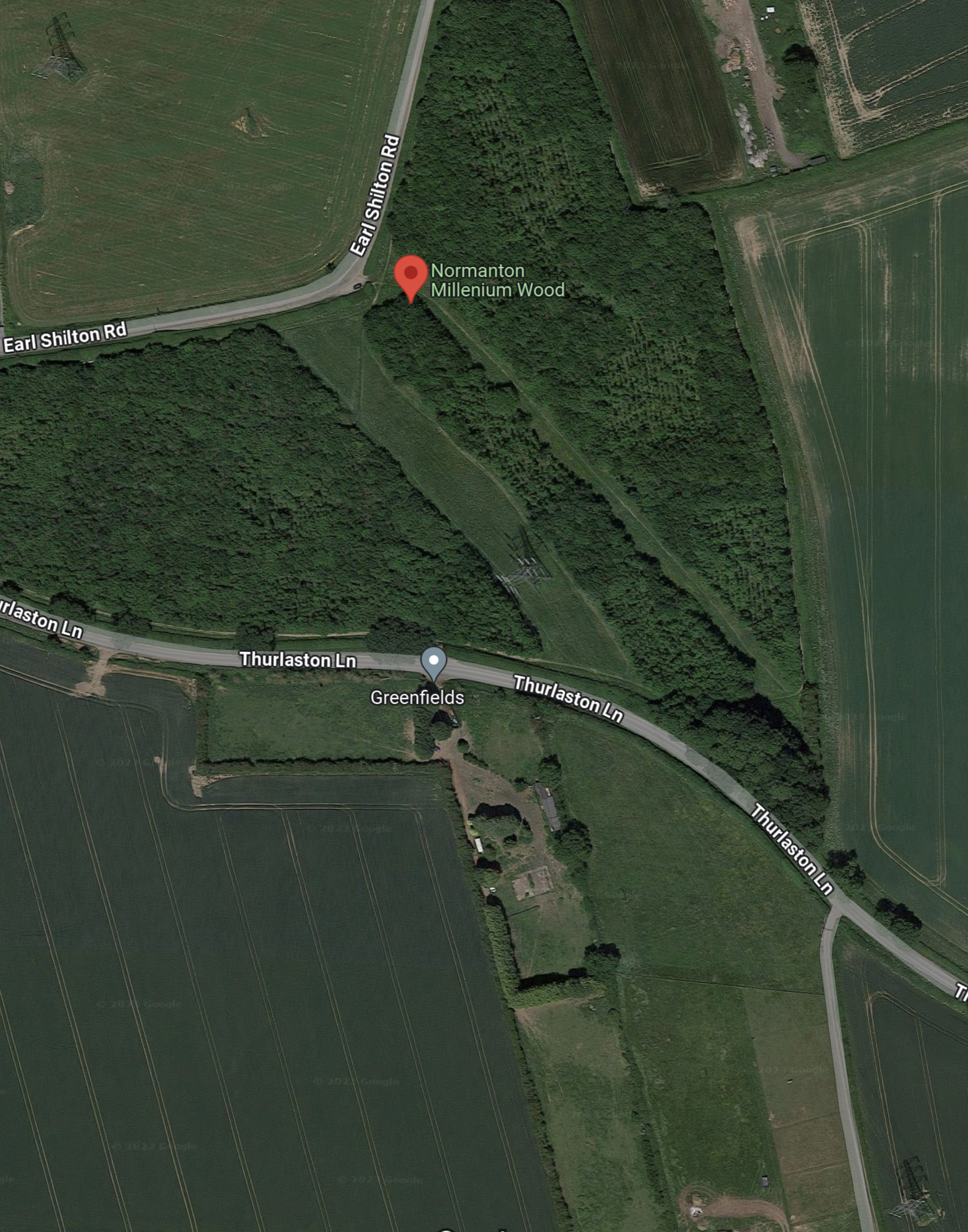
This Google map shows the wood.
Note.
- The red arrow indicates Normanton Millennium Wood.
- I suspect that cleared space in the woodland leading South-East from the red arrow is about 300 metres long and 15 metres wide, which is about 1.1 acres
- As Normanton Millennium Wood is 16.75 acres, I suspect it includes all the woodland to the East of the red arrow, up to the cultivated farmland.
- If you look carefully, you can see a large electricity pylon in the wider cleared area, to the South of the red arrow.
- When I created this map, I clipped it so that the next pylons to the North-West and South-East were in the respective corners of the map.
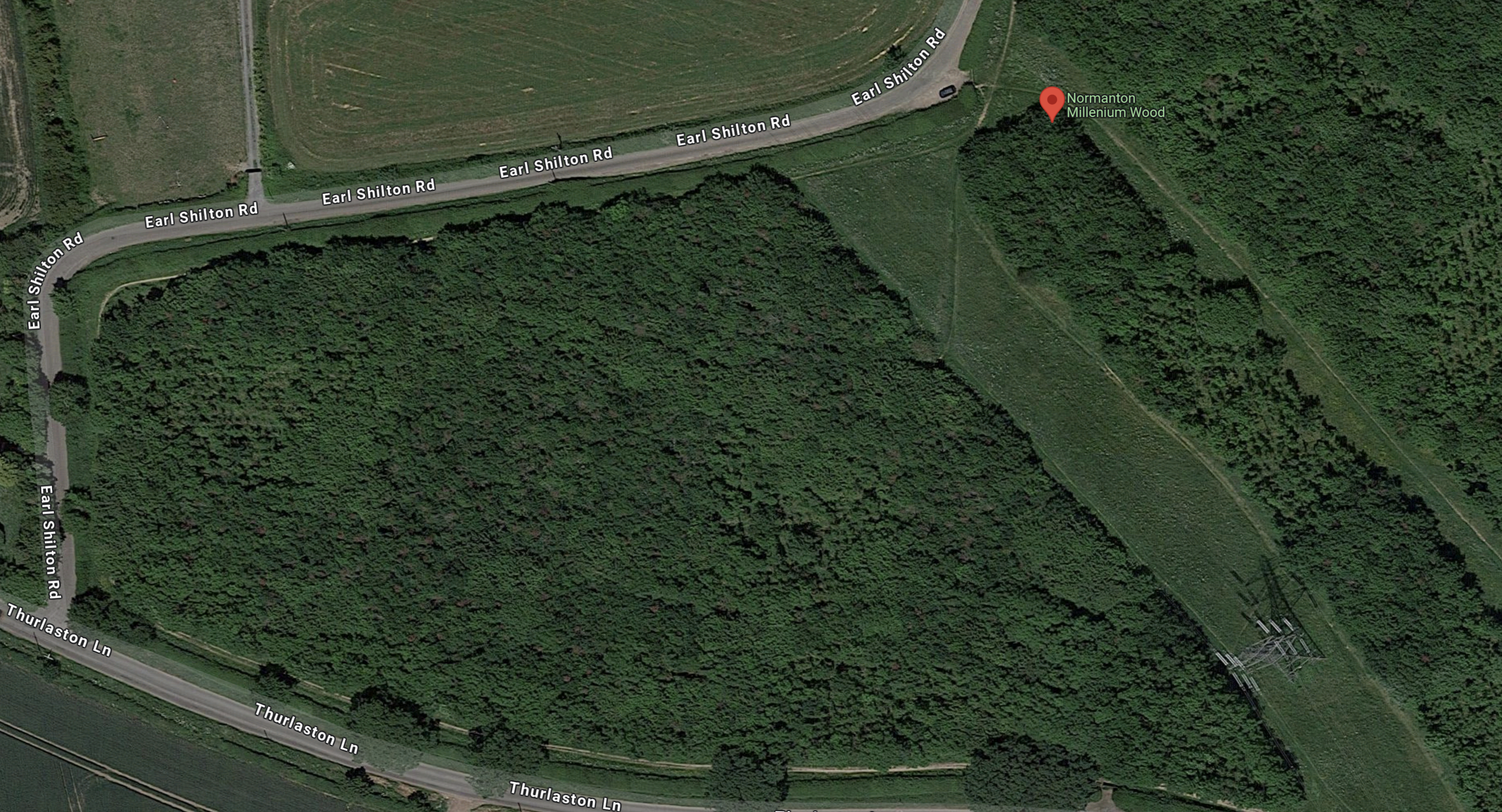
This second map shows the land to the West of the red arrow, which is enclosed by the roads.
Note.
- As before the red arrow indicates Normanton Millennium Wood.
- The electricity pylon is clearly visible on the cleared strip.
- The land to the East of the cleared strip looks like its been planted with trees in the last decade or so.
- The land to the West of the cleared strip looks more like scrub, that has grown up after years of neglect.
- I estimate that the area of the cleared strip and the scrub, is around nineteen acres.
- This news story from Exagen, is entitled Woodland Planting At Normanton Energy Reserve – Becca Leake is a must-read as it outlines how woodland will be planted at the site.
As there is no local substation, it looks to me, that a new substation will be built close to the electricity pylon, with the battery to its West.
Conclusion
It seems a good design for a large battery site, which will be shielded from neighbours by a large area of woodland.
I am also sure, that this battery and the one talked about in New Octopus Energy Makes First Investment To Develop UK’s Largest Battery, are the same battery.
All the numbers in both articles are identical.
Fugro To Monitor Offshore Wind Biodiversity By Using eDNA Samples
The title of this post, is the same as that of this article on offshoreWIND.biz.
This is the sub-heading.
Dutch geo-data specialist company Fugro has launched the BeWild project, aimed at measuring biodiversity at offshore wind farms.
I have a feeling that this fishing-for-DNA technique could have lots of uses, including some very unusual ones.
The article is worth a detailed read and Fugro and their partners certainly seem to be doing a full investigation.
These three paragraphs list the partners and the things they will provide or research.
Support will be provided by Wageningen University which will focus on the DNA sequencing methodology of marine eDNA, researching the governance of these new forms of automated data collection to provide guidance on the design principles for the expansion of nature-inclusive wind energy infrastructures.
Additionally, Stichting de Rijke Noordzee will explore how to integrate biodiversity monitoring with regular asset inspection; Mecal – ATS will develop an improved scour protection system with the potential to enhance biodiversity; Seekable will optimise cable burial monitoring solution; and CrossWind will provide access to an operational wind farm for testing and investigations.
The BeWild project is being developed with the Mission-driven Research, Development, and Innovation (MOOI) subsidy from the Ministry of Economic Affairs and Climate, and implemented by the Netherlands Enterprise Agency (RVO).
It certainly appears very comprehensive.
Solar Farms And Biodiversity
I have an old farmer friend, who told me this tale.
His neighbour put up a few acres of solar panels on a field, that adjoins one of his fields, where it generally grows cereal crops.
He told me that he felt he was seeing more hares on his land and wrote to me asking if it could be the solar panels.
I searched the Internet and couldn’t find anything at the time.
But, it should be remembered, that hares have an unusual way of bringing up their leverets, where the mothers generally abandon them during the day and feed them in the evening.
We did wonder, if the solar panels offered protection to the leverets from aerial predators. And the mothers were learning that solar panels were a safer place.
This morning someone made a comment about solar panels on a page in The Times and I searched again.
I found this article on the Solar Power Portal, which is entitled Solar Farms And Biodiversity and thoroughly read it.
It doesn’t say much about hares, but it puts a strong case, that solar panels can increase biodiversity.
 The Anonymous Widower