Crossrails For The North
Regularly there are references in the media for Crossrail for the North.
This article in Rochdale Online is entitled Andy Burham calls for ‘Crossrail for North’
Note that the misspelling of Andy Burnham; the Mayor of Manchester’s name is from the web site.
Andy Burnham and many others have a point that West-East connections across the North are not good, but it is not that simple.
Hence the reason, I’ve called this post Crossrails For The North and not Crossrail For The North.
Northern And London Crossrails Compared
If you look at Greater London, the distance between Reading and Shenfield stations, which are two of the termini of London’s Crossrail, is about eighty miles and when Crossrail opens a train will take about one hour forty minutes.
By comparison, Liverpool to Leeds is just over seventy miles and the current fastest trains take ninety minutes with two stops at Manchester Victoria and Huddersfield stations.
Those that live East of Leeds, keep reading.
The differences between the two routes, when Crossrail opens will be mainly down to the number of stops, frequency and connectivity.
- The Northern Route is shorter and hence marginally faster.
- The London route has more stops.
- The London route has a higher frequency.
- The London route is electrified.
- The London route will be served by specially-designed Class 345 trains.
But possibly most importantly, the London route connects to a large number of North-South cross-city railways.
It is sensible to think of London’s Crossrail as a loose ball of chunky knitting wool with a big fat needle stuck through it.
The ball of knitting wool is Central London with all its Underground and Overground Lines.
- Bakerloo Line – North-West – South-East through City Centre
- Central Line – West-East through City Centre
- District Line – West-East through City Centre
- East London Line – North-South to East of City Centre
- Gospel Oak to Barking Line – West – East to North of City Centre
- Hammersmith and City Line – West – East through City Centre
- Jubilee Line – North-East through City Centre
- Metropolitan Line – West – East through City Centre
- Northern Line – North-South through City Centre
- Northern City Line – North from the City Centre.
- North London Line – West – East to North of City Centre
- Piccadilly Line – North – West through City Centre
- Thameslink – North – South through City Centre
- Victoria Line – North-East – South-West through City Centre
- Waterloo and City Line – South from the Centre Centre
- West London Line – North-South to West of City Centre
Crossrail is the big fat needle struck right through the middle.
You could actually argue that not just one big fat needle is through the middle, as Crossrail is paralleled by some of London’s historic Underground Lines.
- The Central Line connects at Stratford, Liverpool Street, Tottenham Court Road, Bond Street and Ealing Broadway stations.
- The District Line connects at Whitechapel and Ealing Broadway stations.
- The Metropolitan Line connects at Whitechapel, Farringdon and Paddington stations.
- In the future, the North London Line will connect at Stratford and the new Old Oak Common station.
Crossrail is going to be a massive playground for the duckers-and-divers, as they search for the fastest route.
How London Crossrail Will Develop
London Crossrail is not a complete system, with certain connections not of the best.
- Eurostar from St. Psncras International
- HighSpeed services from Stratford International
- HS2
- Piccadilly Line
- Scottish and Northern services from Euston and Kings Cross
- Victoria Line
Several of these connections can be addressed by smaller projects like the necessary rebuilding of tube stations like Bank, Charing Cross, Euston and Oxford Circus.
A lot of London politicians are pushing for Crossrail 2 , but London will be given a big increase in capacity with Crossrail and I think there is an opportunity to redefine the scope of the later project, in the light of what happens after Crossrail opens.
Consider the following, which will happen after Crossrail opens.
- Huge pedestrianisation will happen in the City of London and the West End.
- Hopefully, walking in large parts of Central London will improve to the standard of the bus- and car-free Central Liverpool.
- On foot interchanges like Oxford Circus-Bond Street and Bank-Liverpool Street will be easier and quicker than now.
- The long-neglected and ill-fated Northern City Line is getting new trains, higher frequencies and hopefully a deep-clean of the stations.
- Liverpool Street and Moorgate stations will effectively become one station with world class connectivity.
- The Waterloo and City Line will be improved and probably go 24/7!
- Waterloo station will get a forty percent capacity increase this summer.
- The Northern Line Extension to Battersea will open in 2020.
- New trains will have been delivered for London Overground’s Liverpool Street and Gospel Oak to Barking services.
Londoners will fully exploit the network and importantly Transport for London will have detailed information from the ticketing system on the routes taken and the bottlenecks as they develop.
Access For All
Access for All is a National programme, that is making stations all over the country accessible to as many passengers as possible.
Check the list of stations being updated under Access For All
After the General Election, I would not be surprised to see funding for this programme increased all over the country, as it is both necessary and a quick way to attract more passengers to the railways.
New Stations
Since 2000, seventy-four new stations have opened or reopened.
I can rarely remember stations reopening last century, but the 4-5 new stations every year since the turn of the Millennium, seems to have continued this year with the opening of Cambridge North, Ilkeston and Low Moor
The New Franchises
Five franchises have been awarded lately.
- Greater Anglia
- Northern
- ScotRail
- South Western Trains
- TransPennine
A feature of all these franchises is that the operators are introducing a lot of new trains and substantially refurbishing others.
Will this trend continue?
Obviously, the operators have done their sums and find that new trains attract more passengers.
There is a major problem with new trains, in that capacity to build them must be getting very short. I also don’t think that Chinese trains will be welcomed.
If I was Prime Minister, I’d make sure there was enough capacity to build and refurbish trains in the United Kingdom.
Building Crossrail 2
There is no doubt that at some time in the future, Crossrail 2 will be built.
But unlike Crossrail, which is a massive project similar in size to the Channel Tunnel,, the electrification of the Great Western Railway or HS2, it is a collection of smaller projects that can be phased over the years, with each phase giving substantial benefits to London, train companies and passengers, be they Londoners, commuters, visitors or tourists.
I would build it in the following sequence of sub-projects.
- Four-Tracking Of The West Anglia Main Line – Extra capacity on the West Anglia Main Line is needed for both improved London-Stansted-Cambridge services and Crossrail 2.
- New High-Capacity Crossrail-Compatible Trains North of London – Greater Anglia and London Overground have already ordered these trains to replace the current thirty-year-old trains.
- Station Improvements North of London – Improvement are much needed and are already planned and underway at Tottenham Hale and Meridian Water.
- Improve Connection To Sub-Surface Lines At St. Pancras Station – The current connectivity is terrible between these lines and Thameslink and the HighSpeed lines to Kent.
- Connect Euston Square Tube Station To Euston Station To Give Extra Capacity During Euston Rebuilding For HS2
- Introduction Of A New Stratford-Tottenham Hale-Angel Road Service – The delivery date for STAR is 2019.
- Introduction Of Chingford-Walthamstow-Stratford Services – This would improve access to Crossrail and take pressure from the Victoria Line.
- New Stansted And Cambridge Services From Stratford – Greater Anglia have suggested this and there’s even an unused loop at Stratford, that could be used to turn trains and allow them to call at Stratford International for Eurostar to the Continent and HighSpeed services to Kent.
- More Terminal Capacity for Trains From North of London – The Stratford loop would increase the terminal capacity for Greater Anglia and also give access to the Jubilee Line for London Bridge, Waterloo and Westminster.
- Use Improved Capacity At Waterloo To Increase Services On Proposed Crossrail 2 Southern Branches – The extra capacity should help.
- New High-Capacity Crossrail-Compatible Trains South of London – South Western Trains have indicated this will happen.
- Station Improvements South of London – Improvements are much needed.
- Rebuild Euston Tube Station In Cnjunction With HS2 –
Only when these phases are completed, would the central tunnel be bored.
This step-by-step approach has several advantages.
- The pace of the project can be geared to the finance and resources available.
- Some developments can have a significant local design and scope input.
- Much needed stations can be built early to generate passengers and cash flow.
- Trains can be follow-on orders to Crossrail.
- The suburban sections of the route will always be available for passenger traffic.
When Crossrail 2 is complete, the second big fat knitting needle has been stuck in the ball of wool.
What Can The North Learn From London?
I would argue that one of the keys to London’s success over the years has been its comprehensive multi-layered public transport system.
- Crossrail, Crossrail 2, Thameslink and the Overground could be considered the top layer.
- The Underground, the Docklands Light Railway and the suburban electric trains are the middle layer.
- Buses form the local and bottom layer.
Underneath a walking and cycling layer is emerging.
The North of England can be considered a series of local transport networks, which are connected by a series of major lines, which are equivalent to London’s Crossrail, Crossrail 2 etc.
Northern Connect
I find it interesting that Northern are introducing a Northern Connect service, which Wikipedia describes as follows.
From December 2019, Northern will operate a network of twelve Northern Connect interurban express services. Eleven of these will be operated by brand-new Class 195 diesel multiple units and Class 331 electric multiple units, whilst the Middlesbrough to Carlisle via Newcastle route will be operated by refurbished Class 158 units.
Places that will be served by Northern Connect routes include Bradford, Chester, Halifax, Leeds, Liverpool, Manchester, Middlesbrough, Nottingham, Newcastle, Preston, Sheffield, Barnsley, Lincoln, Wakefield and York.
Local Networks In The North
Some of the local Northern networks in places like Leeds, Liverpool, Manchester, Newcastle, Nottingham and Sheffield are certainly better than others.
It could also be argued that the six cities I named, are among the most successful and vibrant cities of the North.
I feel that for the railways to be successful in the North and for some cities to have a major improvement in prosperity, that some of the local networks need substantial improvement.
TransPennine And Feeder Routes
The starting point is to detail the Northern Connect and TransPennine Express services in the North.
The Northern Connect services given in the January 2016 Edition of Modern Railways are as follows.
- Middlesbrough to Newcastle
- Newcastle to Carlisle
- Hull to Sheffield
- Nottingham to Bradford via Leeds
- Lincoln to Leeds via Sheffield and Barnsley
- Liverpool to Manchester Airport via Warrington
- Chester to Leeds via Warrington, Manchester Victoria and the Calder Valley
- Blackpool North to York via Preston and Leeds
- Barrow to Manchester Airport
- Bradford to Manchester Airport via the Calder Valley.
- Blackpool to Manchester Airport
- Windermere to Manchester Airport
I suspect plans have changed since January 2016, but the possible routes are a good start.
According to Wikipedia, TransPennine routes are as follows.
- Liverpool Lime Street to Newcastle via Manchester Victoria, Huddersfield, Leeds and York
- Manchester Airport to Middlesbrough via Manchester Piccadilly, Huddersfield, Leeds and York
- Manchester Airport to York via Manchester Piccadilly, Huddersfield and Leeds
- Liverpool Lime Street to Scarborough via Manchester Piccadilly, Huddersfield, Dewsbury, Leeds and York
- Manchester Piccadilly to Hull via Huddersfield, Dewsbury, Leeds and Selby
- Manchester Airport to Cleethorpes via Manchester Piccadilly, Stockport, Sheffield, Meadowhall and Doncaster
- Manchester Airport to Edinburgh Waverley/Glasgow Central via Manchester Piccadilly
These routes will change in the next year, when the Ordsall Chord opens.
The opening of the chord, may mean that certain services to Manchester Airport, will not need to reverse at Manchester Piccadilly.
Summarising the East-West routes across the Pennines gives.
- Newcastle to Carlisle
- Manchester Victoria to Leeds via the Calder Valley Line
- Manchester Victoria to Leeds via Huddersfield
- Blackpool North to Leeds via Preston and the Calder Valley Line
- Manchester Piccadilly to Doncaster via the Hope Valley Line and Sheffield
None of these lines are fully electrified.
They are also connected to their ultimate destinations by feeder lines.
- Liverpool to Manchester Airport via Warrington
- Chester to Manchester Victoria via Warrington
- Liverpool to Manchester Victoria
- Leeds to Newcastle via York
- York to Middlesbrough
- York to Scarborough
- Leeds to Hull
Only the following lines will be fully electrified by December 2017.
- Liverpool to Manchester Victoria
- The West Coast Main Line
- The East Coast Main Line
- Some Suburban Routes in Blackpool, Liverpool, Manchester and Preston
- Some Suburban Routes in Bradford and Leeds
Most of the routes will have to be run by diesel or bi-mode trains.
The Crossrails For The North
There are five East-West routes across the Pennines used by Northern Connect and TransPennine Express.
- Newcastle to Carlisle
- Manchester Victoria to Leeds via the Calder Valley Line
- Manchester Victoria to Leeds via Huddersfield
- Blackpool North to Leeds via Preston and the Calder Valley Line
- Manchester Piccadilly to Doncaster via the Hope Valley Line and Sheffield
To these I would add two extra lines.
- Leeds to Carlisle via Settle
- Preston to Leeds via Burnley, Colne and Skipton.
Note
- I have added the Settle-Carlisle Line, as it is world-renowned, is in excellent condition and if provided with a decent train service, could be a major attraction, that would bring tourists to the area.
- The Skipton to Colne Line should be reinstated, to create a direct connection between the electrified local networks servingLeeds/Bradford and Liverpool/Manchester/Preston.
But there would be seven magnificent routes across the Pennines, which could be updated to the following objectives.
- Frequent trains on all lines with at least two trains per hour (tph)
- 100 mph running where possible.
- As high a frequency as possible on the core section between Manchester Victoria and Leeds. Plans exist for six tph, which is a good start.
- In the East trains would fan out to Cleethorpes, Grimsby, Hull, Newcastle and Scarborough, as they do now.
- In the West trains would fan out to Blackpool, Chester, Crewe and Liverpool.
- Lots of cross-platform connections at stations like Leeds, Liverpool, Manchester Victoria, Newcastle, Preston and York with long distance North-South services to London and the South and Scotland.
- All stations would be step-free with lifts or ramps.
In addition provision should be made early to make sure that there are good connections to HS2.
Electrification
Obviously, electrification would be an ultimate goal on all these East-West routes.
But there are various problems with the electrification of the Peenine sections of the routes.
- These lines have large numbers of low bridges and high viaducts.
- Electrification would need to be robust because of the weather.
- Electrification gantries might not fit well in the scenery.
- Installation and servicing of overhead electrification may not be an easy process.
On the other hand, the noise of diesel trains might not be welcomed.
However, I believe that in the next ten years much quieter self-powered trains will be commonplace.
At the present time, if diesel or bi-mode trains are acceptable, then they should be used to provide a service.
Looking at the various feeder routes to the East and West of the Pennine sections, it is a different matter.
- Routes are less challenging.
- There are fewer bridges and viaducts.
- Installation and servicing of overhead electrification would be easier.
There is already a lot of electrification at the East and West, which could be extended to places like Chester, Hull and Middlesbrough.
A Pennine core without difficult electrification, between electrified feeder routes may be the most efficient way to run the routes using bi-mode trains.
It might be sensible to use Class 88 bi-mode locomotives instead of the currently proposed Class 68 locomotives with rakes of coaches, as is planned by TransPennine Express.
A Hull to Liverpool service would run under the following power.
- Hull to Bradford via Leeds – Electricity
- Bradford to Stalybridge- Diesel
- Stalybridge to Liverpool via Manchester Victoria – Electricity.
Around thirty miles would be on diesel and the difficult electrification in the Pennines would be avoided.
Infrastructure
This table is a brief summary of the routes.
- Newcastle to Carlisle – Double track, 18 stations
- Manchester Victoria to Leeds via the Calder Valley Line – Double track – 17 stations
- Manchester Victoria to Leeds via Huddersfield – Double track – 14 stations
- Blackpool North to Leeds via Preston and the Calder Valley Line – Double track – 14 stations
- Manchester Piccadilly to Doncaster via the Hope Valley Line and Sheffield – Double track – 18 stations
- Leeds to Carlisle via Settle – Double track – 10 stations
- Preston to Leeds via Burnley, Colne and Skipton – Part Single track
Note.
- Most routes are double track, which aids train scheduling.
- All except Skipton to Colne seem to be in good condition.
- I can’t find much information about speed limits.
I think it is true to say, that none of the routes could be a high speed line, although a large proportion could have substantial speed increases.
From what I have seen in East Anglia, I suspect most routes could be upgraded to 100 mph, which with the train frequencies of say four tph could give a substantial increase in service quality.
Stations
Many of the secondary stations on these routes are not blessed with facilities like ticket machines, lifts and step-free access.
If I compare, what I see on the web, with what I have experienced in East Anglia, the quality of the smaller stations is not good.
Services
The services along the lines are not of a high frequency or of a high speed, but Northern and TransPennine Express intend to increase frequencies and speed.
The new trains with their faster stops will help.
This is said about the Future Services of TransPennine Express on Wikipedia.
A twice-hourly service between Manchester and Newcastle will be phased in between December 2016 and December 2017, made up of the existing service from Liverpool and a reinstated service from Manchester Airport. Trains between Liverpool and Newcastle will be extended to Edinburgh via the East Coast Main Line, giving a twice-hourly service between Leeds and Edinburgh together with an hourly CrossCountry service. Trains between Liverpool and Scarborough will be rerouted via Manchester Victoria and Newton-le-Willows to provide a half-hourly fast service between Liverpool and Manchester. It is also planned to operate a six train per hour frequency between Manchester and Leeds, up from five today.
I can’t find anything about timings.
A High Speed Line
Building a new high speed line will be difficult, expensive and may take years, as there will probably be a need for a costly tunnel through solid rock between Manchester and Leeds.
So a prudent Project Management strategy could be phased in the same way I proposed for London’s Crossrail 2.
- Increase Line Speed – This would probably give the largest benefit, as it would enable more and faster trains.
- Electrify From Leeds To York – This would enable TransPennine’s Class 802 trains between Liverpool/Manchester Airport and Newcastle/Edinburgh to run more efficiently.
- Electrify From Liverpool To Manchester Airport Via Warrington – This would tidy up electrification between Liverpool and Manchester.
- Electrify To Chester From Crewe and Warrington – This would link North Wales to the TransPennine routes.
- Electrify From Leeds To Hull – This would be a comparatively easy electrification.
- Create The Skipton To Colne Link – This would link the two Norhern suburban electric networks and become a valuable transport asset for both local residents and visitors.
- Improve Stations – Better facilities and atep-free access is desperately needed. Especially at secondary stations.
- Improve Local Networks In Selected Cities – Some are much better than others.
- Increase Train Frequencies – Run at least two tph on all routes.
Hopefully, a decent service can be provided, until a new high speed route can be built.
One great advantage that this project has compared say to the electrification of the Great Western Railway, is that because there are several current routes, if one needs to be closed for a short time, there is a suitable alternative.
The Future Of The Calder Valley Line
On Saturday and Sunday, I did four trips on the Calder Valley Line
- From Leeds to Burnley Manchester Road
- From Burnley Manchester Road to Manchester Victoria
- From Manchester Victoria to Hebden Bridge
- From Hebden Bridge To Leeds
The pictures aren’t as comprehensive, as I would like, but at times the rain was very heavy.
The Route And Trains
This diagram clipped from Wikipedia, shows the route of the Calder Valley Line.
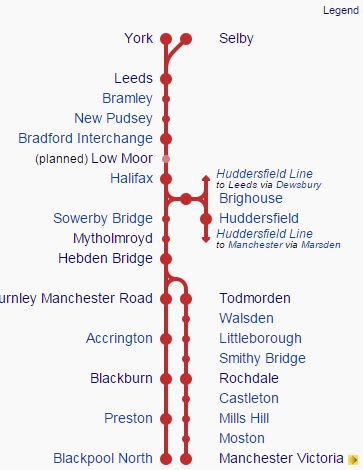
Calder Valley Line
Note.
- Since the opening of the five hundred metre long Todmorden Curve last year, there is now a direct hourly service between Blackburn and Manchester Victoria via Accrington, Burnley Manchester Road and Todmorden. I used this valuable new service on Sunday.
- Brighouse station reopened in 2000 on a link between the Calder Valley Line and the Huddersfield Line.
- The Huddersfield Line is being electrified.
- Low Moor station is being built and should open next year.
There is not much electrification.
- Leeds to York is either electrified or will be in conjunction with the Huddersfield Line electrification.
- Other routes between Leeds and the other Bradford station; Forster Square are electrified.
- Manchester Victoria station is electrified.
- Preston station is electrified and hopefully will be electrified to Blackpool North station.
The trains are a mixture of diesel Class 150 and Class 158 trains, run by Northern Rail. The Class 150s are a bit small and uncomfortable for the route and the top speeds of 75 mp for the Class 150s and 90 mph for the Class 158s, are probably not fast enough, especially as the two ends of the line have higher speed limits.
The Future
Wikipedia has a section on the Future of the Calder Valley Line. This is said.
Improvements to the line are proposed as part of Network Rail’s Northern Hub plans, which would allow for more frequent services on the line. Some services via Bradford would also be extended to Chester,Crewe, Liverpool and Manchester Airport. The Chester & Liverpool services have since been incorporated into the new Northern Rail franchise agreement – awarded to Arriva Rail North in December 2015 and due to start in April 2016, these will be marketed under the “Northern Connect” brand and operated by new 100mph DMUs once delivered. The Manchester Airport trains will follow one the Ordsall Curve is completed in 2018.
Low Moor station, between Bradford Interchange and Halifax, is due to be re-opened in 2016. A business case is being developed to re-open Elland station between Halifax and Brighouse.
There is no mention of electrification, for which the earliest dates are quoted as somewhere in the period from 2019-2024.
But there is this article is on the Shields Gazette web site, with a title of Electrification of the Calder Valley is ‘top priority’ says Rail Minister.
This article is backed up by other statements, so Network Rail and the Government are thinking seriously about electrification of the Calder Valley Line.
Network development and/or electrification is happening at both ends of the Calder Valley Line and I’ll look at both.
Network Development in Leeds and Bradford
The West Yorkshire Metro has proposed electrification of the Harrogate Line and have performed an extensive new station study.
They have already opened Apperley Bridge station and Kirkstall Forge station will follow in a few weeks.
The new stations survey mentions these new stations.
- East Leeds Parkway – This will be a Parkway station on the Selby Line and will also be a terminus for services from the West, that now terminate in Leeds.
- Elland – This will be between Halifax and Brighouse.
- Haxby – This will be on the York to Scarborough Line
- Crosshills – This will be on the Airedale Line
As I said earlier Low Moor station is being built. It will be on the unelectrified line between Bradford Interchange and Halifax. If Elland station is reopened, then it will be the other side of Halifax towards Brighouse. To serve both these new stations trains will have to serve the following stations.
- Bradford Interchange
- Low Moor
- Halifax
- Elland
- Brighouse
- Huddersfield
This is a modification to the current hourly service from Bradford Interchange to Huddersfield via Brighouse.
In the next few years hopefully, Huddersfield will be electrified, but there is no chance that this route into Bradford Interchange will be electrified at the same time. It would probably be pointless, as Bradford Interchange station, unlike Bradford Forster Square station is not electrified.
To make matters a lot more complicated, the stupid fact that Bradford has two entirely separate stations, means the following.
- There is no train, that calls at both Leeds and Bradford and goes on to Huddersfield and Manchester.
- There is no train, that calls at both Leeds and Bradford and goes on to Halifax and Hebden Bridge.
- There will be no direct train between Leeds and Low Moor.
I think other journeys of less than twenty or thirty miles in the Leeds-Bradford area will probably be either impossible or much more complicated than they should be.
Also, at the moment, two of the Leeds-Bradford routes are electrified and the Calder Valley Line is not.
The only new electrification in the area planned, will be the fast route on the Huddersfield Line from Leeds to Huddersfield via Dewsbury.
To help in comprehension, this is a Google Map, showing how the Calder Valley Line links into Bradford Interchange.
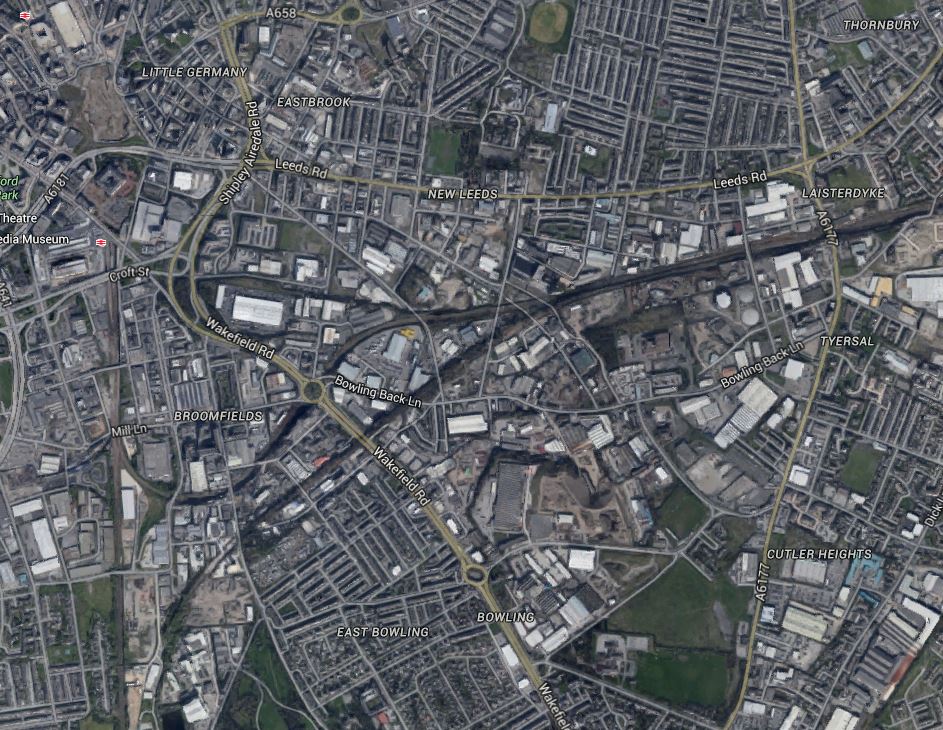
Bradford And The Calder Valley Line
Bradford Forster Square Station is in the North-East corner of the map, with Bradford Interchange below it.
Note how the Calder Valley Line comes in from Leeds in the east, before doing a turn to the north and Bradford Interchange station. After reversing in the station, trains leave the station in a southerly direction towards the new Low Moor station and onto the West. Because of the dark scar below the line, I wonder if in the past, there has been a connection by-passing the station.
It’s a mess!
The solution needs to be four-fold.
- Electrify Leeds to Huddersfield via Dewsbury. This is being done.
- Electrify the Calder Valley Line from Leeds through Bradford and Low Moor as far as Halifax.
- Electrify the link between the Calder Valley Line and the Huddersfield Line through Brighouse.
- Sort out the absurd situation of the two Bradford stations.
This would enable the West Yorkshire Metro to expand its network of electric trains in the area. It could even use IPEMUs, which would charge their batteries on the electrified core network and then provide services to other towns and cities.
- Scarborough via York and Haxby
- Hull
- Sheffield via Doncaster
- Ripon via Harrogate – I wrote about this in North Yorkshire Proposes Rail Expansion
- Colne via Skipton and a new section of track. – I wrote about this in The Todmorden Curve Has Helped A Campaign For More
I’m sure that the West Yorkshire Metro can be ambitious and will have other and better ideas.
Network Development in Lancashire
Currently, there is a lot happening at the other end of the Calder Valley Line.
- The Todmorden Curve has opened and a new hourly service runs between Blackburn and Manchester Victoria.
- Manchester Victoria station is becoming a top class station and an electrified hub for services spreading out from Manchester.
- Manchester Victoria to Liverpool Lime Street is now electrified.
- Manchester Victoria to Blackpool North via Bolton and Preston is being fully electrified.
- The Ordsall Curve is finally being built to link Manchester Piccadilly and Victoria stations.
- Merseyrail is acquiring a new fleet of trains, which may include IPEMUs.
With the devolution of local rail services to local bodies, I suspect other things will happen.
Northern Connect
Northern Connect is a new sub-brand that will be introduced by Arriva Rail North.
Services in the sub-brand using the Calder Valley Line include.
- Chester to Leeds via Warrington, Manchester Victoria and the Calder Valley
- Blackpool North to York via Preston and Leeds
- Bradford to Manchester Airport via the Calder Valley.
Will the first two services call at Bradford Interchange and will the third call at Leeds?
According to the January 2016 Edition of Modern Railways, these routes will be worked by new diesel multiple units.
The Chester and Manchester Airport services may need to be delayed until after the Ordsall Chord is opened.
But whatever happens Arriva Rail North will be running more services on the Calder Valley Line.
For commercial reasons, they would like to do the following.
- Run faster services.
- Run more frequent services.
- Run services with smart new trains.
- Run services with electric trains.
All except the last could be possible in the next few years.
The Current Infrastructure
The Calder Valley Line between Halifax and Burnley is summed up by Wikipedia like this.
For the section between Halifax and Burnley the line uses the valley of the River Calder, which in fact comprises two separate valleys with rivers of the same name, that of West Yorkshire and the Lancashire River Calder thus giving the services their name; it also follows the Rochdale Canal from Todmorden into Manchester. Since the route crosses the Pennines, there are many tunnels to negotiate en route.
I counted twelve tunnels and at least two major viaducts. The tunnels include at least three over a thousand metres, one of which; the Summit Tunnel is over 2.6 miles long.
The Summit Tunnel is one of the oldest rail tunnels in the world, is lined with 23 million bricks and has been used continuously since it opened in the 1840s.
This Google Map shows the challenging nature of the line.

Between Burnley And Todmorden
Note how the line threads its way between the hills and houses and uses a tunnel to get through.
It must be a nightmare on which to work.
As if the hills, valleys and rivers wasn’t enough, stuck in the middle of the line is the Grade II Listed Hebden Bridge station. I wrote about it in Hebden Bridge and feel that the heritage lobby will strongly resist any changes to this station.
In fact, electrification across the Pennines could bring out all the environment lobby, who feel views are more important, than jobs and prosperity.
I have a feeling, that any sane electrification engineer will look at this line between Manchester Victoria and Halifax and between Blackburn and Todmorden and say that electrifying the line is just not on!
He or she would also feel that leaving the sleeping giant of the Summit Tunnel lie would be best.
But apart from that, the line seems sound and in good order.
Electric Trains On The Calder Valley Line
If electrification of the Calder Valley Line is a top priority of politicians how can that be squared with the undoubtedly difficult nature of the work that would be required to electrify the line.
So what can be electrified?
- As I said earlier, there will be strong pressure to electrify around Leeds and Bradford. to perhaps as far as Halifax and Brighouse.
- I also suspect that electrifying from the West Coast Main Line at Preston to Blackburn would be relatively easy.
So this would leave the these gaps of lines and routes without electrification.
- Blackburn to Halifax – Around thirty miles
- Manchester Victoria to Halifax – Around thirty-five miles
- Blackburn to Manchester Victoria – Around forty miles
All of these runs would be totally within the range of an IPEMU.
Preston to Blackburn electrification, might also allow IPEMUs to take over the following routes.
- Blackpool South to Colne and possibly on to Skipton on a new section of track.
- Blackpool North to Settle
- Manchester Victoria to Clitheroe via Blackburn
So I believe it is possible for the Calder Valley Line to get electric trains, without the cost and disruption of installing the overhead wires.
The Summit Tunnel On The Calder Valley Line
Until I started writing my post called Manchester Victoria To Hebden Bridge, I’d never heard of the Summit Tunnel on the Calder Valley Line.
Reading Wikipedia, the tunnel sounds like a masterpiece of Victorian engineering.
- It is 2.6 km. long and was built by hand through shale, coal and sandstone, in the 1830s.
- It was once the longest rail tunnel in the world.
- The tunnel takes two tracks in a single horseshoe-shaped bore, which is lined with twenty-three million bricks.
- It has caused odd bits of trouble in the last thirty years, so I suspect it is well known to and respected by tunnel engineers.
- It has been in continuous use since it opened.
I suspect many engineers will let this sleeping giant lie, after taking every check that he or she is fast asleep.
I also suspect that the heritage lobby, could get very protective about this tunnel.
If they electrify the Calder Valley Line, they would probably treat this tunnel in one of two ways.
- Leave well enough alone and use electric trains with an IPEMU capability.
- Call in the Swiss, who seem to be the experts in electrifying tunnels.
I would think, that the first option will be chosen, as it will be more affordable and probably have no more risk, than today’s use of diesels through the tunnel.
The IPEMU could have been designed for this tunnel, as it is the only electric train, that could pass through, without any modifications to the tunnel.
Why Does Bradford Have Two Stations?
When I wrote The New Apperley Bridge Station, I noted that on my journeys on the Calder Valley Line on Saturday and today, my trains called at Bradford Interchange, but that the trains through Apperley Bridge station called at Bradford Forster Square station.
So I asked myself, the question, that is the title of this post.
This Google Map shows the two stations.
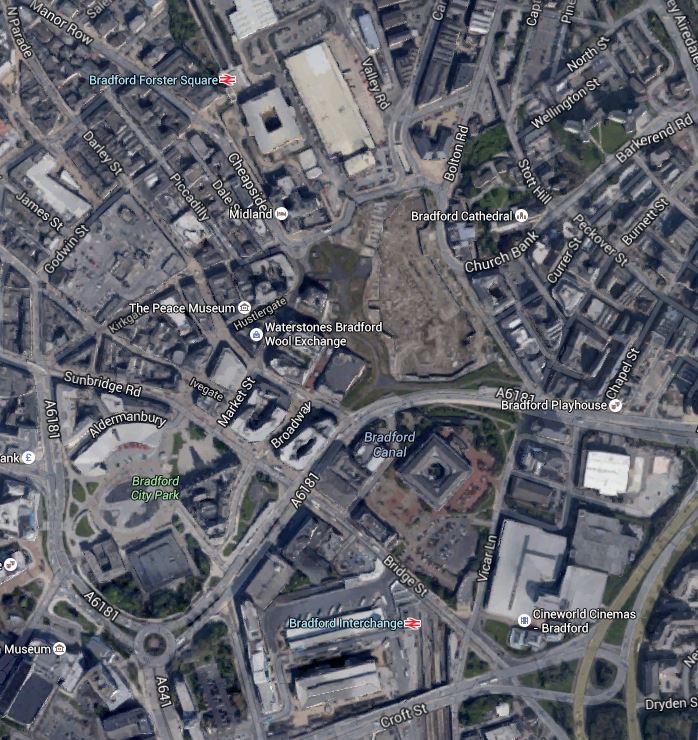
Bradford Stations
Bradford Forster Square station is towards the top and Bradford Interchange station is towards the bottom of the map.
Bradford Interchange, which is a combined bus and rail station rebuilt and opened in the 1970s, which is not an outstanding period for superbly executed Rail stations.
To make matters worse, all trains must reverse at Bradford Interchange, which means the driver changes ends.
Note that between the two stations, there is a large shopping centre, that has been opened in 2015.
You’d have thought with all this rebuilding that a solution to the two station problem would have been found.
Two solutions have been proposed.
- Bradford Crossrail – A heavy rail link between the stations.
- A tram-train is outlined in this article in the Bradford Telegraph and Argus.
I know the Germans would squeeze a tram-train through somewhere, but I suspect there might be something more imaginative and much more affordable.
After all the distance is 0.7 km. and the stations only have seven platforms between them.
Around the world, there are several successful lightweight people movers in city centres.
- High-tech and expensive monorails.
- Light railways like the Docklands Light Railway in London.
- Tram shuttles.
- Travelators and escalators.
- Free mini buses as in Manchester.
Surely, a good engineering solution at an affordable price must exist., which could connect the two stations to each other and to the shopping centre.
But what about some eco-friendly battery buses, as the distance is under a kilometre.
.
From Hebden Bridge To Leeds
The weather was bad and on the last leg from Hebden Bridge to Leeds, I didn’t see much.
According to the Bradford-Halifax section in the Wikipedia entry for the Calder Valley Line, there are five tunnels of which two are over a thousand yards.
So as on the rest of the line electrification could be challenging.
On the other hand some sections, like Sowerby Bridge-Halifax might be easier to electrify.
But I can’t help feeling, that whatever Network Rail decide to do about this line, that IPEMU technology will be part of the solution.
Say you have a section of a couple of miles, that because of various issues would be virtually impossible or very expensive to electrify.
Could a train approaching the neutral section drop its pantograph, use battery power in the neutral section and then automatically put the pantograph up to reconnect to the electricity supply, once the neutral section was passed?
As a Control Engineer, I know such automation is possible, but can it be implemented on a train at 100 mph?
I suspect that the answer is yes and by the end of 2017, there’ll be videos of an IPEMU, swapping from overhead to battery power and back at high speed.
Hebden Bridge
I’m treating Hebden Bridge and the Grade II Listed Hebden Bridge station as a single post, as one would do other places where the station welcomes you to the town or city and is most certainly part of the identity. I would also place Brighton, Cambridge, Liverpool Lime Street, Portsmouth and Rochester, in that category, but there are others.
These pictures show my very wet visit.
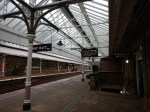
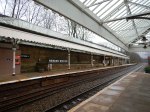

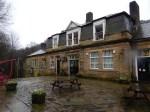
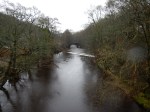
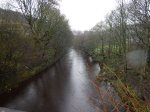
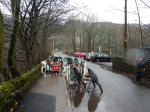
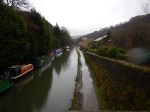
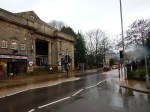
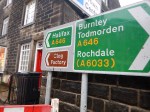
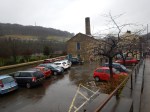
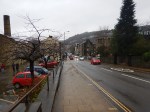
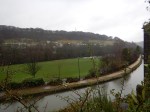
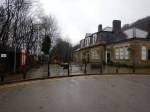
I shall go back one dsy, when the weather is better.
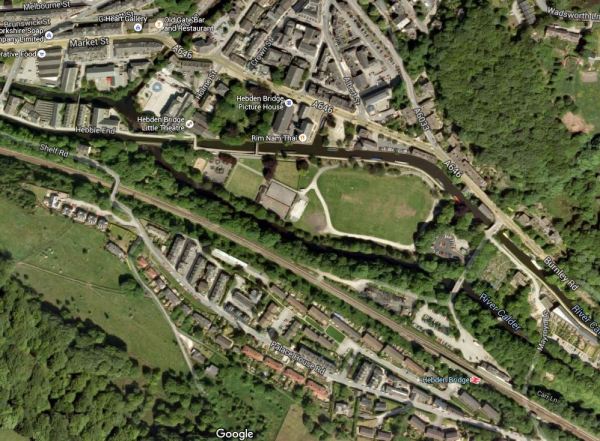
This Google Map shows the town and the station.
Hebden Bridge
Note the Rochdale Canal and the River Calder running in the same direction as the railway.
I believe that Hebden Bridge could be key in the electrification strategy of the Calder Valley Line.
A personable member of Northern Rail’s staff told me a tale about step-free access at the station. There is a subway under the tracks and this used to be served by two parcels lifts. I was told, that it was suggested that the lifts be replaced by passenger lifts, to make the station step-free, but as the station is Grade II Listed, this was not allowed.
What will happen in the end over access, I know not, but in my dealings with Listed Buildings Officers in Suffolk, they tend to be practical and lookfor a compromise, that satisfies all parties. Surely, there could be a design of lift, that would satisfy both the heritage and disabled lobbies without an outrageous expense.
This leads me to the electrification through Hebden Bridge station.
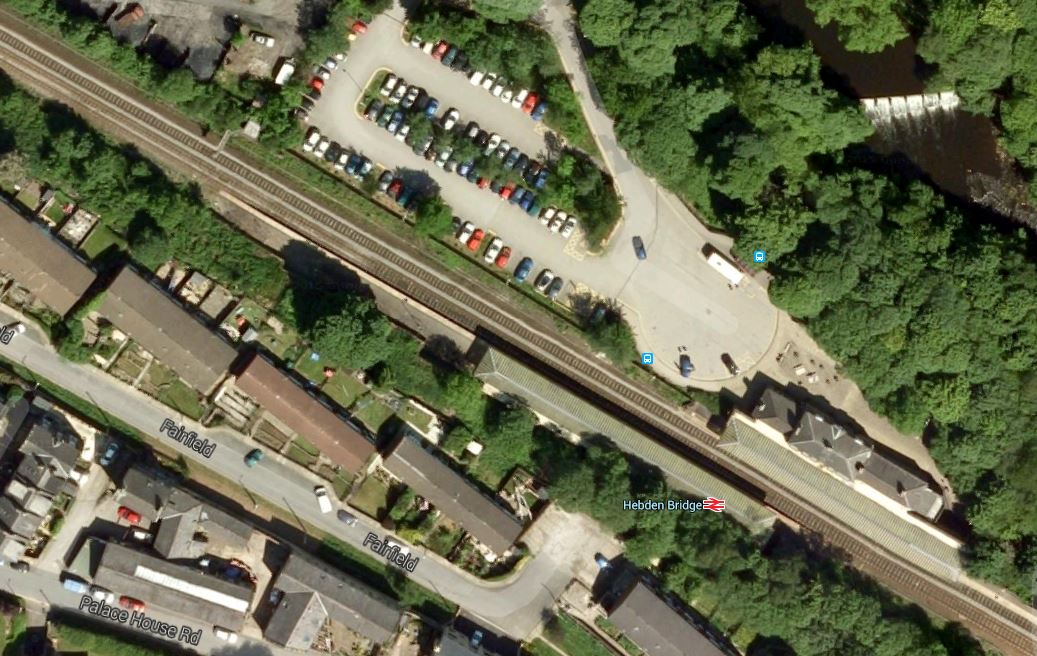
Look at this enlarged Google Map of the station.
Hebden Bridge Station
I think you can see the following.
- The platforms aren’t that long and would need to be lengthened for the four-car trains that would surely be appropriate after electrification.
- The canopies of the platforms will have to be cut back, so that the overhead wires and their supports can be erected.
I don’t think the heritage lobby will like either of these changes.
But what could they object to, if the electric trains were quiet four-car Class 387 IPEMUs, using selective door opening on the current platforms?
These trains could serve Hebden Bridge station tomorrow, if Leeds to Bradford and Blackburn were electrified.
There would be no other overhead wiring needed
Manchester Victoria To Hebden Bridge
The weather wasn’t good as I took the hourly train on the Calder Valley Line between Manchester Victoria and Hebden Bridge stations.
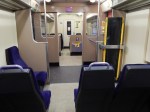

The train was a Class 150 train, which as the first picture shows had been refurbished, but really on a line between the two of the biggest cities in the north, shouldn’t something better be used.
As with my earlier trip from Burnley Manchester Road to Manchester, the line has a fair selection of viaducts, tunnels and challenging structures.
The tunnels include the Summit Tunnel, which is a masterpiece of Victorian engineering, that has been in continuous use since the 1840s.
I don’t know whether Network Rail will want to electrify the Summit Tunnel, but I believe that it could be declared safe for IPEMUs to pass through without extensive modification.
East Of Todmorden
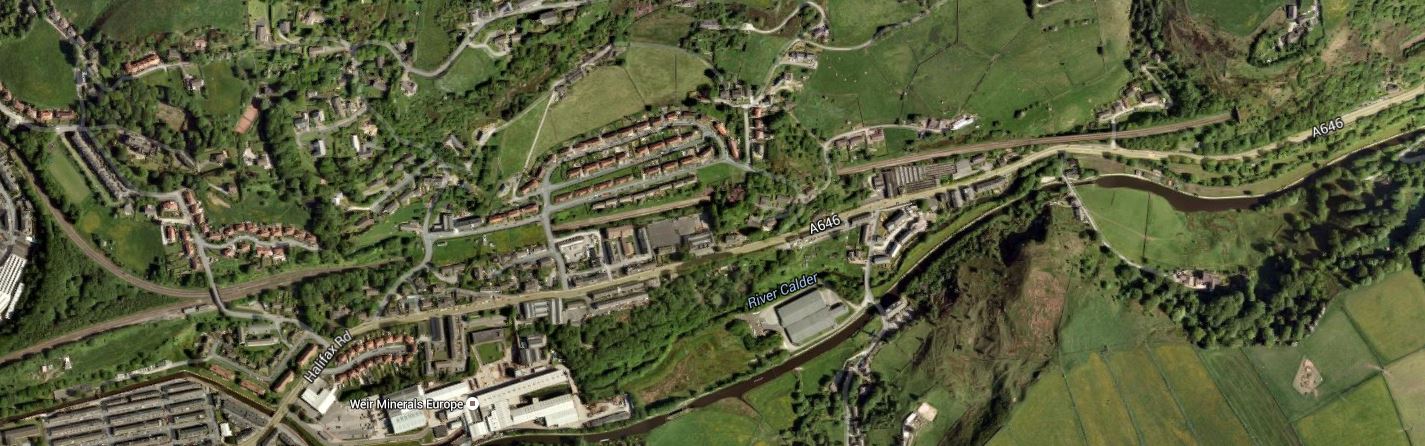
Between Todmorden and Hebden Bridge, there is the Hall Royd Junction, which incorporates the Todmorden Curve and three more smaller tunnels. This Google Map shows the line East of Todmorden.
Note that the Todmorden Curve had not been built, when the Google Map image was taken. The three tunnels are not as long as the Summit Tunnel and are each about two hundred metres long.
The engineering isn’t probably as challenging as that between Burnley and Todmorden, but there will be a lot of it.
If IPEMUs are used, provided the track, tunnels and viaducts are up to scratch, then all that will need to be done is check everything out.
An Early Sunday Start From Burnley To Manchester
I started early and took the 08:39 train from Burnley Manchester Road station to Manchester Victoria station.

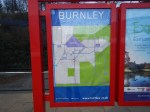
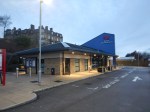
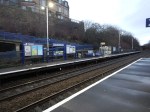
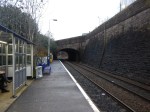

It is a picturesque ride around the Todmorden Curve, over valleys on high viaducts and through traditional stone-built villages and towns, with the hills of the Pennines in the background and quite a bit of water alongside the rail line.
The line has improved greatly in the last few years and there are lots of tidy stations, with seats, shelters and information boards. The only larger ones are Burnley Manchester Road, Todmorden and Rochdale.
Despite the early hour on a Sunday, there were quite a few passengers and the train was about three-quarters full at Manchester Victoria.
Thinking back to my first time by train to Burnley in 2011, the rail link has improved dramatically.
- A smart new station has been built.
- The Todmorden Curve has been opened to provide a direct train service to Manchester.
- An hourly service links Burnley and Manchester Victoria via the curve.
From reports, I’ve read, the line is well-used.
This question has to be asked – Could the line be electrified?
Look at some of the pictures and they show the challenging nature of electrifying the line.
- From Burnley to Todmorden, there are a number of well-built Victorian stone over-bridges.
- Also on this stretch there are at least two high stone viaducts.
- There are several tunnels, includin the Summit Tunnel, which is 2.6 km. long and has been in continuous use since the 1840s.
- Many stations have been upgraded or rebuilt recently.
- Also in this area, some new bridges across the line for new roads and the Metrolink, seem to appear to be rather low.
Also, look as this section of the line between Burnley and Todmorden.
Between Burnley And Todmorden
Note how the rail line curves between the hills and the houses, using tunnels and viaducts to get go on its way.
It’s one of those lines, where you’d try to find an alternative to traditional electrification. If it’s not space, it’s heritage issues and there would be lots of bridges, viaducts and tunels to rebuild.
Go west from Burnley and the line has a couple of high viaducts and a couple of tunnels, but the East Lancashire Line seems to get easier west of Blackburn station, with a line over mainly flat countryside with plenty of space on either side. At Preston it connects to the electrified West Coast Main Line.
Electrifying from Preston to Blackburn, would open up several routes to the use of IPEMU trains.
- Blackpool South to Colne – A substantial part of the route of the fifty mile route from Blackpool South to Colne would be electrified and from the performance figures I’ve seen, this route would be an easy one for something like an IPEMU-variant of a four-car Class 387 train.
- Burnley to Manchester – The service I rode from Burnley to Manchester starts at Blackburn and finishes in a fully electrified Manchester Victoria. So to answer my original question about whether the route could be electrified, there is actually no need to electrify, as IPEMUs could easily link two electrified terminals over that distance.
- Manchester to Clitheroe – Look at the Ribble Valley Line on Wikipedia and there are five viaducts and three tunnels listed, in a line of around thirty miles. However, the good news is three-fold. The line has been well looked after, it’s promoted as a tourist attraction and soon, it will be electrified from Manchester as far as Bolton. I can’t see why with a small top-up at Blackburn, that this route couldn’t be run by an IPEMU.
- Blackpool North to Settle – This route is run as a tourist train called DalesRail on Sundays in the Summer, when it goes all the way to Carlisle. An IPEMU could certainly run a service between Blackpool North and Settle, but I doubt it could stretch all the way to Carlisle along the Settle-Carlisle Line, as there are some massive gradients on that line.
- Blackpool North to Leeds – This route along the Calder Valley Line via Hebden Bridge, Halifax and Bradford would be totally within range of an IPEMU, once Blackburn to Preston is electrified. If necessary, Leeds to Bradford could be electrified as well. A train fit for the Northern Powerhouse, powered by batteries and built in Derby!
This all illustrates how an IPEMU can benefit from even short sections of electrification. Blackburn to Preston would be under twenty miles of electrification without troublesome viaducts and tunnels across fairly flat country and it opens up several routes to new electric trains.
It’s funny, but if you are going to use IPEMU trains, you electrify all the lines, that you can electrify and maintain with ease and leave all the difficult bits to the battery feature in the trains.
Jumping The Electrification Gap Between Leeds And Manchester
The Battery High Speed Train
An Aventra uses a modern version of the same bogies that are used in the Class 222 trains, which are capable of 200 kph. As the Class 387 train, which is a version of the Electrostar, can travel at 110 mph, I wouldn’t rule out that the more modern Aventra could run at 200 kph or 125 mph. Obviously, this speed would probably only be attainable in places on the East Coast Main Line.
Example times between York and Newcastle include.
- East Coast InterCity 225 – 56 minutes
- East Coast InterCity 125 – 62 minutes
- Transpennine Class 185 – 67 minutes
So if the performance on the line of an Aventra IPEMU was the same as an InterCity 225, then this would knock eleven minutes of the trip to Newcastle
Acceleration on batteries would be the problem, not maintaining a high speed. that had been built up whilst running under the wires.
When jumping the gap in the electrification between Leeds and Manchester, as the train will have been running from either Liverpool or York, I would suspect that it would set out over the Pennines with a full load of electricity.
Manchester To Leeds Electrification Gap
The Manchester to Leeds electrification has now been paused and it is likely that it will not be completed in the next ten years.
The line has its problems as the three-car Class 185 trains, that work the line, are totally inadequate for the route.
There are two major routes between Leeds and Manchester.
- The Huddersfield Line via Dewsbury, Huddersfield and Stalybridge.
- The Calder Valley Line via Bradford Interchange, Halifax, Hebden Bridge, Todmorden and Rochdale.
The shortest distance by rail between Manchester and Leeds is just 43 miles. When I saw this, I didn’t believe it, but it’s all in this article in the Guardian.
So this means that if you want to run an electric train between Liverpool and Manchester to Leeds, York and Newcastle, the Aventra IPEMU would bridge the gap with ease.
The demonstration version of the Aventra IPEMU was a modified Class 379 Train and had a range of sixty miles on batteries.
So even this modified Stansted Express would have been able to bridge the gap on both routes with ease.
A fully engineered production Aventra IPEMU would be unlikely to have a shorter range on batteries.
So Aventra IPEMUs create a fully-electrified TransPennine route from Preston, Liverpool and Manchester in the West to Leeds, York and Newcsastle in the East.
Destinations In The West
These are all current Western destinations for Transpennine Express.
- Barrow – On an unelectrified branch line from an electrified Carnforth.
- Blackpool North – On an unelectrified branch line from an electrified Preston.
- Liverpool – On a direct line from Manchester that is completely electrified
- Liverpool via Warrington – On a direct line from Manchester that is partially electrified.
- Manchester Airport – Electrified from Manchester
- Windermere – On an unelectrified branch line from an electrified Oxenholme.
All could be served by using Aventra IPEMUs.
I suspect it would also be possible to serve Chester.
I’m not sure how Aventra IPEMUs would affect slower services like York to Blackpool North across the Pennines, but I suspect they would be faster than the current diesel multiple units.
With the franchises being reallocated, I suspect that it will be done in such a way, that the trains across the Pennines give a much better service.
Destinations In The East
These are all current Eastern destinations for Transpennine Express.
Cleethorpes – Probably too far, but the Class 185 trains could run the service as they do now!
Hull – Hull is perhaps fifty miles East of the East Coast Main Line and I believe that a solution can be found to do this on an out-and-back basis.
Middlesbrough – This is a few miles from Darlington
Newcastle – Electrified all the way from Leeds
Scarborough – The York to Scarborough Line is forty two miles long and I believe that a solution can be found to do this on an out-and-back basis.
Whether Aventra IPEMUs can do the return trip from the East Coast Main Line on an out-and-back basis to Hull and Scarborough, depends very much on how the range of the trains work out, when the production trains are delivered. I suspect Bombardier know and have either calculated it or proven it on a test rig, but obviously they are keeping it quiet and sticking with the sixty miles total range obtained with the Demonstrator.
If they can’t make it, I suspect that they can provide some form of charging at the Eastern termini.
I do suspect that because of the reorganisation of the two franchises we may see some extra destinations in the East.
Times Across The Pennines
At present times on the major routes are.
Liverpool to Newcastle – 3 hours
Liverpool to Hull – 2 hours 30 minutes with a change at Leeds
As I indicated earlier there is eleven minutes to take off the Newcastle journey and the change at Leeds probably wastes ten minutes on the Hull trip.
Other factors would have an effect.
- The time spent on a stop by the Aventra IPEMU will be less than that of the current Class 185 trains.
- If diesel multiple units on the two TransPennine routes can also be replaced with Aventra IPEMUs, then these trains would be less likely to slow the fastest expresses.
- The Aventra IPEMUs are faster than the current trains.
- Network Rail will probably be able to do some small amount of trackwork to speed trains up in places.
I have no idea what the eventual TransPennine time will be, but it will be a few minutes less than today’s times.
The Todmorden Curve Has Helped A Campaign For More
The opening of the Todmorden Curve seems to have been a success according to press reports I’ve found, but this article from the Lancashire Telegraph, entitled New hope for campaigners looking to re-establish link between East Lancashire and North Yorkshire, shows that the opening is having other effects. This is the first paragraph.
A NEW hope has emerged for campaigners looking to re-establish a link between East Lancashire and North Yorkshire after a transport chief signalled concerns about possible logjams in Calderdale and Leeds.
The link between Colne and Skipton, which is mentioned in the article is shown in this map.
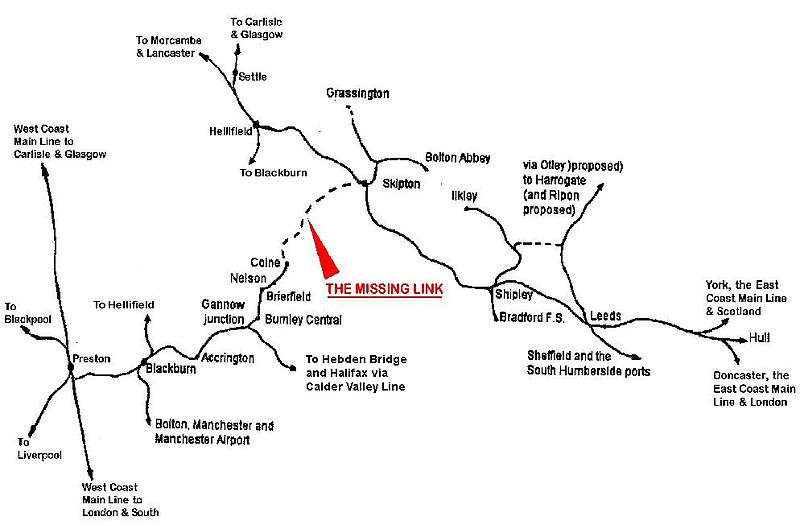
Skipton To Colne
It is being promoted by the Colne-East Lancashire Rail Action Partnership.
Having explored the area a lot in the last couple of years. I feel very much that tram-trains perhaps linked to Blackpool and/or Manchester have a lot of possibilities. I said as much in Could Tram-Trains Be Used To Advantage In Blackpool? It may sound fanciful and ambitious, but a single track tram-train link from Colne to Skipton, would have a high passenger capacity and wouldn’t require the infrastructure of heavy rail.
Things seem to be moving fast in East Lancashire.
In North London, there has been strong enthusiasm for the recent extension of the Overground. I now perceive a wanting for more of the same.
So are the good citizens of East Lancashire behaving in the same way?
 The Anonymous Widower