Gospel Oak-Barking Fleet Plan Remains Unclear
The title of this post is the same as that of this article on Rail Magazine.
In the article, there is a picture of 378232 at Barking station.
According to the Wikipedia entry for Class 378 trains, this unit is listed as being four-cars and TBA (To Be Allocated?)
So is it a spare train, that is used for driver and staff training and route proving?
It was certainly doing the latter at Barking.
The Situation On The Gospel Oak To Barking Line Is Critical
This page on the Barking-Gospel Oak Rail User Group web site is their latest newsletter, which was issued on the 14th of January.
These are the headlines on the newsletter.
- Train Service On Brink Of Collapse
- Not Enough Trains For Viable Service
- TfL Has No Idea When New Trains Will Be Fit For Service
- Rail Users Demand Mayor Takes Action To Restore Reliable Train Service Now
- Rail Users Demand Compensation After Years Of Misery
It’s all strong stuff.
Trains that work are urgently needed to replace the diesel Class 172 trains, which will all leave by the end of April or even March.
Possible Replacement Trains
These types of trains have been touted as replacement trains.
Class 315 trains
TfL has started to send some Class 315 trains, made redundant by TfL Rail, for scrapping.
Could some of these be held back for use on the Gospel Oak to Barking Line?
- They should fit the route.
- London Overground already runs these trains to Cheshunt, Chingford and Enfield Town.
- The expertise and driving experience must be there to run a service.
But, as there have been no reports of any Class 315 trains on the route, I suspect that there’s a reason, why these trains can’t fill the gap.
Could it be the disability regulations, which kick in at the end of 2019?
The proposed Class 710 rains ordered for both Gospel Oak to Barking Line and the Watford DC Line are dual voltage.
As the Willesden TMD was built to handle trains with the ability to use third-rail electrification, is this ability needed to access the depot?
But Class 315 trains are 25 KVAC only, so this could mean they are unsuitable.
Class 365 Trains
Class 365 trains got ScotRail out of trouble, but like the Class 315 trains, they are 25 KVAC only, so may have the same stabling issues.
They would also be a new train class for London Overground.
Class 319 Trains
Class 319 trains are dual-voltage and could probably be used on both routes, but they would need a refurbishment and would also be a new train class for London Overground.
Class 378 Trains
Class 378 trains already work the Watford DC Line and after the test of a four-car unit to Barking, London Overground probably know how difficult, it would be for four-car trains to work the route.
The trains are dual-voltage and London Overground’s strategy of basing trains for both routes at Willesden TMD would probably be possible.
Drivers and other staff know them very well, as do the passengers.
I am drawn to the conclusion, that of the trains available in the event of non-delivery of Class 710 trains, the Class 378 trains are the best choice.
How Many Trains Are Needed For The Gospel Oak To Barking Line?
The full service was run by a fleet of eight Class 172 service.
As the same number of Class 710 trains have been pencilled in for the route, I must assume that this is the number of trains required. I think six trains are needed for the service, with two in reserve or maintenance.
How Many Class 378 Trains Are Needed For A Full Overground Service?
If I go through the routes of the original Overground, I find the following.
Dalston Junction And Clapham Junction
Trains take 46 minutes to go South and 44 minutes to come North and a round trip would take two hours.
This means thatthe current four trains per hour (tph) service would need eight trains.
Dalston Junction And New Cross
Trains take 22 minutes both ways and a round trip would take an hour.
This means that the current four tph service would need four trains.
Highbury & Islington And Crystal Palace
Trains take 44 minutes to go South and 43 minutes to come North and a round trip would take two hours.
This means that the current four tph service would need eight trains.
Highbury & Islington And West Croydon
Trains take 52 minutes both ways and a round trip would take two hours.
This means that the current four tph service would need eight trains.
Euston And Watford Junction
Trains take 47 minutes to go South and 50 minutes to come North and a round trip would take two hours.
This means that the current three tph service would need six trains.
Stratford And Richmond/Clapham Junction
Between Stratford and Richmond, trains take 59-64 minutes to go West and 62 minutes to come East.
Between Stratford and Clapham Junction, trains take 62 minutes to go West and 64 minutes to come East.
The round trip times are very similar and are around two and a half hours.
This means that the current eight tph service would need twenty trains.
Summarising, these services gives.
- Dalston Junction and Clapham Junction – 8 trains
- Dalston Junction and New Cross – 4 trains
- Highbury & Islington and Crystal Palace – 8 trains
- Highbury & Islington and West Croydon – 8 trains
- Euston and Watford Junction – 6 trains
- Stratford and Richmond/Clapham Junction – 20 trains
This gives a total of 54 trains. As there are fifty-seven Class 378 trains, this means there are three spares to cope for maintenance and breakdowns.
London Overground have plans to increase frequencies and they are detailed in this table.
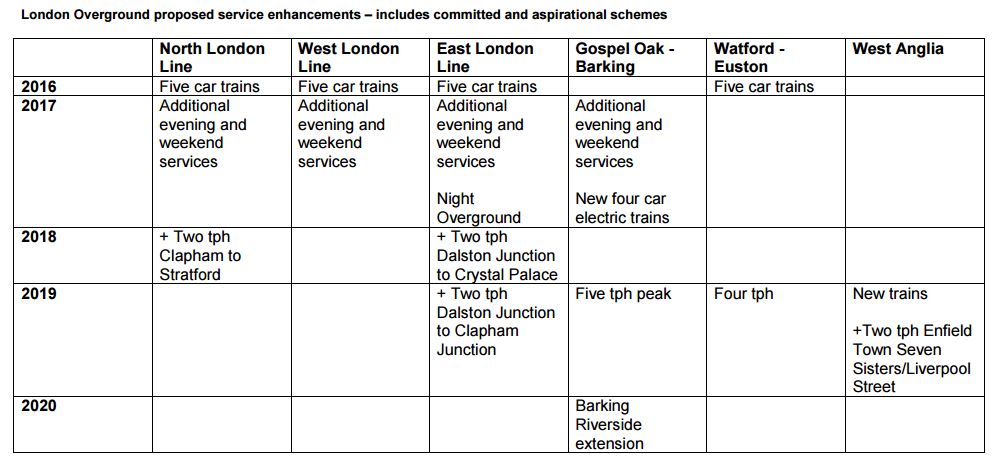
Note that four extra services are planned for the East London, North London and Watford DC Lines.
- Two extra tph between Stratford and Clapham Junction, which has already been implemented.
- Two extra tph between Dalston Junction and Clapham Junction. This would mean that twelve trains would be needed for this service.
- Two extra tph between Dalston Junction and Crystal Palace. This would mean that twelve trains would be needed for this service.
- One extra tph between Euston and Watford Junction. This would mean that eight trains would be needed for this service.
Summarising again gives.
- Dalston Junction and Clapham Junction – 12 trains
- Dalston Junction and New Cross – 4 trains
- Highbury & Islington and Crystal Palace – 12 trains
- Highbury & Islington and West Croydon – 8 trains
- Euston and Watford Junction – 8 trains
- Stratford and Richmond/Clapham Junction – 20 trains
This gives a total of 64 trains.
As London Overground only has 57 Class 378 trains, this proposed timetable is impossible without some new Class 710 trains.
London Overground plan to use some of the Class 710 trains to release Class 378 trains from the Watford DC Line, to reinforce East London Line services.
So it looks like the late delivery of the Class 710 trains has also scuppered London Overground’s plans to increase services on the East London Line.
How Many Class 378 Trains Could Be Scraped Together?
This table shows the number of Class 378 trains needed for the current service.
- Dalston Junction and Clapham Junction – 8 trains
- Dalston Junction and New Cross – 4 trains
- Highbury & Islington and Crystal Palace – 8 trains
- Highbury & Islington and West Croydon – 8 trains
- Euston and Watford Junction – 6 trains
- Stratford and Richmond/Clapham Junction – 20 trains
This gives a total of 54 trains. With just three trains spare.
As the Gospel Oak to Barking Line needs eight trains to run a full service, this is not enough.
What strategies can be applied to increase the number of trains available?
Reduce The Stratford And Clapham Junction Service To Two tph
The Stratford and Clapham Junction service was two tph until recently, when it was raised to four tph.
Reducing it back to two tph, would reduce the number of trains required on Stratford and Clapham/Richmond services by five.
This would give eight spare trains, which would be almost enough to run a full service on the Gospel Oak to Barking Line.
Provided of course, that there was a hundred percent availability, which is rather an impossible dream.
Introduce The Class 710 Trains On The Watford DC Line
The Class 710 trains for the Gospel Oak to Barking Line are dual-voltage trains, which will also run on the Watford DC Line. So would it be a sensible idea to introduce these trains first on the Watford DC Line?
- The third-rail electrification on the line is at least fifty years old, so must be fully tested.
- The drivers have extensive route knowledge of running electric trains on the route.
- Willesden TMD, where the Class 710 trains are stabled, is on the Watford DC Line.
- The route is only shared with the Bakerloo Line.
- The route is to be equipped with six Class 710 trains anyway.
Every Class 710 train introduced will release a Class 378 train.
But if the Class 710 trains don’t work, this is no help!
Introduce The Class 710 Trains On The North London Line
Running on the North London Line is more complicated than the Watford DC Line, but five-car Class 710 trains, are planned for this route.
They could be introduced to release Class 378 trains.
The Four-Car Train Problem
Every four-car train created means that a trailer car is removed from a five-car Class 378 train.
I would assume that it is most likely, these spare cars will be put into store until the, the new Class 710 trains finally enter service.
Or would they be added to other Class 378 trains to create six-car trains, which would then be run on the North or West London Lines, where the platforms could be almost long enough? Selective door opening on the trains could also be used at short platforms.
Conclusion
I feel if the London Overground swap trains around and perhaps reduce the Stratford and Clapham Junction service to its old level of 2 tph, then enough Class 378 trains would be available to run a full four-car service on the Gospel Oak to Barking Line.
Merseyrail Reveals Latest Station Closures For Upgrade Work Ahead Of New Trains
The title of this post is the same as that of this article on Liverpool Business News.
This is the first paragraph.
Merseyrail has announced details of the next phases of station closures as it upgrades is platforms to make them ready its new £460m fleet of trains due to come into service in 2021.
In total, there are eleven phases of work to give all platforms level access to the new trains.
I am fairly sure that no other local rail network in the UK, will have this quality of level access.
Some stations on the London Overground have similar access, but not that many. When you consider, that many station platforms have been rebuilt and they are only used by Class 378 trains, I believe an opportunity was missed.
The article says this about Merseyrail‘s new Class 777 trains.
Swiss manufacturer Stadler has started the manufacturing process at its Szolnok plant in Hungary on the new fleet of 52 trains. There, the car-body production is under way with the units being machined, welded, sandblasted and coated in special protection and premium quality paint to combat corrosion, caused by the contact with sea-water.
Most of the current Class 507/508 trains are forty years old, but they appear to me to be one of the most bottom-friendly suburban trains in the UK, with desirable 2+2 seating. I regularly travel on Class 313 trains, which are similar trains of the same vintage, into and out of Moorgate, and these are scrapyard specials compared to Merseyrail’s spotless, spacious and comfortable trains.
These pictures from March 2017, show the current trains.
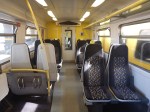
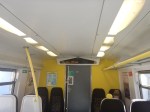
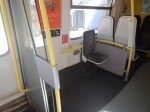
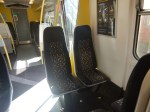
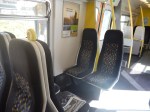
They certainly look to be in good enough condition to see all the new trains into service and through their inevitable teething troubles in the next couple of years.
Conclusion
,The care being taken by Merseyrail and Stadler in the preparation for and design of their new trains, seems to indicate that they are intending to get forty years out of the new fleet.
Batteries In Class 378 Trains Revisited
Two and a half years ago, I wrote Will London Overground Fit On-board Energy Storage To Class 378 Trains?.
This post effectively updates that post, with what we now know.
As far as I know, batteries have not been fitted to the Class 378 trains, but there have been other developments involving Bombardier since.
Aventras
The linked post was based on statements by Marc Phillips of Bombardier in this article in Rail Technology Magazine entitled Bombardier enters key analysis phase of IPEMU. He also said about Aventras.
Bombardier is also looking at battery options on new builds, including its Aventra platform.
I have stated several times including in Rail Magazine, that the Class 345 trains for Crossrail must have batteries and no-one has told me that I’m wrong.
Battery Train Applications
The Rail Technology article also says this.
Bombardier has started assessing potential customers for battery-powered trains, looking first at branch line applications. Batteries could be a solution allowing non-continuous electrified infrastructure, and emergency rescue and last-mile opportunities.
The article was written three and a half years ago and I suspect Bombardier have been busy researching the technology and its applications.
The High-Speed Bi-Mode Aventra With Batteries
This train was first reported to be in development in this article in Rail Magazine, which was entitled Bombardier Bi-Mode Aventra Could Feature Battery Power.
The article stated the following.
- Battery power could be used for Last-Mile applications.
- The bi-mode would have a maximum speed of 125 mph under both electric and diesel power.
- Bombardier’s spokesman said that the ambience will be better, than other bi-modes.
I very much believe that the key to the performance of this train is using batteries to handle regenerative braking in both electric and diesel modes.
In Mathematics Of A Bi-Mode Aventra With Batteries, I looked at how the train might operate.
Bombardier with better data and the latest mathematical modelling techniques have obviously extensively modelled the proposed trains and prospective routes.
No sane company listed on a Stock Exchange would launch such a product, if it didn’t know that the mathematics of the dynamics and the numbers for the accountants didn’t add up.
Voyagers With Batteries
In Have Bombardier Got A Cunning Plan For Voyagers?, I discuss a snippet found in the July 2018 Edition of Modern Railways, in an article entitled Bi-Mode Aventra Details Revealed.
In a report of an interview with Bombardier’s Des McKeon, this is said.
He also confirmed Bombardier is examining the option of fitting batteries to Voyager DEMUs for use in stations.
Batteries appear to be being proposed to make the trains more environmentally-friemdly and less-noisy.
Talent 3 With Batteries
Bombardier have launched a version of their Talent 3 train with batteries. This is the launch video.
Some of Bombardier’s points from the video.
- Emission-free
- The current range is forty kilometres
- The range will be extended to a hundred kilometres by 2020.
- Charging for forty kilometres takes between seven and ten minutes from overhead electrification.
This looks to be a serious train with orders from German train operators.
It would appear that Bombardier are very serious about the application of batteries to both new and existing trains.
Class 378 Trains And Batteries
What could batteries do for the Class 378 trains?
It looks like over the next few years, the Class 378 trains will be increasingly used on the East London Line, as they have the required evacuation capability for the Thames Tunnel.
Various documents indicate that to maximise capacity on the line, the following may happen.
- Some or all services may go to six trains per hour (tph)
- Trains may be lengthened to six-cars from five-cars.
Extra destinations might be added, but although this could be easy in South London, it would probably require a lot of station or platform development in the North.
Trains Required For The East London Line
If you look at the timing of the East London Line, you get the following journey times for the four routes.
- Highbury & Islington to West Croydon – 52-57 minutes
- Dalston Junction to New Cross – 24 minutes
- Highbury & Islington to Crystal Palace – 46 minutes
- Dalston Junction to Clapham Junction – 47-48 minutes
It could almost have been choreographed by Busby Berkeley.
This means that to run four tph on the routes needs the following number of trains.
- Highbury & Islington to West Croydon – 8 trains
- Dalston Junction to New Cross – 4 trains
- Highbury & Islington to Crystal Palace – 8 trains
- Dalston Junction to Clapham Junction – 8 trains
Which gives a total of 28 trains.
To make all these services six tph, would require the following number of trains.
- Highbury & Islington to West Croydon – 12 trains
- Dalston Junction to New Cross – 6 trains
- Highbury & Islington to Crystal Palace – 12 trains
- Dalston Junction to Clapham Junction – 12 trains
Which gives a total of 42 trains.
At present only the Crystal Palace and Clapham Junction routes have dates for the extra trains and if only these routes were increased in frequency, there would be a need for 36 trains.
Six-Car Trains
The trains might also go to six cars to increase capacity on the East London Line.
As I indicated in Will The East London Line Ever Get Six Car Trains?, cars could be used from the five-car trains not needed for the East London Line.
You would just end up with a number of three- and four-car Class 378 trains, that could be used on other routes with less passengers.
My conclusion in Will The East London Line Ever Get Six Car Trains? was this.
It will be interesting to see how London Overground, increase capacity in the coming years.
There are fifty-seven Class 378 trains in total, which have the following formation.
DMOS-MOS(B)-PTOS-MOS-DMOS
They can be lengthened and shortened, by adding or removing MOS cars.
As an extra MOS car was added to convert all trains from four-cars to five-cars a few years ago, I suspect it is not the most difficult of processes.
It should also be noted that the original three-car trains for the North London Line had the following formation.
DMOS-PTOS-DMOS
If all East London Line routes go to six tph, the required number of trains would be forty-two.
This would leave a surplus of fifteen trains to act as donors for lengthening.
To make all trains six-cars would require a further forty-two MOS cars.
Reducing the trains not needed for the East London Line to three-cars, would yield thirty MOS cars.
This could give the following fleet.
- Thirty six-car trains.
- Twelve five-car trains
- Fifteen three-car trains
To lengthen all trains needed for six-cars would require another twelve MOS cars to be obtained.
Some services could be run with five-car trains, but I don’t think that be a good idea.
I am inevitably led to the conclusion, that if the the Class 378 trains need to be extended to six-cars, then Bombardier will have to produce some more cars.
Adding Batteries To A Six-Car Class 378 Trains
Batteries would be added to Class 378 trains for all the usual reasons.
- Handling energy from regenerative braking.
- Health and safety in depots and sidings.
- Short movements on lines without electrification
- Emergency train recovery
But there might also be another important use.
The Thames Tunnel is under five hundred metres long.
As the only trains running through the tunnel are Class 378 trains, it might be possible and advantageous to run services on battery power through the tunnel.
I will estimate the kinetic energy of a six-car Class 378 train, as the batteries must be able to handle the energy of a full train, stopping from maximum speed.
- The empty train will weigh around 192 tonnes
- The maximum speed of the train is 75 mph.
- The train will hold 1050 passengers, who I will assume each weigh 90 Kg with baggage, bikes and buggies.
- This gives a fully loaded train weight of 286.5 tonnes.
Using the Omni Kinetic Energy calculator gives an kinetic energy of 45 kWh.
If four 100 kWh batteries can be fitted under a two-car Class 230 train, then surely a reasonable amount o capacity can be fitted under a six-car Class 378 train.
These pictures show the under-floor space on a dual-voltage Class 378/2 train.
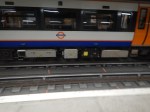
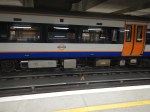
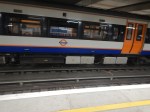
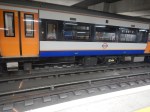
As a six-car train will have five motored cars, why not put one 50 kWh battery in each motored car, to give a capacity of 250 kWh.
In an article in the October 2017 Edition of Modern Railways, which is entitled Celling England By The Pound, Ian Walmsley says this in relation to trains running on the Uckfield Branch, which is not very challenging.
A modern EMU needs between 3 and 5 kWh per vehicle mile for this sort of service.
So how far would a six-car Class 378 train go with a fully-charged 250 kWh battery?
- 5 kWh per vehicle mile – 8 miles
- 4 kWh per vehicle mile – 10 miles
- 3 kWh per vehicle mile – 14 miles
- 2 kWh per vehicle mile – 20 miles
This is only a crude estimate, but it shows that fitting batteries to a Class 378 train with batteries could give a useful range.
Adding Batteries To A Three-Car Class 378 Trains
The same calculation can be performed for a three-car train created by removing the two MOS cars.
- The empty train will weigh around 96 tonnes
- The maximum speed of the train is 75 mph.
- The train will hold 525 passengers, who I will assume each weigh 90 Kg with baggage, bikes and buggies.
- This gives a fully loaded train weight of 143.3 tonnes.
Using the Omni Kinetic Energy calculator gives an kinetic energy of 22.4 kWh.
Unsurprisingly, the kinetic energy of the three-car train is around half that of a six-car train.
As a three-car train will have two motored cars, why not put one 50 kWh battery in each motored car, to give a capacity of 100 kWh.
Using the Ian Walmsley formula gives the following ranges.
- 5 kWh per vehicle mile – 7 miles
- 4 kWh per vehicle mile – 8 miles
- 3 kWh per vehicle mile – 11 miles
- 2 kWh per vehicle mile – 17 miles
When you consider that the length of the Greenford Branch Line is 2.5 miles, these ranges are very useful.
Routes For Three-Car Class 378 Trains With Batteries
I would suspect that these trains will have the following specification.
- Dual-voltage with ability to use either 25 KVAC overhead or 750 VDC third-rail electrification.
- A maximum speed of 75 mph
- Three cars
- Passenger capacity of 525 passengers.
- Range of between seven and fifteen miles
So for what routes would the train be suitable?
Brentford Branch Line
There have been various ideas for reopening the freight-only Brentford Branch Line to passenger traffic.
The simplest proposal would be to run a two tph shurttle train Southwards from Southall station.
As the branch is only four miles long, I believe that a three-car Class 378 train, which ran on battery-power and charged at Southall station could work the branch.
Greenford Branch Line
I’ve already mentioned the 2.5 mile long Greenford Branch Line.
The following work would need to be done before the trains could be used.
- Electrification of the bay platform at West Ealing with 25 KVAC overhead wires.
- Electrification of the bay platform at Greenford with 750 VDC third-rail.
- Minor lengthening of the bay platform at Greenford to allow sixty metre long trains.
- An extra crossover at the West Ealing end of the branch.
With these modifications it might be possible to run four tph on the branch.
Romford To Upminster Line
Currently, the Romford-Upminster Line uses a single train to shuttle the three miles at a frequency of two tph.
If the passing loop were to be reinstated, I believe that two trains could run a four tph service.
Using battery-power on the line and charging on the existing electrification at either end of the line might be a more affordable option.
It should be noted that increasing the current two x four-car tph to four x three-car tph, would be a doubling of frequency and a fifty percent increase in capacity.
West London Orbital Railway
The West London Orbital Railway is outlined like this in Wikipedia.
The West London Orbital is a proposed extension to the London Overground that makes use of a combination of existing freight and passenger lines including the Dudding Hill Line, North London Line, and the Hounslow Loop. The route runs for approximately 11 miles from West Hampstead and Hendon at the northern end to Hounslow at the Western end via Brent Cross West, Neasden, Harlesden, Old Oak Common, Acton and Brentford.
This is one of those plans, which ticks a lot of boxes.
- The tracks are already in existence.
- There is a proven need.
- Passenger numbers would support at least four tph.
- The route connects to Crossrail and HS2.
- Changing at Old Oak Common to and from Crossrail gives a quicker route to Heathrow for many in West London.
- There is electrification at both ends of the route, with only four miles without any electrification.
- At only eleven miles, it could be run by electric trains under battery power.
- The cost is quoted at around £250 million.
- Studies show it has a benefit cost ratio of 2.2:1.
As the route is now being promoted by the Mayor of London, I have a feeling this route will be created in time for the opening of HS2 in 2025.
If you want to know more about the proposals, this document on the Brent Council web site, which is entitled West London Orbital Rail, was written by consultants WSP to analyse the proposals and give a cost.
This is paragraph 5.4.38
At this stage we are assuming that the railway will be operated by diesel traction, or possibly battery or hybrid traction. While the Kew – Acton and Dudding Hill Line sections are not electrified, all the rest of the line is and battery technology may have developed sufficiently by the time of opening to be a viable option. Therefore, potential subsequent phases of the
enhancement plans could electrify the non-electrified sections.
The consultants go on to say, that stabling for diesel trains is more difficult to find in London than for electric..
The route would be suitable for Class 378 trains with batteries, but the consultants say that four-car trains will be needed.
So four-car Class 378 trains with a battery capability will be needed.
Alternatively, new four-car Class 710 trains, which I’m certain are built around a battery capability could be used instead.
A rough estimate says that for the full service of two four tph routes will need a total of eight four-car trains.
This is a much-needed route with definite possibilities.
Should A Battery MOS Car Be Designed?
If the Class 378 trains are lengthened to six cars, it looks like there will be a need for at least twelve new MOS cars.
I wonder, if it would be better to design a new BMOS car with batteries, that could either be created from an existing MOS car or newly-built.
The car would have the following specification
- It would be able to replace any current MOS car.
- It would contain the appropriate size of battery.
The advantages of a compatible new BMOS car are.
It would not require any modifications to the PTOS or DMOS cars, although the train software would need to be updated.
It would make it possible to easily create trains with a battery option with a length of four and five cars.
Could The PTOS Car Be Updated With Batteries?
This could be a logical way to go, if a battery of sufficient size can be fitted in the limited space available with all the other electrical gubbins under the floor of a PTOS car.
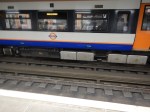
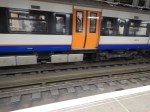
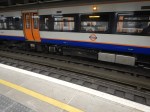
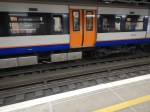
These pictures show a Class 378/2 PTOS car.
Modifying only the PTOS cars would give the following advantages.
- Only the PTOS car would need to be modified.
- PTOS cars for Class 378/1 trains would be 750 VDC only.
- PTOS cars for Class 378/2 trains, would be dual-voltage.
- Only PTOS cars for Class 378/2 trains would have a pantograph.
I will propose that the PTOS car is fiited a 100 kWh battery.
This would be sufficient for the six-car East London Line services, as all it would do was handle the regenerative braking energy, which has a maximum value of just 45 kWh. Battery range of the train would be between three and five miles, which would be enough to recover the train if power failed.
For three-car trains, the 100 kWh ranges would be as I calculated earlier.
- 5 kWh per vehicle mile – 7 miles
- 4 kWh per vehicle mile – 8 miles
- 3 kWh per vehicle mile – 11 miles
- 2 kWh per vehicle mile – 17 miles
Which is a very useful range.
If some four-car trains, were built by adding a new MOS car, the ranges on 100 kWh batteries would be.
- 5 kWh per vehicle mile – 5 miles
- 4 kWh per vehicle mile – 6 miles
- 3 kWh per vehicle mile – 8 miles
- 2 kWh per vehicle mile – 12.5 miles
As the Dudding Hill Line is only four miles long with electrification at both ends, these four-car Class 378 trains would be able to work the routes of the West London Orbital Railway.
Conclusion
Fitting batteries to Class 378 trains opens up a lot of possibilities.
One scenario could be.
- Forty-two six-car trains for the East and |South London Lines.
- One three-car train for the Brentford Branch Line
- Two three-car trains for the Greenford Branch Line.
- Two three-car trains for the Romford to Upminster Line.
- Eight four-car trains for the West London Orbital Railway.
There would be two spare three-car trains and another twenty MOS cars would be required.
.
New Livery For Class 378 Trains
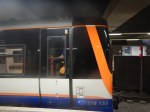
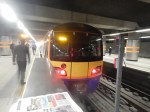
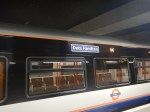
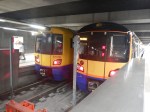
I took these pictures of a Class 378 train with new the new livery and seat covers on two trips into Dalston Junction station.
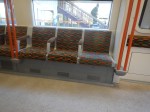
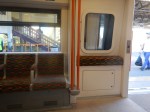

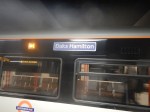
Who is or was Daks Hamilton?
Whilst searching for the answer to my question, I found this December 2009 article on Rail Magazine, which is entitled A Benchmark For Inner Suburban Trains. Richard Clinnock; the author finishes the article with these paragraphs.
So what is the final verdict? Simple: these trains are superb. They may seem to be fairly basic with few seats and no bins, but then they are about moving large numbers of people over relatively short distances.
Bombardier has delivered a train it can be proud of, and has really set the benchmark for future designs for inner suburban trains.
His verdict is still valid and nearly nine years on , the Capitalstars are still trundling reliably, in a circle around London.
But except for the Class 345 and Class 710 trains for Crossrail and the Overground respectively, no operator or transport authority in the UK, has followed London’s bold step of bench seats along the sides of the train.
You do see this layout in Europe, but often with hard one-piece plastic seats, that should be burned to generate electricity.
I think that Transport for London and Bombardier took, what they knew worked from the train-builder’s superb S stock for the sub-surface lines of the Underground and applied it to the new trains for an outstanding success.
If this type of seating works in London, why has it not been specified on new trains for Merseyrail and the Tyne and Wear Metro.
The Future Of The Class 378 Trains
London Overground have a problem with the new Class 710 trains, in that they can’t work the East London Line, as they have no emergency access that can be used in the Thames Tunnel.
So it looks like for the foreseeable future, Class 378 trains will be needed to work the East London Line.
Interior Update
The trains need wi-fi and USB sockets.
Vivarail have put USB sockets in Class 230 trains.
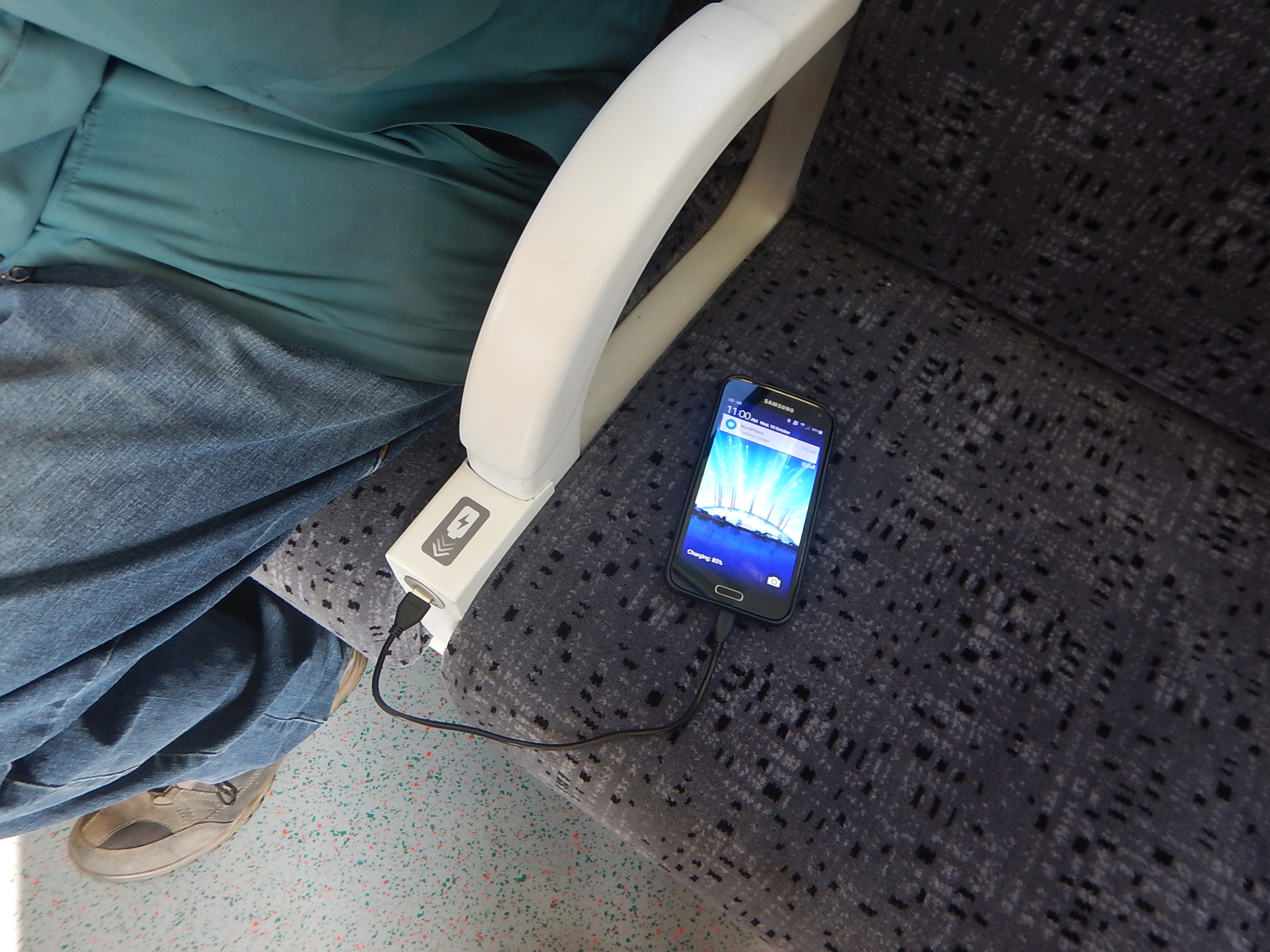
A similar setup in the armrests of a Class 378 train would be welcome.
This is the armrest in a Class 378 train.
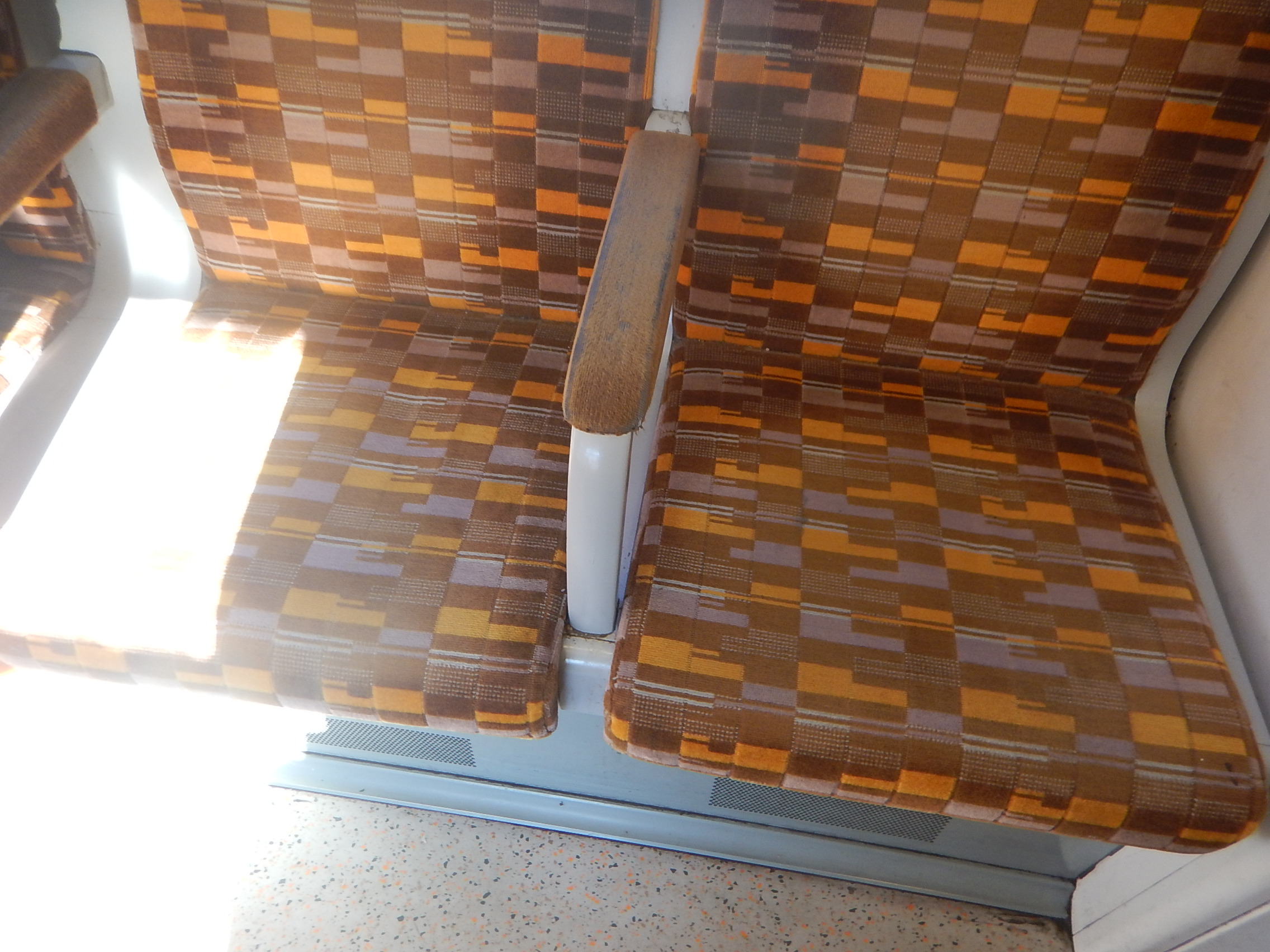
Could it be modified to include a USB socket?
Will The East London Line Ever Get Six-Car Trains?
On the East London Line yesterday, I was in the front car and it was noticeable how passengers moved backwards and forwards along the train so they could find a seat and also get in and out easily at the stations with short platforms.
It got me thinking, about whether six-car trains could be run on the East London Line.
Before I discuss this, I’ll give a few facts. Some are history and some are future plans.
The Original Line
I can remember taking the London Underground era line between New Cross Gate and Whitechapel stations, to get between Haywards Heath and Mile End stations. I had a client at the former and my youngest son, used to live by the latter.
The trains were four-car A60/62 Stock with a length of just 65 metres!
There were five intermediate stations, which coming North were as follows.
- Surray Quays
- Canada Water
- Rotherhithe
- Wapping
- Shadwell
The platforms and those at Whitechapel, were probably not much longer than the original trains.
The platforms have been improved in recent years.
- When the Jubilee Line was built, Canada Water station was rebuilt, but the platforms on the East London Line were not substantially lengthened.
- When the Overground was created in the early part of this century, the platforms ended up at their current length of around eighty metres.
- Recently, to create a better interchange for Crossrail, the platforms at Whitechapel station have been lengthened to around a hundred metres.
So there is now four short platforms on the East London Line.
The Class 378 Trains
The Class 378 trains were originally ordered as three-car trains, which were about sixty metres long.
Was this short length to fit the short platforms or was it because it was felt that these trains would be adequate for the route?
By the time, the trains entered service in 2010, the trains had all been extended to four-cars.
But this was still inadequate and in 2013 an order was placed to lengthen all trains to five cars, which was completed in January 2016.
Fitting Five-Car Trains Into Four-Car Platforms
Travel in the last coach of a train between Shadwell and Canada Water stations and when a station stop is made, you are left in the tunnel.
Some or all the doors don’t open and a announcement tells you, that if you want to get out, you should move forward in the train. This picture shows the last carriages of a train at Canada Water station.
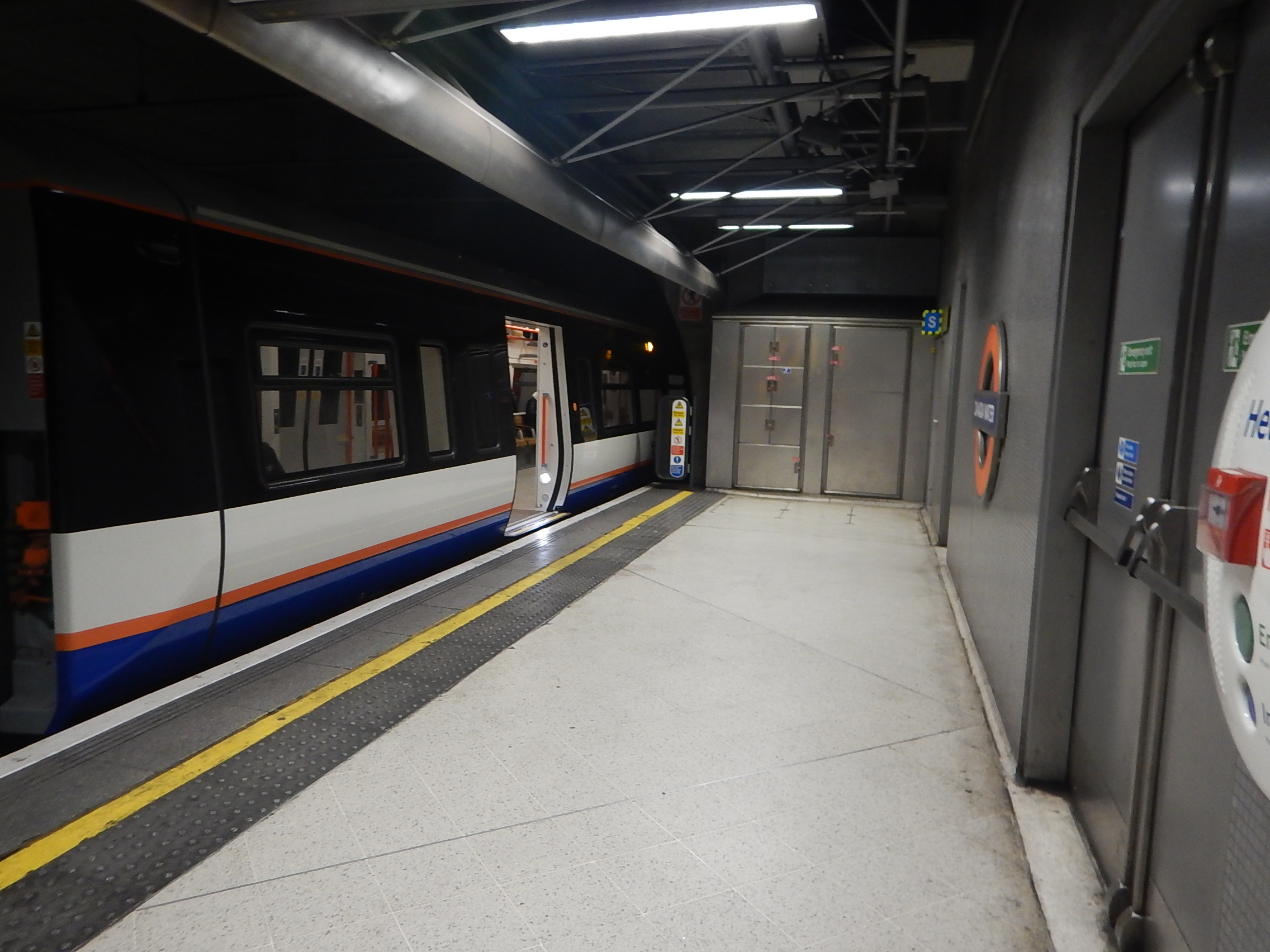
The less-than-perfect arrangement works very well.
- The walk-through nature of the trains means passengers can easily walk forward if required.
- The announcements are numerous and clear.
- Only Canada Water station, with its interchange to the Jubilee Line is a busy station.
But what probably makes the system work so well, is the fact that East Londoners are the World Champions at ducking and diving and they adjust their behaviour to the less-than-perfect arrangement.
The Length Of The Northern Platforms
Travelling home to Dalston Junction station in the last carriage, I got the impression, that all platforms are built to comfortably accept five-car trains.
It also appears that the two central bay platforms at Dalston Junction station were built for five-car trains.
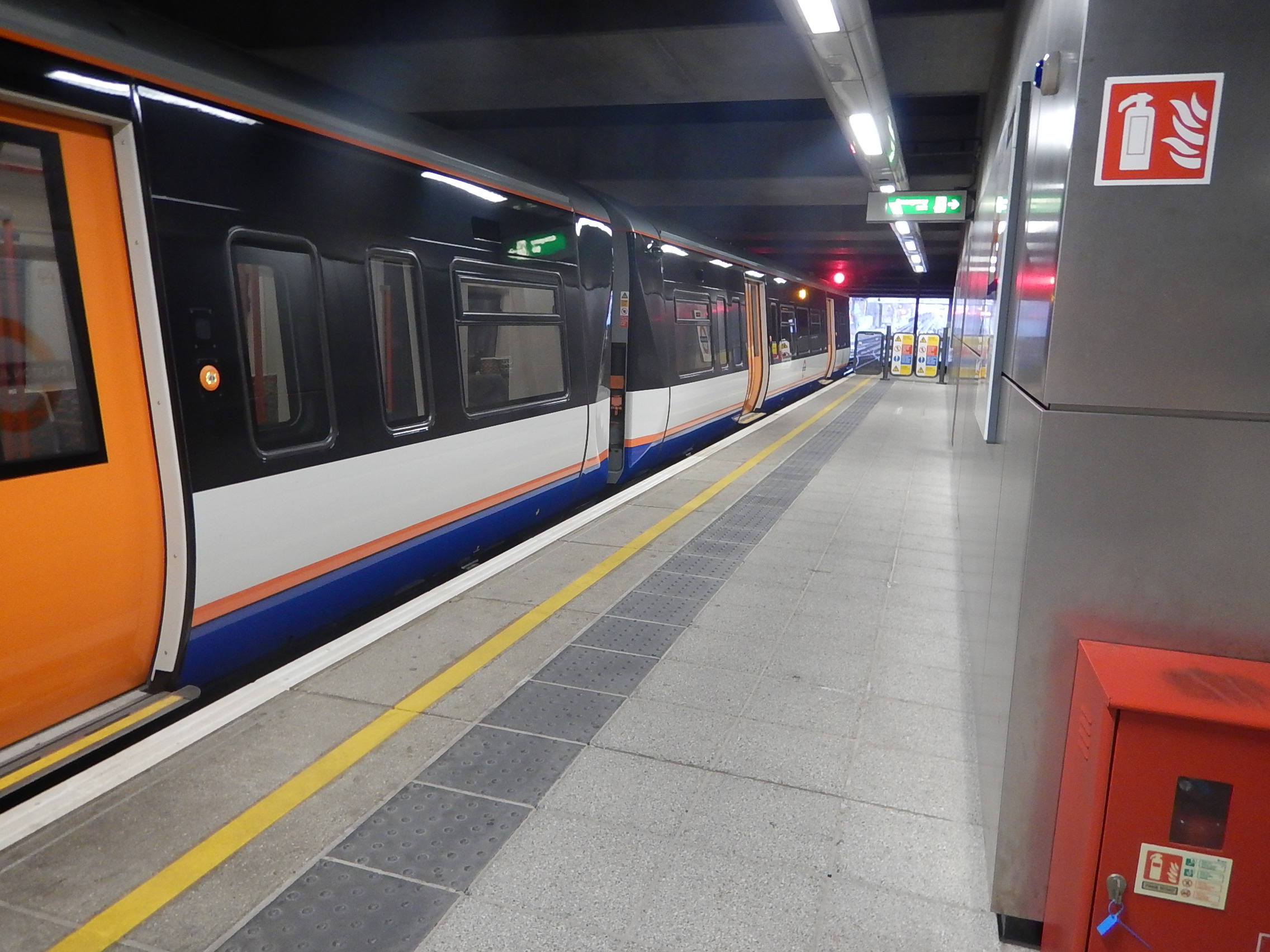
This picture shows Platform 2 at Dalston Junction station.
The Length Of The Southern Platforms
I have looked at nearly all the Southern platforms on all four Southern branches and there seems to be few if any platforms, that couldn’t take a six-car train. It should be noted that most platforms are shared with Southern services which are run by longer trains.
These pictures show Sydenham station.
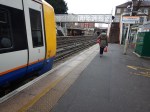
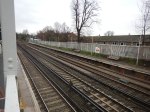
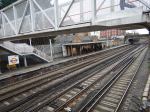
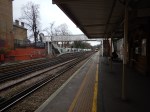
Platform lengths like these are typical of many stations.
Work would be needed at Platform 2 at Clapham Junction station.
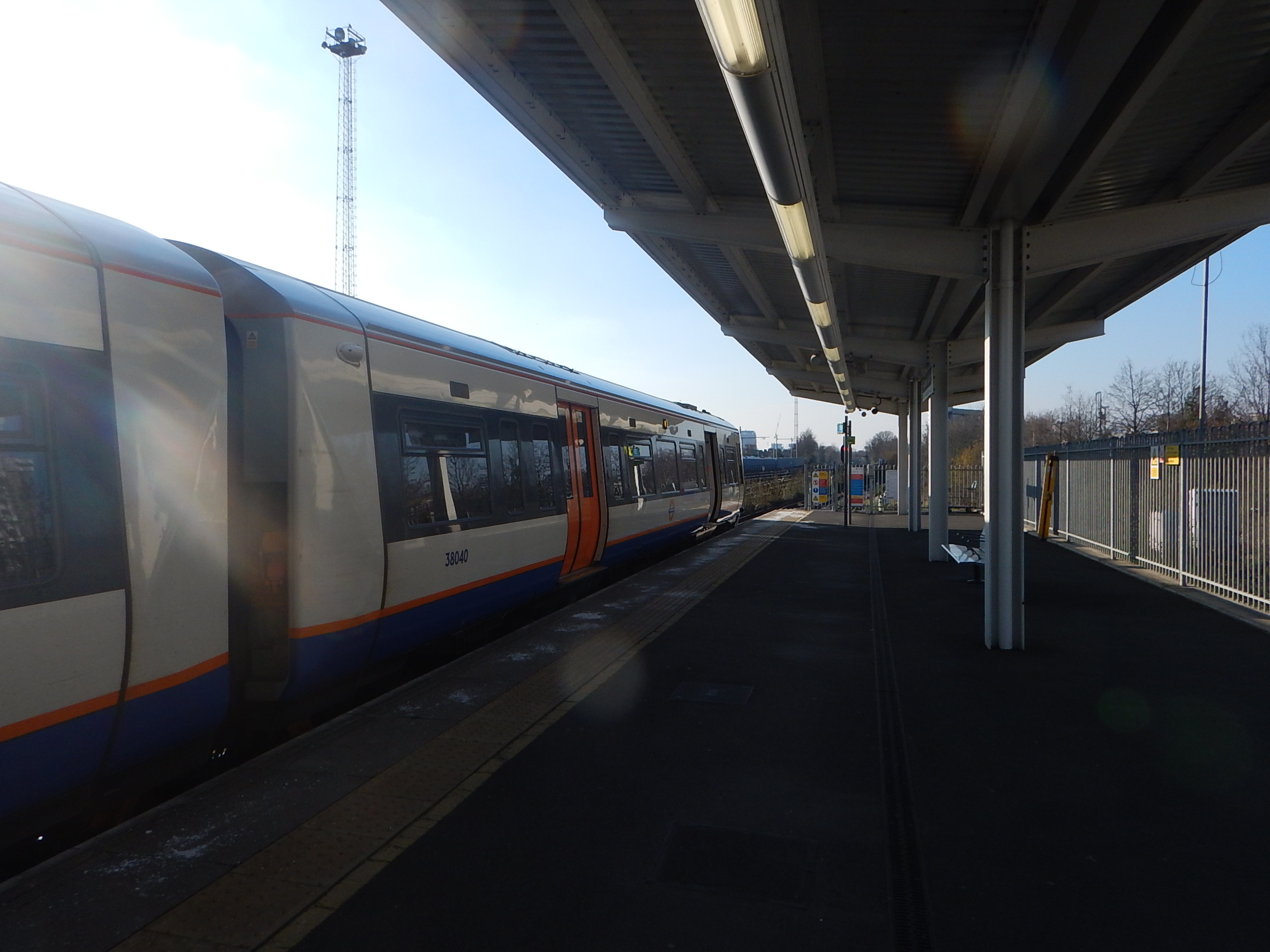
But there is space to extend the platform.
There are no problems at West Croydon station, where it seems all trains now use the bay Platform 1.

There appear to be no plans to increase services to West Croydon station from four tph, but turning the trains in the bay platform might make scheduling easier.
The Rebuilding Of Whitechapel Station
Whitechapel station is being rebuilt to provide an interchange between Crossrail, the District and Hammersmith & City Lines and the East London Line.
- The rebuilt East London Line platforms appear to be long enough for six-car trains.
- There will be two footbridges over the East London Line.
- There will be lifts and possibly escalators.
It will be a major high-capacity interchange.
The connection to Crossrail at Whitechapel station may actually take pressure from the Canada Water station.
Will passengers from the Northern section of the East London Line change at Whitechapel for Crossrail, if they are going to the West End or Canary Wharf, rather than using the Jubilee Line from Canada Water station.
As Crossrail will open up a large number of new routes, I believe, Whitechapel station will become one of the most important interchanges in East London.
East London Line Frequency Will Be Increased
This table shows Transport for London’s plas for the London Overground.
Note.
- In 2018, two extra trains per hour (tph) are planned to be run between Dalston Junction and Crystal Palace.
- In 2019, two extra tph are planned to be run between Dalston Junction and Clapham Junction.
This will mean that the frequency through the core of the East London Line will rise from 16 tph to 20 tph. This will be a train every three minutes.
It also means that the London Overground will be running ten tph between Whitechapel and Sydenham stations, with a call at New Cross Gate, which could become an important interchange.
Platforms Would Need To Be Lengthened
I think that, unless someone can come up with an innovative solution, that there will need to be some platform l;lengthening to accommodate six car trains on the East Londoin Line.
The tricky problem would be extending the platforms at Shadwell, Wapping, Rotherhithe and Canada Water stations.
Could Frequencies Be Increased?
After the increase of frequencies to Crystal Palace and Clapham Junction to four tph, there will be twenty tph, through the core of the East London Line.
With five-car trains, this would be a hundred cars per hour and with six-car trains, it would be 120 cars per hour.
Suppose another four tph, were to be squeezed through the core, then this would be 24 tph. With five-car trains, this would be 120 cars per hour.
There would be two main alternatives to increase the frequency.
- Run six tph on all the four routes.
- Add a new route, with a frequency of four tph.
Note.
- Twenty-four tph, is a frequency that is proposed for Crossrail and Thameslink using digital signalling.
- There will be one train every two and a half minutes.
- No major engineering work would be required at the stations with short platforms.
I very much feel, that increasing the frequency of trains, will be more affordable than using six-car trains.
The Problem Of Creating Six-Car Trains
Note these points about running trains through the core of the East London Line.
- Class 378 trains have an end door, so that passengers can be evacuated in the Thames Tunnel.
- Aventras don’t have end doors and would need to be updated.
- Five-car Class 378 trains can be replaced by Aventras on the North London Line and the Watford DC Line, to release more trains for the East London Line.
But the biggest problem, is probably that Bombardier don’t make Electrostars any more, and the factory ihas been turned over to Aventra production.
Conclusion
I will be very surprised if Network Rail’s original plan on six-car trains on the East London Line happens in the next few years.
What Is The Operating Speed Of Class 710 Trains?
So far, five classes of Aventra trains have been allocated TOPS numbers and their own Wikipedia pages.
- Crossrail – Class 345 trains – 145 kph
- London Overground – Class 710 trains – Speed not disclosed
- Greater Anglia – Class 720 trains – 160 kph
- South Western Railway – Class 701 trains – 160 kph
- c2c – Class 711 trains – 160 kph
The other orders for West Midlands Trains are given as 145 kph for the Cross-City Line and 180 kph for longer distance trains, in Wikipedia.
Looking at these speeds, I think that the operating speed of the Class 710 trains, must either be the 145 kph of the Crossrail trains or the 160 kph of the suburban trains. Or they could be the 121 kph of London Overground’s Class 378 trains.
But it has not been disclosed.
As probably most Aventras use similar running gear and electrical and control systems, I wouldn’t be surprised that maximum operating speed, is just a setting in the train’s control computer.
London Overground’s Aventra Routes
Timings on London Overground’s routes, that will be run by Class 710 trains are as follows.
- Euston – Watford Junction – 47 minutes – 15 stops
- Liverpool Street – Cheshunt – 39 minutes – 15 stops
- Liverpool Street – Chingford – 27 minutes – 6 stops
- Liverpool Street – Enfield Town – 33 minutes – 13 stops
Comparing the new Class 710 trains to the current Class 315 and Class 317 and Class 378 trains, there are or may be performance differences.
- Class 315 and Class 378 are slower trains with a 121 kph operating speed.
- Class 317 trains have an operating speed of 161 kph.
- Dwell times mat be less on the new trains compared to some or all of the existing types.
So how will these differences effect the various routes?
Euston – Watford Junction
There seems to be long turnrounds on this service and I’m fairly certain faster trains could run this service more efficiently, which may mean that the same number of trains could run at a frequency of four trains per hour (tph).
Liverpool Street – Cheshunt
This service is based on a six minute turnround and I suspect could be run more efficiently, if a faster train could get each way in under thirty minutes.
Liverpool Street – Chingford
It looks like this four tph service is run pretty efficiently, but there is a ten minute turnround at Chingford.
Liverpool Street – Enfield Town
The Liverpool Street to Enfield Town service waits nineteen minutes before returning, so small savings in dwell times and a faster train, might allow a two tph service to be setup, where trains depart on the half-hour, using just two trains.
Four tph, which is planned to start on this route in 2019, would need just four trains.
Summery Of London Overground Routes
Faster trains with shorter dwell times will certainly improve the timings and frequency of London Overground’s services, that they intend to run with Class 710 trains.
I’m pretty certain, that they will enable the following.
- Four tph – Euston to Watford Junction
- Four tph – Liverpool Street to Enfield Town
They will also improve timings on Liverpool Street to Cheshunt.
Conclusion
But what will be the operating speed of the Class 710 trains?
I said it will be somewhere between 145 kph (90 mph) and 160 kph (100 mph)
Or it could be the 12kph of the current Class 378 trains.
Consider.
- I think that 145 kph, will be able to handle the two planned increased frequencies of four tph.
- 145 kph is identical to the Crossrail trains.
- 160 kph is identical to the Greater Anglia trains.
- 121 kph is identical to the London Overground Class 378 trains.
- 160 kph seems to be the speed of suburban Aventras.
It’s a difficult one to call!
Will The New Class 710 Trains Use Selective Door Opening At Gospel Oak Station?
These two pictures were taken of a Class 172 train in Platform 3 of Gospel Oak station.
The two-car Class 172 trains are just over 47 metres long.
In The Aventra Car Length Puzzle, I said that the Class 710 trains for the Overground would have twenty metre long cars, which is similar to the 20.4 metres of the Class 378 trains.
For information other four-car electric units, that Aventras are likely to replace have the following car-lengths
- Class 315 trains – 19.80 metres
- Class 317 trains – 19.83 metres
- Class 319/769 trains – 19.83 or 19.92 metres
- Class 321 trains – 19.95 trains
- Class 455 trains 19.83 trains.
So it looks like the Class 710 train, has been sized as a direct replacement foe much of the Mark 3-based electric multiple units.
This would mean, that no platform lengthening work needs to be done, when the many older units are replaced with new Aventras.
It would also mean that as I talked about in Musical Trains On The Overground, that Aventras could share routes with Class 378 trains without too much trouble on the North and West London Lines.
So will a four-car Class 710 train, which will be about eighty metres long fit Platform 3 at Gospel Oak station?
This Google Map shows the station.
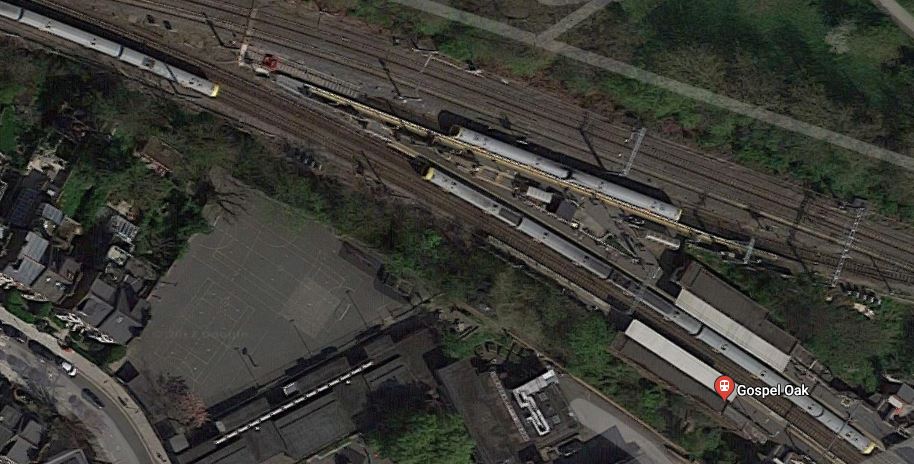
Note that a Class 172 train is in Platform 3 and in Platform 2 there is a five-car Class 378 train.
The length of Platform 3 can be ascertained and it looks like that Platform 3 is already long enough for an eighty metre train.
If it isn’t Bombardier certainly have fitted Selective Door Opening to the new trains.
Technology Doesn’t Have To Be Complex
This article on the Rail Tecjnology Magazine web site is entitled Easing The Capital’s Cramped Carriages.
On the London Overground, the Class 378 trains are Electrostars with an air suspension.
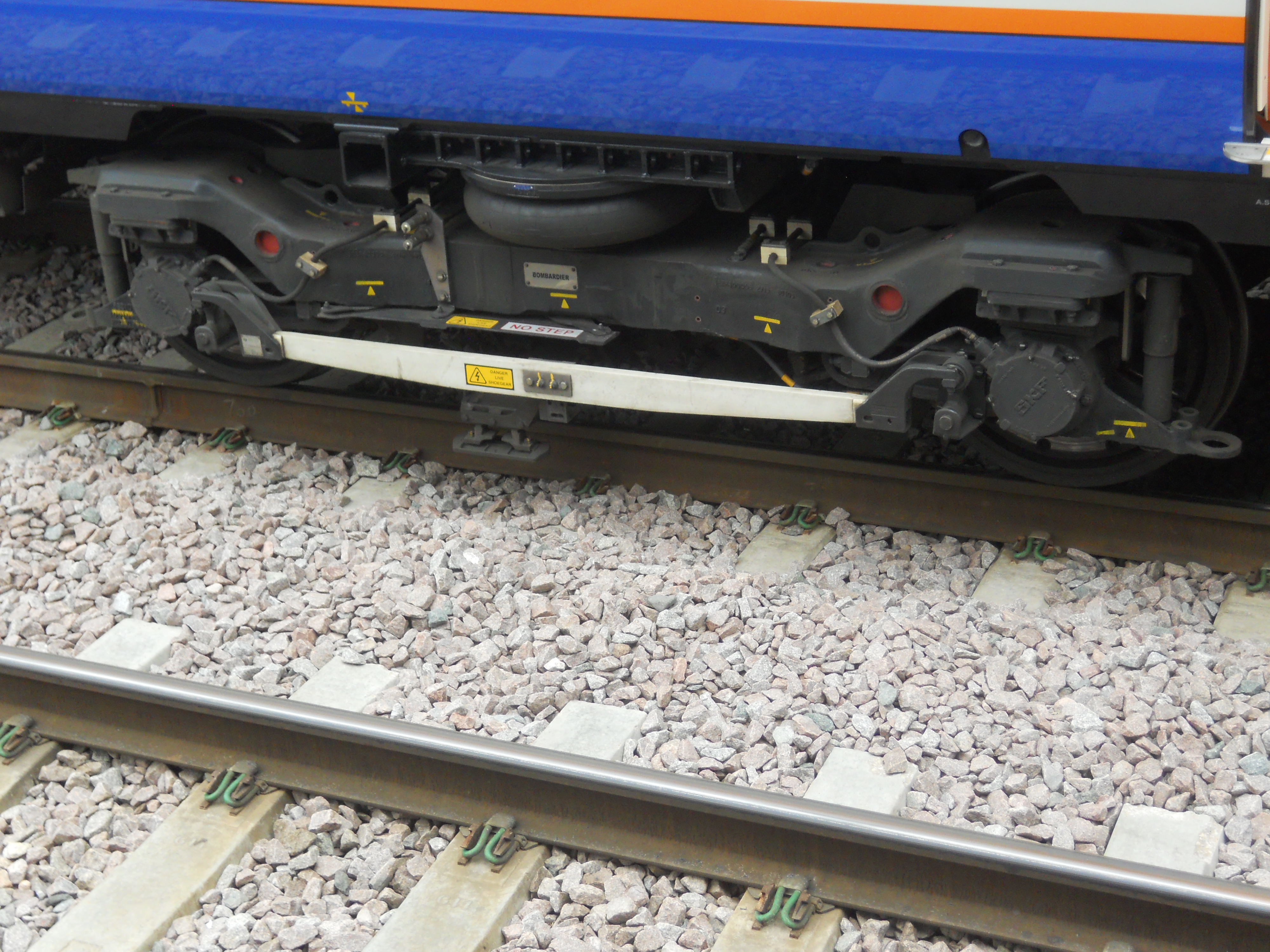
Note the rubber suspension bag between the bogie and the car on this Class 378 train. As more people, dogs, buggies and heavy bags are loaded into the train, more air is pumped into the suspension bag to keep the train level, so that the train rides better and passengers don’t have to step up and down to get in.
The pressure in the bag gives a very good estimate of the number of passengers in each particular carriage in the train.
The Rail Technology Magazine article describes how this information is collected and then processed and distributed to the iPads and iPhones of station staff, so they can direct passengers to the least crowded parts of the train.
I have read that other train manufacturers are working on sophisticated head-counting software using CCTV cameras, as I saw deployed on a 141 bus in Transport for London’s Latest Plot To Get Us To Climb Stairs. That device has disappeared, so I suspect there were problems, privacy issues or it just cost too much.
The system on a Class 378 train must be a lot simpler and cheaper to install, especially if the train has been wi-fi enabled. The Class 378 trains don’t have wi-fi, but many Electrostars do.
As information is always key in any system, it can lead to various developments.
- Modern station displays can be updated to show the train loading.
- There may be cases where train loading affects the platform a train would use at a terminus.
- Automated messages about train loading could be displayed on the train.
- Detailed train loading information must be useful in designing a train interior and also station layouts.
I suspect that those behind this project have got lots of applications.
Toilets In Class 345 Trains
I visited this topic in Do Crossrail Trains Need Toilets? over two years ago, when I said this.
Surely, a much better and more affordable solution would be to update the ribbon maps in all Underground and Crossrail trains to show if the station had toilets, in the same way, they show the step free access. Some extra signs on stations showing the status and location of toilets would also be a good idea.
Incidentally on the Essex and Reading legs of Crossrail, several of the stations already have decent toilets. Getting off a train and catching the next one, to have a relaxed toilet break, is probably not a huge delay, due to the high frequency of the trains.
London has a chance to set high standards in this area, without putting toilets on any trains.
My views haven’t changed, but I do think that now the Aventra is in limited service, I can speculate further.
Walk-through Trains, First Class And Toilets
London now has five walk-through trains.
- Class 378 trains on the London Overground.
- S Stock on the London Underground
- Class 700 trains on Thameslink.
- Class 707 trains on South West Trains
- Class 345 trains on Crossrail.
In some ways the Class 700 train is the odd train out, as it has both First Class seating and toilets.
It should also be noted that Greater Anglia’s new Class 720 trains don’t have First Class, but it appears they have toilets.
Walk-through trains are an undoubted success, as any Overground or Underground passenger will confirm, after seeing the way other passengers move around the train to both get a seat and be able to make a convenient exit.
First Class causes problems, as it blocks off this passenger circulation, unless it as one end of the train. But this means that First Class passengers might have a long walk to their seat at the wrong end of the day.
I wonder if walk-through trains encourage passengers to not use First Class, as the freedom to circulate in Standard Class makes the travel experience better.
It will be interesting to see how posh commuters from Frinton take to Greater Anglia’s new Class 720 trains.
Another problem of First Class sitting at one end of the train, is that if toilet provision is made, there must be a toilet near to First Class.
So if you don’t have First Class in a train up to perhaps ten cars, you can get away with perhaps a universal access toilet and a standard one.
From comments I get, most people seem to like the Class 395 trains or Javelins, that work the Highspeed services to Kent. These trains are six-car, with no First Class and two toilets.
So are these trains setting the standard for the Greater Anglia’s Class 720 trains?
Toilets On Class 345 Trains
The initial layout of Crossrail with terminals at Abbey Wood, Heathrow, Reading and Shenfield, has a longest journey from Reading to Shenfield of 102 minutes according to the Crossrail web site. But there are toilet facilities at Reading and Shenfield.
However, there is the possibility, that Crossrail trains may serve other terminals like Gravesend, High Wycombe, Southend and Tring.
Tring to Southend would be a journey of two hours, so a toilet is probably a necessity.
The current Class 345 trains have been designed to be nine-car units, although at present they are running as seven cars because of platform length issues at Liverpool Street.
I’ve read somewhere that Crossrail has been designed so that the trains can be increased to ten cars, if there should be a need for more capacity.
- Platforms have been lengthened to at least two hundred metres.
- All stations seem to have been updated for a large number of passengers.
- Lengthening from seven to nine cars is obviously a simple matter.
- A similar lengthening of the Class 378 trains was not a major exercise.
So surely, it would be a simple matter to slot in a car with a toilet.
So perhaps we might see an extra tenth car added to Class 345 trains, that is tailored to the route, as this ability to add and remove cars, is a feature of all Aventras.
Hitachi’s Class 800 trains also have the capability, as I suspect every well-designed train has.
The Ultimate Airport Train
Imagine a tenth car on Heathrow services.
- Disabled toilet.
- Ticket machine.
- Visitor information and shop.
- Space for large luggage.
The mind boggles!
Conclusion
If an operator wanted Aventras with a disco car, I’m sure Bombardier would oblige! At a price!
 The Anonymous Widower