Why Do UK Train Operating Companies Dislike Siemens Trains?
This post was suggested by this article on Global Rail News, which is entitled TransPennine Express Class 397 Fleet Taking Shape.
The following sections describe how the various train companies are replacing their trains built by Siemens.
TransPennine Express
TransPennine Express (TPE) currently have two fleets of Siemens trains; Class 350 and Class 185 trains.
Class 350 trains
TPE currently has a fleet of ten four-car Class 350 trains, which were built by Siemens and are used on electrified services between Manchester Airport and Scotland. They are being replaced by twelve five-car Class 397 trains.
The comparison between the two trains gives clues as to why the fleet is being replaced.
- The Class 397 trains are 125 mph capable, which means they can mix it with the Virgin’s Class 390 Pendelinos of a similar performance.
- The Class 350 trains are only capable of 110 mph.
- The fleet needed to be increased in number to handle services between Liverpool and Scotland.
- The five-car Class 397 trains fit the capacity needed for the Scottish routes better than the four-car Class 350 trains.
- The Class 350 trains don’t have wi-fi/4G and power-points to the current standard on some of the latest trains, like the Aventra.
I’ve not ridden in these trains, so I can’t comment on their quality.
I suspect it’s that the Class 397 trains have the 125 mph capability and adding another 110 mph train from Liverpool to Scotland would be too much for the West Coast Main Line to handle.
If you look at the current scheduled times of Virgin and TPE between Wigan North Western and Glasgow and Scotland, you get the following.
- Virgin – Wigan North Western to Glasgow – 2 hours 31 minutes
- TPE – Wigan North Western to Glasgow – 2 hours 46 minutes
- Virgin – Wigan North Western to Edinburgh – 2 hours 39 minutes
- TPE – Wigan North Western to Edinburgh – 2 hours 53 minutes
So it looks like the new 125 mph trains could save around fifteen minutes on a journey between North West England and Scotland. In addition to the quicker journey time for passengers, it might mean that TPE can use their trains more efficiently.
Nothing has been said, but I suspect that the new Class 397 trains can couple and uncouple automatically, as the Class 395 trains do regularly.
This would allow TPE to run a service like this.
- Two five-car trains start independently from Liverpool and Manchester Airport.
- The trains would couple together at Wigan North Western or Preston.
- They would then run to Carstairs at 125 mph.
- The trains would then split.
- One train would go to Glasgow and the other would go to Edinburgh.
The Southbound service would reverse the process.
In the 1960s, I travelled from Glasgow to Manchester on a service like this. T remember, that I was very late into Manchester, as we were delayed at Carstairs by the late arrival of the train from Edinburgh.
It looks to me, that TPE have decided to replace their Class 350 trains, with a faster and more flexible fleet, that can be run according to passenger demand.
Class 185 Trains
TPE also have a fleet of fifty-one three-car Class 185 trains, that were built by Siemens in 2005-2006.
These trains were in some ways very badly-specified for the route and have some deficiencies.
- There are not enough of them and they suffer badly from overcrowding.
- They are 100 mph trains, which means they are inadequate on the West Coast and East Coast Main Lines.
- They lack wi-fi and power sockets.
- They are diesel trains, that sometimes work on electrified lines, like Liverpool to Manchester and Leeds to Newxastle.
It is no surprise that TPE have decided to replace twenty-two of the Class 185 trains with Class 68 locomotive-hauled Mark 5 coaches and Class 802 trains.
- This gives a twenty-seven percent increase in the number of carriages.
- The Class 802 trains are 125 mph capable, so will be very handy for Liverpool to Newcastle and in a few years time to Edinburgh.
- The coaches are also built to be capable of 125 mph, but they would need faster locomotives to run at that speed.
- The new fleet will have the wi-fi and power sockets that passengers require.
This new fleet will certainly be better suited to TPE’s needs.
Greater Anglia
Greater Anglia are replacing all their trains, including their fleet of twenty-one four-car Class 360 trains, that were built by Siemens in 2002-2003.
However, in the August 30th Edition of Rail Magazine, there is an article entitled Trio Of Class 360 Desiros Reach Norwich For GA Timing Test.
It appears that, as the fastest trains in Greater Anglia’s fleet, they are being tested in case the new Class 745 trains are not ready before January 1st, 2020, when the Mark 3 coaches have to be retired.
South Western Railway
South Western Railway have a mixed fleet, which includes a lot of trains built by Siemens.
Class 707 Trains
South Western Railway (SWR) are still taking deliveries from Siemens of a fleet of thirty five-car Class 707 trains, that they inherited from South West Trains.
However, they have decided to replace the trains and their Class 455 trains with new Aventras.
I think that the main reason for having a fleet of 100 mph suburban trains, is that they get lots of advantages when it comes to creating passenger-friendly timetables.
But there are other reasons.
- SWR have said that all their trains will have toilets. The Class 707 trains don’t.
- The new fleet contains a lot of ten-car trains, whereas the Class 707 trains are all five cars.
- If all the trains are identical, this must give advantages with respect to management of trains and staff.
It looks to me, that South West Trains choice of fleet wasn’t in tune with SWR’s philosophy.
The Return Of The Class 442 Trains
Surprisingly, SWR are bringing back thirty-year-old Class 442 trains for the London to Portsmouth routes.
SWR probably need more trains to augment their forty-five Class 444 trains and a hundred plus Class 450 trains, which were all built by Siemens around the turn of the millennium.
Refurbishing the Class 442 trains is probably more affordable than ordering more trains from Siemens.
They can also be fitted with wi-fi, which the Class 444 and Class 450 trains lack.
West Midlands Trains
West Midlands Trains will takeover from London Midland in December 2017.
Currently, London Midland operate seventy-seven four-car Class 350 trains, built by Siemens in 2004-2014.
West Midlands Trains have promised to introduce 225 new carriages on Euston services.
As these trains work on the West Coast Main Line will they be 125 mph units like the Class 397 trains, so they can mix it with the Pendelinos?
Whatever happens, it does seem that the 100-110 mph Class 350 trains without wi-fi, may be living on borrowed time.
Thameslink
Thameslink is now a rail line run exclusively by Class 700 trains, built by Siemens in the last few years.
The trains were ordered without wi-fi and passengers are often critical of the trains.
In my opinion, the trains are inferior to Crossrail’s Class 345 trains, which have both wi-fi and 4G connectivity.
Conclusions
When I travel in a train that Siemens have built for the UK network, I often feel disappointed and think that they could have done better.
Perhaps the exceptions are South Western Railway’s Class 444 and Class 450 trains, but they lack wi-fi. These trains were built some years ago before it had been invented.
Wi-Fi
The Department for Transport now insists that passengers get free wi-fi and Crossrail is throwing in 4G connectivity as well.
I’m not sure, if there’s a Siemens train in the UK with wi-fi.
But then most trains in Germany have very poor wi-fi in my experience.
Could the design of Siemens trains make fitting of wi-fi and UK-sized power sockets difficult?
Contracts
Most trains these days are leased on long-term contracts, which includes maintenance. Could this cause problems with updating trains?
With the old BR-era trains, there are several depots and factories where trains can be updated and Bombardier seem to update their old tranis regularly at Derby. So is Siemens unprepared to update its older trains on the UK network?
The Aventras Are Coming
The first Class 345 trains are appearing with a quiet and smooth ride, excellent performance and wi-fi and 4G connectivity.
Siemens will have to raise their game to compete.
Could South Western Railway Use Class 395 Trains Instead Of The Proposed Class 442 Trains?
In When Do Mark 3 Coaches Accept The Inevitable?, I mused about why South Western Railway were using refurbished Class 442 trains on the routes betweenLondon and Portsmouth.
The reasons for using these refurbished trains include.
- They could be very powerful trains if they were retractioned.
- The Portsmouth Direct Line is very challenging.
- The trains might become 100 mph plus trains, which could save minutes on journey times and aid timetabling.
|The current Class 444 and Class 450 trains working the route may be 100 mph trains, but could it be that the required performance improvements need a more powerful and/or faster train?
I suspect too, that as the trains are based on legendary Mark 3 coaches, the interiors can be refurbished to a high standard with everything passengers need and want.
In Ultimate Class 395 Train, which is part of my analysis into Kentish routes in Kent On The Cusp Of Change, I proposed upgrades to a new batch of Class 395 trains.
- Batteries To Enable Working To Hastings For The New Southeastern Franchise
- Wi-Fi And 4G Capability
- Up To 125 mph Capability On 750 VDC Third-Rail Electrification
Would these trains be an alternative to the Class 442 trains for the Portsmouth Direct Line even using batteries to handle the topography of the line, regenerative braking and save energy?
If they were working a line like the Portsmouth Direct Line, where acceleration and power is probably more important than outright speed, the trains could be rated accordingly. The operating speed on the line is currently 90 mph, but how much time would be saved with perhaps a 110 mph train and some or all of the line able to handle speeds of 100 mph plus?
The choice of refurbished Class 442 trains, which are claimed to save five minutes on fast services and seven minutes on slow ones, says a lot about what is possible between London and Portsmouth.
But would a Class 395 train, similar to those needed on Kentish routes without the 25 KVAC capability be an off-the-shelf new train that could give the same or even better journey time improvements?
When Do Mark 3 Coaches Accept The Inevitable?
What Is A Mark 3 Coach?
This is a preamble to the main post, but if it is not included, you won’t understand a remarkable engineering story about how a nearly fifty-year-old British Rail design lies at the heart of the plans for an upgraded train service on one of the UK’s most important rail lines.
The Wikipedia entry for the British Rail Mark 3 Coach , starts with these two paragraphs.
The British Rail Mark 3 is a type of passenger carriage developed in response to growing competition from airlines and the car in the 1960s. A variant of the Mark 3 became the rolling stock for the High Speed Train (HST).
Originally conceived as locomotive-hauled coaching stock, the first coaches built were for the prototype HST in 1972. Production coaches entered service between 1975 and 1988, and multiple-unit designs based on the Mark 3 bodyshell continued to be built until the early 1990s. The Mark 3 and its derivatives are widely recognised as a safe and reliable design, and most of the surviving fleet is still in revenue service on the British railway network in 2016.
The Mark 3 coach is of an older age.
- The structure was reputedly designed by traditional methods without computer.
- Salford University Engineering Department did a finite-element structural analysis on the structure a few years ago and gave it a very good rating.
- The coaches have a full monocoque construction with an all-welded mild steel stressed skin rather than aluminium.
- Many engineers and passengers feel that it is one of the best-riding coaches in the world.
- The coaches have a reputation for exceptional strength and crash-worthiness, which was proven in the Oxshott A244 Bridge Incident, where a 24 tonne cement mixer lorry, fell fifty metres directly onto a Mark 3-based Class 455 train, without any fatalities.
But in some ways though the trains most worthy characteristic, is that train refurbishment companies and their engineers can convert them to any passenger or traction specification, that an operator wants.
The Mark 3 may only be a humble railway coach, but it is one of the world’s great engineering designs.
First and MTR Take South Western
The front cover of the May 2017 Edition of Modern Railways has the usual variety of headlines to grab the atrtention of passing browsers in station newagents.
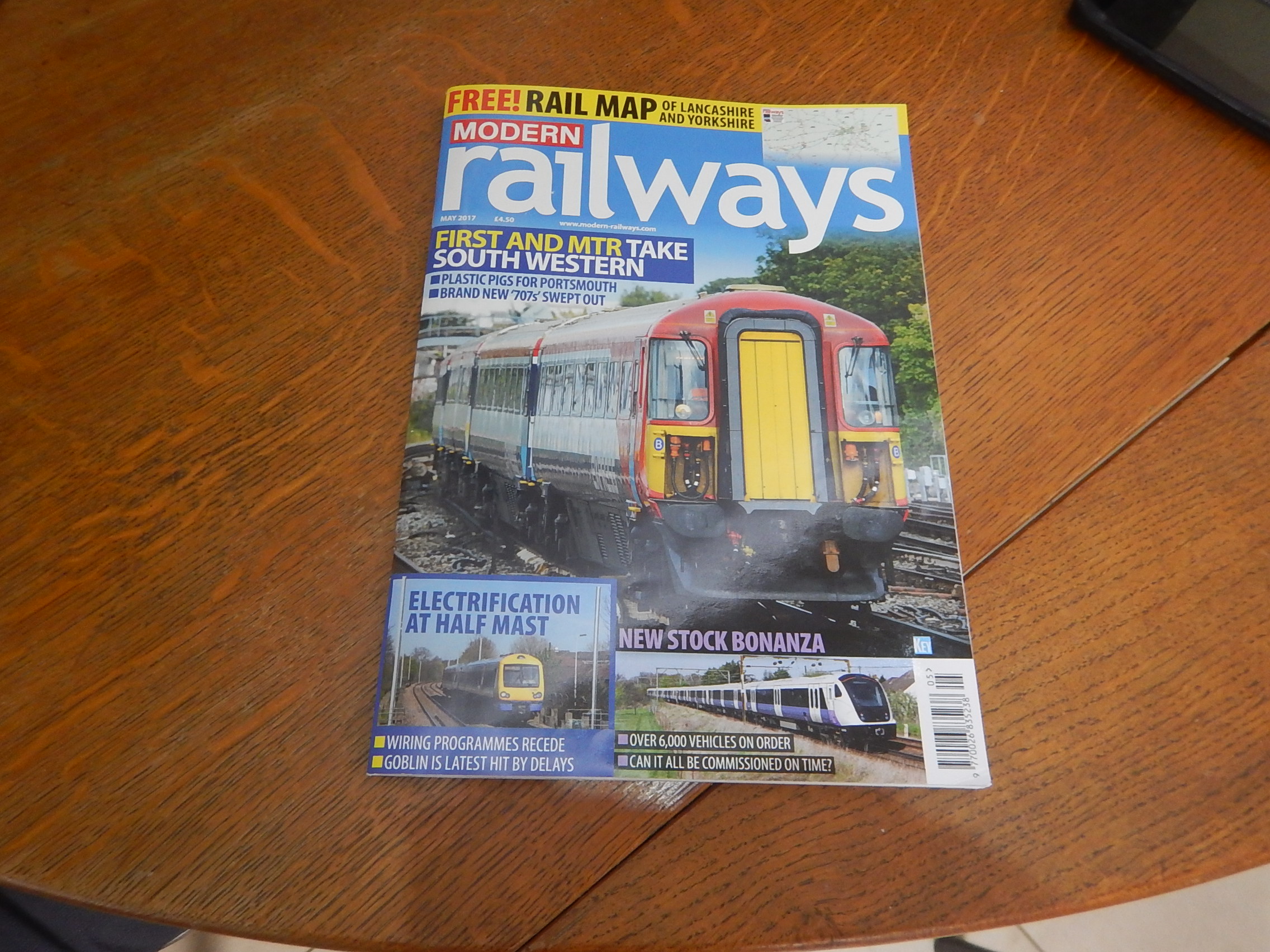
The main headline is First and MTR Take South Western with underneath it two sub-headlines of Plastic Pigs For Portsmouth and Brand New 707s Swept Out.
Further down, there is another headline of New Stock Bonanza.
Bringing Back The Class 442 Trains
Between the various headlines, is a picture, not of one of the new trains, but of one of the plastic pigs. It should be said, that this is the nickname for the Class 442 trains, built by British Rail way back in the late 1980s.
The Class 442 trains were originally built to serve the routes to Weymouth and in some ways they are the ultimate Mark 3-based design. They have proper sliding external doors, that meet all the regulations. This is an extract from Description in the Wikipedia entry for the Class 442 train.
As was common on the British Rail Southern Region, many electrical components – including traction motors and electrical control gear – were salvaged from the Class 432 units they replaced. For this reason the older 4REP and 4TC units had to be withdrawn before their replacements were built.
The Class 442 was one of the first types to make extensive use of plastics in construction, and earned the nickname among staff and rail enthusiasts of “Pigs” or “Piggies”. When they were first introduced the units were plagued by minor technical failures, but they have subsequently become among the most reliable EMUs operating in the UK
With this attitude to saving money, how did anything good ever get built?
I’ve only ever ridden in a Class 442 train once and that was to Gatwick Airport a few years ago. Using the trains on the Gatwick Express was a mistake, as the trains were not friendly to airport passengers, as the luggage space was totally inadequate.
London To Portsmouth In Class 442 Trains
But now South Western Railway are bringing the Class 442 trains back into service between London and Portsmouth.
The May 2017 Edition of Modern Railways says this about the reintroduction of the trains, under a sub-heading of Plastic Pigs’ Revenge.
The Class 442 EMUs built by British Rail for the Bournemouth-Poole-Weymouth electrification in 1988, are to be upgraded, including replacement traction equipment.
The article also mentions that on a demonstration run in April 1988, a Class 442 train claimed a world record of 108 mph for a third-rail train.
Currently, services between London and Portsmouth take the following times.
- London to Portsmouth – Fast – one hour thirty-three minutes with seven stops
- London to Portsmouth – Slow – two hours nine minutes with fourteen stops
- Portsmouth to London – Fast – one hour forty-two minutes with seven stops
- Portsmouth to London – Slow – two hours eight minutes with fourteen stops
With those journey times, I shouldn’t think that it is the easiest route to schedule given the amount of traffic at the London end of the route.
According to Modern Railways, there is an aim to save five minutes on fast services and seven minutes on slower ones.
Could this actually make the scheduling problem easier?
A fast return journey currently takes three hours fifteen minutes plus, whatever it takes to turn the train at both ends of the route. I think that this is a variable amount and is adjusted according to time of day. So knocking ten minutes off the return journey might well enable the turn-round times to be more even and create a more passenger-friendly timetable.
So how will these time savings be achieved?
Upgrading The Class 442 Trains
As I said earlier, Modern Railways are saying that the traction equipment is being replaced.
Seeing that the current traction equipment for a Class 442 train,came from a Class 432 train, which were built in the mid-1960s, I suspect the current design may be reliable, but could be improved upon, with respect to power and electrical efficiency.
The very least we will see will be new traction motors and control systems, with the probable addition of regenerative braking, where the traction motors generate electricity to slow the train.
Note.
- The current Class 442 trains do not have regenerative braking, so a lot of energy is wasted.
- The Class 444 trains which work from London to Portsmouth have regenerative braking, so obviously the track can handle the reverse currents.
So if nothing else, a new traction package which included regenerative braking, would make a sensible saving in electricity.
I suspect, there are engineers in one of the companies that specialise in upgrading traction packages, working to create the ultimate traction package for the Class 442 train. It would deliver.
- Fast acceleration and braking consistent with what is acceptable to passengers.
- Regenerative braking.
- Minimum energy usage.
Some might think a pantograph for 25 KVAC should be fitted, but I think the train is being modified to be a pure and simple; Pompey Rocket. The transformer to allow dual-voltage working would add weight and would rarely be needed.
A Train With An Engine In The Middle
The Class 442 train is unusual in that it only has one powered car and that is the piggie in the middle of each five-car train.
In A Train With The Engine In The Middle, I described the Stadler GTW, which is a three-car train, with one passenger car either side of a power module.
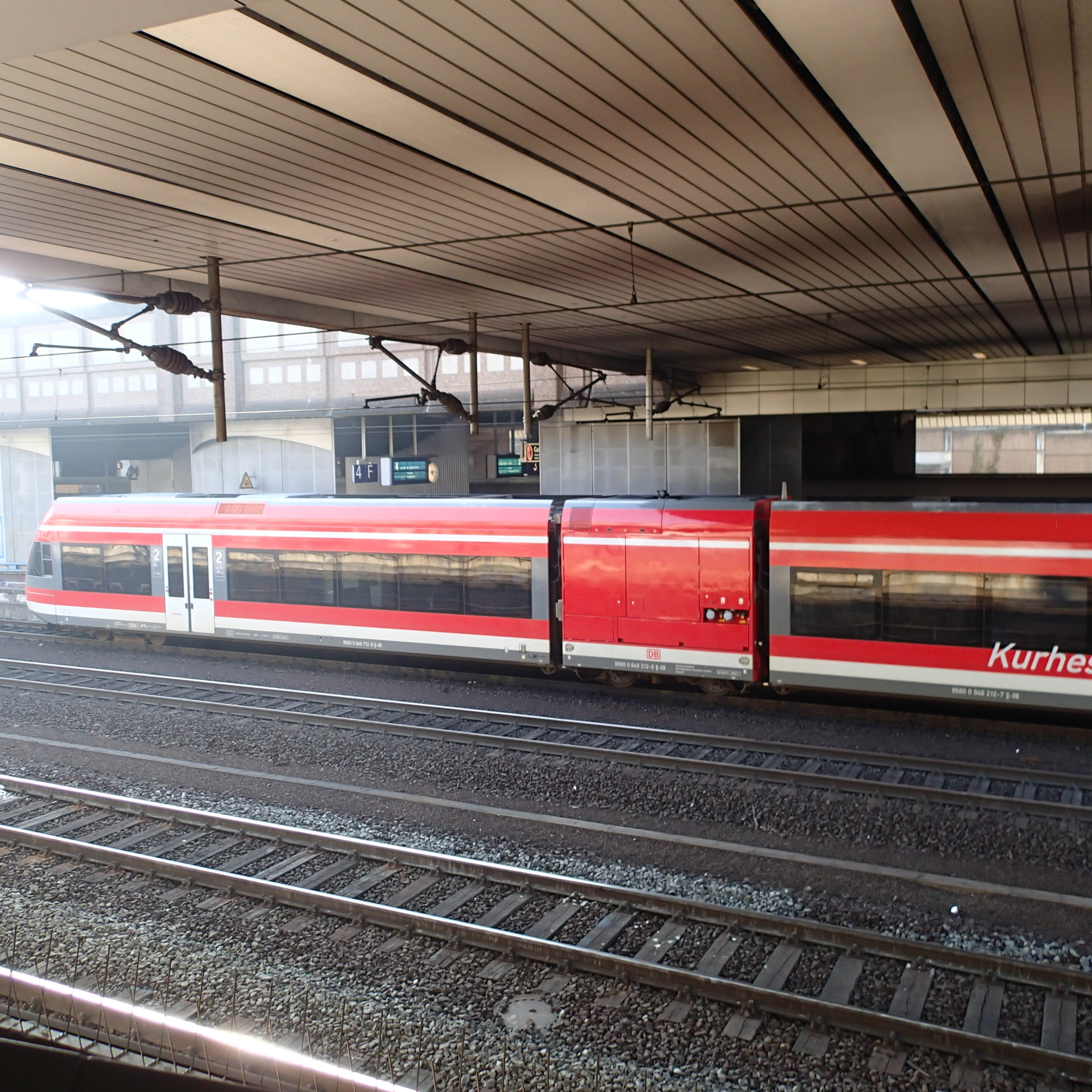
Wikipedia says this under Description for the Stadler GTW.
Although the traction is good for the powered bogies the concept has the same problem as other light railcars with the brakes on the non-powered axles having lower grip than traditional railcars. This has led to actual restrictions when leafs are on the rails as the wheel slide protection can not fully compensate the effect. The central power module has limits with heat dissipation as well which can lead into situations where the power output needs to be limited which is automatically done in this construction concept.
Perhaps because it is a heavier train, the Class 442 trains doesn’t have these problems!
I also have personal memory from about 1970.
At the time, I worked in simulation at ICI Plastics in Welwyn Garden City. I remember reading how British Rail Research at Derby had applied their analogue computer and dynamic modelling skills to the problems of why so many four-wheel freight wagons were derailing. They solved that problem and I have a feeling the work influenced the design of the running gear of the Mark 3 coach.
Could the unusual concept of the powered middle car of five have been influenced by all the research?
Incidentally, five-car Electrostars like Class 377 and Class 378 have unpowered middle cars, with most of the others powered.
Comparing power of a five-car 100 mph Class 442 train with a five-car 100 mph Class 377 train and they both have traction motors rated at a total of 1200 kW. The 442 weighs in at 199.54 long tons, as opposed to the 170.9 long tons of the Class 377 train, so it could appear that the modern train has faster acceleration.
The Class 442 Train And The High Speed Train Compared
By comparison, Wikipedia quotes the at rail power of a Class 43 locomotive as 1,320 kW.
Obviously, it was a deliberate design to put the motored car of the Class 442 train in the middle. But was it also, so that when working as a pair, you had two powerful power cars at 54 long tons separated by four lighter, but very stiff Mark 3 cars at between 35-39 long tons?
After all by the mid-1980s, British Rail had a lot of experience of running Mark 3 coaches between two powerful Class 43 locomotives, in the High Speed Train.
Surprisingly, the Class 43 locomotive is only 15 long tons heavier than the Class 442 motored car.
So could the Class 442 train be considered an electric HST, with a couple of extra cars at each end?
The dynamics could be similar and I suspect British Rail knew the dynamics of Mark 3 coaches and locomotives well.
After all, a few years later High Speed Trains on the East Coast were lengthened from 2+8 to 2+9, with it appears few problems.
The Ease Of A Power Upgrade
Upgrading the power on a Class 442 train could be easier than some.
- All the power systems, except for the current collection, are in piggie numbered three in the middle.
- Changes will be needed in the driver’s cabs, but I suspect that most changes in the rest of the train will be purely cosmetic and for the ease of passengers and crew.
- The interior layout of the powered car has been chopped and changed many times, so it could be rebuilt to see the trains to their final retirement.
- Engineers have plenty of space in which to work.
- The upgrade would be more like updating a locomotive than an electric multiple unit.
I doubt it would be a very high cost upgrade, but the budget won’t need to be small, as an alternative fleet of eighteen 100 mph trains wouldn’t come cheap.
I suspect too, that in the rebuilt power car, no technology that helps the train meet the required performance, will be ruled out on grounds of cost.
Will The Upgrade Include A Battery?
I just wonder, whether onboard energy storage features in the engineers’ thinking?
This page on the Southern Electric Group website, shows a series of side views of the motored car. It would be interesting to see if a battery about the size of the 75 KwH unit in a Routemaster bus could be squeezed underneath.
Suppose the energy generated by the regenerative braking whilst stopping, were to be stored in such a battery.
This would mean.
- Braking energy could be used to accelerate the train after the stop.
- Less energy would need to be transferred from the train using the third-rail.
- Electricity would be saved.
- The train would have a short range on battery power.
In the Wikipedia entry for the Portsmouth Direct Line, there is a section called Topography Of The Line. This is said.
The central part of the route, from Guildford to Havant, runs through relatively thinly populated country. The line was designed on the “undulating principle”; that is, successive relatively steep gradients were accepted to reduce construction cost. In the days of steam operation this made the route difficult for enginemen.
Leaving the Southampton main line at Woking, the line diverges southwards falling to Worplesden and then climbing to Guildford, using the River Wey valley. After gentle gradients, the line then climbs from Godalming for eight miles (13 km) at 1:80/1:82 to a summit near Haslemere; it then falls at 1 in 100, climbing briefly at Liphook and then falling at 1 in 80 to Liss. A second climb of three miles (5 km) follows to a summit at Buriton Tunnel, then falling at 1 in 80 and then more gently for 8 miles (13 km) to Havant.
I’m sure that extensive modelling of the Portsmouth Direct Line has been done and it has been investigated whether a small amount of energy storage would be useful in assisting performance and saving electricity.
Will These Modifications Produce The Proposed Timings?
The upgraded Class 442 trains will probably be able to execute a stop at a station in a shorter time than the current Class 444 trains.
On the slow services, South Western Railway is aiming for a saving of seven minutes on a journey with fourteen stops, or a saving of just thirty seconds a stop.
I also suspect that services on the challenging Portsmouth Direct Line would be helped with a modern traction package and South Western Railway’s goal of a five minute saving is possible, especially as the seven stops might give three and a half minutes.
Conclusion
I suspect that someone will come up with a very innovative traction package.
The inevitable retirement could be a lot of years away yet!
Some Trains Never Know When To Retire
This article in the Railway Gazette, which is entitled Southampton – London open access service proposed, caught my eye.
I like disruptive innovation in all its forms. When you consider that my pension is paid by the money I made from two examples of disruptive innovation, I would be a hypocrite to think otherwise.
To me, an open access operator on the railway, is just another form of disruptive innovation.
Although not open access operators, some of the smaller rail companies like Chiltern, c2c and London Overground are very much disruptive innovators.
If they get the product right they succeed, if they don’t they fail.
These train companies also bring much needed competition to a route.
I use them, when they are convenient to me and in the last couple of months, I’ve used several of them.
These points gleaned from the article describes the proposed Southampton London service.
- Alliance Rail Holdings hope to start a new Southampton – London Waterloo route in December 2017.
- Alliance envisages that there would be seven off-peak services a day, with two Peak services from 2018.
- They will be offering a high class service.
- They are proposing to use Class 442 trains for the route.
It is a proposal, I shall watch with interest.
I have never had many rides in a Class 442 train, but they are interesting beasts.
- They started to be introduced in 1988, so are nearly thirty years old.
- In some ways they are the ultimate development of the Mark 3 coach, with air-conditioning and plug as opposed to slam doors.
- They hold the speed record for a third-rail electric train.
- When first delivered, their reliability was questionable, but over time, they seem to have become a dependable electric multiple unit.
Recently, they have been working the Gatwick Express, but now that route has brand new Class 387 /2 trains, they are in storage.
It may seem strange to start a new train company with thirty-year-old trains, but then Mark 3 carriages still feel they have another few years yet. Certainly, companies like Chiltern and Abellio Scotrail are still recruiting them at the scrapyard’s door and giving them a treatment worthy of Joan Collins or Roger Moore.
In addition, there is this article from Rail Magazine, is entitled Refurbished Mk 3s for Tornado.
It describes how, a rake of Greater Anglia’s Mark 3 coaches, will be acquired to be used with the new-build steam locomotive 60163 Tornado.
I’ll be long dead, when the last Mark 3 coach is finally retired from revenue-earning service on the UK’s railways.
What Do We Do With Four-Four-Two?
I’m not referring to the formation used in football, but the Class 442 trains used on the Gatwick Express from Victoria.
At nearly twenty years old they are still comfortable trains in which to travel and I’ve used them a couple of times to get to or from Gatwick Airport and Brighton from London. As far as I’m concerned, they are not my preferred way to get to the airport, as they leave from Victoria, which is not as easy to get to as London Bridge from Dalston.
But there is nothing wrong with the Class 442 as trains, especially as they are based on the legendary Mark 3 coach and they hold the speed record of 174 kph for third rail electric trains.
The fact that they are third-rail only electric trains, is one of their two main problems. The other is that they weren’t designed as airport trains and are fairly unsuited for loading and unloading heavy cases.
It should be noted, that all of the third-rail electrics trains, built in the last few years are either dual voltage trains or they have a pantograph well, so they can be easily modified, so they can work with 25kV overhead electric lines.
The renewed franchise holder for Gatwick Express is reported as going to acquire a new specialist fleet of trains for the service, which will be delivered in 2016.
So we have the problem of a set of twenty-four five coach trains, with no service for which they are suitable.
They are fast trains, which means that only the suitable lines on which they could run are from Victoria to Brighton and Waterloo to Portsmouth, Southampton, Bournemouth and Weymouth. But they are unsuitable for the Victoria service, and they are not needed on the Hampshire services.
They are probably too old and too difficult to convert to overhead electric. It would seem to me with my engineering hat on, that to convert trains from third rail to overhead, unless that was in mind in the original design, is not a job with a small budget.
So conversion is probably a complete no-no!
So does the scrapyard beckon?
I would think so, but then a new coach costs around £1.5million and there are 120 coaches.
On the other hand, rail engineers have been living off scraps from the government for so long, that they are not short of innovative and oddball ideas. As an example read this article about how the previous Gatwick Express trains, the Class 460, were split up and used to lengthen the Class 458.
There are only two places where the Class 442 could appear to find a home.
The first is the two Coastway lines; East and West, which run from Ashford in the East to Portsmouth and Southampton in the West, via Hastings and Brighton. It would release other trains for use elsewhere, but I doubt it would need many of the twenty-four trains.even if the frequency was increased significantly.
The only other place where they could be used is on an electrified West of England Main Line to Salisbury and Exeter. I found this letter from South West Trains on the Network Rail web site. It states a whole list of advantages of electrying fom Basingstoke to Exeter.
So could the Class 442 find a home here on a third-rail electrified railway to Exeter?
It would probably go against policy to electrify such a long line in the archaic and incompatible third-rail system, but the upgrading does come with a set of fast affordable second hand trains in good condition, with an increasing reputation for reliability.
Another factor is whether Network Rail build a new route to Plymouth, as is outlined here on the BBC. If they do, I would suspect they would electrify it with overhead wires, so to have third rail to Exeter from Basingstoke, wouldn’t be that sensible.
So I still think that the Class 442 will go to the scrapyard.
But I wouldn’t mind being shown to be wrong and that the trains find a good home on somewhere like the West of England Main Line or the Coastways.
 The Anonymous Widower