More Class 68 Locomotives On The Way
So far there have been twenty-five orders for the new Class 68 locomotive and as there is no adverse criticism of the new locomotive on the web or in the railway press, it has to be assumed that they are working fairly well.
So it was no surprise to see this article on Global Rail News, with a title of DRS orders further seven Class 68 locomotives.
Let’s hope when the related Class 88 locomotives from the same manufacturer generate such a small amount of negative publicity, when they are introduced in the next year or so.
Two Nose-To-Nose Turtles
Turtle seems to be becoming the nickname for the new Class 68 locomotives.
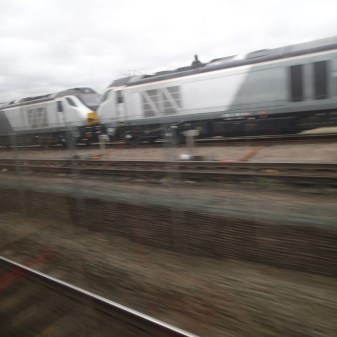
Two Nose-To-Nose Turtles
I spotted these two in the sidings alongside the Chiltern Line. There will be a total of twenty-five delivered to the UK in the current order and they will be followed by the Class 88, which is a locomotive than can either use electrical or diesel power.
The purpose of the unusual power arrangement of the Class 88, is so that on a journey say from Felixstowe to Acton, it can use electrical power for most of the journey with short runs using the diesel engine at the start and finish. In passenger duty they could be used on a run like London to Norwich under electrical power and then under diesel power to Great Yarmouth.
The politicians may have dithered over electrification, so engineers have come up with an electric locomotive, that can jump the gaps.
Innovations In Diesel Locomotives
All across Europe there is a shortage of locomotives to pull both freight and passenger trains. In some ways this may well be good news, as it could be said that the economies of some countries are at last picking up.
In the UK, there have been orders for the new Class 68 to pull both freight and passenger trains and for some more of the ubiquitous Class 66. As the latter class doesn’t meet the current emission standards, the order for the Class 66 will probably be the last for the type. In my view that is a good thing, as I’ve talked to drivers and although the engines are reliable, the working environment could be better. They also aren’t popular with some residents, who live near busy freight routes, as they aren’t the quietest.
So in the UK, we’ve seen a scraping around for motive power, and this partly explains, why some elderly engines, like the Class 20, I saw a couple of days ago, are still working.
But we have also ordered some new Class 88, which are an electric engine, with an on-board diesel engine, so are capable of going all over the network. So for say Felixstowe to Manchester via the routes through London, could be done without changing the engine en route.
I also found another interesting idea on the web yesterday. This article in Global Rail News describes the delivery of a new TRAXX locomotive in Germany. What is unique about the TRAXX P160 DE is that instead of one large diesel engine, it has four smaller ones. So the power can be adjusted to the load, therefore using less fuel and creating much less noise.
This technique has been used on some diesel multiple units like the Class 185 used by Trans Pennine. On their hilly routes, some parts need more power than others, so these trains have an eco-mode.
Over the next few years, we will see a lot more serious developments with respect to more power, better fuel economy and less noise.
Enthusiasm For Class 68 And Class 88
I found this article from Rail Engineer about the new Class 68 and Class 88 locomotives that will soon be pulling freight and passenger trains on the UK rail network.
The article is enthusiastic about the two classes, but notes that the Class 68 will not meet the toughest EU pollution regulations. This is particularly appropriate given that the UK and some European countries are suffering high levels of air pollution. The Rail Engineer article says this about compliance to the new regulations.
The CAT engines meet European Stage IIIA emission standards, and can be modified to meet 2012 IIIB emission standards by replacing the exhaust silencer with a diesel particulate filter. However, because of the UK’s restricted loading gauge, this would involve considerable re-design work if it were to be applied to the Class 68.
It is important that rail locomotives are improved, as the current mainstay, the Class 66 is not liked by those who live on busy freight routes, due to its noise. I’ve also talked to drivers, who feel they have other problems too.
As an engineer, I feel that the best solution is the next generation of locomotives like the Class 88, which will be a 200 kph electric locomotive with an on-board diesel for running on non-electrified track. I wrote about the Class 88 here.
 The Anonymous Widower