Siemens And South West Trains Unviel The Class 707 Train
In The Aventra Car Length Puzzle, I talked about the flexibility of Bombardier’s new Aventra trains. The first of these; Crossrail’s Class 345 trains, will hit the tracks in May 2017, when according to the September 2016 Edition of Modern Railways, they will enter service between Liverpool Street and Shenfield.
A month or so earlier,if all goes to plan, South West Trains will start running their new Class 707 trains, which are being built by Siemens in Germany.
This train is described in the following article in the same edition of Modern Railways.
The original in-service date of the Class 707 trains was July 2017, so having lost a bit of credibility with the late entry into service of the closely-related Class 700 trains, are Siemens trying to beat Bombardier’s Aventra into service?
Obviously, there a lot of new trains that will be ordered in the next few years and all tricks will be employed.
Reading, the article about the Class 707 trains, three things stand out thoughtful design, flexibility and future proofing.
- Although, the trains will be third-rail only, the first two trains will be fitted with pantographs during testing, to prove that the concept works. This means the trains could be passed to another operator in the future.
- No toilets are fitted, but all the wiring and plumbing is there, so they can be fitted later.
- Siemens have gone for 2+1 seating rather than longitudinal bench seating as on the Class 378 trains, because of the feet-sticking-out problem.
- The trains fature wide open gangways.
- The trains have air-conditioning.
- Unlike the Class 700 trains, the trains have wi-fi.
- The trains are full of electronics and are information-rich for passengers and drivers.
A lot of what I have said here, also applies to Bombardier’s Aventra.
This is said about the operation of Class 707 trains in Wikipedia.
The Class 707 units are intended primarily for services between London Waterloo and Windsor & Eton Riverside, allowing the Class 458 trains used on those services to be cascaded back to operations to Reading, which will then allow the Class 450s to move elsewhere. The intention is to run these services, as well as others via Staines, and some mainline services to Basingstoke, as ten-car trains with pairs of Class 707s.
So the lack of an end gangway will mean that the trains can’t run as a true ten-car train.
Of the other variants of these trains; Class 700 trains are fixed formations of eight and ten cars, that won’t be working as pairs and the Class 717 trains for Great Northern will have end gangways because of the tunnels they run through.
So I wonder why, South West Trains didn’t go for five-cars with end-gangways or ten-car trains.
Interestingly, Abellio’s order of new Aventra trains for East Anglia includes a mix of five and ten car trains. Will the five-car trains be able to work as pairs and will they be gangwayed? Nothing has been announced yet!
I think the theme running through both train designs, is the customer gets the trains that best fit their method of working.
A First Ride In A Class 700 Train
Today, I caught the 10:48 between East Croydon and London Bridge stations,. I took that train as this service was mentioned as the first one to be served by a new Class 700 train, in this article on Global Rail News.
As the pictures show it was one of the new twelve-car Siemens trains.
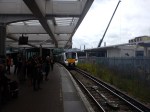

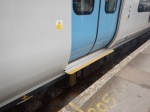
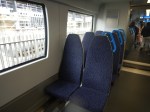
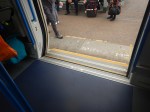

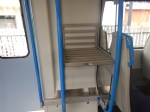
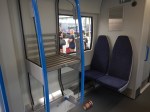
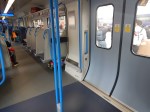
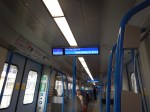

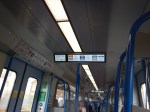
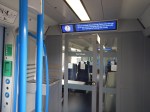
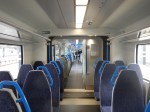


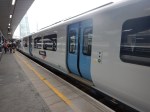
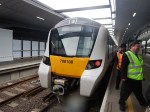
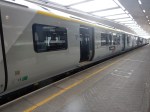
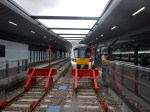
If I would give it a complement it would be competent, as most new trains seem to be these days.
The design features I like include.
- The spacious lobbies.
- The walk-through train.
- 2 x 2 seating.
- The comprehensive information system.
- The extra luggage racks, in addition to the usual racks above the seats.
- The simple colour scheme.
- The trains would work with platform-edge doors.
- Putting First Class at both ends of the train.
Passengers might complain about the following.
- The lack of audible messages. – I liked the quiet, but I’m not blind.
- The lack of tables in Standard Class compared with say the Class 387 trains, that currently work the line.
- The length of the train at 242.6m., if they get in the wrong carriage.
- The high step up into the train.
The last one is possibly to be compatible with other trains and is being addressed at East Croydon station, by raising the platforms. I didn’t go to Gatwick, but imagine large numbers of heavy cases being loaded and unloaded.
It will certainly be interesting to compare the Class 700 train, with Crossrail’s new Class 345 train, that is being built by Bombardier and could be testing later this year, with introduction in May 2017.
The length of the Class 700 and Class 345 trains at 242.6 and 200 metres respectively will certainly fuel the old chestnut about whether double-deck trains would have been better.
As I found with my short trip on a Class 700 train, walking from the back to the front could be a challenge for some. But commuters will develop strategies to make the journey easier.
So some may argue that double deck-trains might be easier on passengers.
But Thameslink and Crossrail have not been built for double-deck trains and certainly the older tunnels couldn’t accommodate them, without complete closure for a couple of years, so they could be rebored.
Both lines serve airports and stations, where passengers are likely to be bringing heavy baggage. This makes loading especially difficult on a double-deck train and delays the service.
Both trains have been designed with large lobbies and the Class 345 trains have three sets of doors on either side of each carriage. But they’ll need this space and doors as the longest trains carry upwards of 1,500 passengers.
These two fleets of massive trains will certainly change London. But I see problems in some areas, that must be addressed on Thameslink.
Stations
To realise the full potential of the Class 700 trains on Thameslink, some stations may need improvements.
Brighton could make for a lot of walking up and down the platform. Travelators?
I also think that Brighton needs a high-capacity East-West transport system to cope with the large number of passengers. Could the East Coastway and West Coastway Lines be connected together by a tunnel or a bridge over the station, which incorporated two connecting platforms?
East Croydon needs more improvements.
A dedicated island platform for Thameslink, as Crossrail has at Whitechapel, would knit all the branches together, so that journeys between any two branches were made easier and station footfall was reduced?
Gatwick is getting improvements, with a new concourse..
St. Pancras only has one big entrance in the middle. Does it need an extra Southern entrance? Or will passengers use stations like Farringdon, Finsbury Park and London Bridge to avoid the badly-designed station.
I certainly will avoid joining Thameslink at St. Pancras like the plague.
Step-Free And Disabled Access
The stations may be step-free, but the train-platform interface is not. However this is said in this document on the Thsmeslink Programme web site.
Platform humps at central London stations will provide level access for swift boarding by wheelchairs and people with buggies or heavy luggage – meaning no more ramps at the busiest central London stations.
I would assume humps would also be provided at stations like Gatwick and Brighton, if it were to be found they were needed.
I suspect, that in the end, humps will be provided at all stations served by Thameslink, as it will ease the logistics of running the system.
Platform Edge Doors
I don’t like platform edge doors as a passenger, but as an engineer, they make loading and unloading trains more efficient.
The Central Tunnel
The big problem with Thameslink, is that we are aiming to get twenty-four trains per hour under London.
Trains will have a schedule and must be driven exactly to those times. As the time between trains is just one hundred and fifty seconds.
So supposing, there was a problem with loading at say Purley and the train was delayed by five minutes, you have a serious problem, that would knock on for some time.
Every possible cause of delay should be eliminated.
- All stations must have humps for wheelchair users.
- Central stations may get platform edge doors.
- Stations must be improved so that passenger flows are not impeded.
- Train reliability must be as close to a hundred percent as possible.
As a Control Engineer, I strongly believe that all trains should be driven automatically.
An illustration of the problem was provided this morning at East Croydon, whilst I was waiting for my Class 700 train..
There were late trains all over the place, due to various problems including power supply, signalling and staff sickness.
, The Thameslink service is going to need all the help it can to get all the trains lined up and on time to go through the central tunnel.
What About Crossrail?
Crossrail has big advantages over Thameslink.
- ; All of the central stations have new platforms, which have been designed to fit the new trains.
- The branches to the four terminals, run for nearly all of their routes on dedicated tracks without other trains.
- The central stations have platform edge doors for safety, which may improve time-keeping on the service.
Overall though, Crossrail is a much simpler design than Thameslink.
Making Crossrail work will be a lot easier than making Thameslink work!
Sutton Station
Sutton Station is one of the stations on a proposed South London Outer Orbital
These are pictures I took of the station and the town as I passed through.
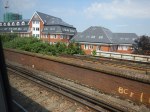
Sutton is one of those stations, that will see a dramatic improvement in services in the next few years.
- Thameslink will get newer higher-capacity Class 700 trains.
- The Tramlink may finally reach the town. I wrote about this and a further extension in Why The London Tramlink Should Be Extended To The Royal Marsden Hospital.
Given all the development around the station, more services will be desperately needed.
Sutton will develop into a major hub station like Wimbledon, but with not anywhere near as many services as East Croydon.
A South London Orbital Route should call at Sutton to tap into the stations excellent connectivity.
The Class 700 Train Launch At Blackfriars Station
I took these pictures when Thameslink launched the new Class 700 train this morning, at Blackfriars station.
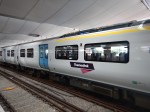
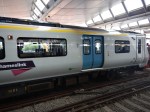

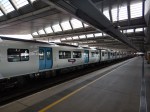
I’ll be very pleased, when I get to have a ride and take a look inside. I suspect six on a Sunday morning at St. Pancras Thameslink, will be a good place to start.
Hayes Shuttles To Start
This is the headline on an article in the May 2016 Edition of Modern Railways about the May 15th timetable changes. This is said.
Great Western Railway had planned a launch of electric services using Class 387/1 EMUs transferred from Govia Thameslink Railway with the start of the new timetable on 15 May. The operator was to use the ‘387s’ on a series of peak hour shuttles between Paddington and Hayes and Harlington, but delays to the introduction of Class 700s on Thameslink services mean the cascade of ‘387s ‘ has also been delayed.
I have searched the Oracle (National Rail’s Journey Planner) and can find just one extra train from Paddington, which is a new service at 07:15 going to Hayes and Harlington.
The Oracle also shows that the first two services of the day on the Greenford Branch only go as far as West Ealing after May the 15th.
How many people from the Greenford branch will be complaining about the loss of their early morning trains to Paddington?
The Modern Railways article also suggests, that as Bombardier have been making good progress on the building of the eight extra Class 387 trains, that these might be delivered in the summer, to enable GWR to run more services. As some of the Porterbrook trains have been promised to c2c before the end of the year, that means that GWR’s extra trains will be delivered before December 2016, as they are first in the queue.
The article says that a full service can’t be run until infrastructure works at the East of Hayes and Harlington station is completed.
I think we’ll see a gradual improvement of electric services between Paddington and Hates and Harlington over the rest of this year.
These questions will certainly be answered.
- When will the bay platform at West Ealing station for Greenford Branch Line trains be opened?
- Will the bay platform at West Ealing station be electrified?
- Will the eight extra Class 387 trains have an IPEMU-capability, as had been rumoured in Modern Railways?
- How much acrimony is being heaped on Siemens about the non-delivery of the Class 700 trains?
- Are the bosses of Great Western Railway and Govia Thameslink Railway still talking?
- Will Porterbrook add to their order of twenty extra Class 387 trains?
It does seem to me, that the big winners out of this mess, could well be Bombardier and Porterbrook.
I also feel that there will be some surprises between now and the end of the year.
I will keep most of my predictions to myself!
However, it would appear that if there was a plan to create an IPEMU variant of the Class 387 trains, the non-delivery of the Class 700 trains, has effectively made this plan difficult and late.
Where Are The Class 700 Trains?
According to the Class 700 entry in Wikipedia, the first train should have entered service on Saturday.
But it didn’t and there’s nothing on the Internet as to why!
New Trains On Thameslink
I had breakfast at Kings Cross and then hopped across the city on Thameslink to Blackfriars to go for a walk through the Tate Modern. I came back to Farringdon, as because the East London Line is closed, a bus from Moorgate is the best way to get home.
These were pictures I took of new trains on Thameslink.
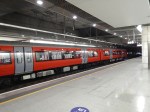
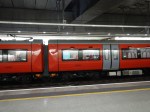
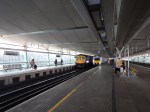
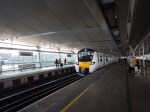
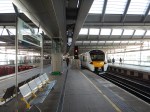
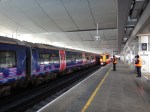
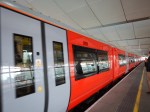

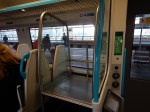
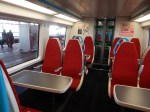
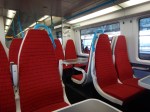
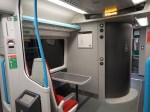
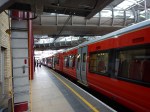
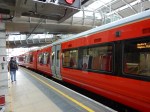

Note the following.
- The red trains with the grey doors are Class 387/2 trains destined for the Gatwick Express later this month.
- The interior shots were all taken in a Class 387/2 trains.
- The white train with the sloping front and the light blue doors, is a new Class 700 train, which will run on Thameslink.
The pictures were taken at St. Pancras International, Blackfriars and Farringdon.
The new Class 387/2 trains had a definite feel of the Class 387/1 trains about them, except they had sizeable luggage racks and possibly more tables.
There are better and more luxurious airport trains in the world, including probably the Class 332 trains of Heathrow Express. But as a train to speed you to the Airport in thirty minutes or so, with plenty of space for you and your luggage, they probably pass the first test by a good margin.
They would be very good on other Airport routes in the UK.
- Routes connecting Manchester Airport to Liverpool, Manchester, Crewe and Blackpool.
- A possible Gatwick Express route from Reading to Ashford International, which I think could happen, if an IPEMU variant were to be developed.
- To and from Airports like Cardiff, Stansted and Southend.
An IPEMU variant could be useful in developing spurs to airports like East Midlands, Luton and Glasgow, which would be built without wires from lines with full electrification. Bombardier has the technology, all they need is the orders.
Would this approach be an affordable way to create the much needed airport link at Glasgow Airport?
- A single-track spur leading from the Inverclyde Line to the Airport to a single platform station would probably have enough capacity for a two or three trains per hour service.
- No electrification would be needed, which would mean that there would be greater flexibility in the route of the line. It might even go in a single-track tunnel under taxiways.
- There would be some modification to the signalling.
- The trains would be bog standard Class 387/2 trains, except for the energy storage.
- Two trains would probably give a two trains per hour service to the airport, as Glasgow Central to Paisley \st. James takes around twenty minutes.
- The trains would just be more trains running between Glasgow and Paisley.
- It would be simpler than a tram-train and require no special rules or modified stations.
- I can’t think of any new regulatory issues, as it will be a train running on a railway.
- There would need to be some staff training.
The overall system would be no more complicated than running the demonstration Class 379 IPEMU on the Harwich branch, which seemed to work so well.
How much would it cost?
The creation of the new line to Ebbw Vale Town station and the single platform station is reported to have cost less than twelve million pounds.
According to this article in Railway Technology, Porterbrook have paid £100million for twenty Class 387 trains, so two trains would cost ten million.
I also think that provision of the track and trains in something like the Glasgow Airport Rail Link, is the sort of project that a company would provide and then lease to the train operator.
No wonder, that Bombardier have won an award for the technology and Porterbrook bought some Class 387 trains on spec.
South Croydon Station
I took these pictures at South Croydon station.

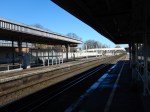
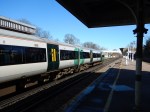

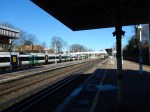
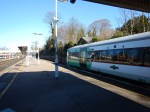


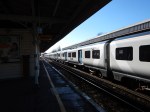
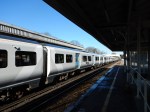
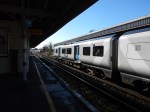
I think it would be true to say, that South Croydon station is looking for a place in the rail network South of London.
The typical off-peak service in trains per hour is:
- 2 to London Victoria via East Croydon and Norbury
- 2 to London Bridge via East Croydon and Forest Hill
- 4 to Caterham
Which isn’t much for a station with six platforms.
As I watched for about fifteen minutes, I saw all manner of trains speed through including a new Class 700 train.
When Thameslink opens in 2018, current plans don’t have any trains calling at South Croydon. I think that these will be changed so that a regular pattern of four trains an hour in both directions will call, as Thameslink will want to give passengers at as many stations as possible access to Thameslink services.
If they don’t, I hope they are ready for the protests.
Anybody at station X without Thameslink will be complaining if station Y does!
A Class 700 Train On Test
I took this picture of a Class 700 train just North of Norwood Junction station.
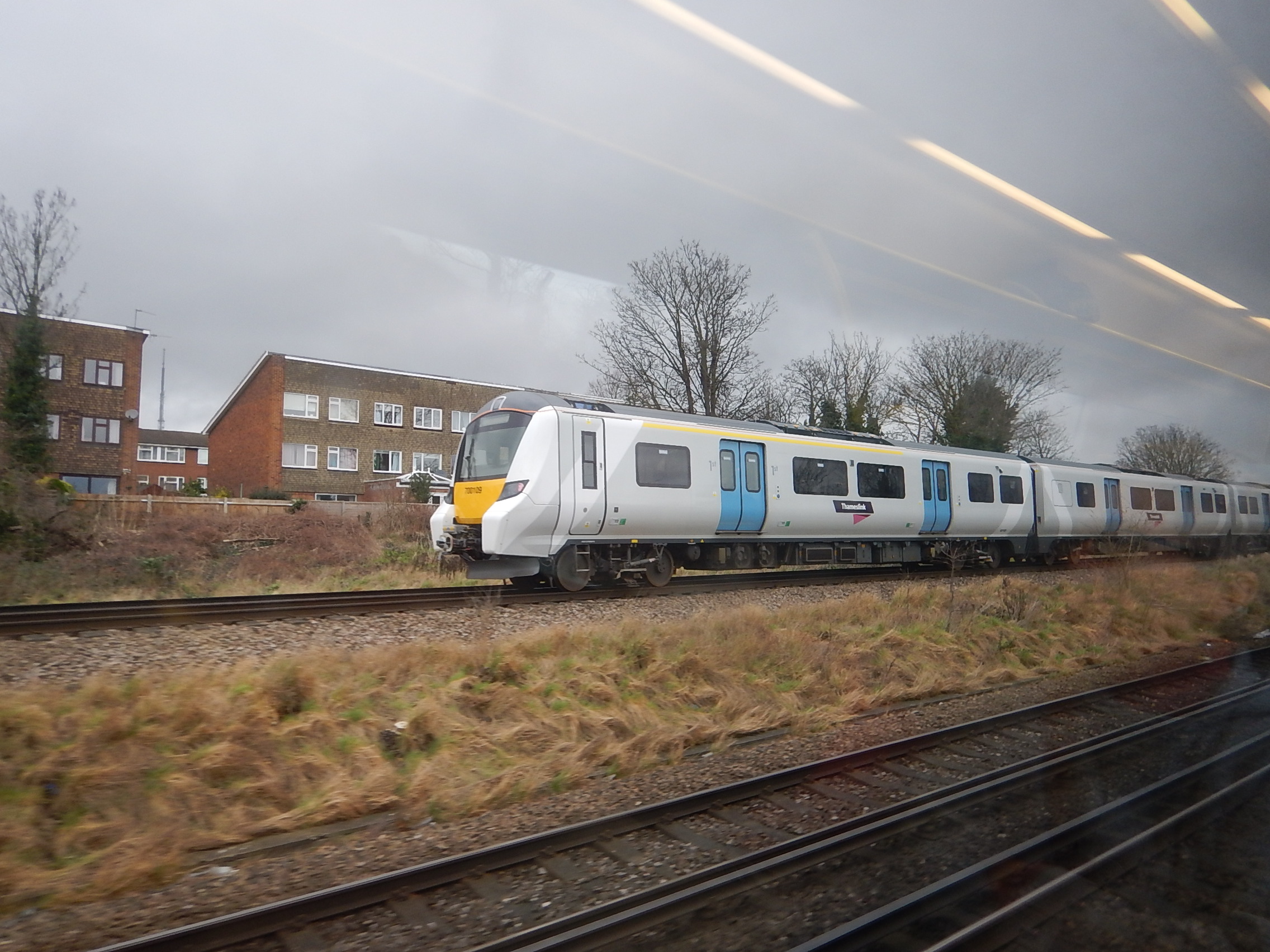
A Class 700 Train On Test
After halting for a minute or so, it turned off towards Crystal Palace.
During the day, I also saw a couple of bright-red Class 387/2 Gatwick Expresses running around. In one case, I felt that it wasn’t just an eight-car formation, but possibly a twelve-car. As I was in a waiting room at East Croydon station, I can’t be sure, but it certainly appeared to be a long train.
According to this page on the Thameslink web site, the Class 700 trains will start to be introduced on the 16th April 2016.
The Thameslink web page also says that the introduction of trains will be completed in June 2018. So give or take a month, that is twenty-five months to introduce sixty eight-car and fifty-five twelve-car trains. So that is a rate of somewhere between four and five trains per month.
At present the Thameslink service is run by three different types of trains.
- Twenty-nine Class 387/1 trains, which are supposed to be going to the Great Western Railway, but can’t as there are no overhead wires.
- Thirty-two Class 377 trains, which could go to Southeastern to improve their services. Clare Perry has promised new trains and these would fit.
- Upwards of fifty Class 319 trains, which I suspect will do what Mark 3 based stock does best and fill in where operators have a shortage of trains. Handsome is as handsome does!
It does appear that as time progresses there will be a number of Class 387 trains, available to provide a quality service.
It’s why I think, thast some will be converted into IPEMUs.
And as GTR, have lots of experience and drivers for Class 387s, it would appear logical that Class 387 IPEMUs would be used to replace the Class 171 trains on the services on the Oxted Line and the Marshlink Line.
One of North London’s Forgotten Lines Is Awakening
Four of the nearest stations to my house are Moorgate, Old Street, Essex Road and Highbury and Islington. which all lie in an arc on the Northern City Line to Finsbury Park and on to North London and Hertfordshire, where it terminates at Hertford North, Letchworth, Stevenage and Welwyn Garden City.
Traditionally, the line has always only run on a five day-a-week basis, with no service at weekends. As it serves Arsenal’s past and future stadia, I’ve always thought this was a bit short-sighted.
But then I’ve always felt that British Rail considered it was a railway, that they didn’t really want after they acquired it from London Underground following the Moorgate Tube Crash.
So when this month, when they decided to run a weekend service and the weekday service until 23:59, I did not notice any announcement. I use Highbury and Islington station several times a week and I certainly didn’t see a poster.
This is one of those things that should be filed under At Last! Especially, as the southern end of the line in a few years time will connect a large number of lines together.
- Moorgate – Northern, Metropolitan and District Lines and Crossrail (2019)
- Old Street – Northern Line
- Essex Road
- Highbury and Islington – East London, North London and Victoria Lines
- Drayton Park
- Finsbury Park – Piccadilly and Victoria Lines and Thameslink (2019)
If Crossrail 2 ever gets built, it will connect to this line too!
The forgotten nature of the Northern City Line is illustrated, by the elderly Class 313 trains on the line. There are currently forty-four three-car sets on the line, usually working as six car services, so giving effectively twenty-two trains.
But the days of the Class 313 are numbered as according to this article on Rail Magazine, the operator; Govia Thameslink Railway has just ordered twenty-five six car Class 700 trains from Siemens. This is said about the trains.
The new trains will be Class 700s, and will be a variant of the 1,140 vehicles currently being delivered by Siemens to GTR for Thameslink. They will run on routes from Moorgate and London King’s Cross to Welwyn, Hertford, Stevenage and Letchworth. They will be fixed length with full width inter-vehicle gangways, air-conditioning, real time information and power points.
Of all the lines in London that could benefit from a fleet of new trains, this must be one of those routes, where they will give the greatest improvement.
Especially, as for the operator, it is just more of the same trains, they will be using on Thameslink.
But will they be exactly the same?
This is said in the Wikipedia entry for Class 313 trains.
Since they were designed for use on Great Northern Suburban Inner Suburban services from Moorgate to Welwyn Garden City or Hertford North, Letchworth Garden City which included a section of ‘tube’ line built to take standard size trains between Drayton Park and Moorgate, they are built to a slightly smaller loading gauge than conventional trains. They are standard length and width, but the roof is lower, most noticeable due to the lack of a “well” for the Stone Faiveley AMBR pantograph on the centre coach. They have to comply with regulations for underground trains, such as having doors at each end of the train for evacuation onto the tracks, and when on 750 V DC supply the traction supply for each motor coach is separate, whereas on conventional 750 V DC trains each coach in a unit is linked by a 750 V bus line. Due to this, each motor coach has shoe gear on both bogies, whereas normally it would only be on the leading bogie. They are fitted with trip-cocks that are struck by a raised train-stop arm at red signals and will apply the brakes if the train passes one.
I suspect there will be some intensive work to make the Class 700 trains meet the regulations for underground trains.
To say some of the stations at the southern end of the route are tired and/or difficult for those who need step-free access, would be an understatement.
Moorgate is getting improved for Crossrail and Finsbury Park is getting a much-needed redevelopment. This will only increase the pressure to rebuild stations like Old Street, Essex Road, Highbury and Islington and Drayton Park.
As it goes further north, I do wonder if we’ll see new stations to serve future housing developments, especially on the Hertford Loop Line.
The other possibility of improving services from Moorgate is that the top speed of the new Class 700 trains is 100 mph, whereas the speed limit on the Hertford Loop is only 75 mph.
So will we see the extra three trains available used to move services off the crowded section of the East Coast Main Line over the Digswell Viaduct onto the Hertford Loop Line.
With some clever rescheduling, this might create a path or two on the East Coast Main Line.
The operator is not going to spend those millions on a new set of trains and not make them sweat!
I certainly think, that we’ll see good connectivity between trains on the Northern City and Hertford Loop Lines with Thameslink services to Peterborough and Cambridge.
It will be interesting to see their plans, when they are revealed.
My one worry is that all those new trains will tempt a lot of passengers out of the woodwork!
But one of London’s railways will not be forgotten for very long!
 The Anonymous Widower