London Takes The Great Leap Forward
From today on all public transport in London, you can use your UK contactless payment card as a ticket. Full details are on the BBC’s web site. Certain mobile phones can also be used.
Some are predicting it’ll all end in tears, but I suspect passengers will take one of two routes; carry on as now with Oyster or a Freedom Pass, or embrace the new technology with enthusiasm and a correct level of mistrust. After all, there doesn’t seem to have been any reports of problems since London’s buses went cashless a few months ago.
As a Freedom Pass user, it won’t effect me directly. But I always carry an Oyster card for the cable car, visitors or emergencies. But there may come a time, when I can leave this out of my wallet.
London is setting a standard here and surely, this should be implemented all over the UK as soon as possible. But I can’t help feeling that some authorities will invent their own totally incompatible systems.
After all, the best way to hack off a visitor to the UK, who perhaps wants to visit people and places in several areas, is to present them in every place with a different ticketing system.
I Lost My Freedom Pass
Two weeks ago my small ticket wallet with my Senior Railcard, John Lewis credit card and Freedom Pass.
I went down Liverpool Street station immediately and for a tenner, I got a replacement railcard and I just phoned my credit card company to replace that.
But for the Freedom Pass was much slower to get a replacement. I phoned 0300 330 1433 and they gave me a reference and an address to which I should send the tenner.
My cheque has now cleared, but I haven’t received the new pass.
I have been travelling around London recently tracing the Goblin Extension, so every day I have had to buy a Zone 1-6 Travelcard at £8.90 or because I have a Senior Railcard at £5.90. I do have an Oyster for emergencies and I’ve used that at times.
The money isn’t the problem for me, although it could be for some.
But to get a discounted Travelcard, I can’t just go to the ticket machine at Dalston Junction, I have to go to the Ticket Office. It’s not a real pain, but yesterday, I had been to my doctor’s to pick up a prescription and so used Haggerston station to buy my ticket, which was very slow, as they were having all sorts of problems with the gates and lifts, so the staff were otherwise engaged.
One problem I have with cashless buses, where you must use a card, is that I have no contactless credit card, as my providers don’t issue them. So I have to travel with a spare loaded Oyster card to get me home on the bus.
These last few days have been quite an inconvenience.
It would be a lot worse, if I lived some distance away from a station with a Ticket Office.
There should be somewhere, where you can go to get a replacement Freedom Pass and the replacement system should be able to respond faster.
No Contactless Bank Cards On The Emirates Air-Line
When I rode the Emirates Air-Line, I topped up my Oyster and I asked one of the guys there, if come September, I could use a contactless bank card.
No! As they’re not part of Transport for London.
Come on! That would surely incease ridership, as anybody could just turn up and go!
Ticketing In London Takes Another Big Step
Over the last month,since London’s buses went cashless, the silence has been deafening about this issue and I haven’t found any news reports about problems or complaints.
So it was no surprise to see that from September 16th the Underground, Overground and DLR will accept contactless bank cards.
There are still a few small steps to take, like bringing all of other rail companies into the system. Once this is done, you could say turn up at Gatwick Airport touch your contactless bank card on the reader and then again, when you get to Victoria, to get into Central London. Obviously, you can do that from September 16th at Heathrow or City Airports, as they are in the Transport for London area.
One of the things also to be introduced is a weekly cap. So will this mean that if you put a weekly ticket on Oyster, you won’t need to any more.
London Buses Go Cashless
Today was the first no-cash day on London’s buses and I took five trips. I didn’t see anybody board and offer cash.
Perhaps tomorrow, with the Tour coming and people returning to work will throw up some problems.
But after chatting with passengers and an off-duty driver, I think there won’t be much trouble.
The only people who seem to be against the move are the Green Party. Why? Perhaps they are jealous as they didn’t think of it or feel all buses should be free!
Think Quarts Into Pint Pots
London Underground’s Victoria line, may have been a technological triumph for 1968, when it opened as an automatic train line, where the driver doesn’t really drive the train. Although, he or she is the person in charge. Incidentally, when the line opened in 1968 a lot of the electronic control systems used valves rather than transistors. I can remember reading about the line in a copy of Simulation magazine when I worked at ICI around 1970. It was truly cutting-edge world-beating technology in its time.
But you can’t say much for some of the stations, which were built on the cheap and are very much sub-standard compared to the extensions to the Piccadilly Line built in the 1930s.
But now the trains are running at a maximum rate of 34 trains an hour for much of the day, as is reported in this article on Global Rail News. Here’s the first three paragraphs.
London Underground’s Victoria line is now operating 34 trains an hour – ‘the most frequent train service in the UK’.
Peak-time services have been incrementally increasing since the Victoria line upgrade was completed in 2012 from 28 trains an hour to 30, 33 and finally 34.
Passengers now only have to wait two minutes between trains and there are also more trains running the full length of the line from Brixton up to Walthamstow Central.
So in two years capacity has increased by over twenty per cent, mainly by good design and engineering.
I wonder what the engineers, who built the line in 1968, would think of their baby now!
You have to also wonder if by applying the principles used on the Victoria line. could be applied to other lines in the Underground. Upgrades on lines like the Piccadilly have been delayed, but I do think, we’ll see some more squeezed out of the current system.
There are of course things that are being done and as a regular Underground user you tend to feel that the system may be more crowded, but you seem to get fewer delays. Perhaps reliability of trains, power systems and escalators is getting better.
It will also be interesting to see what happens next Monday, when buses go cashless. It might be anywhere between a disaster and a triumph.
At the disaster end of the scale, it will load more passengers onto the Underground.
But if it is a triumph and speeds up the buses, as I think it could, will passengers who can, swap from the cramped and dark Underground to a lighter and more spaceous bus, if it only takes a couple of minutes longer. Living in Hackney with no Underground, I change my route according to which bus arives first. Since the 38 has been run by New Routemasters, it has been effectively cashless, with passengers using the closest and most convenient door and only the few who need to pay using the busier front door by the driver. Certainly, if I want to get to the Angel quickly, I’ll choose a 38, as against a 56, which goes the same way, but is often overtaken, by a succession of New Routemasters.
If cashless buses work well, this will surely hasten the removal of ticket offices on the Underground, with contactless bank cards, supplementing Oyster and Freedom Passes. What differences, will this make to the ridership on the Underground?
The only thing that is certain, is that more quarts will continue to be poured into pint pots all over London’s transport system.
What Will Be The Effects Of Cashless Buses?
When London’s buses go cashless on the sixth of July, London and the passengers on its buses, will submit themselves to a big experiment.
But as I said in this post, nearly all of the staff and passengers seem to be strongly in favour.
The average London bus driver isn’t stupid, as what employer would allow an imbecile to have control of any £200,000 machine. The biggest problem they have with cash, other than the security one, is the inevitable delay, when passengers go searching for small change. London buses are timed to the minute and drivers seem not to like to miss their schedule.
I haven’t found any actual data on what passengers think about going cashless, but I have seen or heard no complaints in the media. I have heard the odd moan though, when a bus is delayed by passengers searching for small change. Although, that seems to have happened less since it was announced buses were going cashless and contactless bank cards could be used.
There will obviously be some troubles on the sixth, but I suspect TfL will put a lot of extra staff on the buses to smooth things through.
Remember though that according to Wikipdeia, London’s buses are used by six million riders a day and that every touch-in is registered on TfL’s ticketing system. That will generate an enormous amount of data.
When it has all settled down, just by examining before and after data will give conclusions, that will help with the planning of London’s transport system.
Will going cashless speed the buses?
Will the buses be carrying more or less passengers?
Will we be seeing a new group of passengers using a bus for the first time?
Would visitors to London, use their bank card or an Oyster?
Will we see a long term decline in the use of Oyster on buses?
I will not speculate, but let the data do the talking!
But the biggest effects will be felt, if the scheme works well and increases the revenue and profitability of London’s buses.
How many cities seeing how the London system works, would decide to go to a similar system? Many bus systems like Manchester, Liverpool, Edinburgh and Glasgow are not very comprehensible to a visitor without a guide, but London’s simple touch-in once with your bank card system, is probably understandable to everybody familiar with a contactless bank card.
I would also see London using the same system on the Underground, Overground and railways within London.
As Oyster now works on train journeys around London and many stations like Cambridge, Watford and Brighton are gated, would we see pressure to allow the Oyster/bankcard ticketing on journeys around the broader South East of England. Yesterday, when I went to Salisbury, I paid £24.60 for my walk-up Off Peak ticket, which was the same price as if I’d bought it earlier in the day on-line. It would have been so much more convenient to have touched-in at Waterloo and touched-out at Salisbury with a contactless bank card. Especially, as I just missed the previous train to Salisbury, so with a contactless bank card ticket, I’d have got there thirty minutes earlier.
So will we see the creeping of Oyster/bank card ticketing out from London? One problem is Railcards, but I’m sure one could be associated with a particular bank card.
Would it increase the resolve of TfL to introduce cashless ticketing all over the Underground, Overground and trains in the London area?
London’s new ticketing regime is going to provide a lot of answers to questions, some of which haven’t even been thought up yet. It is also going to ask a lot of politicians to bury some of their views. A lot of money will have been proven to have been wasted on systems that can never accept contactless bank cards.
Scaremongering Over Cashless Buses
I travel on London buses regularly and probably every other trip, I hear a message broadcast on the bus saying that from the 6th of July, London buses will go cashless.
Yesterday, when the message was played, I started talking to the young lady sitting next to me. We both agreed that we rarely see anybody pay cash on the 38s or 56s we regularly used, although we did think we’d been held up by a passenger scrambling for small chsnge. Transport for London (TfL) say the number paying by cash, has dropped below one percent for those, who use cash on the buses.
Speaking to one of tail-gunners on a 38 last week, she said that staff were looking forward to the cashless buses, as it should further cut the dangers of dealing with the public.
So it would appear from my small survey, that passengers and bus staff are in favour of buses going cashless. I certainly haven’t heard anybody sounding off on the Dalston omnibus about it being a bad idea.
However, there was this story in the Standard last night, which claimed up to two thousand passengers could be stranded every day in London, due to lost Oyster cards. Here’s the first couple of paragraphs.
But notice it is the Green Party complaining.
If this means that 770,000 people are given a free ticket every year at the cash price of a ticket of £2.40, this would cost TfL just under £2,000,000. Compare that with the savings of £24million from going cashless stated in this article on the BBC. The remaining savings would buy a lot of buses or fund other improvements.
You can just hear the rattle in the various canteens in bus garages, as they prepare the teacups for the inevitable storms.
Manchester Metrolink’s E-Ticketing
Manchester tram system, Metrolink, is introducing electronic ticketing. This is one of their trial readers.
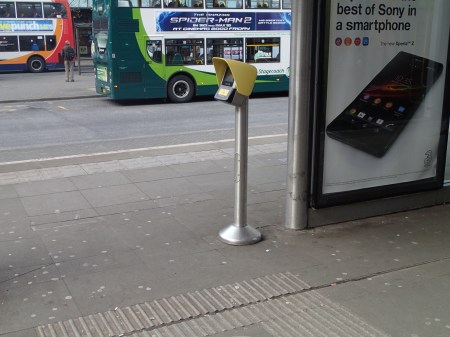
Manchester Metrolink’s E-Ticketing
The system is called Get Me There and from what I can find, it will be on another different system to London’s Oyster.
As Oyster is being modified to accept contactless bank cards, I would hope that Manchester will do the same.
As we are still a united kingdom, surely we need a set of ticketing rules that are the same across the country.
First amongst these rules is that all ticketing systems for public transport must work with contactless bank cards. Surely, the lack of any major opposition to the abolishing of cash on London’s buses, is proof that London has got their offering right. In two years or so, no visitor to London with a contactless bank card will need to buy a ticket.
This surely is a great attraction to all visitors to a city.
The next step in London, may well be that if you are over the requisite age, you can nominate a bank card to be your Freedom Pass, thus cutting the number of cards people have to carry.
Did The Tube Strike Show The Value Of Cashless Buses?
We won’t know yet, as Transport for London, won’t have done the analysis, but as the buses took the strain during the Tube strike of the last two days, it will be interesting to see how much extra cash they took.
If it was very little, then most of the extra passengers were using Oyster or contactless bank cards.
But I did see a group at a bus stop, examining cards to see who’d got ones that worked on the buses.
I suppose, if that is correct, that Bob Crow, has shown Londoners how good cashless travel can be!
 The Anonymous Widower