Sixty Years On
I must have been about seven, when I went with my father to Earls Court to see the Printing Exhibition.
My father didn’t like deep tube lines, which I’d always put down to an experience during the Second World War.
So his route to Earls Court after parking his car outside his print works in Station Road, wasn’t to go the obvious one by Underground from Wood Green Tube station.
We walked up the hill to the train station that is now called Alexandra Palace station. In those days it was called Wood Green (Alexandra Park) and I still refer to it as Wood Green station, as the Underground one is Wood Green tube station.
From the station we took a local steam train, probably hauled by a Class N2 from the 1920s into Kings Cross. At Kings Cross it was onto a Metropolitan line train to Hammersmith and then it was back a couple of stops on the Piccadilly line to Barons Court for the exhibition.
A roundabout way compared to the way most would go. But it ewas an adventure for a seven-year-old, especially as you got to see lots of interesting machines at the exhibition.
I’d always though, as I said that something nasty in the war had put my father off the tube, but now I’m getting older, I find the older deep tube lines rather stuffy and usually plan my journeys to avoid them. As my father and I share several health problems like arthritis and catarrh, I now wonder if his avoidance of the deep lines, was because he didn’t like the atmosphere down there. You have to remember, that in the 1950s, smoking was allowed in the Underground, which certainly didn’t help matters.
Last night, I heard that Alexandra Palace was one of twenty-six stations that were going to get upgraded access. So I went to have a look.
What a change!


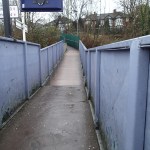


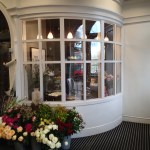

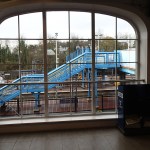
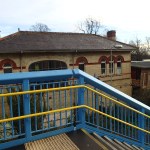


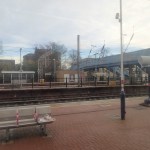
The pedestrian bridge across the lines will probably be fitted with lift towers and given a general upsprucing.
I particularly liked the architectural idea of the large window overlooking the tracks. There must be times when staff need to watch all platforms and this view sometimes must be better than sitting in the office watching screens.
In fact with its cafe and details, the station has the feel of a classy historic shopping arcade, all done with a modern feel. Whoever designed and rebuilt this station, has set a high bar for the hundreds of smaller stations all over the country.
So is it true to say that Crossrail 2 will be getting its first updated station in a few years and long before the new line is built?
The Fifteen Billion Pound Railway
I’ve just watched the latest episode of the BBC documentary on Crossrail call the Fifteen Billion Pound Railway.
Part of this episode told a history of tunneling through the last fifty years, through old film and the eyes of one of the tunnellers, who’s been digging for fifty years, starting with manual methods on the Victoria line.
It is fascinating to see how techniques have improved even over the last couple of decades.
Just as with North Sea Oil exploration, where projects got easier, as cranes got bigger, it looks like tunnelling will get easier, as tunnel boring machines get bigger, more powerful and better designed.
So when they build Crossrail 2 will it be a quick and more financially efficient project? Having spoken to some of the planners of the project on Friday at Dalston Library, I suspect it will be. Especially, as they are cutting out one of the Hackney stations to save a billion and moving one terminus from Alexandra Park to New Southgate stations.
The lessons learned on Crossrail will also effect HS2, where I suspect we’l see even more tunnels, in the final design.
The End Of The Line For Crossrail 2?
Southgate is famed in transport and architectural circles for its wonderful Underground station. So you would think, that New Southgate station would be even better and certainly newer.
But you’d be mistaken as these pictures show.




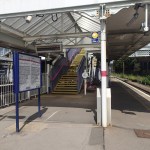
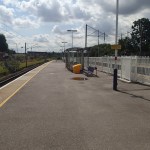


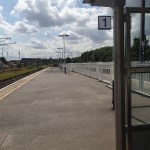
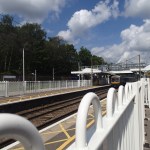

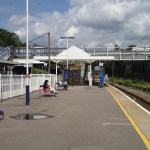


This is the station though, which is now being proposed as one of the northern terminals of Crossrail 2.
I suspect the station will probably be rebuilt, even if Crossrail 2 doesn’t use it as a terminus, as it must be one of the worst examples of corrugated iron stations in the country.
I can’t say I can remember ever catching a train from New Southgate Station, until today, when I returned to Central London. I also don’t think I’ve ever taken a train to the station either, although I’ve been on trains through the station countless times.
It does appear that there is space for another platform either side of the current station, which must be the minimum if the station is to be a terminus for Crossrail 2.
Travelling back in to London after taking the pictures, I can understand, the proposed change of terminus to the station from Alexandra Palace. There’s just so much more space to put a depot if one is needed. New Southgate would also allow a future development of Crossrail 2, to use the Hertford Loop as another branch.
Looking at the map, as New Southgate station is close to the North Circular Road and is generally surrounded by industrial estates, although there is some housing, there would be scope to probably create a really good transport interchange with a large bus station and perhaps even a tram line along the North Circular Road from Brent Cross to Enfield or Southgate. If nothing else, all of the work should result in the notorious bottleneck on the road being eased.
Untangling The Knitting
I said in this post that due to good project management, I don’t believe that Crossrail 2 will get built as the planners think it should be now.
On the Great Northern branch, it is not just a question of choosing between New Southgate and Alexandra Palace as the terminus.
This branch will also be shared with two other services; Thameslink to the South of the Thames and the Northern City line into Moorgate.
Not only do you have the East Coast Main Line, but you have the Hertford Loop, going to Stevenage and the North.
To further complicate matters, you have the problem of the Digswell Viaduct and the possibility of the East West Rail Link going through the area.
I think the only certainty is that Crossrail 2 will be the catalyst that pushes the engineers to find a brilliant but unexpected solution.
In fact, I think from a logical point of view the problem of the Digswell Viaduct and the associated double-track section should be solved first, as it could be the key key that unlocks everything.
After all, if the line was four tracks all the way to Stevenage ans possibly even Peterborough, it would give the train companies all sorts of options about where to terminate suburban services out of London.
If there was more capacity on this section of the East Cosast Main Line, I’m sure that the train companies would find plenty of innovating ways to use it.
Should Crossrail 2 Go To Alexandra Palace Or New Southgate?
It looks like the planned terminus of the Great Northern branch of Crossrail 2 is going to be New Southgate rather than Alexandra Park.
I knew that area well fifty years ago, but looking at a recent map, there still seems to be plenty of space for a depot for the trains.
So at a first glance it would seem that the choice is probably down to engineering, operational and architectural reasons.
My Pension Could Get A Boost in 2029
I have a good pension, although if I have a problem with it, it’s that I can’t find enough ways to spend it.
But the announcement yesterday that Crossrail 2 might open in 2029 can only be good for me.
I live in a quiet plesant tree-lined road about five minutes walk from Dalston Junction station, which could be one of the stops on the line. Even if it is not and Hackney Central and Angel are the two nearest stops, it all must be beneficial for the value of my house.
I would suspect that if Dalston Junction is not on Crossrail 2, then the Eastern Curve at the station might be reopened, so that East London Line trains can terminate somewhere in North East London.
After being ignored by transport planners for years it now seems that the North Eastern areas of London are finally getting the public transport, they desperately need.
Judging by the welcome the Overground has received in this area, I suspect that the good burghers of Hackney will welcome Crossrail 2 with open arms.
Crossrail 2 is having a consultation locally in July. I shall be going.
Was It A Mistake To Close The Palace Gates Line?
I must be one of the few people still alive, who regularly watched trains trundle up and down the Palace Gates Line between Palace Gates and Seven Sisters stations. I’ll admit that I didn’t see many trains, as I sat in my father’s office in Station Road Wood Green on a pile of ledgers in the early 1950s. Admittedly, most trains were just a single coach pushed or pulled by an ancient tank engine, but they kept this then five-year-old amused. Some psychologists might argue, it created my life-long fascination with trains.
But think what could be happening now to East Coast Main Line freight trains travelling to or from London Gateway or the Channel Tunnel, if the line hadn’t been closed and dismantled? The Palace Gates Line was linked to the Hertford Loop, so would it be that the line was used to get freight trains through North East London?
If nothing, it shows how those in charge of the railways in the 1960s were very bad at predicting what the railways would be like fifty years on.
But now Alexandra Palace is being proposed as one of the northern terminii of Crossrail 2, with the line being in tunnel from there to Seven Sisters and then on to my local stations at Dalston Junction and the Angel.
It would not probably be the most difficult of projects to add a junction at Seven Sisters, that allowed trains using the Crossrail 2 tunnel, to have access to the Gospel Oak to Barking line.
Such access would allow freight trains to travel under North East London. But I doubt that Transport for London would want freight trains running through their tunnels. But with platform edge doors, at any intermediate stations, would this still be the problem it is now? I wonder if anybody has put a tunnel under a city big enough to take freight trains and shared the line with the city’s local passenger trains or metro? I can’t find one in Wikipedia.
But if freight can’t use the Crossrail 2 tunnels, what about a third tunnel on the same alignment?
This is probably very fanciful, but we do need some way of getting freight through East London to the railway lines to the North. One alternative would be to make the M25 five or six lanes each way!
Closing the Palace Gates Line just removed an option and closing it today if it still existed, would probably not be contemplated.
Is CrossRail 2 Going To Follow The Palace Gates Line?
The latest plan for CrossRail 2 shows the line going to Alexandra Palace. I assume they mean the main line station although the route is a bit vague. This article seems to think the line will come from Seven Sisters station up the Palace Gates line.
I used to watch the old steam trains on this line in the 1950s, sitting on the ledgers at my father’s print works in Wood Green.
I don’t know whether they could get the trains through, although the main obstacle is probably the shopping centre on the High Road.
The Latest Proposal For Crossrail 2
Crossrail 2 has been around since the early days of the twentieth century, but it is only now that Crossrail is well underway, that a serious proposal for a north-east to south-west cross London railway has been brought forward. It’s here on the BBC.
Crossrail 2 will be a lot easier than Crossrail.
When we were planning North Sea Oil platforms in the 1970s, every few years the cranes, barges and drills would be a lot bigger. So for a start, the tunnelling machines available to Crossrail 2, will be an order of magnitude bigger than those for Crossrail. I suspect if you look at the map for Crossrail 2, the two machines will start at Hackney and come out at Wimbledon or vice-versa, as there is no major junction in the middle like Farringdon, where the machines will have to be extracted or turned.
The project engineers for Crossrail 2, will probably take advantage of all the tricks they have learned on the previous project.
But if they follow the design published yesterday, there is tremendous simplification in the design, with much simpler-to-build stations in Central London. One is the very large double-ended station at Euston-Kings Cross. Why we don’t have more of these, I do not know!
I think, an early start is needed.
 The Anonymous Widower