A North London Line With Digital Signalling
In Digital Signalling Implications For North London, I indicated that there may be benefits in equipping the North London Line with digital signalling.
- It would ease co-ordination of services between Gunnersbury and Richmond stations, where track, stations and signalling are shared with the District Line.
- All freight trains are being fitted with digital signalling capabilities.
Obviously, the other benefits of digital signalling like closer running of trains would apply.
Current Service Levels
The Service Levels section of the Wikipedia entry for the North London Line, gives the following details..
Services run seven days a week and since the December 2018 timetable change are the same all day.
- Four trains per hour (tph) – Richmond and Stratford
- Four tph – Clapham Junction and Stratford
Which gives eight tph between Willesden Junction and Stratford
Compared to the service I remember from the 1980s, it is a great improvement.
Possible Future Service Levels
London Reconnections is a web site, that usually gets things right.
In this article, which is entitled More Trains for London Overground: A Bargain Never to be Repeated, this is said.
London Overground have a long-held desire to increase the frequency on the WLL from 4tph to 6tph. They also aspire to another 2tph (at least) from Clapham Junction continuing to Stratford, to further increase the frequency on the North London Line (NLL). This would enable 10tph on eastern end of the North London line. This is due to be implemented with the main order of the new Class 710 stock.
What, it is suspected, London Overground would really like is to have 6tph from Richmond to Stratford and 6tph from Clapham Junction all the way to Stratford. Unfortunately, the additional trains to Stratford would appear to rely on freight, travelling between East London and the West Coast Main Line, using the route via Gospel Oak instead of via the NLL. Until that actually happens, sometime after the electrification of the GOBLIN, such an intensive service on the NLL can only be a dream.
Would this mean this service?
- Six tph – Richmond and Stratford
- Six tph – Clapham Junction and Stratford
Which gives twelve tph between Willesden Junction and Stratford
I can’t say I’d complain living equidistant from Dalston Kingsland and Canonbury stations.
Richmond Station
The current service between Richmond and Gunnersbury station is as follows.
- Four tph – London Overground to Stratford
- Six tph – District Line to Upminster
Digital signalling on the District Line is likely to add 33% capacity to Peak Hour services, so this would mean another two trains to Upminster.
So a future service could be as follows.
- Six tph – London Overground to Stratford
- Eight tph – District Line to Upminster
This level of service could be easily handled by conventional signalling and good driving or by digital signalling.
Piccadilly Line To Ealing Broadway Station
This article on Chiswick W4, is entitled Major Reorganisation Of Local Tube Services Planned.
This is said.
The decision appears to have been made by Transport for London (TfL) to press ahead with a major restructuring of local underground services. This would see the District line service to Ealing Broadway ended and services switched to the Piccadilly line. The rolling stock would transfer to the Richmond and Wimbledon branches of the District line allowing an increase in regularity for these services.
Currently, Ealing Broadway station has a six tph service to Upminster on the District Line.
This map from carto.metro.free.fr shows the lines at Ealing Broadway station.
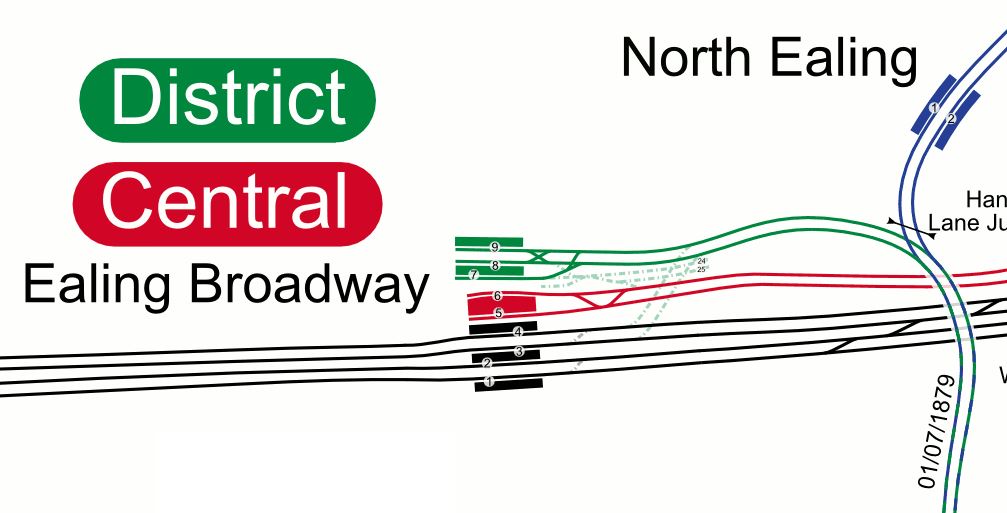
Note that after the changeover, the following would apply.
- The Piccadilly Line would have three platforms.
- In a few years time, the Central and Piccadilly Lines will have similar trains.
- Passengers for Turnham Green, Stamford Brook and Ravensbrook Park, would use the Piccadilly Line, which would probably have a higher frequency.
- Passengers for Victoria and other stations in the East on the District Line, would probably have a step-free cross-platform interchange at a number of stations.
But I think, that probably the main reason for the change, is that it will make the proposed frequency of well upwards of twenty tph of the Piccadilly Line easier to operate.
Consider.
- The platforms would help with service recovery,
- I suspect that TfL would like to see a Victoria Line frequency of thirty-six tph.
- Currently, twenty-four tph run between Arnos Grove and Acton Town in the Peak.
- Twenty-one tph run in the Off Peak.
If thirty-six tph is the intended frequency, then two terminal platforms in a rebuilt step-free Ealing Broadway station, could turn a lot of trains.
A Side Effect Of Changing The District Line Terminus
If the District Line service of six tph to Ealing Broadway, were to be reallocated between Richmond and Wimbledon, this would add three tph to the section between Gunnersbury and Richmond.
So now we could be looking at seventeen tph between Gunnersbury and Richmond stations.
Will that mean that North London Line trains to Richmond will need digital signalling and automatic train control?
The West London Orbital Railway
The proposed West London Orbital Railway will use the Dudding Hill Line to create the following services.
- West Hampstead to Hounslow
- Hendon to Kew Bridge
If both routes run at four tph, then it will add eight tph to the North London Line between Acton Wells and South Acton junctions.
Added to the six tph between Richmond and Stratford, this would be fourteen tph through Acton Central and South Acton stations.
Digital signalling on the North London Line and the West London Orbital Railway would probably ease the merging of trains for the joint section.
Freight
It appears that there are up to four freight trains per hour in both directions on the line.
The Level Crossing At Acton Central Station
I doubt the users of the level crossing at Acton Central would like the levels of traffic, that digital signalling would enable.
A Summary Of Passenger Services
I can summarise the passenger train frequencies as follows.
- Stratford to Willesden Junction – 12 tph
- Willesden Junction to Acton Wells Junction – 6 tph
- Acton Wells Junction to South Acton Junction – 14 tph
- South Acton Junction to Gunnersbury – 6 tph
- Gunnersbury to Richmond – 16 tph
I have assumed all developments mentioned earlier take place.
The Effect Of High Speed Two And Crossrail
When High Speed Two and Crossrail open at Old Oak Common station, this must surely increase the number of passengers using the North London Line, by a significant amount.
There will be two new stations.
- Old Oak Common Lane station will be between Willesden Junction and North Acton stations.
- Hythe Road station will be on the West London Line between Willesden Junction and Shepherds Bush stations.
Will the proposed six tph, each of five cars have sufficient capacity?
Conclusion
It looks to me, that they’ll come a time, when digital signalling will be needed to squeeze the required number of trains along the North London Line.
As I said in the previous section, traffic will continue to grow on the North and West London Lines because of High Speed 2 and Crossrail, as it has done since the route’s reopening with new trains in 2010.
I feel there will come a time, when trains will have to be lengthened from their current length of five cars.
Can all the stations on the route be extended if necessary?
Digital Signalling Implications For North London
As I write this post, two big digital signalling projects are ongoing.
Four Lines Modernisation
This project is described in this document on the TfL web site.
This video is from that document.
The TfL web site says this about the new signalling system.
Work to install a new signalling and control system began in summer 2016. This will eventually allow the trains to be driven automatically, with a train operator in the cab to open and close the doors. The train operator will be responsible for managing customer information and safety.
Similar technology introduced in recent years on the Jubilee and Northern lines improved performance. The new signalling system allows trains to be run closer together, meaning a more frequent service and shorter waiting times, allowing more people to be carried. This new technology will enable us to reduce delays and improve reliability.
The programme will allow us to operate 32 trains per hour, a 33% increase in peak-hour capacity. Installation work will require some line closures.
So it looks that by around 2023, there will be a lot more trains running on the Circle, District, Hammersmith & City and Metropolitan Lines.
The Four Lines Modernisation will have implications for other services.
North London Line
Between Gunnersbury and Richmond stations, the District Line and the North London Line share track, stations and signalling.
This map from carto.metro.free.fr shows the complexity of the tracks around Gunnersbury station.

Obviously, whatever signalling is installed, it must be capable of handling both District and North London Line trains at Gunnersbury Junction and to and from Richmond.
Metropolitan Line To Amersham
Between Harrow-on-the-Hill and Amersham stations, the Metropolitan Line and the London-Aylesbury Line, share track, stations and signalling.
This map from carto.metro.free.fr shows the lines at Harrow-on-the-Hill station.
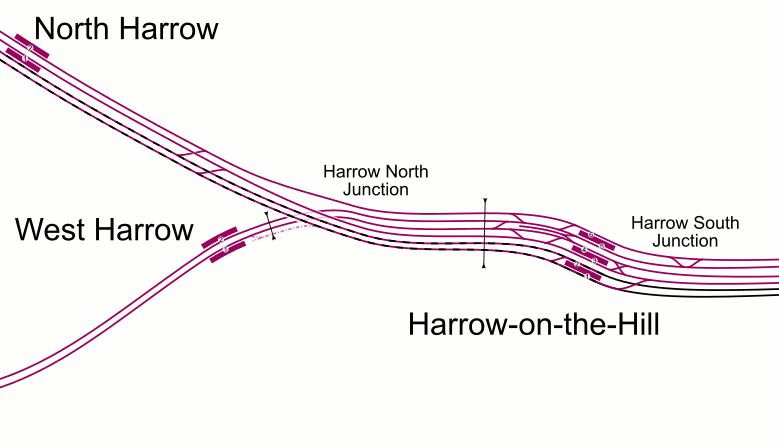
and this one shows the layout at Amersham station.
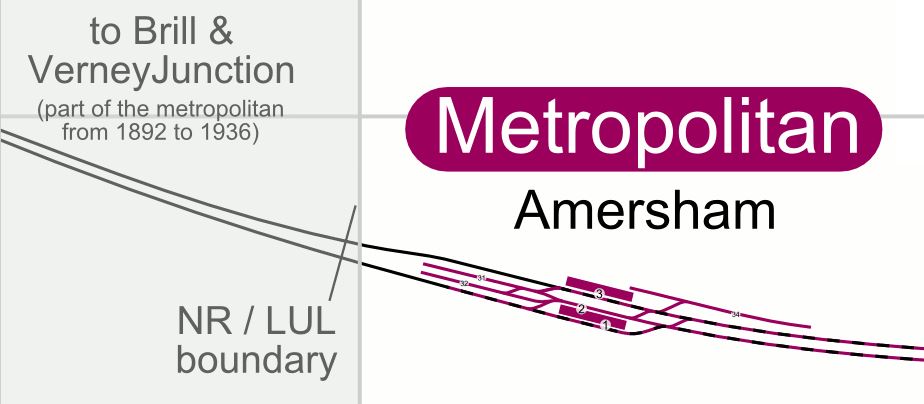
The solution for this section of track is detailed in the Wikipedia entry for the Metropolitan Line, where this is said.
Trackside signals with automatic train protection (ATP) will remain on the line north of Harrow-on-the-Hill, shared with Chiltern Railways DMUs
It is a solution, but will it last for ever?
And what about the Croxley Rail Link, if that is ever built?
Freight Trains Are Going Digital
This page on the Network Rail web site is entitled Freight Trains In Britain To Be Upgraded With Delay-Busting Digital Technology In Multi-Million Pound Deal.
The article says that all 750 freight locomotives will be upgraded.
This project must have implications for the freight services that run across North London on the Gospel Oak to Barking Line and North London Line, especially if these lines were in the future to be digitally signalled.
A Digitally-Signalled Bakerloo Line
At some tie in the next few years a decision will be made about what to do with the Bakerloo Line.
- It will be extended to Lewisham.
- It will receive new trains.
- It will be left as it is.
Options one and two would probably involve new digital signalling.
Addition of digital signalling to the Bakerloo Line would mean implications for the Watford DC Line, with which the Bakerloo Line shares the track between Queens Park and Harrow & Wealdstone stations.
Conclusion
I am drawn to the conclusion, that digital signalling in North London could bring capacity benefits.
Electrostars Are Going Digital
This article on the Railway Gazette is entitled Electrostar ETCS Contract Awarded.
Hopefully, this will mean that as more lines become part of the Digital Railway, Electrostars can all be fitted accordingly.
It should be noted that all the major train leasing companies seem to be part of the deal.
Crewe Hub To Be First ‘All-Digital’ Station, Says Transport Chief
The title of this post is the same as that of this article in the Warrington Guardian.
This is the first three paragraphs
Delays caused by signalling faults could eventually be a thing of the past on trains running to and from Crewe.
At a meeting on Friday Pete Waterman, chairman of the Cheshire and Warrington Local Transport Body (LTB), revealed that Network Rail, the Department for Transport and HS2 Ltd have agreed that the town will become home to Britain’s first all-digital station.
It means that all trains running from Crewe to Warrington, Chester and other destinations across Cheshire would benefit from the same technology which will be used by HS2 services – meaning lines could run more efficiently with trains travelling in a tighter sequence.
I feel that increasingly, digital signalling will be used to improve capacity on UK railways.
Call For ETCS On King’s Lynn Route
The title of this post, is the same as that on an article in Edition 849 of Rail Magazine.
The article is based on this document on the Fen Line Users Aoociation web site, which is entitled Joint Response To Draft East Coast Main Line Route Study.
In addition to ETCS, which could improve capacity on the East Coast Main Line, they would also like to see journey time reductions using trains capable of running at 125 mph or faster on the King’s Lynn to King’s Cross route.
The Fen Line
The Fen Line runs between Ely and King’s Lynn stations.
- It is mainly single -track with a double-track section at Downham Market station.
- The line has an operating speed of 90 mph.
- The line is electrified.
- All stations have two platforms.
- Looking at the line from my virtual helicopter, I suspect that redoubling would be possible.
- Passenger numbers are increasing at stations on the line.
- There are several level crossings.
It also would appear that because of the complicated nature of timetabling trains on the East Coast Main Line to the South of Hitchin, that there are often delays on the Fen Line, as there is only one passing place at Downham Market.
I therefore agree with the opinions expressed on the Fen Line Users Association, that restoring double-track could help reduce delays on the Fen Line.
The Cambridge Line
The Cambridge Line connects Cambridge to the East Coast Main Line at Hitchin.
- It is double-track throughout.
- It is fully electrified.
- It has a 90 mph operating speed.
- King’s Lynn to King’s Cross services use the line.
- Currently four trains per hour (tph) run between Cambridge and Kings Cross.
- This will be increased by two tph, when Thameslink is fully operational.
King’s Lynn to King’s Cross services use this line.
The Current Timetable
Trains seem to take around an hour and forty minutes to go from King’s Cross to King’s Lynn, where they take under ten minutes to turnround and then they take around an hour and forty minutes to return to King’s Cross. I suspect, it isn’t the easiest service for an operator to mrun, as a train could be sitting in King’s Cross for thirty minutes.
How Could The Service Between King’s Lynn and King’s Cross Be Improved?
From the Rail Magazine article, the views of the Fen Line Users Association and the details of the route, the following could help.
ERTMS And ETCS
ERTMS and the closely related; ETCS are digital systems that enable trains to run faster and closer together, which could increase the capacity of the line and reduce journey times.
The Wikipedia entry for the East Coast Main Line says this about recent and future development of the signalling.
A new Rail Operating Centre (ROC), with training facilities, opened in early 2014 at the “Engineer’s Triangle” in York. The ROC will enable signalling and day-to-day operations of the route to be undertaken in a single location. Signalling control/traffic management using ERTMS is scheduled to be introduced from 2020 on the ECML between London King’s Cross and Doncaster – managed from the York ROC.
I would think it likely that if the whole route from King’s Lynn and King’s Cross were digitally signalled, there would be advantages.
- It would help the merging of trains at Hitchin.
- It would help in managing trains on the single-track sections of the Fen Line.
The Rail Magazine article mentions flighting trains on the single-track sections, where two or more trains in the same direction, went though in succession.
It would also allow closer spacing and higher frequencies on the East Coast Main Line.
All trains using the route, including freight trains, would need to be fully equipped for digital signalling.
Improving The Fen Line
The biggest improvement would come by redoubling the line between Littleport and King’s Lynn.
- Trains could pass anywhere on the Fen Line.
- It might also be possible to avoid complicated operating procedures.
- Timetabling should be easier.
- Extra services would be possible.
- Delays should be reduced, as there would be less knock-on effects from problems on the East Coast Main Line.
On the flat lands of the fens, it might also be possible to increase the operating speed.
Improving Ely
Ely is a mess, where trains always seem to be waiting for something.
Hopefully, improvements are on the way, as I wrote in Are The Trains In Ely Finally To Be Sorted?
According to an e-mail and comments on this post, Ely North Junction needs improvement.
This Google Map shows the junction.
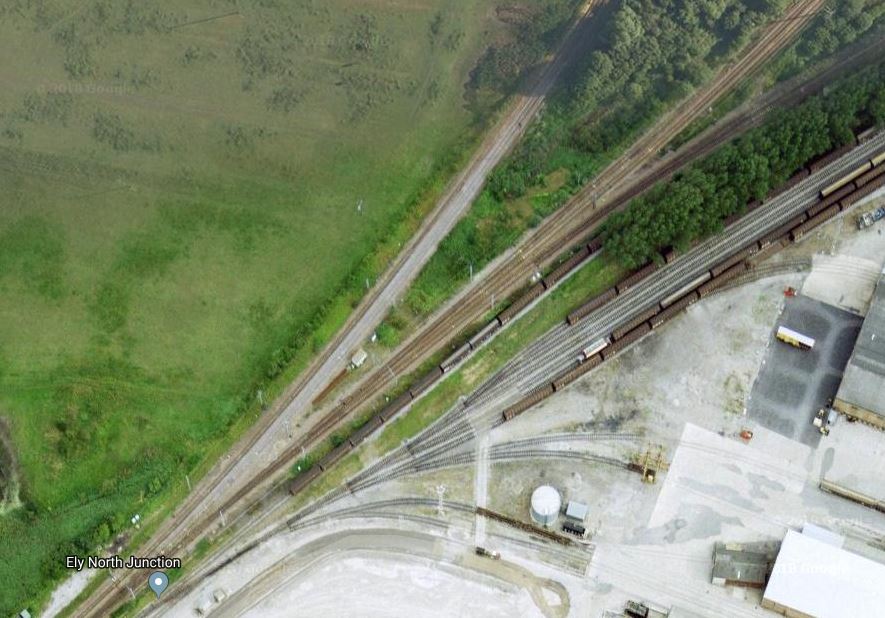
Note.
- Ely station is to the South West.
- starting at the top-left and going clockwise, lines go to Peterborough, Ely and Norwich.
- The last set of lines are sidings.
There would appear to be two solutions.
- Extra lines and flat junctions can be added. Flat junctions mean that trains have to cross each other.
- From what I’ve read digital signalling is very good at handling junctions, by making sure trains present themselves correctly, so this may be a better solution.
Either solution could be make to work very well!
Improving The Cambridge Line
There don’t appear to be any projects on the Cambridge Line, but I suspect that Network Rail are looking for small things, that will save minutes here and there.
125 Mph Trains
Who’d have thought forty or fifty years ago, that someone would seriously suggest running trains capable of 125 mph to King’s Lynn?
The Class 387 trains are 110 mph trains and I have recorded one at that speed on the East Coast Main Line.
Would a 125 mph train, be able to use that speed South of Hitchin?
If it could then.
- It could cruise on the fast lines with all the fast trains to and from the North.
- It would cut a couple of minutes from the journey time.
Once digital signalling is operational, the trains could be closer together, which would increase line capacity.
There are several fast electric multiple units, that have been built in recent years or are on order.
- Bombardier Class 387 – 110 mph – In service.
- Bombardier Aventra – 110 mph -In development for West Midlands Trains.
- CAF Class 397 – 125 mph – In development for TransPennine Express.
- Hitachi Class 801 – 125 mph On test for service entry this year.
- Siemens Class 350 – 110 mph – In service.
Bombardier are also showing ideas for a 125 mph bi-mode Aventra to various train operating companies, which I wrote about in Bombardier Bi-Mode Aventra To Feature Battery Power.
To build a 125 mph bi-mode train, you probably start with a 125 mph electric train.
So have Bombardier designed a 125 mph version of the Aventra?
It would appear, that Bombardier, Hitachi and possibly CAF and Stadler will be offering 125 mph electric multiple units, with a bi-mode version if needed, for lines without electrification.
But there are several routes in addition to Kings Cross to King’s Lynn
- St. Pancras to Corby
- Euston to the West Midlands
- Liverpool/Manchester to Edinburgh/Glasgow
- Leeds/York to Edinburgh/Glasgow.
- Waterloo to Bournemouth/Southampton/Weymouth
Train travel could be getting faster?
Conclusion
The ultimate benefit would come if trains could do a round trip in under three hours.
This would probably need a journey time of perhaps an hour and twenty-four minutes between King’s Cross and King’s Lynn. It is certainly not possible now, but it might be with the following.
- 125 mph-capable trains.
- Digital signalling on the East Coast Main Line and on the Cambridge and Fen Lines.
- 125 mph running, where possible on the East Coast Main Line.
- Improvements at Ely.
- Full double-tracking of the Fen Line.
- If possible, 100 mph running on the Cambridge and Fen Lines.
A three-hour round trip would allow the current service of one tph to be run with just three trains.
If both of the twice-hourly fast services between Kings Cross and Cambridge were extended to King’s Lynn, instead of the current one, this would mean that the following service could be possible with just six trains.
- Two tph
- Stops at Cambridge, Cambridge North, Waterbeach, Ely, Littleport, Downham Market and Watlington.
- Ten x 23 metre cars or twelve x 20 metre cars.
- Possibly a bistro.
- Trains might stop at Royston, Hitchin and/or Stevenage.
It would be a passenger-attracting 125 mph Metro.
There is improvement to come between King’s Cross, Cambridge and King’s Lynn, if the financial case stacks up.
 The Anonymous Widower