East West Rail Moves On Phase 2
East West Rail is the project to create an electrified 100 mph railway from Oxford to Ipswich and Norwich via Milton Keynes, Bedford and Cambridge.
This map from the East West Rail web site, indicates the route.

East West Rail
Phase 1 is now almost complete with the linking of Bicester to Oxford.
Services are running between Oxford Parkway and London Marylebone via Bicester Village. Hopefully, Oxford will be reached in Spring 2016.
A statement by East West Rail entitled Alliance contracts awarded for East West Rail Phase 2, has been relkeased about the award of contracts for Phase 2 of the line to connect Bicester, Milton Keynes and Bedford. This is said.
An alliance of four equal parts between Network Rail, Atkins, Laing O’Rourke and VolkerRail will build East West Rail Phase 2 (EWR2) – linking Oxford, Milton Keynes and Bedford, and Milton Keynes with London Marylebone via Aylesbury.
The contracts will enable the following services.
- Oxford – Milton Keynes (calling at Oxford Parkway, Bicester, Winslow and Bletchley)
- Oxford – Bedford (calling at Oxford Parkway, Bicester, Winslow, Bletchley, Woburn Sands and Ridgmont)
- Milton Keynes – Aylesbury – London Marylebone (an extension of the existing service between Marylebone and Aylesbury Vale Parkway, with stops anticipated at Bletchley, Winslow, Princes Risborough and High Wycombe)
- Increased capacity for freight services
The following work will be done.
- A new station at Winslow
- Two new platforms at Bletchley – Click for some details
- Construction of 18 new overbridges.
- Construction of 22 new footbridges/subways
- Changes to 97 railway crossings
It is not a small project.
I find it interesting that the work is an alliance of four companies.
This method of working has been used successfully at Stafford, in the Stafford Area Improvements Program to relieve the bottle-neck at Norton Bridge Junction on the West Coast Main Line.
Hopefully, it will avoid another Great Western Railway style of fiasco.
First Great Western’s Pragmatic Large And Little Solution To The Problems Of Great Western Electrification
The electrification of the Great Western Main Line from West of Airport Junction to Bristol, Cardiff and Swansea is proving to be a difficult project to deliver.
This article on the BBC web site talks about the problems and starts with these paragraphs.
Electrifying the Great Western line is “a top priority”, the transport secretary has said, as he announces a rethink of a £38bn programme to overhaul Britain’s railways.
Patrick McLoughlin said Network Rail’s five-year plan was being “reset” as it was “costing more and taking longer”.
In an ideal world, the whole of the Great Western Main Line and its branches to places like Worcester, Gloucester, Cheltenham, Exeter,Plymouth and Penzance would be electrified.
But it was never intended to electrify the major branches and for a time InterCity 125 diesel trains will be used on these lines.
Then in February 2014, the sea wall at Dalwish was breached in a storm and much of the track and Dawlish station was washed away. Although the line was rebuilt in a few months, it is only recently that the sea wall and the walk alongside the railway has been reinstated.
The force of the storm probably put an end to thoughts for many years of fully electrifying the line from Exeter to Plymouth and Penzance
The Large Class 800 Electro-Diesel Train
The trains that will work the Great Western Main Line to Bristol and Cardiff are the Hitachi Super Express, which comes in two variants.
The two trains are very similar, but the Class 800 has on-board diesel engines to generate electricity. Wikipedia says this.
The Class 800 units will be electro-diesel multiple units, able to draw power from electrified overhead lines where available and power themselves via underfloor diesel generators outside of the electrified network. The train specification requires that this changeover can occur at line speed. The trains are able to be converted to electric only operation by removal of the diesel engines
Current plans are for 21 9-car Class 801 and 36 5-car Class 800 to replace 60 InterCity 125.
With no prospect of electrification to Devon and Cornwall and because of the nature of the line with gradients, First Great Western have taken the pragmatic decision to order twenty-nine more trains, which will effectively be a variant of the Class 800, but with uprated diesel-engines and larger fuel tanks. It’s reported in this article in the Railway Gazette International.
So the total fleet will eventually be 47 9-car trains and 39 5-car trains of all new variants to replace 60 2+7 InterCity 125 and 5 5 car Class 180 trains.
So it would appear that about 490 x 23 metre cars will be replaced by 618 x 26 metre cars. On a crude calculation that is just over a forty percent increase in capacity, with a sixteen percent increase in the number of trains.
When everything is delivered towards the end of this decade, First Great Western would seem to have available a substantial increase in capacity, with a large proportion of the fleet having a go-anywhere capability because they are electro-diesel trains.
So it looks like some of these trains will be used to extend the network, as well as increase the frequency to Devon and Cornwall.
But there will be no need to need for any extra electrification. Although of course if there were, this would only be to the advantage of the electro-diesel trains, which would run on electric power for longer.
The Little Class 387 IPEMU
If the rumours about the Class 387 trains for First Great Western in this month’s Modern Railways are true, then some or all of the eight trains on order will be IPEMUs, with an on-board battery to power the train for up to sixty miles.
Modern Railways said this about their use.
Delivery as IPEMUs would allow EMUs to make use of as much wiring as is available (and batteries beyond) while electrification pushes ahead under the delayed scheme, and in the longer term would allow units to run on sections not yet authorised for electrification, such as Newbury to Bedwyn. The use of IPEMUs might also hasten the cascade of Class 16x units to the west of the franchise.
As Newbury to Bedwyn is probably less than twenty miles, a Class 387 IPEMU could easily do the trip out and back on a battery, charged whilst running from Paddington.
There is also a small problem highlighted in a section entitled Review after May 2015 general election in an article on Wikipedia describing the Great Western electrification.
This has led to speculation that the GW electrification scheme (although it remains “top priority”) could be cut back. On 27 May 2015, the website of Theresa May, MP for Maidenhead, contained the following: “… a recent report stated that it would not be ‘technically feasible’ for electrification to go ahead on the Marlow branch, raising questions about the future of the Henley branch as well”
The Marlow and Henley branches are 7.25 and 4.5 miles long respectively and mainly run a shuttle service to the main line with occasional services to Paddington.
So would it be more cost-effective to use a Class 387 IPEMU on these branches, as there would be no need to electrify the lines?
If a Class 387 IPEMU was good enough for these branches, what about the other branches on the Great Western Main Line to Greenford and Windsor and Eton Central?
The only work that would need to be done on these branches to accept the 4-car Class 387 IPEMU would be some platform lengthening and electrifying any bay platforms they use on the main line.
There may be other places on the Great Western Main Line, where electrification can be omitted by the use of the Class 387 IPEMU.
Class 387 IPEMU Or Aventra IPEMU?
This question has to be asked.
The Class 387 train on which the Class 387 IPEMU will be based is a member of the Electrostar family of trains, that have been produced by Bombardier since 1999,
The Electrostar is being superseded by the new Aventra family and the first orders have been placed for Crossrail and the London Overground.
The improvements in the Aventra design are summed up here in Wikipedia. This is said.
The multiple units have been designed to be lighter, more efficient, and have increased reliability. They will have lightweight all-welded bodies, wide gangways and doors to shorten boarding times in stations, and ERTMS. The design incorporates FlexxEco bogies which have been used in service on Voyagers, Meridians and newerTurbostars.
The design features a gangway design that allows maximum use of the interior space and ease of movement throughout the train.
As the Aventra is a new train, that has been designed since the successful IPEMU trial with a Class 379 in 2014, I do wonder if it has been designed with the ability to be fitted with an on-board battery to make it an Aventra IPEMU! In this article on Global Rail News this is said.
AVENTRA can run on both 25kV AC and 750V DC power – the high-efficiency transformers being another area where a heavier component was chosen because, in the long term, it’s cheaper to run. Pairs of cars will run off a common power bus with a converter on one car powering both. The other car can be fitted with power storage devices such as super-capacitors or Lithium-Iron batteries if required. The intention is that every car will be powered although trailer cars will be available.
So every Aventra can be converted to an Aventra IPEMU! And as that article was written in 2011, it increasingly looks like the IPEMU trial was a test of one of the new systems for an Aventra.
It would surely be a big advantage to a train operator running a fleet of Aventras, if they could add and remove battery packs as their schedules required.
But surely, because of the fact that an Aventra is lighter and more efficient than a Class 387, I wouldn’t be surprised that the range of an Aventra IPEMU is greater than the sixty miles quoted for the prototype.
Every extra mile, that the train can complete on batteries would open up new routes.
I suspect too that the Aventra IPEMU will have more customer appeal than a Class 387 IPEMU.
No-one will believe that a train running on batteries could possibly be a viable proposition, so at least if it looks like one of the new Crossrail Class 345 trains, passengers would at least think the train was modern.
So I wouldn’t be surprised if the order for Class 387 IPEMU was delivered as Aventra IPEMUs.
Oxford
To say that Oxford station has had planning problems in the last few years would be a massive understatement. I talked about them in Network Rail’s Problems In Oxford.
According to this article on the BBC, planning permission has at last been given to extend platforms at the station, so that Chiltern Trains can run services to the city.
But there is no mention of a new platform on the South side of the station, as is mentioned in Future Expansion in the station’s Wikipedia entry.
Or any mention of electrification either!
So will Network Rail postpone the new platform and the electrification to Oxford?
If they do, then First Great Western can serve the city by Class 800 trains going along the Cotswold Line to and from Evesham and Worcester.
First Great Western could also still use the current Class 165/6 trains, but they would like to cascade them to other places on their network.
Now here’s a thing!
Didcot to Oxford is probably less than thirty miles, so once Didcot is electrified, Oxford could be easily reached by an IPEMU.
If this happened Oxford would get new 110 mph 4-car electric trains to replace 90 mph 2-car and 3-car diesel trains.
The electrification needed for the East-West Rail Link would be done later, when Oxford decided to join the twentieth century.
Rolling Stock Cascade
At present First Great Western has a fleet of diesel multiple units that work the Thames Valley Services.
- Sixteen 3-car Class 165 trains
- Twenty 2-car Class 165 trains
- Twenty-one 3-car Class 166 trains
These will be replaced by twenty-one 4-car Class 365 trains from Great Northern and twenty-nine 4-car Class 387 trains cascaded from Thameslink as the new Class 700 trains arrive.
Another order for eight 4-car Class 387 trains has been placed and it is this order that Modern Railways said could be for IPEMUs.
In terms of carriages 151 diesel carriages are being replaced by 232 electric ones.
According to this document on the ATOC web site, this will happen to the Class 165 and Class 166 trains.
Some will be displaced by electrification (and the resulting cascade) on Great Western. One option is that they remain in service, to accommodate growth and to provide a cascade of Class 15x vehicles, subject to necessary modifications and PRM-TSI.
So it looks like they will be used to replace the outdated Class 15x trains.
Cardiff to Portsmouth
Cardiff to Portsmouth is a route run by First Great Western. When I went from East London To Yeovil By The Long Way, I used a First Great Western Class 158 train from Fratton to Salisbury. I said this in the related post about the journey.
I think this journey shows up our trains in a reasonable light. The journey times are slow not because of slow trains, but because of the frequent stops and complicated route. The journey took three hours seventeen minutes from Littlehampton to Yeovil, but there was only thirty-three minutes wasted in connections.
Although some trains date from the 1980s, there wasn’t anything as bad as the dreaded Pacers that inhabit the North. The services were pretty well-used and except for the short leg from Littlehampton to Fratton, there was a catering trolley on all trains.
I do think though, that perhaps this journey might be better done in something like a 4-car Class 800. Although, there isn’t much electrification to make use of until you get to Bristol, once you’ve left Southampton.
An IPEMU wouldn’t be much help, as it’s a long way between Cardiff and Portsmouth.
So is there a need for a 4-car Class 800 train, optimised for long cross-country routes, where there is not much electrification or high-speed running?
Conclusion
The Large and Little approach by First Great Western seems to be a pragmatic way around the problems of the Great Western electrification.
The new Class 800 trains and their closely-related siblings will enable services to be expanded at the extremities of their network, without any need for full electrification.
If all or some of that future order for eight Class 387 trains, was for the IPEMU variant or were even Aventras, so long as electrification reached Newbury and Didcot, new Class 387 IPEMUs could run to Marlow, Henley, Windsor, Oxford and Bedwyn.
One side effect would be the release of Class 165/6 trains, currently used on the routes out of Paddington and the branch lines, for other services on their network.
Two Solutions To Make Crossing A Railway Safe
On the way to football tonight in Ipswich, I went to have a drink with a friend, who lives near Thurston station on the Ipswich to Ely Line, where there is a good real ale and cyder pub. Crossing the tracks at Thurston is via a simple walk across controlled by traffic lights between the two platforms.


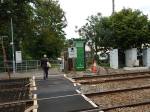
Of all the stations I use regularly, this is the only place where such a system is in use. Unless of course you count the trams at Ampere Road by the Croydon Ikea. A few hundred metres to the west of the station a bridle way and cycle path crosses the railway and Network Rail have built this bridge.


There have been reports like this one in the East Anglian Daily Times, which has a headline of Poll: £1.5m ‘monster’ railway bridge at Thurston is dubbed a ‘total waste of money’
This bridge is an interesting case of what to do where there are gated crossings of railway lines.
I think before being too critical of Network Rail we should bare these points in mind.
1. Suicide
This article on the BBC web site talks of a death at a crossing in the Thurston area. Network Rail get far too many deaths on the railway and it is a sad fact, that stepping in front of a train, is a common method of suicide.
2. The East-West Rail Link
The East-West Rail Link will use this line to get from Ipswich and Felixstowe to Cambridge and Ely. This link will be an electrified 100 mph railway that will run trains between East Anglia and the Midlands and the West. So although the line carries perhaps a couple of trains every hour each way, in perhaps ten years time, this will probably be a few times more. And as the line is pretty straight as the pictures show, the operating speed could be a lot higher.
3, Horses
If you read all the comments about the bridge no-one mentions taking a horse over the railway.
Horses are flight animals and if spooked will run fast away from the perceived danger.
Many horses too, don’t like going under high-voltage cables. Whether it is because they can sense the magnetic field generated by the electricity or they don’t like the whistling sound,I don’t know. But if the crossing is going to be used by horses, it will have to be of the size it has been built.
I’m not sure, but I think this is the only way to get a horse from one side of the railway to the other, unless you go all the way and go under the bridge by Thurston station.
4. Getting The Design Right
This bridge illustrates that getting the design right and satisfying all users and critics who never use the bridge is an almost impossible task.
Aesthetically, I don’t like the bridge, but unless they dig a subway under the railway, there is nothing else that can be done to satisfy all users and critics of the design.
Note that when the railway is upgraded to be part of the East-West Rail Link, Thurston station will have to be rebuilt and I suspect it will have a bridge over the railway, probably with lifts and a price tag well upwards of £2million.
There will be some serious discussions.
The Reality Of The East West Rail Link
Earlier this week, I took pictures of the work going on at Bicester to connect the Chiltern Line to Oxford.
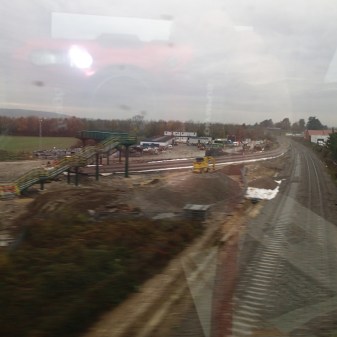
The railway passing underneath the Chiltern Line will become part of the East West Rail Link, which will hopefully link Oxford and Cambridge within the next ten years.
Modern Railways this month has a welcome page to the magazine entitled A Mini Adventure, which describes a promotional trip by Chiltern Railways on the possibly-to-be-reopened Cowley Branch. James Abbott, the Editor, says this.
A railway linking the ‘technology crescent’ – an arc about 60 miles from London stretching from Harwell and Didcot through Oxford and Milton Keynes to Silicon Fen – is well on the way to becoming reality.
He then goes on to say that he can see an East West railway starting at a Reading linked to Heathrow, giving international access for the technology crescent with just one change.
The Bicester Chord Takes Shape
I took the Chiltern Line to Stratford upon Avon today and I was able to get these pictures of the building of the Bicester chord.
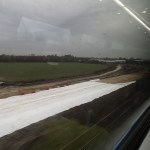
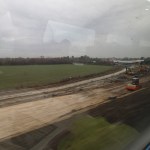
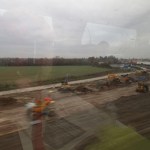

This will allow Chiltern Trains to start services between Oxford and Marylebone sometime in 2015.
The Bicester Chord is the first idea of several to come to fruition and transform railways in the area between Oxford, Banbury and Milton Keynes.
The East West Rail Link will be built and electrified, to link Oxford, Bicester, Milton Keynes, Bedford, Cambridge, Ipswich and Norwich.
The Cowley Branch at Oxford will be opened to passenger traffic.
Marylebone to Birmingham will drop to ninety minutes.
Chiltern Trains will probably want to expand. This is probably just as well, as if HS2 is to be built and Euston rebuilt, someone will have to get the passengers between London and Birmingham.
Will Crossrail Go To Hertfordshire?
Yesterday, it was reported on the BBC that the government is seriously thinking of diverting some Crossrail trains to Hertfordshire possibly terminating them at Tring.
This is an old idea originally proposed by Network Rail and discussed here in Wikipedia. This is what is said.
Network Rail’s July 2011 London & South East Route Utilisation Strategy (RUS) recommended diverting West Coast Main Line (WCML) services from stations between London and Milton Keynes Central away from Euston, to Crossrail via Old Oak Common, to free up capacity at Euston for High Speed 2. This would provide a direct service from the WCML to the West End, Canary Wharf and other key destinations, release London Underground capacity at Euston, make better use of Crossrail’s capacity west of Paddington, and improve access to Heathrow Airport from the North.[113] Under this scheme, all Crossrail trains would continue west of Paddington, instead of some of them terminating there. They would serve Heathrow Airport (10 tph), stations to Maidenhead and Reading (6 tph), and stations to Milton Keynes Central (8 tph).
I think this could turn out to be an excellent change of plan. It certainly won’t add a billion or so to the costs of the project. Tring station would appear to have quite a large number of platforms and the only major infrastructure for the route would appear to be a tunnel at Old Oak Common.
Crossrail as originally designed went to Heathrow and Maidenhead in the West and Shenfield and Abbey Wood in the East. Sensibly in my view, Maidenhead has been changed for Reading in the West, to add a whole new level of connectivity to the West of England and Wales. Connecting to the West Coast Main Line could add similar connectivity to the North West of England, North Wales and Scotland.
So should Crossrail go to Tring or perhaps a more substantial interchange on the West Coast Main Line, which has cross platform interchange to Virgin’s streams of Class 390 Pendolinos to speed North? The excerpt from Wikipedia, I quoted earlier, says eight trains an could go to Milton Keynes.
I estimate that if Crossrail services terminated at Milton Keynes, the trains would get there within a few minutes of an hour from Canary Wharf. That is only twenty minutes more than it will take from Heathrow to Canary Wharf.
But Milton Keynes is more than a New City on the West Coast Main Line, it is an important staging post on the East-West Rail Link from Cambridge and East Anglia to Oxford and the West Country, so making Milton Keynes one of the Crossrail termini and linking it to the North with frequent services, could give whole new areas of the country like East Anglia and the West of England much better train services to the North.
If Milton Keynes was developed as this major hub, this would have other consequences.
- The East-West Rail Link should probably be built as a 200 kph capable railway, so that Oxford to Cambridge services could be well under two hours.
- The East-West Rail Link connects to the Midland Main Line at Bedford and Chiltern Services at Bicester, so should it complete the set by going to Cambridge via Peterborough, where it can interchange with the East Coast Main Line. It is the cheapest possible route of the rail link, but what people who live in places like Oakham will think about it, I do not know.
- HS2 might be being built in the wrong place, as if Milton Keynes becomes this important rail hub, surely it should visit the city.
All I can say, is that extending Crossrail to Hertfordshire and Milton Keynes, will make planners think very hard about connections from the terminus to points to the North, East and West.
Is George Osborne A Closet Trainspotter?
We all know that sometimes George Osborne travels by trains, due to the story about tickets.
But does the Chancellor’s interest in trains and all things rail go deeper?
The reason I say this, is that since he has been Chancellor, the UK rail network has seen unprecedented investment.
If you read an account of his early life and education on Wikipedia, there is no clue there. But then if you live a substantial part of your early life in London, it must implant at least some thoughts in your mind, that public transport is good and necessary. It certainly did with me and I can think of a couple of my friends, who have also been seduced by the philosophy of London Transport and its successor, Transport for London.
But look at the rail projects, that have been given approval or firmly backed since he became Chancellor.
I won’t count HS2, as if you believe the Labour Party, that would be starting if they were now governing the country. I think the only thing that will derail HS2, is another 2008-style crash of the banking system.
London’s two major cross-London lines; Thameslink and Crossrail, could have been cut back in scope, but Crossrail if anything has got slightly bigger. This in part, is due to the way that the project is managed and partly financed. I hope some of the lessons learned on this project, are applied to projects like HS2 in the future.
Perhaps the most important project that has started to grow since 2010 is the Northern Hub. And grow it is! More lines seem to be marked for electrification and stations for rebuilding, every few months or so. He even seems to be taking the lead on creating HS3 across the Pennines. You could argue that as a Northern MP, he’s only looking after his consituents’ interests or has his eyes firmly on the 2015 General Election.
But whatever you say, Manchester and Leeds will have a fast electrified connection by 2018, because Osborne has provided the funding for the electrification on all the main lines from Blackpool, Preston and Liverpool in the east to Manchester and on to Leeds in the East. I wouldn’t bet against that by 2020, Network Rail’s engineers have stretched the electrification to Hull.
I would also argue that he has backed the full modernisation of the Great Western Main Line. Given the economic situation, cutting back the electrification to Bristol could have been a prudent decision, as it would have cut out the difficult Severn Tunnel electrification.
But this project has survived intact. Would a less rail-friendly Chancellor have insisted on cutting the project back?
The long-awaited electrification of the Midland Main Line was announced in 2012.
It could be argued that if you were electrifying the Great Western Main Line, then the Inter City 125s, released from that line could have been used to improve services on the Midland Main Line.
Many politicians would have used that argument in the past. Probably both Harold Wilson and Margaret Thatcher would have done that, as they are reported to have not thought much of trains.
Under the current government, some other substantial but low-profile projects have been proposed and funded, and in some cases even started.
The Electric Spine is an £800million project to connect Southampton to the Midlands and the North by an all-electric railway up the spine of England. The line will be mainly for freight and when completed will take lots of trucks off the roads.
Linked to the Electric Spine is the first part of the East West Rail Link, that will eventually go between Ipswich to Oxford, via Cambridge, Bedford and Milton Keynes.
I’ve talked about the upgrade of the GNGE before and this mainly-freight line will take a lot of freight off the East Coast Main Line to improve the passenger trains between London,Newcastle, Leeds and Edinburgh. As we’ve managed without it for years, will we be missing it, if it wasn’t upgraded.
In the last few days, there has been announcements concerning the Cornish Main Line and the Glasgow Airport Rail Link.
But George Osborne has also been lucky in that more and more passengers want to use the railways, and engineers have come up with better and more affordable ways of increasing capacity and providing better trains and stations.
As an example of the latter, the actual trains are a major cost of any new project with a typical coach sometimes costing £1.5million. We have a shortage of diesel trains on the one hand, and on the other there are some old electric trains that are being replaced by shiny new ones. But we are lucky in that a lot of these older trains were well-built in the 1970s and 1980s, often from body shells based on the legendary Mark 3 coaches, so they can be refurbished to be virtually as-new trains. We are also very good at taking these old trains and making them comfortable, as anybody who has ridden an Inter City 125 will testify.
So what projects do I think we’ll see announced before the General \election in 2015?
I suspect, it will be a lot more of the same, spread around the UK.
Over the last few years, one of the things we’ve seen is a host of smaller projects, that remove bottlenecks, like the Hitchin Flyover, the Bacon Factory Curve and the Todmorden Curve, to name just three of several. I suspect various rail companies have been pushing for some of these schemes for many years and now that they have been completed, they will have all the costs, engineering and statistics to show where else, flyovers and curves could be built to improve the railway.
There will also be quite a few extensions to electrification, as when you are doing this, often you can feed the new wires from the current infrastructure, so you don’t need expensive new systems to connect them to the UK’s electricity grid.
And what about some new stations, as often they are a very good way of increasing capacity without building new rail lines or adding new trains. Retailers have long recognised that smart new stores attract footfall and I suspect it’s the same for railways.
It was interesting to note that the announcements about Glasgow talked about improving the buses. If we integrated buses and trains properly with good maps and information on how to use buses, with special attention for visitors, everyone would benefit.
So what specific projects might be announced.
I will start with East Anglia, an area I know well.
In East Anglia, the freight routes out of Felixstowe are busy, so I wouldn’t be surprised to see the line from Felixstowe to Peterborough being electrified, especially if when it was opened up to take the large freight containers, they made enough space for the electric wires. There might also be some selective reopening of lines across the Fens, so that freight trains can reach the GNGE without going through Peterborough.
But the flagship project will be Norwich in Ninety. It has a good ring to it, won’t be that expensive, as it could probably be achieved using the existing trains, with perhaps new motive power and a Chiltern Railways-style refurbishment. Being cynical, it would probably ensure more votes, than any other similar-sized project.
Without doubt in Kent, the Marshlink Line will be electrified, as it would enable fast trains to London from Hastings, Bexhill and Eastbourne, and also open up all sorts of possibilities along the South Coast.
As you move along the coast, there might be odd pieces of electrification infill and tidy-up, but probably nothing major, except perhaps the Oxted Line to Uckfield
Further west, I would electrify Basingstoke to Exeter, if for no other reason, than to release the Class 159 for service elsewhere.
Will there be a plan to reinstate the continuation of this line to Plymouth, after the troubles of last winter at Dawlish? I would have thought, that if it was in government thinking, at least a study would have been announced. But then you wouldn’t show your hand too early.
Reading the magazines and web sites, it would appear that there could be extensions to electrification, around big cities like Birmingham, Liverpool, Manchester and Leeds. I’ve left out Csrdiff, as many of the Valley Lines there are being electrified, as was announced in 2012. Liverpool, which I know well could be a big beneficiary, as there is a lot of scope for electrifying through to Preston to avoid the change of train, I performed at Ormskirk on this trip.
One thing that will happen is that George Osborne will sign the death warrants for a lot of the Class 142, Class 143 and Class 144 Pacers. Several of these are on lines, which will be electrified, so they will be replaced by younger and hopefully refurbished Class 315 and Class 319 electric trains. Some of the Pacers will be refurbished or cannibalised for spares, but as all fall foul of the disability regulations, many will be scrapped. The difference will be made up with an order for some new Class 172 or similar from Bombardier, which could be the last diesel multiple unit order placed by railways in the UK. That could be a good political point to use against the Green Lobby.
It has been announced that the new franchise for Thameslink called Govia Thameslink Railway, will also be buying new trains for the Gatwick Express and the Great Northern suburban routes. The plans are detailed here.
There are also those projects that for years successive governments have placed in the box marked, Leave For The Next Government. In that category, I would place the Digswell Viaduct, the problem of getting freight trains from the London Gateway through or around the capital to the Midlands and the North, the rebuilding of Euston station, whether HS2 is built or not, and what to do with the remaining level crossings. Plans need to be put in place for all of these and many other projects that governments have ducked for decades.
If I was George Osborne though, I’d have one big worry.
Whoever wins the election in 2015, will be the biggest beneficiary of all this planned spending, as many projects like Crossrail, Thameslink and the Great Western Main Line, will be fully implemented just before the 2020 General election.
On the other hand perhaps, Noel Coward had it right, when he told Mrs. Worthington to not put her daughter on the stage. Now, she should send her to a good University to do engineering, so she could help the UK rail industry spend its money wisely.
Untangling The Knitting
I said in this post that due to good project management, I don’t believe that Crossrail 2 will get built as the planners think it should be now.
On the Great Northern branch, it is not just a question of choosing between New Southgate and Alexandra Palace as the terminus.
This branch will also be shared with two other services; Thameslink to the South of the Thames and the Northern City line into Moorgate.
Not only do you have the East Coast Main Line, but you have the Hertford Loop, going to Stevenage and the North.
To further complicate matters, you have the problem of the Digswell Viaduct and the possibility of the East West Rail Link going through the area.
I think the only certainty is that Crossrail 2 will be the catalyst that pushes the engineers to find a brilliant but unexpected solution.
In fact, I think from a logical point of view the problem of the Digswell Viaduct and the associated double-track section should be solved first, as it could be the key key that unlocks everything.
After all, if the line was four tracks all the way to Stevenage ans possibly even Peterborough, it would give the train companies all sorts of options about where to terminate suburban services out of London.
If there was more capacity on this section of the East Cosast Main Line, I’m sure that the train companies would find plenty of innovating ways to use it.

