Electrification Of The Felixstowe Branch And Other Lines In East Anglia
I’m using the Felixstowe branch as an example, as I used to live near Felixstowe station and I know the area well. I’ll make these assumptions.
- In this rail forum, the cost of electrification was given in 2010 as £100,000 per single track kilometre.
- The passenger line from Ipswich to Felixstowe is about 16 miles with only 6 miles being double-track. So that is effectively 22 miles or 35.4 kilometres of track.
- The Port of Felixstowe is exclusively served by diesel locomotives of various noisy and environmentally-non-friendly types, although sometimes these are changed for an electric Class 90 locomotive at Ipswich. So we can probably leave the Port out of the calculations, especially as they don’t seem to keen on electrification.
- Of the four stations on the line a couple would need to have lengthened platforms for a four-car train.
- The passenger service is roughly hourly and can be run by a single train.
- As the line has a W10 loading gauge, all of the bridges would probably be big enough to accept overhead electrification.
So we get a very rough electrification cost that will be £3.5million at 2010 prices to enable electric trains to go to Felixstowe station. You would have to add any platform costs.
At present the service is run by one inadequate single car Class 153 train.
This train pulls into a bay platform without electrification at Ipswich, which is certainly long enough to take one four car Class 387 train and could probably be lengthened to take an eight-car or two separate trains.
It would probably be necessary to electrify enough of the platform and the route to the branch , so that an IPEMU could be fully charged before it left Ipswich station for Felixstowe. As all of this electrification would be linked to the current electrification on the Great Eastern Main Line, it wouldn’t be an unaffordable cost.
I don’t know the cost of leasing a four-car Class 387 train, but I have read here that forty-five Class 710 Aventra trains, will cost £260million or about six million each. This cost is probably inclusive of servicing, financing and other costs.
This calculation is obviously only very rough, but it does show the advantages of electrifying a branch line using IPEMUs rather than traditional electrification.
- If the line has sufficient gauge clearance for the IPEMU, there are no bridge reconstruction or track lowering costs.
- Only sufficient electrification to charge the train is needed.
- Where the branch is linked to an electrified main line, connection costs of the minimal electrification are minimised.
- Platforms will need to be lengthened as necessary.
From this rudimentary analysis, it would appear that the cost of electrifying a branch line is roughly the same as the capital cost of a new IPEMU.
Looking at the two approaches for the Felixstowe branch for passenger trains only, we get something like.
- Traditional electrification would cost about £3.5million plus the cost of the train, which would probably be an old EMU ready for the scrapyard at a million or so.
- A new IPEMU would cost £6million and there would probably be a cost of under a million to upgrade the line.
But the IPEMU approach would give you other advantages.
- The train company would be running a modern train only a few years old at most.
- New trains attract passengers.
- The train could also run on main lines to create new routes and services.
The only losers in the IPEMU approach are the construction companies, putting up the wires and rebuilding bridges.
Passengers, train companies, local residents and the environment would all gain.
I’ll also look at some of the other branch lines in East Anglia.
The Gainsborough Line
The Gainsborough Line from Marks Tey to Sudbury is just over nineteen kilometres long, so it could easily be within the capability of an IPEMU, which charged on the main line at Marks Tey station.
This line shows the advantages of the IPEMU approach.
- The line goes over the Chappel Viaduct, which is Grade II Listed and one of the largest brick structures in England. Overhead wires could be a problem with both the engineers installing them and the heritage lobby.
- This branch could be extended towards Cambridge and surely to extend a branch without electrification would be easier.
- Passenger numbers might show that some trains should perhaps go to or from Colchester and/or Ipswich. IPEMUs are fast enough to mix it on the main line, with its 100 mph speed.
- The stations on this line are very basic and an IPEMU wouldn’t require any lectrification works.
But the reason, I’d use IPEMUs on this branch, is that a higher capacity line with trains to Marks Tey and perhaps Colchester, would probably take traffic off the congested roads to Sudbury.
The East Suffolk Line
It is my belief that the East Suffolk Line from Ipswich to Lowestoft ,will be electrified using IPEMUs.
- The new franchise has stated that the operator will run direct services between Liverpool Street and Lowestoft. Will the operator want to run this using diesel trains?
- A chord is possibly to be built at Reedham to allow direct Lowestoft to Yarmouth trains.
IPEMUs are not necessary as diesel trains could be used, but four car trains would create much needed capacity between Yarmouth, Lowestoft and Ipswich.
The line is fifty miles or just under eighty kilometres long, so charging would be needed at Lowestoft and/or Yarmouth.
I think the Reedham Chord is integral to Network Rail’s plans for the line and the related Whery Lines, as it is only mentioned in this document on their web site, which is entitled Improving Connectivity.
An Ipswich-Manningtree-Colchester Metro
I think that due to the flexibility of the IPEMU and its ability to run on the main line, could lead to something like an Ipswich-Manningtree-Colchester Metro.
There would certainly be advantages in terms of train and platform utilisation, if branch lines were able to run services in a back-to-back manner passing along the main line.
There could be a core route on the main line perhaps serving.
- Marks Tey
- Colchester
- Ardleigh -possible reopening
- Manningtree
- Bentley – possible reopening
- Ipswich
Services would start and finish on the various branch lines.
- Sudbury on the Gainsborough Line
- Harwich on the Mayflower Line
- Colchester Town
- Clacton-on-Sea and Walton-on-the-Naze on the Sunshine Coast Line.
- Felixstowe on the Felixstowe Branch.
Obviously, if such a system were to be created, the design would depend on how passengers used the system and where new developments happen.
The Wherry Lines
The Wherry Lines reach east from Norwich to Lowestoft and Yarmouth. None of the lines are very long, but they suffer from a shortage of suitable rolling stock and especially trains that could go between London and Yarmouth in the summer.
IPEMUs would solve the rolling stock problem and could serve these routes.
- Liverpool Street to Yarmouth via Ipswich and Norwich
- Liverpool Street to Yarmouth via Cambridge, Cambridge North, Ely and Norwich
- Norwich to Yarmouth and back to Norwich
- Norwich to Lowestoft and back to Norwich
- Norwich to Lowestoft via Yarmouth and Reedham and back to Norwich.
Services could also link to the East Suffolk Line for Ipswich to give a second route between Ipswich and Norwich.
The Bittern Line
The Bittern Line reaches North from Norwich to Cromer and Sheringham and like the other Norfolk branch lines at thirty miles it is well within the range of an IPEMU.
Rackheath Eco-Town lies close to Salhouse station and plans for the town envisage a new station and a frequent service to Norwich.
There has been talk of tram-trains, but IPEMUs could also be used.
I think the biggest problem at the moment is getting the town built.
The Main Lines Without Electrification
The following lines are not electrified.
- The Breckland Line between Cambridge and Norwich.
- The Ely to Peterborough Line
- The Ipswich to Ely Line
All of these lines could have electrified services provided by IPEMUs.
The Network Rail document; Improving Connectivity, also mentions changes at Newmarket.
Currently, there are two services between Ipswich and the West.
- Cambridge to Ipswich
- Ipswich to Ely and Peterborough
They provide a rather uneven hourly service across Suffolk.
Network Rail are proposing an island platform at Newmarket. The Cambridge to Ipswich service will be as now, but it will have cross-platform interchange with a new Newmarket to Peterborough via Ely service at the updated station.
This will mean that there will be an increased frequency on the line and passengers from Ipswich wanting to go West will be able to get any train and change if necessary at Newmarket.
Could the platform used by the Newmarket to Peterborough service at Newmarket have facilities to charge IPEMUs?
I wrote about an update Newmarket station and other topics in Better East-West Train Services Across Suffolk.
New Stations
In this analysis Cambridge North station, which serves the Cambridge Science Park, keeps cropping up. According to Wikipedia, this is the proposed service pattern.
5tph to Cambridge, with 2tph continuing to London King’s Cross; 1tph continuing to London Liverpool Street and 1tph continuing to Stansted Airport. 4tph to Ely, with 1tph continuing to King’s Lynn, 1tph continuing to Birmingham New Street and 1tph continuing to Norwich.
It may be all right if you’re going to Cambridge, London or Norwich, but what about those who want to go to Bury St. Edmunds or Ipswich.
Is this just another manifestation of the prejudice, that Suffolk is full of yokels and idiots?
Look at the rail maps of East Anglia and there are disused stations and places that appear to need one all over the four eastern counties.
I think just as Yorkshire and Devon have developed a penchant for building new stations, I think we’ll see a few built in the area.
Remember that IPEMUs with their regenerative braking and large doors are stop-start specials, that can call at a station, discharge and load passengers, and be on their way, much quicker than the current diesel multiple units.
Long Distance Services
There are still two services starting and finishing in East Anglia, that travel across the country.
- Norwich to Liverpool
- Birmingham to Stansted Airport
Both could be run using IPEMUs.
I do wonder if it would be better to improve services between Cambridge, Cambridge North, Ely, Ipswich, Norwich, Peterborough and Stansted Airport and link up with these cross-country services at Cambridge, Ely and Peterborough.
When the new franchise is awarded in June 2016, thins will probably be clearer.
Conclusion
Remember that Abellio Greater Anglia were very much part of the testing and demonstration of the IPEMU technology last year, so I suspect that they would like to rid the franchise of diesel trains, as most in East Anglia aren’t the best.
The requirements for the new franchise include.
Improve the quality of trains running on East Anglia’s network, providing a modern service with state of the art trains – extra points will be awarded to bidders who include plans to trial new technologies in rolling stock.
Abellio’s and other studies have probably shown, that electrification of passenger trains in East Anglia can be completed using IPEMUs.
So be prepared to see a new franchise awarded, that promises to eliminate diesel trains from East Anglia.
I think this analysis also shows how when in an area, there is a fair amount of electrification, IPEMUs can successfully fill in all the missing links.
Other areas where IPEMUs could do the same thing now or after the current electrification programs are completed include.
- Birmingham
- Bristol
- Glasgow
- Merseyside and the North West
- Newcastle and Middlesborough
- South Wales
- Sussex
I already feel, that one new line; the Barking Riverside Extension of the Gospel Oak to Barking Line has been designed without electrification.
Will We See IPEMUs In Hastings?
I have just been pointed to this article in the Hastings Observer, which is entitled Hybrid trains alternative to electrifying 1066 country railway. This is said.
Battery-powered high-speed trains were proclaimed as the way to decrease rail journey times in 1066 country at a transport summit today (Friday, March 18).
Hybrid Javelin trains would eliminate the need to electrify the Marshlink but still reduce the time it takes to get to London, according to transport representatives at Sussex Coast College.
Network Rail’s senior strategic planner in the south east Paul Best explained how they are proposing an ‘incremental approach’ to electrifying the railway between Ashford and Bexhill.
He said they can increase speed limits in certain places but also look into using hybrid trains with a battery so they can be used on the normal track and electric line from St Pancras to Ashford, which would reduce journey times
So let’s look at this statement in detail. Note that I use Independently-Powered Electric Multiple Unit or IPEMU instead of battery trains.
I think it will be unlikely, that if this comes to pass, that the trains will be Class 395 trains, colloquially known as Javelins.
- I don’t think Hitachi could deliver their made-in-Japan product for some time due to busy production schedules.
- Hitachi have not disclosed any plans for a battery variant of a Class 395 train.
- Paul Best of Network Rail isn’t reported as mentioning Javelins.
Hitachi may be able to deliver such a train in the future and I may be wrong about their capabilities.
I think if we see Paul Best’s hybrid trains working between St. Pancras and 1066 country, then there is only one proven train; an IPEMU or battery-powered version of the Class 387 train.
- Soon, there could be several of the trains sitting in sidings or being built at Bombardier’s factory in Derby.
- All or most of the Class 387 trains are owned by Porterbrook. Leasing companies are not charities and like their assets to sweat.
- Bombardier and Network Rail demonstrated the IPEMU technology in public service over twelve months ago.
- Class 387/2 trains destined for Gatwick Express have been extensively tested on the West Coast Main Line. Has their 200 kph capability been explored?
- Southern, who have lots of experience of running Class 387 trains, are responsible for the services between Hastings and Ashford International.
- Adding the required signalling and certifying the Class 387 trains for HS1, shouldn’t be a difficult problem.
- Jumping the electrification gap of the Marshlink Line, is well within the capability of a Class 387 train with an IPEMU capability.
The only problem I can see, is that they are only a 110 mph train as opposed to the 140 mph of the Class 395 train, when that train runs on HS1. So would this cause route planning problems? But then the line can accommodate slower freight trains.
But I did say the following in Will Southern Create A South Coast Express Using IPEMUs?, about an electrified service on the Marshlink Line.
Using IPEMU trains would simplify the job and mean no electrification would be needed.
It would appear that Network Rail are thinking along similar lines.
The High Speed Battery Train
Are Bombardier creating a genuine high speed train with a 200 kph capability and the ability to run for at least fifty miles on battery power.
- Bombardier certainly have the experience to build a 200 kph train for the UK, in that both Class 221 trains and Class 222 trains were built by Bombardier.
- If they had to settle for the 175 kph of the current Class 387 train, that wouldn’t be too serious a problem. Especially, if they could squeeze the extra 25 kph in a few years, with an upgrade.
- Class 387 trains have been running on Thameslink since December 2014.
- A lot of technology like LED lights, regenerative braking, efficient air-conditioning and automatic train control systems are available to make trains use less electricity.
- The battery technology has been reported as going through extensive testing in Mannheim.
Without doubt Bombardier can produce a 175 kph (110 mph) train based on the Class 387 train and they could be able to stretch that to a 200 kph (125 mph) one!
That would be some train!
The IPEMU Market
If they can produce a high speed train with an onboard energy storage, it is not a speculative product without a market.
In addition to the Marshlink Line, all of these lines have a proportion of running at around 160 kph or over and then an extension, that is not electrified.
- Liverpool Street to Lowestoft – This route is in the new Greater Anglia franchise.
- Liverpool Street to Yarmouth via Cambridge, Ely and Norwich.
- Liverpool Street to Peterborough via Cambridge.
- Ipswich to Cambridge, Ely and Peterborough.
- Kings Cross to Grimsby, Hull and Lincoln.
- Kings Cross to Hartlepool, Middlesbrough and Sunderland.
- Liverpool to Newcastle and Edinburgh via Manchester, Huddersfield and Leeds.
- Liverpool to Hull via Warrington, Manchester, Sheffield and Doncaster.
- Blackpool to Leeds via Preston and the Calder Valley Line.
- St. Pancras to Corby and Leicester
- Euston to Barrow, Blackpool, Chester, Huddersfield and Shrewsbury
- Paddington to Bedwyn, Henley, Marlowe, Newbury, Oxford and Windsor
In addition, there are some routes , which could be served, with some short stretches of electrification or a means of charging the train at the terminus.
- Waterloo to Exeter via Salisbury.
- York to Scarborough
- Edinburgh to Tweedbank
- Settle to Carlisle
- Carlisle to Newcastle.
And then there’s all the branch lines!
Conclusion
Could we be witnessing a rail revolution powered by batteries?
I certainly think we are and have thought so for some time.
Who’ve have thought that Network Rail would spill the beans in Hastings about a rather charming line across the Romney Marsh?
A Trip To Cardiff
Yesterday, I went to Cardiff to see Ipswich lose to Cardiff City.
These are some pictures I took on the way.
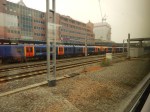

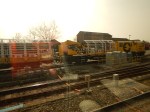
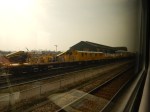
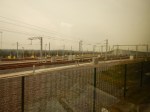

I think it is true to say that the electrification is being put up by snails and there seems to be little progress since I wrote Passing Didcot Power Station twelve months ago.
Note the following.
- Very little seems to be happening around Reading station, except the erection of a few masts.
- The cause of a lot of the trouble – the HOPS train at Swindon.
- The depot for the Class 800/801 trains at Filton Triangle.
- The extra platforms at Cardiff Central station.
- The work at Cardiff to create a new Central Square.
A lot of the work, that is this side of Bristol, is a total disaster.
Are The Electrification Gantries Going In The Middle At Horwich Parkway Station?
Traditionally, when a line is electrified in the UK, either a gantry or a wire is put over all the lines and supported on both sides of the track.
So I was surprised to see these circular structures between the tracks at Horwich Parkway station.


I thought at first, that they were drainage access points, but Network Rail’s are usually rectangular and often covered with a blue grating during construction.
I suspect that the substantial road bridge and possibly the footbridge will be used as supports for the overhead lines, so it would mean that if a substantial gantry was placed at the Northern end of the station, a few central masts would probably give enough support to the catenary, as it passed through the station.
It is possibly significant that there is no circular structure under the footbridge, despite being about the right place in a sequence of structures. If they were to do with drainage, you would still need drainage under the bridge, but if they are for electrification, then the footbridge could be used for support of the overhead wires.
This is a Google Map of the station, with the ends of the platforms in the South East corner.
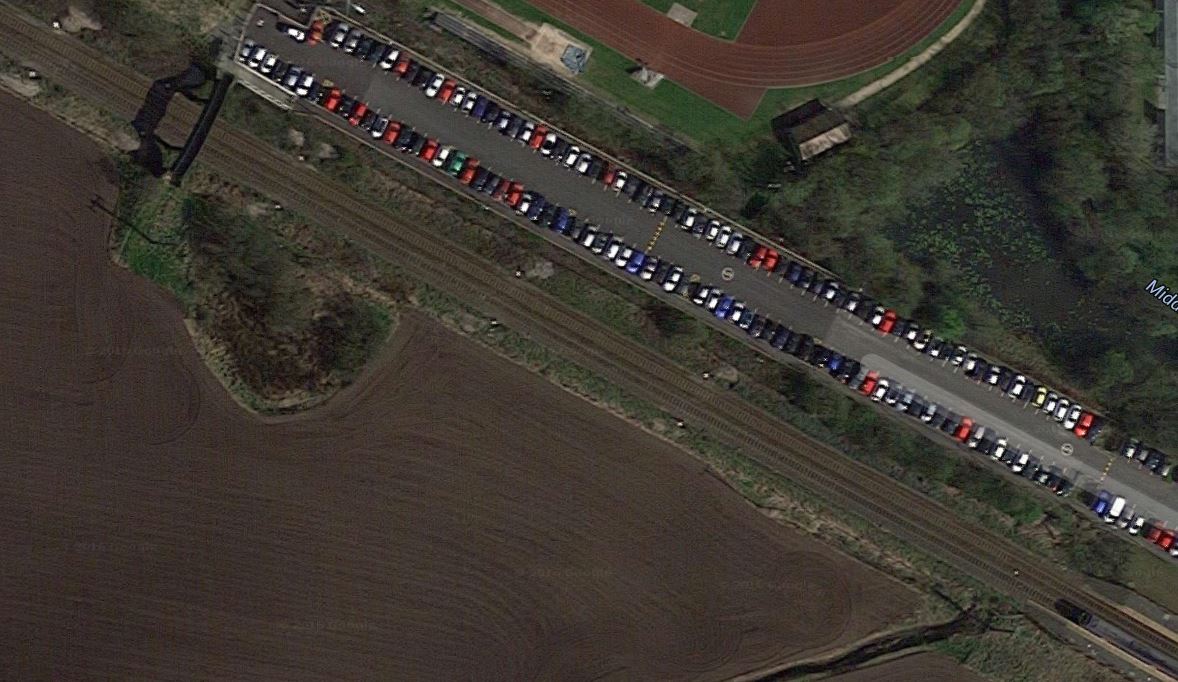
Horwich Parkway Station
Note the five pairs of white spots along the line, one pair of which is in the shadow of the footbridge.
If you can’t see them click the image and show it in your browser.
Could the white dots be concrete piles for the electrification? As I left Horwich Parkway station, I noticed some piles to the South of the station and they were uncovered, showing white concrete.
Just in front of the train in the station, it is possible to see another white dot between the tracks. A circular structure is also visible in the pictures of the station.
It would also appear that one set of foundations are missing between the single dot and the pairs along the line. Could this be, because a substantial gantry is being erected here, to support the catenary at the Northern end of the station?
So it would appear that masts could be used in the centre at Horwich Parkway station, but after An Hour In Farnworth, I am rather dubious that a similar technique could be used at Farnworth station.
Improving The Hastings Line
In The Lewes Horeseshoe, I discussed how an idea from Railfuture might be used to improve services between London and the South Coast.
I came to the conclusion, that if various improvements were carried out, including the running of trains with Class 395 performance from Ashford to Brighton along the East Coastway Line, that this would present an opportunity to close and rebuild the Hastings Line.
The Hastings Line is only thirty-two miles long from the South Eastern Main Line to Hastings, but there are deficiencies in the tunnels, which led to four of the eight tunnels being made single-track, when the line was electrified in 1986.
Surely, the fact that the line is constantly switching from double to single track, is one of the reasons, that the line only has a pathetic one semi-fast and one stopping train per hour between London and Hastings.
But things have moved on since 1986!
Network Rail must have learned a lot of tricks with tunnels. In particular, all the lessons learned in the re-boring of Farnworth Tunnel will be invaluable.
The length of the line is also such, that services could be run using IPEMU trains, charging the on-board storage on the South Eastern Main Line and between Battle and Hastings stations.
Would running some parts of the Hastings Line without power, mean that it could be simplified by the partial removal of electrification?
I estimate that around twenty-five miles would be without electrification, which would be an easy gap to bridge for an IPEMU.
Would this simplification in the various single-track tunnels, coupled with modern tunnelling techniques, allow Network Rail to create a fully double-tracked route from the South Eastern Main Line along the full length of the Hastings Line to Hastings?
If four trains per hour could be run between London and Hastings, that would be a tremendous improvement. At the London end of the route, the Thameslink Programme should create extra capacity for trains into Charing Cross station.
In addition, it would appear that the line is already capable of handling ten-car trains. Could this be stretched to twelve?
I am certain, that in the light of developments in the last few years, that Network Rail are looking at ways of increasing the capacity on the Hastings Line.
They’re also probably looking to do other engineering work, as there was a major landslip on the line a couple of years ago.
But in truth nothing can be done, until alternative routes are provided via Ashford and/or Brighton, as the tunnel work would probably mean that the Hastings Line would need to be closed, whilst some of the work is performed.
Unless a sensible alternative is provided, I’m sure Disgusted of Tunbridge Wells will be penning another letter to the Telegraph.
Future-Proofing The Uckfield Branch
The Uckfield Branch of the Oxted Line was open today, so as in A Trip To Uckfield, I had to use a Rail Replacement Bus from Crowborough, I took a train to Uckfield station and back from London Bridge. These are some of the pictures I took at Uckfield station.
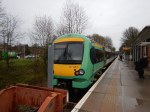
I can’t disagree with what I said in the previous post.
The platform work is certainly being done to a standard and length, that should be good enough, if the Uckfield Branch is used to create a second Brighton Main Line, by extending the line past Uckfield to Lewes on the route of the former Wealden Line.
All of the platforms I have seen on the Oxted Branch seem to be capable of taking a twelve-car train.
Uckfield’s Long Single Platform
Although, I suspect that Uckfield itself could be a bit longer, especially as workers still seemed to be extending it further to the North.
I would think, that this long platform would enable two eight-car trains to be parked in the station, if there was a need in the Peak or because one of the trains had failed.
It’s just more future-proofing.
Oxted’s Bay Platform
Platform 3 at Oxted station is a South-facing bay platform, which is used to provide shuttle and other services down the two branches. In the last couple of years, it has been electrified, which is just more future-proofing, in case it was required to run an electrified shuttle to East Grinstead.
IPEMUs To Uckfield?
The Oxted Line is electrified from London Bridge as far as Hurst Green station, where the two branches split.
- The East Grinstead Branch is electrified.
- Uckfield Branch is not and is about twenty miles long.
As a typical Electrostar IPEMU based on say a Class 387 train, would probably have a range of at least fifty to sixty miles, it would appear that IPEMUs could work the London Bridge or Victoria to Uckfield service.
- Between London Bridge and Hurst Green the trains would take thirty-two minutes, getting power from the third-rail electrification. Batteries would also be charged on this leg.
- Between Hurst Green and Uckfield, they would take forty-two minutes and rely on battery power.
I suspect too, that third-rail IPEMUs could charge their batteries fully before they left London Bridge.
Platform 3 at Oxted station might also be useful for charging an IPEMU running a shuttle service on the Uckfield Branch.
In my view, the work done on the Uckfield Branch in recent months has created a line, that would be an ideal route for IPEMUs to provide the service.
- Platforms have been sufficiently lengthened.
- Signalling can probably already cope with the longer trains.
- There is no more electrification required.
All that is needed is to add an IPEMU-capability to the required number of Class 387 trains and train the staff.
How Long Is An IPEMU?
There is one mathematical and marketing problem, that must be solved before trains are run.
Class 387 trains come in sets of four-cars and on Thameslink, typically run in formations of four-, eight- or twelve-cars.
What is the optimal length to run services on the Uckfield Branch, as determined by passenger demand?
And can this length of train be provided?
I’ve not seen anything for instance, which says how many IPEMUs can form a single train.
But I suspect that Bombardier wouldn’t design a train, without a multiple-working capability.
And of course, the Uckfield Branch has been future-proofed for twelve cars.
I suspect that the capacity of the Uckfield Line will be determined more, by the size of the car parks.
Onward To Lewes
This article in the Uckfield News is entitled £100k Budget pledge for Uckfield to Lewes rail line study.
So it is possible that the Uckfield Branch could be extended by about ten miles to Lewes, along the route of the disused Wealden Line.
Intriguingly, as Lewes is fully electrified an IPEMU train going from London Bridge to Lewes would do less distance on batteries than a train going from London Bridge to Uckfield and back.
One of the problems with extending past Uckfield, is that the trains would have to cross the B2102 by the station in the middle of Uckfield.
This used to be a level crossing and I’m certain, that this option will not be reinstated for safety reasons. It has to be said, that as an IPEMU could cross on battery power, there might be a better solution, than a traditional level crossing.
But IPEMUs have another advantage, in that they could use a short underpass without electrification. I just wonder whether that some clever design could squeeze the railway line under the road.
Conclusion
If the passenger demand is there, there would appear nothing in the design of the upgrade to the Uckfield Line, to stop IPEMUs being used to fulfil that demand.
The IPEMU Advantage
Others question and they do rightly, my enthusiasm for the IPEMU or the battery-powered train.
This post which takes information from a variety of sources explains why I think as I do.
This document on the Network Rail web site explains the thinking of Bombardier and Network Rail.
Running Trains
Running trains is a co-operation between several parties.
- The passengers.
- The train operating companies like Virgin Trains, LOROL, Abellio Greater Anglia etc.
- The train builders like Bombardier, CAF, Hitachi, Siemens etc.
- The infrastructure provider like Network Rail, airports, property developers etc.
- The regulators and elected bodies like Government, TfL etc.
So what advantages does an IPEMU bring to each group?
The Train Builders
Is it simply a matter of who makes the best trains, will get the greatest number of orders?
The train of the future will.
- Be powered by electricity.
- Have regenerative braking to capture braking energy as electricity.
- Have a lot of power-hungry passenger features like air-conditioning, wi-fi and charging sockets.
- Have the ability to move to a limited amount without power, in depots, when the power fails, or where there are deliberate electrification gaps.
- Have a very sophisticated drive control and train management system, which matches train speed and acceleration to location, line, traffic, weather, passenger demand and type of power available.
In some ways regenerative braking is the most important, as it can save almost twenty per cent of the electricity used by a train.
I wouldn’t be surprised that, in a few years time, manufacturers will find it very difficult to sell a train without regenerative braking.
The electric power generated in regenerative braking can either be returned to the power supply or stored on the train.
Returning power is easy on DC systems using conductor rail, like subways, the Underground or Southern Electric, but can be expensive on 25 kVAC overhead systems.
Remember too, that when a train stops, it has to start again and will want the braking energy back.
From an engineering point of view, probably the best way to create an electric train with regenerative braking is to have onboard energy storage to capture the braking energy.
This is already done extensively in an analogous manner with hybrid road vehicles. It could even be done now with a diesel-electric train such as an Inter-City 125.
This leads to the proposition that within a few years all train manufacturers will need to make trains, with some form of battery or onboard energy storage.
The latter term is better as who knows what will be used for energy storage in the future? Batteries, KERS and super-capacitors have all been used in rail applications.
Consider.
- All of Bombardier’s new Aventra trains, have provision to plug in an energy storage device, if the customer wants one.
- Several tram manufacturers have products which use onboard energy storage, that have already been ordered and/or delivered.
- Road transport and increasingly buses and passenger cars are hybrid with onboard energy storage.
- Trains with onboard energy storage can be moved without power in depots and when wires come down.
- Bombardier have stated that their IPEMU technology is also being designed to retrofit to existing modern trains like Class 375/377/378/379/387 etc. trains.
- The complicated mathematics of steel wheel on steel rail mean the extra weight of the onboard energy storage is not a disadvantage.
All of this goes together to make the cost of running a train more affordable.
Bombardier’s Prototype IPEMU
Bombardier must be pretty bullish about their technology, as a year ago, they allowed the public to ride on a Class 379 train, that had been modified to be a technology demonstrator.

An Outwardly Normal Class 379 Train
I rode the train and was very impressed.
,It felt just like a standard train and I wouldn’t have known it was running on battery power except for the engineer sitting opposite, who was monitoring the train on his laptop.
Since that ride, there has been no adverse reports in the press and Bombardier have won an award for the technology.
When I am asked what are some of the most impressive experiences in my long life, riding this train certainly ranks towards the top, of those, which were not of my design or creation.
Until I came home and looked up the physics of steel wheel on steel rail, despite being an electrical engineer, I just didn’t believe that batteries could move a train.
In The Technology That Enables The Aventra IPEMU, I wrote about the physics and also what Bombardier seemed to be planing for the new Aventra train, which will have the capability of onboard energy storage.
I think it is true to say, that the unique thing Bombardier has done is to put a credible package together and demonstrate it in public.
The Train Operating Companies
Train companies gain a rather diverse set of advantages from IPEMU technology..
- More services can be given modern electric trains.
- Depots and sidings can be built without electrification, which saves money and makes them safer for the workforce.
- Electrification can be cut back to where it is actually needed.
- Regenerative braking cuts times at stops and increases service speed.
- As trains use less electricity, costs are less.
- IPEMU trains have a limited diversion capability, which can ease disruption.
- The company has a greener profile.
Hopefully, the performance and profile of the company will attract more customers and hence increase profits.
The Passengers
They will gain mainly from the benefits of modern electric trains.
But IPEMUs will bring other benefits to passengers.
- New services to new destinations.
- Faster services on routes with lots of stops.
- Better response when problems inevitably occur with overhead wires.
Hopefully, the lower cost of electric trains with regenerative braking may even result in lower fares.
The Regulators And Politicians
I have a feeling that the regulators will like the IPEMU, as the benefits will mean that passengers should be happier with better services, at hopefully a lower fare.
Politicians, and regulators are mainly of that ilk, that loves to leave a legacy. And they especially like to leave a legacy, which means they get voted back!
Consider the simple one or possibly two station extension of the Gospel Oak to Barking Line (GOBlin) to Barking Riverside.
- It looks like it will sensibly be done after the main route is fully electrified.
- Only Class 710 trains would be used on the extension.
- These trains will be Aventras and could easily be fitted with an IPEMU capability.
- Once it leaves the main line all infrastructure is new.
I believe that using an IPEMU on the extension would be beneficial.
- No electrification would be needed.
- Stations would be simpler.
- There would be no visual intrusion of overhead gantries.
- Train noise would be less.
- Removing electricity would make the environment safer.
- No one is likely to object.
But the main benefit, is that the extension can be built at a much lower cost.
How many new or improved short extensions to the main electrified rail network would IPEMU technology enable?
The politicians will come to love the concept of an IPEMU!
The Infrastructure Providers
Network Rail helped fund the original trial at Manningtree using a modified Class 379 train and you can understand why!
Electrification of lines is enormously expensive for infrastructure companies.
- Putting up wires means raising hundreds of bridges and boring out tunnels.
- Putting up wires seems to constantly drill through important cables.
- Putting up wires in depots, stations and sidings can be very complicated.
- Putting up wires raises heritage issues.
- The Nimbys often don’t like unsightly wires.
- A major cost is often getting the power to the wires.
- Upgrading existing electrification for traditional regenerative braking is not a simple operation.
- Engineers to do the work are in short supply.
So infrastructure companies will probably welcome anything that cuts the amount of new electrification and upgrade work.
One piece of technology we will see increasingly, is the ability of electric trains to deploy and retract the pantograph at line speed, as I believe the new Hitachi Class 800 trains can do.
So where will we see IPEMU technology used to cut the amount of electrification, but not the deployment of electric trains?
- Any branch line from an electrified main line, that is currently run by a diesel multiple unit. Branch lines like Felixstowe, Henley, Marlow, Sudbury, Uckfield and Windsor are probably IPEMU-ready after some platform extension and signalling work for longer trains.
- New extensions from an electrified line to major property developments like Barking Riverside.
- New extensions into restricted spaces, such as airports like Glasgow and Luton.
- Existing lines that connect two electrified main lines like Cambridge to Ipswich and Cambridge to Norwich.
- Electrification gaps can be left in heritage areas like the Grade 2-listed Hebden Bridge station or where the Midland Main Line, runs through the Derwent Valley Mills World Heritage Site.
- Electrification gaps can be left where the geography is just impossible to build, access or maintain the overhead wires.
- Depots and sidings can be left without electrification.
Obviously, electrification gaps can only be left where all trains are diesel, bi-mode or have an IPEMU capability.
Relying on rumours and snippets in the media, the Internet and on blogs, I think we’ll see IPEMUs used in these places first.
- The extension of the Gospel Oak to Barking Line to Barking Riverside.
- Branch lines on the Great Western Railway, between London and Didcot.
- Branch lines in East Anglia.
- Merseyrail to Preston and Wrexham.
- Removal of diesel trains from the Southern franchise in Sussex and Kent.
I would add the Northern City Line, but the order for new trains has gone to Siemens.
The electrification of this line from Finsbury Park to Moorgate is a mixture of third rail and overhead.
As the new trains will be the only ones working this line, a train could use an IPEMU capability South of Finsbury Park. When all the Class 313 trains have been moved on, the third rail electrification would not be needed.
As it’s a couple of years before the Class 700 trains are delivered, I just wonder if they’ll have an IPEMU capability.
According to this article in the Daily Telegraph, Siemens are certainly experimenting with the use of batteries in trains.
The Current Status
Of the major manufacturers, this is the current published status, as far as I can determine.
- Bombardier have demonstrated their technology in public and used it in trams.
- Bombardier are researching heavily into the best battery system at Mannheim.
- Bombardier have also built large numbers of EMUs in recent years, that are suitable for retrofit with IPEMU technology.
- CAF spend heavily on R & D, have used the technology in trams for some years.
- CAF have sold that type of tram to the Midland Metro.
- JR East, who are on the list of preferred suppliers for Merseyrail’s new trains, have working Battery Trains In Japan.
- Siemens and Alsthom have trams running on batteries.
- Hitachi are backing the bi-mode, but must have access to Japanese technology.
On the down-side Bombardier have well publicised financial problems.
The Future
Currently, the IPEMU technology has a range of about fifty miles on battery, which if there is no en-route charging means that it could be used on short branches up to twenty miles.
This range will grow, as engineers know how to stretch the onboard energy storage capacity.
Engineers will also learn how to use the technology to take electric trains into more and more places, that are now thought impossible.
I think that the launching of battery trams in Birmingham will alight everybody’s minds to the possibilities of battery power.
Bridges Around Crouch Hill Station
I took these pictures to show a few of the problems and easy bits of electrifying the Gospel Oak to Barking Line, around Crouch Hill station.
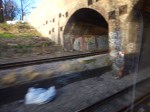
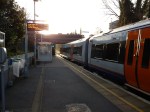
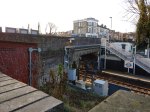
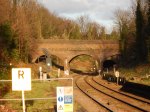
For comparison, this is Google Map of the station and the bridge and tunnel to the East.

Crouch Hill Station
Note the Victoria Road Bridge and the meting of several roads over the Crouch Hill Tunnel.
I think you can make the following observations.
- There is quite a large green margin to each side of the rail line. This surely should make design of the overhead wires and the various support services like power supplies and control gear easier.
- The Victoria Road Bridge appears to be in good condition and I suspect the arches are large enough to accommodate the overhead wires.
- Is the Crouch Hill Tunnel large enough?
- The bridge at Crouch Hill station appears to be a tight fit and I suspect, the track will need to be lowered to allow space for the overhead wires.
- The current platforms at the station are probably not long enough for four-car trains, but note that there are unused sections of the platforms that could be brought back into use.
- In the picture showing the Victoria Rosad Bridge, you can just see one of the piles at the end of the unused platform extension.
In common with much of the line, the infrastructure seems generally to be in good condition.
I think the updating and electrification of Crouch Hill station will be very typical of other stations on the line.
Moving Towards A Pan-European Locomotive
This article on Global Rail News is entitled Traxx approved for entire DACH region.
The article talks about how the Bombardier Traxx Last Mile locomotive has been approved for Germany, Austria and Switzerland (DACH). The Global Rail News article, says this about the locomotive.
The Last Mile variant, although an electric locomotive, has a low-emission diesel engine and battery on board, allowing it to run on both electrified and non-electrified routes.
One of my first thoughts, was it’s a pity that the standard Traxx is probably two large for the UK’s small loading gauge.
But then I found this article in Railway Gazette, about a proposed UK version of the locomotive. This is said.
Bombardier believes that the Traxx P200 AC UK Bo-Bo electric locomotive fitted with a ‘last mile’ diesel engine would offer ‘a lot of value for money’ for UK operators such as Greater Anglia. Whereas the MkIII coaches used on London – Norwich inter-city services are ‘excellent’ vehicles that may last for another 20 years, the Class 90 locomotives will need to be replaced before that.
Lacchini emphasises that a 25 kV 50 Hz version of the Traxx family suitable for the UK with its small loading gauge will not require a special design to be developed. About 60% of components are common to all versions of the Traxx, one feature being the location of the main traction package in the centre of the locomotive rather than on either side of a central aisle. This makes it relatively easy to build a smaller and narrower version that would fit the UK loading gauge, Lacchini indicated.
It looks to me that Bombadier have designed a powerful family of electric locomotives, that can be used in much of Europe.
With the Class 88 locomotive also due to be delivered soon, it does appear that the UK may have a choice of modern locomtives for freight trains and fast passenger services in the near future.
 The Anonymous Widower