Along The Avocet Line
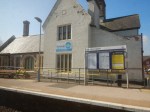
I took these pictures on a trip from Exeter to Exmouth and back on the Avocet Line.








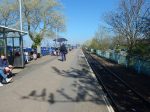
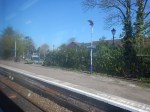
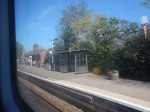

These are my thoughts under various topics.
Exmouth
Exmouth reminded me of the seaside town, where I spent a fair bit of my childhood; Felixstowe.
- They are both coastal towns.
- Exmouth has the larger population of 34,400 to Felixstowe’s 23,000.
- Both have adequate shopping centres, although Exmouth has a large Marks and Spencer Simply Food by the station.
I didn’t get to the beach.
The Starcross And Exmouth Ferry
There is a ferry between Starcross station and Exmouth, which seems to be well used.
Exmouth Station And The Train Service
Exmouth station was rebuilt in 1986 and it is a one-platform station with facilities and a large Marks and Spencer Simply Food.
The only problem is the trains themselves, as their frequency, which is generally two trains per hour, is acceptable.
But two Class 143 trains coupled together is inadequate, for a summer’s day when passengers have buggies, bicycles and lots of young children.
Monkerton Station
Monkerton station is a proposed new station on the Avocet Line, that would be built between Polsloe Bridge and Digby & Sowton.
The Seaside Special
Exmouth station and the Avocet Line powerfully makes the case for a Seaside Special train.
- Four cars.
- Independently-powered by diesel or perhaps batteries in the future.
- A range of perhaps thirty miles.
- Lots of space for buggies, bicycles and large suitcases.
- Step-across access between platform and train.
I’m sure Greater Anglia and Great Western Railway, with help from other train operating companies could come up with workable specification.
Get the specification right and it might be the short distance commuter train, where a proportion of passengers want to bring bicycles.
With the current developments in train refurbishment, the new Class 319 Flex and Class 230 trains might be the place to start.
Trains Between Barnstaple, Exmouth and Paignton
The trains work a triangular schedule with Barnstaple, Exmouth and Paignton stations at the points and most cross-Exeter services calling at Exeter Central and Exeter St. Davids stations,
Current times in the afternoon timetable for the various legs are
- Exeter St. Davids to Barnstaple – Minimum – 68 minutes – 6 stops
- Exeter St. Davids to Barnstaple – Maximum – 77 minutes – 11 stops
- Barnstaple to Exeter St. Davids – Minimum – 62 minutes – 6 stops
- Barnstaple to Exeter St. Davids – Maximum – 76 minutes – 10 stops
- Exeter St. Davids to Exmouth – Minimum – 29 minutes – 5 stops
- Exeter St. Davids to Exmouth – Maximum – 34 minutes – 9 stops
- Exmouth to Exeter St. Davids – Minimum – 26 minutes – 5 stops
- Exmouth to Exeter St. Davids -Maximum – 34 minutes – 9 stops
- Exeter St. Davids to Paignton – Minimum – 54 minutes – 8 stops
- Exeter St. Davids to Paignton – Maximum – 62 minutes – 8 stops
- Paignton to Exeter St. Davids – Minimum 48 minutes – 6 stops
- Paignton to Exeter St. Davids – Maximum – 62 minutes – 8 stops
From the timetable, the timings seem all over the place.
But consider.
- I was told that the trains aren’t very reliable and sometimes a Class 143 train turns up and struggles.
- So timings are probably worked out for a Class 143 train, which is a Pacer.
- Some trains skip several stops.
- The Exmouth and Paignton legs seem to have better performance, but then the terrain is not so hilly.
- Four-car trains are needed much of the time. At least platforms seem to be built for at least that length.
The people who devised the current timetable probably found it challenging.
It could probably be simplified, by more, better, faster and more powerful trains.
After I visited the Buxton Line I wrote Thoughts On The Buxton Line.
I said this.
The Buxton Line is very stiff for a railway in England. Wikipedia says this about the rolling stock.
Due to steep gradients on this line, Class 142 and Class 153 DMUs are banned from the section of line between Hazel Grove and Buxton. Therefore, services to Buxton are worked by Class 150 and Class 156 DMUs. Also Class 158 DMUs were once blocked from operating on the line to Buxton due to the possibility of the large roof-mounted air vents striking low bridges on the route.Piccadilly to Hazel Grove services used Class 323 electric multiple units up until 2008.
I went up in a Class 150 train and came down in a Class 156 train.
The Class 150 train definitely found the climb a struggle and it wasn’t even that full.
So why if Northern have stopped using Class 142 and Class 153 trains on steep hills, does it look like GWR are still doing it on the Tarka Line?
Probably, because it is all they’ve got!
If the electrification of the Great Western Railway had been going to the original schedule, the trains would have been replaced with some of the twenty two-car and sixteen three-car Class 165 trains or twenty-one three-car Class 166 trains, currently used between London and Reading.
Surely, these would be able to work as three or four car units on the lines out of Exeter!
As the trains are more powerful, perhaps they could work a faster and more passenger and operator friendly timetable.
The Tarka Line
The Tarka Line is a branch line in Devon that runs up from Exeter St. Davids station to Barnstable station.
I went to Barnstaple in the rush hour in a packed three car train, consisting of a Class 150 and a Class 153 train working together, asw a three-car unit.
The lady next to me, said she lived in Bideford, so she had a drive from Barnstaple.
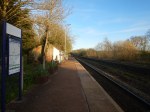
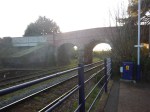
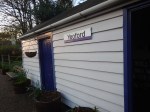
Coming back down, the train was almost empty, so I took a pit stop at Yeoford station in a local pub called the Mare and Foal, before catching the next train back to Exeter. That train was a refurbished Class 150 train, that I wrote about in What Train Is This?
These pictures show Yeoford station to give a flavour of the line.


The Link To The Dartmoor Railway
This Google Map shows the section of the Tarka Line North from Yeoford station, which is in the South East corner.

At the village of Penstone, the Dartmoor Railway breaks off to the West to go to Okehampton station.
Under Future in the Wikipedia entry for Yeoford station, this is said.
The Dartmoor Railway plan to reopen the disused platform at the station in order to create an interchange with the Tarka Line (and thus the national network). Through running from Yeoford to Okehampton was intended to commence in 2009 but this was delayed pending the finalising of transfer arrangements with Network Rail. Accordingly, the “Sunday Rover” service run by Great Western Railway again operated on Sundays throughout the summer of 2009, although not calling here. Though the GWR summer trains have continued to operate since (running again each summer from 2013-16), agreement over the use of Yeoford as an interchange has still not been reached and it is unclear as to when (or if) this will be possible.
If this does happen, it could be the first step in opening up a second East-West route across Devon.
This page on the Dartmoor Railway web site is entitled GWR Sunday service to Okehampton and gives details of the GWR Summer Sunday service.
Reopening the old LSWR route across Devon will be driven by the following.
- New housing developments in the area.
- Tourism
- Creating employment.
- Bringing quarried materials to construction distribution depots and sites by rail.
- Creating a second route to Cornwall in case of disruption at Dawlish.
Murphy’s Law will of course apply and once the route is open, there will be no more disruption at Dawlish.
If the route is built, it will allow local trains to do a circular route from Exeter calling at the following stations in large towns.
- Crediton
- Okehampton
- Tavistock
- Plymouth
- Newton Abbott
The route would give connections to branches to Axminster, Barnstaple, Exmouth, Gunnislake, Paignton and Tiverton.
Onward To Bideford
The Wikipedia entry for Bideford station says this.
Recently, the station was included on the ATOC Connecting Communities report, that recommends closed lines and stations that should have a railway station. The report suggests the reopening of the Barnstaple – Bideford railway line.
This Google Map shows the centre of the town of Bideford.
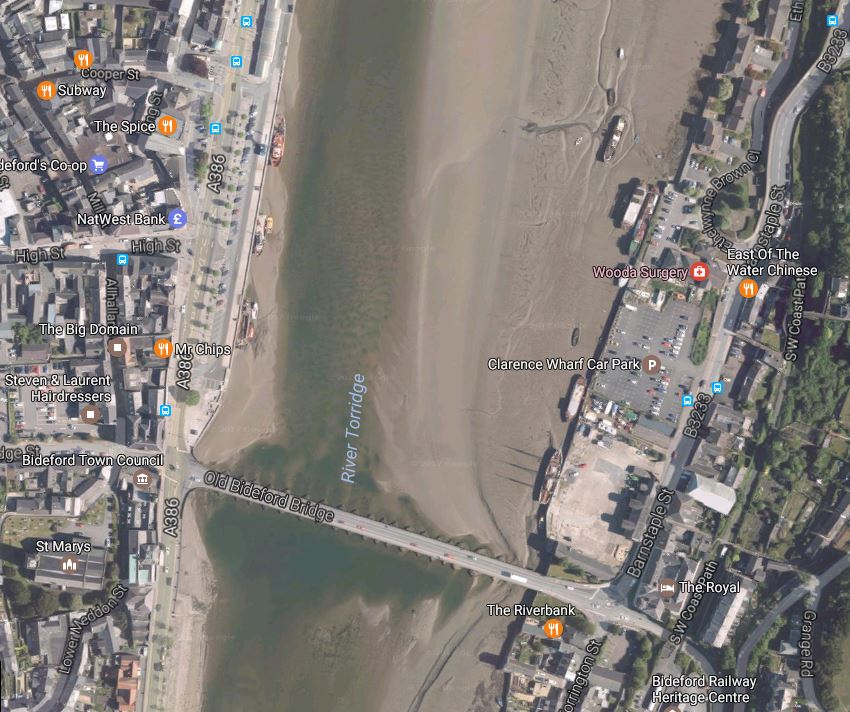
The old station was located at the site of the Bideford Railway Heritage Centre at the Eastern end of the Old Bideford Bridge.
So could the railway line between Barnstaple and Bideford be reopened?
This Google Map shows the other end of the line at Barnstaple.
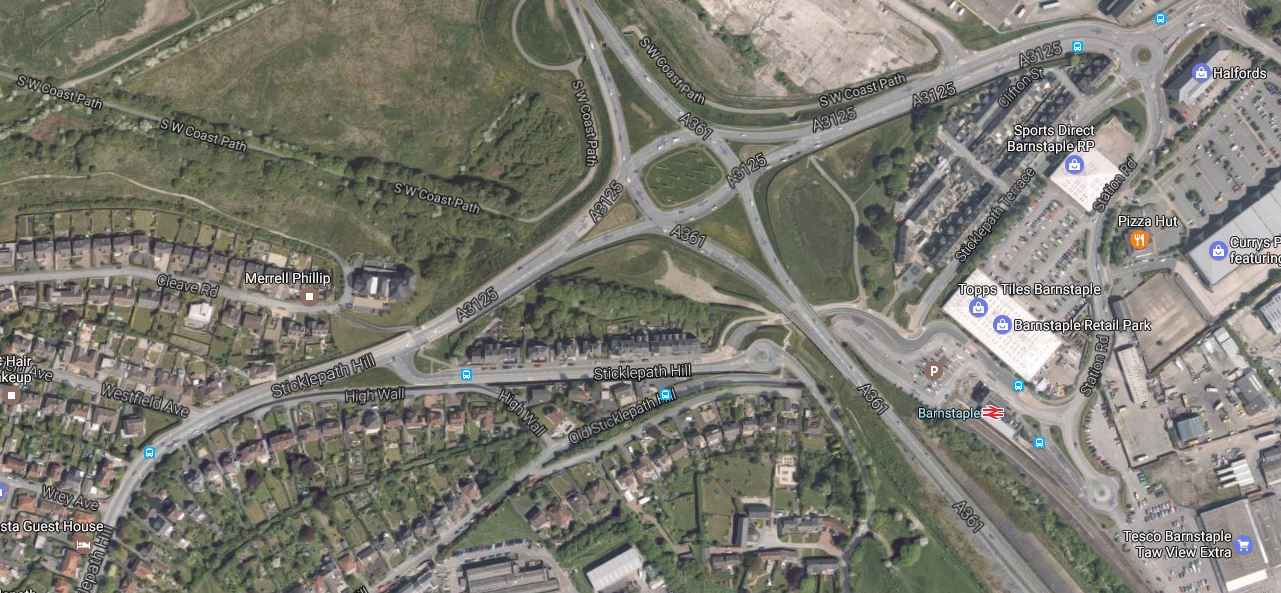
The old railway line is now used as the South West Coastal Path.
I think with traditional technology, it will be unlikely that the railway is rebuilt, as walkers and others will rightly object to noisy diesel trains or electrification of any kind, disturbing the countryside.
But as I wrote in No-Frills Mini Trains Offer Route To Reopening Lines That Beeching Shut, engineers won’t give up in providing solutions for difficult to serve places.
I believe that within ten years, a silent battery-powered train, will be ghosting its way along a single track railway between Barstaple and Bideford, that is shared with walkers and cyclists.
Remember engineering is the science of the possible, whereas politics is all impossible dreams.
 The Anonymous Widower