Should We Create A Northern Playground In Addition To A Northern Powerhouse?
George Osborne and other politicians, thinkers, academics and businessmen talk about creating a Northern Powerhouse.
I am very much in agreement to these aims, but from my London-based viewpoint, I tend to think that the North has a lot more to offer.
Two of the bigger successes of the North in recent years have been the reinvigoration of Liverpool as one of the best tourist destinations in the world and the Tour de France in Yorkshire in 2014.
So should any Northern Powerhouse plans, take more than a large nod to emphasising the leisure and tourism opportunities in the area?
The government’s plan for transport in the North released yesterday and discussed in this post, is fifty years too late and if it’s implemented, it will be some years, before High Speed Trains touch 140 mph on the way between Liverpool and Hull and Newcastle.
The high speed railway should remain an end objective, but in the mean time, we should do various things to make the wait bearable.
1. Electrification In The North
The Electrification in the North study recommended that virtually all lines north of a line drawn between Chester and Lincoln be electrified. A rolling program should be planned that virtually eliminates diesel-powered passenger and freight trains.
This would speed up services between all the major cities and also connect all of the wonderful rural lines that cross the Pennines and hug the coastline to major centres of population.
So this electrification program is just as much Northern Playground as Northern Powerhouse.
2. Contactless Ticketing
Plans for the North talk about an Oyster Card for the North. As so many Londoners will tell you, Oyster is old superseded technology and so last decade.
We need a universal contactless ticketing system based on bank cards that works all over the UK!
This would mean that you just turned up at any station, bus or tram stop in the UK, touched in and you’re off on your journey.
Those who doubt this is possible, should spend a week using their bank card as a ticket in Greater London. They will find a system totally devoid or hassle and cash, well-liked by both passengers and staff. It also automatically gives you the cheapest price for the collection of journeys you take over a day, week or month.
Leisure passengers by their more spasmodic and impulsive nature will benefit tremendously from simple contactless ticketing.
3. Maps And Information Everybody Can Understand
As London was first in the world with decent maps and also because it is so large, that no resident knows the whole city, London needs comprehensive maps and travel information displayed everywhere in a common easily-understood and learned format.
As the combined population of the North of England is upwards of eleven million as against the eight of Greater London in a wider area, I suspect those in the North find themselves in an unknown area more often than those in Greater London.
So one thing that the North needs for both Playground and Powerhouse is a universal mapping and information system, which is the same all across the various parts of the North.
I feel that the North should use London’s system, which includes.
1, A detailed local walking map on every bus stop, tram stop and station.
2. Comprehensive bus information at every station.
3, A detailed bus spider map on every bus stop, tram stop and station.
4. A five digit number on every bus stop, which if sent as an SMS message to a short SMS number, gives details of the next few buses.
,I doubt that this will ever happen, as no council in the North would ever allow something to be used in exactly the same way as it is in London. Or if it was one of the larger cities, in the same format as another.
If the system relied on passengers having and using smart phones, then it should be prohibited.
But quite frankly, at the moment the information systems in the North are truly dreadful.
4. Two Hours From London
This is a list of the major cities of the North and typical fastest journey times by train to and from London.
Barnsley – 2:34 to 2:45 – Change at Sheffield
Blackburn – 2:56 – Change at Preston
Blackpool – 2:45 – Change at Preston
Bolton – 2:45 – Change at Manchester
Bradford – 2:49 to 2:52 – Change at Leeds
Burnley – 3:41 – Change at Preston
Darlington – 2:20 – Direct
Doncaster – 1:34 to 1:38 – Direct
Halifax – 2:48 – Direct/3:08 – Change at Leeds
Harrogate – 2:43 – Change at York or Leeds
Huddersfield- 2:52 to 2~:54 – Change at Manchester or Leeds
Hull – 2:33 – Direct
Leeds – 2:11 to 2:13 – Direct
Liverpool – 2:12 to 2:14 – Direct
Manchester – 2:07 to 2:09 – Direct
Middlesbrough – 2:57 to 2:59 – Change at Darlington
Newcastle – 2:50 – Direct
Preston – 2:08 – Direct
Rotherham – 2:16 to 2:28 – Change at Doncaster or Sheffield
Sheffield – 2:01 – Direct
Stockport – 1:55 to 1:56 – Direct
Warrington – 1:44 – Direct
Wigan – 1:55 – Direct
York – 1:50 to 2:02 – Direct
This list shows several things.
1. Many of the direct journeys between London and the North could be brought consistently under two hours, once ERTMS allows 140 mph running on the East Coast Main Line and the West Coast Main Line in a few years time.
2. Electrification of the Midland Main Line to Sheffield will bring that city consistently under two hours from London, which will speed up the journey to Barnsley, Rotherham and other places.
3. Some destinations like Blackpool, Bradford, Huddersfield, Hull and Middlesbrough would get a significantly faster service to and from London, if there was no need to change.
If we get the expected speed up on the East and West Coast Main Lines, what sort of times will we get to the major cities in the North.
Adjusting for the probable speed increase from 125 to 140 mph. gives these estimates for the following journeys.
Darlington – 2:05
Doncaster -1:26
Hull – 2:17
Leeds – 1:57
Liverpool – 1:59
Manchester – 1:55
Newcastle – 2:32
Preston – 1:54
York 1:47
I think we can say that in a few years time, many more towns and cities in the North will be within two hours from London, which can only be beneficial to those places for both Powerhouse and Playground purposes.
I regularly go to the North for the day by train to see football. Some places like Middlesbrough and Blackburn are tiring journeys, but get them under two hours and leisure traffic can’t help but increase, especially, if there were more affordable good hotels and better late train services back to London..
5. Better Connectivity
More places could be brought under the important two hour ideal, if perhaps the east-west routes interfaced better with the north-south ones at places like Darlington, Doncaster, Leeds, Preston and York.
In an ideal world, a passenger from say London to Hull, should be able to step off a northbound train at Doncaster and just by walking across the platform to step on to a train for Hull. At the same time passengers from Sheffield and Rotherham going to Newcastle would just step across the platform the other way.
This may seem rather utopian, but precise timing of trains is what ERTMS is supposed to enable.
The easier it is to get between any two points in the North, the more things will be improved.
6. High Speed Lines Across The Country
When the upgrade and electrification of the Midland Main Line is completed in 2020, there will be three major 140 mph railways between London and the North.
To complement these there needs to be High Speed Lines across the country from say Liverpool to Hull and Newcastle.
Any east-west lines will connect with the north-south lines at places like Darlington, Doncaster, Leeds, Manchester, Newcastle, Preston, Sheffield and York.
As I said in the previous section, there needs to be good interfaces between the two sets of lines to speed up journeys to stations that are a change away from the north-south lines.
At some point in the future, there will be a need for purpose-built High Speed Lines across the county.
But by the time this is done, I think tunnelling techniques will have improved to such a degree that instead of building a surface railway with all the planning and other difficulties that entails, a tunnel will be bored under the Pennines to connect Hull and Doncaster with Liverpool. The tunnel would be arranged to pass under major stations like Sheffield and Manchester Piccadilly and could connect to them by lifts and escalators.
Such a tunnel could be bored to a W10 loading gauge, so that it could transfer freight containers under the Pennines to link Liverpool and the West Coast Main Line with the Electric Spine to Southampton and the East Coast Main Line to London Gateway and Felixstowe. I believe a high-capacity freight railway between east and west through the Pennines, will have the same effect as theFelixstowe-Nuneaton freight corridor has had on the A14.
This Google Earth image shows the towns and cities between Liverpool and Hull.
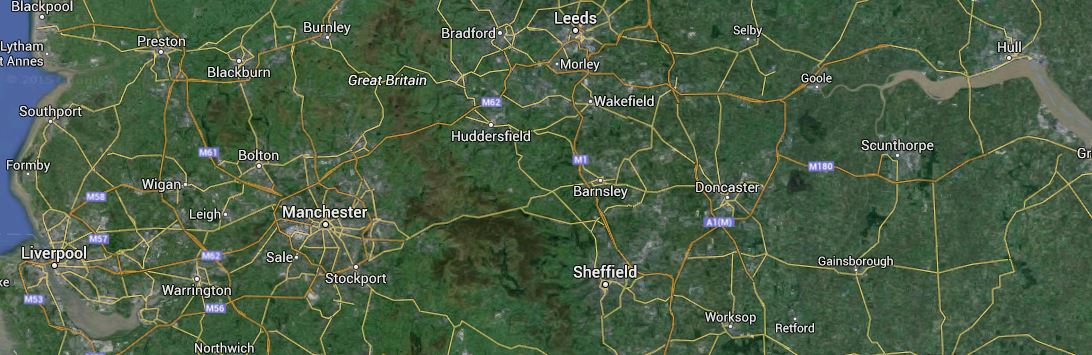
Liverpool To Hull
It may seem a long way to bore a tunnel even if it didn’t go all the distance, but we’re probably talking about 2030 and the machines then, will make today’s machines look like toys. The tunnel would probably start west of Manchester and go to east of Sheffield, which would be under fifty kilometres, connecting to Liverpool and Hull by means of surface lines.
Also if any new route could handle freight and link the Port of Liverpool to the east side of England this could have interesting possibilities.
For instance, would it be quicker for containerised freight from the United States and Canada to reach Germany and Central Europe if it went via Liverpool and a freight train through the Channel Tunnel?
Plans of this nature have existed for years, but none has ever been implemented. Some proposals for the Great Central Railway are given here.
It all goes to show that modern technology will create lots of options for putting a High Speed Line across the country.
Both Powerhouse and Playground will benefit.
Rail Freight Contributes £1.6billion To UK Economy In 2013
This is said in a report on Rail Magazine, based on details from the Rail Delivery Group.
The report also says that £30 billion of goods were moved by rail and that the amount of shipping containers moved has increased by 30% since 2006.
How much extra motorway space has been created by all this rail freight?
Sunderland Port Gets A Rail Connection
I’m all for freight traffic to be on the railways, even if it sometimes means that noisy and smelly freight trains pass through residential areas. But on the plus side, I’ve seen how rail improvements connecting the Port of Ferlixstowe to the wider rail network, has taken so much traffic off the busy A14. It is my belief, that one of the best ways to increase motorway capacity, is to remove as much long distance freight as possible.
DB Schenker obviously want to promote rail freight for commercial reasons and they seem to be backing a lot of new rail developments like the Northern Hub.
So I was not surprised to see the company very much behind the re-opening of a rail link into the Port of Sunderland, as reported in this piece in Modern Railways. DB Schenker’s spokesman says this.
‘Ports play a crucial part in DB Schenker Rail’s growth strategy and we are delighted to bring rail back to Port of Sunderland.
It will be interesting to see how busy this rail link becomes in the next few years.
Increasingly, these last mile rail links are being created or renewed. The only losers are probably the drivers of heavy good vehicles.
This small rail link has been renewed in an area that could see a lot of development in the next few years. This Google Earth map shows the rough route of the rail link along the coast.
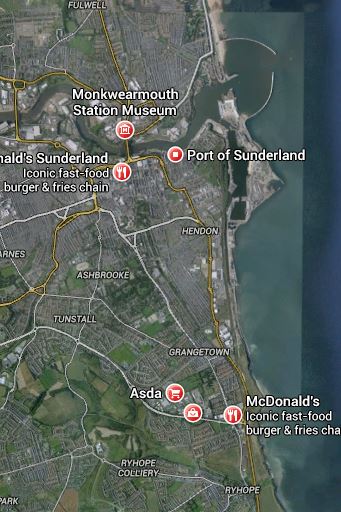
The Durham Coast South Of Sunderland
Sunderland Port is marked by the two curved breakwaters at the top and the link joins the Durham Coast Line that runs from Newcastle via Sunderland and Hartlepool to Middlesbrough, at Ryhope Grange junction, which is near to the marked McDonalds.
The Durham Coast Line has an hourly service between Newcastle and Middlesbrough and also connects various ports and sites to the rail freight network. It is also used by Grand Central services between Sunderland and London and as a diversionary route for the East Coast Main Line. Local groups are also keen that the line be upgraded with a better passenger service between the Tyne, Wear and Tees areas.
In a sane world, this line would be a prime candidate for electrification linked to the East Coast Main Line at Newcastle and Darlington. A few points.
1. It would be an important electrified diversion for the increasingly crowded East Coast Main Line.
2. I suspect Grand Central and other East Coast Main Line operators are pushing for this electrification, as it would enable direct high speed services between Newcastle and London via Sunderland, Hartlepool and Middlesbrough.
3. After the completed electrification of the Trans-Pennine routes, it would also improve services from towns and cities not on the East Coast Main Line to the western side of the Pennines.
However full electrification is probably not possible as the northern part of the line has been electrified for the Newcastle Metro to a different standard. But the new passenger trains like the Class 800 and new freight locomotives like the Class 88, would just switch to their on-board diesel power,
As an aside here, Tees Valley Metro, is being developed around Middlesbrough, in rather a stop-go fashion. Surely if the Durham Coast Line is electrified and that electrification is extended to Darlington and then perhaps on the Tees Valley Line to Bishops Auckland to serve both the National Railway Museum at Shildon and the Hitachi train factory at Newton Aycliffe. It would seem a bit mad to build a large factory to make electric trains and then have to haul them in-and-out with a diesel locomotive.
If nothing else, all of these options prove to me, that the North East should have a similar sort of autonomy as Greater Manchester is getting. That would enable the area to bring together all of the ideas about extending the transport system.
Looking at Wikipedia’s list of proposed rail infrastructure projects, these are in the North East.
Newcastle Station Redevelopment
Tyne And Wear Metro Developments
It’s not a long list. Other areas south of Hadrian’s Wall, like Bristol, Birmingham, Cardiff, Leeds, London, Merseyside and Manchester have much better developed plans on the drawing board, even if they know some will be a long time coming.
I wonder if Department of Transport officials when talking to representatives from the North East, say to them, you’ve got an electrified railway to London, the Tyne and Wear Metro, rebuilding of Newcastle station and a brand new train factory, so what more do you want?
Surely, local elected representatives should decide what is best value to the communities they serve. No-one based outside an area, can ever know all of the subtle local reasons, why things should or should not be done. As an example, Greater Anglia’s stations in East London are managed from Norwich. I don’t think they manage them very well and not for good reason are most being put under the care of Transport for London.
Most transport in the North East should be under the control of a single body, so that the limited finances available will be better allocated.
Would Reorganising Cross-Channel Freight Cut Illegal Migration?
People can argue about the advantages and disadvantages of migration into the UK.
But in my view one of the reasons for the high level of illegal immigration into the UK, is that it is a rich source of income for criminal gangs and probably money lenders in countries like Syria, Ethiopia and Somalia, which transport these migrants to the French ports. Never underestimate the role of money-lenders in these sort of enterprises!
Once in the ports, they probably only have one reliable way to get into the UK and that is to sneak or be welcomed aboard a truck. I have only heard very occasionally of an illegal immigrant trying to get into the UK in someone’s car.
So could we reorganise cross-channel freight to cut illegal migration?
It would be a good exercise to analyse truck movements through the Channel Tunnel and see how many could be replaced by a direct rail container transfer. It could be argued that jumping on to a train going at over a hundred kilometres per hour is not easy and this alone would cut the number who try to enter the UK illegally.
Could we also run the truck-shuttles from a dedicated truck terminal at a remote location perhaps fifty kilometres from the tunnel itself? I’ve heard drivers complain of bad facilities and not being able to stop before the tunnel, so this could be a lot better for the drivers. I’m sure the French have a really isolated spot close to the autoroutes. If someone thought about this sort of terminal, it could be made into a very secure and comfortable facility.
Obviously, we’d need a similar facility on the UK side! Manston?
Government Calls For More Strategic Rail Freight Interchanges
Modern Railways is reporting that a government report is calling for the development of Strategic Rail Freight Interchanges (SRFIs). It says this.
A new government report calls for development of Strategic Rail Freight Interchanges (SRFIs) to deal with growth in the rail freight sector and encourage a modal shift from road to rail haulage.
So how many large rail freight interchanges exist in the UK?
An article in Wikipedia called Rail Freight in Great Britain, lists a number of inland freight terminals. Most seem to be small with the exception of Daventry.
Living in London, I have seen the saga of the development of a rail freight terminal at Radlett. But nothing seems to be happening at present and despite the site being granted planning permission in July 2014, this is the sort of project that might not survive the next General Election. Another large freight interchange; the East Midlands Gateway at a site North of East Midlands Airport, appears to be very much opposed by the local residents.
We have a choice in this country. We can either take the freight containers to and from the ports, a trainload at a time or we can move them singly or hundreds of trucks. As at some point for the local distribution and collection, a tuck must be involved, there will be a need for SRFIs, where goods are sold or manufactured. Obviously, in a few cases, as with the Mini plant at Cowley, trains will go into the manufacturing sites.
Bear in mind that schemes like the Felixstowe-Nuneaton Freight Capacity Improvement which will take 225,000 lorries off the road, will increase the need for inland freight terminals and hopefully free up the roads.
But if we are going to have long freight trains winding their way across the country and through London like these vans, we must do a few things to improve life for the neighbours of rail lines. After all, the standard freight motive power of a Class 66 diesel locomotive is a smelly and noisy beast.
- As many freight lines as possible must be electrified and some powerful electric locomotives must be sourced. The Great Western Modernisation and Electric Spine will help, but important freight routes like Felixstowe-Nuneaton must also be electrified.
- In London, the Gospel Oak to Barking Line is being electrified and hopefully, the days of diesel locomotives in the capital are numbered.
- There are also places on cross-country routes like Lincoln, where level crossings and long freight trains, are a big source of annoyance. These points of irritations must be replaced by bypasses or bridges.
There is one important benefit of electric freight services, that has nothing to do with the moving of goods. It is the ability to run more and better passenger services using electric trains. In the next few years, due to the upgrading of existing electric services, there are also quite a few good quality electric trains that can be cascaded and/or refurbished.
As an example, if Felixstowe to Nuneaton were to be electrified, then services from Cambridge, Ely, Ipswich and Stansted to Birmingham could be run by a train like a Class 319. In fact, as that electrification would link to both the East Coast and West Coast Main Lines, other services into East Anglia would be possible.
White Vans On The Overground
When I was on the platform at West Hampstead station on the North London Line, a train load of cars and vans came through.
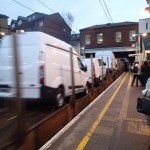
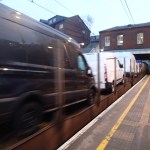
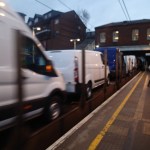
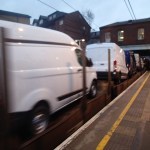
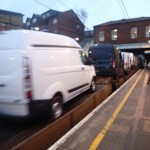
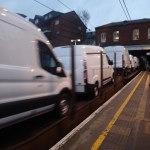
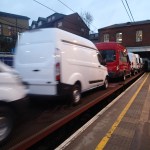
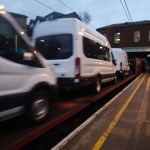
With DB Schenker’s new car import-export depot at Barking, I think we’ll see a lot more trains like this.
Will The Felixstowe Branch Be Electrified?
In the previous post on diesel-hauled freight trains on the Overground, I mentioned Network Rail’s Anglia Route Study.
This study says two things about the Felixstowe Branch.
There will be more double track to increase capacity and it is an aspiration to have two trains per hour on all branch lines from the Great Eastern Main Line.
If the latter is implemented on the Felixstowe branch, it will be a good thing, but it would need another train and the increased frequency would probably be opposed by the port.
If the line were to be electrified, the finding of a reasonable Class 313/315/317 train to work the branch shouldn’t be difficult and it would be faster and with better acceleration than the current Class 153, so it could keep out of the way of the freight trains.
As a lot of the line is to be double tracked, I wouldn’t be surprised if this work, at least makes electrification possible.
I sometimes think, that I can remember reports from the 1950s, saying that London to Ipswich and Norwich together with the Felixstowe branch would be electrified by 1964.
Is This A New Economic Indicator?
I have just read this article in Global Rail News, which states that the rail freight section will recruit and train over 200 new drivers in the current year.
It would seem likely that the more freight moved by rail, the greater the economic activity.
I’ve chatted with a few drivers on trains and most seem happy with their jobs, even if some do moan about some of the cabs on certain freight locomotives.
 The Anonymous Widower