Will The Felixstowe Branch Be Electrified?
In the previous post on diesel-hauled freight trains on the Overground, I mentioned Network Rail’s Anglia Route Study.
This study says two things about the Felixstowe Branch.
There will be more double track to increase capacity and it is an aspiration to have two trains per hour on all branch lines from the Great Eastern Main Line.
If the latter is implemented on the Felixstowe branch, it will be a good thing, but it would need another train and the increased frequency would probably be opposed by the port.
If the line were to be electrified, the finding of a reasonable Class 313/315/317 train to work the branch shouldn’t be difficult and it would be faster and with better acceleration than the current Class 153, so it could keep out of the way of the freight trains.
As a lot of the line is to be double tracked, I wouldn’t be surprised if this work, at least makes electrification possible.
I sometimes think, that I can remember reports from the 1950s, saying that London to Ipswich and Norwich together with the Felixstowe branch would be electrified by 1964.
Is This A New Economic Indicator?
I have just read this article in Global Rail News, which states that the rail freight section will recruit and train over 200 new drivers in the current year.
It would seem likely that the more freight moved by rail, the greater the economic activity.
I’ve chatted with a few drivers on trains and most seem happy with their jobs, even if some do moan about some of the cabs on certain freight locomotives.
The Noisy Class 66 Locomotive
The Class 66 locomotive used on UK railways is not a friendly beast as it makes a lot of noise and smell. There is a Wikipedia section on Cab Design Problems, which says this.
The British trade union ASLEF has complained that the locomotives are unfit and unsafe to work in, citing a lack of air conditioning, and poor seating and noise levels.
I’ve spoken to various Class 66 drivers and many don’t like the working environment, but like things like the reliability.
If you type “Class 66 noise” into Google, you find some interesting articles.
One interesting point about Class 66 locomotives is that they don’t meet the new emission regulations and so no more can be ordered. The details are all here on Wikipedia.
Because of this and the noise and smells the locomotives, I think that they should where possible, not work trains through built-up areas.
Ipswich To Felixstowe Has Improved
Over the last few months, I’ve travelled half a dozen times between Ipswich and Felixstowe by train.
I can’t remember a train being late at all, since the Bacon Factory Curve has been opened.
And here’s why!
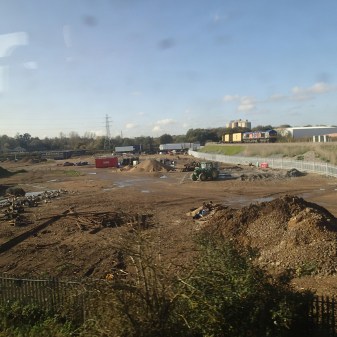
A Freight Train Waiting On The Bacon Factory Curve
Note the freight train waiting for our one-coach Class 153 to pass. Before the curve opened the freight train would have had to go into Ipswich yard and the locomotive would have had to run-round to the other end, causing all sorts of disruption to the Great Eastern Main Line and especially the Felixstowe Branch.
Also now I noticed that trains coming out of Felixstowe and going South towards London, now sometimes seem to get their diesel locomotive changed for a Class 90 electric one.
The next improvement will come when more of the Felixstowe branch line is double-tracked and the whole branch is electrified.
It’s all a far cry from when I lived in Felixstowe in the 1960s, where the most reliable way to get between the two towns was to cycle along the A45 or A14 as it is now! There were only a handful of trains every day.
How many other places on the UK network need smaller improvements like the Bacon Factory Curve to be implemented?
The Rail Line Into London Gateway
I took this picture as my train to Stanford-le-hope passed the rail line into London Gateway.
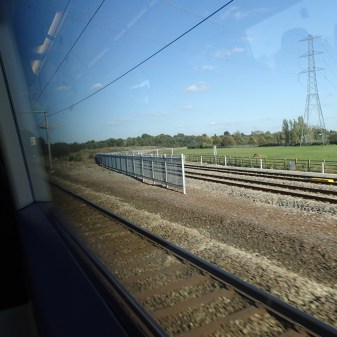
The Rail Line Into London Gateway
It shows the double-tracked rail line into the port.
I would assume it will be electrified, when the main routes through London, like the Gospel Oak to Barking Line, are also fitted with overhead wires, so that freight trains can use efficient electric haulage.
Bacon Factory Curve At Work
I took this picture from an Ipswich to Cambridge train.
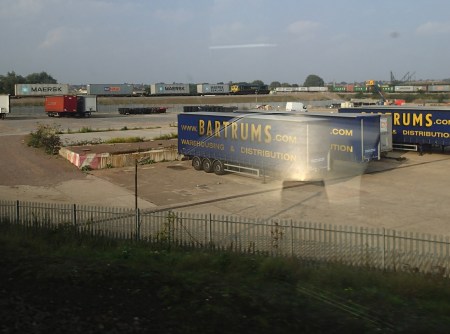
Freight Trains On The Bacon Factory Curve
It shows how the Bacon Factory Curve is working.
The train on the left is held on the curve itself, whilst the train on the right is proceeding towards Felixstowe.
In contrast to months ago, my train was not delayed and went straight past the junction.
An Unpleasant Experience
I took this picture at Highbury and Islington station from the second footbridge, that links the platforms to the Emergency Exit.
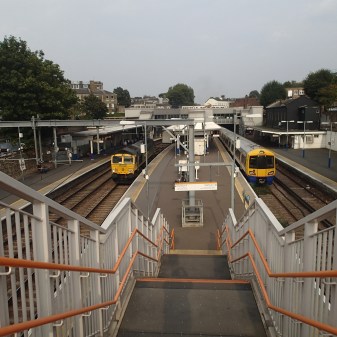
An Approaching Class 66
I have talked about the noise of Class 66 locomotives before in this post, where I said this.
It is important that rail locomotives are improved, as the current mainstay, the Class 66 is not liked by those who live on busy freight routes, due to its noise. I’ve also talked to drivers, who feel they have other problems too.
I could have been more critical. The Class 66 to the left of the picture was pulling a heavy freight train and passed under me, whilst working hard.
The noise was bad, but not as bad as the stink of the exhaust of the massive diesel engine.
I remarked on this to a member of the station staff, who was tidying up underneath the bridge and he said he hated them.
As there are now alternatives, surely pure diesel engines like the Class 66, that don’t meet the latest environmental regulations, should at lest be banned from operating in heavily-populated built-up areas.
In fact, as this line is electrified, what is a Class 66 doing on this line anyway?
Do We Want Platoons of Trucks?
I first read about this idea in the Sunday Times, but I have found a detailed article on the bbc.com website. Here’s the lead paragraph.
Convoys of wireless-linked semi-autonomous vehicles could soon be hitting our roads, giving drivers a chance to put their feet up on the morning commute.
I don’t drive and I miss driving, like you miss the teenager next door, who thinks he’s the best drummer since Ringo, who has just left home.
The technology may well work, but it’s in the same category as driverless cars and unmanned level crossings. They’re all perfectly good and safe until something goes wrong. How many air accidents were never envisaged, when the aircraft was designed?
The thing though about this technology, is there is already a proven alternative in the UK. It’s called freight trains. The money would be better spent removing trucks from the roads, as far as possible. Obviously for long distances across countries like the US, Canada, Australia and Russia, it may well have a place.
 The Anonymous Widower