Could Thameslink Connect To Heathrow?
This may seem an outrageous idea.
But I think it could be possible.
Can Class 345 Trains And Class 700 Trains Use The Same Tracks And Platforms?
Crossrail may use Class 345 trains and Thameslink may use Class 700 trains, but can the two trains use the same tracks and platforms?
Recently, Cambridge North station has opened and it will certainly be compatible with Class 700 trains and Greater Anglia’s Class 720 trains, which are closely related to the Crossrail trains.
Heathrow’s platforms do not have platform-edge doors.
Both trains are designed to work at high frequencies using ERTMS.
So I think the answer to my question is a solid yes!
How Would Thameslink Trains Get To Heathrow?
The original plan for Heathrow Express envisaged using both Paddington and St. Pancras as terminals in Central London.
It would have used the Dudding Hill Line as a connection between the Great Western Main Line and the Midland Main Line.
This Google Map shows the tracks to the East of Acton Main Line station.
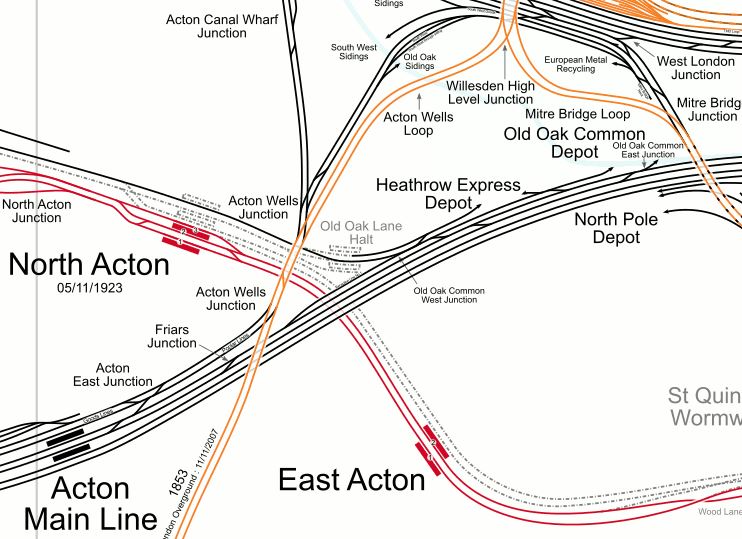
Note.
- The four tracks of the Great Western Main Line run through Acton Main Line station.
- The most Southerly pair of tracks are the fast lines, whilst the next pair are the slow lines as used by Crossrail.
- The tracks shown in orange are the North London Line.
- The two extra lines to the North of Acton Main Line station are the Goods Lines, connect at Acton Wells Junction to the North London Line, so freight trains can go across London between the Great Western Main Line and Stratford.
After crossing over the Central Line, the route splits with the North London Line going East to Stratford and the Dudding Hill Line going North through Acton Canal Wharf Junction.
To get to and from Heathrow, the services would take the same route as Crossrail to the West of Acton Main Line station.
The services would use the existing Cricklewood Curve Junction to connect with the Thameslink route to the North of Cricklewood station.
What New Infrastructure Would Be Required?
The infrastructure needed would not be of the sort of scale needed for Crossrail or Thameslink.
- The Dudding Hill Line is would need to be electrified.
- The Dudding Hill Line is double-track throughout.
- The 30 mph speed limit of the Dudding Hill Line would need to be increased.
- Would Harlesden and Dudding Hill stations be reopened or other new ones built?
- The stations at Heathrow could probably handle Class 700 trains without too much difficulty.
- There might be a need for a flyover to sort out the tangle of lines between Cricklewood and St. Pancras.
But nothing is too complicated or difficult.
What Frequency Of Thameslink Trains Would Serve Heathrow?
Currently, the following services are provided
- Heathrow Express has four tph to Terminal 5 via Heathrow Central
- There is a shuttle between Heathrow Central and Terminal 4, run by Heathrow Express.
- Heathrow Connect run two tph to Heathrow Central.
When Crossrail opens in December 2019, the service to Heathrow will be four trains per hour (tph) to Terminal 5 and two tph to Terminal 4.
Crossrail will also provide the shuttle between Heathrow Central and Terminal 4.
It is certainly not a system designed by any individual or committee with any sense of good design.
At least, both Terminal 4 and Terminal 5 stations have two terminal platforms, so the two stations should each be able to handle up to eight tph.
If they did this would mean up to sixteen tph on the Heathrow spur, which would be well within the capability of the route and trains running using ERTMS, which will handle up to 24 tph on both Crossrail and Thameslink in the few years.
Under current plans, it appears that when Crossrail opens, the stations will get the following services.
- Heathrow Central – 10 tph
- Heathrow Terminal 4 – 2 tph plus shuttles
- Heathrow Terminal 5 – 8 tph
I’m assuming that Heathrow Connect will quietly fade away.
With a bit of reorganisation of the services, it should be possible to squeeze another six tph into the airport, without building any new terminal platforms.
So I feel that say four tph Thameslink trains to Heathrow would be possible.
Could Crossrail Handle The Extra Trains?
The Thameslink trains would have to run on the Crossrail tracks between Acton Main Line station and Heathrow Airport Junction.
Currently Crossrail are proposing running 12 tph on this section, so as ERTMS can handle double this, I suspect there shouldn’t be too much of a problem.
Could Thameslink Handle The Extra Trains?
This article on Rail Engineer, which is entitled Thameslink Signalling Update, says this about possible Thameslink frequencies.
To meet the specification of 24 tph through the Thameslink core section, it is necessary to deploy Automatic Train Operation (ATO). This will provide a peak theoretical capacity of 30 tph, thereby creating a reliable 24 tph service with acceptable recovery margins.
So an extra six tph could be possible.
Would A Service Between Heathrow and Gatwick Airports Be Possible?
In my view it would be the logical service.
It would certainly be possible!
And it could also be a journey without any change of train!
Would There Be Any Other Useful Connections?
These are a few thoughts and ideas.
Same Platform Interchanges
Cross-city lines like Crossrail, Merseyrail’s Northern Line and Thameslink, have the advantage, that if you are going in the right direction, but are on a train to the wrong destination, you can just get off the train and wait for the correct train.
So if you leave Heathrow on a Gatwick train and you need to go to Maidstone East, you would get off at any of the stations in the central core and wait until the next Maidstone East train arrives.
Everybody will have their own favourite interchanges. Mine would probably be Blackfriars station, as it is above the Thames, has lots of seats and there is a large coffee shop on both platforms.
The ability to do this will mean that all stations South of West Hampstead Thameslink station will have a very easy link to and from Heathrow.
Reversing Stations
Crossrail has several stations where you can reverse your direction of travel by just walking across the platform. Whitechapel station will allow passengers to go between Abbey Wood and Shenfield stations without going up or down any steps or escalators.
Thameslink only has one reversing station at London Bridge station, although St. Pancras Thamslink has escalators and lifts to allow passengers to change direction in a short time.
West Hampstead Interchange
If plans for a West Hampstead Interchange materialise, this will link the following lines.
- Chiltern Railways
- Jubilee Line
- Metropolitan Line
- Midland Main L:ine
- North London Line
Note.
- This could be a very good interchange to be connected to Heathrow.
- West Hampstead Interchange would be a good alternative until Old Oak Common station is built.
- Passengers going between Heathrow and stations on the Midland Main Line to the North could change here.
Those like me living along the North London Line would find it a convenient way to get to and from Heathrow.
Kings Cross And St. Pancras Stations
The massive complex at Kings Cross and St. Pancras stations currently links the following lines.
- Eurostar
- Midland Main Line
- East Coast Main Line
- Southeastern Highspeed services
- Circle Line
- Hammersmith and City Line
- Metropolitan Line
- Northern Line
- Piccadilly Line
- Victoria Line
But the only way to get directly to Heathrow is a nearly hour long journey on the Piccadilly Line. Thameslink could be just over half that time, in a less cramped train.
Blackfriars Station
I use Blackfriars station a lot, as it is my the Tate Modern.
But others will use it as a same platform interchage for reasons I outlined erlier.
London Bridge Station
London Bridge station is another important interchange, with links to the following lines.
- Southeastern services to Kent
- Southern services to Surrey and Sussex.
- Jubilee Line
- Northern Line
Note.
- This new station is well-equipped and interchange is totally step-free.
- It is also a short walk to the city across London Bridge.
- This station will be a very good same platform interchange.
- The station allows passengers to reverse direction by just walking across the platform.
As with West Hampstead, this could be a very good interchange to be connected to Heathrow.
East Croydon, Orpington and Wimbledon Stations
East Croydon, Orpington and Wimbledon stations, which are important local hubs, would all be well-connected to Heathrow.
Collateral Benefits
Crossrail 2
Crossrail 2 is planning to have a Euston St. Pancras station, which is described like this in Wikipedia.
It would be a “mega station” serving the existing Euston, King’s Cross and St. Pancras main line stations. If funded and completed, it will be one of two such stations on the Crossrail 2 route (the other being Dalston).
If this station is designed properly, I am sure it will have the following.
- A step-free and convenient link to both Thameslink and Eurostar.
- Some form of high-capacity hi-tech people-mover, stretching under Euston Road, linking Kings Cross, St. Pancras and Euston stations.
I believe a station design is possible that makes the connection between HS1 and HS2 a no-hassle transfer for all passengers in less than ten minutes.
The people-mover should be in place when HS2 opens in December 2026, so that a credible HS1 to HS2 link opens at the same time.
Gatwick, Heathrow, HS1 And HS2 Will Be On One Rail Line
This could be of tremendous benefit to Londoners, travellers, tourists, rail companies and airlines, but Heathrow might not like it, as it could undermine their dominant position.
If Crossrail 2 opens around 2030, this will bring Stansted into the hub.
The Most Important Railway Station In The World
Eventually, Euston St. Pancras station will become the busiest and most important railway station in the world.
How Will Terminal Development At Heathrow Affect Crossrail And Thameslink?
Heathrow are disclosing a master-plan, for rebuilding a lot of the airport to make it more efficient and up with the best.
- There will be two main terminals; Heathrow West and Heathrow East with satellites in between handling the actual planes.
- These two terminals and the satellites will be between the two existing runways, with a passenger and baggage transport system beneath.
- Terminal Five will become Heathrow West.
- An extended Terminal Two will become Heathrow East.
- Crossrail, Heathrow Express and the Underground will serve both main terminals.
I believe that this rebuilding could start in the next few years.
Heathrow will make sure they future-proof rail access, so we could see.
- More terminal platforms at both Heathrow East and Heathrow West
- Through platforms at Heathrow West to allow trains to go West from both terminals.
- Freight shuttles bringing in provisions for the airport, the airlines and the aircraft.
This will allow Crossrail, Thameslink, Heathrow Express and other operators to have as many services as is thought necessary.
The biggest constraint will be the capacity of the Great Western Railway and the two tracks used by Crossrail.
Will Other Operastors Be Allowed Use Heathrow?
This probably depends more on politics than anything else, but technically these facts apply.
Bombardier Aventras
Bombardier have hinted that the design of an Aventra can provide commuter trains like Crossrail’s Class 345 trains and 125 mph expresses.
So it would be likely that a 125 mph Aventra of appropriate length would be able to serve Heathrow, if that were thought necessary!
All Trains Would Be Electric
I suspect that regulations would mean all trains would be electric, as you don’t want diesel or hydrogen fuels in the tunnels under Heathrow.
ERTMS
I also suspect that all trains using the eathrow stations would need to be equipped with ERTMS.
Possible Routes
Who knows what routes will become possible, but as the list of trains grows that are acceptable to Heathrow, various possibilities will arise.
- Great Western Railway to Bristol
- Great Western Railway to Cardiff
- London Overground to Clapham Junction station
- London Overground to Stratford
- South Western Railway to Southampton
- East Midlands Trains to Bedford/Kettering/Corby
- West Midlands Trains to Watford/Milton Keynes/Birmingham
After Heathrow terminals are updated to East and West, there would be scope for cross country routes going vaguely South-West to North-East calling at both terminals in Heathrow.
Will Thameslink And Crossrail Strangle Heathrow Express?
I wonder if a ink to Thameslink will be more valuable to Heathrow, than Heathrow Express.
- Abandoning Heathrow Express would release valuable platform space at Heathrow and Paddington.
- Crossrail and Thameslink together would have connections all over London, rather than just Paddington.
- Crossrail to and from Paddington would only take about five or six minutes longer.
- Heathrow Express will have to update their trains with ERTMS and to compete with Crossrail.
- Heathrow Express usually means a taxi to your hotel to and from Paddington.
- Crossrail will connect the West End, The City and Canary Wharf to Heathrow.
Convenience and cost will eventually strangle Heathrow Express.
Conclusion
The following statements would appear to be true.
- Class 345 and Class 700 trains can use the same infrastructure.
- Crossrail and Thameslink both use ERTMS.
- The stations at Heathrow,the Western section of Crossrail and the Thameslink core have spare capacity.
This means it should be possible to extend Thameslink services to Heathrow with a frequency of at least four tph, using an electrified Dudding Hill Line.
Some new infrastructure would be required, but nothing as comprehensive, as that for Crossrail and Thameslink.
Crossrail To Heathrow, Reading And Southend
Crossrail To Heathrow
In the Wikipedia entry for Crossrail, there is a section called Extensions.
This is said under a sub-section called Heathrow Express.
The RUS also proposes integrating Heathrow Express services from Heathrow Terminal 5 into Crossrail to relieve the GWML and reduce the need for passengers to change at Paddington.
Note RUS refers to Network Rail’s Route Utilisation Study of 2011 and GWML is the Great Western Main Line.
Currently, Heathrow Express takes fifteen minutes to go between Paddington and Heathrow Central stations, with Heathrow Connect taking thirty-two minutes with five stops.
The journey time calculator on the Crossrail site, says the trains will take twenty-three minutes with six stops. But as I said in Are Crossrail And Bombardier Having Us On?, Crossrail’s journey time estimates aren’t very good to say the least.
I think until the Crossrail trains reach Heathrow next May 2018, any speculation I make of the time they take between Paddington and Heathrow Central will be very wide of the mark.
However, this can be said of Heathrow Express and Crossrail to Heathrow.
- As the RUS says Heathrow Express services use four paths per hour on the GWML in both directions and these paths would be released for other services if Heathrow Express used the dedicated Crossrail tracks.
- Most Heathrow Express passengers will not be going to Paddington or the surrounding area of the station.
- When fully developed Crossrail will connect Canary Wharf, the City of London, the West End and the Queen Elizabeth Olympic Park, to name just four important destinations, directly to Heathrow Airport.
- If Crossrail works as it says on the box, every travel guide and expert, will recommend you use your contactless bank card to travel on this wonderful new airport train.
- I would suspect, that given Heathrow’s expansion plans, that the Heathrow branch of Crossrail has a capacity in excess of ten trains per hour (tph).
- The accommodation and comfort level in Crossrail’s Class 345 trains is high and well suited for an airport service.
I think that Heathrow Express will be increasingly deserted by passengers, in favour of the cheaper and more convenient Crossrail.
So could the two services be integrated together?
In theory, Heathrow Express could use the Crossrail tracks to Paddington, but there would be problems.
- Heathrow Express trains would have to leave the Crossrail tracks to get into Paddington.
- Would Crossrail want non-stop trains speeding through suburban stations like Southall, with their high suicide rates?
So then why not create a Heathrow Express, that used the Crossrail tracks and stopped at say Old Oak Common (for HS2), Paddington, Bond Street, Farringdon (for Thameslink), Liverpool Street and Canary Wharf?
- Heathrow Express would have to buy new trains compatible with the platform-edge doors in Crossrail’s tunnels.
- Where would the trains be turned back? Perhaps a turnback facility could be built at Liverpool Street at a cost of several hundred million pounds!
- It would still speed through suburban stations.
- Trains moving at different speeds would reduce the capacity of Crossrail.
- As Crossrail and Heathrow Express will use the same platforms at stations, how do you stop people without expensive special tickets using Heathrow Express?
Heathrow will continue to argue to keep Heathrow Express, but in practice in the future, it will be as outdated a concept as trains pulled by steam engines.
So one of two things will happen.
- Heathrow Express will continue as now, using two valuable platforms at Paddington and the four equally valuable paths per hour on the GWML.
- It will be discontinued.
I believe that in some date in the future, only three rail services will serve Heathrow.
- London Underground’s Piccadilly Line.
- A Crossrail service to London and the East.
- A Crossrail service to Reading and the West, which would rejoin the slow tracks of the GWML to the East of Langley station.
The two Crossrail services would probably be run back-to-back, so that fewer trains were turned back at Heathrow.
The two Crossrail branches to Heathrow and Reading would merge easily to the West of Hayes and Harlington station and there would be no complications caused by Heathrow Express trains crossing to and from the fast lines.
Crossrail To Reading
Just over a month ago, Transport for London (TfL) ordered four extra Crossrail trains and announced extra services to Heathrow and Reading. I discussed this in Crossrail Expands Before It Opens
I said this.
Four new Class 345 trains are being ordered, which will mean that in the Off Peak the following will happen.
- Trains between Whitechapel and Paddington will increase from 16 tph to 20.
- Trains between Paddington and Shenfield will increase by two tph
- Trains between Paddington and Abbey Wood will increase by two tph
- Trains between Paddington and Reading will double from two tph to four.
- Trains between Paddington and Maidenhead will increase from four tph to six
- From December 2019, six tph will call at Heathrow Terminal 5.
I also found this quote in the article on Global Rail News, that was the source for the increased services.
The increased service frequency will be achieved, in part, by replacing five Great Western Railway services with Elizabeth line trains.
So could we be seeing a degree of co-operation between TfL, Crossrail and Great Western Railway, whereby the following services are provided?
- Slow stopping services are run by Crossrail on the two slow lines.
- Fast and semi-fast services are run by Great Western Railway on the two fast lines.
This would be operationally simple and might even create extra paths into London for more long-distance services.
The problem are the local stopping trains to Oxford (2 tph) and Bedwyn (1 tph). Will they run on the slow or fast lines between Paddington and Reading?
Consider the service to Bedwyn.
- A five-car Class 800 train could run the service.
- Small modifications at Bedwyn would probably be needed to allow the Class 800 train to use the turnback.
- The train would run using electricity until the wires ran out near Newbury and then diesel.
- The service could run semi-fast or non-stop between Paddington and Reading.
- Nine-car Crossrail Class 345 trains would probably need a lot of platform lengthening, in addition to the electrification to be used to Bedwyn.
And the stopping service to Oxford.
- A five-car Class 800 train could run the service.
- A planned new bay platform at Oxford station would handle the service.
- The train would run using electricity until the wires ran out near Didcot and then diesel.
- The service could run semi-fast or non-stop between Paddington and Reading.
- Niine-car Crossrail Class 345 trains would probably need some platform lengthening, in addition to the electrification, to be used to Oxford.
If the two services are considered together, they could join and split at Reading to save paths on the fast lines.
I think that on balance to use a pair of Class 800 trains would be better than to extend Crossrail past Reading.
Consider.
- A second service to Bedwyn could be easily added.
- A large number of long-distance trains call at Reading station.
- Reading has been designed for easy interchange between fast and slow services.
- Crossrail will be providing at least four tph between Paddington and Reading that stop at all stations.
- Reading has services into Waterloo.
I’m certain that the train companies can find a very efficient solution.
I can see a situation, where Great Western Railway aren’t going to need many Class 387 trains in the Thames Valley.
Crossrail To Oxford
This may seem a bit over the top, but analysis might show, that the best way to create more capacity between Reading and Oxford, might be to extend two Reading Crossrail services each hour to Oxford, when the electrification to Oxford is complete.
Crossrail To Southend
Just as it appears there is co-operation between Crossrail, Great Western Railway and TfL, could similar co-operation between Crossrail, Greater Anglia and TfL, result in improved services on the Shenfield to Southend Line? I wrote about this in Crossrail Tests Its Trains In Southend.
The Long Distance Class 345 Train
Adding Oxford and/or Southend to Crossrail services, may need a sub-class of Class 345 train to be created, due to the length of the journey. Toilets would be the obvious addition.
Heathrow Plan To Build Third Runway – On Stilts Over M25
This is the title of an article in the Business section of the Sunday Times.
Apparently, three viaducts would be built over the M25, with a wide one for the runway and two narrower ones for the taxi-ways.
Sounds fine by me!
I also feel that the technique of using stilts could be applied to build new housing and commercial properties over roads and railways.
Look at all that space over some city centre stations!
Crossrail And Heathrow In Legal Dispute Over Fees
This title of this post is the title of an article in the Financial Times.
This dispute will run and run, as it is a gift to the lawyers.
As it is the greedy owners of Heathrow, won’t allow Crossrail trains to go directly to Terminal 5, which means you will have to use the Piccadilly Line or change trains.
But I think, that there are obstacles to Heathrow’s plans to rip-off passengers.
- They still need to get Planning Permission for the Third Runway.
- Transport for London will start to upgrade the Piccadilly Line in 2019 and new trains will arrive in 2022.
- Heathrow Express will still only get you to Paddington at a rip-off price.
The other winner could be Gatwick, who seem to want to work with Transport for London, rather than fight with them.
Platforms 13 And 14 At Paddington Station
These pictures show work at Platform 13 and 14 at Paddington station.






It looks like they’re being tidied up and lengthened, so that when in 2018 Heathrow Connect is transferred to Crossrail, the platforms can be used by the 200-metre long Class 345 trains.
It will only be a temporary arrangement as in 2019, Heathrow Connect trains will use the core tunnel under London.
- 4 tph between Abbey Wood and Heathrow Terminal 4.
There will also be 4 tph on Heathrowc Express from Psaddington to Hrathrow Terminal 5.
So it looks Heathrow will be trying to con passengers to use the expensive Heathrow Express. Edpecially from Terminal 5!
It is only continuing to fleece passengers, as it is totally pointless for savvy travellers.
Quite frankly, if you’re anywhere to the East of Paddington, would you change at Paddington to waste money, when a change at Heathrow Central will be free?
It would be far better to run 8 tph to the Airport, with four tph going to each of Terminal 4 and Terminal 5. Four tph could start at Shenfield and four tph at Abbey Wood.
And then there’s the problem of vFreedom Passes. Will I be able to use my pass on Crossrail to get to Heathrow?
Around The Hounslow Loop Line
The Hounslow Loop Line is a suburban railway in South-West London, that runs in a loop off the Waterloo to Reading Line.
Today, to get to know the line, I took a Hounslow train from Waterloo and after passing through Clapham Junction, Putney and Barnes stations, the train took to the Hounslow Loop Line calling at a succession of stations on both sides of the Thames.
We waited a minute or so at Hounslow station, before starting to return via Whitton and Twickenham stations.
When the train got to Richmond station, I changed to the North London Line to come home directly, whilst the train went back into Waterloo, by way of the Waterloo to Reading Line.
These pictures give a flavour of the Hounslow Loop Line.






It is a very tidy suburban line.
- Most platforms have been lengthened to take ten-car trains.
- Whitton station has been rebuilt as I wrote about in How To Spend Five Million Pounds.
- It has a triangular junction with the North London Line around Kew Bridge station.
- In the mid-2000s, the train frequency on the line was doubled from 2 trains per hour (tph) to four.
All of this work has led to a 162% increase in passengers between 2004-5 and 2007-8.
I wonder what is the limit of trains round the Hounslow Loop Line.
This is more proof if it were needed, that suburban lines need at least 4 tph to really bring in the passengers.
Transport for London’s Orbital Railway
In August 2014, I wrote Will The Gospel Oak To Barking Line Be Extended To Hounslow?, which was based on a Modern Railways report on the Mayor’s Transport Infrastructure Plan for 2050. This is said.
There may be a case for further orbital rail capacity, says the document – it shows an indicative, uncosted network to link Hounslow, Old Oak Common, Neasden, West Hampstead, Harringay, Walthamstow, Barking, Abbey Wood, Bexleyheath, Norwood Junction, Sutton and New Malden and back to Hounslow, with another route between Abbey Wood and New Malden via Lewisham, Peckham Rye and Wimbledon.
The proposed orbital railway passes takes a route from Hounslow to Wimbledon via the following stations.
- Whitton
- Twickenham
- Strawberry Hill
- Teddington
- Kingston
- New Malden
- Raynes Park
Nothing concrete has been said since about the railway, but the following is happening or planned.
- The Gospel Oak to Barking Line (GOBlin) is being electrified.
- New four-car Class 710 trains will go to the GOBlin and the Watford DC Line.
- More five-car Class 378 trains will be available to boost services on the North London Line.
All these should happen by the end of 2018.
Will More North London Line Trains Go To Richmond?
Currently the North London Line service from Richmond is 4 tph to and from Stratford.
It takes around an hour, which is ten minutes faster than going via Waterloo and taking the Jubilee Line.
The only possibly faster way would be when Old Oak Common station is opened and a change there would be made to Crossrail.
I estimate, that this could result in a timing of around 45 minutes or perhaps lightly less.
As Old Oak Common station, will also have connections to HS2, the West Coast Main Line ans other important routes, Richmond to Old Oak Common could become a very heavily used route.
4 tph would probably not be enough trains, especially as the current service to the East from Willesden Junction is 8 tph.
So I think it quite likely, that the frequency between Richmond and Old Oak Common stations would be eight tph.
The extra four trains, wouldn’t need to go all the way to Stratford, as there has been talk of alternative routes.
- Terminate at Old Oak Common.
- Terminate at somewhere convenient on the North London Line.
- Terminate at Barking via the Gospel Oak to Barking Line
- Go Along the Dudding Hill Line to Brent Cross Thameslink
The choice would be large.
But could Richmond handle the increased frequency of trains?
If the trains used the same route as now, there is probably a current limit of 4 tph, as the route is shared with the District Line from Gunnersbury station. Especially, as the District Line service will be increased!
So alternative ways of turning the trains is needed.
Trains could take the Houslow Loop Line after South Acton station and go through Hounslow, Whitton and perhaps terminate at Twickenham, where it should be possible to create a suitable bay platform.
But it’s not just events at Twickenham that need more capacity and North London Line services, so could we see services going in a loop via Hounslow, Whitton, Twickenham and Richmond?
This Google Map shows the line between Richmond and North Sheen stations.

Between Richmond and North Sheen Stations
Note.
- Richmond station is to the West.
- North Sheen station to the East.
- The North London Line turns North off the line through the two stations.
In some ways, North Sheen station is a bit of a mess and a real problem.
- It has a level crossing at one end.
- It has no disabled access.
- There is another three level crossings between Mortlake and Barnes stations, which are the next stations on the line towards London.
- The level crossings feature regularly in Google News with respect to accidents, failures and suicides.
It might be best, if North Sheen station was completely rebuilt and the level crossings are consigned to the dustbin of history.
This map from carto.metro.free.fr shows the layout of lines at Richmond station.
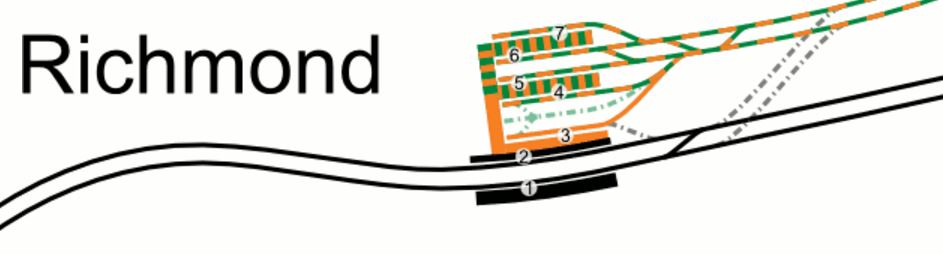
Platforms And Lines At Richmond Station
I don’t think it would be too difficult to complete the loop, so that trains from the North London Line could turn without needing a terminal platform
It has a level crossing at one end.It has no disabled access.There is another three level crossings between Mortlake and Barnes stations, which are the next stations on the line towards London.
Improving Richmond To Waterloo
But the problems of the level crossings are still there!
These posts describe the line between Richmond and Barnes station.
- Is There A Worse Station Than This In London?, describes North Sheen station.
- Mortlake Station With A Level Crossing
- A Level Crossing In White Hart Lane, Barnes
- A Pair Of Level Crossings At Vine Road, Barnes
Currently, 8 tph run on the lines between Richmond and Waterloo via Clapham Junction stations.
In the other direction, the service is as follows.
- 2 tph to Reading
- 2 tph to Windsor and Eton Riverside.
- 2 tph to Waterloo via Hounslow and Brentford
- 2 tph to Waterloo via Kingston and Wimbledon.
Richmond will become an important station connecting lots of places to Old Oak Common.
Will 8 tph between Richmond and Waterloo be sufficient?
Heathrow Airtrack
Heathrow Airtrack was an attempt to create a link from Waterloo to Heathrow Airport.
Wikipedia says this about the proposal.
The scheme, estimated to cost around £673 million, was controversial mainly because of the projected impact on local road traffic due to the high number of level crossings on the route.
Trains would have been 2 tph calling at the following stations.
- Clapham Junction
- Richmond
- Twickenham
- Feltham
- Staines
Could another 2 tph be squeezed in through Richmond?
With difficulty and Automatic Train Operation, it might be a possibility.
But it also looks like the level crossings have already killed one project.
On the other hand, it does appear that if more capacity could be created between Richmond and Waterloo, other services would follow.
Why I Like The Heathrow Southern Railway Proposal
Rail Projects
For nearly twenty years I spent a lot of time talking to project managers and reading about the implementation of large projects and systems.
It has led me to various conclusions about large projects and what makes some succeed and others fail.
If you look at rail projects over the last few years, you get some very good examples of projects and some very bad ones too!
Look at how the following factors affect the outcome.
Size
In my view, size can be discounted, as it doesn’t seem to affect the outcome. There’s been good and bad projects of all sizes.
I think it’s just as likely to get a severe problem on a small project as a large one.
Stations
There has been the occasional station project delivered late, but in general stations have been on time and mostly on budget.
Some like Canary Wharf, Kings Cross, Manchester Victoria, Reading and St. Pancras aren’t small and a few existing ones have been rebuilt around a working station.
The project management has been good, but could it also be that building a station, with the exception of the tracks, is not much different to constructing any other complicated hi-tech modern building, like an office block, university building or a hospital?
Tunnels
In all the tunnels built in London over the last fifty years, there has only been a couple of problems with the actual tunnels during construction and since.
None were serious!
I think until proven otherwise, we seem to have tunneling under control.
Tracks, Chords, Bridges and Dive-Unders
Over the last few years, several major bottlenecks have been removed at places like Acton, Hitchin, Ipswich, Jane Croft, Norton Bridge and other places by creating lengths of new railway. Sometimes, they have even been electrified.
Network Rail and their contractors seem to have improved dramatically, since the dark days of Hatfield.
I’ve Started So I’ll Finish
I believe that the best way to give a project problems, is to get everybody all geared up to start work, only for management or politicians to have second thoughts.
Give The Public Bread And Circuses
We can’t rate Crossrail yet, but Thameslink has not been a very happy project.
A lot of Thameslink’s problems have been magnified by the way they have treated the public.
Crossrail on the other hand has been open, as to what is happening and hasn’t been slow to use things like archaeology to their advantage.
Large Projects Should Be A String Of Smaller Ones
In my view large projects should be a string of smaller projects, that can be done independently.
If you look at Crossrail, the largest project is the creation of the tunnels through London, which can be built without affecting the existing railway. When they are virtually complete, then the tracks are changed to connect the new and old railway.
In some ways it’s a bit like building a housing estate on a greenfield site, where you put in the roads and services first and then build all the houses.
With Crossrail, very few Londoners or travellers will have had their daily lives disrupted.
The smaller, but still large projects are now being built along the tunnels.
Crossrail has been well-designed around a project plan that allowed it to be built.
Thameslink on the other hand, is several big projects, all of which have the ability to cause major disruption.
- The creation of two new tracks from London Bridge to Charing Cross.
- The total rebuilding of London Bridge station.
- The Bermondsey dive-under to untangle the tracks.
- The project is also complicated by the introduction of the new Class 700 trains.
As these projects are all being done at the same time, it is a recipe for chaos and disruption.
Thameslink is very delayed from its original planned finish date and it has been started and stopped more times than a 73 bus on Oxford Street.
Electrification
Electrification is the fox in the chicken coop, especially when it is being added to existing lines.
Look at these schemes.
- Great Western Electrification
- North Western Electrification
- Edinburgh to Glasgow Improvement Program
You could even include the Gospel Oak to Barking Line Electrification, where things don’t seem to be going very fast on a smaller scheme.
Is it we’re just not any good at it, or is it that electrifying old infrastructure, with all the problems that brings, a very difficult job.
The Heathrow Southern Railway
It is outlined on this web site, which I suspect will become more informative. If you want to know more, buy the December 2016 Edition of Modern Railways.
This Google Map shows Heathrow Airport and the area to the South and South-West.
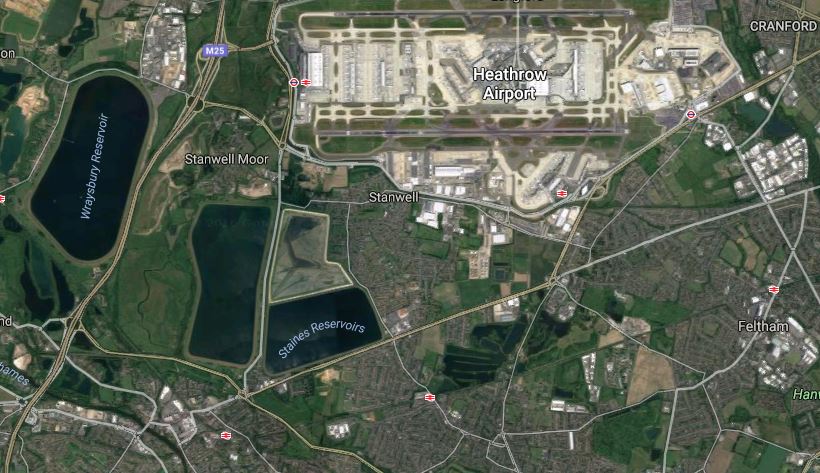
South And South-West Of Heathrow Airport
Note the A30 road going diagonally across the map South of the Airport.
South of this road is a row of three stations; Staines, Ashford and Feltham, which are all on the Waterloo to Reading Line. To the West of Stains, the Staines to Windsor and Eton Line branches away to the North via Wraysbury.
The proposal for the Heathrow Southern Railway envisages.
- A short tunnel into the existing Heathrow Terminal 5 station, which was designed to accept a line from the West
- A rail link alongside the M25 to a junction on the Staines to Windsor and Eton Line just West of the M25.
- A chord at the junction of the Staines to Windsor and Eton Line and the Reading to Waterloo Line to allow trains to go between the Airport and Reading.
- The rail link alongside the M25 would continue South and connect the Airport to Chertsey station on the Chertsey Branch Line. This would allow trains to run between the Airport and Woking.
This Google Map shows where the rail link would go between Terminal 5 and Staines.
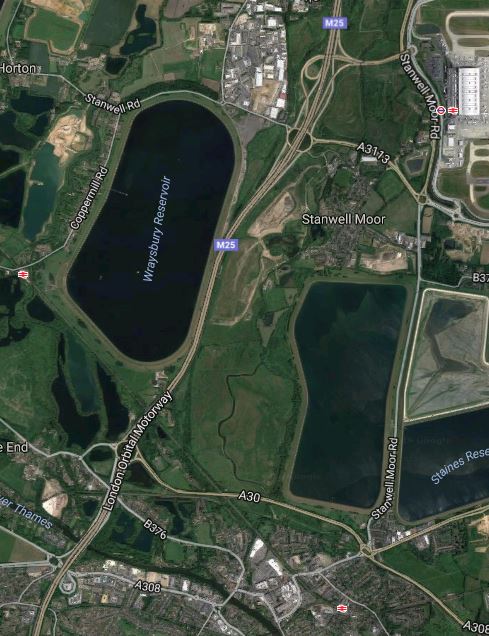
Terminal 5 To Staines
Staines is the station at the South of the map with Wraysbury at the West. \they are joined by the Staines and Windsor and Eton Line, will will have a connection to the Airport.
This Google Map shows Stainesstation and the rail lines in detail.
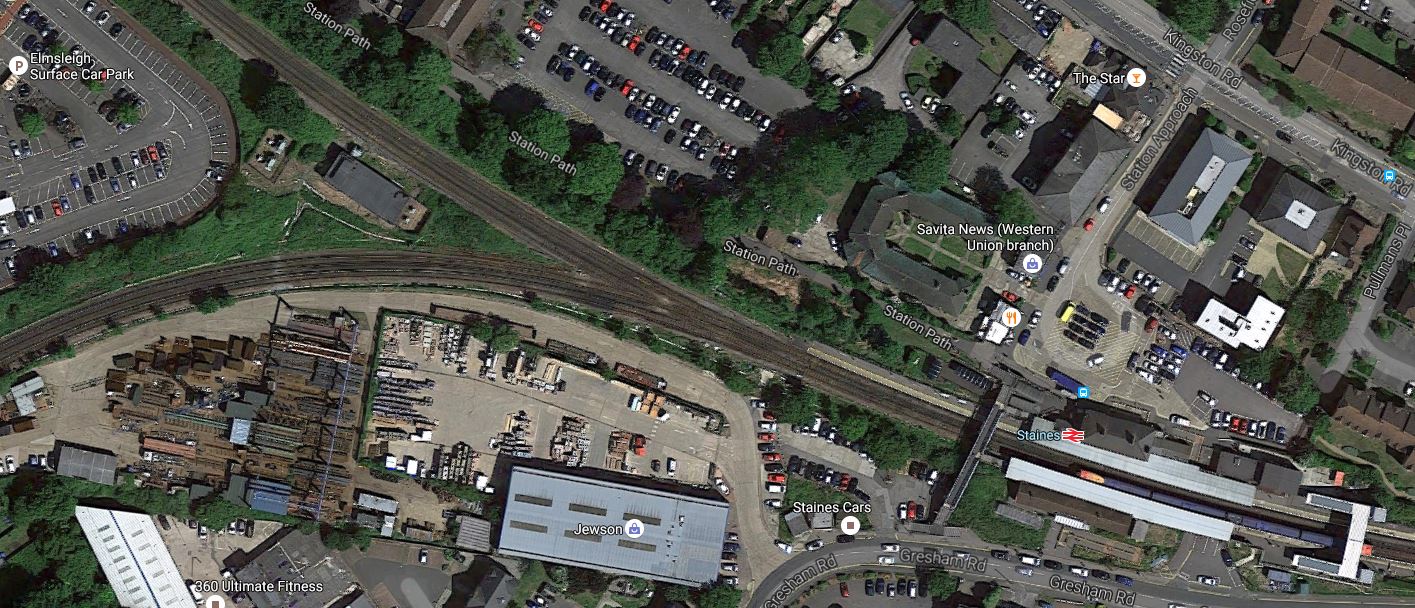
The line to the North West goes to Windsor, whilst the one to the West goes to Reading. The line to the East goes to Waterloo via Feltham, Twickenham and Clapham Junction.
It might be tight to create a chord between the Windsor and Reading Lines, but Heathrow Southern Railway believe there is room for a bay platform at Staines station. They also propose, that Staines could be another Crossrail destination.
This Google Map shows the route to connect the rail link to Chertsey station.
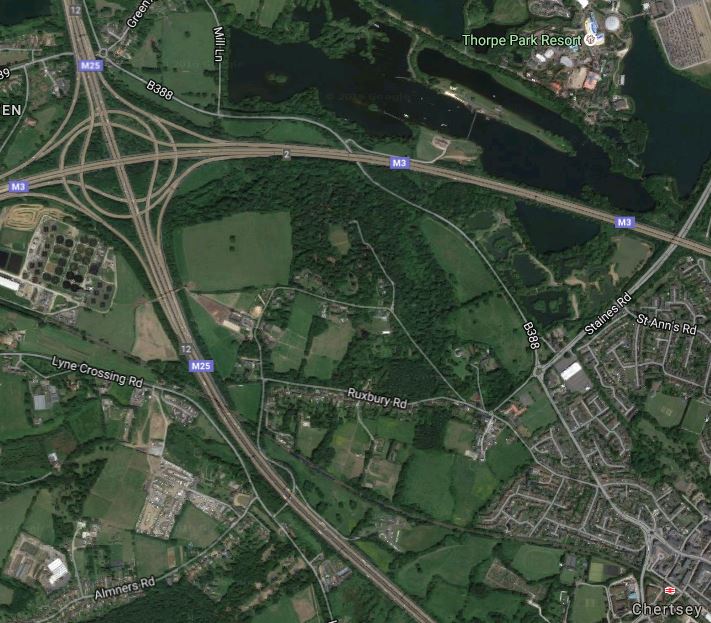
Chertsey Station And The M25
Chertsey station is in the South-East corner of the map, with Thorpe Park Resort in the North East corner.
The junction between the rail link from Terminal 5 and the Chertsey Branch, would probably be close to the motorway.
So why do I like this proposal?
The main work needed for the core of the railway is as follows.
- Create a rail tunnel into the existing station at Heathrow Terminal 5.
- Build a railway alongside the M25 to connect to existing rail lines to Waterloo, Stains and Woking.
- Update the railways and stations under Heathrow to allow trains to go from Old Oak Common through the Airport and out the other side.
Once the core is complete, a succession of smaller projects would connect the railway to longer distance services at Basingstoke, Clapham Junction, Old Oak Common, Reading and Waterloo stations.
There is a lot to like about the concept.
Construction
These points apply to the construction of the rail link.
- Much of the difficult construction work is probably inside the fence at Heathrow, creating the connection to Terminal 5 station.
- The problems of constructing on this route alongside the motorways, are probably well-known.
- The M25 could even be put in a tunnel, with the railway on top.
- The map in Modern Railways shows no tunnels except for the one to Terminal 5 and just three rail bridges.
- I doubt there would be much demolition of properties.
- Land take inside built-up areas would be minimal, with junctions outside of the towns and villages.
I feel that with good project management the railway could be built without disrupting existing rail services or road traffic.
Electrification
The route would be electrified with the following points applying.
- Heathrow Terminal 5 station is electrified at 25 KVAC overhead.
- Most of the lines South-West of Heathrow are electrified using 750 VDC third-rail.
- Modern trains like Crossrail’s Class 345 trains and Thameslink’s Class 700 trains can handle both systems.
- There is no electrification of existing railways.
- Electrification of any new railway could use third-rail, to be less visually intrusive.
I doubt there will be any problems with electrification.
Connectivity
The new link provides excellent connectivity to places like Basingstoke, Clapham Junction, Guildford, Paddington, Reading, Richmond, Waterloo, Windsor and Woking.
It also has excellent links to these services.
- Crossrail at Heathrow, Old Oak Common and Paddington.
- South Western Railway at Guildford, Waterloo and Woking.
- Chiltern and HS2 at Old Oak Common.
- Great Western Railway at Paddington and Reading.
The Heathrow Southern Railway is so much more than a link into Heathrow from the South and West.
South Western Railway
The new franchise for London and the South-West would appear to be ambitious and it has already decided to change its rather assorted suburban trains for a new fleet of Class 701 trains.
These new trains are from the same Aventra family as Crossrail’s Class 345 trains.
South Western Railway also has a common part-owner with Great Western Railway, which must mean that co-operation between the two operators is more likely, than a turf war about who runs services into Heathrow.
In some ways though, one of the biggest strengths of the Heathrow Southern Railway, is that it could take the pressure of the South West Main Line and allow some services to use Paddington instead of Waterloo as a terminus.
Heathrow’s Plans
Heathrow may get a third runway, but their plans do envisage a complete rebuilding of the airport into two main terminals; East and West, which would be served by all trains.
Whatever they do, one of Heathrow’s biggest problems is the pollution caused by the road traffic servicing the airport.
A comprehensive rail network stretching East and West of the airport, must surely help in reducing this pollution, by bringing more passengers, works and freight into the airport on electric trains.
Funding
Because of the possible returns on capital, I suspect that it would be very easy to finance privately.
Conclusion
It is definitely one of those projects, where by creating something a bit out of the ordinary, leads to lots of other worthwhile things.
Feltham Station
I hadn’t intended to go to Feltham station, but whilst talking to a South West Trains driver, he suggested I go to look at the improvements there and the level crossing.
Location
This Google Map shows the station’s location to the South-East of the Airport.
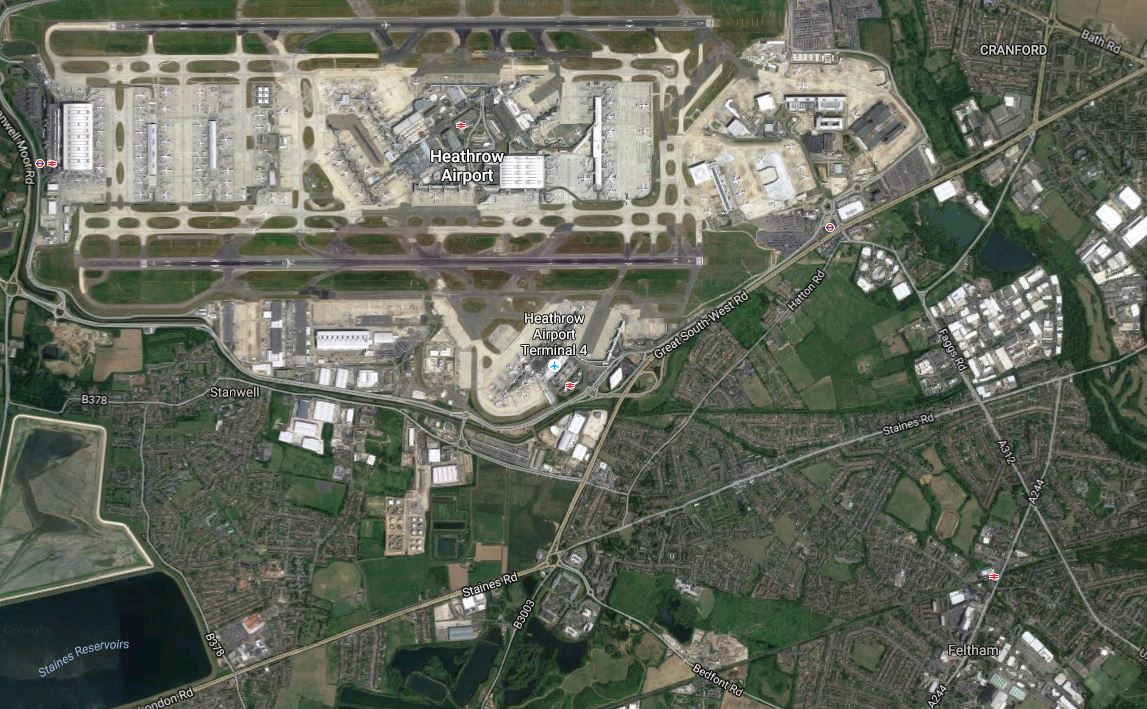
Heathrow Airport And Feltham Station
Feltham station is the station in the South East corner of the map.
A Modern Station
Feltham station is a modern station, as these pictures show.










If it has one problem it is the level crossing at the Western end of the station.
Services
The station is well-connected with six trains per hour (tph) to and from Waterloo on weekdays and 5 tph on Sundays.
But there are a long list of stations, who have in excess of 2 tph connections to the station on weekdays and good connections on Sundays. The list includes.
- Clapham Junction
- Putney
- Reading
- Richmond
- Staines
- Twickenham
- Weybridge
- Windsor and Eton Riverside
It is an impressive level of connectivity to the buses that serve Heathrow’s terminals.
I was at Feltham station for about twenty minutes and saw several newish buses drive off towards Heathrow.
A railway called Heathrow Airtrack was proposed, but abandoned to link Waterloo to Heathrow, via Feltham.
It doesn’t seem to be mentioned much these days.
I just think, that because the services through Feltham are at a level of one train every ten minutes and because the line has several level crossings, that trying to squeeze an airport service into the mix, although probably not impossible, was difficult and would give rise to too many objections to fight off.
An Alternative Link
But Heathrow may have the solution in their hands and that would be to use an enlarged version of the Heathrow Pod system, that I wrote about in A Visit To Heathrow Terminal 5.
Or they could use some other charismatic system, that flew people at helicoptor-height over the route to and from Heathrow.
Several systems come to mind; cable-car, tram, monorail, a modern Schwebebahn or MAGLev.
The Schwebebahn in Wuppertal, was built over the River Wupper in the early Twentieth Century and it still running today. I wrote about it in The Wuppertal Schwebebahn. You wouldn’t build anything like this, but the construction of the Schwebebahn shows that you can put a lightweight railway over a river.
This Google Map shows Feltham station in greater detail.
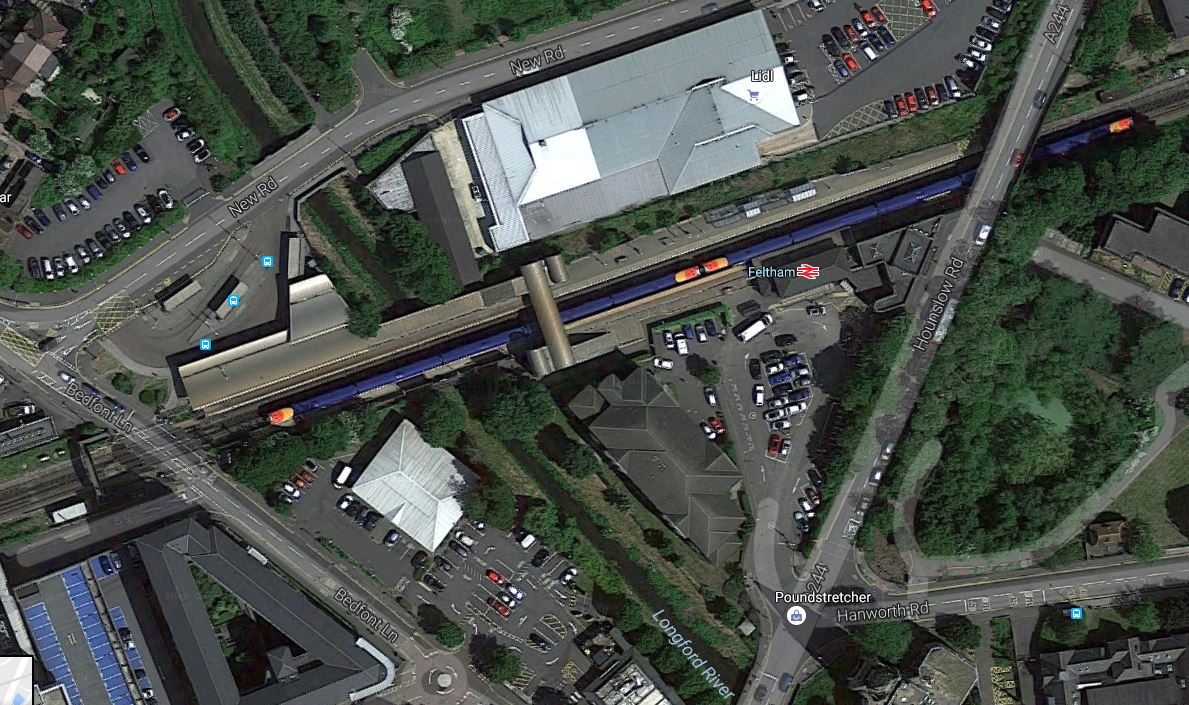
Feltham Station And The Longford River
Note the Longford River, which passes under the station.
This Google Map shows Terminal 4 at Heathrow Airport.
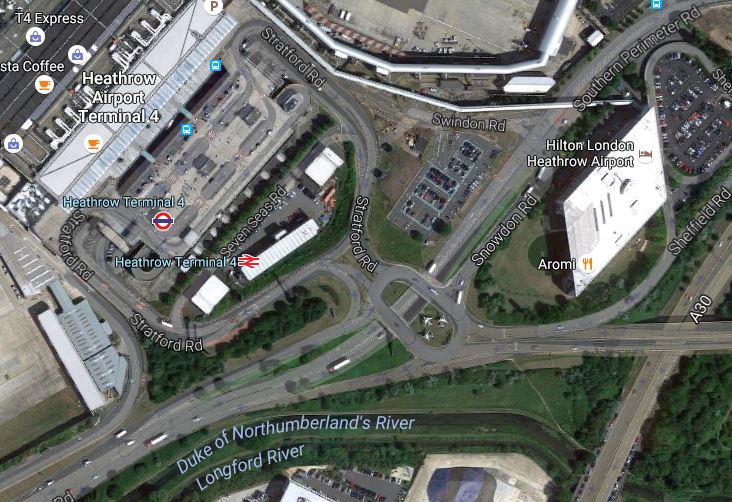
Heathrow Terminal 4 And The Longford River
Again note the Longford River.
So could some form of lightweight aerial railway be created to run at perhaps fifteen metres above the river and some of the roads in the area. This picture shows the Heathrow Pod that connects some car parks to Terminal 5.
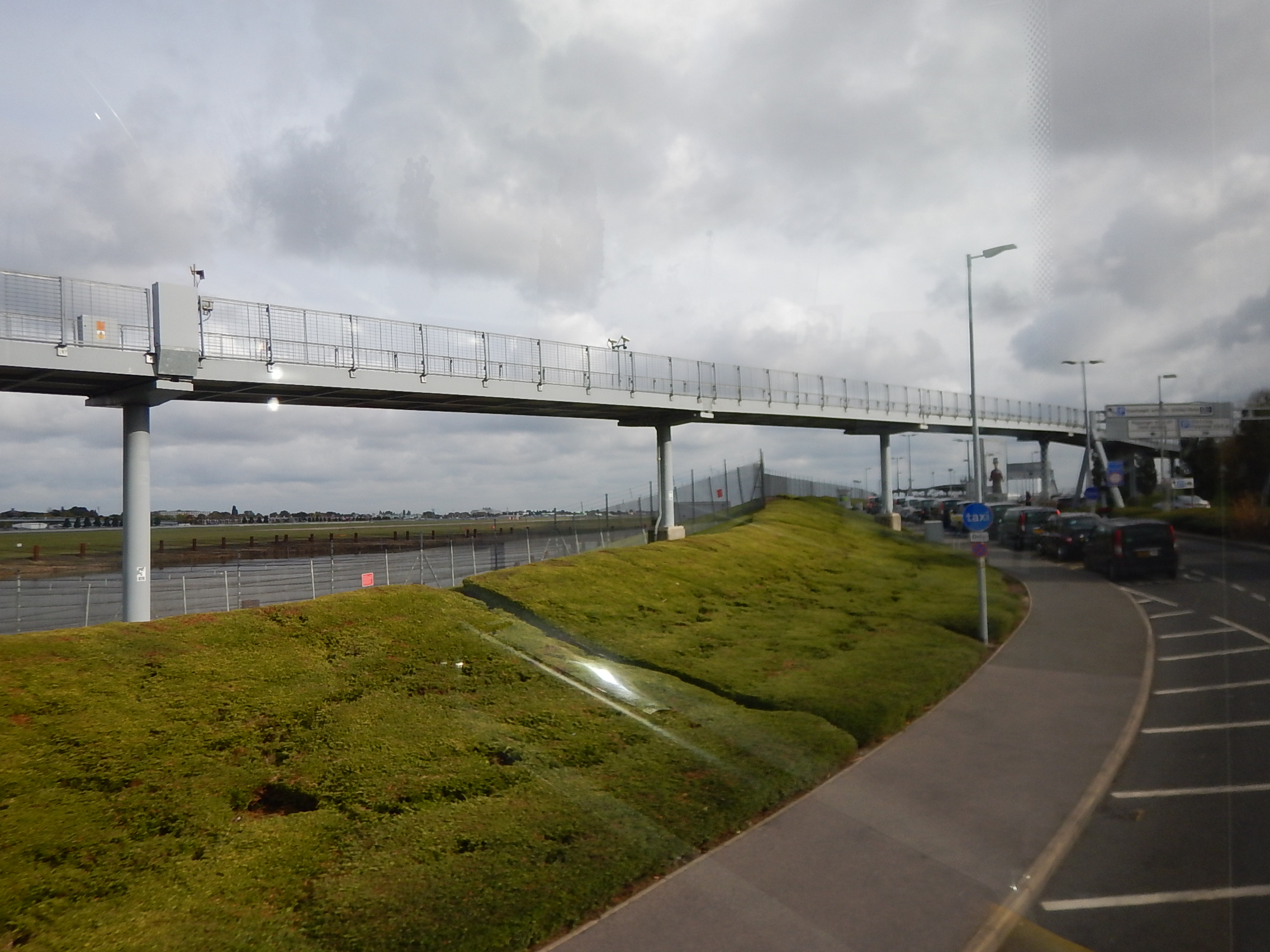
The Heathrow Pod Crosses To Terminal 5
The Terminal 5 system is described here in Wikipedia and is 3.9 km long. I estimate that Feltham to Terminal 4 would be about 6 km.
As Heathrow are thinking of using the Heathrow Pod system to go all the way to Kingston, I would suspect that Feltham would be in range.
My big worry would be, that the number of pods required to transfer passengers to and from Feltham might be too large for the system.
So I think that even if the Heathrow Pod system couldn’t be used for the link, within a few years, someone will devise a system that would create the ultimate airport link between Feltham and Heathrow Airport.
Heathrow Services Post Crossrail
To take some of the pictures for A Look At Stockley Junction, I took Heathrow Connect to the Airport..
My return ticket from Hayes and Harlington station, cost me £8.20 with a Senior Railcard, which must be one of the most expensive journeys per mile in the UK. Especially, as there are only two trains per hour (tph). Considering that I could have done the journey quicker yesterday, using a 140 bus, as the train was ten minutes late.
But it would be difficult to take the pictures I wanted from the bus.
Arriving at Heathrow, I thought that a hot chocolate would be in order, so I set off for Terminal 2.
Passenger friendly the journey is not, so as I wanted to get back, I returned to the station to catch the next train.
I did not see a single sign to Heathrow Connect, with this one being typical.
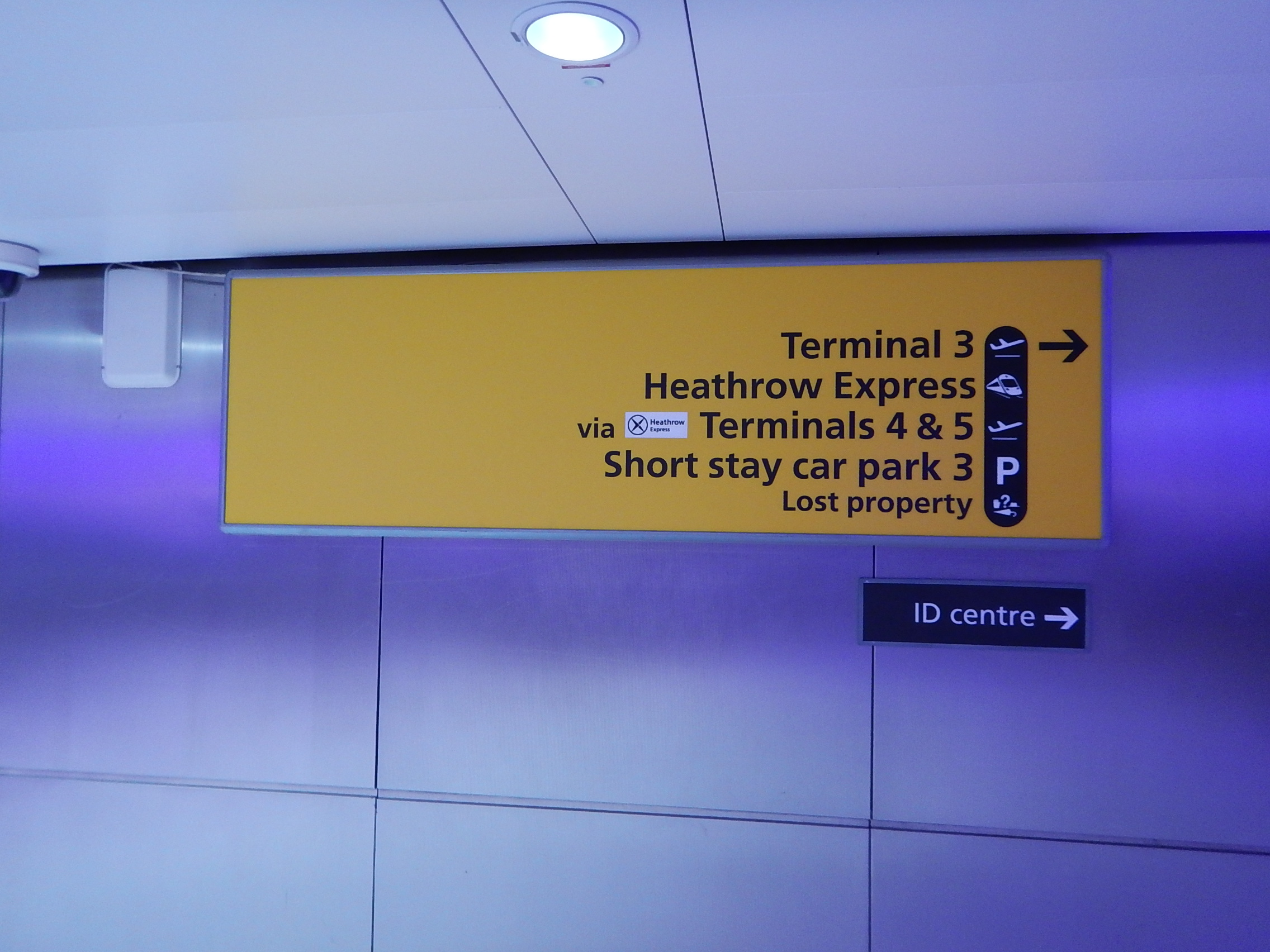
Where’s Heathrow Connect
I knew where to go, as I’d walked it.
Incidentally, it is easy enough to find the overpriced Heathrow Express, but how many passengers with a brain want to go to the disconnected Paddington?
Some like me might actually want to go to Hayes and Harlington or perhaps Maidenhead.
I didn’t ask, but I wonbder if the advice to go to Maidenhead, is to take Heathrow Express to Paddington and then get a train to Maidenhead. The Oracle (Nation Rail’s Journey Planner) recommends taking Heathrow Connect to Hayes and Harlington, but will all the staff.
Current Services To The Airport
There are four ways to get to Heathrow by public transport.
Heathrow Express – 4 tph to and from Paddington. – Overpriced
Heathrow Connect – 2 tph to and from a series of stations along the route to Paddington – Infrequent and overpriced.
Piccadilly Line – Slow, frequent, usually reliable and the most affordable.
Bus – For a lot of those living near the Airport, this is the preferred route.
This map from carto.metro.free.fr shows the layout of the rail and Underground lines.
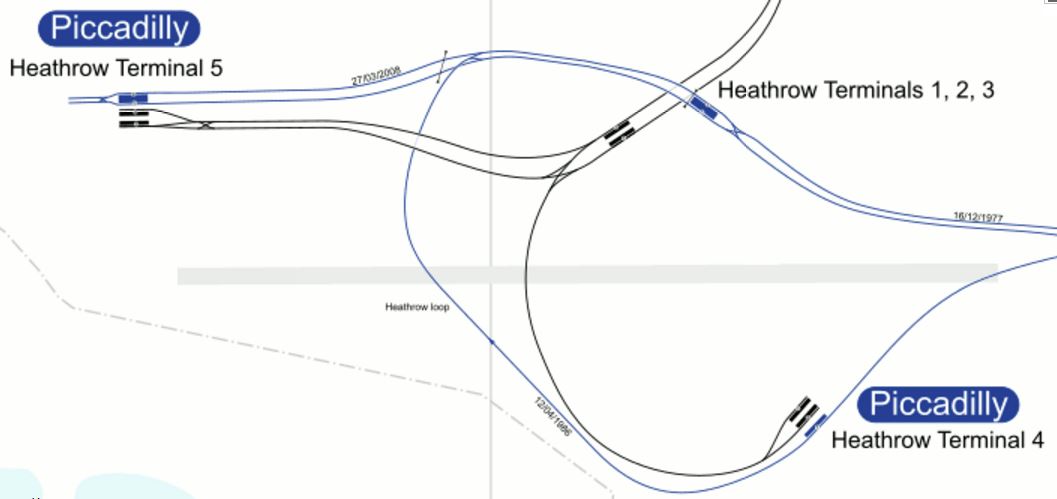
Rail And Underground Lines At Heathrow
Simple it isn’t!
But that is what you get if you dither over the next runway in the South-East for forty years.
Heathrow’s rail links are so very Topsy, unlike those at Birmingham, Edinburgh, Gatwick, London City, Luton, Manchester, Southend and Stansted.
Not all the others are perfect, but they’re getting better.
Crossrail
Crossrail will be the new wayto get to Heathrow and in some ways it is a replacement for Heathrow Connect. This is said under Future in the Wikipedia entry for Heathrow Connect.
From May 2018, Crossrail trains will replace all Heathrow Connect trains between London Paddington and Heathrow terminals 2, 3 and 4. Furthermore, as of December 2019 all services will run through the new tunnels at Paddington to central London destinations including Bond Street, Liverpool Street and Canary Wharf
So, it would appear that there will no substantial improvement until December 2019.
This is a detailed timetable, with particular reference to going between Heathrow and the City of London and Canary Wharf.
- May 2018 – Heathrow Connect will be taken over by Crossrail. We’ll certainly see better signage and service under Transport for London’s management.
- May 2018 – The Crossrail start schedule on Wikipedia, also shows that the shuttle between Heathrow Central (Terminals 1,2 and 3) and Terminal 4, will be transferred to Crossrail. Terminal 5 will be reached by using Heathrow Express from Heathrow Central.
- May 2018 – Heathrow Connect in the guise of Crossrail will be serving erminals 1,2, 3 and 4, but not Terminal 5. Will we be seeing new Class 345 trains and a higher frequency to Heathrow? I woulden’t be surprised if Heathrow Airport, try every trick to keep Crossrail out of the Airport, to protect the revenue on Heathrow Express.
- December 2018 – Crossrail services between Paddington and Abbey Wood will start, thus linking Paddington to the City of London and Canary Wharf. There will probably be a longish walk between the two parts of Crossrail at Pasddington, but the tunnel across London, will give Paddington the much need-connectivity, it’s needed since the Second World.
- May 2019 – Crossrail services between Paddington and Shenfield via Whitechapel will begin, thus meaning that many travellers East of Paddington, will use a single change there to get to and from Heathrow.
- December 2019 – The full Crossrail should open, meaning that there will be direct trains between Abbey Wood and Heathrow Terminal 4 calling at Canary Wharf, Liverpool St-Moorgate, Farringdon, Tottenham Court Road, Bond Street, Paddington, Heathrow Central and all the stations in between.
Trains into the Airport will be.
- 4 tph – Heathrow Express for Paddington, where many passengers will change to and from Crossrail.
- 4 tph – Crossrail to Abbey Wood.
One will be expensive and the other will be affordable and much more convenient, as it reaches the places passengers want to start or finish their journey.
It looks good, but there are a some questions to answer.
Is eight tph enough trains to and from the Airport?
If you compare Heathrow with Gatwick, Luton and Stansted, eight tph seems good.
However, I found this article in TravelWeekly, which is entitled Gatwick outlines plans for a train departure to London every three minutes.
It gives a very good summary of the train services that will run to Gatwick after Thameslink is completed.
- Four tph dedicated Gatwick Express trains to Victoria
- Six tph to Victoria – originating from East and West Coastway, Horsham/Littlehampton, and Three Bridges/Haywards Heath
- Four tph to Bedford via London Bridge – originating from Gatwick and Brighton
- Two tph to Cambridge via London Bridge – originating from Brighton
- Two tph to Peterborough via London Bridge – originating from Horsham
- Two tph to London Bridge – originating from Littlehampton/West Coastway, and Haywards Heath/Three Bridges.
That is a total of twenty trains to and from London and beyond and most of the South Coast from Southampton to Hastings.
How many better rail-connected airports are there anywhere in the world?
Luton and Stansted are also have aspirations to improve their rail links.
I think that passengers will press for increase in the frequency of services to the Airport and they’ll want more destinations.
After all Shenfield and Abbey Wood are planned to have 8 tph all day to and from Central London, with at least twice as many in the Peak.
How do passengers get to and from Iver, Langley, Maidenhead, Reading and all staions to the West of Hayes and Harlington?
A rail link into Terminal 5 from the West is planned, but something needs to be done before that is completed probably in the mid-2020s.
After December 2019, their will be four routes.
- Go to Paddington and use Heathrow Express – Expensive
- Go to Hayes and Harlington and take Crossrail into Heathrow Central – Requires two step-free changes of train.
- Take a coach from Reading.
- Go to Hayes and Harlington or West Drayton stations and use a local bus.
I can see something innovative being done at Hayes and Harlington station.
There is probably capacity between Heathrow Terminal 5 and Hayes and Harlington stations for a 4 tph shuttle in both directions, that would also solve the Terminal 5 connectivity problem.
Southall could even be an interesting alternative, as there is lots of space.
What Would Be My Solution?
I would use Hayes and Harlington station, as the interchange for Heathrow Airport.
In an ideal layout there would be three slow lines through Hayes and Harlington station, with two island platforms separating the lines. From the South, they would be.
- The Reading-bound (Up Slow) line.
- The Heathrow shuttle line, which would also be used by Crossrail trains going to and from Heathrow Terminal 4. This liine would be bi-directional.
- The London-bound (Down Slow) line.
Between the platforms would be two welcoming island platforms to give passengers a step-across interchange, between trains.
It would need a major rethink of the station.
But consider.
- Passengers from the West for Heathrow would just walk across the platform to get their train.
- Passengers for Heathrow Central could take any train.
- Passengers for Terminal 4 or Terminal 5 might need to wait a few minutes for an appropriate train.
- Crossrail passengers for Terminal 5, would change at Hayes and Harlington.
- Passengers from Heathrow for the West would just walk across the platform to get the train.
- No passenger would need to change platforms using the step-free bridge.
What is being provided at Hayes and Harlington station is very much a poor design.
Will the current Heathrow Connect service between Paddington and Heathrow Central and Terminal 4 be dropped?
I can’t see any point to it, after Crossrail has an all-stations service to the Airport from Paddington.
How do passengers get to and from Terminal 5?
I proposed the shuttle to do this, with passengers changing at either Hayes and Harlington or Heathrow Central stations, to a train going to either Terminal 4 or Terminal 5.
Will passengers be able to use contactless cards to the Airport?
I think if the decision was down to the Mayor, Transport for London or the people of London, Oyster and contactless bank cards would be a way of paying a fare to Heathrow, as it is to Gatwick.
Will passengers like me with Freedom Passes, be able to use Crossrail to Heathrow?
Boris said Yes and I suppose the current Mayor, Transport for London and card holders, will expect it to be possible, as it is on the Piccadilly Line.
Conclusion
The Heathrow spur of Crossrail has not been thought out too well!
 The Anonymous Widower