The Battle for HS2
I listened with interest to the debate on Radio 5 yesterday morning about the London to Birmingham route of the High Speed Rail route called HS2.
On the one side were a few people who feel the line should be built and extended to the north, but the vast majority, including the respected rail commentator, Christian Walmar, were against the proposal. Many on both sides preferred emotive arguments instead of facts.
A classic selfish comment was from a man with a Range Rover, who said that to turn up and use the train cost him much more than the fuel for his gas-guzzler.
He may have a point about costs and I suspect he’s one of those who wouldn’t really wants to be seen dead on a train and say if he had an appointment in the West End of London, he’d drive. He’s probably one of those who rants against fuel, parking and clamping charges too.
I am sceptical about the need for HS2, although I do concede that we need extra capacity to the Midlands, North and Scotland. But a lot of this is to get freight up and down the country. You’d think this was a no-brainer, but any freight developments like the Radlett freight terminal, will get the Nimbys, who are worried more about their house prices than the ecomony of the country out in force.
To be fair to the government, they are trying to get a coherent strategy together on HS2 and the essential freight developments, and realise that if they don’t the problems in the economy will mean they are a one-term government. But if the strategy is accepted by those of sense, the Nimbys will still vote against it, when the election comes.
After all a good rail strategy would mean that people will have to give up some of the things that they consider essential to their life, like the cottage in the country.
So what we see on HS2 is just a small skirmish in the long war against climate change. Many people will never change their selfish lifestyles and will fight and of course voteto keep their large car affordable.
So what would I do?
I did lay out a ladder strategy in Relections on My Journey to Scotland, with better West and East Coast routes. Whether or not we build HS2, some of that strategy needs to be done anyway.
- Higher capacity on the West and East Coast routes.
- Electrify Glasgow-Edinburgh, TransPennine and create a fast Birmingham to Peterborough route via Leicester or Derby.
- Create proper interchange stations, so that changing is easy and quick. We need stations to be proud of that are destinations in their own right at Birmingham and many other places. How many stations are places where you could meet someone special for lunch or a business meeting? It is a list of two; St. Pancras and Liverpool Street. Although to be fair, some could be there fairly easily with vision and a small investment.
- Scrap all of the dreadful rolling stock like Pacers, used in the North, East Anglia, the West and Wales that connect a large part of the country to the fast network and replace them with modern comfortable trains.
- Whether HS2 is built on not, Euston should be rebuilt and be properly connected to King’s Cross and St. Pancras.
- Safeguard the proposed route of HS2.
The Noise of a High Speed Train
There is quite a reasoned article on the BBC today about the sort of noise you might get from a high speed train on HS2 and how you could reduce it.
The article doesn’t mention a technology that by 2020 will probably be available to quieten the train and that is the use of anti-noise, where an equal and opposite noise is generated to cancel the sound of the train. I dabbled in this twenty years ago and even then the technology had been successfully applied in a few applications. But even if anti-noise itself is not used, in ten years or so how trains create noise will be better understood and better design will be used to cut the noise.
I may be generally against the building of HS2, but I do think that noise will not be one of its biggest problems.
What Do We Do With the Olympic Stadium?
The row about what to do with the Olympic Stadium in Stratford after the Olympics rumbles on apace.
The original plan to turn it into a smaller 25,000 seat stadium might be a wonderful legacy for athletics, but would it be the best use of it after the Olympics. There are perhaps a couple of meetings a year that could fill such a stadium, unless the World or European Championships are held in London. And knowing London and Londoners like I do, 25,000 seats would probably be too small. So we might have a white elephant that would require lots of continuing funding.
To have a dual-use stadium as West Ham propose may not be a good idea. Fans don’t like watching football over an athletics track and I can understand why. I watched Ipswich play in the old Olympic Stadium in Moscow and the view was atrocious. Especially, as I had forgotten my binoculars. I also went to Stamford Bridge, when it still had the dog track in place and that wasn’t good either. So I can understand the views of fans and Harry Redknapp, when they say football and athletics don’t mix.
But there is a more fundamental problem and that is that football (and cricket and rugby for that matter) rely heavily on providing a lot of corporate entertainment with boxes, restaurants and fast food bars. Athletics crowds are different, probably more knowledgeable and have different and conflicting needs. They also stay longer making a whole day of the trip.
There is probably only one mixed use stadium that works and that is the Stade de France in Paris. In some ways this illustrates the problems, in that the French stage football, rugby and athletics, whereas, in England, rugby has Twickenham and football has Wembley.
The question has also to be asked if athletics wants a spiritual home like football, rugby and cricket.
It probably does, but a 75,000 seater stadium would be a white elephant, costly to fund.
It could also be argued that it has a spiritual home at Crystal Palace, which has been the scene of some great days of athletics. But it needs to be knocked down and rebuilt, preferably to a size of 30,000 seats that could be temporarily expanded to stage World or European Championships. One of the other problems of the stadium, was that it didn’t have good transport links direct from North and East London. But this has been partly solved by the new East London Line.
In fact, it would be good for South London if the whole Crystal Palace site was properly developed as a sport and leisure park, to compliment Stratford. Very little has been done since the original palace burned down before the Second World War. And if Crystal Palace is properly redeveloped, why not do the same at Alexandra Palace? The famous race course is still there.
What we need is a proper strategy for London, that is properly thought through. In fact this is the main problem with the Olympic stadium in that it was built to a cost for a limited life, rather as part of a whole strategy.
I have just Karen Brady, the West Ham, Vice Chairman, on BBC Breakfast and she put a convincing case for their mixed-use plans, which would include cricket. So is this just one part of a strategy, which should include plans for North, South and West London as well.
And then there is the elephant in the room; Chelski. Arsenal have a 60,000 seat stadium and Tottenham will have one, whether they move to Stratford or not. They wouldn’t be able to develop at Stamford Bridge, but what about a new stadium, where HS2 connects to Heathrow at Old Oak Common?
So the problem is a lot bigger than just what you do with Stratford.
Reflections on My Journey to Scotland
In my Modern Railways for October, which I bought in Doncaster, there was an heretic article by Chris Stokes, asking if we really needed HS2 or the High Speed Line to the North, which would go to just Birmingham at first. He described it as a vanity project.
Twelve months ago, I was a sceptic on whether we needed a High Speed Line to the North, mainly because I didn’t think it would do anything for anybody in East Anglia where I lived. If I needed to get to the North, I wanted a fast line from somewhere I could drive to easily like Peterborough.
But when it was announced that the route would be to Birmingham in the last days of the disastrous NuLabor experiment, I warmed to it a bit, although I did think it needed to go via Heathrow. I also thought very much that it was a Nimby’s charter.
But Chris’s article has now turned me back to very much a sceptic. Competition being what it is, his argument, that unless you virtually close down the West Coast and Chiltern Birmingham services, no-one will pay a premium to go from London to the Midland’s premier city. My son incidentally always goes by Virgin and has never thought about using Chiltern, as Euston is on the same Underground Line as where he lives.
Chris also argues, that the amount of First Class traffic will decrease due to austerity, good housekeeping and modern technology removing the need to travel. Some years ago, I installed a Management Information System in a company, which was web-friendly and even allowed the computer-phobic CEO to find out how the company was doing from any computer in the world. But also, the modern traveller will become First Class smart and book it when and where they need it. So if you think there is a premium market that saves a few minutes, forget it!
Put simply, a lawyer say going to Birmingham from London for the day, will choose his route and class dependent on what is best for his needs. Hopefully, when I move to London, it will be in walking distance of Canonbury. Who’s to say that in 2015, someone isn’t running an express to say Milton Keynes, Coventry and Birmingham from Stratford and East London on the North London Line and possibly the Primrose Hill Tunnel?
So what will happen to lines to the North, if we don’t build HS2 on schedule? We’ll get the usual whining, we always get when the investment is cut, but let’s look at the reality of what will happen!
We now have two good and pretty reliable and fast train lines from London to the North of England and Scotland. I was told on my trip to to Inverness that it should be possible to be some minutes under four hours from Edinburgh to London. This compares with a fastest journey now of about four hours twenty minutes, although Operation Peppercorn is aiming for the magic four hours flat for the fastest trains with a stop at Newcastle. Glasgow to London by comparison is now about four hours and twenty minutes. Many of my Scottish friends say this is fast enough to mean they won’t bother to fly to London, as airport checks and delays are getting worse and they can use phones and laptops on the trains.
If there is a problem with the two stiles of a possible ladder reaching up the United Kingdom, is that some of the interfaces to other lines are poor. But the basics and some of the rungs of the ladder are already in place.
There are a succession of large stations on both lines, such as Peterborough, Crewe, Doncaster, York and Newcastle, which can be developed into easy change stations to other places. As I said earlier, Doncaster isn’t bad and I think Peterborough is going to be developed and hopefully linked to the nearby shopping centre, but a lot of work needs to be done.
As I rode out of Edinburgh towards Inverness, I was impressed to see that electrification has started to link Edinburgh and Glasgow. As it is trains now run every fifteen minutes and most take just fifty to link Scotland’s two capitals. I suspect that this will become a very important link between the two fast lines, not only because of level cross-platform interchange from the South to local trains, but also because full electrification would allow fast direct trains from Glasgow to York and Edinburgh to Liverpool. Taking the first journey, my road atlas estimates that at four hours ten minutes, which compares with about four hours by train now with two changes and two different companies. I estimate that something like a Pendelino could do this journey direct with perhaps just a stop at Newcastle in about three hours fofty-five minutes. Who would back against, Peppercorn 2, squeezing more minutes out of the East Coast Line.
A similar situation could exist between Newcastle, York and Doncaster in the East and Manchester, Liverpool and Preston in the West, by expanding and electrifying the TransPennine network. Edinburgh to Sheffield is a journey that uses either a direct diesel service or a change to TranPennine at Newcastle. If TransPennine was a level change at Newcastle from one fast electric to another, there would be a much better service.
London too has a strong link across, although as I said Euston is not a welcoming station, but when you’ve got three world-class stations in Kings Cross, St. Pancras and Euston, as you will have, an innovative transport solution along Euston Road could surely be achieved. For a start let’s have a proper walking route a hundred metres or so north of Euston Road, with cafes and shops. But I’m certain that people should be encouraged to take the Metropolitan Line rather than the Victoria or Northern. Perhaps we need a moving walkway! Euston is supposed to be being developed and also be a terminal for HS2. If the latter does happen, there will be a lot of grief and opposition in that area of London. That development, whether it incorporates HS2 or not, will divert rail passengers to other routes, such as Chiltern for Birmingham and East Coast for Scotland.
There is also another link that might be brought into use, especially if Euston has to be partially closed to traffic, whilst it is rebuilt. That is the link to Manchester out of St. Pancras, which was used reasonably successfully as Operation Rio during the West Coast Main Line upgrade. I’ve always argued that this should have stayed in place, as it interfaces well with the A14 at Wellingborough for those going from East Anglia to the North Midlands,Sheffield and ultimately Manchester.
So what’s missing?
As I found going to Scunthorpe, it’s not what’s missing in this case, but what’s still here; Pacers. All of these links to the two stiles of the ladder must be upgraded to the standard of the diesel trains, I used in Scotland. And where possible, they should link easily to the fast services. I think that this will happen, but in some ways it depends on a strong electrification program to release suitable diesel units.
The real problem though is the lack of a full East-West route between say Peterborough and Birmingham or perhaps Milton Keynes and Stevenage or Cambridge. The Peterborough to Nuneaton route is being upgraded for frieght and passenger trains between the two towns take seventy-five minutes. So it would look like that route could be another rung in the ladder. The other route is the possible Oxford-Cambridge Line, which could be built, if funds were made avaialable.
I believe strongly that the two route ladder offers advantages over just building a speculative line from South to North, which would cost several times the amount needed to build the two route ladder.
For example, as electrification progresses, subsidiary lines like Birmingham to Bristol could be further improved, so that more and more people had less than two hour access to the main network. More rungs could be opened up, by any company that feel there was a niche to be filled.
So should HS2 be built? I think that one day it might be built, so we must safeguard the route, so that at some future date it could be added as another part of the network.
If Beeching made one big mistake it was not in making sure that abandoned rail lines were able to be rebuilt. How many lines hastily abandoned in the 1960s are needed now? But perhaps it would mean knocking down a hundred or so houses and a Tesco’s!
Here Come the Nimbys
They are going to announce the compensation scheme for the High-Speed Line to the North (HS2) today, so what does the BBC do? They get a stupid Nimby on the BBC Breakfast counch. Looking at her, she looks like a typical Home Counties woman, who thinks much more for herself, than the general population. I was uncertain about HS2, until I read an article in Modern Railways, which convinced me that the planned route, via the Chilterns was correct.
There are a lot of unpopular developments we need like nuclear power stations and freight distribution depots. Done properly and sympathetically, they can be to everybody’s benefit.
We must not let the Nimbys win!
Reversing at Marseilles
The train reversed at Marseilles. So instead of going backwards, I was now facing north and on the eastern side of the train, so I didn’t get any of the sun that was going. There wasn’t much and we did have a bit of rain.
It started twenty minutes late at 13:30 and arrived in Lille at 18:00, which meant it lost another five minutes. But I still had enough time to get the Eurostar to London.
This train was via Paris Charles de Gaulle, so I didn’t have to change trains in Paris.
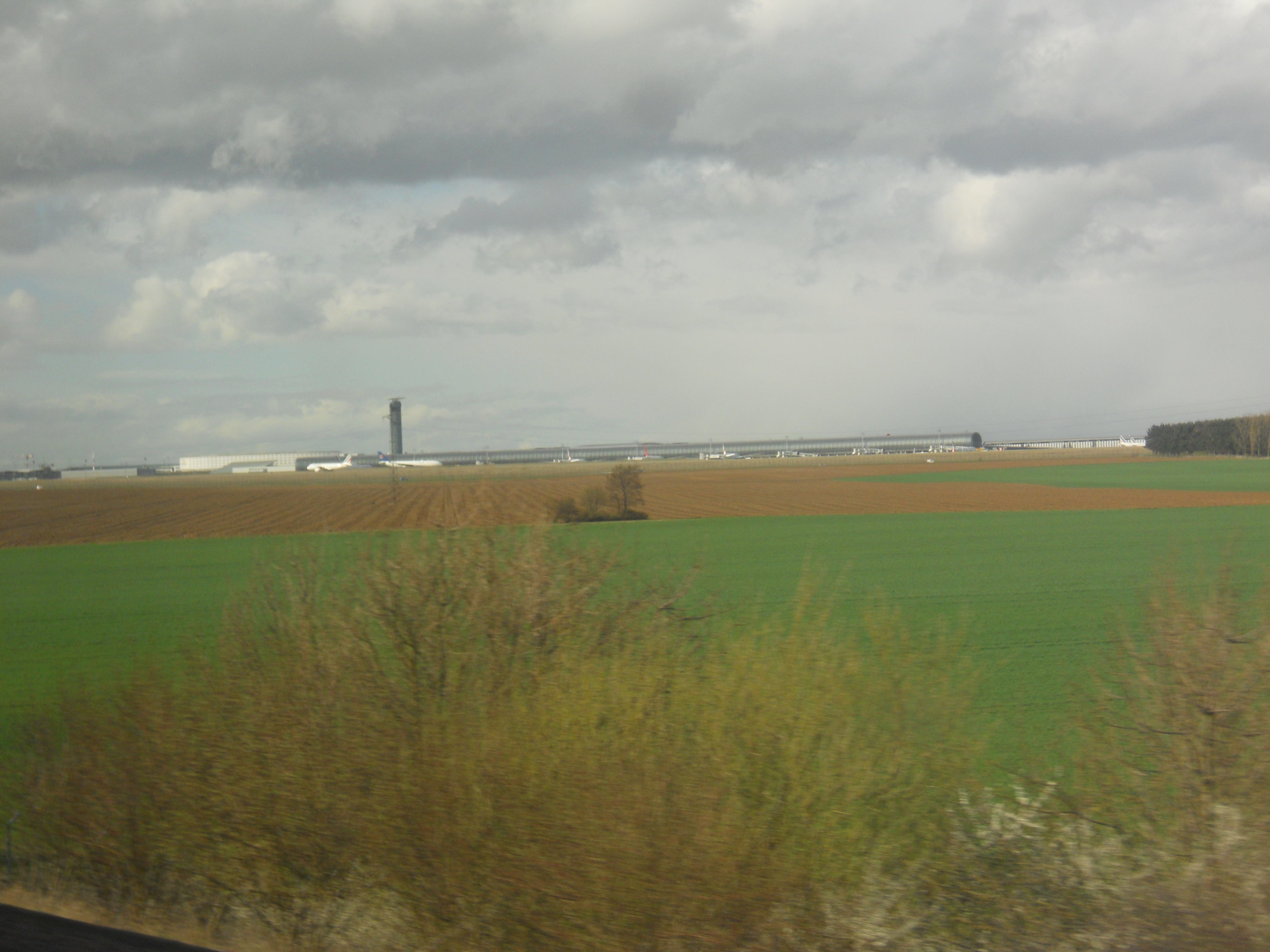
Charles de Gaulle Airport from the TGV
Why is it we don’t plan to build a connection between HS1 and HS2 in London, just like the French have done around Paris?
After all Birmingham to Paris would be only about three and a half hours, which would probably be quicker than a plane, if you took in the transfers to and from the airports.
 The Anonymous Widower