A Little Chord Goes A Long Way
This article in Rail Magazine is entitled Halton Curve Gets The Green Light.
I wrote about the Halton Curve in Could Tram-Trains Be Used To Advantage In Liverpool? I said this in a section entitled Upgrading The Halton Curve
Funds have been made available to upgrade the Halton Curve, so that trains can reach Chester from Liverpool South Parkway via Runcorn.
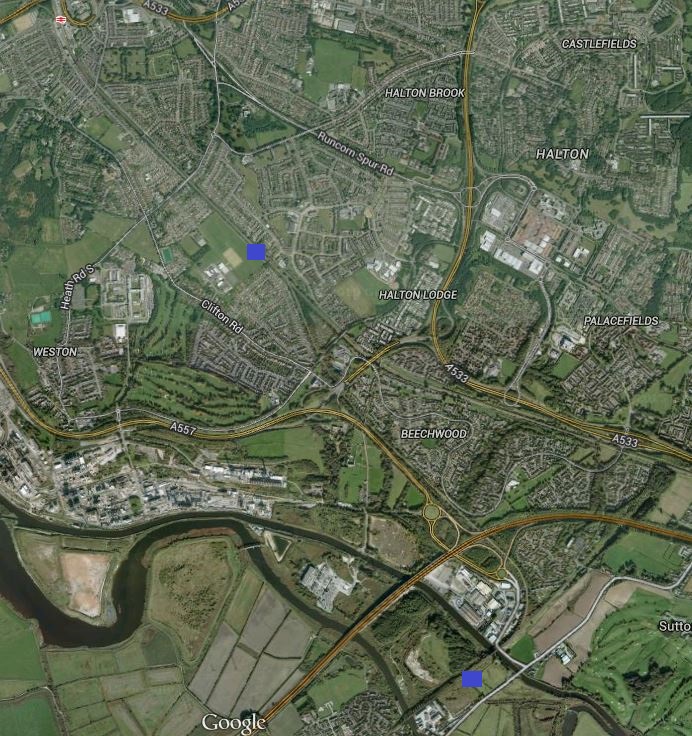
The Halton Curve
The two blue squares indicate the two ends of the current single-track curve. The top one is where the curve leaves the Liverpool branch of the West Coast Main Line south of Runcorn station and the bottom one is where it joins the Chester to Manchester Line east of Frodsham.
The main reason for doing this would be to allow trains from Chester and North Wales better access to Liverpool Lime Street and South Parkway stations, and the John Lennon Airport.
As the Tier Two and Three electrification plans for the North as they effect Merseyside, includes full electrification of the lines around Chester, this would mean that an upgraded curve would be electrified.
There are probably good reasons to add an extra track to the curve, which would make it possible for Chester to be a new southern destination of the Northern Line.
The Rail Magazine article says this.
The Liverpool City Combined Authority has approved a range of projects aimed at improving travel across Merseyside, including reinstatement of the Halton Curve.
Also endorsed by the Welsh Government and by Cheshire West and Chester Council, bringing the line back into full use will entail an hourly direct service between Liverpool and Chester, and the extension of some services into Wales.
So just as the Todmorden Curve helped with the rail system around Burnley and the Ipswich Chord helped in Suffolk, will the Halton Curve help to develop the railways on Merseyside?
What is interesting about this decision, is that this appears to be a Liverpool decision, not one from Central Government.
Should more infrastructure decisions be devolved?
I think it’s very much a big yes!
–
More On Class 345 Trains
In an article in this month’s Modern Railways, which is entitled 345 Counting On It, Ian Walmsley gives more details of the new Class 345 trains for Crossrail.
Ian uses phrases like.
Let’s get this out of the way first before I start enthusing (and I will) – personally I don’t like the interior colours.
Now I will go into full enthusing mode,
The bogies are the FLEXX Eco Bogie B5000-derivative inside-frame design similar to that on the Meridian (probably the only good thing about Meridians in my view)
The bodyshell is brilliant, and I say this as a passenger and an engineer.
The train is a fine piece of work.
He finishes by saying that he thinks the train will be a success for Bombardier.
Ian also throws in a few clues as to where Aventras might end up.
The 125 mph Aventra
Apparently, 125 mph Aventras are a possibility.So we could see High Speed Trains with similar performance to an InterCity 125, based on a train originally designed for commuters across London.
The High Speed Train With Batteries
One thing that Ian doesn’t mention about the Class 345 trains is whether they will be fitted with onboard energy storage. But he does say this.
Most braking will be done electrically, regenerating power to the grid.
So the answer is probably no! But it should be noted that Bombardier have told me that all Aventras are wired to accept onboard energy storage.
This raises the interesting possibility of the High Speed Train running on batteries.
I think that this could be a surprisingly large market.
Think of the routes which consist of two types of line.
- A high speed electrified line, which permits trains to travel at 100-125 mph.
- A secondary or branch line without electrification, that is up to about forty or fifty miles long.
On a quick look, I can think of these routes.
- London Liverpool Street – Ipswich – Lowestoft
- London Liverpool Street -Norwich – Yarmouth
- London Kings Cross – Bradford
- London Kings Cross – Harrogate
- London Kings Cross – Huddersfield
- London Kings Cross – Hull
- London Kings Cross – Lincoln
- London Kings Cross – Perth
- London Kings Cross – Sheffield
- London Kings Cross – Sunderland
- London St. Pancras – Hastings – Eastbourne – Brighton
- London Euston – Blackpool
- London Euston – Chester
- London Euston – Huddersfield
- London Euston – Shrewsbury
- London Waterloo – Exeter
I am assuming that electrification is at 2016 mileage.
As electrification increases more and more routes will be possible using a High Speed Train with batteries to extend the route away from the main line.
Merseyrail
Ian mentions Merseyrail as another target.
They would appear to be a good match to Merseyrail’s specification, that I wrote about in Is Liverpool Planning To Invade Manchester By Train?
- Merseyrail are looking to buy energy-efficient trains.
- Merseyrail stated in Modern Railways that they were seriously interested in having IPEMUs.
- Merseyrail want to expend their network and routes to Preston, Manchester via Kirkby, Chester via the Halton Curve and Wrexham via the Borderlands Line are very IPEMU-friendly routes.
- Merseyrail needs trains that are certified for working in tunnels.
- Merseyrail needs trains that can work on both third-rail and overhead electrification, which the dual-voltage Class 710/2 Aventra trains for the London Overground can do.
- Ian feels the train’s low weight could be enough to avoid sub-station upgrades.
In addition, the modular nature of the Aventra design means that Merseyrail could have a mixture of train lengths and voltages to optimise their procurement and operating costs.
East Midlands Trains
Ian says this about using Aventras for East Midland trains electrics.
As a 125 mph unit it would cope well with Corby commuters and the ‘Master Cutler’ crowd. – It is all about the interior.
I think there are other factors, that could be useful, if some or all of the trains were an IPEMU variant.
- I think Corby could be reached from St. Pancras by an IPEMU using the existing electrification.
- Running on batteries through the Derwent Valley World Heritage Site, might avoid tricky negotiations with the heritage lobby.
- Services could be extended past the current terminals of Nottingham and Sheffield.
Using Aventra IPEMUs would enable a whole new method of railway electrification.
Starting from Bedford, the electrification would be performed northward and as each section was completed, the Aventras could reach twenty or thirty miles further.
So electric train services would arrive at a town earlier than by using traditional methods.
Europe
Ian finishes the article with.
With the new design, Bombardier can take them all on. I think we will see this product platform around for many years, capitalising on the succes of Electrostar, and who knows, maybe even exporting to Europe? 345 – count on it.
If Bombardier have the right product, why not?
Liverpool’s Railways Get A Makeover
Unlike some places, which are getting major new stations or lines on their rail networks, Liverpool is getting a package of smaller projects according to this article on the BBC.
- New and longer platforms at Lime Street station, with upgraded signalling equipment. This will enable longer trains and more frequent services
- Renewing tracks on the Merseyrail underground loop
- Laying additional track between Huyton and Roby – this will enable faster services between Liverpool and the east
- Building a new station at Maghull North – between the existing Maghull and Town Green stations
- Newton-le-Willows station will be improved
- New Liverpool-to-Chester service and the re-opening of the Halton Curve
But they do add up to a total of £340million.
Liverpool Lime Street Station
Liverpool Lime Street station got a major upgrade for when Liverpool was the 2008 European Capital of Culture and the lines are currently being fully electrified, so the station improvements will complete the transformation of the station into a fitting gateway to the Liverpool Maritime Mercantile City, which is a UNESCO World Heritage Site.
It might even become a Grade I Listed Building in its own right.
This is said about the remodelling of the station in Wikipedia.
A £340m remodelling of the station will take place from 2017 This will create two new platforms between the existing platforms 7 and 8, with other platforms being lengthened and widened. The remodelling will allow for new services to Glasgow, starting in 2019. A supermarket and new shops will also be built. The station will close for nine days from 30 September 2017 and will also close in autumn 2018 (with dates yet to be confirmed)
On a personal note, I hope it will allow Virgin to run two trains per hour (tph) to and from London. They might even be longer too!
I also wonder if the platforms will be large enough for the trains for HS2, when Liverpool gets two tph from the South.
Newton-le-Willows Station
What happens at Newton-le-Willows station will be interesting to see.
This used to be said under Relocation Proposal in the Wikipedia entry for the station.
There have been proposals to move the station eastwards, due to the poor accessibility of the approach roads and very limited parking, to a site possibly near the M6. However, this could cause some political issues, as it may place the station partially over the Merseyside border into theGMPTE area. Some benefits of this though, would be an opportunity to create a substantial interchange with the West Coast Main Line which passes just east of the existing station, and a large park and ride, reducing car traffic into both Liverpool, Warrington and Manchester. The proposed plans were scrapped in June 2009
It strikes me that Liverpool and Manchester should bury the hatchet on this one!
Apparently, they have buried it, as under Redevelopment this is now said.
Merseytravel put forward proposals in December 2015 for the station to be developed as an interchange station. The proposals were later approved with the work scheduled to be completed by March 2018.
This Google Map shows Newton-le-Willows station and the surrounding area.
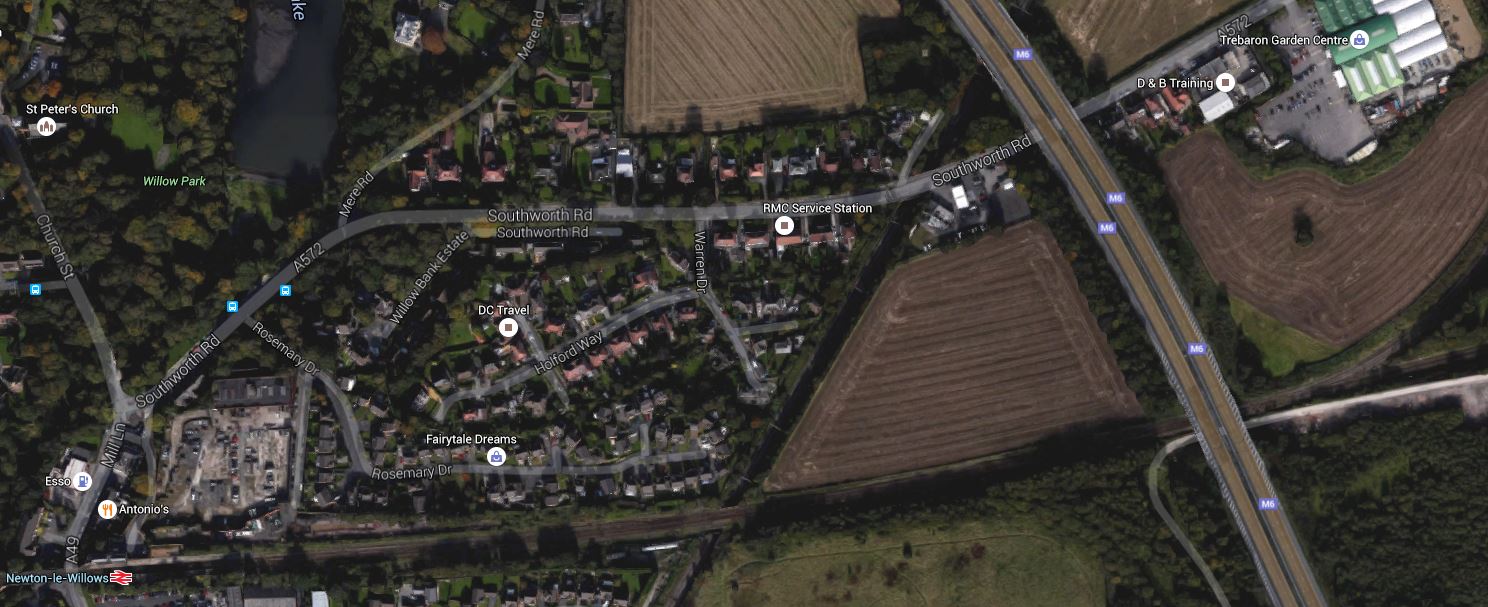
Newton-le-Willows Station
I wonder if there is a Grand Design for the UK’s ultimate parkway station.
Trains With An IPEMU Capability
This is an aside to explain the concept of an Independently Powered Electrical Multiple Unit or IPEMU.
It’s just an electrical multiple unit, with some form of energy storage, which is typically a battery. The battery is charged, where there is overhead wires as in Lime Street or third-rail as on the Wirral and Northern Lines.
To a passenger, they’re just like a normal electric train.
On Merseyside, the classic route would be to go up the Northern Line to Ormskirk and then use the batteries to get to Preston via the electrified main line.
Merseyrail have stated that they want their new trains to have this capability.
There are four main reasons.
- They can open up new routes.
- The energy created when the train stops can be used to get it moving again, thus making the train more energy efficient.
- The power in the batteries can be used in emergency in the tunnels, if the main power supply fails.
- Short lengths of up to a few miles of railway can be left without electrification.
Trains with this capability will become increasingly common.
Onward To Chester And North Wales
You can never accuse Merseyrail of not being ambitious and reopening the Halton Curve and running services to Chester, opens up possibilities for services between Liverpool, John Lennon Airport and North Wales.
As Liverpool also have plans to link the Wirral Line to the Borderlands Line possibly using trains with an IPEMU capability, connectivity between Liverpool and North Wales is set to be increased substantially.
Conclusion
I think it is true to say, that Liverpool have a very useful package of improvements here and when coupled with the new trains that Merseyrail are choosing, Liverpool appears to be moving towards a very good local rail network.
Could Virgin Run A Double Shuttle?
Coming back from Manchester today, I didn’t book a ticket, but then I never do when returning to London.
Suppose I’m going to a football match or a meting at a place like Huddersfield, which is a single change at Manchester Piccadilly or Liverpool Lime treet station.
Going North, I’ll choose a train that gives me about an extra hour to get me to the stadium in time for the match. This means that if the trains are running to time, I will have time to buy a gluten-free lunch at Carluccio’s in Piccadilly station or Liverpool before doing the second leg to the destination.
I might book a First Class Advance, but usually on a Saturday, I’ll book an Off Peak ticket in Standard Class and pay the Upgrade on the train.
Coming home, I’ll always use an Off Peak ticket, as from many places, you can never guarantee to be able to get to the station to catch a booked train. Especially, if it’s a wekend and there are Rail Replacement Buses.
I use similar booking tactics to places like Birmingham, Cardiff, Leeds, Liverpool, Sheffield and York.
It is a tactic that works well and I’ve never needed to buy a new ticket to get home, because I’ve missed a booked train.
Today got me thinking, as I came home from Manchester.
Would it be more profitable, if Virgin ran the service between London and Manchester as a turn-up-and-go Shuttle?
- Passengers would be able to book the trains in the normal manner.
- It would also be possible to turn up at Euston or Manchester and just by touching in and touching out with contactless technology at your destination to get on the train.
- Perhaps it could all be done on a simple terminal where you choose your class and destination, paying for the ticket with contactless technology using ApplePay, AndroidPay or a bank card.
- At Manchester Piccadilly, I had plenty of time today, so taking ten minutes to buy a ticket wasn’t a problem.
- Surely, the quicker you can buy a ticket, the more passengers will travel.
- Three trains an hour would run in both directions always starting from the same platforms.
It could get very interesting, if it was made into a double shuttle, with Euston to Liverpool services.
I suspect there’s a pattern, that perhaps has six trains an hour to Crewe, with some trains going to Manchester and others to Liverpool.
IPEMU Trains And Terminal Tunnels
The strongest hint about purchasing trains with an IPEMU capability has come from Merseyrail.
I wrote about these trains in a Merseyside context in Is Liverpool Planning To Invade Manchester By Train? This is an extract from the post, which details their declared interest in IPEMUs.
In the October 2015 edition of Modern Railways, there is an article about Merseytravel looking for a new fleet of trains for their 750V DC network, which is entitled New Trains For Liverpool. This is said.
Merseytravel has indicated that it will be seeking ‘innovative proposals’ from manufacturers, with considerable emphasis being placed on the overall cost of operating the fleet rather than just the basic cost of the trains themselves. Options such as regenerative braking and onboard systems to store energy under braking to be used for acceleration will attract particular interest. The independently-powered EMU (IPEMU or battery train) concept evaluated earlier this year on a modified Class 379 in East Anglia ,might see an application here.
I thought that the main reason for the IPEMU capability would be to connect Preston to Liverpool via Ormskirk and Manchester Victoria to Liverpool via Kirkby.
But does Merseyrail have other reasons? Type “Merseyrail power supply problems” into Google and you get a lot of matches, especially concerning Kirkdale depot.
To emphasise this in Liverpool City Region Long Term Rail Strategy, this is given as an objective.
Future proofing the power requirements of the Merseyrail network by undertaking a full power upgrade.
This question has to be asked – If all trains had an IPEMU capability, could the power supply to the tracks be simplified?
Perhaps the tunnels under Liverpool could be worked on battery power, with the trains charging on the surface. Would it be an advantage, for maintenance and safety reasons not to have any electrical power supply in the tunnels?
So are there any other lines that end in tunnels in other parts of the UK?
I can only think of one – The Northern City Line, which terminates at Moorgate station.
This is said, under Current Roling Stock in the Wikipedia entry for the line.
The line is electrified with 25 kV AC overhead line from Finsbury Park to Drayton Park, and 750 V DC third rail from there in tunnel to Moorgate. Services are operated by dual-voltage Class 313 electric multiple units(EMUs), the only units certified for use on the line. In keeping with regulations for trains operating in single-bore tunnels, they have emergency doors at the end of each unit, and when operating on 750 V DC the two motor coaches are electrically separate as far as the traction supply goes. Unlike other contemporary units, there are no DC traction supply jumper cables between carriages. All Class 313 units operating over the NCL have their Driving Motor B vehicle at the London end, and whilst on DC are electronically limited to 30 mph,[8] which is the maximum line speed. All stations are long enough to accept six car trains.
The Class 313 units are amongst the oldest still operating on the National Rail network. As a consequence, when it took over the Thameslink/Great Northern franchise, Govia Thameslink Railway announced that it would procure a total of 150 new carriages to completely replace the Class 313 fleet operating services to Moorgate
So it would appear that an IPEMU capability on the trains, which would use battery power south of Drayton Park, could be an alternative to a dual-voltage train, with an unusual configuration to meet the regulations.
But as I reported in One Of North London’s Forgotten Lines Is Awakening, Siemens have already received an order for twenty-five six-car Class 700 trains, to run on the line.
So IPEMUs won’t be used there!
Will Merseyrail Rescue Croston?
Like everybody, I have been watching the news and in particular the floods in the North.
There have been several reports from the village of Croston, which has suffered particularly badly!
I don’t know the village, but I looked it up on Wikipedia and found that there is a Croston station serving the village.
This Google Map shows the village and the station.
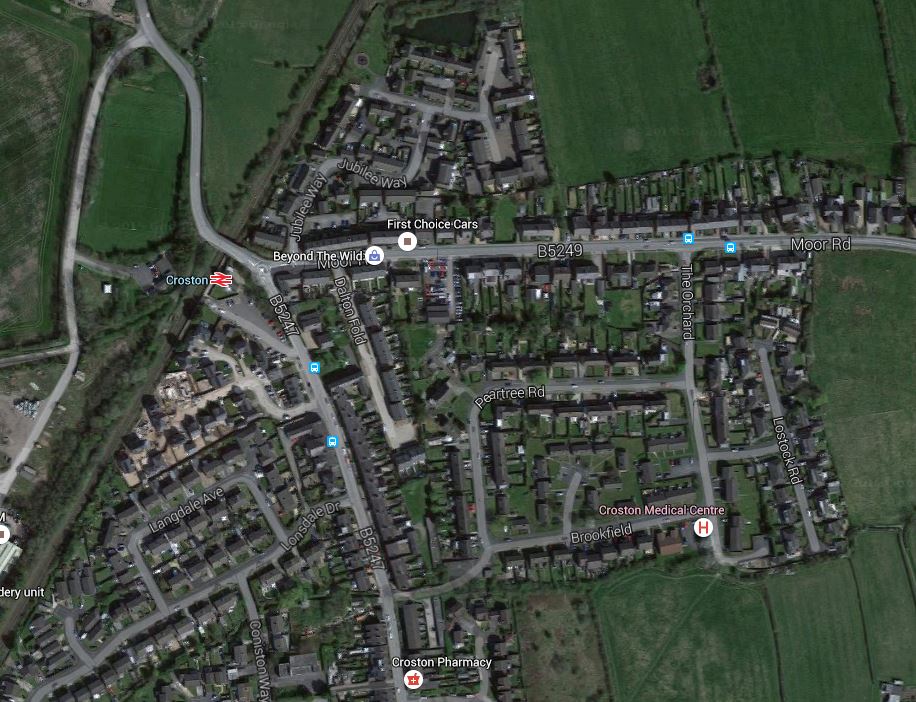
Croston Station
Croston station lies on the Ormskirk Branch Line, which connects Ormskirk on the Mersetrail network around Liverpool, to Preston and the the West Coast Main Line. The Ormskirk Line one of those terrible and neglected pieces of infrastructure, left behind after the cuts of the 1960s and 1970s,
Merseyrail have ambitions to connect Liverpool to both Preston via Ormskirk and Manchester via Kirkby with new electric trains. I wrote on this in Is Liverpool Planning To Invade Manchester By Train? I said this.
———-
In the October 2015 edition of Modern Railways, there is an article about Merseytravel looking for a new fleet of trains for their 750V DC network, which is entitled New Trains For Liverpool. This is said.
Merseytravel has indicated that it will be seeking ‘innovative proposals’ from manufacturers, with considerable emphasis being placed on the overall cost of operating the fleet rather than just the basic cost of the trains themselves. Options such as regenerative braking and onboard systems to store energy under braking to be used for acceleration will attract particular interest. The independently-powered EMU (IPEMU or battery train) concept evaluated earlier this year on a modified Class 379 in East Anglia ,might see an application here.
It does appear on a quick look, that a version of the new Aventra train, which comes with an IPEMU capability as standard might be suitable for Merseyrail, as it could connect Preston to Ormskirk and Manchester to Kirkby, without any more electrification.
———-
Some of my thoughts in the Invading Manchester post, is based on this document, which is entitled Liverpool City Region Long Term Rail Strategy, so it is not idle speculation.
A half-hourly four-car service through Croston and other stations in the area linking to Liverpool and Preston using IPEMU trains, would not help directly with the floods, but would get people into and out of the area without needing to use a vehicle on flooded roads.
I’m sure that the engineers from Bombardier and Network Rail will ensure that an IPEMU can operate some kind of service in conditions as we’ve experienced over the last few days.
Intriguingly, I have just been reading this article in Rail Technology Magazine, which is entitled Bombardier enters key analysis phase of IPEMU. In a section entitled Market Applications, this is said.
Bombardier has started assessing potential customers for battery-powered trains, looking first at branch line applications. Batteries could be a solution allowing non-continuous electrified infrastructure, and emergency rescue and last-mile opportunities.
Although emergency rescue is probably more about power loss than floods, Bombardier obviously feel that an IPEMU has some genes inserted from a cross-country vehicle.
Knowing the way Liverpudlians think, I suspect that what was said about IPEMUs for Merseyrail in the October 2015 edition of Modern Railways will happen.
Reaction In The North To Rail Franchise Awards
I have been browsing the local papers in the North, to see the area’s reaction to the award of the new Northern and TransPennine franchises.
This article in the Liverpool Echo is entitled 4,000 more seats in £1.2bn boost for North West trains, which seems a very positive headline. This is the first paragraph.
Nearly 4,000 more seats on Liverpool and Manchester services during the morning peak and a new, direct Liverpool to Glasgow service were among the promised benefits of a trains package announced today.
They use a lot of positive language and only have a slight worry about what it will mean for fares.
This extract from another article, may be a bit parochial, but it is proud of Liverpool’s involvement in formulating the winning bids.
Merseytravel – who were involved in drawing up the specifications for the bidders – said there was a commitment to four fast services an hour between Lime Street and Manchester and two per hour between Liverpool, Leeds and York, as well as more services to Preston.
There will also be an early Northern service from Lime Street to Manchester Airport (arriving no later than 4.45am), and daily services to Manchester Airport via both Newton-le-Willows and Warrington Central.
It is also positive and just as I found in the city, when they introduced the Class 319s electric to Manchester Victoria, Merseysiders seem to be looking forward to better services.
Coverage on the Manchester Evening News, like this article entitled Hundreds of new carriages promised as Arriva and FirstGroup win Greater Manchester rail franchises, seems to be more cynical and snipes at Arriva for other issues. It doesn’t have the practical tone of the Liverpool reporting.
For instance, the Liverpool reporting stresses the much better service to Glasgow, Edinburgh and Newcastle, but despite Manchester will get a doubling of Scottish services, it isn’t given the same prominence.
Across in Leeds, the Yorkshire Post has an article entitled December 10: New age of the train – or not? This said.
Unlike previous deals which did not foresee the untapped potential of this region’s railways, Transport Secretary Patrick McLoughlin has used this opportunity to insist that the new franchise-holders invest in new rolling stock to help ease overcrowding on rush-hour trains. Yet it remains to be seen whether these operators, and their partners, can deliver the “world class rail service” envisaged by Mr McLoughlin and which is so integral to the much-vaunted Northern Powerhouse which aims to improve connectivity between major cities.
It looks to me that the Yorkshire character is shining through.
So on this quick look Liverpool is more positive and Manchester and Leeds are a tad negative.
Could it be that of the three cities, Liverpool is very proud of its locally-managed franchise, Merseyrail and are those in the area bigger train users than people to the East?
I also suspect, that at present, Liverpool with the electric trains to Manchester, has benefited most from rail dvelopment in the last few years.
Will The Canny Glaswegians Back Tram-Trains?
This article on Global Rail News is entitled Glasgow Planning Airport Tram-Train. This is said.
A tram-train, which would operate between Glasgow Central Station and Paisley Gilmour Street before moving onto a new light rail line to the airport, is the preferred option.
This Google Map shows the relationship between Paisley Gilmour Street station and the airport.
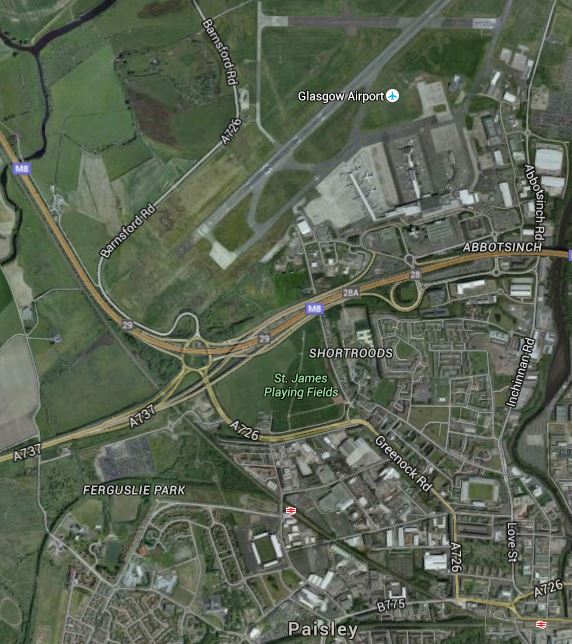
Glasgow Airport Tram-Train Link
Paisley Gilmour Street station is in the bottom right corner of the map and the Inverclyde Line runs past the Airport alongside the M8 Motorway, after passing through Paisley St. James station.
The article gives some interesting figures on the costs of the .link between Glasgow Central station and the Airport.
- A conventional rail link would cost £317million.
- A tram-train link would cost £144million
- A light rail rapid transit, which would need a change of vehicle at Paisley Gilmour Street would cost £102million.
These costs probably explain, why the Germans are building as many tram-train systems as they are!
Having seen tram-trains working in a number of German cities, I would choose a tram-train tomorrow.
These points should be noted.
- The tram-train trial between Sheffield and Rotherham should highlight the changes that would need to be made to existing stations, signalling and operation.
- The Class 399 tram-train, would probably be used. It is a standard German tram-train modified to run on our overhead line electrical voltage. Surprisingly, it is the Germans, who are non-standard.
- When running as trams, tram-trains have all of the tram’s agility to go round tight curves and sneak into cramped sites.
- When running as trains the performance of the Class 399 tram-trains is only marginally slower than the Class 314 trains, that current work the Inverclyde Line. So they would be able to mix it on the train line.
- Passengers will probably think that they’re on a train, that is perhaps a bit different.
- Liverpool are seriously thinking of using tram-trains to connect to Liverpool Airport.
The only unusual thing in the proposed Glasgow and Liverpool tram-train systems, is that tram-trains are running as trains for most of their routes, except for the branch into the airport.
Normally tram-trains run as trains outside of the City Centre and as trams inside it. But then both Liverpool and Glsasgow don’t have any other tram system.
Boxing Day Trains On Merseyside
The title of this post is the title of an article in Rail Magazine.
Running trains on Boxing Day for one of the busiest shopping and sporting days of the year, is a logical thing to do.
But where are my trains to Ipswich on that day?
Significant Documents
When I wrote Increased Frequencies On The East London Line, I relied on this document from Transport for London (TfL) entitled London Overground and Docklands Light Railway Growth.
The document was significant because of its openness and the way it laid out how the London Overground and the Docklands Light Railway will cope with growth.
I think the document also shows how a properly planned public transport project attracts users, that are a precursor to the growth.
After all, in the last few months, I’ve seen the extension of the Nottingham Express Transit and the opening of the Borders Railway, neither of which have attracted substantial amounts of negative comment.
So perhaps we’re now getting rather good at planning these types of projects.
Over the last few months, I’ve read some significant documents, that look to the future.
- Transport for London’s London Infrastructure Plan for 2050
- Liverpool City Region Long Term Rail Strategy
- Greater Manchester Rail Policy
All are quality documents and are superb starting points for the development of railways in their area.

