Price Framework Paves Way For Vast Electricity Storage Scheme
The title of this post, is the same as that of this article on The Times.
This is the sub-heading.
SSE welcomes step forward in plans to build the £1.5bn Coire Glas hydroelectric project
These two paragraphs outline the article.
Ministers have provisionally agreed to a power pricing framework that could pave the way for more pumped storage hydroelectricity projects in Britain, including a gigantic £1.5 billion scheme from SSE that is starting to take shape in the Scottish Highlands.
The Department for Energy Security and Net Zero said it intended to develop a “cap and floor” pricing mechanism that would advance the Coire Glas storage project being developed by SSE, the energy company, and could unlock further pumped storage power stations.
Coire Glas will be one of the largest renewable power projects ever built in the UK.
- It will have a power output of 1.5 GW, which is comparable with some of the large wind farms in the North Sea or four gas-fired power station or Rolls-Royce SMRs.
- It will be able to store 30 GWh of electricity and provide 1.5 GW for twenty hours.
- Coire Glas has a web site.
- Coire Glas will more than double pumped storage hydroelectric capacity in the UK.
Bath County Pumped Storage Station in Virginia, US claims to be the world’s largest battery, but Coire Glas will be able to store more electricity.
You wait decades for one of these monsters to come along in the UK and SSE also have another on the way.
- Loch Sloy hydroelectric power station is the largest conventional hydroelectric power station in the UK.
- It has an output of 152 MW.
- It opened in 1950 and was largely built by German and Italian prisoners-of-war.
SSE plan to convert Loch Sloy power station into a pumped storage hydroelectric power station.
- It will be able to store 25 GWh of electricity.
- Loch Sloy will be the upper lake.
- Loch Lomond will be the lower lake.
- The existing dam, upper lake, pipes and powerhouse will be retained.
- The developments have a web page.
The project is aimed at a commissioning date of 2028.
This paragraph explains how the ‘cap and floor’ mechanism works.
In the scheme, operators would be guaranteed a minimum level of revenue, while consumers would be protected by a price ceiling, above which surplus revenue would be returned to them.
And these two paragraphs give SSE’s reaction.
Finlay McCutcheon, 46, director of onshore Europe at SSE, said the pricing framework was welcome news. He said that a deal for Coire Glas was needed by the end of this year to secure a firm investment decision by early 2026. Planning for the project started in 2007.
“Given the time taken to reach this point, much work is now needed to ensure an effective mechanism is finalised and put in place as early as possible to enable Coire Glas to take final investment decisions and move into construction,” he said.
I believe that the negotiations between the Government and SSE will lead to a monster on Loch Lochy and another one on Loch Lomond.
Conclusion
There are also these pumped storage hydroelectric schemes under development.
- Balliemeanoch Pumped Hydro – 1.5 GW/45 GWh
- Balmacaan Pumped Hydro – 600 MW/15-20 GWh
- Corrievarkie Pumped Hydro – 1.5 GW/14.5 GWh
- Fearna Pumped Hydro – 1.8 GW/37 GWh
- Glenmuckloch Pumped Hydro – 400 MW/1.6 GWh
- Loch Earba Pumped Storage Hydro – 900MW/33 GWh
- Loch Kemp Pumped Storage Hydro – 300MW/9 GWh
- Loch Na Cargeach/Red John Pumped Storage Hydro – 450 MW/2.8 GWh
These total up to 7.4 GW/100+ GWh.
This page on the Strathclyde University web site, gives these GWh figures for the possible amounts of pumped-storage that can be added to existing schemes.
- Errochty – 16
- Glasgarnock – 23
- Luichart – 38
- Clunie – 40
- Fannich – 70
- Rannoch – 41
- Fasnakyle – 78
- Tummel – 38
- Ben Lawers – 12
- Nant – 48
- Invermoriston – 22
- Invergarry – 41
- Quoich – 27
- Sloy – 20
That is a total of 514 GWh.
Scotland will be the Saudi Arabia of energy storage.
Repurposing The Sloy/Awe Hydro Scheme
The Sloy/Awe hydro-electric scheme was built in the 1930s and 1950s, by the North of Scotland Hydroelectric Board.
- The scheme is now owned by SSE Renewables and has a page on their web site.
- There are ten individual power stations; Sloy, Sron Mor, Clachan, Allt-na-Lairige, Nant, Inverawe, Inverawe, Loch Gair, Striven and Lussa.
- There are four dams; Sloy, Allt-na-Lairige and two dams at Shira.
- Cruachan used to be part of this scheme, but is now owned by Drax.
This map from the SSE Renewables web site shows the layout of the dams and power stations.
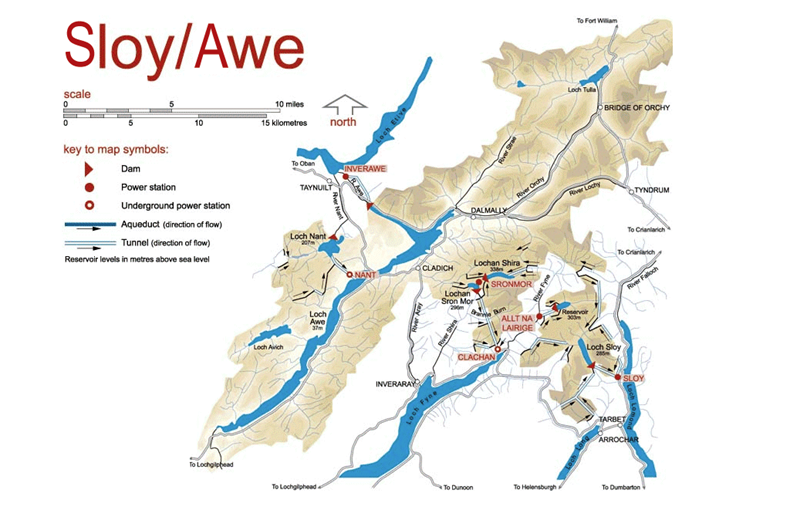
The sizes of the power stations in the scheme are as follows.
- Sloy – 152.5 MW
- Sron Mor – 5 MW
- Clachan – 40 MW
- Allt-na-Lairige – 6 MW
- Nant – 15 MW
- Inverawe – 25 MW
- Kilmelford – 2 MW
- Loch Gair – 6 MW
- Striven – 8 MW
- Lussa – 2.4 MW
This gives a total power of 261.9 MW.
It should be noted that Cruachan power station is also in this area and in Drax’s Plans For Cruachan, I talked about expanding the station from a 440 MW/7.1 GWh pumped-storage station to one of 1040 MW/7.1 GWh.
Scotland would appear to have 1.3 GW of hydro-electric power between Loch Awe and Loch Lomond.
This Google Map shows the same area as the SSE Renewables Map.
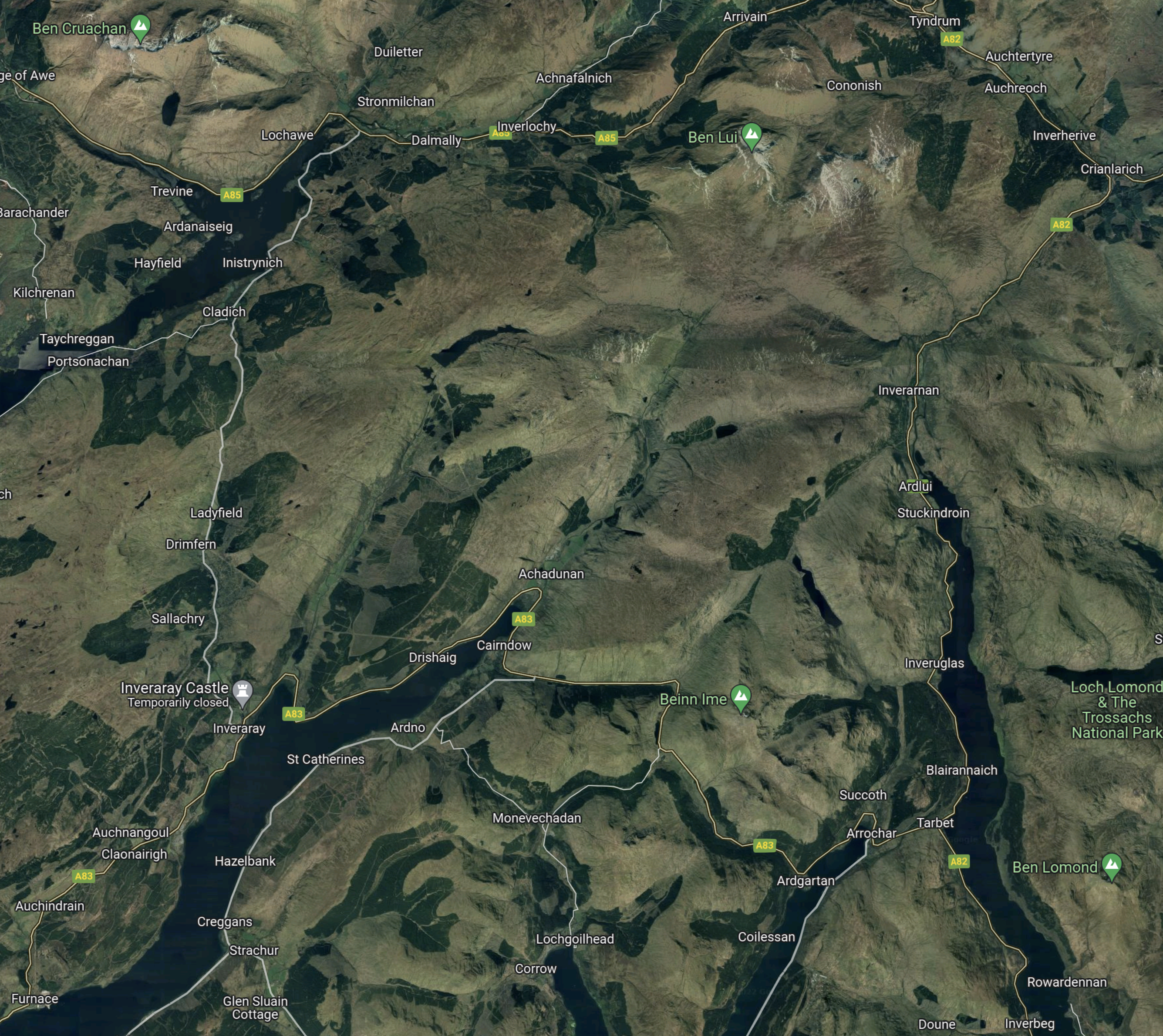
Note.
- Loch Awe, which is the sixth biggest freshwater loch in Scotland, is in the North-East corner.
- Loch Fyne, which is the longest sea loch in Scotland, is in the South-West corner.
- Loch Lomond, which is the second biggest freshwater loch in Scotland, is in the South-East corner.
- Loch Long reaches up from the South to the West of Loch Lomond.
These are four big lochs.
Strathclyde University And Pumped Storage Power For Scotland
This page on the Strathclyde University gives a list of the pumped storage potential for Scottish hydrogen-electric dams and power stations.
These figures are given for the dams and lochs in the Sloy/Awe scheme.
- Sloy – 20 GWh
- Nant – 48 GWh
It would appear that based on research from Strathclyde University, that the Sloy/Awe scheme could support over 60 GWh of pumped storage.
Water Flows In The Sloy/Awe Scheme
Looking at the SSE Renewables map of the Sloy/Awe scheme, water flows appear to be as follows.
- Loch Awe to Loch Etive via Inverawe power station.
- Cruachan reservoir to Loch Awe via Cruachan power station.
- Loch Nant to Loch Awe via Nant power station.
- Loch Nant to Loch Etive via Inverawe power station.
- Lochan Shira to Lochan Sron Mor via Sron Mor power station.
- Lochan Sron Mor to Loch Fyne via Clachan power station.
- Allt-na-Lairige reservoir to Loch Fyne via Allt-na-Lairige power station.
- Loch Sloy to Loch Lomond via Sloy power station.
All the water eventually flows into the sea to the West from Loch Etive and Loch Fyne.
Refurbishing And Repurposing The Sloy/Awe Scheme
Perhaps as the power stations are now over fifty years old, one simple way to increase the generating capacity of the Sloy/Awe scheme, might be to selectively replace the turbines, with modern turbines, that can generate electricity more efficiently.
I suspect that SSE Renewables have an ongoing program of improvements and replacements for all of their hydro-electric stations in Scotland. Some turbines at Sloy power station have already been replaced with larger ones.
Adding Pumped Storage To The Sloy/Awe Scheme
Strathclyde University picked out two places where pumped storage could be added; Sloy and Nant.
I discussed Sloy power station in A Lower-Cost Pumped Hydro Storage System and came to these conclusions.
- For £40 million, 14 GWh of pumped storage can be created at Sloy.
- But it could be bigger than 14 GWh, as this page on the Strathclyde University web site, says 20.4 GWh is possible.
- This would surely, be a project that could be first in the queue, once the environmental problems are solved.
20 GWh or even 14 GWh of pumped storage would be nice to have reasonably quickly.
As I said, this must be a high priority project.
The other project is at Loch Nant.
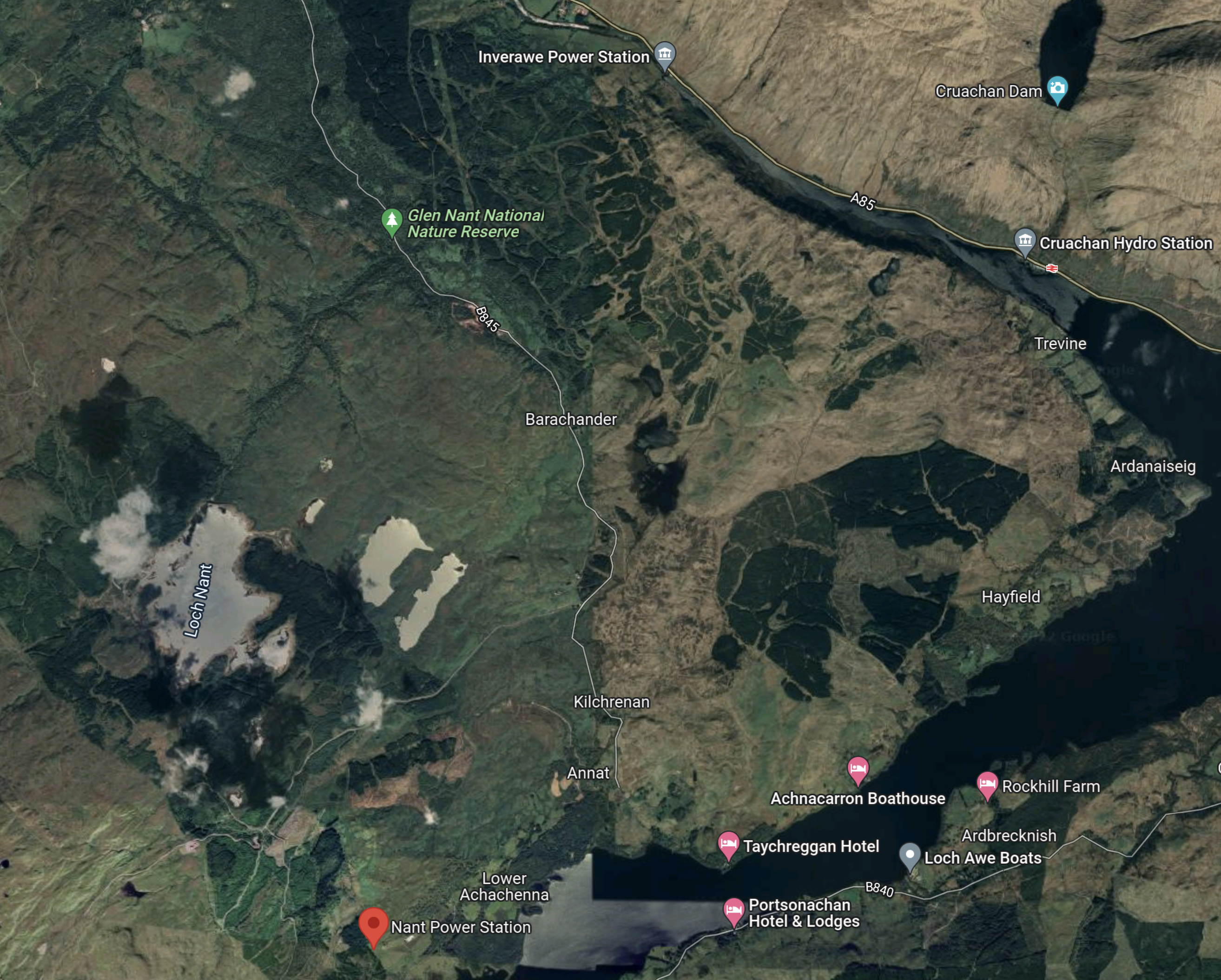
Note.
- Loch Nant is in the Western side of the map.
- Nant power station is marked by the red arrow.
- The loch to the South of the power station is Loch Awe.
- It appears that water can also go from Loch Nant to Inverawe power station to the North-East of the loch.
- Inverawe power station is on Loch Awe, which curves round Loch Nant.
- The 440MW/7.1 GWh Cruachan pumped-storage power station is on the other side of Loch Awe in the North East corner of the map, with the Cruachan dam and reservoir above.
Strathclyde University says that 48 MWh of pumped-storage could be possible at Loch Nant.
- Comparing the size of Cruchan reservoir at 7.1 GWh and the larger Loch Nant, gives me hope that Loch Nant could hold upwards of 20-30 GWh.
- From pictures on this page at Subterranea Britannica, it appears Nant power station has only a single 15 MW turbo-generator.
- Inverawe power station is a 25 MW power station with a single turbo-generator.
I suspect that pump-turbines could be installed to fill Loch Nant from Loch Awe, just as was done at Foyers, where a 300 MW pumped storage power station was created.
Conclusion
There would appear to be up to two schemes, that could each add around 20 GWh of pumped storage.
One advantage is that the waters of Loch Awe and Loch Lomond can be used for the lower reservoir.
 The Anonymous Widower