Wet-Free London
When you know London well, you get to know the public transport routes on which you don’t get as wet as others. I should also say, I never use an umbrella, as umbrellas are for wimps and softies.
I had to go to Maplin’s at Liverpool Street and then John Lewis at Oxford Street.
The obvious way to get to Maplin’s from my house is to walk two hundred metres and get the 141 bus, which stops outside the store.
But the rain was heavy so I took the much shorter walk and got a 38 bus to The Angel. I then got the 43 bus from the sister stop at the Angel to Maplin’s. After getting what I wanted at Maplin’s, I dodged under the buildings into the dry of Liverpool Street station, where I bought my paper.
It was then the Central Line for Oxford Circus, but how wet would I get walking to John Lewis. You used to be able to exit the station on the North West corner of Oxford Circus, so you could walk sheltered by the buildings to the store. But not any more and you have to exit on the South East corner and fight your way through the crowds and the bad weather. If ever a station is not fit for the number of passengers, who use it, it is Oxford Circus.
I did think about using Bond Street and walking back to John Lewis, but it would still mean crossing the road. Then I remembered that the 25 bus passed Chancery Lane station, so I surfaced and walked the few yards to the stop.

The pictures don’t do the rain justice. But at least I got on a 25 bus without getting too wet.
The advantage of the 25 bus, is it stops alongside John Lewis and you just walk into the store.
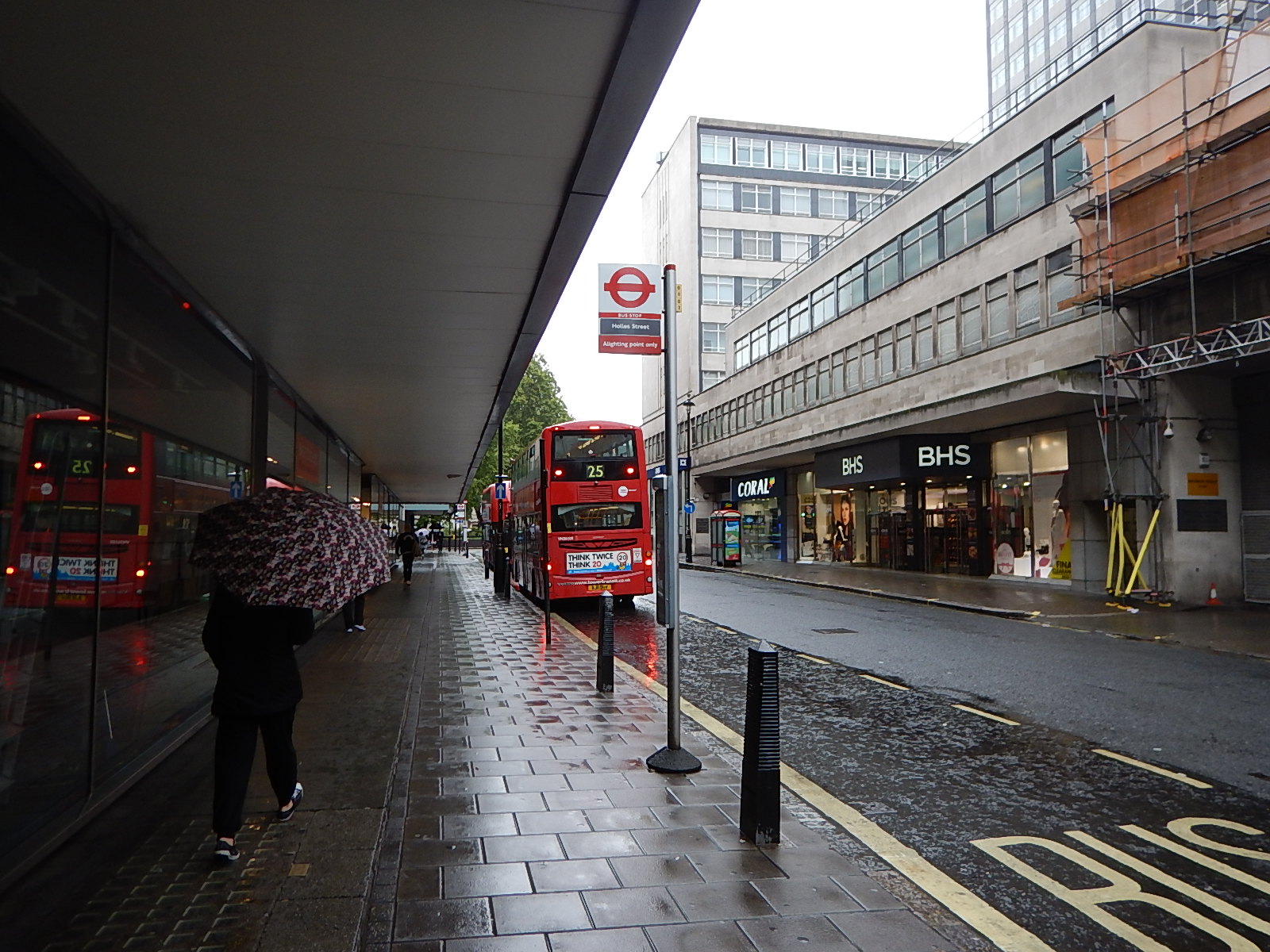
The 25 Bus At John Lewis
I bet John Lewis would like to have 25 buses go to Oxford Circus – John Lewis rather than Oxford Circus.
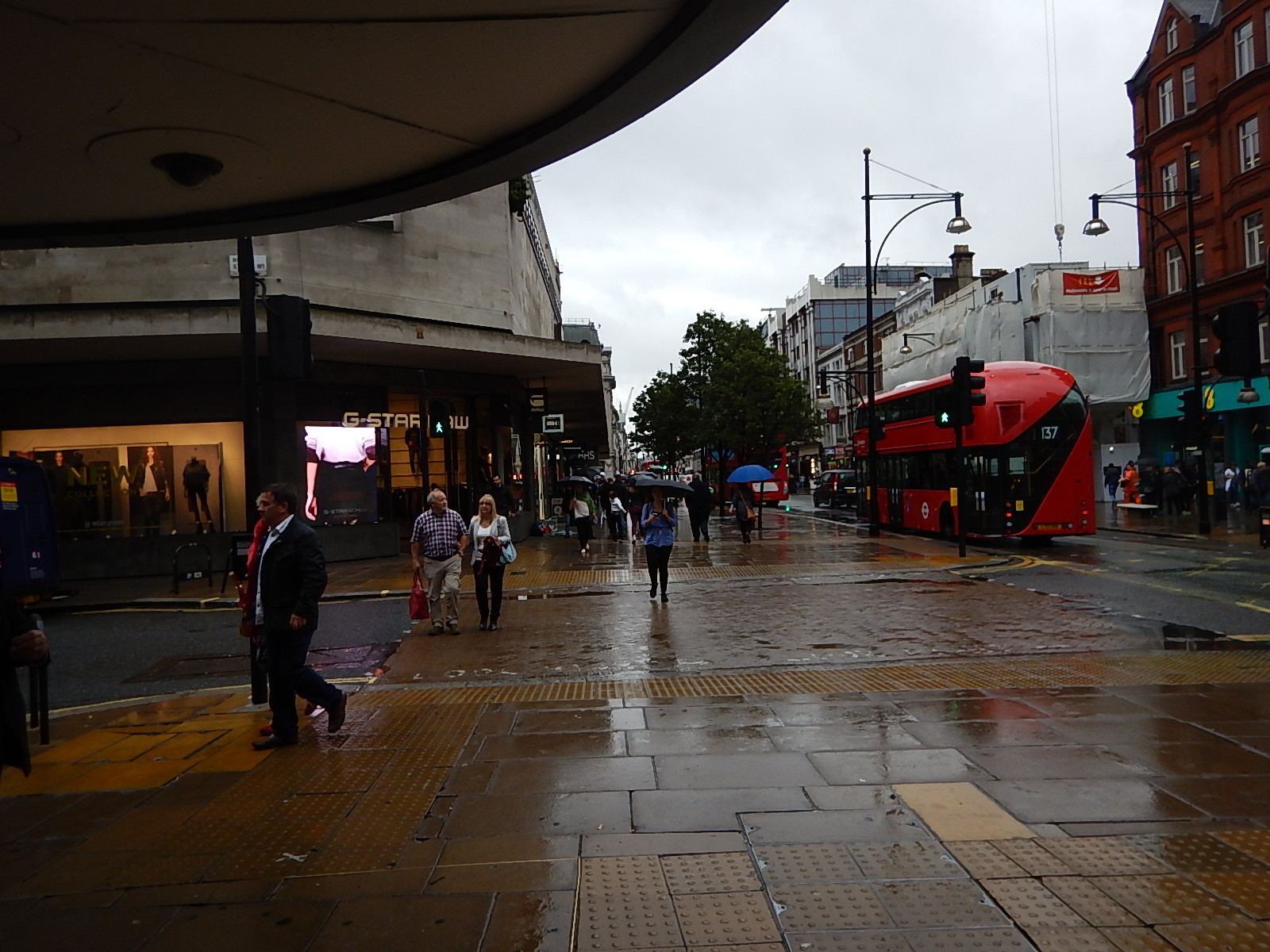
John Lewis To Oxford Circus
Leaving John Lewis, I was able to walk along Oxford Street under the shop overhangs to the North West entrance at Oxford Circus station.
Should London Allow All Doors Entry To Buses?
London is unique in the United Kingdom, in that nearly all of the buses have at least two doors.
The standard London buses have a front entrance and a middle exit, which gives the advantage of separating those getting on the bus and those getting off. In addition as the wheelchair ramp is under the middle door, loading and unloading wheelchair-bound passengers is a much less disruptive and much more efficient process.
Last football season in Reading, the bus had to be unloaded to get a wheelchair and its passenger on-board. It delayed the bus by about five minutes. Some fans were getting angry and started a chorus of “Why Are We Waiting”
In contrast in London, I saw an incident, where a passenger in a wheelchair needed to get on and the wheelchair space was full of babies in buggies. The ramp was put down, three buggies were immediately unloaded with no fuss, the wheelchair was pushed in and then two of the buggies were slotted in. The third was folded and carried on. It was all very civilised and in total contrast to the Reading incident. Effectively, the ramp and the pavement creates a very large lobby, which makes it easy for the wheelchair space to be rearranged. In my many trips on London buses, I’ve never seen a problem around the wheelchair bay.
But the biggest argument for a separate entrance and exit bus, was put to me by a bus driver and union rep, I met on a bus in Manchester. He said that because London buses separate entrance and exit, this pushed the low-life away from the driver and they don’t try and steal his money. London buses now don’t accept money and other drivers from places like Scotland and Liverpool have told me they want cashless buses as it cuts attacks on staff.
Additionally in London, we have the three-door Routemasters with an extra door at the rear. All doors have places to touch in with your contactless card, with one each side of the middle door.
Rarely do passengers get in at the two rear doors and not touch-in. If they do, they are often reminded by other passengers, with a knowing look.
Recently, I was at Kings Cross and two buses that get me near my house turned up at the same time; a two-door 476 and a three-door Routemaster running on route 73.
The 476 was in front and empty, but I took the 73, as I felt because it loads and unloads more quickly, it would get me home sooner.
It did! Perfectly illustrating the principle that more doors make a bus go faster.
There is probably an equal split of the type of the bus I can get home from the Angel and I feel that I’m not alone in choosing a New Routemaster if one is following a standard two-door bus. Baby buggy pushers also seem to wait, as it must be much easier to get in the middle door of a new Routemaster.
|As we are well-educated on how to use the buses here in Hackney, I wonder what would happen, if London’s two-door buses allowed entry through the middle door, by putting ticket readers at the door.
Having watched the behaviour of passengers on New Routemasters for quite a few years now, I think it would be worthwhile to try it as an experiment in certain areas of the capital.
We might find it increased the capacity and speed of London’s buses.
A Flypast Over London
I took these pictures as the Battle of Britain Memorial Flight flew over the City of London today.




The fourth picture shows the area where I was standing on the walkway across the Barbican.
It is a good place to see any flypast that is going over Buckingham Palace, as the pilots use the three distinctive towers to line up for their trip across London. This Google Map shows Central London.
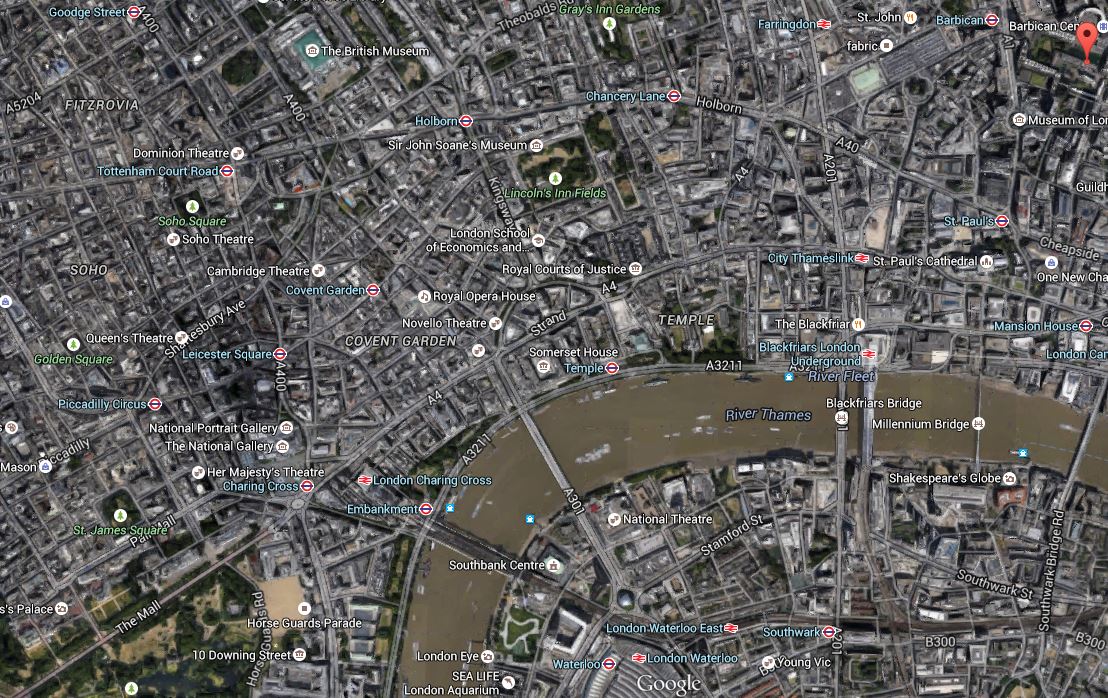
Flypast Route Over London
The Barbican is illustrated by the red arrow and Buckingham Palace is at the bottom left hand corner.
The procedure used by the Battle of Britain Memorial Flight was explained, when one of the pilots was the guest of Test Match Special on BBC Radio.
When asked what you do if there is an engine failure, the pilot stated that there is only the Thames.
London Just Carried On
Ten years ago today, I published a post on my old blog entitled Carry On London, as a reflection after the bombings earlier in the day.
I make no apologies for repeating it today.
Tuesday, I went to the funeral of a friend. Alex died young at 48. Life is cruel. But even the funeral was not a sad affair! Alex wouldn’t have wanted it so and stated it probably many times before she died!
Wednesday, I was in Trafalgar Square, when my fair and beloved city, London, was announced as the winner of the 2012 Olympic Games. Life can be so sweet.
But then we have the bombings of today!
Thousands of times, I’ve travelled through the tunnels under London. Many times, I’ve done the stretch between Kings Cross and Russell Square, where most of the casualties occurred. Occassionally, I’ve used the two parts of the Circle Line, where the other two bombs went off.
Am I bitter? Angry? Sad? Vindictive?
Not sure!
Sad yes! As why would anybody want to do such a thing! How would I feel if one of my sons did that? I would know I had failed. How would I feel if one of my sons had got caught in the blasts. I don’t know! But thankfully they didn’t.
So it has to be sadness at the moment. Vindictiveness only follows the old eye for an eye maxim, which means that we all go blind!
But perhaps, the greatest thing we can do is just carry on, remembering those that died and vowing to be more vigilant so that it won’t happen again.
Fay would have done that. She worked for my father and during the Second World War, the shy girl from North London, worked as a conductor on the buses. One day, the bus she should have been on, was hit directly by a German bomb. Everybody died! She just remembered the tragedy, I suspect she cried long and hard, and then she carried on.
A few crackpots, who take the good name of Islam in vain, should never be able to bring London to its knees, when the evil Hitler and the Luftwaffe failed.
A last point for Bush and all those who think that the death penalty is a deterrent in these sort of cases. I’ll ignore the fact that the London atrocities may well have been suicide bombers, which are usually pretty difficult to execute. But as I am someone who has no belief in any religious being at all, I do believe that we should do all we can to preserve reasonable life here, as there is nothing more to come. So if we ever execute anybody, then we are losing our own humanity and descending below their level.
Carry on London.
A lot has happened to me since that fateful day of the 7th July, 2005.
My wife of nearly forty years and our youngest son, both died of cancer. I then had a stroke, which left me unable to drive. So I’ve moved back to London and almost ironically, I now live close to the route of the number 30 bus, one of which was destroyed with the loss of thirteen lives in the bombings.
But London has looked after me, as only one of the world’s great cities can.
And London has carried on, just as Fay believed you should.
Is A Mobile Phone A Dog And Bone With Legs?
My father, who was not really a real Cockney, as you couldn’t quite hear Bow Bells from where he was born, was a regular user of rhyming slang.
I was writing a message to someone and suggested we text each other.
I then realised that I’d never heard rhyming slang for mobile phone, which led me to the title of this post.
This page supports the use of Obi Wan Kenobi.
An Amateur Tube Map
This amateur Tube Map is published in Gizmondo.
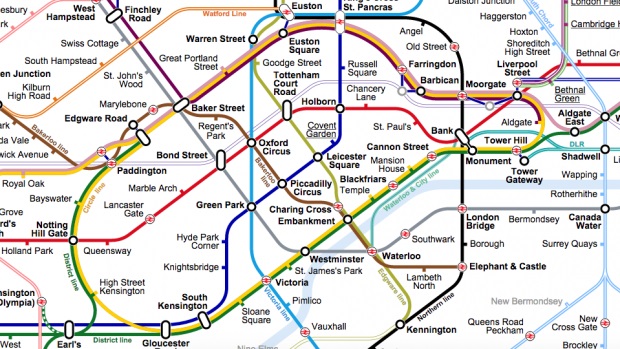
Amateur Tube Map
It is a brave attempt to make something that is getting increasingly complicated, more readable.
As I travel around Europe, I see some terrible maps, but the biggest sin is places, where they show their maps far to small or place them so you have to be nearly two metres tall to see them.
London has a unique advantage in that many stations have been designed so you go down the escalators, you are often in a large spacious lobby, with often quite large flat walls. Also with the removal of booking offices, there is now often a sizeable flat wall, as you enter the station from the street.
The current common map in stations is printed in A0 format which is 841 x 1189 millimetres. But there are larger paper sizes.
So why not use 2A0 (1189 x 1682 mm.) or even 4A0 (1682 z 2378 mm.)?
They could be printed direct onto high-strength vinyl in a similar way to the advertising you see wrapped around buses and trains.
Not all maps would be this size, but I believe putting them in prominent locations on the transport network would be a good idea.
After all, we’re always being told Big is Beautiful.
Eventually, as electronic screens get larger and more affordable, these could be used.
It doesn’t really matter what the map looks like, as I hope any bad ones would never be displayed.
But size and readability is everything!
The New Freedom Pass Map
This document on the Transport for London web site, is the latest definitive map of where I can roam with my Freedom Pass.
The big addition for me is Shenfield, as although I don’t go there often, I could use it as the station to get my train for football at Ipswich.
I would have to change trains twice, but I could still arrive on the same 13:43 train into Ipswich.
But by using TfL Rail to Shenfield and then Abellio Greater Anglia from there, my Saturday Off-Peak Return, drops from £26.25 to £16.75, which is a saving of £9.50.
Similar savings even occur for a Tuesday evening match, as the cheapest fare drops from £28.70 to £19.35. It would also appear that you just buy an Off Peak Return, which is a saving in aggravation.
I’m only working on the current timetable, but I suspect that a new Anglia franchisee in a couple of years time, might stop all of the Ipswich and Norwich trains at Shenfield for Crossrail. It will probably be quicker to go from Liverpool Street, but there will be a lot of possibilities for saving money.
I also suspect that, when Crossrail opens, then Reading, like Heathrow and Shenfield, will appear on the Freedom Pass map, so instead of going to Paddington, will I join trains to Wales and the West Country at Reading.
The biggest effect on the economy of the spreading of the Freedom Pass, will be that more and more retirees will move into the capital, thus fuelling the rise in house prices.
So perhaps the best way to spend that pension pot is to buy a place in London.
Street Art In Fitzrovia
Traffic light control boxes are being used as canvases for art in Fitzrovia.




There’s more in this article on the BBC web site.
Humour On The Overground
This story from the Standard has gone viral around London.
London Overground and Underground staff are increasingly posting humorous messages at several stations.
Does this happen on any other metro or tram system?
Crossrail 2 Through East London
TfL have now published their preferred route for Crossrail 2 and in this post I will detail, how I think it will affect East London.
In this post, I will refer to the Crossrail currently being built as Crossrail 1 to avoid confusion.
The Progression Of Large Projects
I have been around the management of large projects for just over forty years, since I wrote my first software system for project management in 1973. From talking to project managers over that time, I have come to various conclusions, some of which will certainly affect the realisation of Crossrail 2.
The second system I wrote; Artemis, was very much involved in providing the necessary management for the development of North Sea Oil. Project managers told me many times, that things were getting easier and more affordable because of the development of bigger and better rigs, platforms and lifting capabilities. In parallel better techniques and methods were also being developed.
I was also told many times, that doing the second, third or fourth version of something like a concrete production platform, got easier each time, especially if substantially the same team could be used.
Crossrail 2 Is The Next In A Long Line
You could argue that Crossrail 2 will be the latest in a succession of large tunnelling projects under London, since the Second World War.
1 The Victoria Line was bored in the 1960s and I can remember seeing film of the digging of both this line’s tunnels and those at Dartford on the television. Pleasant and safe working, it was not! The BBC have posted a 1969 documentary called How They Dug The Victoria Line on iPlayer. It is a must watch!
2. The Jubilee Line was bored in two sections and was completed as we see it now in 2000. In some ways it is the first modern line and stations in London, where some the latter were built to be architectural gems, like some of London’s pre-war stations.
3. Around the turn of the millennium, the Docklands Light Railway was also extended with two branches and four tunnels under the Thames. I have a feeling that the tunnels of the DLR are the first under London to have wholly concrete as opposed to all or partly iron or steel linings. This video, shows the tunnel from Bank to Shadwell.
4. The London tunnels of HS1, were completed in 2007 to St. Pancras and were the first full-size rail tunnels to be dug under London, since the Snow Hill Tunnel opened in 1866.
5. Over the last few years, the forty-two kilometres of tunnels for Crossrail 1 have been bored under London. Like HS1’s tunnels they are full-size with overhead electrification and hopefully non-corroding concrete linings.
These five tunnels show a constant progression of larger and better-designed and constructed tunnels, that have been built by using a succession of bigger and better machines.
You also have a tremendous base of knowledge built-up by companies, engineers and tunnel workers, which as the recent documentary on the BBC about Crossrail showed, includes families and individuals, who’ve worked on all these five tunnels and a good few others besides!
It is my belief that when the politicians press the Go-button on Crossrail 2, the tunnels will make a painless progression under London as Crossrail 2 sneaks along the defined route.
Crossrail 1 And Crossrail 2 Compared
At first sight, both Crossrails would appear to be two large tunnels and train lines across London, from where lines fan out into the wider suburbs and nearby towns and cities at each end.
But there are some major differences.
Crossrail 1 is much more complicated than Crossrail 2. I suspect some will argue that if they were designing Crossrail 1 today, it would be very different to what is being built. For instance, of the major rail terminals in London, it only serves Liverpool Street and Paddington. I think that the design of Crossrail 2 cleverly builds on Crossrail 1 and helps get over some of the earlier line’s deficiencies.
Crossrail 1 was designed in an era, where passengers needed booking offices in stations. In the last couple of years, the growth in contactless ticketing is showing that booking offices can be closed and the space used for more productive purposes.
Crossrail 1 chose to have the major tunnel portals at Royal Oak, Pudding Mill Lane and Plumstead which would appear to be much more cramped and congested sites than those of Crossrail 2 at Tottenham Hale, New Southgate and Wimbledon.
In addition the surface sections of Crossrail 1 would appear to require a lot more work to bring them up to modern standards, than similar parts of Crossrail 2.
This efficient simplicity in the design will keep costs, time-scales and disruption during the construction phase of Crossrail 2, to a much lower level than Crossrail 1.
Crossrail 1 was skilfully threaded through the mass of tunnels under London, as the BBC documentary showed. The engineers could have gone deeper to get under the Northern Line at Tottenham Court Road but for some reason they didn’t. Perhaps going deeper would have meant difficulties and extra costs in the design of stations. Crossrail 2 will have to go deeper in the Dalston area to get under High Speed One and it will also have to pass Crossrail 1 at Tottenham Court Road. The tunnels of High Speed One are at a depth of 34 to 50 metres, so will we see Crossrail 2 bored across London below all the other foundations and infrastructure?
Crossrail 1 by virtue of its route through Central London has necessitated the expensive rebuilding of quite a few stations. It has also needed expensive new stations at Canary Wharf, Woolwich and Custom House. On the other hand, Crossrail 2 would appear not to require so many stations to be completely rebuilt, as the three central stations of Euston/St. Pancras, Tottenham Court Road and Victoria, will have been or are being rebuilt for other reasons and like Angel will have been rebuilt with provision to link to Crossrail 2. This will save time and costs in construction and probably mean that the disruption caused by Crossrail 2 would be much less than Crossrail 1.
The big station reconstruction will be Euston for HS2 and that will cause massive disruption to everything. Making sure the new station will connect easily to Crossrail 2, is a small problem in the grand scheme of things.
When Crossrail 1 opens, Whitechapel station will be the Jewel In The East. And this will not be just about how the station was designed and will look, but about the way it was built. Instead of digging down from the current station to the new Crossrail 1 tunnels, the thirty metres or so long shaft for the escalators and lifts is being dug upwards from the tunnels, using a coal mining technique called uphill excavation.
Currently the escalators in London with the highest vertical rise are those at Angel station, which rise twenty-seven metres, but this is a dwarf compared to some of the longest in the world. Crossrail 2 looks certain to break London’s record.
Crossrail 2 Could Be A Very Deep Line
I think we could see an unprecedented deep tunnel for Crossrail 2 across London, with tunnels in places over fifty metres below the surface. By comparison, Crossrail 1 is thirty metres deep at Whitechapel, which is not as deep as the Saint Petersburg metro , which has one station at a depth of eighty-six metres.
No major station rebuilding, the digging of stations from the tunnel up, longer escalators and other smaller improvements in techniques and machines , lead me to the conclusion, that the central section of Crossrail 2 will be one deep tunnel that excavates its way to the surface mainly direct into existing Crossrail 2-ready stations.
It will be a very cost effective and hopefully much quicker way of building a railway under London, which could cause a lot less disruption than the current Crossrail 1.
What Can Crossrail 2 Learn From Crossrail 1?
In my view from the outside, Crossrail 1 has been a pretty well-managed project. But it has skilfully used various ideas to make construction flow smoothly.
One big problem with large tunnelling projects is getting rid of all the spoil dug out of the tunnels. Crossrail 1 changed, the tunnelling strategy to remove excavated material by barge from Leamouth rather than the originally proposed complex conveyor system in Mile End.
To further use the spoil on the Wallasea Island Wild Coast Project was a master-stroke with a large dose of green.
It would appear that all three of Crossrail 2’s portals have good rail and/or water access to remove spoil. Will it be used to similar effect?
Crossrail 1 has been able to use archaeology for positive publicity to balance negative stories. I don’t think Crossrail 2 will be going through such rich veins of historical interest, but they will have to find a positive story to spin, that is not directly-related to the project.
Crossrail 1 had a major problem with the junction of the two eastern branches under Stepney. Instead of being heavy, they worked with the Stepney City Farm to create a solution acceptable to both parties. Crossrail 2 must work the same way in sensitive areas, like their proposed junction under Stamford Hill and the only new station on the line at Chelsea.
When people talk about Crossrail 1, the subject of disruption always comes up. In any plan for the design and construction of Crossrail 2, minimising disruption should be an important objective.
There is an entry entitled Controversy in the Wikipedia entry for Crossrail.
This is one of the things that is said.
There had been complaints from music fans, as the redevelopment of the area forced the closure of a number of historic music venues. The London Astoria, the Astoria 2, The Metro, Sin nightclub and The Ghetto have been demolished to allow expansion of the ticket hall and congestion relief at Tottenham Court Road tube station in advance of the arrival of Crossrail.
Crossrail 2 might well find that if they avoided unnecessary demolition, they might calm a few Nimbys.
What Can Crossrail 2 Learn From Other Metros?
From the little of Crossrail 1, I’ve seen in reality, and the masses of visualisations I’ve seen in places like the Crossrail 1 web site, the line strikes me as sound and solid, but not that adventurous in its approach to design and architecture. The stations with perhaps a couple of exceptions, do not have mould-breaking designs that characterise the Piccadilly and Jubilee Lines.
London Transport, the predecessor to Transport for London, was rightly famous for its design from typefaces and maps to stations and buses.
The rules still seem to be applied, but Crossrail 1 doesn’t seem to have extended them, in the way that the Victoria Line did and the Docklands Light Railway and the London Overground still are.
I recently went to Bilbao and saw Norman Foster’s award-winning Metro, which is very much a design-led system.
Crossrail 2 needs to find itself a modern extension of London Transport’s philosophy. They might perhaps start by stealing and Londonising the Bilbao’s fosteritos.
The Safeguarded Areas For Crossrail 2
Crossrail 2 has now firmed up the areas they want to be safeguarded from any possible development that might make building the line difficult.
Building.co.uk has also given a handy checklist of all the changes, that have been recently agreed.
The web site says this about safeguarding.
The updated route means that relevant planning applications in safeguarded areas will be referred to TfL for advice. If development interferes with Crossrail 2, either a compromise will be reached or the development will not be allowed.
It also says this about TfL and compulsory purchase.
TfL said it currently has no plans to compulsorily purchase properties along the route.
This page on the Crossrail 2 web site, explains all about safeguarded areas and acts as a key to the detailed maps.
The maps show the route of the line and how it effects individual areas, streets and houses.
The only problem is that the PDF maps are sometimes a bit on the skew, but hopefully they will be improved.
Crossrail 2 Through East London
I’m going to look at the area as it works it way through Hackney from Tottenham Hale to The Angel.
Tottenham Hale
The portal for the North Eastern branch is south of Tottenham Hale station, from where it goes up the West Anglia Main Line to Cheshunt, Broxbourne and Hertford East.
It is basically a good plan, as it would appear that the tunnel portal appears to be in an area with all the beauty and charm of East London after the Blitz. It is also located close to rail and water for the efficient and environmentally sound removal of tunnel spoil. Thames Water are even ceating the Walthamstow Wetlands in the area and may have innovative uses for some f the tunnel spoil.
This post entitled Crossrail 2 At Tottenham Hale, shows some maps and pictures and gives my thoughts in full.
South Tottenham/Seven Sisters
It looks increasingly like South Tottenham and Seven Sisters stations could share a double-ended Crossrail 2 station and become a major interchange between London Overground ‘s Gospel Oak to Barking and Lea Valley Lines, the Victoria Line, Crossrail 2 and National Rail services.
Such an interchange will support major development in a part of London, that desperately needs more housing, jobs and leisure and business opportunities.
This post entitled Crossrail 2 At South Tottenham/Seven Sisters, shows some maps and pictures and gives my thoughts in full.
The Junction Under Stamford Hill
The two northern branches of Crossrail 2, that go to New Southgate and Tottenham Hale respectively, would appear according to the safeguarding map on the Crossrail 2 web site, to join together under Stamford Hill.
It all seems to point to some clever strategy and alignments, that will allow the junction to be created deep underground, without disturbing anything or anybody on the surface.
This post entitled The Crossrail 2 Junction Under Stamford Hill, shows some maps and pictures and gives my thoughts in full.
Dalston
If there is one area in East London that needs to see its existing transport links tidied up and new ones added, it is Hackney and Dalston.
I have heard from Michele Dix of Crossrail 2, that they are looking at a double-ended station to serve both Dalston Kingsland and Junction stations. This was said.
We have been working closely with the London borough of Hackney on the early development of the proposals for how Crossrail 2 could ultimately serve Dalston. The work to date has been based around delivering a double-ended station, with one end being at Dalston Junction, and the other at Dalston Kingsland, thereby allowing the Crossrail 2 station to link to both existing stations. As Mr. Miller rightly points out, the distance between the existing stations is well suited to the 250m long platforms that will be required for the Crossrail 2 station, and the greater interchange opportunities to London Overground services also deliver significant benefits.
I believe that there is an opportunity to create a world class station that subtly brings together all the good elements of the area. The only necessary demolition would be the unloved Dalston Kingsland station. TfL have told me off the record, that Kingsland station will be replaced fairly soon.
This post entitled Crossrail 2 At Dalston, shows some maps and pictures and gives my thoughts in full about the stations.
De Beauvoir Town
Looking at the safeguarding maps gives the impression that Crossrail 2 will swing under De Beauvoir Town before turning in the direction of the Angel and Kings Cross.
I think the only negative effect will be the possible use of the Bentley Road Car Park as a work site. Why else would it have been singled out for safeguarding?
This post entitled Crossrail 2 Under De Beauvoir Town, shows some maps and pictures and gives my thoughts in full.
Angel
Just as at Stamford Hill, I feel that Crossrail 2 could effectively take a route through the hill at the Angel, well below the foundations of any building on top.
Angel station was rebuilt in the 1990s and this was after a route for Crossrail 2 was first safeguarded, so I suspect that creating a Crossrail 2 station at Angel would have been taken into account in the rebuilding.
I think the biggest decision to be made at the Angel, is whether the new station is double-ended with entrances on both sides of the hill or it just pops up into the current station.
As at Dalston, there is scope for the creation of an affordable world class station, which is subtly blended with the good buildings in the area.
How Will Crossrail 2 Be Built?
Crossrail 1 was built rather traditionally, in that the tunnels have been bored first and then the stations have been created. One thing that surprised me was that the surface sections, which have nothing to do with the tunnels were not prepared for Crossrail 1 a lot earlier.
This is probably because politicians dithered for years about giving the go-ahead for the line. More time and the better planning before tunnelling started would have enabled, the surface stations and possibly one or two of the Central London ones to be made Crossrail 1-ready.
Crossrail 2 has a big advantage over Crossrail 1, when it comes to the politics of the route and construction.
With the exception of a few stations in Hertfordshire and some in the boroughs of Elmbridge, Spelthorne and Epsom and Ewell, Crossrail 2 is a London project, where nearly everything is under the control of Transport for London and ultimately the Mayor. As the only work that will need to be done to outlying stations like Hertford East and Epsom, is bring the existing structures up to a modern standard, that will be capable of handling larger trains, I can’t imagine many complaints about Crossrail 2 from that quarter. It’s interesting to note, that now tunnelling is complete most of the negative stories from Crossrail 1 are about works on the surface section.
As construction of Crossrail 2 is unlikely to start for some years, the tunnelling can probably be scheduled to start after all of the stations have been upgraded to be Crossrail 2-ready.
When St. Pancras was rebuilt for High Speed One, provision was made for Thameslink, and in the same way when Euston and Victoria are rebuilt, I will be surprised if the designs don’t incorporate full provision for Crossrail 2.
Where I live in Dalston, which according to my letter says will have a double-ended station serving both Dalston stations, a TfL manager told me that Dalston Kingsland station is to be rebuilt in the next few years. So as Dalston Junction station was built with Crossrail 2 in mind, boring the tunnels through Dalston will only require threading two needles with the same thread simultaneously.
Probably the only station that needs to be created or rebuilt after or alongside the tunnelling is Chelsea Kings Road, which I suspect will be more politically difficult than any other.
A lot of other features of Crossrail 2, like trains, signalling and the design of tunnels, platforms, track and overhead line systems will probably be the same as Crossrail 1.
I would suspect that a decision will be made to use the same Class 345 trains for Crossrail 2, that are being built for Crossrail 1. The only difference would be that they will need to be dual-voltage to run on the third-rail lines in the south. But they could be built as a run-on to the trains needed for Crossrail 1 and possibly introduced early on the surface lines from Liverpool Street to Hertford North or Victoria to Epsom. I feel that a common weakness of Crossrail 1 and Thameslink, is that they are introducing new types of train as they are respectively building or updating the lines. By using a proven train type the risks associated with the project will be reduced.
So I think we will get a series of phases for Crossrail 2.
1. Introduce some of the new trains on some of the surface sections. New trains on these lines will be needed anyway, as some of the current ones are getting pretty tired and dated.
2. Rebuild Euston station for High Speed Two and make provision for connection to Crossrail 2. This phase alone is probably the most expensive and contentious rail project that will happen in London in the next few years and inextricably links the work for Crossrail 2 and HS2.
3. The current situation at Victoria station is difficult to say the least. Hopefully in 2018, it will have a much better Underground station, with two platforms at which Crossrail 2’s tunnellers will aim their boring machines.
4. Make all the existing stations on the surface lines, Crossrail-2 ready and to a modern standard. Much of the work on the surface sections will be done anyway under Network Rail’s Access for All program.
5. Bore the tunnels through Central London.
6. Fit out the tunnels and the new station platforms.
7. Build the station at Chelsea. This could be an independent last phase, as was Pimlico station on the Victoria Line
Obviously, there are other ancillary projects like the creation of a depot for the trains and as a lot of Phases 1 to 4 won’t interfere with Phases 5 and 6, it could be scheduled to be done at the same time, if planned properly.
As so many elements of Crossrail 2 should be the same as Crossrail 1, any good project manager would probably say costs would be saved by scheduling Crossrail 2 to follow Crossrail 1 by a couple of years or so.
Conclusion
I am optimistic that Crossrail 2 can set new standards of design, affordability, accessibility and neighbourliness as it is built across London in a much shorter time with less demolition and disruption than Crossrail 1.
Well! At least I’m very hopeful!
 The Anonymous Widower