Crossrail 2 Through East London
TfL have now published their preferred route for Crossrail 2 and in this post I will detail, how I think it will affect East London.
In this post, I will refer to the Crossrail currently being built as Crossrail 1 to avoid confusion.
The Progression Of Large Projects
I have been around the management of large projects for just over forty years, since I wrote my first software system for project management in 1973. From talking to project managers over that time, I have come to various conclusions, some of which will certainly affect the realisation of Crossrail 2.
The second system I wrote; Artemis, was very much involved in providing the necessary management for the development of North Sea Oil. Project managers told me many times, that things were getting easier and more affordable because of the development of bigger and better rigs, platforms and lifting capabilities. In parallel better techniques and methods were also being developed.
I was also told many times, that doing the second, third or fourth version of something like a concrete production platform, got easier each time, especially if substantially the same team could be used.
Crossrail 2 Is The Next In A Long Line
You could argue that Crossrail 2 will be the latest in a succession of large tunnelling projects under London, since the Second World War.
1 The Victoria Line was bored in the 1960s and I can remember seeing film of the digging of both this line’s tunnels and those at Dartford on the television. Pleasant and safe working, it was not! The BBC have posted a 1969 documentary called How They Dug The Victoria Line on iPlayer. It is a must watch!
2. The Jubilee Line was bored in two sections and was completed as we see it now in 2000. In some ways it is the first modern line and stations in London, where some the latter were built to be architectural gems, like some of London’s pre-war stations.
3. Around the turn of the millennium, the Docklands Light Railway was also extended with two branches and four tunnels under the Thames. I have a feeling that the tunnels of the DLR are the first under London to have wholly concrete as opposed to all or partly iron or steel linings. This video, shows the tunnel from Bank to Shadwell.
4. The London tunnels of HS1, were completed in 2007 to St. Pancras and were the first full-size rail tunnels to be dug under London, since the Snow Hill Tunnel opened in 1866.
5. Over the last few years, the forty-two kilometres of tunnels for Crossrail 1 have been bored under London. Like HS1’s tunnels they are full-size with overhead electrification and hopefully non-corroding concrete linings.
These five tunnels show a constant progression of larger and better-designed and constructed tunnels, that have been built by using a succession of bigger and better machines.
You also have a tremendous base of knowledge built-up by companies, engineers and tunnel workers, which as the recent documentary on the BBC about Crossrail showed, includes families and individuals, who’ve worked on all these five tunnels and a good few others besides!
It is my belief that when the politicians press the Go-button on Crossrail 2, the tunnels will make a painless progression under London as Crossrail 2 sneaks along the defined route.
Crossrail 1 And Crossrail 2 Compared
At first sight, both Crossrails would appear to be two large tunnels and train lines across London, from where lines fan out into the wider suburbs and nearby towns and cities at each end.
But there are some major differences.
Crossrail 1 is much more complicated than Crossrail 2. I suspect some will argue that if they were designing Crossrail 1 today, it would be very different to what is being built. For instance, of the major rail terminals in London, it only serves Liverpool Street and Paddington. I think that the design of Crossrail 2 cleverly builds on Crossrail 1 and helps get over some of the earlier line’s deficiencies.
Crossrail 1 was designed in an era, where passengers needed booking offices in stations. In the last couple of years, the growth in contactless ticketing is showing that booking offices can be closed and the space used for more productive purposes.
Crossrail 1 chose to have the major tunnel portals at Royal Oak, Pudding Mill Lane and Plumstead which would appear to be much more cramped and congested sites than those of Crossrail 2 at Tottenham Hale, New Southgate and Wimbledon.
In addition the surface sections of Crossrail 1 would appear to require a lot more work to bring them up to modern standards, than similar parts of Crossrail 2.
This efficient simplicity in the design will keep costs, time-scales and disruption during the construction phase of Crossrail 2, to a much lower level than Crossrail 1.
Crossrail 1 was skilfully threaded through the mass of tunnels under London, as the BBC documentary showed. The engineers could have gone deeper to get under the Northern Line at Tottenham Court Road but for some reason they didn’t. Perhaps going deeper would have meant difficulties and extra costs in the design of stations. Crossrail 2 will have to go deeper in the Dalston area to get under High Speed One and it will also have to pass Crossrail 1 at Tottenham Court Road. The tunnels of High Speed One are at a depth of 34 to 50 metres, so will we see Crossrail 2 bored across London below all the other foundations and infrastructure?
Crossrail 1 by virtue of its route through Central London has necessitated the expensive rebuilding of quite a few stations. It has also needed expensive new stations at Canary Wharf, Woolwich and Custom House. On the other hand, Crossrail 2 would appear not to require so many stations to be completely rebuilt, as the three central stations of Euston/St. Pancras, Tottenham Court Road and Victoria, will have been or are being rebuilt for other reasons and like Angel will have been rebuilt with provision to link to Crossrail 2. This will save time and costs in construction and probably mean that the disruption caused by Crossrail 2 would be much less than Crossrail 1.
The big station reconstruction will be Euston for HS2 and that will cause massive disruption to everything. Making sure the new station will connect easily to Crossrail 2, is a small problem in the grand scheme of things.
When Crossrail 1 opens, Whitechapel station will be the Jewel In The East. And this will not be just about how the station was designed and will look, but about the way it was built. Instead of digging down from the current station to the new Crossrail 1 tunnels, the thirty metres or so long shaft for the escalators and lifts is being dug upwards from the tunnels, using a coal mining technique called uphill excavation.
Currently the escalators in London with the highest vertical rise are those at Angel station, which rise twenty-seven metres, but this is a dwarf compared to some of the longest in the world. Crossrail 2 looks certain to break London’s record.
Crossrail 2 Could Be A Very Deep Line
I think we could see an unprecedented deep tunnel for Crossrail 2 across London, with tunnels in places over fifty metres below the surface. By comparison, Crossrail 1 is thirty metres deep at Whitechapel, which is not as deep as the Saint Petersburg metro , which has one station at a depth of eighty-six metres.
No major station rebuilding, the digging of stations from the tunnel up, longer escalators and other smaller improvements in techniques and machines , lead me to the conclusion, that the central section of Crossrail 2 will be one deep tunnel that excavates its way to the surface mainly direct into existing Crossrail 2-ready stations.
It will be a very cost effective and hopefully much quicker way of building a railway under London, which could cause a lot less disruption than the current Crossrail 1.
What Can Crossrail 2 Learn From Crossrail 1?
In my view from the outside, Crossrail 1 has been a pretty well-managed project. But it has skilfully used various ideas to make construction flow smoothly.
One big problem with large tunnelling projects is getting rid of all the spoil dug out of the tunnels. Crossrail 1 changed, the tunnelling strategy to remove excavated material by barge from Leamouth rather than the originally proposed complex conveyor system in Mile End.
To further use the spoil on the Wallasea Island Wild Coast Project was a master-stroke with a large dose of green.
It would appear that all three of Crossrail 2’s portals have good rail and/or water access to remove spoil. Will it be used to similar effect?
Crossrail 1 has been able to use archaeology for positive publicity to balance negative stories. I don’t think Crossrail 2 will be going through such rich veins of historical interest, but they will have to find a positive story to spin, that is not directly-related to the project.
Crossrail 1 had a major problem with the junction of the two eastern branches under Stepney. Instead of being heavy, they worked with the Stepney City Farm to create a solution acceptable to both parties. Crossrail 2 must work the same way in sensitive areas, like their proposed junction under Stamford Hill and the only new station on the line at Chelsea.
When people talk about Crossrail 1, the subject of disruption always comes up. In any plan for the design and construction of Crossrail 2, minimising disruption should be an important objective.
There is an entry entitled Controversy in the Wikipedia entry for Crossrail.
This is one of the things that is said.
There had been complaints from music fans, as the redevelopment of the area forced the closure of a number of historic music venues. The London Astoria, the Astoria 2, The Metro, Sin nightclub and The Ghetto have been demolished to allow expansion of the ticket hall and congestion relief at Tottenham Court Road tube station in advance of the arrival of Crossrail.
Crossrail 2 might well find that if they avoided unnecessary demolition, they might calm a few Nimbys.
What Can Crossrail 2 Learn From Other Metros?
From the little of Crossrail 1, I’ve seen in reality, and the masses of visualisations I’ve seen in places like the Crossrail 1 web site, the line strikes me as sound and solid, but not that adventurous in its approach to design and architecture. The stations with perhaps a couple of exceptions, do not have mould-breaking designs that characterise the Piccadilly and Jubilee Lines.
London Transport, the predecessor to Transport for London, was rightly famous for its design from typefaces and maps to stations and buses.
The rules still seem to be applied, but Crossrail 1 doesn’t seem to have extended them, in the way that the Victoria Line did and the Docklands Light Railway and the London Overground still are.
I recently went to Bilbao and saw Norman Foster’s award-winning Metro, which is very much a design-led system.
Crossrail 2 needs to find itself a modern extension of London Transport’s philosophy. They might perhaps start by stealing and Londonising the Bilbao’s fosteritos.
The Safeguarded Areas For Crossrail 2
Crossrail 2 has now firmed up the areas they want to be safeguarded from any possible development that might make building the line difficult.
Building.co.uk has also given a handy checklist of all the changes, that have been recently agreed.
The web site says this about safeguarding.
The updated route means that relevant planning applications in safeguarded areas will be referred to TfL for advice. If development interferes with Crossrail 2, either a compromise will be reached or the development will not be allowed.
It also says this about TfL and compulsory purchase.
TfL said it currently has no plans to compulsorily purchase properties along the route.
This page on the Crossrail 2 web site, explains all about safeguarded areas and acts as a key to the detailed maps.
The maps show the route of the line and how it effects individual areas, streets and houses.
The only problem is that the PDF maps are sometimes a bit on the skew, but hopefully they will be improved.
Crossrail 2 Through East London
I’m going to look at the area as it works it way through Hackney from Tottenham Hale to The Angel.
Tottenham Hale
The portal for the North Eastern branch is south of Tottenham Hale station, from where it goes up the West Anglia Main Line to Cheshunt, Broxbourne and Hertford East.
It is basically a good plan, as it would appear that the tunnel portal appears to be in an area with all the beauty and charm of East London after the Blitz. It is also located close to rail and water for the efficient and environmentally sound removal of tunnel spoil. Thames Water are even ceating the Walthamstow Wetlands in the area and may have innovative uses for some f the tunnel spoil.
This post entitled Crossrail 2 At Tottenham Hale, shows some maps and pictures and gives my thoughts in full.
South Tottenham/Seven Sisters
It looks increasingly like South Tottenham and Seven Sisters stations could share a double-ended Crossrail 2 station and become a major interchange between London Overground ‘s Gospel Oak to Barking and Lea Valley Lines, the Victoria Line, Crossrail 2 and National Rail services.
Such an interchange will support major development in a part of London, that desperately needs more housing, jobs and leisure and business opportunities.
This post entitled Crossrail 2 At South Tottenham/Seven Sisters, shows some maps and pictures and gives my thoughts in full.
The Junction Under Stamford Hill
The two northern branches of Crossrail 2, that go to New Southgate and Tottenham Hale respectively, would appear according to the safeguarding map on the Crossrail 2 web site, to join together under Stamford Hill.
It all seems to point to some clever strategy and alignments, that will allow the junction to be created deep underground, without disturbing anything or anybody on the surface.
This post entitled The Crossrail 2 Junction Under Stamford Hill, shows some maps and pictures and gives my thoughts in full.
Dalston
If there is one area in East London that needs to see its existing transport links tidied up and new ones added, it is Hackney and Dalston.
I have heard from Michele Dix of Crossrail 2, that they are looking at a double-ended station to serve both Dalston Kingsland and Junction stations. This was said.
We have been working closely with the London borough of Hackney on the early development of the proposals for how Crossrail 2 could ultimately serve Dalston. The work to date has been based around delivering a double-ended station, with one end being at Dalston Junction, and the other at Dalston Kingsland, thereby allowing the Crossrail 2 station to link to both existing stations. As Mr. Miller rightly points out, the distance between the existing stations is well suited to the 250m long platforms that will be required for the Crossrail 2 station, and the greater interchange opportunities to London Overground services also deliver significant benefits.
I believe that there is an opportunity to create a world class station that subtly brings together all the good elements of the area. The only necessary demolition would be the unloved Dalston Kingsland station. TfL have told me off the record, that Kingsland station will be replaced fairly soon.
This post entitled Crossrail 2 At Dalston, shows some maps and pictures and gives my thoughts in full about the stations.
De Beauvoir Town
Looking at the safeguarding maps gives the impression that Crossrail 2 will swing under De Beauvoir Town before turning in the direction of the Angel and Kings Cross.
I think the only negative effect will be the possible use of the Bentley Road Car Park as a work site. Why else would it have been singled out for safeguarding?
This post entitled Crossrail 2 Under De Beauvoir Town, shows some maps and pictures and gives my thoughts in full.
Angel
Just as at Stamford Hill, I feel that Crossrail 2 could effectively take a route through the hill at the Angel, well below the foundations of any building on top.
Angel station was rebuilt in the 1990s and this was after a route for Crossrail 2 was first safeguarded, so I suspect that creating a Crossrail 2 station at Angel would have been taken into account in the rebuilding.
I think the biggest decision to be made at the Angel, is whether the new station is double-ended with entrances on both sides of the hill or it just pops up into the current station.
As at Dalston, there is scope for the creation of an affordable world class station, which is subtly blended with the good buildings in the area.
How Will Crossrail 2 Be Built?
Crossrail 1 was built rather traditionally, in that the tunnels have been bored first and then the stations have been created. One thing that surprised me was that the surface sections, which have nothing to do with the tunnels were not prepared for Crossrail 1 a lot earlier.
This is probably because politicians dithered for years about giving the go-ahead for the line. More time and the better planning before tunnelling started would have enabled, the surface stations and possibly one or two of the Central London ones to be made Crossrail 1-ready.
Crossrail 2 has a big advantage over Crossrail 1, when it comes to the politics of the route and construction.
With the exception of a few stations in Hertfordshire and some in the boroughs of Elmbridge, Spelthorne and Epsom and Ewell, Crossrail 2 is a London project, where nearly everything is under the control of Transport for London and ultimately the Mayor. As the only work that will need to be done to outlying stations like Hertford East and Epsom, is bring the existing structures up to a modern standard, that will be capable of handling larger trains, I can’t imagine many complaints about Crossrail 2 from that quarter. It’s interesting to note, that now tunnelling is complete most of the negative stories from Crossrail 1 are about works on the surface section.
As construction of Crossrail 2 is unlikely to start for some years, the tunnelling can probably be scheduled to start after all of the stations have been upgraded to be Crossrail 2-ready.
When St. Pancras was rebuilt for High Speed One, provision was made for Thameslink, and in the same way when Euston and Victoria are rebuilt, I will be surprised if the designs don’t incorporate full provision for Crossrail 2.
Where I live in Dalston, which according to my letter says will have a double-ended station serving both Dalston stations, a TfL manager told me that Dalston Kingsland station is to be rebuilt in the next few years. So as Dalston Junction station was built with Crossrail 2 in mind, boring the tunnels through Dalston will only require threading two needles with the same thread simultaneously.
Probably the only station that needs to be created or rebuilt after or alongside the tunnelling is Chelsea Kings Road, which I suspect will be more politically difficult than any other.
A lot of other features of Crossrail 2, like trains, signalling and the design of tunnels, platforms, track and overhead line systems will probably be the same as Crossrail 1.
I would suspect that a decision will be made to use the same Class 345 trains for Crossrail 2, that are being built for Crossrail 1. The only difference would be that they will need to be dual-voltage to run on the third-rail lines in the south. But they could be built as a run-on to the trains needed for Crossrail 1 and possibly introduced early on the surface lines from Liverpool Street to Hertford North or Victoria to Epsom. I feel that a common weakness of Crossrail 1 and Thameslink, is that they are introducing new types of train as they are respectively building or updating the lines. By using a proven train type the risks associated with the project will be reduced.
So I think we will get a series of phases for Crossrail 2.
1. Introduce some of the new trains on some of the surface sections. New trains on these lines will be needed anyway, as some of the current ones are getting pretty tired and dated.
2. Rebuild Euston station for High Speed Two and make provision for connection to Crossrail 2. This phase alone is probably the most expensive and contentious rail project that will happen in London in the next few years and inextricably links the work for Crossrail 2 and HS2.
3. The current situation at Victoria station is difficult to say the least. Hopefully in 2018, it will have a much better Underground station, with two platforms at which Crossrail 2’s tunnellers will aim their boring machines.
4. Make all the existing stations on the surface lines, Crossrail-2 ready and to a modern standard. Much of the work on the surface sections will be done anyway under Network Rail’s Access for All program.
5. Bore the tunnels through Central London.
6. Fit out the tunnels and the new station platforms.
7. Build the station at Chelsea. This could be an independent last phase, as was Pimlico station on the Victoria Line
Obviously, there are other ancillary projects like the creation of a depot for the trains and as a lot of Phases 1 to 4 won’t interfere with Phases 5 and 6, it could be scheduled to be done at the same time, if planned properly.
As so many elements of Crossrail 2 should be the same as Crossrail 1, any good project manager would probably say costs would be saved by scheduling Crossrail 2 to follow Crossrail 1 by a couple of years or so.
Conclusion
I am optimistic that Crossrail 2 can set new standards of design, affordability, accessibility and neighbourliness as it is built across London in a much shorter time with less demolition and disruption than Crossrail 1.
Well! At least I’m very hopeful!
Transport for London Is The Fastest Growing Contactless Merchant In The UK
The title of this post is the title of an article in Computer Weekly, which describes the enormous take-up of using contactless cards for payment on London’s transport system. This is the first two paragraphs.
Transport for London (TfL) has become the fastest growing contactless Visa merchant in Europe, and the fastest growing Mastercard and American Express merchant in the UK, a mere six months after it first launched contactless payments in September 2014.
TfL claimed 60 million contactless journeys had now been made on its system since September 2014, 20 million of those since mid-February 2015, and 14% of all journeys made on the system were now contactless.
Perhaps, the most surprising thing, is why so few other transport operators in the UK, Europe and the wider world, have disclosed plans to go to a similar system.
Perhaps, what is most remarkable about London’s contactless payments system, is that there seem to have been no adverse media reports on the system, whereas before it started various political parties were saying it would be a disaster of Titanic proportions.
It probably says more about the average politician’s knowledge of technology, than anything else.
I believe that any city or region that doesn’t sign up for contactless ticketing will see a reduction in visitors and economic activity.
If you take Scotland as an example of a region, where several antique ticketing systems are still in existence, the total population is less than that of Greater London. So if it can be implemented in London, surely an appropriate system can be used in Scotland.
The Advantage Of Contactless Payment On Public Transport In London
On Tuesday, I had a visitor, who came from outside London. He parked his car at the northern end of the Jubilee Line at around nine in the morning and then bought himself a Travelcard for twelve pounds. By changing at West Hampstead, he was able to easily get to me in Dalston. He went back the same route and was in his car going north before the evening peak.
If he’d used an Oyster Card, this would have been capped at £5.20,according to this page on the TfL web site.
You also get the same cap, if you use a contactless bank or credit card.
So are the days of Travelcards numbered?
As I can’t find any problems with contactless ticketing in London on the Internet, I think next time you visit London and have a contactless card that is accepted, then I think it would be an idea to try it.
I certainly wouldn’t bother with a ticket if I needed to buy one and look forward to the day, when I can use my contactless card to take a local train or tram in Manchester, Leeds, Newcastle and Liverpool, by just touching in or out as necessary.
The Saddest Building In London
Others will have their own favourite building vying for this title, but surely Millennium Mills, the derelict flour mill by the Royal Victoria Dock is close to the top of a lot of lists of sad buildings.








For years it has stood there unloved between the dock and the Docklands Light Railway, pleading to be put out of its misery.
One of the problems with the building, is that it is full of asbestos and removal and disposal will cost millions.
But help is at hand according to this article in the Newham Recorder, which details a Government grant to kick-start the development. Here’s an extract.
The former flour factory, which was built in 1905, has been vacant since the early 1980s but will get a new lease of life as a hub for start-up businesses, while homes will be built on the surrounding land..
The £12m, which has come from the government’s Building Foundations for Growth Enterprise Zones capital grant fund, is being used to speed up the redevelopment.
It means work to remove asbestos can get under way much earlier than originally scheduled, speeding up the renovation by five years.
Judging by the picture in the report, it would appear that something positive is at last being done with one of London’s saddest buildings.
Transport for London Have A Small Problem
This year a the end of May, some of the Lea Valley Lines and the Shenfield Metro part of Crossrail come under the control of Transport for London.
But what are they going to do with the iconic Tube Map?
This reasoned article on The Londonist gives their ideas including starting again and imagining how Harry Beck would have drawn it now!
Whatever they do, millions will think it’s been done wrong.
It All Happens In London In May
May is looking to be a big month for the infrastructure of London.
I’ve just read this article in the Hackney Gazette, which is entitled Canary Wharf Crossrail Artwork Released.
But as the article says, we won’t see the artwork until 2018, when Canary Wharf Crossrail station opens.
But what the article does say, is that the shops, restaurants, bars and the roof garden will open to the public in May.
So what else is happening in May?
1. Crossrail will take over the Shenfield Metro services in May. I have spoken to staff about this and everybody I spoke to seemed positive about the move and there has been the odd article like this one in the Btrentwood Gazette that has shown a positive tone.
2. Cossrail has put out this report, which says that tunnelling will be complete in the Spring amongst other things.
3. The Lea Valley Lines become part of the London Overground on the 31st of the Month. I don’t think you’ll find many, who believe it was wrong that London took over the North and East London Lines to create the Overground in 2007. So probably the sentiment for this takeover is positive.
4. Today on Hackney Central station, I asked a London Overground employee, when the pedestrian link to Hackney Downs station will open. It should be in May. He also told me about all the other developments at Hackney Central that are being planned, like extra lifts. The Overground does seem to have instilled infectious enthusiasm into its staff.
There is also the little matter of the first General Election of 2015.
My Second Paris Transport Day Ticket
This is the second ticket that I used to get a day’s travel in Paris.
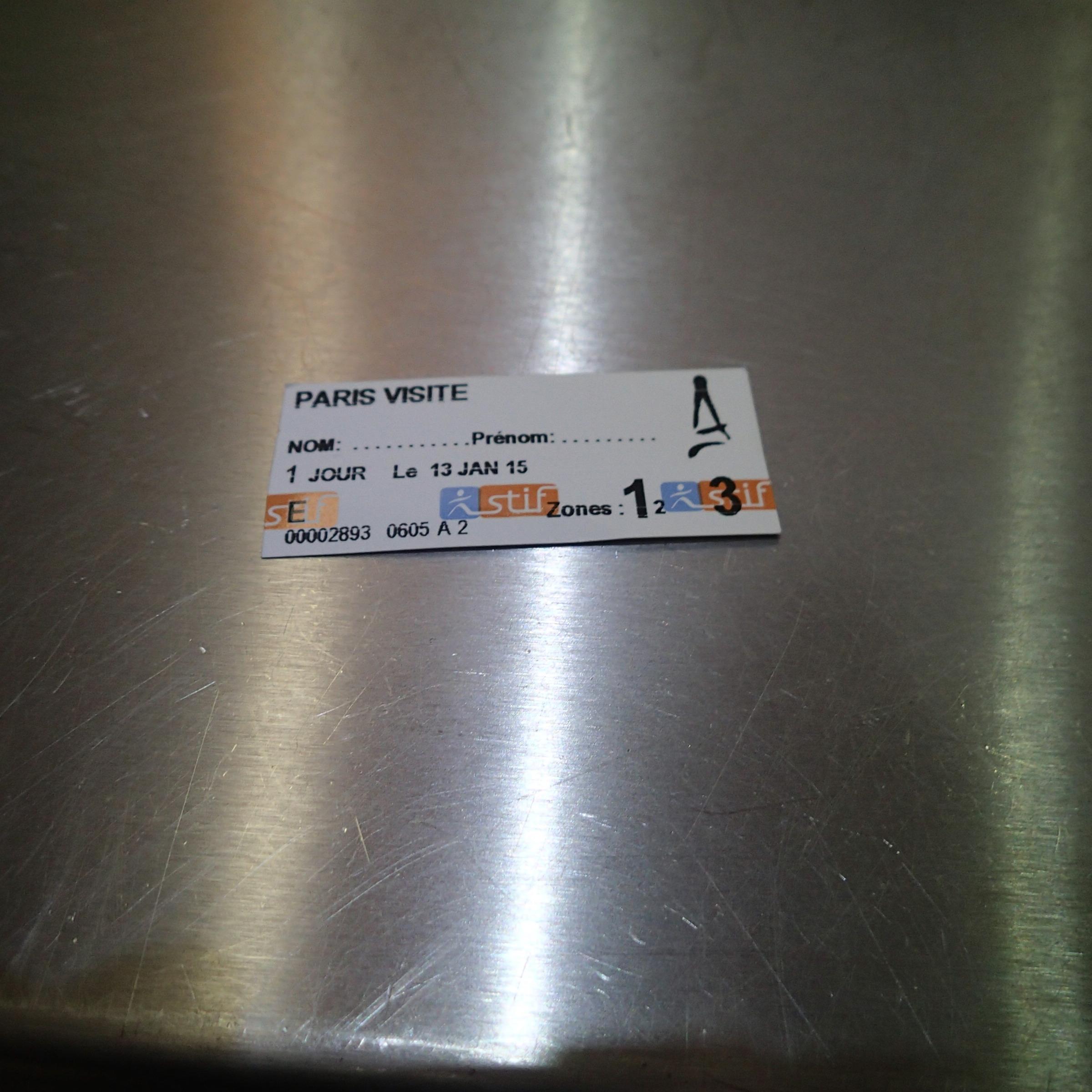
My Second Paris Transport Day Ticket
The first one fell apart when it rained, so I had to exchange it for another.
Paris has a system called Navigo, which is very much the same as London’s Oyster. But Paris doesn’t seem to offer contactless payment with a bank debit or credit card and I can’t find any plans for them to do so.
Surely, every public transport system in the world should be moving towards contactless bank card ticketing.
Paper ticketing for transport is so nineteenth century.
I know I like the UK’s orange credit-sized rail tickets, but then they fit everybody’s wallet and are understandable by everyone and the newest ones are computer readable, by your standard scanner.
I suspect that Londoners planning a weekend away, will look at the ticketing in their possible destinations and might choose one where contactless bank cards can be use as tickets.
If I was a world dictator, one of the things I’d do is make all buses, trams and trains accept contactless bank cards as tickets. It must surely create lots of jobs in tourism, as people would travel more, if they knew that when they ended up in say Tokyo, Helsinki or Belgrade, all they needed was work out the map of the trains and not bother with the ticketing.
London’s Extraordinary Demographic Rebound
One of my Google alerts pulled up an article with this title in the Financial Times. It has a sub title of
Population Surpasses 1939 Peak And Raises Pressure For Investment
Which sus the article up pretty well.
It is a fascinating read.
London’s Proposed Ultra Low Emission Zone
London is proposing to have an Ultra Low Emission Zone. Here’s the summary of the proposal.
Air pollution affects the quality of life of a large number of Londoners, especially those with respiratory and cardiovascular conditions. It is estimated in 2008 more than 4,000 deaths in London were brought forward due to long term exposure to air pollution.
I’m all for this, as not only will improved air quality help my breathing, but also it will hopefully get some of the older and larger vehicles off the roads.
As a pedestrian, I’ve nearly been hit a couple of times, when something like an older 5-series BMW has been driven far too fast across lights turning red. Strangely, these near misses have never occurred with a vehicle less than a couple of years old. I think people tend to look after new vehicles better, or is it that as they are fully-taxed and insured, they are traceable. Usually, the drivers have the look of someone, I wouldn’t want as a friend.
But not everybody wants it, as this article on ITV shows.
A Simple Gluten-Free Guide To London For Visitors
In Oliver’s yesterday, I met an American couple, who were visiting London and Paris. They could have been on honeymoon even, but they certainly wanted to eat gluten-free.
So I decided to put up this simple guide, which includes some my favourite restaurants and the rules by which I live.
Marks and Spencer
I’ve eaten gluten-free bread all over the UK and most of Europe, including in specialist gluten-free bakeries. But none compare with the range of breads in Marks and Spencer, if you take availability into account. Most of their stores in London, including those in stations, have a range of bread, biscuits and cakes. And many have gluten-free sandwiches, which you usually have to buy early, as many on their way to work, buy them as they pass by.
Marks also sell lots of salads, fruit and vegetables, including single bananas.
There are also gluten-free quiches and scotch eggs. I also thing, that the company is implementing a policy of making sausages, burgers and other goods, as free of all allergens as possible. Most packaging is clearly labelled in English, French and Dutch. I regularly eat their ultimate burgers and specialist gluten-free fishcakes.
So if you’re staying in London for a few days make sure you check out the nearest store to where you are staying.
I would issue a slight word of warning.
Suppose you are travelling outside of London to visit an attraction. Don’t expect that the range in all stores will be the same as London! So make sure you plan your eating properly or take supplies from a store in London.
Incidentally, I have found that their sandwiches usually last a day past their sell-by date, if kept unopened in a fridge. In fact generally, their bread, unlike some others, seems to last well. Even when it is past the sell-by date, the bread, still makes an acceptable toast.
EatNakd Bars
EatNakd bars are my staple snack, that I carry with me most of the time. I usually get mine in a supermarket from the Free From section, but they are turning up in more and more places.
Holland and Barrett
Holland and Barrett is a chain of health food shops and every one has a selection of gluten-free snacks amongst a comprehensive range of foods and supplements for the health conscious. Most seem to have a selection of EatNakd bars too!
Restaurant and Cafe Chains
As in all the corporate world, some are good, some are very average and some are downright bad. I use four chains regularly as I know I can trust them and perhaps more importantly I like their menu.
Bill’s – I’ve recently discovered this chain, which seems to be expanding fast. They sell themselves as opening from breakfast to bedtime.
Carluccio’s – This group is expanding all over the country, with a lot of restaurants in the London area. They have a gluten-free menu and pasta is always on offer. A particularly useful one for me on my travels around the country is the restaurant in Manchester Piccadilly station, where I often change trains.
Jamie’s Italian – Jamie’s Italian is a good upmarket alternative, which has a comprehensive gluten free menu including pasta.
Leon – This a smallish chain, that is setting new standards in fast food. I regularly use them, when I want an interesting small eggy snack for breakfast. Some of them, actually serve tea and coffee in large real mugs.
Patisserie Valerie – Probably best described as an upmarket cafe chain, but the tea and coffee are good and they do have an acceptable gluten-free brownie.
Pizza Express – C and myself would regularly eat in one of the numerous Pizza Express restaurants until I was diagnosed with coeliac disease. After that, it was less often, as you can only eat so many salad nicoise. Now I regularly go as I’ve always liked a good pizza. They may not be as good as the one I ate in Munich, but they are certainly as good as any in the UK. If you choose your Pizza Express with a bit of care, you can find some with excellent views or in historic locations and buildings. I regularly eat in one by the Globe theatre, that has good views of the River.
I shall probably add other chains to this list, as there are some restaurants on my radar, that may grow up to be more widespread.
Indian Restaurants
I have generally found that an Indian restaurant with good tablecloths and an owner, who speaks good English, generally cook with chick-pea flour and are usually gluten-free. Or at least, I’ve never had a problem. Some might in some, as a lot of very competent and affordable Indian restaurants in the East End of London, don’t serve alcohol. But they usually say you can get beer or wine at a nearby shop!
If I need an Indian meal, I usually go to the Angel Curry Centre in Chapel Market at the Angel.
Gluten-Free Cake
There is quite a bit of excellent gluten-free cake in London and even in the smallest non-chain cafes, you’ll see one displayed. There is an excellent chocolate chip and mandarin cake that turns up all over the East. Obviously they mine it somewhere near the Olympic Park.
Railway Stations
Network Rail, who manage a lot of the bigger stations in the UK, have stated that they want to get the fast food chains like Burger King, McDonalds and Starbucks out of the stations.They hsave said they want to go upmarket with chains like Carluccio’s and Patisserie Valerie. They also seem to be encouraging local cafes, like the one at Alexandra Palace station. London Overground also seem to be using up spare space for local cafes, some of which, like Crystal Palace, are very good.
As many stations now seem to be featuring a Marks and Spencer food outlet and these are increasingly featuring coeliac-friendly food, it’s a far cry from the day, when comedians made the joke about their father working as a sandwich curler for British Rail.
As many busy provincial interchange stations like Liverpool, Birmingham and Manchester have a Marks and Spencer and a cafe/restaurant that does a passable gluten-free, train travel is almost becoming a preferable alternative to driving. Unless of course motorway service stations have improved since I last visited one.
Trains for me in the UK are not a problem, as I usually take something I’ve either made or cooked, or bought elsewhere. On some operators like Virgin, if you pick your train out of London correctly and travel First, you can sometimes have a gluten-free breakfast.
Gordon Ramsay
I once talked to Gordon Ramsay on the radio about gluten-free food in a restaurant. He said that if you book at least 24 hours before and say you want a gluten-free meal, the restaurant has no excuse for not giving you what you need. He also said that if they think they’re a good restaurant and can’t offer gluten-free food, then they’re not a good restaurant. I’ve never eaten in one of his upmarket restaurants, but I have eaten in his Plane Food at Heathrow and his restaurant certainly follows his advice. Although, I broke his rule, by just turning up. But he still got his share of a satisfied customer’s money.
I have found that his advice usually works, except in a couple of cases where they have said they can’t, so I’ve just gone elsewhere.
Treats
I like good food and there are some very interesting restaurants, where gluten-free food features.
Arbutus – In my view Arbutus is one of the best restaurants in London. It was also one of C’s favourites.
First Great Western Pullman Dining – This must be one of the best, if not the best food on a scheduled train. Read about Pullman Dining and my experiences to Plymouth and Cardiff. To my mind, there’s no better way to go to Devon, Cornwall or South Wales.
Oliver’s Fish and Chips – If you’d like to try traditional fish and chips, but gluten-free, then Oliver’s is your place on one of their Gluten Free Wednesdays
View Tube – The View Tube is one of London’s most unusually placed cafes, as it sits on top of Bazalgette’s sewer, looking out over the Olympic Park. You couldn’t do better than start your trip to the park, by having coffee and a tasty snack here. Just go to Pudding Mill Lane DLR station and look for the yellowy-green building made out of containers.
Vozars – Vozars is unique, in that it combines gluten-free food with gluten-free beer. It is also tucked away in the heart of Brixton and can be difficult to find, but it is always worth a visit.
Yard at Alexandra Palace station – An upmarket cafe, that certainly impressed me.
This small list will grow!
 The Anonymous Widower