A Plea For Help From Lancashire
I have a Google Alert setup to look for stories about the Todmorden Curve. Normally, it picks up worthy stories about the Todmorden Curve and the new services from Blackburn and Burnley into Manchester.
However, today, I picked up this story from the Rissendale Express, which is entitled Rossendale Scribbler: Forget the bus station, we should look to rail to improve our transport links. This is the first couple of paragraphs.
Watching the TV news on Sunday night, I saw a report on the opening of the Todmorden Curve – a short stretch of railway which now makes it possible to travel directly from Burnley to Manchester by train.
As train fans know, this stretch of track is but a few hundred metres long, yet it’s taken an absolute age to get it opened.
So you’d think that if a rail link is good for Burnley and Blackburn, then one would be good for Rossendale, which lies to the north of Bury and south of Blackburn.
The Rossendale scribbler then goes on to explain how Lancashire County Council is giving £3.5million to create a bus station in Rawtenstall, whereas he and a lot of the locals would prefer a rail service. A couple of weeks ago I had to take a bus from Blackburn to Manchester and I know where my sympathies lie.
He then goes on to explain, that there is already a rail line, but it is a heritage railway called the East Lancashire Railway. He then says this.
After all, Rossendale has a head start over many areas wanting a rail link – the railway track is already down.
Of course, fans of the East Lancashire Railway speak of concerns that commuter services would damage the heritage railway which attracts so many visitors to the area.
That need not be so of course. The two could run side by side, and train services running on from the ELR to Manchester could bring more people to the heritage line.
Some suggestions put the cost of commuter services at £10.5m.
It strikes me that if it is best for all citizens of the area, then a solution must be found that allows commuters into Manchester to share the line with those that want to play with steam trains.
There is also this article on the Manchester Evening News, where rail enthusiast, Pete Waterman, talks a lot of sense about dual use of the line.
If the Todmorden Curve is a success, I think that there will be more pressure to bring a commuter service into Manchester via the East Lancashire Line.
And then you get a story like this in the Lancashire Telegraph, which is entitled TODMORDEN CURVE: £12m spin-off for Burnley’s economy
Enough said!
As someone, who lives in an area of London, that has been reinvigorated by the refurbishment of the North and East London Lines, I know the effect a good rail line can have on employment, leisure, business and housing opportunities. So if running services into Manchester, would give the area a significant uplift, the services should start.
Perhaps one way to do create a service would be use Class 399 tram-trains to extend the Metrolink from Bury, if they are proven to work successfully between Sheffield and Rotherham in the next few years. After all, the first phase of the Manchester Metrolink to Bury was built by converting the old East Lancashire Railway,
I’m certain, that if the Germans or the French were creating a system like the Manchester Metrolink now, they would look at tram-train technology based on the Karlsruhe model. But this type of tram-train operation only dates from 1992, so unfortunately Manchester didn’t have the option to look at it, when the Metrolink was first proposed in 1982.
A Transport Hub Fit For A Major Airport
I’ve only been to Manchester Airport once and that was many years ago, when I flew my Piper Arrow into the then single-runway airport.
On my trip north today, I wanted to take a ride on one of the refurbished Class 319 trains running between the airport and Liverpool Lime Street, so as I got a good deal on tickets including a trip in First to Crewe, I went via the airport.
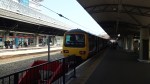

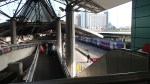

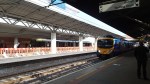
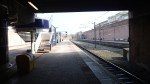
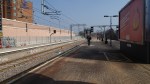
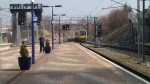
The pictures show the rail station at the airport, which has three platforms for trains and one for the Metrolink. A fourth rail platform is under construction.
Most of the pictures were taken looking towards the entry to the station, with the platforms being number 1, 2 3 and 4 for right to left (south to north).
If the Metrolink platform was given a number, it would be five.
This Google Earth image shows the station and the surrounding area.
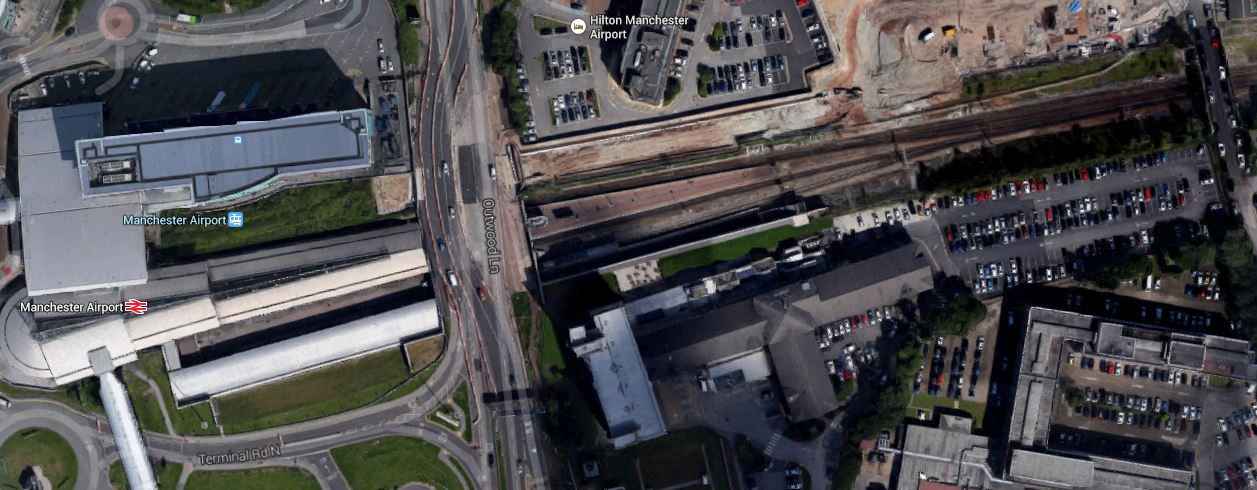
Manchester Airport Station
Note the current three rail platforms with the Metrolink between them and the bus station. My Class 323 train from Crewe arrived on the southernmost platform, which is numbered one. Platforms two and three are either side of a long island and it would appear that the construction work between platform three and the Metrolink and the bus station will be the new platform four.
A station-man indicated that the lines into the station are a bit limited and expansion of the rail links out of the station might be something to upgrade in the future.
One difference between this airport station and most of the other ones I’ve visited was that it wasn’t buried deep in a dark claustrophobic pit under the airport. So I was able to walk up and down in the sun, whilst waiting for my train!
My only disappointment was that instead of getting a refurbished Class 319 train, I got a clean Class 156 train.
Will Manchester Victoria Station Be Promoted To The Premier League?
When I arrived at Manchester Victoria station, I expected the usual mess and a walk to pick up the tram to Piccadilly.
But I was greeted by a dry station, where the trams were now sheltering under an almost complete, but spectacular roof!
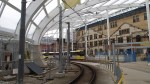

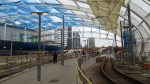
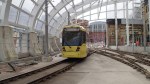
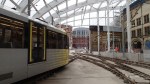







Victoria may date from the 1840s, but look at her now!
There was also today’s news on the Modern Railway’s web site, that the Class 319 trains had started working from Liverpool to Manchester Airport.
As my train went past Liverpool South Parkway later, I got several glimpses of smartly refurbished trains cascaded from Thameslink.
Soon, they will be running between Liverpool Lime Street and Manchester Victoria stations via Wigan.
Are one sprightly Victorian lady and a set of reliable British Rail-era electric trains finally going to give Manchester and Liverpool, the first class train connection they need and deserve?
Are Tram-Trains A Good Idea?
After my trip around Germany and France, have I come to any conclusions about the concept of tram-trains?
I must admit, I was sceptical when I set out, as some of the claims about the advantages of tram-trains seemed too good to be true!
So what are their strengths? And how would they fit the planned test route to Rotherham that will extend the Sheffield Supertram?
Dual Voltage
In both Mulhouse and Paris, the tram-trains are dual voltage and can run on both 750 V DC and 25kV AC. This type of tram-train will become the standard as main lines are increasingly electrified with the higher AC voltage.
In the case of Sheffield, which will be electrified to London, Doncaster and other places in the next decade or so, dual voltage Class 399 tram-trains will be essential to future proof the system.
Standard Gauge
All except one of the tram and tram-train systems I used or saw were standard gauge systems. The exception was Darmstadt, where trams were of a narrow gauge. Any standard gauge system could be used by tram-trains of the same gauge. In the UK, France and Germany that means to incorporate tram-trains on a tram network, that the tram network must be standard gauge.
There are no tram systems in the UK, that are not standard gauge.
Tram-Trains Can Be Low Floor
Buses and trains are moving towards totally flat and low floors, where to enter you just step or wheel yourself across.
The Mulhouse and Paris Siemens Avanto tram-trains achieve this and it has been stated that the Class 399 tram-trains for Sheffield will be low-floor.
Tram-Trains Are Larger Than Trams
Generally tram-trains are larger than trams. I don’t know for sure, but this could be for crash-worthiness reasons when running as trains.
With Sheffield this is an advantage as the Sheffield trams are bigger than most of those in other systems.
Tram-Trains Are Faster Than Trams
I don’t know at what speed the tram-trains that I rode ran, but it was certainly faster than the average tram.
Tram-Trains Are Almost As Fast As Pacers
A Class 142 Pacer has a top speed of 120 km/hr, whereas the Siemens Avanto used in Mulhouse and Paris has a top speed of a hundred and the Class 399 tram-trains for Sheffield have a top speed of 110 km/hr.
I suspect though that the electric vehicles have better acceleration and braking, so they might even be quicker over a route like the Hope Valley Line. I won’t comment on the passenger experience, but I will say that they probably have a slightly higher capacity of over two hundred, if you count standing passengers.
Tram-Trains Release Platforms In City Centres
This was well-illustrated in Kassel, where the Hauptbahnhof has been effectively released for other uses after the building of two underground island platforms.
By joining services together it might also be possible to release platform needs, just as Thameslink and Crossrail will do in London.
I’ve spent a lot of time waiting for local train services in Sheffield, so is there any scope for joining more services together.
Acting Like Trams In A City Centre
This was impressively shown in Kassel, where except for the colour and size, you couldn’t tell which vehicles were trams and which were tram-trains.
Sheffield’s tram line layout is very like Kassel with a shared centre section.
Acting Like Trains On Train Lines
Once on a railway line, the trams must be able to use the voltage of that line, have the same crash protection and signalling of a train and have the performance not to interfere with all other traffic.
Tram-Trains Can Have Alternative Power Sources
Around the world, there are several examples of tram-trains that have on-board diesel engines as well. Kassel has ten for a start.
And there are of course the battery trams in Nice and Seville.
Tram-Trains Don’t Need Lines To Be Converted
If tram-trains need to use a line they don’t stop other traffic like freight trains and express passenger services using that line. In some places in the UK, tram lines have been created by ripping up heavy rail tracks, which might need to be used again.
Tram-Trains Can Create An Extensive Network
The Manchester Metrolink has a network of around ninety kilometres, whilst Sheffield’s Supertram has a length of around thirty.
Compare this to Kassel at over a hundred and eighty kilometres and Karlsruhe at over two hundred and sixty.
The two German cities are substantially smaller than the two major English ones.
Tram-Trains And Sheffield
Tram-trains are not some difficult concept, but any competent group of railway, tram, electrical and control engineers should be able to create a system that works pretty well.
At least in choosing the line to Rotherham, they haven’t set themselves too difficult a task. Sheffield also has a very good layout in the area to the east and north of the main line station.
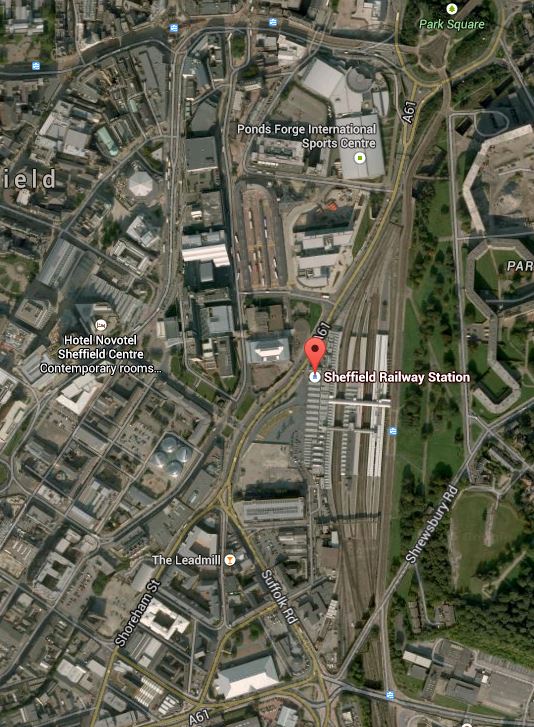
The Trams Around Sheffield Station
There are some things to note in this Google Earth map.
1. At the top right of the map, the three branches of the system meet in a triangular junction. The northern branch goes to Meadowhall and in the future Rotherham, the southern branch goes past the rail station and the western branch goes through the city centre. I don’t think that services use this junction in every posible direction, but it appears to have been future-proofed to cater for all eventualities.
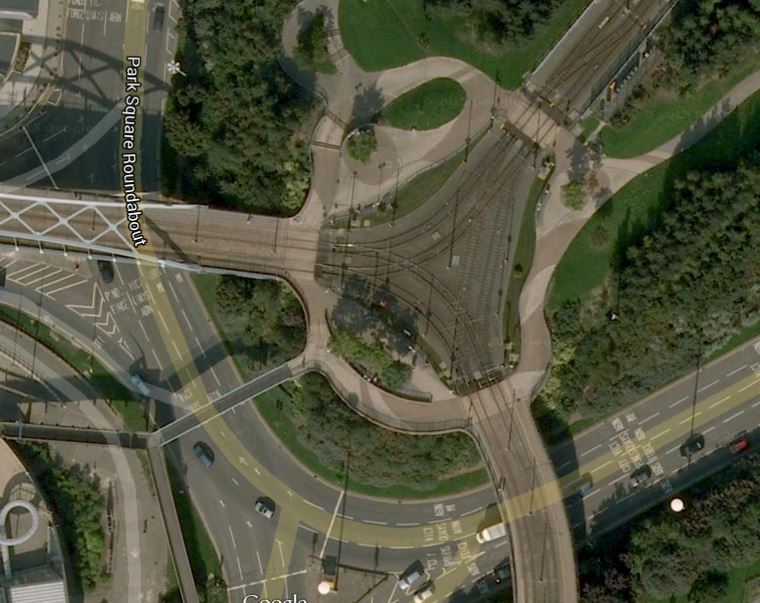
In this enlargement, the tracks and wires are clearly shown.
2. The southern branch past the station runs parallel to the rail lines.
3. There is quite a bit of space to put in extra tracks.
I also think, that after seeing the systems in Kassel and Karlsruhe, Sheffield could incorporate tram-trains fairly easily. Not being the first is a definite advantage, as ideas, designs and technology have moved on, as the Mulhouse system showed.
At some point in the future a lot of rail lines in the Sheffield area are going to be electrified to the main line standard of 25 kV AC and this might mean that the line used by the tram-trains to get to Rotherham in future may have this voltage. The Class 399 tram-trains themselves will be bought with a dual voltage capability, so they won’t care, but it seems a pity to put up one set of wires and then rip them down for another. Perhaps, you put up main line catenary initially and use it to provide a 750 DC supply! I’ll leave that one to the engineers.
An Extension To Dore
Plans have existed in the past to extend the Sheffield Supertram to Dore and some reports state that Dore will be linked to Meadowhall to improve HS2 connectivity. This Google Earth map shows Sheffield and Dore and Totley stations.
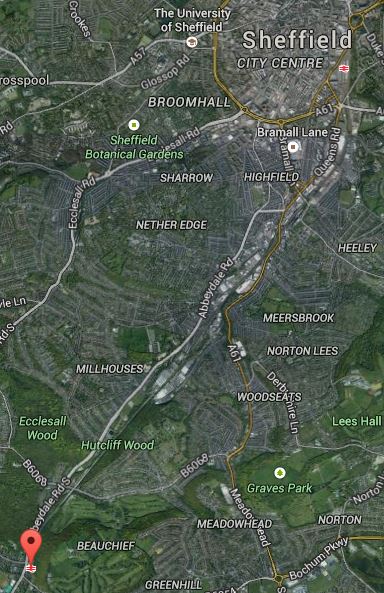
Sheffield To Dore
Dore and Totley station is on the Hope Valley Line, which will probably be electrified in the next ten years or so.
So could tram-trains come past Sheffield station and then go down an electrified Hope Valley Line?
I know little of the area, but because plans have been drawn up in the past, others must have a good idea. This document from Sheffield University written in 2003, gives a summary of what might happen.
But it predates any thought of tram-trains in Sheffield.
Could The Hope Valley Line Run Tram-Trains To Both Sheffield And Manchester?
This section in Wikipedia’s article about the Hope Valley Line, talks about proposals to to extend the Manchester Metrolink to Rose Hill Marple station on a spur off the line. Tram-trains could be used.
As Dore and Totley station is at the Sheffield end of the Hope Valley Line, could we see tram-trains going to both Manchester and Sheffield?
And What About Manchester And Sheffield?
I can remember reading in my Meccano Magazine in the 1950s about the ground-breaking electric-hauled Woodhead Line between the two cities.
This is said about tram-trains in the Wikipedia section for extensions to the Manchester Metrolink.
Metrolink and the TfGM Committee have prepared five costed proposals for extending Metrolink using tram-train technology over the existing heavy rail network in the region; along the Mid-Cheshire Line (between Stockport and Hale), the Hope Valley Line (between Manchester and Marple), the Glossop Line (between Manchester and the dual termini at Hadfield and Glossop), the Manchester to Sheffield Line (between Manchester and Hazel Grove), and along the Manchester to Southport Line (between Manchester and Wigan via Atherton), with an estimated total funding requirement of £870 million as of 2013.[197] TfGM intend to proceed to the identification of potential rail industry funding options, subject to a review of lessons from a tram-train pilot scheme in Sheffield.
So could we see the opening up of routes between the two cities using tram-trains, if the trial in Sheffield to Rotherham is successful.
The old Woodhead Line is just over sixty kilometres long, which means that from what I saw in Karlsruhe and Kassel, tram-trains could easily handle the distance between Manchester and Sheffield.
An interesting possibility for which the technology exists is a dual voltage tram-train leaving Manchester and taking the Hope Valley Line, which is electrified at its western end, which then travels over the Pennines to Dore, using either diesel or battery power, from where it becomes a tram on Sheffield’s network.
It won’t happen soon, but it is no fantasy, as I’ve seen all the technology needed in Kassel, Karlsruhe and Essex.
So will we see, heresy-of-heresies, an operational merging of the tram systems across the Pennines?
But imagine two, three or even four new tram-trains an hour on each of the routes between Manchester and Sheffield, that would extend their journeys into the city-centres, rather than need valuable platform space at Sheffield or Manchester Piccadilly stations.
I don’t know the lines well, so this might be pure speculation, but as the systems in Germany showed, if you get the track, power and signalling working, then good tram-trains can go virtually anywhere they’re needed.
A Vision For The North?
Let’s assume that the tram-train experiment from Sheffield to Rotherham is a success, which after my German and French experiences, I wouldn’t bet against.
So what happens next?
That is very much in the hands of the politicians, at both a national and local level, but from Sheffield and Manchester I could see tram-trains getting used on the numerous local lines that fan out from Manchester and Sheffield.
1. At present many of these lines are served by dreaded diesel Pacers, so the new tram-trains would be very welcome.
2. Some lines like the Hallam Line between Sheffield and Leeds via Barnsley could probably be just electrified with 750 V DC, to allow tram-trains to run.
3. As at Kassel not all lines would need to be electrified, as other technologies exist.
Everybody needs to have a bit of vision and if the Class 399 tram-trains, do what it says in the specification, we could be seeing them all over a dense network of lines in the north.
If all of these lines were upgraded, there is one thing that will happen for certain. The areas will improve in all ways, with better housing, more jobs and business and leisure opportunities.
Conclusion
To answer my original question, tram-trains are not a good idea, but a brilliant affordable solution to the big problem of urban transport all over the world.
In the UK, we must prove that the technology will work in a UK environment and I suspect there are many councils, tram and train operators eagerly awaiting the outcome.
Manchester Trams To Get Wi-Fi
Modern Railways is reporting that all trams in Manchester are to get wi-fi.
Now that wi-fi is becoming more universal on trains in the UK, with some operators like Chiltern and Virgin offering it free to all passengers, it would seem logical to apply the technology to trams and light rail systems. I believe Edinburgh is going along the wi-fi route with its new trams.
Naively, as trams go slower and tend to operate on the surface in cities, the technical problems of wi-fi on Manchester trams must be less than those on say a Scottish rail line.
Expanding The Manchester Metrolink
In my view the Manchester Metrolink has not grown as fast as it should have done. A good proportion of the system opened in the early 1990s and nothing really seemed to open until the last few years.
For a lot of that twenty year gap, the government was one that you’d think would be sympathetic to expanding public transport in areas, where they could count on the vote. Perhaps, though Blair and Brown were more interested in war abroad than looking after the North!
There have been various plans to extend the Metrolink to places like Middleton, Salford, Stalybridge, Stockport and Trafford Park, but strangely not Bolton. Only the extension to Trafford Park has been funded.
Now I don’t know Manchester politics, but I do feel that if there had been a Manchester mayor for say the last ten years, I suspect with someone batting for Manchester, some of these extensions would have been progressed. Now that one should be there in 2017, hopefully progress will be quicker.
On this post there are comments about the non-extension of the tram from East Didsbury to Stockport.
So can this line be easily built, as it seems to me, as someone who only knows the area from the 1960s and a good map, that it would be of benefit to a lot of people?
Also if the Metrolink went to Stockport rail station, it would surely give an alternative Manchester station for those living on the tram network, just as Watford, Stratford, Ealing Broadway, Wimbledon and others do for the London Underground/Overground. Travellers should be given the choice of as many different routes as possible.
So I looked up how this line would get from East Didsbury to Stockport and found this article, which describes a route as proposed in 2004.
Reading the article, the route seems to be rather complicated and expensive, as it crosses the River Mersey several times and it doesn’t go to the rail station.
So perhaps if Stockport, is ever linked to the Metrolink, it will use a different route.
It all illustrates that extending the Metrolink isn’t as easy as it might first appear. I hope Manchester has got some good transport planners, who know the city well.
As an aside here, it is worth thinking about how the Northern Hub and in particular, the Ordsall Curve linking Manchester Piccadilly and Victoria, will indirectly affect the Metrolink. There could be at least four trains per hour both ways between the two stations and six going towards Bolton and Preston according to Wikipedia. So as some of these services will go south towards Stockport and the Airport, Manchester will probably see a high-frequency service between Piccadilly, Victoria, Bolton, Stockport, Salford and other places in the Greater Manchester area. The trains will all be electric and probably something like the ex-Thameslink Class 319. These trains will extend journeys all round the area to Blackpool, Huddersfield, Leeds, Liverpool, Preston, Warrington and Wigan. With not a lot more electrification, places like Blackburn, Burnley, Sheffield and Southport could be brought into an electrified network, where high-capacity trains run at least four times an hour on all routes.
One thing that would need to be done is improve the interchange between the Metrolink and some of the central Manchester rail stations. Victoria is showing glimpses of being superb, Piccadilly needs to be a much shorter walk and perhaps Salford Crescent needs to be linked to the tram.
I don’t drive and suspect will never do so again, but one thing that always worries me about city transport systems is, are there enough Park-and-Ride spaces and especially close to the motorways? I know London lacks badly in this area and suffers because of it. So how does Manchester stack up?
By the end of this decade, Manchester could be getting the transport system it needs and deserves.
It’s All Go On The Manchester Metrolink
According to this article in Global Rail News, work has now started on the Second City Crossing or 2CC. But it is the last paragraph that shows how the Manchester Metrolink is developing.
November has seen several significant milestones ticked achieved for the Metrolink system, with funding confirmed for the Trafford Centre extension and the opening of the system’s new airport line.
More projects like this should be promoted if we are going to create a powerhouse across the North.
Incidentally, with my project management hat on, I don’t think the upgrading of Manchester Victoria station and the Metrolink has been planned as the partially joint project they so obviously are.
On my travels around Manchester in the last couple of years, I have sometimes found it extremely difficult to get between the two main stations; Victoria and Piccadilly. That would have been eased by making sure there was always one reliable easy-access properly-signposted link at all times.
The Rail Projects Keep Coming
I’ve just been reading the rail news sites like Modern Railways and Global Rail News and over the last few days some substantial projects have been announced.
The project that will affect me most is an upgrade to the Great Eastern Main Line.
It’s not any new features, but an upgrading of track, overhead wires and signalling. Network Rail say this.
As part of the upgrade, one of NR’s ‘high output’ machines will begin replacing ballast along the route to ensure the track bed is safe and well-drained. The machine is currently being used to upgrade the Great Western main line, and will move to the GEML in the New Year.
It will also upgrade one track at a time, so it’s unlikely there will be substantial blockades. Traditionally, this sort of work would have meant weekend closures and buses. So Network Rail seem to be doing sometime better.
Network Rail are also replacing the Scarborough Bridge on the Scarborough Branch Line. The work is described here and this is a paragraph.
The bridge, which was originally built in 1845 and then rebuilt in 1875, is now life-expired. Work will see the bridge decks and tracks replaced and a new walkway installed to improve safety for railway workers. The work is part of a £6 million investment by Network Rail.
So it’s only a small project, but I’m sure it’s important to a lot of travellers.
The extending of Chiltern’s network to Cowley has also been announced. I think we’ll see a lot of projects like this, where old lines are given something to do in the next couple of decades.
Network Rail has also announced a £200million project to do more work on the improvement of lines between Edinburgh and Glasgow.
As with the electrification across the North of England, electrification is another prime example of the failure of Central government to do the right thing to create infrastructure and fuel jobs, businesses and growth. This describes the scope of the work.
The companies will work with Network Rail to electrify the main line between the cities, complete route clearance works at Winchburgh Tunnel, infrastructure works at Glasgow Queen Street and Edinburgh Waverley stations and extend platforms at Croy, Falkirk High, Polmont and Linlithgow.
What will fast electric trains running between Scotland’s two major cities, do for the area? Wikipedia lists several benefits including this one.
Service frequencies between Edinburgh and Glasgow Queen Street increased from four trains per hour to six per hour, with the fastest journey time being reduced to 35 minutes. This would have resulted in a total of 13 trains per hour between the two cities across all routes;
Currently, services take from about 50 minutes to an hour and a quarter.
Global Rail News has announced that funding is in place to extend the Manchester Metro to the Trafford Centre.
An aside here is to look at the list of proposed changes and expansions to the Manchester Metrolink. Every council in the area seems to have its own pet ideas and surely this must be best argument for a peacemaker and decision taker in Manchester, like TfL are in London.
I wonder how many more of these projects will be announced before the General Election in May.
Victoria Gets A Posh Umbrella
Manchester Victoria was a terrible station, with a difficult connection to Manchester Piccadilly. The connection improved with the Metrolink, but as they are now rebuilding Victoria, it’s got worse again. As I’m now familiar with the walking route, I was able to put a couple right about the way to go.
There must be something in the Manchester civic psyche, that likes to confuse people.
But Victoria seems to be getting on with its rebuilding, which includes a posh roof over everything and a new footbridge.
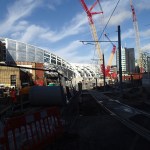
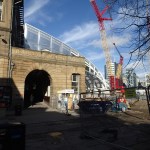

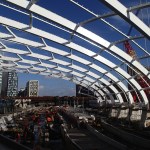
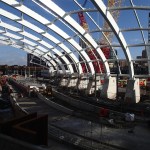
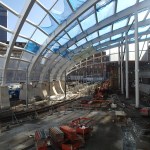
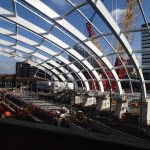
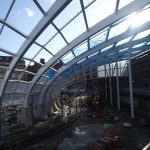
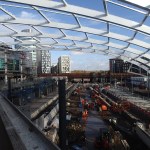


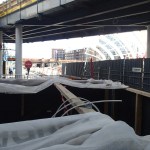
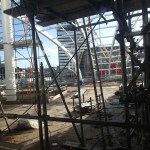
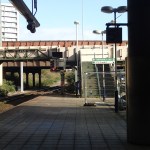
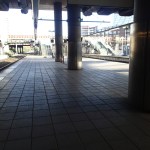
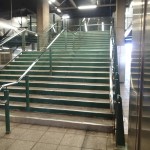
Unfortunately, the electrification to Liverpool Lime Street seems to be having problems and it will be some months before Class 319 electric trains are working the route, hopefully before next spring.
It does look to me, that when complete, anywhere on the tram routes in Manchester will have easy access to the electrified Trans-Pennine links at Manchester Victoria, which could become an architectural icon of the North. You’ll get the tram to Victoria and then totally under the new roof, you’ll go through the ticket gates and across the fully-accessible footbridges to the appropriate platform to await your train.
In addition, those who arrive from London and the South at Piccadilly and are perhaps going on to places like Burnley, Blackburn and Hebden Bridge from Victoria, will have a completely dry route, which is of course important in Manchester, using the trams. The trams must use contactless bank card tickerting though to be compatible with what other cities, like London, are doing.
This is Network Rail’s page on the £44million work.
I think everyone will agree that it’s all a bit different to the concrete crap that British Rail built forty to fifty years ago, like Euston and Manchester Piccadilly, when those with special access needs or advanced age didn’t exist, as everybody was adult and fit as a butcher’s dog.
I can remember meeting a friend in the newly-opened extension to Kings Cross station and looking with amazement at the structure that had been created.
Why shouldn’t other rail stations be given an added wow factor?
Especially now, when we have the architects, computers, techniques and materials to build them in an affordable manner. How many stations could be rebuilt using the same methods as New Cross Gate?
Good stations, like good clean electric trains, have one common problem. They are passenger magnets and very often attract so many extra paying passengers, that we have to expand the system.
I have a feeling that after they see the completed scheme, they’ll be wanting some of their other architectural disasters like Salford Crescent and Oxford Road stations, at least given the treatment that Network Rail have applied at Huyton.
Manchester Metrolink’s E-Ticketing
Manchester tram system, Metrolink, is introducing electronic ticketing. This is one of their trial readers.
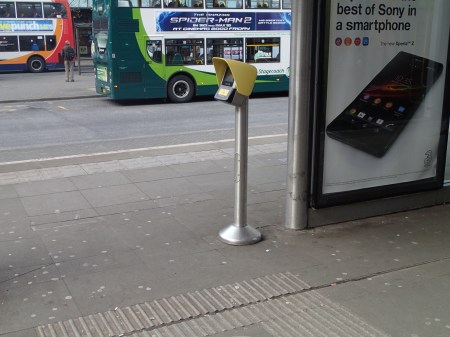
Manchester Metrolink’s E-Ticketing
The system is called Get Me There and from what I can find, it will be on another different system to London’s Oyster.
As Oyster is being modified to accept contactless bank cards, I would hope that Manchester will do the same.
As we are still a united kingdom, surely we need a set of ticketing rules that are the same across the country.
First amongst these rules is that all ticketing systems for public transport must work with contactless bank cards. Surely, the lack of any major opposition to the abolishing of cash on London’s buses, is proof that London has got their offering right. In two years or so, no visitor to London with a contactless bank card will need to buy a ticket.
This surely is a great attraction to all visitors to a city.
The next step in London, may well be that if you are over the requisite age, you can nominate a bank card to be your Freedom Pass, thus cutting the number of cards people have to carry.
 The Anonymous Widower