Gibb Report – Moorgate Services Could Be Transferred To The London Overground
The Gibb Report, looks in detail at services out of Moorgate station on the Northern City Line in detail.
Note that current plans for this line include.
- New Class 717 trains to replace the Class 313 trains, which are little better than scrapyard specials.
- Higher frequency and faster services to Hertford North, Letchworth Garden City, Stevenage and Welwyn Garden City.
- Better Off Peak services.
- A step-free connection at Moorgate to Crossrail and four Underground lines.
It could also be rebranded as the Great Northern Metro.
Chris Gibbs flags up various issues with this service. He says this about the infrastructure.
25 new Class 717 six-car trains are being built by Siemens as a dedicated fleet for this route, and will be maintained by GTR at their Hornsey Depot. The line between Drayton Park and Moorgate is a former underground line transferred to BR in 1976 and partly converted for main line trains.
It retains various Underground characteristics, such as third rail electrification with a fourth return rail, and tripcocks at all signals, and I believe Old Street and Moorgate stations are owned by London Underground as part of shared stations, and are in need of modernisation. The track and signalling is owned and operated by Network Rail.
I would add a personal observation. Highbury and Islington station is a station where the below-ground platforms are in desperate need of improvement and step-free access. Over the last year or so, with GTR’s labour troubles, the operation of the station at times, has not been smooth, much to the exasperation of London Underground/Overground staff.
Chris Gibbs also notes several issues with the employment of staff after 2018.
Other current Great Northern services run between Kings Lynn, Cambridge, Peterborough and Kings Cross, and these will be part of the Thameslink operation from 2018, with most services continuing to destinations south of London and a few running to Kings Cross. I understand Great Northern drivers will be “temporarily” split between Metro and Thameslink in 2017 to avoid them all having to learn the cross London routes and Class 700 trains, so there may then be a some division for TUPE purposes.
At present it is proposed not to initially train about 100 drivers on Class 700 trains, spread across several locations, and it is proposed to open new drivers depots, for example at Welwyn Garden City and Finsbury Park. These proposals have not yet been approved by DfT, and recruitment has not yet begun. However there is still risk that splitting the driver workforce, who currently enjoy variety of work, may be unpopular, and more work is required to evaluate this. All Great Northern Metro services are currently DOO.
It looks like a disaster waiting to happen to me.
He finishes his discussion on the Great Northern Metro like this.
I believe there is an option to transfer the Great Northern Metro operation to TfL and it’s London Overground concession in 2018. If TfL / the London Overground concessionaire were to take the lead in this transfer, and the implementation of the new trains and service, this could reduce risks associated with the Thameslink programme, led by GTR.
However to do this, a decision should be made immediately, and discussions commenced with
TfL, GTR and the London Overground concessionaire.
Personally, I think that this would be a very good idea.
In this area of London, we have three stations that need to be dramatically improved; Old Street, Essex Road and Highbury and Islingtont.
All are on the Northern City Line and they could start with a deep clean at Essex Road, which was probably cleaner when it opened in the same year my father was born.
But being serious, these three stations could be serious development opportunities.
- Highbury and Islington is a major interchange that hasn’t been rebuilt properly since it was bombed in World War 2 and was changed on the cheap to squeeze the Victoria Line through underground.
- Essex Road could also be redeveloped with a modern step-free station underneath.
- Old Street is now surrounded by towers and the road layout is being simpified, so why not put a massive tower on the site and build a modern station underneath?
Having only one operator at the stations must surely ease redevelopment.
I think if the split between GTR and the Great Northern Metro was thought through properly, there could be advantages all round.
- All services North of Welwyn Garden City on the East Coast Main Line and the Cambridge Line would be provided by GTR.
- All Hertford Loop Line services would be provided by London Overground.
- All Hertford Loop Line stations would be managed by London Overground.
- All stations South of Welwyn Garden City on the East Coast Main Line would be managed by London Overground.
- A turnback platform would be built at Stevenage.
- Welwyn Garden City and Stevenage stations would be updated to allow easy interchange between GTR and Great Northern Metro services.
- Alexandra Palace station is developed, so that cross platform interchange is possible between GTR and Great Northern Metro services.
It certainly looks like a properly integrated 100 mph suburban rail route can be built to Stevenage, with similar fleets of 100 mph Class 700 trains and Class 717 trains on Thameslink and the Great Northern Metro respectively.
The East Coast Main Line would work as now.
- Great Northern Metro services between Moorgate and Welwyn Garden City
- Outer suburban services between Kings Cross and Stevenage, Peterborough and Cambridge.
- In 2018, Thamelink will link St. Pancras to Stevenage, Peteborough and Cambridge.
On the Hertford Loop Line, there would just be a Great Northern Metro service between Moorgate and Stevenage, via Hertford North.
There could be possible problems and questions.
- Would residents of Hertfordshire, object to services being controlled by the London Mayor?
- Who would pay for the required turn-back platform at Stevenage?
- Could London Overground absorb the route without too many problems?
- Would there be enough paths on the East Coast Main Line?
- Where would the depot for the Class 717 trains be located?
- How will Siemens respond to the change of operator for their Class 717 trains?
But there are some other factors in favour.
- The Great Northern Metro service on the Hertford Loop Line would effectively be an independent double-track railway capable of handling as many six-car Class 717 trains as were desired. The current three trains per hour (tph) is probably way below the theoretical capacity, which is probably determined by the single platform at Stevenage.
- London Overground successfully integrated the Lea Valley Lines into their operation.
- London Overground and the Great Northern Metro both work under DOO.
- Hopefully, Transport for London have the knowledge to integrate the Class 717 trains into the tunnels to Moorgate. But they have an excellent museum!
- London Overground’s working practices would appear to be similar to those on the Great Northern Metro.
- London Overground’s station manning policies are better for passengers and may even be better for staff, who always seem to be courteous and enjoying their work.
But surely the biggest thing in the transfer’s favour, is that it gives responsibility to new train introduction and updating of the Great Northern Metro to another operator, who has a proven record in this field, so that GTR can concentrate on launching Thameslink services.
Collateral Benefits Of Updating Great Northern Metro Services
After train replacement the Great Northern Metro will be run by modern 100 mph trains, as opposed to 75 mph scrapyard specials.
Currently, the Class 313 trains take the following times.
- Moorgate and Hertford North – 45 minutes – 13 stops
- Moorgate and Letchworth Garden City – 79 minutes – 16 stops.
- Moorgate and Stevenage – 63 minutes – 15 stops.
- Moorgate and Welwyn Garden City – 49 minutes – 16 stops
As modern trains can save a minute or two on each stop, there must be the possibilities of faster services, with the serious possibility of Letchworth Garden City within an hour from Moorgate, with the new 100 mph Class 717 trains.
Stevenage would certainly be well within the hour and I suspect that because of the extra speed an additional fourth train could be run to both Hertford North and Welwyn Garden City, with all Hertford North trains running on and terminating at Stevenage, once the turnback platform is built.
To run four tph each route would require just eight trains or sixteen trains in total.
If you split the order for twenty-five trains into two, that would mean twelve trains would be available for each route, which are enough trains to have the following service.
- 6 tph – Moorgate to Welwyn Garden City
- 6 tph – Moorgate to Stevenage via Hertford North
These are the sort of frequencies that train operating companies like to run in South London.
Alexandra Palace to Moorgate would have a massive twelve tph.
The current timetable handles this frequency in the Peak, so it could be possible all day, with very little work needed on the infrastructure. London Underground would probably laugh at 12 tph, when you consider the Northern and Victoria Lines handle three times as many trains to a two platform below ground terminal.
But is it really needed?
If you look at the timing of the fast Class 387 trains between Stevenage and Finsbury Park, they take around twenty minutes going fast down the East Coast Main Line, as against the Class 313 trains which take forty-four minutes using the Hertford Loop Line. On a rough estimate the new Class 717 trains might be able to do this trip in perhaps twenty-five minutes on an updated Hertford Loop Line.
A fast high-capacity service on this route that has been neglected, must be capable of development with perhaps a Park-and-Ride and a couple of new stations.
It may not be a bad idea to update the Hrtyford Loop Line with modern signalling and to allow faster running, as surely if the normal trains on the loop were modern 100 mph units, then extra paths could be found to act as diversion routes for the bottleneck of the double-track Digswell Viaduct.
It’s amazing how faster trains can unlock the potential of a rail route.
Conclusion
Chris Gibb has made an interesting proposal.
There are good reasons to transfer the Great Northern Metro to London Overground.
- London Overground have the expertise to introduce the new trains.
- Transport for London have the expertise to redevelop the stations on the route at the Southern end.
- GTR will be able to concentrate on Thameslink
- Moorgate, Old Street, Essex Road and Highbury and Islington stations become Transport for London-only stations.
- London would gain a new Metro line between Moorgate and Alexandra Palace via Highbury and Islington and Finsbury Park, that extends into Hertfordshire and has a frequency of at least twelve tph.
- Crossrail gets another North-South feeder line.
- Highbury and Islington and Finsbury Park will become high quality interchanges.
- The Hertford Loop Line can be developed independently of Thameslink and the East Coast Main Line to be a high-capacity North-South Metro from North London to Stevenage.
- The Victoria Line gets a cross-platform connection to the Great Northern Metro for Crossrail at Highbury and Islington.
The only problem, is that it might remove some of the reasons for extending Crossrail 2 to New Southgate.
Overall it strikes me that GTR have been working totally without any vision or any idea about how their new trains will transform the Great Northern Metro.
An Architecture Firm Wants To Turn The London Underground’s Entire Circle Line Into A Three-Lane Travelator
The title of this post is the headline on an article in the Independent.
It is rather an old chestnut and I think it’s been suggested before and even tried out in at Montparnasse station in Paris in 2002.
One of the railway web sites pointed out that the Circle Line in London is also used by District, Hammersmith and City and Metropolitan Line trains, so it would be rather difficult to design.
But I do think we could do with a few more travelators, escalators and lifts in London.
And in some stations Crossrail and other projects will bring these sorts of improvements sooner rather than later.
The Massive Liverpool Street/Moorgate station for Crossrail
Crossrail will combine the two Underground stations of Liverpool Street and Moorgate.
The map from carto.metro.free.fr shows the lines at the two stations.

Note how Crossrail, which is shown in a purpley blue, lies between the two stations, with the Northern Line at the West and the Central Line at the East.
This image shows a visualisation of the station.
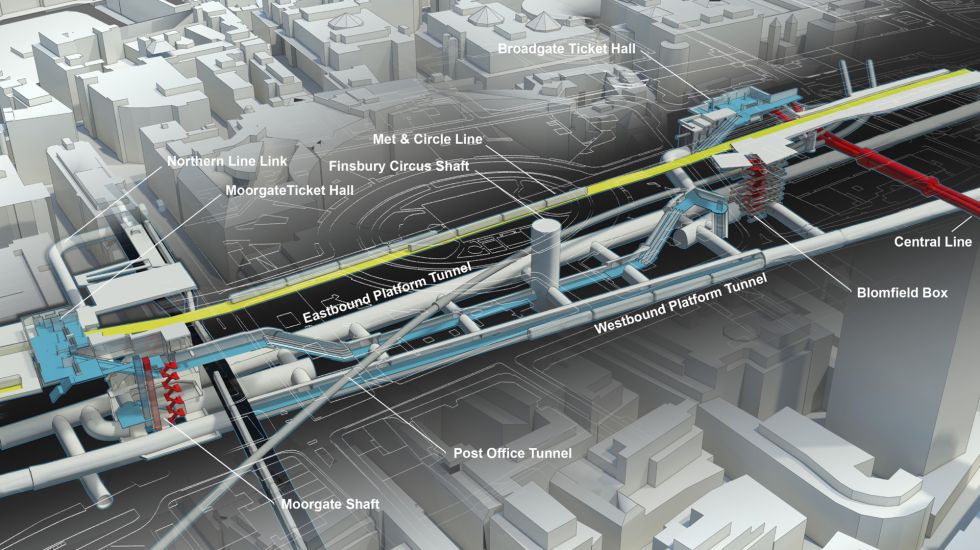
Note how escalators lead down at both ends and you can effectively walk between the two stations with assistance from escalators at both ends..
Passengers arriving on Crossrail will be able to get out of the Eastern end of the platforms and access the following lines.
- Central Line
- Circle Line
- Hammersmith and City Line
- Liverpool Street National Rail services.
- Metropolitan Line
At the Western end of the platforms, there is access to the following lines.
- Circle Line
- Hammersmith and City Line
- Metropolitan Line
- Moorgate National Rail services.
- Northern Line
Both entrances will be very much within walking distance to a lot of the Northern parts of the City of London.
And all routes inside the complex will be step-free with lots of escalators and lifts.
Regularly, I travel on trains into and out of Liverpool Street station and I often get to and from the station by walking between the two stations, as I get a bus to and from Moorgate,
When it is raining heavily as it used to in the past, I will be able to use the Crossrail platforms and two long escalators.
When Crossrail is open through this massive station, thousands or even millions of passengers will change their journeys because of the numerous new routes that will be available.
Paddington
Paddington station will be very much improved interchange.
The map from carto.metro.free.fr shows the lines at the station.
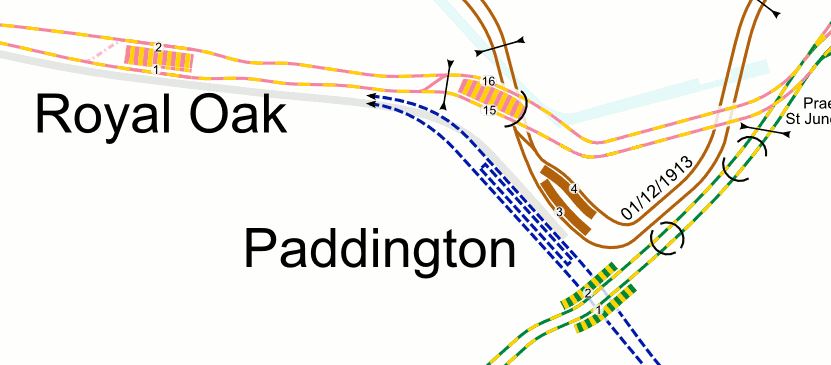
This image shows a visualisation of the station.
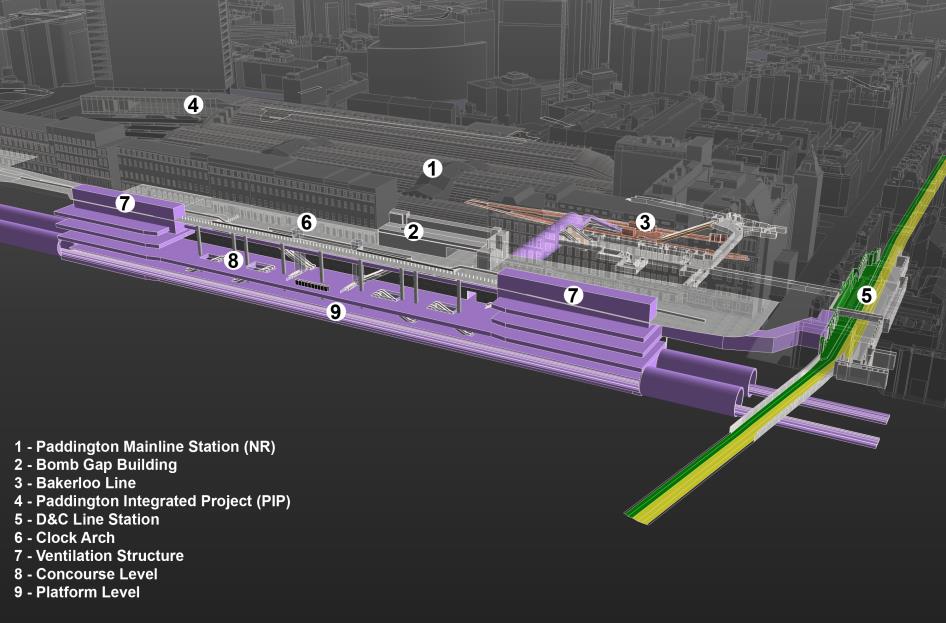
In the building of the Crossrail station, a tunnel with full step-free access is being dug under the concourse of the main line station to connect the Bakerloo Line to the Crossrail station. This article in Rail Technology Magazine which is entitled Contract awarded for £40m Bakerloo Line link, gives a lot more details on the tunnel and its building.
I do think that, the techniques used in the building of this tunnel will find applications in other places.
Tottenham Court Road
Tottenham Court Road station will become a double-ended station.
The map from carto.metro.free.fr shows the lines at the station.
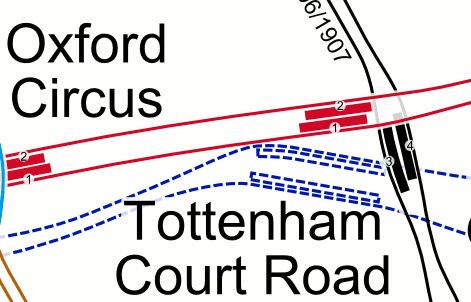
This image shows a visualisation of the station.
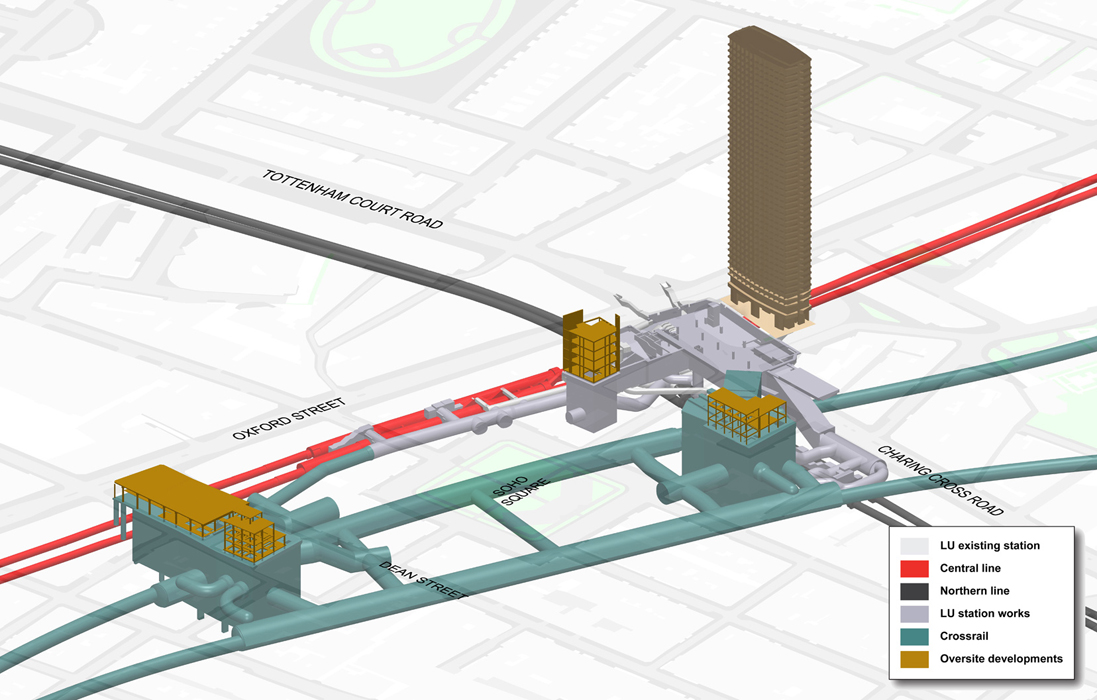
Note Centre Point at the Eastern end of the complex.
The Eastern end of the platforms will have access to the Central and Northern Lines and numerous entrances in front of Centre Point. Much of this work is now substantially complete.





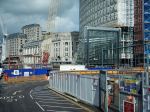
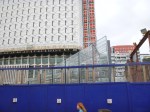
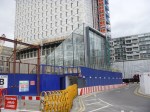
The Western end of the platforms will have access to a new entrance on Oxford Street, just North of Soho Square.

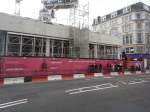
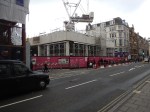
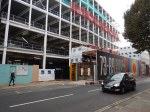
As Oxford Street and Tottenham Court Road will have a lot more pedestrian access, travelling to the area will be transformed.
Bond Street
Bond Street station will become an enormous double-ended station.
The map from carto.metro.free.fr shows the lines at the station and the nearby Oxford Circus station.
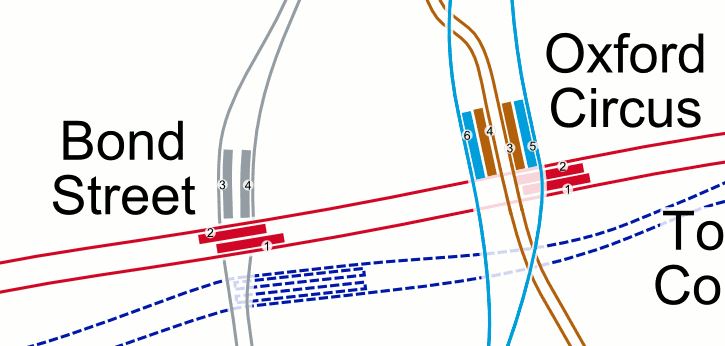
This image shows a visualisation of the station.
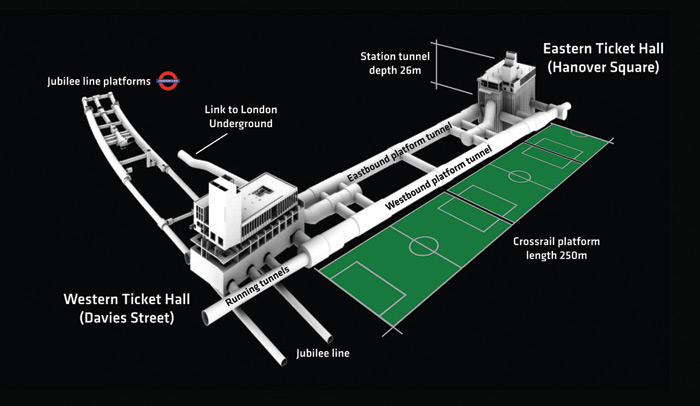
Note the football pitches, which give an idea of size.
Bond Street station will have an interchange at the Western end with the Central and Jubilee Lines, but it will mainly be a station with entrances all over the place.
I have a feeling that Bond Street will the station of choice for most shoppers going to and from the area in the future.
If you’re using Crossrail, just make sure that you get in the right end of the two hundred metre long trains.
Oxford Circus
No work is planned here at present, although I think the station will suffer collateral benefits from the following projects.
- The new Eastern entrance to Bond Street station, which will be ideal for John Lewis.
- The pedestrianisation in the area.
- Works to improve the Bakerloo Line, prior to its extension to Lewisham.
Oxford Street station needs more passenger capacity and is scheduled to be rebuilt in the next ten years or so.
I wouldn’t be surprised to see that if a block anywhere close to Oxford Circus gets redeveloped, Transport for London will be investigating how to get much-needed lifts to the Bakerloo and Victoria Lines.
I have a feeling that we could see something special at Oxford Circus station.
I wouldn’t discount a travelator connection between Oxford Circus station and the Eastern entrance to Bond Street station.
Bank
After Crossrail, the biggest station project in London is Bank station.
The map from carto.metro.free.fr shows the lines at the station.

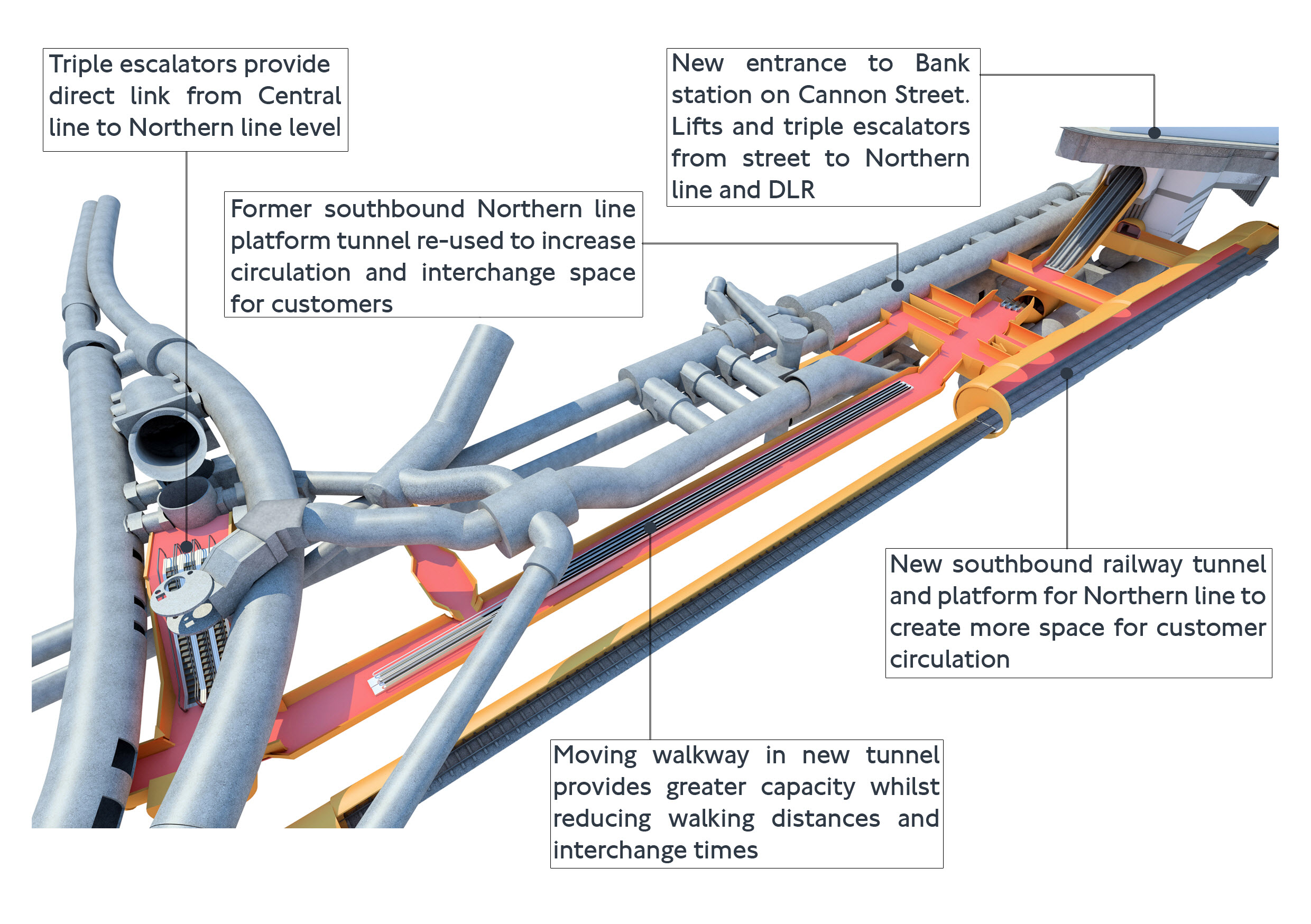
This visualisation, shows what the new Bank station will look like.
The development is comprehensive.
- Two new entrances at Walbrook and Cannon Street.
- Full step-free access with lots of new lifts and escalators.
- Two travelators running North-South through the station.
- A new tunnel for the the Northern Line, with wider platforms.
- Escalator connection between Central and Northern Lines.
- Better connection to the Waterloo and City Line and the Docklands Light Railway.
Completion dates look like 2017 for the Walbrook entrance and 2021 for the completed Bank station.
In some ways Bank station can be considered a Crossrail station, that isn’t on Crossrail.
But it is on the route of one of Crossrail’s little helpers; the Central Line.
Travellers will do one of the following.
- From the Eastern branch of Crossrail,, they will walk across the platform at Stratford station and get the Central Line for a few stops to Bank.
- From the Western branch of Crossrail, they will change at Tottenham Court Road station and get the Central Line for a few stops to Bank.
- From any of the three Crossrail branches, they could use the Central or Northern Lines from Liverpool Street/Moorgate for one stop.
I would walk!
I think that this development will have one of the largest effects of any non-Crossrail transport-related project in London.
I also think that the expansion of Bank station sets a very good precedent.
Both the new Walbrook and Cannon Street entrances are being incorporated into new commercial developments in the area. I know land in the City of London is probably some of the most expensive in the World, but how many improved stations could incorporate housing, retail or commercial development, or perhaps even a hospital.
Victoria
Victoria station is undergoing a major upgrade.
The map from carto.metro.free.fr shows the lines at the station.

Progress has been made with a new entrance on Victoria Street and better connections between the three Underground Lines.
In some ways the biggest triumph at Victoria has been the ability to keep the station working fully, whilst the work is continuing.
A Philosophy For Better Underground Stations
- A large number of passengers.
- More than one line.
- Development above the station.
- Innovative tunnelling.
- Keeping the stations open if possible.
It would also appear that generally the construction companies do a good job and must be accumulating a large amount of knowledge and experience.
So where will they be using their skills next?
A Few Suggestions follow.
One Line Step-Free Stations
This group aren’t Underground stations, in the true sense of the word, but are a collection of Overground, Crossrail and National Rail stations in London that are being updated to full step-free access.
Included are.
- Abbey Wood – In Progress For Crossrail
- Acton Main Line – In Progress For Crossrail
- Alexandra Palace – Future Planned
- Barnes – Future Planned
- Battersea Park – Future Planned
- Bexley – Future Planned
- Blackhorse Road – In Progress
- Brentwood – Completed For Crossrail
- Brondesbury – Future Planned
- Burnham – In Progress For Crossrail
- Coulsdon South – Future Planned
- Ealing Broadway – In Progress For Crossrail
- Ewell West – Future Planned
- Finsbury Park – Future Planned
- Forest Gate – In Progress For Crossrail
- Gidea Park – In Progress For Crossrail
- Goodmayes – In Progress For Crossrail
- Hackney Central -Future Planned
- Hackney Wick – In Progress
- Hanwell – In Progress For Crossrail
- Harold Wood – In Progress For Crossrail
- Hayes and Harlington – In Progress For Crossrail
- Hither Green – Future Planned
- Ilford – In Progress For Crossrail
- Iver – In Progress For Crossrail
- Kensal Rise – Completed
- Langley – In Progress For Crossrail
- Maidenhead – In Progress For Crossrail
- Manor Park – In Progress For Crossrail
- Maryland – In Progress For Crossrail
- Palmers Green – Future Planned
- Peckham Rye – Future Planned
- Petts Wood – Future Planned
- Plumstead – Future Planned
- Romford – In Progressw For Crossrail
- Selhurst – Future Planned
- Seven Kings – In Progress For Crossrail
- Seven Sisters – Future Planned
- Shenfield – Completed For Crossrail
- Shortlands – Future Planned
- Southall – In Progress For Crossrail
- South Tottenham – Completed
- Stratford – Completed For Crossrail
- Streatham – Future Planned
- Taplow – In Progress For Crossrail
- Teddington – Future Planned
- Tottenham Hale – In Progress
- Virginia Water – In Progress
- Walton-on-Thames – Future Planned
- West Drayton – In Progress For Crossrail
- West Hampstead – Future Planned
- White Hart Lane – Future Planned
- Whitton – Completed
Note that Crossrail will mean that twenty-four suburban stations will receive full step-free access.
Network Rail publishes this page on their web site, which is entitled Access For All – A-Z of station improvements.
It gives at least a clue to Network ail’s plans for particular stations.
Crossrail’s High-Tech Leak System At Moorgate Station
Moorgate station is being rebuilt for Crossrail, with a lot of development above the station.
These pictures, show their new high-tech system for protection passengers from the dangers of water leaks.




Some things just can’t be improved upon!
Crossrail Will Be Making Noise On Moorgate
I received an e-mail from Crossrail today entitled Access Passage Under Moorgate.
This is said.
We are making progress with the tunnel connections between the Crossrail Moorgate ticket hall and the station platforms.
From the evening of Wednesday 9 November until Saturday 12 November 2016, we will break out the connection between the top of the escalator shaft and the access passage to Moorgate.
As we are breaking out concrete, there is likely to be some audible ground borne noise and vibration for occupants of nearby buildings and we apologise in advance for any inconvenience caused.
Hopefully, I won’t hear it a couple of miles to the North.
Seriously, though, I don’t think you can get fairer than that, especially, as the works at Moorgate so far, don’t seem to have been particularly disruptive.
The e-mail also pointed me to this cross-section of the station and the works.
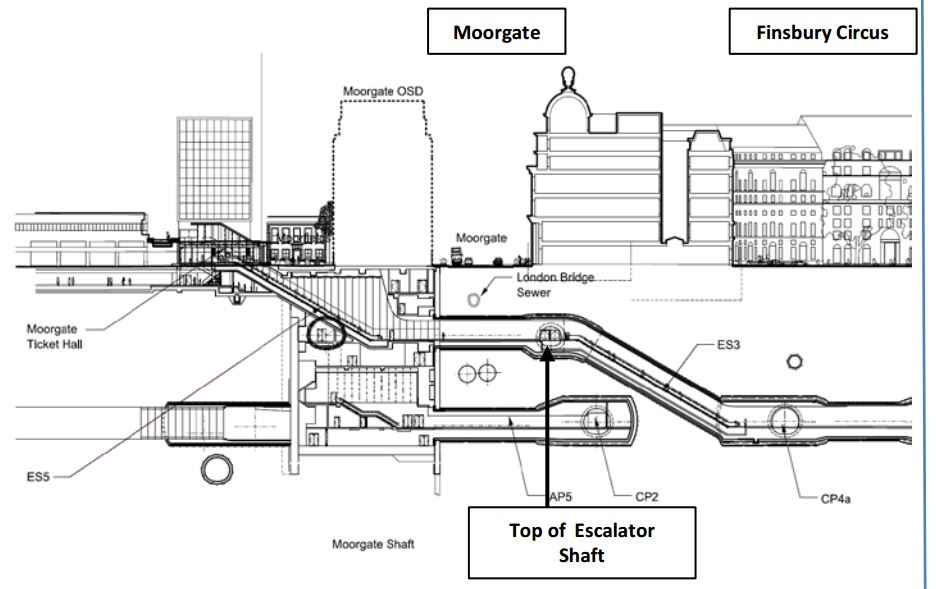
East-West Cross-Section Of Moorgate Crossrail Station
Note.
- Two banks of escalators are used to descend to Crossrail at Moorgate station.
- It is a similar arrangement at Liverpool Street station.
- If you’re walking between the two stations, a good proportion ofthe journet wil be on escalators.
- I think that the two smaller tunnels running under Moorgate and below the lower bank of escalators are the Northern Line tunnels.
It looks like the design has followed the rule of trying to keep to using only North-South and East-West routes for the tunnels.
Could A Reversing Siding Be Built At Alexandra Palace?
I have recently suggested two new or uprated services.
- In Could Passenger Services Be Run On The Canonbury Curve?, I talked how a Finsbury Park to East Croydon service could be a valuable part of London’s rail infrastructure.
- In A North London Metro, I talked about how Northern City Line services out of Moorgate station could be developed into a high-capacity link to Crossrail.
Both of these services could benefit with the ability to turn trains before the Hertford Loop Line splits from the East Coast Main Line.
A Reversing Siding At Alexandra Palace
One possibility is to create a reversing siding at Alexandra Palace station, which would allow the station to be used as a terminus from services from the South.
This map from carto.metro.free.fr shows the lines at the station.
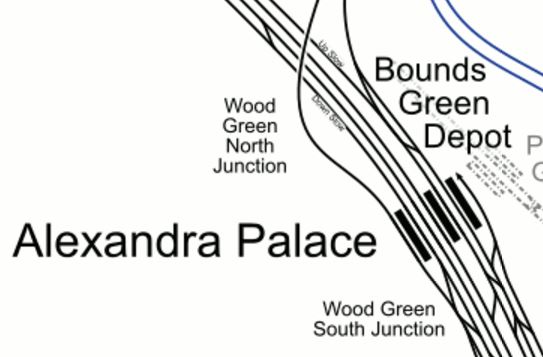
Alexandra Palace Station
Note.
- The fast lines of the East Coast Main Line run through the middle of the station, with the main slow lines on either side.
- The two widely separated tracks going North are the Hertford Loop Line.
- Ignore the blue line, which is the Piccadilly Line.
- The platforms are numbered from East to West and there are four usable faces.
- The most Westerly face is numbered 4 and serves trains going to the Hertford Loop Line.
- Sharing the island with platform 4, is platform 3, which handles direct stopping trains to Welwyn Garden City and the North.
- The layout of platforms 3 an 4 means that there is a step-across interchangebetween trains going on the different routes.
- Platforms 1 and 2 are on the Eastern side of the station and most of the trains from both go to Moorgate.
- Thameslink services will probably use platform 3 going North and one of platform 1 or 2 going South.
- There are a large number of crossovers South of the station to sort the trains between various combinations of routes and platforms.
It is an simple and efficient layout, which keeps local services away from the fast lines in the middle.
But look at this Google Map, which shows Wood Green North Junction, where the East Coast Main Line and the Hertford Loop Line split.
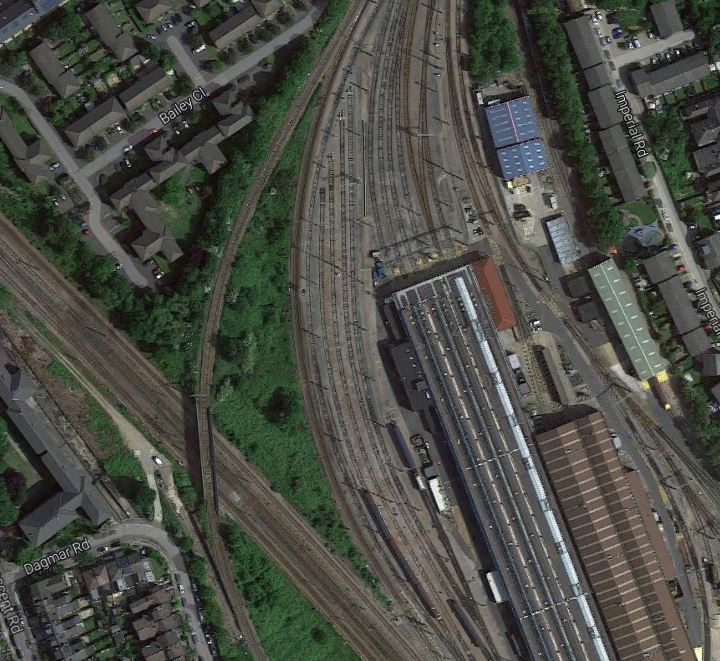
Word Green North Junction
After the down line of the Hertford Loop Line crosses over the East Coast Main Line on a viaduct, it runs through an area of green, with the up line on the other side. Surely, it would be possible to shoe-horn one or even two reversing sidings into this plot, that could at least take six-car trains.
These are some pictures of the area



Probably only the resident wildlife find it attractive.
So a train reversing at Alexandra Palace station would go through the following procedure.
- The train would arrive in the down Hertford Loop Line platform 4 at Alexandra Palace.
- Any passengers still left, would leave the station or catch another train.
- The train would then proceed to the reversing siding between the two lines of the Hertford Loop Line.
- The train would then start its return journey in the up Hertford Loop Line platform 1 or 2 at Alexandra Palace.
Note.
- The train would have been able to reverse without affecting traffic on the fast lines.
- As a maximum of perhaps six trains per hour will be using the Hertford Loop line, there is plenty of spare capacity for extra trains.
- Reversing sidings are always useful when there are problems like failed trains or blockades.
- If it could take an eight-car Class 700 train, it might have uses for Thameslink.
It is one of those small lengths of railway, that if it were properly designed could have a lot more uses than is obvious.
I am also very surprised that as the space is there between the tracks of the Hertford Loop Line, that it hasn’t been used for something productive before.
The Existing Reversing Siding At Bowes Park Station
Bowes Park station is the first station on the Hertford Loop Line. This is said in the Wikipedia entry for the station.
To the north of the station is a single siding in between the two running tracks which is occasionally used to turn around East Coast InterCity 225 and 125 trains heading for Bounds Green Depot just north of Alexandra Palace..
There is a good image on the Railway Herald web site, of an InterCity 125 using the Bowes Park Reversing Siding from August 2016.
Looking at the picture, I wonder if there is space for more than one reversing siding.
The Future Of Bowes Park Station
Bowes Park station is a long wide island platform with rather rudimentary buildings in the middle and stairs up to a bridge over the line.
It must be due a rebuilding to at least add step-free access to the station.
But as it is a valid out-of-station interchange to the Piccadilly Line at Bounds Green station and it has a reversing platform to the North, could this station be in for something more substantial?
Conclusion
I would suspect that Network Rail and the various train operators, are looking at a comprehensive solution in this area that is to everyone’s satisfaction.
At least they start from a good base.
- Alexandra Palace station has a good layout of platforms.
- Interchange between all down services at Alexandra Palace station, uses a single island platform with two faces.
- Up services have two platforms. connected by a bridge.
- There is already a long reversing siding at Bowes Park.
- Trains for the Hertford Loop from the South cross the East Coast Main Line on a flyover.
But above all there is no shortage of space
Related Posts
A Numerical Analysis Of Great Northern’s Class 717 Trains
Could A Reversing Siding Be Built At Alexandra Palace?
Could A Reversing Siding Be Built At Alexandra Palace?
Liverpool Street Crossrail Station Disentangled
A North London Metro
My Memories Of The Lines Out Of Moorgate And Kings Cross
I grew up in North London and I can remember when the suburban services into Kings Cross were hauled by N2 tank engines and later when these were replaced by the Class 105 diesel multiple units.
Around 1970, I used to commute to Welwyn Garden City from Kings Cross and I regularly got Cambridge trains, that were coaches with compartments pulled by the then ubiquitous Class 31 diesel locomotives.
All changed in 1976, when the Northern City Line out of Moorgate and the East Coast Main Line out of Kings Cross were electrified and Class 313 trains started to work the lines.
They still do!
The Current Route
The East Coast Main Line, running North through Finsbury Park is four-tracked with separate fast and slow lines.
There is also the Hertford Loop Line, which effectively gives the route a second set of slow lines between Alexandra Palace and Stevenage.
The two lines have a network of fourteen suburban stations,, where each links with a rather measly three tph into Moorgate.
The line has a few good features.
- The Hertford Loop has grade-separated junctions at both ends and is electrified throughout.
- There are decent termini for the services at Gordon Hill, Hertford North, Letchworth Garden City and Welwyn Garden City.
- There is a flyover at Welwyn Garden City to enable prompt turnaround of the trains.
- The lines allow the trains to use their maximum speed.
- Interchange between the two services at Finsbury Park and Alexandra Palace is generally good.
But the route has the problem of a voltage change between the tunnel to Moorgate and the rest of the line at Drayton Park station, which adds a couple of minutes to every journey.
The Current Service
The current service is three trains per hour (tph) that trundle as fast as their 75 mph top speed and age will allow to the two main destinations of Welwyn Garden City and Hertford North stations. One of the trains from Hertford North in every hour continues to Letchworth Garden City.
This is not the frequent service that attracts new passengers and at least an extra train per hour is needed.
As an example, I can get a direct bus every two or three minutes or so to Essex Road station, from where I can get trains to the North.
But three tph to the two destinations and six tph to Alexandra Palace is not the sort of service on a commuter route out of London. Four trains would reduce my maximum wait for say a Hatfield train from twenty to fifteen minutes.
But there are reasons for this level of service.
- There probably aren’t enough trains.
- Their performance is inadequate.
- The complications of the route, which involves changing voltage at Drayton Park station, slows the service.
Even so they do manage to squeeze 12 tph into Moorgate in the rush hours.
Service Improvements In 2018
In the Wikepedia entry for Bowes Park station, the following is said.
From 2018, the pattern is due to change when Moorgate services via the Hertford loop are curtailed at Stevenage using a new terminating platform there:
- 2 tph Great Northern service Moorgate – Stevenage
- 2 tph Great Northern service Moorgate – Hertford North
This information is not given elsewhere, so I suspect it’s either from someone, who’s got good knowledge or wrong. There is no reference to the source of the information.
But, 2018 is when the new trains will start serving the line. So the Hertford Loop Line could be getting an extra train per hour.
Infrastructure Improvements
There are various infrastructure improvements that need to be done to squeeze the maximum capacity out of the system.
- The archaic voltage change at Drayton Park should be replaced with one using the best modern technology and practice.
- The maximum line-speed on the Hertford Loop Line should be increased to 100 mph wherever possible.
- Platforms should be improved to ease getting on and off trains and facilitate easy interchanges between trains.
- It looks like a bay platform is being built at Stevenage to serve the Hertford Loop Line.
- Would there be any advantage in creating a passing loop or adding a fourth platform at Gordon Hill station?
In addition, I do think that there are opportunities for new stations on the Hertford Loop Line.
The New Class 717 Trains
New Class 717 trains have been ordered to send the Class 313 trains to the scrapyard.
These are similar to the Class 700 and Class 707 trains, so I think we can assume.
- They will have a top speed of 100 mph, where the track allows it.
- They will brake and accelerate faster than the current trains and with better door machinery should save time at every stop.
But I would also suspect that they will handle the voltage change at Drayton Park more efficiently.
It would appear from my calculation in A Numerical Analysis Of Great Northern’s Class 717 Trains, that there are enough Class 717 trains on order for a four tph service to all stations, with 2 tph onwards to Letchworth Garden City or more likely Stevenage.
As the Wikipedia entry for Bowes Park station says 4 tph from 2018, I think it is reasonable to expect that Welwyn Garden City gets the same treatment.
This would produce an eight tph service between Alexandra Palace and Moorgate.
Current timings from Moorgate are.
- Hertford North – 50 minutes
- Welwyn Garden City – 51 minutes
- Stevenage – 63 minutes
So this means one shorter round trip could be done in two hours and a combination of a short and Long one in four.
This would mean.
- 4 tph to Welwyn Garden City would require 8 trains
- 6 tph to Welwyn Garden City would require 12 trains
- 4 tph to Hertford North/Stevenage would require 8 trains
- 6 tph to Hertford North/Stevenage would require 12 trains
But because the Class 717 trains are faster, have a better stopping performance and would probably save time in changing voltages, I wonder if the shorter round trip could be reduced to ninety minutes, with the combined trip at three hours.
This would mean.
- 4 tph to Welwyn Garden City would require 6 trains
- 6 tph to Welwyn Garden City would require 9 trains
- 4 tph to Hertford North/Stevenage would require 6 trains
- 6 tph to Hertford North/Stevenage would require 9 trains
So if the trains and the drivers can perform, it might be possible to have enough trains for a six tph service on both branches with a 12 tph service between Moorgate and Alexandra Palace.
One consequence of running 12 tph into Moorgate all day, might be that there would be no room for extra trains in the Peak. But the service in the Peak of twelve six-car tph would still have the same capacity as the current one
I think that Great Northern’s objective is to run twelve trains into Moorgate all day, with half serving each branch.
The full service to and from Moorgate would probably need 18 trains.
In A Numerical Analysis Of Great Northern’s Class 717 Trains, I said that a 2 tph service between Kings Cross and Foxton would require six trains, that would see the fleet fully utilised.
The Link To Crossrail
In Liverpool Street Crossrail Station Disentangled, I showed that changing between Crossrail and the Northern City Line at Moorgate could be easy.
I have a feeling that with eight or even twelve tph running into Moorgate, many passengers will change at Moorgate to and from Crossrail, even if they want to go to and from places like Hatfield or Potters Bar, for which they can also use Thameslink and a change at Farringdon.
Consider.
- Running twelve tph into a two-platform terminal like Moorgate is way below the frequency of the Victoria Line at Walthamstow Central.
- Half of all trains at Moorgate will go up the East Coast Main Line, with the other half taking the Hertford Loop Line.
- Only one-in-four trains at Farringdon will go up the East Coast Main Line.
- The Moorgate service will stop at all stations to Welwyn Garden City.
- There is a split with suburban trains out of Moorgate and Thameslink out of Farringdon.
- Farringdon to a station on the Hertford Loop Line, would need a second change.
- Canary Wharf to North London and Hertfordshire would be a single change at Moorgate.
Never underestimate the capacity of Londoners to duck and dive to find their best route.
All of this could lead to a lot of passengers on the trains between Moorgate and Alexandra Palace.
The Great North London Metro And Thameslink
If you take the Welwyn Garden City branch of the routes out of Moorgate, it could be running four or possibly six tph between Finsbury Park and Welwyn Garden City. On the same route, according to their latest plans Thameslink will also be running six tph.
Even if they don’t run alternatively, there will certainly be plenty of opportunities to choose to go to Moorgate or take the main Thameslink route.
You might even argue that the Hertford Loop Line and the Northern City Line are just branch lines from Thameslink, with cross- or same-platform interchanges.
But however you put it, the two lines are strongly bound together.
Conclusions
Four tph on both branches with eight tph into Moorgate is certainly possible with the fleet of new trains.
But if the trains can save time at each stop and there are some signalling, voltage-changing and track improvements, I feel it could be possible to run six tph on each branch with twelve tph into Moorgate.
Those sort of frequencies would transform the services out of Moorgate.
They would create a frequent link, which would serve at the Southern end
- Crossrail
- Northern Line
- The City of London
- Canary Wharf
And at the Northern end.
- Thameslink
- Victoria Line
- Piccadilly Line
- North London
- Hertfordshire
It would truly be a Great North Northern Metro.
Related Posts
A Numerical Analysis Of Great Northern’s Class 717 Trains
Could A Reversing Siding Be Built At Alexandra Palace?
Liverpool Street Crossrail Station Disentangled
Liverpool Street station on Crossrail is a massive double-ended beast that stretches as far as Moorgate station, where it has a second entrance.
At the Liverpool Street end, it will connect to the following in addition the the Main Line services out of the station.
- Central Line
- Circle Line
- Hammersmith and City Line
- Metropolitan Line
At the Moorgate end, it will connect to the following lines.
- Circle Line
- Hammersmith and City Line
- Metropolitan Line
- Northern Line
- Northern City Line
This is a visualisation of how Moorgate station will look after it has been rebuilt for Crossrail, that I found on this web page from May 2009, so it may be out-of-date and wrong.
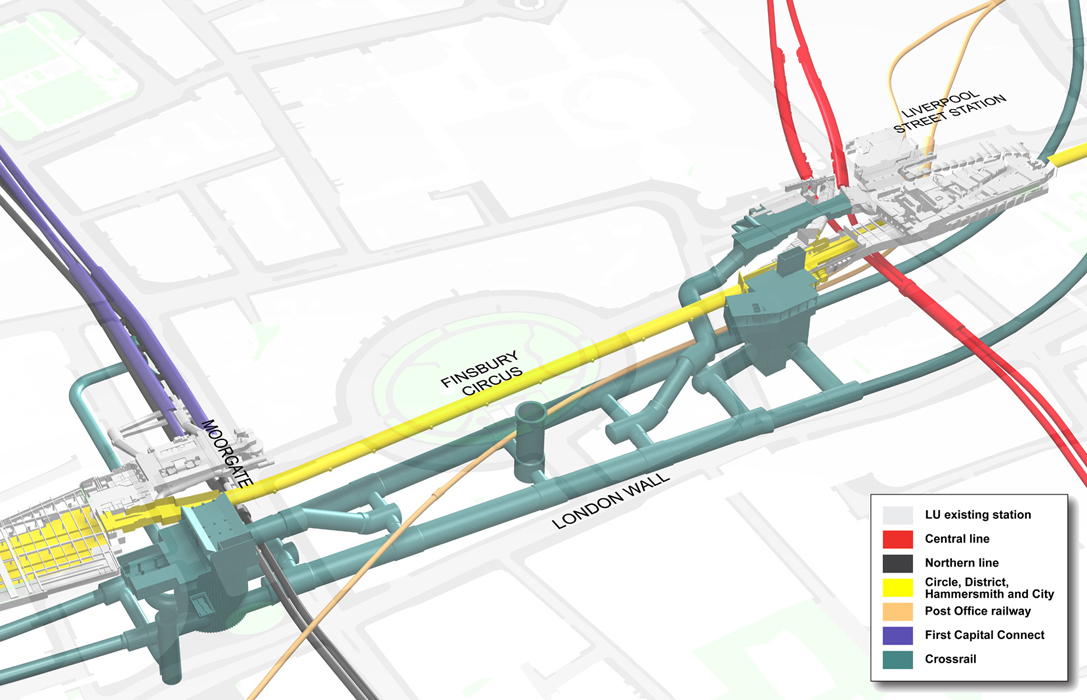
Liverpool Street-Moorgate Station Schematic
Note.
- The royal blue line is labelled at First Capital Connect, for which I use the term Northern City Line.
- Turquoise is used for new Crossrail work, with red and yellow for the Central and sub-surface lines.
- If you enlarge the image by clicking on it, you can clearly see the escalators, that currently connect the Northern City and Northern Lines to the ticket hall.
- Crossrail appears to have an escalator connection to an enlarged Moorgate ticket hall
- The deep level Northern Line, which is shown in black, passes over Crossrail, but underneath the escalators that lead down.
I have since seen a cross-section of the station from Liverpool Street to Moorgate and it would appear that a few improvements have been made.
- A pedestrian tunnel is now planned to run between the Crossrail platforms, which will effectively link the escalators at both ends, which connect into the station entrances and ticket halls upstairs.
- It could be possible that the entrance to the station has been moved towards the East.
The interchanges possible at the combined station are best described as comprehensive.
Changing Between Crossrail And The Northern Line
The Northern Line crosses the Moorgate end of the Crossrail platforms at a right angle and it would appear to have a short escalator or step connection to a cross-passage between the two Crossrail platforms.
The only problem, is that you’ll have to make sure, you’re at the Western end of the Crossrail train.
Changing Between Crossrail And The Northern City Line
It would appear that Crossrail and the Northern City Lines are at roughly the same level and are very well connected.
- Passengers would appear to be able to take an escalator or lift from one set of platforms to the ticket hall and then take another set down to the other line.
- There also appears to be another independent passage, which starts midway down the Northern City Line platforms and takes a circuitous route to the Crossrail platforms.
- There may be another convenient route, where you go via the Northern Line and reappear on the other set of platforms.
It certainly won’t be a difficult interchange for passengers, although you’ll have to remember to position yourself at the Western end of the Crossrail train.
Changing Between Crossrail And The Central Line
The Central Line crosses the Liverpool Street end of the Crossrail platforms at a right angle and it would appear to have a short escalator or step connection to a cross-passage between the two Crossrail platforms.
The connection is not as neat as the Northern Line one at the other end of the Crossrail platforms
The only problem, is that you’ll have to make sure, you’re at the Eastern end of the Crossrail train.
Changing Between Liverpool Street And Moorgate
I’ve read somewhere, that the double-ended station is designed so that passengers can walk easily between the two ends of the station.
My view of the cross-section of the station from Liverpool Street to Moorgate confirms it is a feasble route.
- Passengers at Liverpool Street will descend to an intermediate level, from where the Central Line can be accessed.
- A walk of perhaps fifty metres will take you under the Central Line tunnels and to an escalator, that will descend to a wide passage between the Crossrail platforms.
- A walk of perhaps a hundred metres will give several entrances to the Crossrail platforms and take you to an escalator, which takes you to the intermediate level at Moorgate station.
- A level walk of perhaps thirty metres or so, will take you over the Northern Line tunnels and to an escalator, that gives direct access to the booking hall at Moorgate.
So a passenger from perhaps Ipswich to Hatfield on a very wet day, will dive on arrival at Liverpool Street into the Crossrail station and use it as a dry walking route to the Northern City platforms at Moorgate.
I suspect that an Oyster card or a contactless bank card will give free access to the route.
The same route will give Moorgate passengers access to the Central Line and Liverpool Street passengers access to the Northern Line.
Related Posts
A Numerical Analysis Of Great Northern’s Class 717 Trains
Could A Reversing Siding Be Built At Alexandra Palace?
Could A Reversing Siding Be Built At Alexandra Palace?
Could Passenger Services Be Run On The Canonbury Curve?
How Will House Prices Be Affected By The New Trains In Cuffley?
This was a question, that I was asked by someone, who is thinking of buying a house in the area.
It’s funny how people care more about the price of their house, than getting to work easier and in a reliable way in reasonable comfort, which surely must improve their work performance.
So I did a full analysis of the numbers of trains on the lines out of Moorgate to Hertford North, Welwyn Garden City and Letchworth Garden City to see what they showed.
A Numerical Analysis Of Great Northern’s New Class 717 Trains
I think there are enough trains to run four trains per hour on both routes.
So an extra train an hour must have an affect, if the service is increased!
This question led me to write Could Passenger Services Be Run On The Canonbury Curve?
I am convinced that we’ll be seeing lots of changes on the trains out of Moorgate station and linking from Finsbury Park to Canonury and the East London Line will have lots of benefits for everyone in the North and East of London.
A Numerical Analysis Of Great Northern’s New Class 717 Trains
Great Northern is replacing forty-four Class 313 trains of three-cars with twenty-five Class 717 trains of six-cars to work all services out of Moorgate station and probably some out of Kings Cross station.
So 132 carriages are being replaced with 150, which increases the space by about six percent.
But how many trains are actually needed to work the various routes?
Moorgate To Welwyn Garden City
Moorgate to Welwyn Garden City is a 3 trains per hour (tph) service.
The trip takes 51 minutes, so this means a train can go from Welwyn Garden City to Moorgate and back in under two hours.
We get the number of trains as follows.
- 3 tph needs 6 trains.
- 4 tph needs 8 trains.
- 6 tph needs 12 trains.
Moorgate To Hertford North
Moorgate to Hertford North is a 3 tph service.
,The trip takes 50 minutes, so the needs for the Hertford North are as follows.
- 3 tph needs 6 trains.
- 4 tph needs 8 trains.
- 6 tph needs 12 trains.
Moorgate To Letchworth Garden City
As the extended train to Letrhworth Garden City takes 25 minutes from Hertford North, this probably means that the trains needed for the extended service are as follows.
- 1 extended tph needs another train.
- 2 extended tph needs another 2 trains.
Total Trains On The Northern City Line
So this gives the following totals for trains on the Northern City line.
- 3 tph on each route with 1 tph to Letchworth Garden City needs 13 trains.
- 4 tph on each route with 1 tph to Letchworth Garden City needs 17 trains.
- 4 tph on each route with 2 tph to Letchworth Garden City needs 18 trains.
- 6 tph on each route with 1 tph to Letchworth Garden City needs 25 trains.
I don’t think we’ll see six tph on both routes, as that could be too many trains for the tunnel to Moorgate, which probably has a capacity of less than 10 tph.
Kings Cross To Foxton
In addition, Great Northern run an hourly service between Kings Cross and Foxton, which could use the new trains.
The service takes 75 minutes.
So as the service actually starts and finishes at Cambridge, this probably means the round trip is three hours, so the service will require the following number of trains.
- 1 tph would require 3 trains.
- 2 tph would require 6 trains.
Conclusion
The mathematics say to me, that the number of trains ordered is enough for the following services.
- 4 tph from Moorgate to Welwyn Garden City – 8 trains
- 4 tph from Moorgate to Hertford North – 8 trains
- 2 tph extended from Hertford North to Letchworth Garden City. – 2 trains
- 2 tph from Kings Cross to Foxton and Cambridge – 6 trains.
Although this doesn’t mean that this will be the service pattern.
It’s just if Great Northern wanted to go from 3 tph to 4 tph on the Northern City routes and increase other services, they have ordered enough trains.
Related Posts
Could A Reversing Siding Be Built At Alexandra Palace?
 The Anonymous Widower