Crossrail, HS2 And The Overground Seem To Be Coming Together At Old Oak Common
There has been a report in the Standard, which talks about how Crossrail, HS2 and the Overground could come together at Old Oak Common, which is an area of London ripe for redevelopment.
The report shows this map.
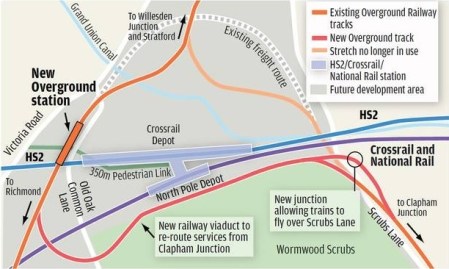
Rail Lines At Old Oak Common
The map is informative and it shows how the West London Line might split from the North London Line at the new Old Oak Common station, rather than at Willesden Junction.
The map though doesn’t show the Dudding Hill Line which joins the North London Line in this area, possibly just south of the new station.
To show the space available in the are, look at this Google Map shoeing the wider area around the proposed station.
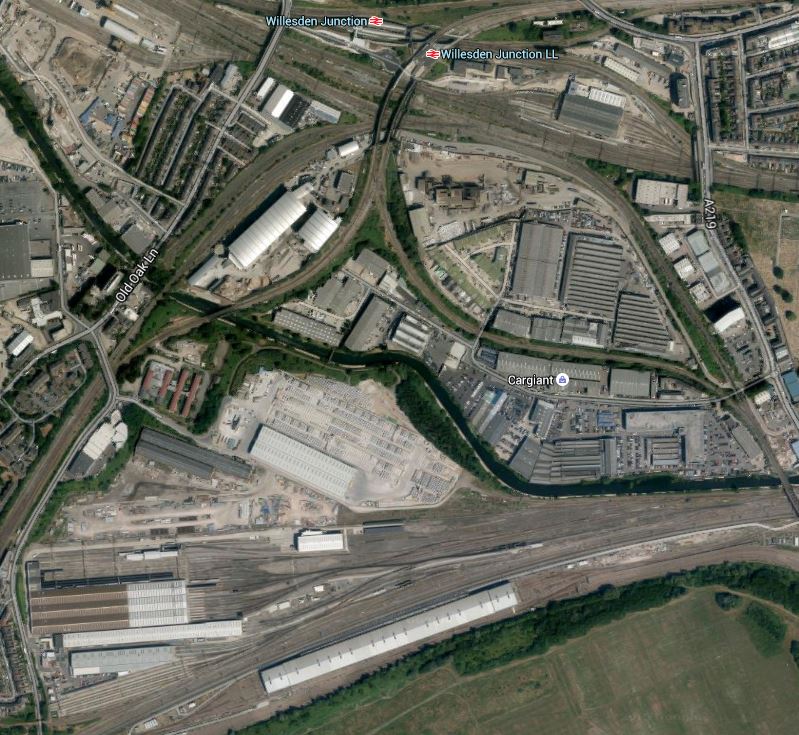
Old Oak Common Area – Downloaded 7th July 2015
There are rail lines everywhere. This second image shows the Southern part of the previous one, along the Great Western Main Line and Crossrail.
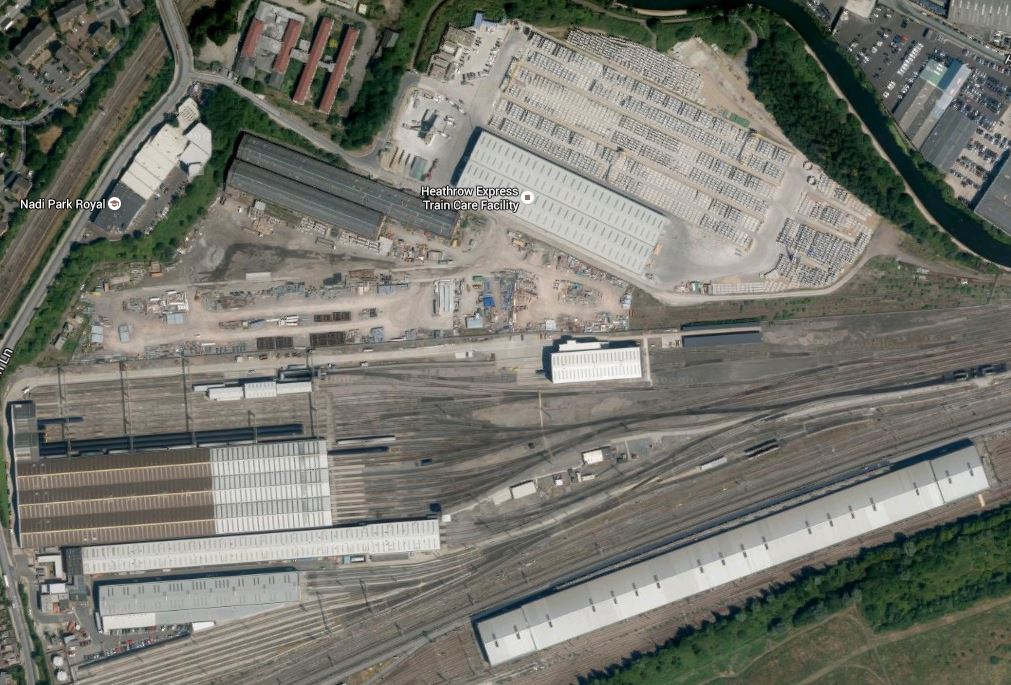
Old Oak Common Detail – Downloaded 7th July 2015
Working upwards from the bottom (South) on this map, you see the following.
1. The long building is the North Pole depot to be used by the new Hitachi Class 800/801 trains, which will be delivered over the next few years.
2. The Great Western Main Line and the future Crossrail tracks.
3. Depots for Heathrow Express and other trains.
4. I think that the large building surrounded by a large amount of grey blobs is the factory that manufactured the tunnel linings for Crossrail.
5. The Grand Union Canal encircles the site.
So could the imaginative minds of the planners at Transport for London have decided to bring the North London Line, an Extended Gospel Oak to Barking Line, Crossrail and HS2 together at the proposed new large development at Old Oak Common? With a little bit more clever design, they might even be able to tie the Central Line into the mix.
I’m all for this personally, as North East London, where I live, will be given a simple route to get to Heathrow and Reading, by just taking the North London Line or the GOBlin to Old Oak Common for Crossrail.
A Vision Of Old Oak Common In The Future
Transport for London’s Transport Plan for 2050 is particularly forceful about what will happen at Old Oak Common.
A key aim beyond this is to integrate Old Oak Common as a Canary Wharf of the future, with around 90,000 jobs and 19,000 homes
They also have a detailed map, showing lines reaching out in all directions, from the junction of Crossrail, HS2 and the Overground. In addition to the links through the Goblin Extension, I’ve traced earlier, there are a possible extension of the West London Line to Balham and a service northwards on the Midland Main Line to somewhere like St. Albans.
So London is getting another hub to complement Stratford and Canary Wharf in the East and Clapham Junction in the South.
Thoughts About The Dudding Hill Line
A friend, who is an expert on the Dudding Hill line or DHL has just e-mailed me after reading my post about Old Oak Common. He says that one of the conditions of the planning permission given for the Radlett Freight Terminal, is that the DHL is opened up, so it can take container traffic. There is a problem at the bridge-cum-tunnel at Harlesden.
I have traced the DHL on the map from where it starts at Cricklewood to past Old Oak Common and on to Acton.
Significantly, its northern end is by Brent Cross Shopping Centre, which is being expanded to form part of the new Brent Cross Cricklewood town centre, for which it is proposed to add a new railway station.
So the line effectively runs between two of London’s biggest and most-needed housing and commercial developments at Brent Cross and Old Oak Common.
I would suspect that there are opportunities for new stations at several places like Neasden and Harlesden.
This whole area of London is rapidly building up a set of questions about public transport that must be answered.
1. How do freight trains from London Gateway and Felixstowe come along the North London line and reach the Radlett Freight Terminal? It’s not clear if it is possible for trains to switch to the Midland Main line in the area of West Hampstead. If not, then that is a possible new piece of infrastructure, that would allow the movements between the ports and Radlett.
2. It has been proposed to put a station at North Acton on the North London line to link with the Central line. Surely, if Old Oak Common is to be built on the Overground, then the interchange to the Underground, would probably be incorporated in that station.
3. Should the Gospel Oak to Barking service be extended past Gospel Oak? As in a few years, this service will be run by new electric trains, which will probably be the Overground’s Class 378, to terminate these services at either Old Oak Common, Clapham Junction or Richmond, would surely make the running of a more frequent service on the GOB easier.
4. If passenger services are to be run on the DHL, then surely this line must be electrified, as this would allow the Overground to run a unified fleet. It would also enable trains to proceed up the Midland Main line, if that was thought to be a worthwhile thing to do. It would also allow freight trains from the west and eventually Southampton to run to Radlett and the north, without a chanmge of motive power en route.
5. If the DHL is electrified then it would probably be using overhead wires, as it effectively links two lines so equipped. So should the short section of the North London line to the west of Acton Central be changed to overhead wires rather than third rail? It would make for a tidier railway, but as the trains are dual voltage, there is no urgency to re-electrify!
The planners in the London Overground part of Transport for London, must be enjoying themselves playing with the best train set in London.
The more I think about all this, especially after seeing how Hackney has responded to being Overgrounded, I come to one conclusion.
If Old Oak Common and Brent Cross stations go ahead, then the Dudding Hill Line must be electrified to take freight trains and an Overground-style passenger train service.
But then what do I know about running trains?
The Ugly Duckling Is Coming To The Aid Of HS2
I’ve called the Overground an ugly ducking that is turning in to a swan before and today, it would appear that it is getting the chance to help out the troubled and unloved HS2. A study has been announced on the Global Rail News website entitled Overground Station For Old Oak Common. Here’s the start of the report.
WSP has been appointed to begin the next stage of planning for a new London Overground station at Old Oak Common.
The consultant is to carry out a Grip 3 study of three options with the hope of establishing the best solution to connect Overground services with the proposed HS2 and Crossrail interchange.
An interchange station at Old Oak Common would certainly make it easier for the good burghers of Hackney and other forgotten areas to access HS2 and Heathrow Airport.
But surely compared to the billions being spent on Crossrail and HS2, a simple interchange station, with links to the Overground, would just be small change. Wikipedia says this.
Proposals being considered by Transport for London include a scheme to realign the routes of the West London and North London line around the Old Oak Common site to create a new London Overground interchange station. The proposal envisages diverting the NLL Richmond route to curve around the eastern side of Old Oak Common, and re-routing the WLL to branch west south of the Mitre Bridge before curving north along a short section of the Dudding Hill Line to join the West Coast Main Line. New platforms serving both the NLL and WLL would be built on the southern side of Old Oak Common, adjacent to Wormwood Scrubs. Alternative versions of this scheme also consider cheaper options such as terminating the WLL at Old Oak Common or two separate London Overground stations.
But perhaps the great and the good don’t want to allow the various plebs and hoi polloi better transport links. They may have also noted that a new station would give better access to Wormwood Scrubs Prison for visitors and escapees.
If Old Oak Common is created as a major interchange, then surely the Gospel Oak to Barking services of the Overground, should be extended at least to the new station. And what about the Dudding Hill line, that passes through the area. Could it finally have found a use except for the odd freight train?
All of this says to me that an Overground station at Old Oak Common is a no-brainer, but then politicians don’t do no-brainers.
Osborne Says Redevelop Euston Before HS2
There is an article in the Standard, where George Osborne says priority should be given to the redevelopment of Euston station, before HS2 is constructed.
I use the station several times a year and compared to Kings Cross, Liverpool Street, Paddington, Waterloo, Marylebone and St. Pancras, it is totally inadequate. It is even worse at the moment, than London Bridge, which is currently a building site.
What makes it so bad, is the lack of connection to the Circle line and the endless dingy walks from the other Tube lines to the station. There is no disabled access to the Underground.
There is a lot of scope to do this rebuilding right. These factors should be considered.
- The effect of the Croxley Rail Link to Watford Junction, which should be completed in 2017.
- Any development at Watford Junction, that could ease pressure on Euston.
- Could Willesden Junction be used to take passengers off the West Coast Main Line?
- Should an Old Oak Common station be built?
Properly planned, rebuilding of Euston,. adds a whole new dimension to HS2. It even questions whether HS2 terminates at Euston!
Could George Osborne’s view on Euston station be coloured, by his own personal experience and those of his constituents?
It doesn’t matter to me, as redeveloping Euston station is good sense, for all sorts of reasons!
More Sense About HS2
The Standard today has this headline on the front page.
Crossrail and HS2 Superhub Will Bring £6bn Boost to North-West London
The article goes on to describe how where HS2 and Crossrail are supposed to meet at the new Old Oak Common station is going to be developed. Here’s the first two paragraphs.
Boris Johnson is to set up an Olympic-style regeneration agency to transform a rundown area into a thriving new district and deliver a £6 billion economic boost to London.
The Mayor wants to use Crossrail links and the planned HS2 route — which will converge at Old Oak Common — to spur the creation of 80,000 homes and 20,000 jobs.
At last someone has seen some sense in how to link HS2 into London. I talked about it earlier, so I won’t repeat myself.
Do We Need A Rolling HS2?
The report today by the think tank, the Institute of Economic Affairs, which says that HS2 will cost a lot more than is currently budgetted for. It’s all reported here on the BBC.
They make a lot of good points in the report.
Extra infrastructure such as trams and trains, will be needed to link other areas to the route.
Extra tunnels and other infrastructure will be needed to buy off the opposition.
The BBC summarises it like this.
The report said HS2 “and the add-on transport schemes will be heavily loss-making in commercial terms – hence the requirement for massive taxpayer support”.
As someone, who is very familiar with project management, I’ve always felt that the logic of HS2 and the way it is being implemented could and will be improved.
If we look at the current rail network, it has problems that will eventually be solved or helped by HS2.
Euston station is not fit for purpose and should be redeveloped and/or relieved. I favour a second terminus of the West Coast Main Line at Old Oak Common, as I mused here.
There are very severe capacity problems on the northern part of the West Coast Min Line between Wigan and Glasgow. This is not part of the current HS2, so perhaps it should be done to make sure the Scots get their connections to the South improved.
The East Coast Main Line to Leeds and Newcastle, has a notorious bottleneck at the Digswell Viaduct and according to this report on the BBC web site, it could be removed for under half a billion.
One problem that HS2 doesn’t solve is the bad connections across the north of England from Liverpool to Leeds and Hull. This BBC report includes an estimate of a billion plus.
So should we just define the route for HS2 and then break it into a series of manageable projects, that are implemented over the years.
We might design large stretches for say 300 kph, but most of the upgraded network would have limits of around 200 to 250 kph. Effectively large sections of the East and West Coast Main Lines can now handle 225 kph and just need resignalling.
The new Class 800 and Class 801 trains will be built to a design speed of 225 kph.
In some ways these trains may be the key to the whole of the expansion of high-speed services. I suspect, we’ll see them on London to Sheffield and Norwich for a start.
Some Sense On HS2
There is a report on the BBC, which says that a new station could be built at Old Oak Common to link HS2 and Crossrail. Here’s the first two paragraphs.
Views are being sought on plans for a High Speed 2 and Crossrail station in west London, as part of a scheme it is claimed could create up to 90,000 jobs.
Greater London Authority is consulting residents on the plan for Old Oak, which it says will generate jobs and see thousands of homes built.
I think it’s a good idea and I suspect many others will too, especially, as it will allow the creation of lots of much needed new homes and jobs in the capital.
Other points include.
- This station would take the pressure off Euston as many passengers coming from or going to the North on HS2 would probably prefer to change to Crossrail for the London end of their journey.
- Would less traffic through Euston mean that the need to rebuild Euston station and its dreadful connections to the Underground, could be sensibly delayed?
- If there is less pressure on Euston, the need for Crossrail 2 is probably less.
- It creates a one change connection between the North and Heathrow Airport.
- If a Thames Estuary Airport is built, then I suspect that would be linked to Crossrail, so that is just one change too.
- This plan creates a link between large areas of West London to long distance rail services, especially if the West London and North London lines were to be improved.
But it does show even more that we need some holistic planning, which sorts out London, its railways and airports for the next thirty years or so.
If you look at the area on a map, you will find that the area is served by several railway lines at present including the Great Western Main Line, the West Coast Main Line, the London Overground and even the Central and Bakerloo Lines of the London Underground. There would also appear to be large areas of industrial land, that would probably be ripe for development.
The Rubbish Talked About HS2
I listened to some of the phone-in about HS2 on Radio 5 this morning, but gave up after most of those in the discussion, weren’t letting facts get in the way of a good selfish argument.
So here’s a few facts and my observations.
The West Coast Main Line is rather a nightmare. It is overloaded now and longer and bigger trains would probably only mop-up a small amount of the increase in passengers that will happen in the next few years. In my travels any Virgin train to or from Glasgow was severely overloaded and this section needs action now.
It was intended that the speed limit on the line would be increased, but because the line isn’t very straight, the cost would be high both in monetary terms and also in blockades whilst it was upgraded. Wikipedia says this about the reasons for the bad design of the line.
Because of opposition by landowners along the route, in places some railway lines were built so that they avoided large estates and rural towns, and to reduce construction costs the railways followed natural contours, resulting in many curves and bends. The WCML also passes through some hilly areas, such as the Chilterns (Tring cutting), the Watford Gap and Northampton uplands followed by the Trent Valley, the mountains of Cumbria with a summit at Shap, and Beattock Summit in southern Lanarkshire. This legacy of gradients and curves, and the fact that it was not originally conceived as a single trunk route, means the WCML was never ideal as a long-distance main line.
The East Coast Main Line is better, but it doesn’t solve the problem on the western side of the country.
So those who talk about increasing the capacity on the West Coast Main Line had better look at the engineering problems involved.
Christian Wolmar, a respected commentator on rail, said on television this morning, that the money for HS2 would be better spent on improving local tranport in cities and large towns, by providing trams and better bus services. He has a point, but there is one fault in his argument.
If we take Manchester as an example, where the tram system is being substantially developed, this will make it easier for long distance travellers to get to Manchester Piccadilly and the West Coast Main Line. If trams are frequent and have substantial car parking outside of the city, it may well persuade many more to take the train rather than driving.
So in fact, his plan will in the long term increase the long distance train traffic increasing the need for long distance services from Manchester and in a decade or so for HS2.
More passengers will also be brought to the line, by improvements to cross country and branch lines. Some of these like Manchester to Leeds are scheduled to be electrified and this can only attract more passengers to the fast London lines, where their local station has no connection.
One point on this is that Network Rail is investing in a special overhead line installation train, that can install a mile of overhead wiring every night with only minimal line closure. This will mean that some lines where only a marginal case exists now, will be electrified. An example is possibly from Felixstowe to Nuneaton via Peterborough, which would allow freight trains to be electric hauled all the way to the North of England and Scotland.
Another big problem is freight, which most would feel is better carried by rail to and from the ports to where it is needed. A few years ago, Felixstowe had just three freight trains a day out of the port. Now it’s a lot higher. Much of the freight will come and go through Felixstowe, Southampton and in the future the new London Gateway development and it will need to be either collected from and delivered all over the country. This would add greatly to the number of freight trains going everywhere. Many of course, will have to go up to Birmingham, the North West and Scotland.
So whatever we do we’ll have to find some way to take the freight north or alternatively free up the West Coast Main Line, by building HS2. Or do we put more trucks on the motorways and clog them up?
Those that propose upgrading the West Coast Main Line with longer and bigger trains, forget one problem, that under the current plans also applies to HS2. And that is what to do with the totally inadequate station at Euston. Of London’s main stations it is one of the worst, as I said here. It will have to be rebuilt whether we build HS2 or not. It really doesn’t have the good ongoing transport links that Kings Cross, Liverpool Street, London Bridge and Paddington have or in some cases will have after Crossrail.
In fact it could be argued that if HS2 has a station at Old Oak Common, this might be a better London terminus for that line, as it links to Crossrail, the Great Western Main Line and possibly Heathrow.
There are also a lot of technology that will make HS2 better from an engineering, environmental and passenger point of view.
For a start tunnelling technology has improved substantially in the last decade or so. If you look at the speed of building the Crossrail tunnels, I think that this shows a big increase to the similar tunnels bored for HS1. Having listened to Justine Greening’s statement in the House of Commons, this improvement is being used to put more of the line underground. We may actually be getting to the point, where tunnels are cheaper to build that lines on viaducts.
We also know a lot more about how to minimise problems when we build large projects. Crossrail for example seems to be causing a lot less problems with construction than HS1 did. Admittedly, it has caused a bit of a problem at some Central London station sites, but no more than say the average large building site or an office block.
Project management has also got a lot better over the last few decades and it is much more likely these days that a large contract is built on time and on budget. Provided the politicians and the civil servants don’t stick their oar in too much and change the specification, it will be all right in the end.
As the Sunday Times pointed out at the weekend design is getting better and the trains on HS2 could be a lot better than Eurostar. We might also see other technologies like anti-noise cutting the noise signature of the trains.
It has also been said that passengers won’t use HS2 because it will be too expensive and too much hassle. But here is where technology will help, in such things as buying tickets, where hopefully we’ll see a touch-in touch-out system like Oyster.
So the doom-mongers will continue to knock HS2, but it has a lot going for it.
The trouble with rail projects, is that if we had a referendum about spending £32 billion on rail or the same amount on roads, the public would vote for the roads. But within a few years they’d be just as gridlocked.
 The Anonymous Widower