Should Crossrail Be Extended From Old Oak Common?
In How Will Chiltern Railways Serve Old Oak Common?, I looked at the possibilities of how Chiltern Main Line services will use the Old Oak Common station complex as an additional London terminus to ease the overcrowding at Marylebone station.
In Will Crossrail Go Up The West Coast Main Line?, I looked at why the extension of Crossrail to Milton Keynes was announced and then cancelled as it was thought to be bad value for money.
But is the general principle of extending Crossrail from Old Oak Common onto a new branch or branches a good idea?
Crossrail Revenue And Profit
If you’re running any railway, you get the highest revenue by running as many trains as you can and making sure that they are full with passengers all the time.
The Central Section of Crossrail between Stratford and Paddington stations will be very heavily used, as it will have to handle the following passenger flows.
- Passengers from the Abbey Wood Branch going to and from Central London
- Passengers from Heathrow going to and from Central London
- Passengers from the Reading Branch going to and from Central London
- Passengers from the Shenfield Branch going to and from Central London
- Passengers from National Rail services at Liverpool Street going to and from Central London
- Passengers from National Rail services at Paddington going to and from Central London
In addition it will also be used as an extra Underground line in Central London
The Central Section will be a cash cow for the Crossrail operator!
The various branches to and from Abbey Wood, Heathrow, Reading and Shenfield, may well be less heavily used, but will probably see a different type of passenger to the Central Section, who might need more space and hopefully a seat.
The Class 345 Trains
The Class 345 trains have been designed for efficiency and flexibility.
- I believe that each car is a separate one-car electric train with its own function.
- Most cars will be motored to distribute traction and braking forces along the train.
- I wouldn’t be surprised to see a battery in each car to handle regenerative braking.
- Cars are joined together to make a train of an appropriate length.
- Initially, the trains are starting at seven cars, but will go to nine cars and possibly ten.
- The interiors have been designed to satisfy both needs of a long distance commuter train and a London Underground train.
The operator will be able to configure the trains as new routes are added and passenger levels change.
Comparing Crossrail And The Victoria Line
It is worthwhile to compare the Central Section of Crossrail with the Victoria Line.
Crossrail’s Central Section has the following characteristics.
- Twenty-four trains per hour (tph) in both directions
- Automatic train operation (ATO)
- Full-size trains of up to ten carriages long
- Platform-edge doors
- Large stations with lots of wide platforms and passages.
- Double-ended stations ay Liverpool Street-Moorgate, Barbican-Farringdon, Tottenham Court Road and Bond Street.
- Step-free access
- Easy access to connecting lines
- Cross-platform reverse at most stations
Whereas the Victoria Line has the following characteristics.
- Thirty-six tph in both directions
- Automatic train operation
- Tube-size trains of six carriages
- Small stations with lots of narrow platforms and passages
- Some step-free access
- Some easy access to connecting lines
- Cross-platform reverse at most stations
The two lines show a difference in design, very much in keeping with their construction dates.
One comparison is surprising.
Crossrail is planned to run twenty-four tph through the Central Section, but if Dear Old Vicky can manage 36 tph on a line built in the 1960s with generally cramped stations, surely Crossrail with the benefit of some of the best modern design can do a bit more.
I’ve read that Crossrail could handle thirty tph, but then we wondered in the 1960s at the Victoria Line’s fast trains and high frequency in the twenties between Seven Sisters and Brixton. And look at the old girl now!
Dear Old Vicky is second in frequency to parts of the Moscow Metro, which run a train every 95 seconds, as opposed to the 100 seconds of the Victoria.
I suspect that grates with the engineers of the London Underground, as no-one likes being second.
A few years ago, the engineers thought 33 tph between Brixton and Seven Sisters was the limit but now there is 36 tph all the way along the line.
So will we see further improvements to the Victoria Line like these?
- A loop at Brixton via Herne Hill station to turn trains at the Southern end of the line.
- Higher capacity stations at Oxford Circus, Euston, Kings Cross St. Pancras, Highbury and Islington, Finsbury Park and Walthamstow Central.
- Air-conditioned, walk-through articulated trains
- Full step-free access at all stations and platforms
- Improved train control software
- Improved methods of working
These and other improvements will push the frequency towards the magic forty tph.
Do I think that forty tph is achievable on a line built in the 1960s?
As a Control Engineer, trained in the 1960s, I can only give one answer. And that must be yes!
I feel that the stations are the key, as at times stations like Oxford Circus and Walthamstow Central are struggling to handle the number of passengers. Victoria was like that a few years ago, but the addition of a new entrance and more and wider passages has made the station seem a lot less crowded.
Surely, Dear Old Vicky has shown what is possible, when you take a well designed railway and try to ramp up the capacity!
Various commentators have said Crossrail will handle thirty tph, but why are they not being more ambitious?
Comparing Crossrail And Thameslink
Crossrail and Thameslink have a lot in common.
- Frequencies of twenty-four tph through their central sections
- High capacity step-free central stations
- High-capacity purpose-built trains
- Automatic Train Control in the central sections.
But there are differences.
- Crossrail’s central section is straight through from Paddington to Stratford, whereas Thameslink has a junction at Blackfriars.
- Crossrail’s central section has seven stations, whereas Thameslink has just five.
- Blackfriars station is also a terminal station on Thameslink’s central section.
- Crossrail’s stations are generally island platforms, which ease reversing direction, whereas Thameslink’s generally aren’t.
- Crossrail is 25 KVAC overhead electrification throughout, whereas Thameslink has a voltage change at St. Pancras.
I think that although both lines will be opened at a frequency of 24 tph, raising the frequency on Crossrail will be easier than Thameslink.
The Importance Of Increasing Frequency On Crossrail and Thasmeslink
The train capacity on the two routes are as follows.
- A nine-car Crossrail Class 345 train can carry 1,500 passengers
- A twelve-car Thameslink Class 700 train can carry 1,754 passengers
- A eight-car Thameslink Class 700 train can carry 1,146 passengers
Compare this with an eight-car Victoria Line 2009 Stock train, which holds just 876 passengers.
So if Crossrail went from 24 to 30 tph through the central section, that would add extra capacity for 9,000 passengers per hour, between Stratford and Paddington.
Building Crossrail and upgrading Thameslink will bring London two high-capacity cross-London Underground Lines.
The more the frequencies on those lines can be increased the higher will be the capacity of the Underground network in Central London.
Crossrail’s Shenfield Branch
The Branch to Shenfield station has the following characteristics.
- It is an almost completely separated double-track railway between Stratford and Shenfield.
- All stations will be step-free.
- Most trains on the route will be Crossrail’s Class 345 trains.
- A few of Greater Anglia’s similar Aventra trains may use the route.
- The route will have modern signalling and ERTMS.
- It is proposed that initially twelve tph will serve the branch
I believe the track, stations and signalling of the Shenfield Branch could handle up to twenty-four tph.
That figure might seem high, but consider the following.
- Shenfield station has three platforms where Crossrail trains can be turned back.
- Walthamstow Central and Brixton stations handle thirty-six trains tph with just two platforms.
- The track layout at Shenfield can accommodate through trains.
Passenger access to the platforms is probably more of a limiting factor, than the track and platforms.
Timings
Currently, Class 315 trains are scheduled to go between Stratford and Shenfield in thirty-six minutes, with faster Longer distance services doing the trip non-stop in fifteen minutes.
- Crossrail is claiming on their web site, that the Class 345 trains will do the trip in thirty-two minutes or four minutes less.
- But there are eleven station between Stratford and Shenfield. So that is a saving of only around twenty-two seconds a station.
I feel Crossrail is playing their timings very safe.
Future Services
I think the following will happen in a few years.
- The current proposal of twelve tph to Shenfield will be increased to something like fifteen or twenty tph.
- Crossrail timings between Stratford and Shenfield will approach the current fastest time of fifteen minutes between the two stations.
- Fast services to and from North of Chelmsford will stop at Shenfield to enable faster and easier journeys.
- Crossrail could be extended to stations like Beaulieu and Southend Victoria.
- Shenfield will become a major rail interchange.
The East of England will see major changes to its rail network.
Crossrail’s Abbey Wood Branch
The Branch to Abbey Wood station has the following characteristics.
- It is a tunnelled double-track railway between Whitechapel and Abbey Wood stations.
- All stations will be step-free.
- All trains on the route will be Crossrail’s Class 345 trains.
- The route will have modern signalling and ERTMS.
- It is proposed that initially twelve tph will serve the branch
I believe the track, stations and signalling of the Abbey Wood Branch could handle up to twenty-four tph.
Future Services
I think the following will happen in a few years.
- The current proposal of twelve tph to Abbey Wood will be increased to something like fifteen or twenty tph.
- Services on the Abbey Wood Branch will continue to match those on the Shenfield Branch, as this makes journeys between the two Eastern branches easier.
- Crossrail could be extended to stations like Ebbsfleet and Gravesend.
- Abbey Wood will become a major rail interchange.
South East London and Kent will see major changes to its rail network.
Summing Up The Two Eastern Branches
The two Eastern Branches can probably provide as many as twenty-four tph for Crossrail.
As the maximum frequency through the Central Section is probably in the thirties, they can allocate services according to where the traffic lies.
It would also appear that as the two services will use the same platforms at Whitechapel station and trains will be every few minutes, that Crossrail is designed to make journeys between say Ilford and Abbey Wood much quicker than by car.
Crossrail’s Reading Branch
The Branch to Reading station has the following characteristics.
- It is a semi-separated double-track railway between Paddington and Reading.
- All stations will be step-free.
- Most trains on the route will be Crossrail’s Class 345 trains.
- Other services may share the tracks.
- The route will have modern signalling and ERTMS.
- It is proposed that initially six tph will serve the branch; four to Reading and two to Maidenhead.
I believe the track, stations and signalling of the Reading Branch could handle up to twenty-four tph,
Future Services
I think the following will happen in a few years.
- The current proposal of six tph to Reading and Maidenhead will be increased increased.
- Crossrail could be extended to stations like Basingstoke and Oxford.
- Reading will become an even more major rail interchange.
West London and Berkshire will see major changes to its rail network.
Crossrail’s Heathrow Branch
The Branch to Heathrow has the following characteristics.
- It is a fully-separated double-track railway between Airport Junction and Heathrow.
- All stations are step-free.
- Most trains on the route will be Crossrail’s Class 345 trains.
- Other services may share the tracks.
- The route will have modern signalling and ERTMS.
- It is proposed that initially six tph will serve the branch.
I believe the track, stations and signalling of the Heathrow Branch could handle in excess of twelve tph.
Future Services
I think the following will happen in a few years.
- The current proposal of six tph to Heathrow is increased.
- Crossrail could be extended to stations beyond Terminal 5.
- Heathrow Express will fade away.
Heathrow will see major changes to its rail network.
Turning Back Crossrail Trains At Paddington
These services will call at Paddington from the East.
- 12 tph from Abbey Wood
- 12 tph from Shenfield
And these from the West
6 tph from Heathrow
2 tph from Maidenhead
4 tph from Reading
This gives an imbalance, so twelve tph will have to be turned back to the East at Paddington.
Crossrail Services
The provisional service pattern is shown in the Wikipedia entry for Crossrail under Services.
It effectively shows the following services, with times are from Crossrail’s provisional journey time calculator.
- 4 tph – Reading to Abbey Wood – 80/78 minutes
- 2 tph – Maidenhead to Abbey Wood – 67/66 minutes
- 4 tph – Heathrow Terminal 4 to Abbey Wood – 60/60 minutes
- 2 tph – Heathrow Terminal 5 to Abbey Wood – 60/60 minutes (assumed same as previous)
- 12 tph – Paddington to Shenfield – 51/51 minutes
It should also be noted that Paddington to Abbey Wood is 29/28 minutes.
Note.
- The first figure is for the West to East journey.
- The second figure is for the East to West journey.
- There isn’t much difference between West to East and East to West journeys.
This leads me to give these numbers for the trains on each route.
- Reading to Abbey Wood – 12 trains
- Maidenhead to Abbey Wood – 5 trains
- Heathrow Terminal 4 to Abbey Wood – 10 trains
- Heathrow Terminal 5 to Abbey Wood – 5 trains
- Paddington to Shenfield – 24 trains
This totals up to 56 trains.
Note.
- My numbers of trains figures, are very rough and are minimum numbers.
- Provisionally, Crossrail will also be running 4 tph between Liverpool Street and Gidea Park in the Peak, which could need four trains.
- Crossrail have ordered 70 trains.
- Some trains will be in maintenance and others will be held in reserve.
Crossrail seem to have ordered a sensible number of trains for the initial services.
Ceossrail Extension To Gravesend
It would appear that a typical Abbey Wood to Gravesend service takes just under half an hour.
This is with slower twenty-five year old Class 465 trains, so extending services to Gravesend would just add an hour to the round trip.
This would make train timetabling easy.
If the Heathrow Terminal 4 service to Abbey Wood was extended to Gravesend, it would require another two trains.
In addition.
- The Class 345 trains have been designed to run on 750 VDC third-rail electrification, with the addition of third-rail shoes.
- I think that the new track layout at Abbey Wood station could cope with four tph running to Gravesend using the North Kent Line.
- A single platform at Gravesend could turn back four tph.
It does look that to choose Gravesend as an extension for Crossrail could be a very good decision.
The New South Eastern Franchise
This will be a key factor in extending Crossrail to Gravesend and I suspect all bidders will give co-operation with Crossrail, a high priority.
I suspect a new franchise will replace a large proportion of the train fleet with new 100 mph traqins and that the Class 465 trains will be retired.
The new franchise is due to start in December 2018.
When Could A Crossrail Service To Gravesend Start?
I believe that the following infrastructure is ready for a four tph Crossrail service to Gravesend.
- The link between Crossrail and the North Kent Line at Abbey Wood station.
- Platform 0 at Gravesend is a twelve-car London-facing bay platform, that could handle the trains.
- Dartford, Gravesend, Greenhithe stations are step-free.
However, certain things must happen before a Crossrail service to Gravesend could start.
- The new Southeastern franchise must be up and running.
- ERTMS must be installed along the North Kent Line.
- All trains running along the North Kent Line must be 100 mph trains, able to take advantage of modern signalling.
- All stations between Abbey Wood and Gravesend must be made step-free.
The new franchise will probably have its new service pattern and modern trains in place by the end of 2023, which would probably make the Crossrail extension easier.
Before a decision is made on the extension, Crossrail needs a couple of years to find out how passengers use the new line and the other services, which will include Thameslink, that call at Abbey Wood station.
Can Crossrail Be Extended From Old Oak Common?
Before answering the question, the related question of whether it is possible should be answered.
Extending Trains From Paddington
Current proposals envisage twelve trains turning back at Paddington.
It would not be difficult if a number of these trains continued to Old Oak Common station.
Can Paddington To Old Oak Common Handle The Extra Trains?
The current proposals envisage just twelve tph using the route between Paddington and Old Oak Common station, with perhaps a few wxtra trains going to and from Old Oak Common Depot.
As the tunnelled section of Crossrail can handle double that frequency, I suspect there will be no problems extending extra trains to Old Oak Common station.
It would appear that there would be no problems extending services to Old Oak Common station.
Where Would The Extra Services Go?
The choices lie between the Chiltern Main Line and the West Coast Main Line.
If we take Crossrail’s well-thought out choice of Gravessend, I think we need a destination, that is ideally just under thirty minutes from Old Oak Common station.
In the next few sub-sections, I’ll look at possibilities.
Extending To High Wycombe On The Chiltern Main Line
A service between High Wycombe and Wembley Stadium stations takes 27 minutes with stops at Beaconsfield, Gerrards Cross and South Ruislip stations. Taking the Acton-Northolt Line and even with stopping at Seer Green and Jordans, Denham Golf Club, Denham, West Ruislip and Greenford, I’m pretty sure, that a train could go from Old Oak Common to High Wycombe and back in comfortably under an hour.
Four tph between High Wycombe and Shenfield would require twelve trains, which is four more than would be needed for the same service between Paddington and Shenfield.
Consider.
- Four tph could easily be turned back in a single platform at High Wycombe station.
- High Wycombe station has plenty of space.
- However, it would need the route between Old Oak Common and High Wycombe to be electrified.
- But, it is a long-term aim of Chiltern Railways to electrify the Chiltern Main Line.
I believe that High Wycombe station could be a viable terminal for Crossrail.
Extending To Milton Keynes Central On The West Coast Main Line
A service between Milton Keynes Central and Wembley Central stations takes 51 minutes with seven stops.
This would mean that a train could go from Shenfield to Milton Keynes Central in comfortably under two hours.
Four tph between Milton Keyns Central and Shenfield would require sixteen trains, which is eight more than would be needed for the same service between Paddington and Shenfield.
Consider.
- Four tph could easily be turned back in a single platform at Milton Keynes Central station.
- Milton Keynes Central station has space for a terminal platform.
- Except for creating the connection at Old Oak Common and updating stations to full step-free access, the infrastructure is pretty good.
- Crossrail would be linked to the East-West Rail Link.
I believe that Milton Keynes Central station could be a viable terminal for Crossrail.
Should Crossrail Be Extended From Old Oak Common?
It is certainly possible to extend to either High Wycombe or Milton Keynes Central.
If a decision were to be made to extend Crossrail, passenger statistics would probably decide, which would be the extra terminal or terminals.
How Will Chiltern Railways Serve Old Oak Common?
Whilst writing A Proposal For Two London Overground Stations At Old Oak Common, I got to thinking about how Chiltern Railways would use Old Oak Common station as a second London terminus, to relieve pressure on Marylebone station.
Lines At Old Oak Common
This map from TfL shows the lines in the area and the location of the proposed two new stations; Hythe Road and Old Oak Common Lane, for the London Overground.
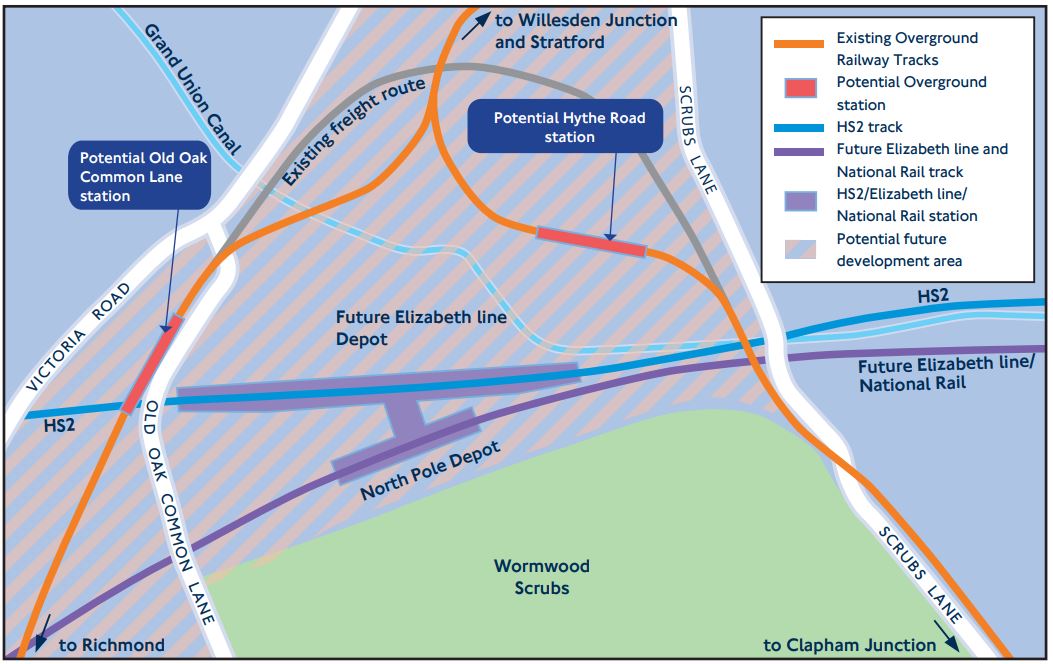
Hythe Road station will be on the West London Line between Willesden Junction and Shepherd’s Bush stations.
Old Oak Common Lane station will be on the North London Line between Willesden Junction and Acton Central stations.
How Will Chiltern Serve Old Oak Common?
Search the Internet for “Chiltern Railways Old Oak Common” and you find little of substance.
So exactly how will Chiltern Railways get trains to the station complex?
Using The Acton-Northolt Line
The Acton-Northolt Line is a logical route from Northolt Junction on the Chiltern Main Line to Old Oak Common.
But there could be problems with the Acton-Northolt Line.
- It will be on top of the tunnel taking HS2 out of London and building HS2 might be difficult.
- It is partly single track and would need to be doubled.
- It might be difficult to find space to build the station at Old Oak Common around the platforms for HS2, Crossrail and the Great Western Main Line.
- Getting tracks to the Northern part of the site for a Chiltern station there, might be difficult.
Points 1 and 2 would probably combine together to delay the Chiltern extension until after HS2 or at least the tunnel, is substantially complete.
This map from carto.metro.free.fr illustrates the problem of finding a place for the station.
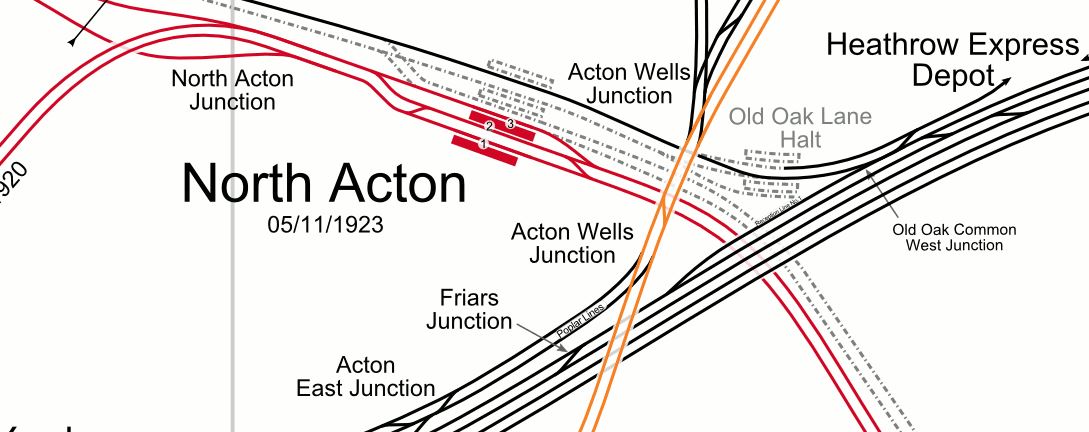
Note.
- The Great Western Railway is the multi-track in black .
- The single track shown in black North of North Action station is the Acton-Northolt Line.
- Old Oak Common Lane station is just to the North of Acton Wells Junction.
- The curves to connect the Acton-Northolt Line to the North London Line would be very tight.
The preferred position for the station is probably in the area of the current Heathrow Express Depot.
An alternative position for the station could be at North Acton station.
This Google Map shows North Acton station and its relation to the proposed Old Oak Common Lane station.
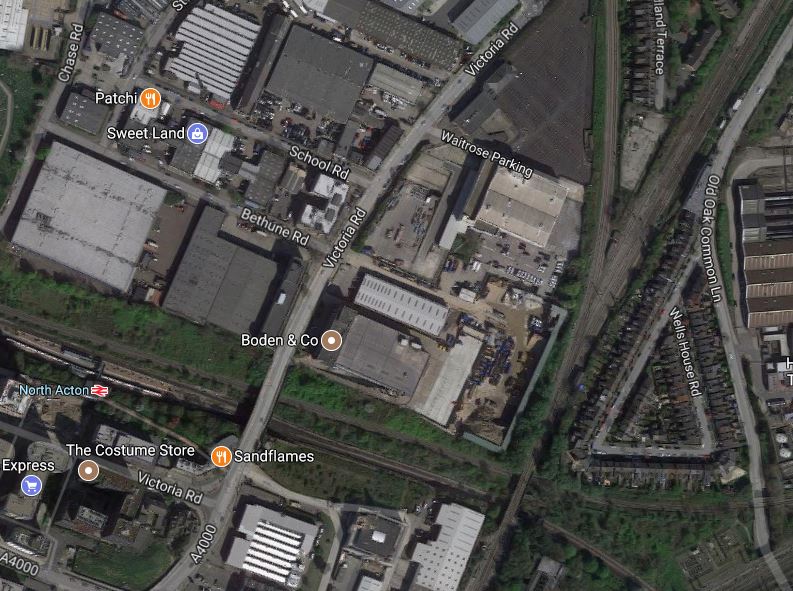
Old Oak Common Lane station would be located North of the Junction, where the Dudding Hill Line and the North London Line split, in the top-right corner of the map.
The rebuilt North Acton station could have the following characteristics.
- Two or possibly three, Chiltern platforms could be built North of the current Central Line platforms.
- The station could have a walking route or moving walkway to connect it to Old Oak Common Lane station and the main Old Oak Common complex.
- It would also fulfil the aims of politicians to link the Central and North London Lines.
It could be a viable alternative with valuable over-site development.
I took these pictures from the bridge, where Victoria Road passes over the Central Line and Acton-Northolt Lines.


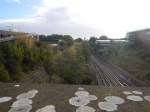
Note.
- The pictures were taken looking East towards Old Oak Common.
- The single-track Acton-Northolt Line is in the shrubbery on the left.
- The Acton-Northolt Line is about two or three metres higher than the Central Line.
- The greyish-blue bridge in the distance carries the North London Line over the cutting.
North Acton station is on the other side of the bridge.
It strikes me that the various levels give possibilities for an improved Central Line layout and a couple of platforms for Chiltern Railways.
Advantages and Problems Of Using The Acton-Northolt Line
The advantages of using this route could include.
- It could open up development sites along the route.
- New stations could be developed at Hanger Lane, Perivale, Greenford, Northolt, South Ruislip, Ruislip Grdens and West Ruoslip.
- The new double-track line could be electrified without disrupting existing services.
- It connects the Chiltern Main Line to HS2 and Crossrail.
- It could enable a Crossrail extension along the Acton-Northolt Line.
The big problem could be doubling the Acton-Northolt Line and building the station, whilst the tunnelling work for HS2 was proceeding.
The Acton-Northolt Line And HS2
I do hope that HS2 is not being designed to block future use of the Acton-Northolt Line.
In fact, I hope the reverse is true and creation of a double-track Acton-Northolt Line is part of the specification for HS2.
Using The Dudding Hill Line
There is a connecting chord between the Chiltern Main Line and the Dudding Hill Line at Neasden.
This map from carto.metro.free.fr shows how trains would get between Wembley Stadium station and the Dudding Hill Line.
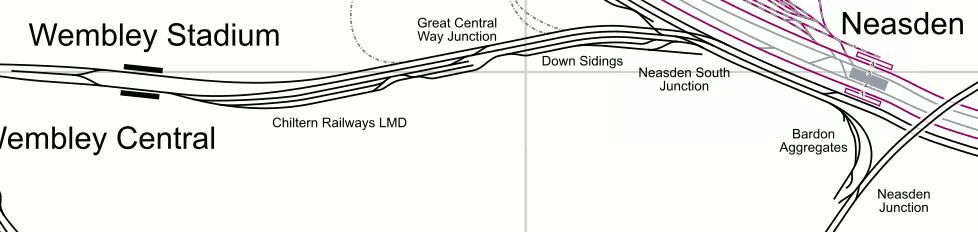
Note.
- The Dudding Hill Line is the line crossing all the tracks to the South of Neasden.
- The route would mean that Chiltern trains would be sent to their destination; Marylebone or Old Oak Common at Neasden.
The biggest problem may be where to put the station, as the Dudding Hill Line passes slightly to the West of the Old Oak Common complex.
But look at TfL’s visualisation for Old Oak Common Lane station.
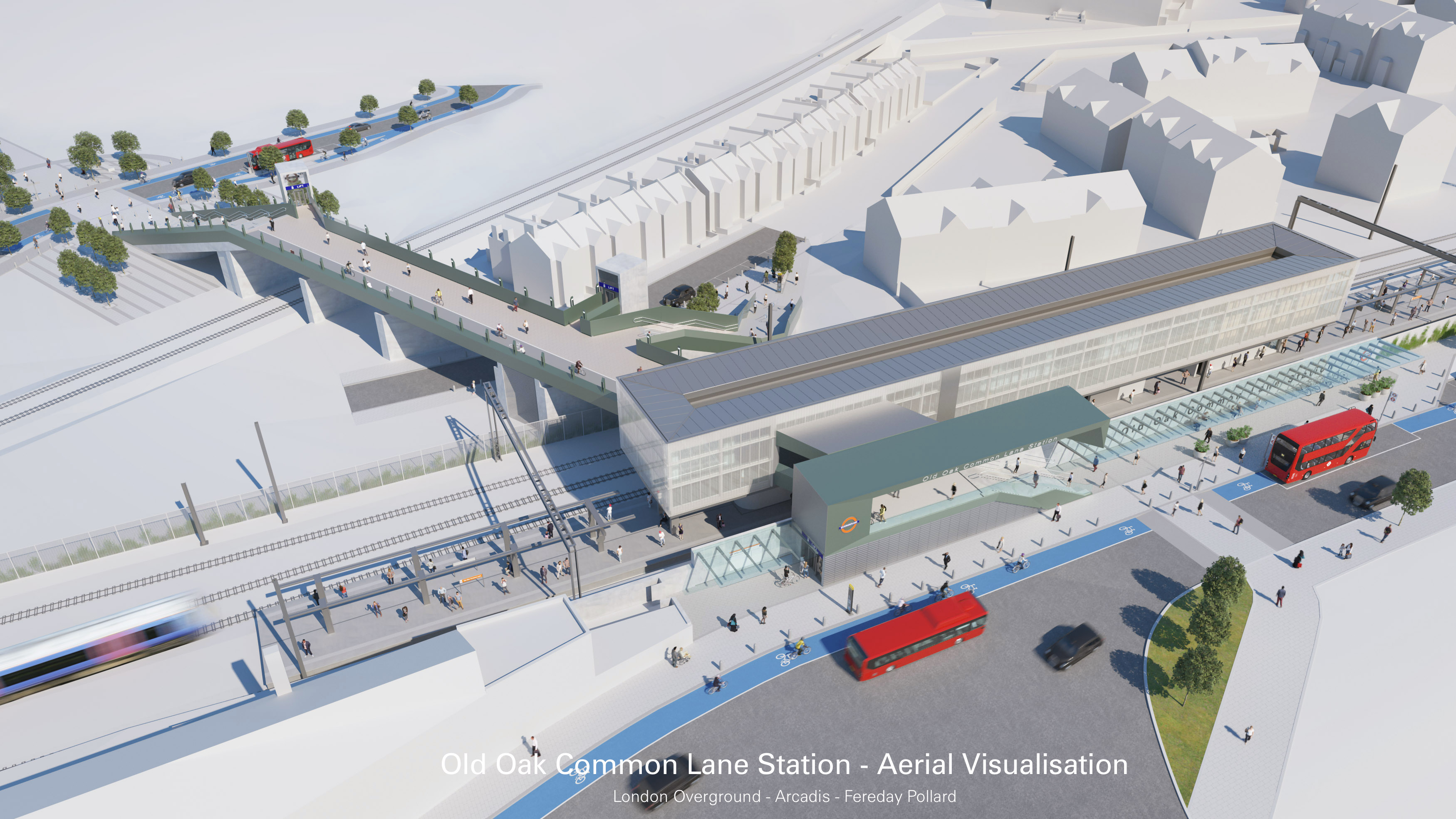
The Dudding Hill Line is shown in the visualisation running under the pedestrian and cycle route to Victoria Road.
This Google Map shows the area in detail.
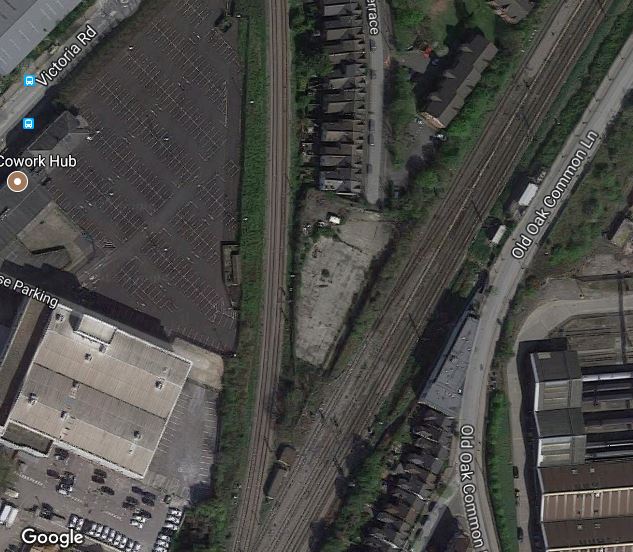
Note.
- The North London Line goes North-East.
- The proposed Old Oak Common Lane station would be built where the road is closest to the North London Line.
- The Dudding Hill Line goes North.
There would appear to be a site ripe for development to the West of the Dudding Hill Line.
Advantages and Problems Of Using The Dudding Hill Line
The advantages of using this route could include.
The station could be built in combination with London Overground’s proposed Old Oak Common Lane station.
- There is a lot of space for the station.
- No new track is required, although the Dudding Hill Line would need upgrading.
- Good connections to HS2 and Crossrail will be built for Old Oak Common Lane station.
- Thestation on the Dudding Hill Line could also be used by the proposed West London Orbital Railway.
- Construction would not be a difficult job and would not affect existing services.
- The site would not be affected by HS2.
The problems are mainly about connectivity to other lines, but well-designed connections to Crossrail and the Central Line would solve a lot of these problems.
Conclusion
There are at least two feasible options for a Chiltern station in the Old Oak Common area.
A Proposal For Two London Overground Stations At Old Oak Common
Transport for London published this proposal a few weeks ago, but it’s only now that I’ve found time to document it here.
TfL’s Proposal
This document on Tfl’s web site, gives full details of their proposals.
The Location Of The Stations
This map from TfL shows the location of the two stations.
Hythe Road station will be on the West London Line between Willesden Junction and Shepherd’s Bush stations.
Old Oak Common Lane station will be on the North London Line between Willesden Junction and Acton Central stations.
This Google Map shows the area.
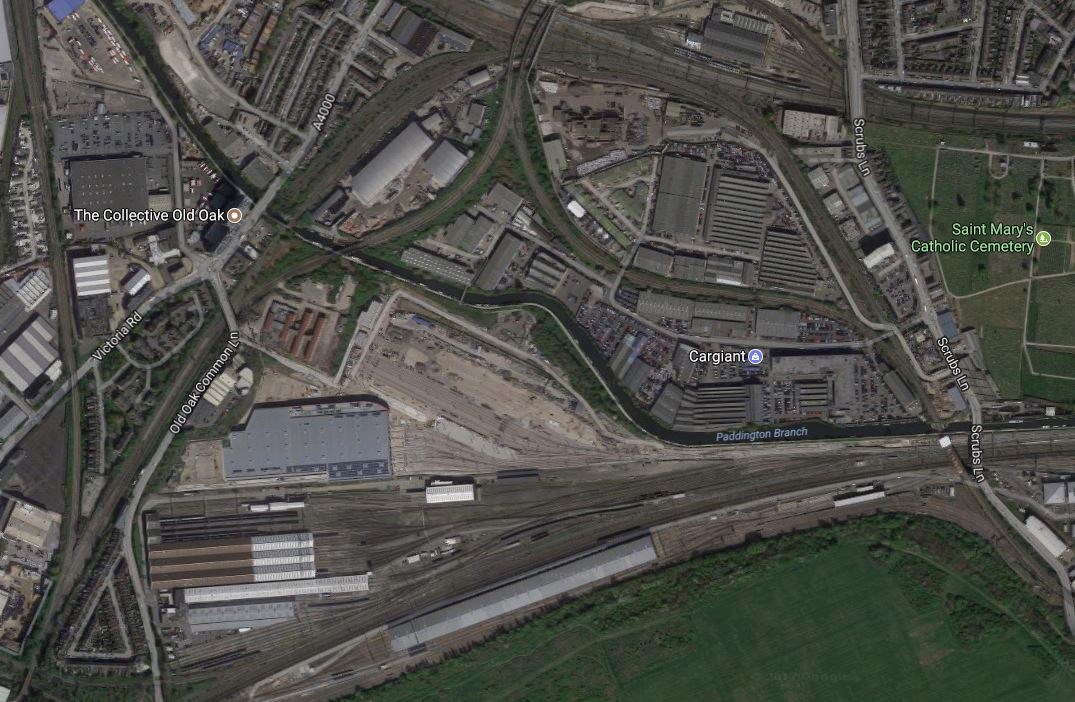
Three features on both maps link them together.
- The Grand Union Canal.
- The layout of the two Overground Lines that meet at the distinctive Willesden High Level Junction.
- The long silver-roofed North Pole Depot at the bottom of the maps.
Note from the Google Map, how much space is available.
Are Two New Stations Needed?
There are various factors at work here.
More Stations And Entrances Shorten Journey Times
Research has shown that the more routes you give passengers, the quicker and easier the journeys.
Old Oak Common Is A Large Site
25,500 new homes and 65,000 jobs are being created in the Old Oak Common/Park Royal area and two new stations are probably needed.
The North And West London Lines Pass Separately Through The Site
Two separate stations give direct services to the following.
- West and South-West London via the North London Line.
- North and North-East London via the North London Line.
- Clapham Junction for South London via the West London Line.
Some might argue, that a new spur from Willesden High Level Junction, where the two lines divide direct to the combined HS2 and Elizabeth Line station, may be a better and cheaper option.
But this would only provide a connection to North and North-East London. Connections to the latter area, are also provided by the Elizabeth Line with a change of train at Liverpool Street or Stratford.
Conclusion About Two Stations
I’m convinced, that two Overground stations are needed and I suspect eventually, there will be other stations.
Hythe Road Station
TfL’s proposal for Hythe Road station would be built to the North of the existing embankment of the West London Line, which would be demolished.
This visualisation is from the TfL document.
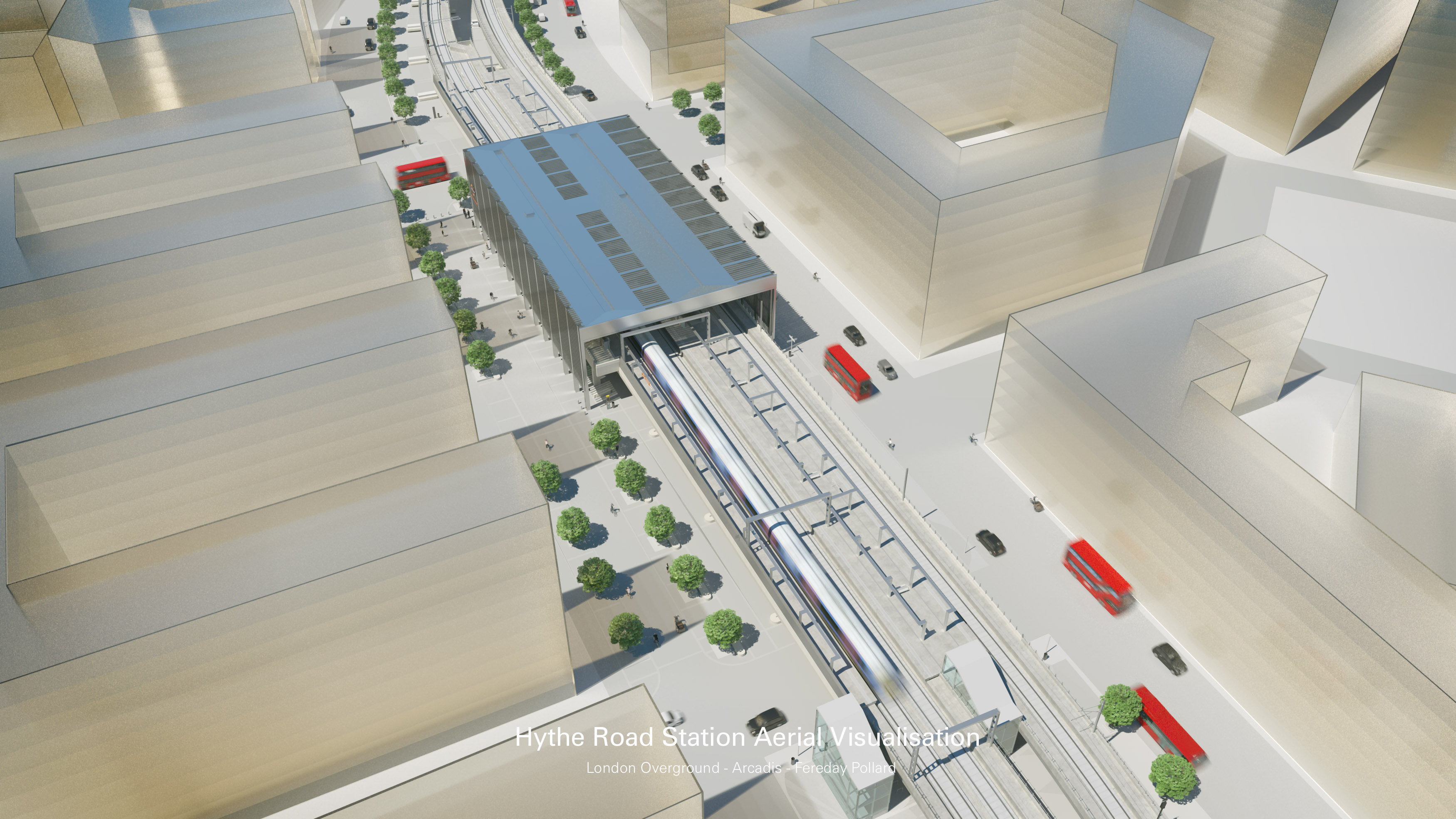
It would appear to be reminiscent of Shoreditch High Street station, but built at ground-level.
Conclusion About Hythe Road Station
It is an inherently simple proposal, that can be built around an existing rail line, so it shouldn’t create too many construction problems.
Old Oak Common Lane Station
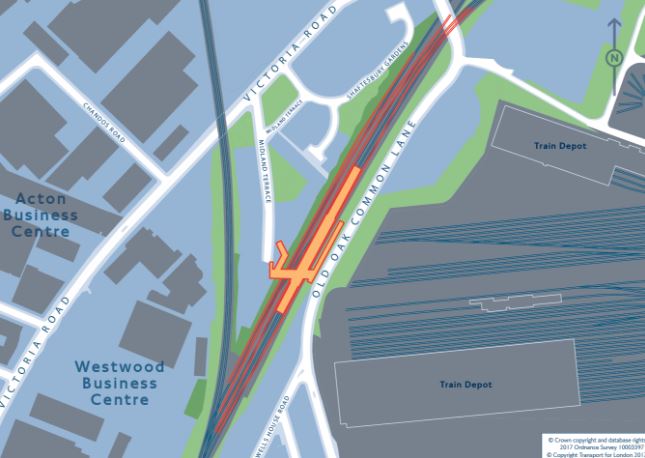
TfL’s proposal for Old Oak Common Lane station would incorporate an overbridge extending westwards to Victoria Road, to allow pedestrians and cyclists to cross the railway.
This map from the TfL document shows the location of the station.
And this Google Map shows roughly the same area.
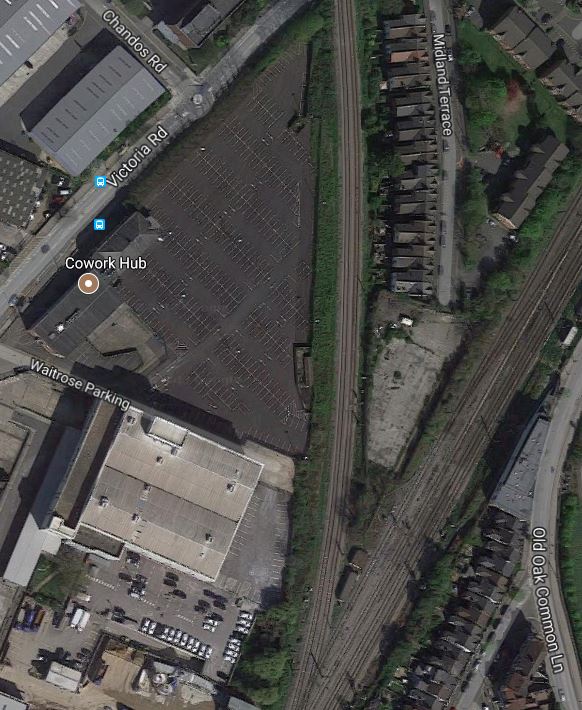
The line breaking off to the North is the Dudding Hill Line, which is an important part of a proposal for a new railway line in West London, which I wrote about in New Railway Line For West London Proposed.
This visualisation is from the TfL document.
Note.
- The bridge for cyclists and pedestrians to Victoria Road.
- The Dudding Hill Line passing under the bridge.
It very much looks like Old Oak Common Lane station could have platforms on the Dudding Hill Line, which would be a very important addition to the West London Orbital Railway proposal.
Cnclusion About Old Oak Common Lane Station
TfL’s proposal looks comprehensive and reasonably simple to build.
It also includes provision to connect to the proposed West London Orbital Railway.
What Else Would I Do?
Here are my thoughts.
An East-West People Mover
The only one thing I would definitely add, is some form of people mover stretching East-West across the whole Old Oak Common site.
My preferred option would be to use a high-level moving walkway perhaps enclosed in a glass tunnel, which would stretch from Victoria Road in the West to perhaps Wormwood Scrubs Park in the East.
Escalators and lifts would give step-free connections to Old Oak Common Lane, HS2, Elizabeth Line and Hythe Road stations.
We’re not getting any younger!
Terminal Platforms
Both stations could have terminal platforms in the visualisations.
But they would surely be a good idea to allow extra services to be run to and from the major station complex.
Both new stations will have a platform on each track.
Would it be a good idea to have a third platform, that could be used as a bay platform in both directions?
A Terminal Platform At Hythe Road Station
The West London Line currently has a Milton Keynes to East Croydon service and this must mean that services to the West Coast and Brighton Main Lines are possible from a Hythe Road station.
- Trains to the South could go to Clapham Junction, East Croydon, Gatwick and any desired station South of London.
- Trains to the North could go to Wembley Central, Watford and Milton Keynes.
A stopping service on the West Coast Main Line would be complementary to HS2. Take for instance, sports or music fans going to an event at Wembley Stadium.
A Terminal Platform At Old Oak Common Lane Station
The only passenger services on the North London Line are London Overground services, between Stratford and Eichmond, but surely a terminal platform at Old Oak Common Lane station could be useful in providing some needed services.
If the West London Orbital Railway is created, this will add eight trains per hour after Acton Central. This might be too many trains for the route, so perhaps there would be a need to turn-back some trains from Stratford at Old Oak Common Lane?
A terminal platform at Old Oak Common Lane station might be used for an extended Gospel Oak to Barking service.
Building The Stations
I haven’t had a good look at the sites of the two stations and I don’t know the area well.
But I do have the feeling that both these stations can be built independently without affecting any other projects.
So they could be built at any convenient time in the development of this large site.
Simon Jenkins Questions Southern HS2 Terminal
Simon Jenkins in the Standard has a piece today entitled It’s Not Too Late To Make HS2 Somehow Work For London, by proposing even at this late stage the Southern terminal of HS2 be moved from Euston station to Old Oak Common station.
He makes these points against choosing Euston.
- HS2 has never had many friends among politicians, railway buffs or think-tanks.
- Serious questions must be asked about HS2’s most costly and controversial feature, the line’s route into Euston from its last stop at Old Oak Common in west London.
- Euston is London’s worst station, with the worst connections.
- The new Euston will need a costly new tunnel under Primrose Hill, incidentally wiping out hundreds of houses.
- It will claim seven of Virgin’s platforms at Euston, thus reducing station capacity.
- For some time, smart money in HS2 circles has been on the line stopping at Old Oak Common, at least “temporarily”
- Successive plans for a new station have been submitted to Camden council and then withdrawn.
- Either way, choosing Euston will mean a decade of chaos.
Against these points he says this in favour of Old Oak Common station.
Meanwhile, a terminus at Old Oak Common is plausible. The old Great Western Railway depot and marshalling yard has become London’s largest regeneration area since Canary Wharf. Its acres of tracks include lines to Paddington, Euston and Heathrow, as well as stations on Crossrail and the Central and Bakerloo lines. The site is near the North Circular and the M40, and is within spitting distance of the M1 and M4. Passengers on HS2 heading for the City would find it more convenient to join Crossrail at Old Oak Common, rather than trundle their bags down crammed access tunnels at Euston.
He makes strong arguments and personally, I would not be against what he says, as getting to Old Oak Common station will be easy for me on the North London Line.
But once Crossrail 2 is built, then Euston will be just two stops away from an enlarged Dalston station at the end of my road.
Conclusion
I can’t lose on house prices!
What Is Happening At Old Oak Common?
I ask this question as I have just read this article on the New Civil Engineer web site which is entitled Old Oak Common Megadeck Momentum Slows.
This is said.
Momentum for the 7ha deck to be built over the Crossrail depot in the new Old Oak and Park Royal development in west London has slowed according to the chief executive of the regeneration body in charge of the work.
Sadiq Khan is blaming Boris, as any politician would.
It is truly a massive site, as this Google Map shows.
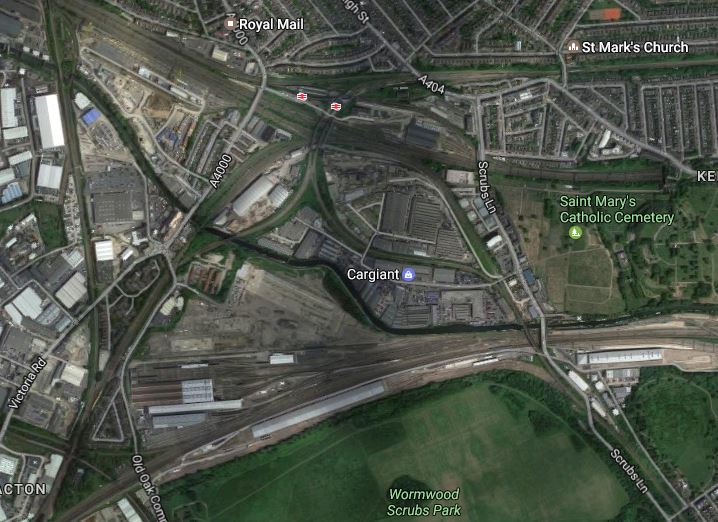
The two stations at the top of the map is Willesden Junction station.
Running across the map is the Great Western Main Line, with the various depots and Cargiant to the North.
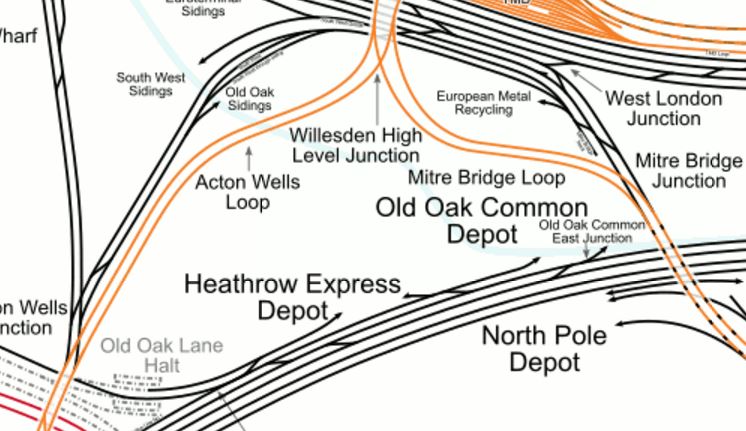
This map from carto.metro.free.fr shows the lines in the area.
This aerial view of the area is from Crossrail.
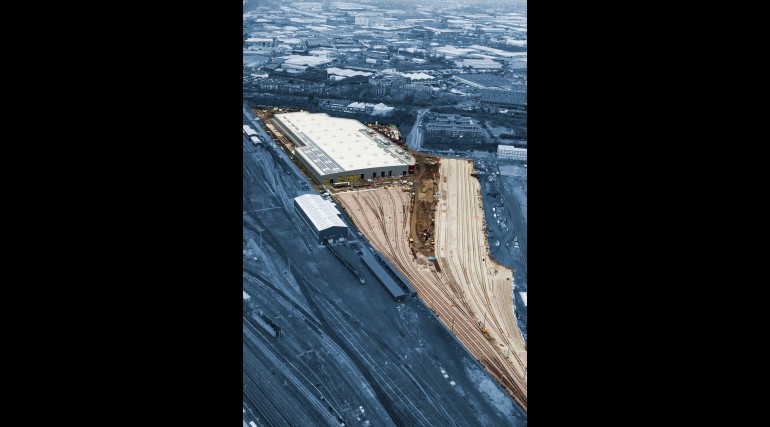
The megadeck is needed to go over much of this area, so that housing and other developments can be built.
Crowded Roads In West London
Today, I tried to get to West Drayton station to have a lunchtime drink with an old mate from Cambridge, who had called me up yesterday, as he might have needed a second person to help him with one of his robotic machines.
But it all went pear-shaped at Paddington, where trains to West Drayton were very much delayed and I was advised to take the Underground to Greenford station and then use a bus.
But at Greenford, there wasn’t a bus map or anybody to ask, so in the end I took a bus to Ealing Hospital, where I thought I knew I could get a bus to West Drayton. But there wasn’t! So I thought about giving up and instead, I got a bus to Ealing Broadway station, to get back to Paddington. But I arrived at Ealing Broadway station, just before a train to West Drayton arrived. I caught that, had a drink with my friend and then caught a train back to Paddington. He didn’t need me to help, as all he needed was a pair of eyes to tell him what was happening at the sharp end of his machine and the client had turned up with his glasses.
So I achieved my objective and also had a wander round the Boroughs of Ealing and Hillingdon on buses and trains.
I trundle round North and East London most of the time and sometimes I even cross the River and go to the Deep South.
But I do find West London the most crowded, with buses slowed by all the traffic on the roads and infrequent very busy trains.
The West of London needs improvement in public transport.
I sometimes think, the traffic has got worse over the forty-six years, I had a driving licence.
Rail And Underground Lines
There are several lines going West from Central London, which include.
- The Chiltern Line from Marylebone to West Ruislip
- The Central Line to West Ruislip
- The Metroplitan Line to Uxbridge
- The Piccadilly Line to Uxbridge
- The Great Western Main Line tfrom Paddington to Reading and Heathrow
- The Piccadilly Line to Heathrow
Going further round, there are several lines from Waterloo going to the South West.
Only one line; the West London Line goes North South, although there used to be others.
The network is probably more sparse than some other directions from London.
Reliance on Cars And Buses
I think this rather thin coverage, puts a heavy radiance on cars and buses, which might explain the crowded roads.
Crossrail
Crossrail will bring improvement with the following Off Peak services in trains per hour (tph), along the slow lines of the Great Western Main Line.
- 4 tph to Heathrow Terminal 4
- 2 tph to Reading
- 2 tph to Maidenhead
Note.
- The central core tunnel probably has a limit of 24 tph.
- The service has a good balance between the various destinations.
- There will also be Great Western Railway services.
- Looking at the Crossrail schedule, there is scope to adjust the schedule on each branch.
I think that as Crossrail develops and the line and its passengers learn more about each other, the service pattern of Crossrail will change.
If I have a worry about Crossrail, it is that few of the stations towards Central London have many parking spaces, so will walking, cycling and the buses be adequate for Crossrail to tap its full potential?
The West London Tram
The West London Tram was proposed by Ken Livingstone in 2002.
These paragraphs from Wikipedia describes the tram and its route.
The West London Tram was a proposed on-street light rail line that was to run along the Uxbridge Road (A4020) corridor in West London, England. The scheme is promoted by Transport for London (TfL) but opposed by the councils of all three London Boroughs through which it would run. It was postponed indefinitely on 2 August 2007
The tram route was planned to run between Uxbridge and Shepherd’s Bush, serving Hillingdon, Southall, Hanwell, West Ealing, Ealing and Acton en route and would have completely replaced a number of equivalent London Bus routes.
If it had been built it would have had good connectivity to Crossrail and the Central Line. But the view of those against the project prevailed.
In my trip today, you could see why probably every car driver in the area, would be against a scheme like the tram. Only at places on the route, where there was a wide island of grass dividing the carriageways, would the tram not have increased congestion.
It looks like the thirty million pounds spent was wasted.
Crossrail And/Or West London Tram?
This Google Map shows the area around the three stations of Hanwell, West Ealing And Ealing Broadway.
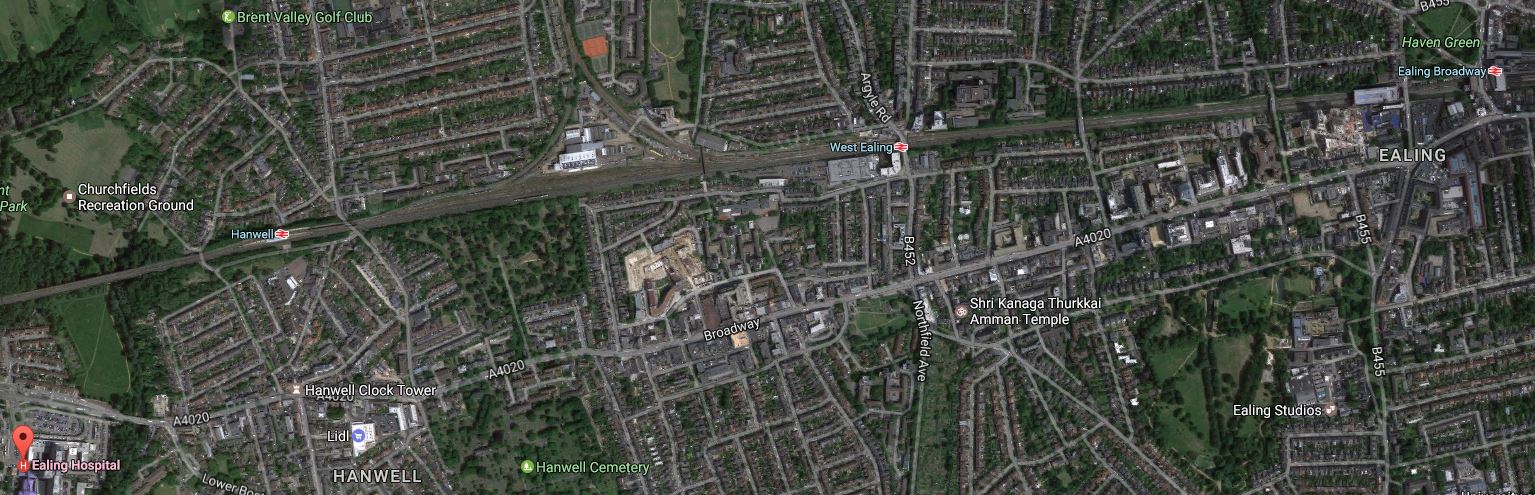
Great Western Main Line And The A4020 Through Ealing
Note.
- The Great Western Main Line across the middle.
- The A 4020 runs South of and parallel to the railway.
- Ealing Hospital is marked by the red arrow in the bottom left of the map.
I asked in the Header to this section if it should be And/Or between the projects.
Undoubtedly, it should be Or! Taxpayers can’t afford both!
In comparing the two, I believe the following points are valid.
- Trams stop about three or four more times than trains.
- The train is faster.
- The tram doesn’t serve Old Oak Common station or Heathrow.
- Trams annoy drivers in the same way that bendy buses do.
- Crossrail has a rich connection pattern compared to the tram.
- Pedestrians probably prefer trams, whilst drivers prefer trains.
The politicians decided and chose the trains.
Making More Of The Railways
If the streets are crowded can we use the existing railways to inject greater capacity into the existing railways in West London?
The key to this, as it sits in the middle of so many lines is the creation of a new station at Old Oak Common.
I will now summarise the possible rail projects that can be developed in West London
Chiltern Railways To Old Oak Common
Chiltern Railways have a capacity problem at Marylebone and one way to alleviate it would be for Chiltern to create a second terminal at Old Oak Common station, which could be accessed using an improved New North Main Line.
There is a real possibility of this project going forward and it could have many worthwhile features.
It would add another East-West route across West London, but with the comprehensive connectivity of Old Oak Common.
Chiltern Metro Creation
Wikipedia says this about a Chiltern Metro.
New Chiltern Metro Service that would operate 4+tph for Wembley Stadium, Sudbury & Harrow Road, Sudbury Hill Harrow, Northolt Park, South Ruislip and West Ruislip. This would require a reversing facility at West Ruislip, passing loops at Sudbury Hill Harrow, and a passing loop at Wembley Stadium (part of the old down fast line is in use as a central reversing siding, for stock movements and additionally for 8-car football shuttles to convey passengers to the stadium for events).[73] This ‘Chiltern Metro’ service was not programmed into the last round of franchising agreements.
When I wrote Could A Chiltern Metro Be Created? and came to the conclusion, that it might be possible, I got several positive responses.
Greenford Branch Improvements
The Greenford Branch Line connects the Great Western Main Line and the New North Line.
This map from carto.metro.free.fr shows the Northern end of the branch, where it joins the New North Line.
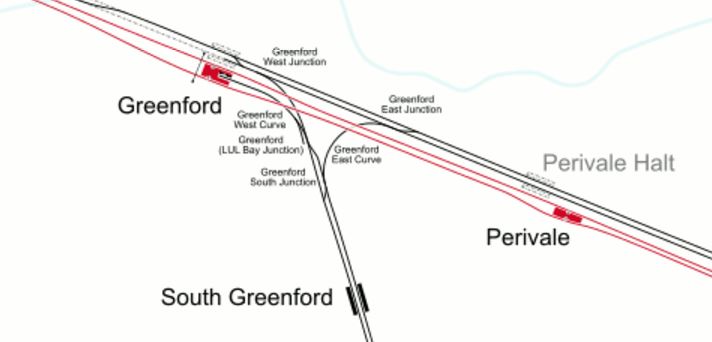
Northern End Of The Greenford Branch
Whilst this map from carto.metro.free.fr shows the Southern end of the branch, where it joins the Great Western Main Line.
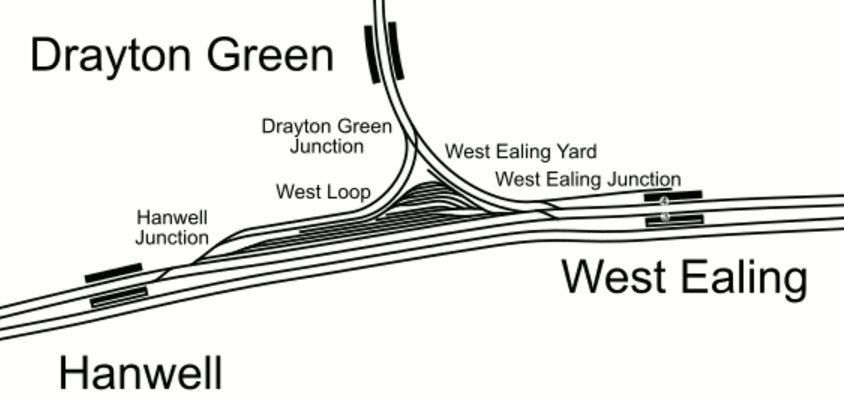
Southern End Of The Greenford Branch
What service the line will get after Crossrail opens has still to be decided,
- 4 tph between West Ealing and Greenford stations is certainly possible.
- There are those, including Ealing Council, who don’t like Greenford losing its direct connection to Paddington.
- A rebuilt Greenford station could incorporate Chiltern services.
As the connections at both ends of the branch allow trains to go in either an East or West direction, could this be useful in creating services between the two main lines?
Brentford Branch Reopening
I wrote about this in Could The Golden Mile In Houslow Get A Station?
The Brentford Branch could be a useful branch, worked by a shuttle train!
Hounslow Loop Line Improvements
The Hounslow Loop Line, which has a strong presence on both sides of the river and takes passengers to and from Waterloo, is being improved to increase capacity.
Could we see the Overground opening new services along the North London Line to perhaps Brentford, Hounslow and Feltham stations?
The route is used by freight trains, and Transport have suggested using the route to create an orbital Overground route.
Conclusions
The railways will take the strain in West London, after the abandonment of the West London Tram.
Could Old Oak Common Be London’s Super Hub Station?
Old Oak Common station is going to be a very important rail hub in the future, with all the services that various companies and organisations would like to see serving the proposed station.
This map shows some of the existing and proposed rail lines in the area.
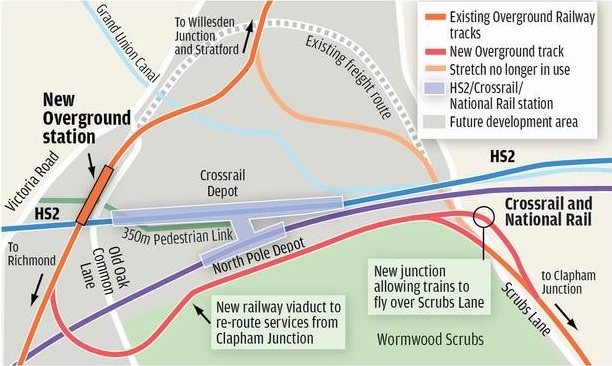
Rail Lines At Old Oak Common
Current Plans
I’ll now list the lines shown in the map or that go through the area. and are listed in Wikipedia, as having connections at the proposed Old Oak Common station.
1. Bakerloo Line
The Bakerloo Line will call
2. Central Line
The Central Line will call.
The Central Line acts as a loop from Crossrail through Central London, serving stations not on the direct route, in Central London between Stratford and Bond Street.
I wrote about the relationship between Crossrail and the Central Line in Ducking And Diving Between Crossrail And The Central Line.
3. Crossrail
Crossrail goes through the area and development of a station has been proposed.
4. Great Western Main Line
The Great Western Main Line goes through the area and local and other services may call.
5. HS2
HS2 will be building a station at Old Oak Common.
6. North London Line
The North London Line is consulting on a new station as I wrote about in Should An Overground Station Be Built At Hythe Road?
The North London Line acts as another East-West line across London and will probably have a frequency of upwards of the current 4 trains per hour (tph) between Richmond and its Eastern connection to Crossrail at Stratford.
7. West Coast Main Line
The West Coast Main Line goes through the area and local and other services may call.
8. West London Line
The West London Line will call and this line gives an easy route to Balham, Clapham Junction and East Croydon stations, which by-passes Central London.
I suspect that the frequency of trains on this route will be increased.
Eight lines is an large amount of connectivity.
Other Possibilities
If that isn’t enough connectivity, there are also these extra possibilities.
1. Chiltern Railways
Chiltern Railways have ambitions to use Old Oak Common station as another London terminus, with perhaps 2 tph.
I wrote about it in Linking Chiltern To Crossrail.
2. Dudding Hill Line
The Dudding Hill Line, runs to the West of Old Oak Common station. It could be electrified and have a station that is connected to Old Oak Common station.
For various reasons, both the Brent and Cricklewood \curves would be electrified, thus giving fully electrified access to and from North and South on the Midland Main Line.
3. Gospel Oak To Barking Line
Transport for London have published ideas to extend the Gospel Oak to Barking Line along an electrified Dudding Hill Line.
Suggestions have talked about 4 tph between Hounslow and Gospel Oak stations.
4. Heathrow Express
Heathrow Express uses the Crossrail route, so it could call.
5. Midland Main Line
If Chiltern can justify using Old Oak Common station, I suspect that services on the Midland Main Line can make the same arguments for using Old Oak Common station as a terminal.
Consider.
- Electrification of the Dudding Hill Line makes this possible.
- St. Pancras which is very much A Fur Coat And No Knickers Station, is short of capacity.
It would give passengers from the East Midlands much better access to London and the South East.
6. Thameslink
There are no plans to link Thameslink to Old Oak Common station, but why not?
I proposed this in Will The Third Runway At Heathrow Be Actually Built In The Near Future?
Under Integration With Both HS1 And HS2, I said this.
It would be possible to do the following.
- Arrange for Heathrow Express and/or Crossrail to call at Old Oak Common for HS2.
- Terminate some Thameslink services at Old Oak Common, thus linking HS1 and HS2.
- Build an easy entrance at St. Pancras to Thameslink close to Eurostar.
- It goes without saying, that Old Oak |Common will make interchange easy between the umpteen lines meeting there.
The Dudding Hill Line would be electrified.
This proposal and the related electrification of the Dudding Hill Line would do the following.
- Give Chiltern, Crossrail, GWR and Heathrow Express a connection to HS1.
- Give Thameslink a better connection to HS2 and the West Coast Main Line
- Create a fast ink between HS1 and HS2.
What could a Thameslink service to Old Oak Common station look like?
- I would terminate 4 tph trains at Old Oak Common to give an adequate level of service.
- It might be advantageous to use eight-car Class 700 trains on this route, so that all trains North of Cricklewood could be twelve-car trains.
- Could the trains going to Old Oak Common be the Wimbledon Loop trains?
- There could be advantages in having 2 tph between Old Oak Common and London Bridge.
Obviously, passenger statistics would determine the services required.
Old Oak Common As An Airport Hub
If all or some of these plans come to pass, Old Oak Common station will be well-connected to the following airports.
- Birmingham – Under 50 minutes by HS2.
- City – Under 20 minutes by Crossrail
- Gatwick – Under 50 minutes by Thameslink
- Heathrow – Around 20 minutes by Crossrail and around 15 minutes by Heathrow Express
- Luton – Under 30 minutes by Midland Main Line.
- Manchester – Around an hour by HS2.
- Southend – Around 80 minutes by Crossrail and Greater Anglia.
- Stansted – Around 55 minutes by Crossrail and Stansted Express.
The figures are very much my best estimates, as the Thameslink and HS2 web sites don’t have simple journey time calculators as does the Crossrail web site.
But these timings do show some interesting facts, that will effect the developments of airports in Southern England.
- Birmingham Airport is a practical alternative for those living with easy access to the HS2 stations at Euston or Old Oak Common.
- Gatwick access needs to be faster to compete with Heathrow and Luton.
- When HS2 reaches Manchester Aiorport, it will be a practical alternative for Middle England.
- Southend Airport will be good for those East of London, but the journey time needs to be cut, by running faster trains to London.
- Stansted Airport needs a faster connection to London and they will push for the four-tracking of the West Anglia Main Line.
There will be a massive battle for passengers and Network Rail will be under tremendous pressure to perform.
Rail Companies, Lines And Terminals, Without A Direct Connection To Old Oak Common Station
There is quite a few, even if you cut out train operators like Arriva Trains Wales, Scotrail, Northern and TransPennine, that don’t serve London.
1. Caledonian Sleeper
With all its connectivity, would Old Oak Common be the logical destination for the Caledonian Sleeper?
Could Old Oak Common, be London’s hub for all sleeper trains?
2. Circle, District And Metropolitan Lines
There are various ways to get on the Circle, District and Metropolitan Lines depending on where you want to go.
Just as the Central Line acts as a loop from Crossrail, the Sub-Surface Lines have various loops running parallel to Crossrail through Central London.
- Circle and Metropolitan Lines, running North of Crossrail, from Paddington to Whitechapel.
- Circle and District Lines, running South of Crossrail, from Paddington to Whitechapel.
- District Line, running, South of Crossrail, from Ealing Broadway to Whitechapel.
My prediction in Is Whitechapel Station Going To Be A Jewel In The East?, seems to becoming true.
3. c2c
As I said in Will c2c Push For Access To Stratford And Liverpool Street?, c2c needs a connection to a station on Crossrail.
With some reorganisation of services, I believe that it might possible to have a 4 tph service to Stratford and Liverpool Street stations, which would give passengers in the c2c area, access to Crossrail
4. East Coast Main Line
These are routes between Old Oak Common and Kings Cross station for the East Coast Main Line.
- Crossrail to Farringdon and then the Metropolitan Line
- North London Line to Highbury and Islington and then the Victoria Line.
- Bakerloo Line to Oxford Circus and then the Victoria Line.
- Crossrail to Tottenham Court Road and then a 10, 73 or 390 bus.
- Narrow boat on the canals.
- If Thameslink should in the future serve Old Oak Common, that can be taken to St. Pancras Thameslink, followed by a walk.
None of the routes are of the best.
If you had plenty of time, Tottenham Court Road station and then a bus would be a good route, as the bus drops you in the front of Kings Cross station, with totally flat access to the trains. If you’re early and it’s sunny, you can sit in the best Waiting Room at a London station.
For local services on the East Coast Main Line, there are two slower alternatives.
- Crossrail to Moorgate and then use the Great Northern Metro.
- Thameslink to St. Pancras Thameslink, cross to the other platform and take Thameslink to Cambridge or Peterborough.
The second route, would be much easier, if St. Psncras had an island platform for Thameslink. At least it’s only escalators and lifts.
There is one development, that might happen, that could improve journeys to and from Kings Cross station. That is the reopening of Maiden Lane station.
5. Jubilee Line
The Jubilee Line has interchanges with Crossrail at Bond Street, Canary Wharf and Stratford stations, with an interchange with Thameslink at London Bridge station.
It also has a step-free interchange with the Bakerloo Line at Baker Street station.
The Jubilee Line also acts as a loop from Crossrail serving stations away from the main route through Central London between Stratford and Bond Street.
6. London Bridge, Cannon Street And Charing Cross
I have grouped all these three stations together as the rebuilding of London Bridge station and the Thameslink Programme have connected these three stations in a way that will change passenger patterns dramatically for users of these three stations.
For myself, it will mean that to access any trains from Cannon Street and Charing Cross or on Thameslink going South, I will probably use a bus to the superb London Bridge station with all its escalators and lifts, rather than fight my way through Central London.
Others will also choose to go direct to London Bridge, possibly by using the Jubilee or Northern Linse. It will be interesting to see how passenger usage changes at Cannon Street and Charing Cross stations.
London Bridge shows what could have been done, if they’d spent the money wisely at the dreadful St. Pancras.
There are four main routes between London Bridge and Old Oak Common stations.
- Bakerloo Line to Waterloo and then the Jubilee Line.
- Crossrail to Bond Street and then the loop of the Jubilee Line.
- Crossrail to Farringdon and then Thmeslink
- If Thameslink serves Old Oak Common, there could even be a direct train.
I suspect there are other routes and it will all be down to personal preference and where you catch your next train in London Bridge.
Cannon Street station could almost be considered a London Bridge North station.
- It has seven terminal platforms. Try fitting more into London Bridge.
- It is within easy walking distance of much of the City of London.
- On a nice day, many might even walk from Cannon Street to Moorgate for Crossrail, as this route could be pedestrianised.
- It has access to the Circle and District Lines, which with a change at Paddington give access to Crossrail and Old Oak Common station.
- In a few years time, it will have good access to the Northern and Central Lines at Bank station.
Cannon Street station will become more important, as Network Rail and the various operators learn how to use the new infrstructure.
Sometimes, I struggle to see the point of Charing Cross station, but as it’s a very busy station others certainly see the station’s purpose.
It’s on the Bakerloo, Circle, District and Northern Lines, so getting to Old Oak Common won’t be a problem.
Transport for London are looking to take over South London inner suburban routes, so I think we’ll see changes in the management of Cannon Street and Charing Cross stations if this happens.
7. Northern Line
Both branches of the Northern Line are directly connected to Crossrail.
- Tottenham Court Road station connects to the Charing Cross Branch.
- Moorgate station connects to the Bank Branch.
Connections to the Northern Line might improve, if two separate lines are created
8. Piccadilly And Victoria Lines
The Piccadilly and Victoria Lines share three interchanges, but unfortunately they have no interfaces with Crossrail and only one poor one with Thameslink.
The best bet is to get on the Bakerloo Line and change at either Oxford or Picadilly Circus.
9. Victoria
Victoria station is another tricky station from which to get to and from Old Oak Common.
- Bakerloo Line to Oxford Circus and then Victoria Line.
- Crossrail to Paddington and then Circle or District Line.
As some services out of Victoria stop at stations served by the West London Line, it is possible to use that line to by-pass Central London.
10. Waterloo
Like London Bridge, Waterloo station is very well connected to Crossrail and the Old Oak Common hub.
- Bakerloo Line direct.
- Crossrail to Bond Street and then the loop of the Jubilee Line.
- Crossrail to Tottenham Court Road and then the Northern Line.
As some services out of Waterloo stop at stations served by the West London Line, it is possible to use that line to by-pass Central London.
Conclusions
I have come to the following conclusions.
Everybody will want to be connected to Old Oak Common station.
Groups of lines across London are emerging.
- East to West – Crossrail, Central, District, Metropolitan, North London, Gospel Oak To Barking, Dudding Hill.
- North to South – Thameslink, West London,East London, Northern.
- North-East to South-West – Crossrail 2, Piccadilly, Victoria.
- North-West to South-East – Bakerloo, Jubilee
A very strong grid with good interchanges is probably the main objective.
Looking at these groups, makes me think, that actions are suggested, that would strengthen the network.
- Build Crossrail 2
- Increase the capacity on the Bakerloo Line
- Split the Northern Line into Charing Cross and Bank branches.
London will quickly fill the extra capacity.
Linking Chiltern To Crossrail
In the November 2016 Edition of Modern Railways, there is an interview with Dave Penney of Chiltern Railways, as the company is opening their service to Oxford station on the twelve of December.
In Connecting To Crossrail, this is a summary of what is said or implied.
- Chiltern could get a couple of platforms at Old Oak Common station, sandwiched between the Crossrail platforms.
- Access to Northolt Junction is possible, to allow services to connect to the Chiltern Main Line using the Acton To Northolt Line.
- Marylebone is almost at capacity.
- Old Oak Common would give Chiltern a second London terminus and access to Crossrail.
- Two trains per hour (tph) could start from Old Oak Common.
- Aylesbury and High Wycombe could get access to Crossrail.
Chiltern would also get access to all the services calling at Old Oak Common.
I think it is an exciting concept.
Will Chiltern Railways Get A Second London Terminus At Old Oak Common?
This article on the Rail Magazine web site is entitled Chilterns Route Study to tackle capacity challenges and it describes how Chiltern Railways may gain a second terminal in London at Old Oak Common, which would link to the following lines.
And that’s only for starters as a couple of Underground and other lines pass through the general area.
The full study on Network Rail’s web site is entitled West Midlands and Chilterns Route Study. This is said about Chiltern Railways.
The Chiltern Route provides an important commuter route into London with connections to the Underground.
- London continues to grow, and evolve with economic hubs expanding beyond the traditional City
- Growing towns with major housing development planned at Aylesbury, Bicester and Princes Risborough
- Marylebone Station is approaching its maximum capacity, in terms of train numbers and passengers
- Any expansion of Marylebone is likely to be expensive, and disruptive due to its constrained location.
The report suggests using Old Oak Common as an additional terminal, connected to the Chiltern route. It gives these benefits.
- Up to 4 additional trains per hour, with more travel options in to London.
- Access to HS2, Crossrail and Great West Main Line.
- Reduced cost and disruption compared to upgrading Marylebone.
The report is recommending building a new station at Old Oak Common, rather than upgrading Marylebone.
I think that this is a very sensible use of the space and existing railways in West London.
In Could A Chiltern Metro Be Created?, I looked at the lines between Marylebone and West Ruislip, where Chiltern Railways have ambition to create a Chiltern Metro. I said this.
I think Chiltern too, will make a bid to get into running services on the Greenford Branch and the Acton-Northolt Line, as it would give them a very useful destination in London of Old Oak Common.
Whatever happens, there will be some interesting rail developments involving Chiltern Railways in West London.
Old Oak Common Station And The Acton-Northolt Line
This map from carto.metro.free.fr shows the lines around Old Oak Common.
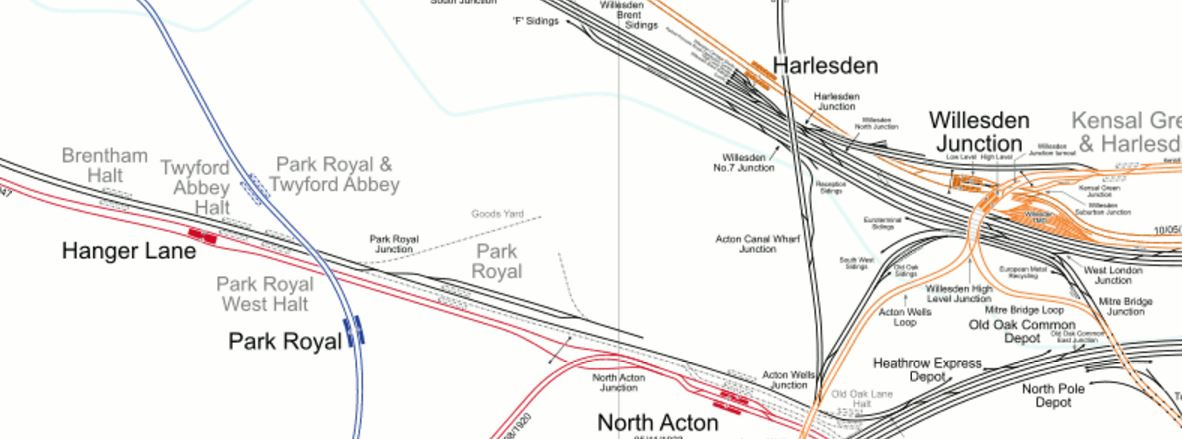
Old Oak Common Station And The Acton-Northolt Line
Note the West Coast Main Line and Great Western Main Line go to the North and South respectively of the Old Oak Common site.
The line going to the West alongside the Central Line is the Acton-Northolt Line which links in the West to the Chiltern Main Line, just to the East of South Ruislip station.
This is the best map, I can find of the proposals for Old Oak Common station.
Rail Lines At Old Oak Common
And this map from carto.metro.free.fr shows roughly the same area.
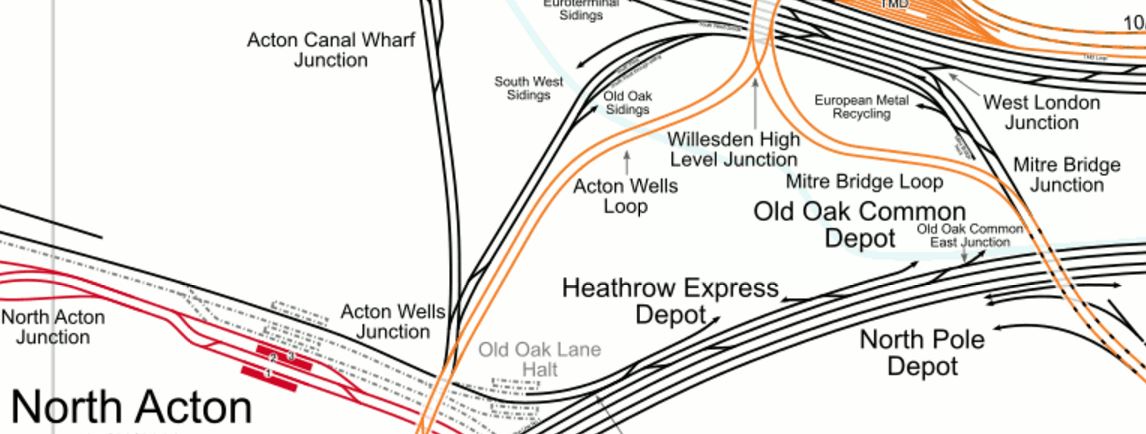
Current Lines At Old Oak Common
The Acton-Northolt Line is currently single-track and without electrification or any stations, other than South Ruislip and West Ruislip after Northolt Junction, where it joins the Chiltern Main Line.
From following the line both on a Central Line train and on Google Maps, it would appear that restoring the Acton-Northolt Line to its original double-track should be possible.
With regard to electrification, as Old Oak Common station will be electrified for Crossrail, the North London Line and other lines, it would at least have power at one end.
The Current And Proposed Service Pattern
Wikipedia lists the current services, outside the peak from Marylebone on Chiltern as the following.
- 2 trains per hour (tph) to/from Birmingham (one fast, first stop Bicester North, and one semi-fast, first stop High Wycombe).
- 1tph to/from Banbury (semi-fast, first stop High Wycombe). Some extend to Stratford-upon-Avon.
- 1tph to/from Bicester North (semi-fast, first stop Gerrards Cross)
- 1tph to/from Princes Risborough (semi-fast, first stop Gerrards Cross)
- 1tph to/from High Wycombe (stopping service)
- 1tph to/from Gerrards Cross (stopping service)
- 2tph to/from Aylesbury (via Amersham). One of these services in each hour continues on to serve Aylesbury Vale Parkway
- 2tph to/from Oxford Parkway (fast)
So that is nine trains an hour through West Ruislip, two up the Aylesbury Line and eleven between Marylebone and Neasden.
The Network Rail report, is saying that another four trains per hour would run from Old Oak Common station, which would mean thirteen trains an hour through West Ruislip.
Where these four trains will go will be up to Chiltern, but I’m sure they’ll find the passengers to fill them.
Does London Need To Get A Grip On Rail Connectivity?
This article in the Standard has a title of Old Oak Common regeneration scheme ‘risks being London’s worst cock-up in 50 years’. This is the first three paragraphs.
Boris Johnson’s flagship regeneration scheme at Old Oak Common is in danger of turning into London’s “worst cock-up in 50 years”, a leading government adviser warned today.
Urban planner Sir Terry Farrell said the £10 billion development, the biggest in Britain, is heading for disaster because of the rush to finish Crossrail.
He blamed politicians for ducking key decisions and said the Mayor was partly responsible for a shortsighted “pass the parcel” approach. Sir Terry said: “If a tenth of the energy he put into the Boris island airport idea had gone into Old Oak Common I feel sure it would have happened without a problem.”
Old Oak Common is going to be a major development of 25,000 homes and 55,000 jobs created over the next fifteen years. A major transport hub will be created at Old Oak Common station will be created, linking some or all of the following lines together.
- Bakerloo Line
- Central Line
- Crossrail
- Dudding Hill Line
- Great Western Main Line
- HS2
- North London Line
- Watford DC Line
- West Coast Main Line
- West London Line
This map shows the plans for Option C of TRfL’s Old Oak Common proposals.
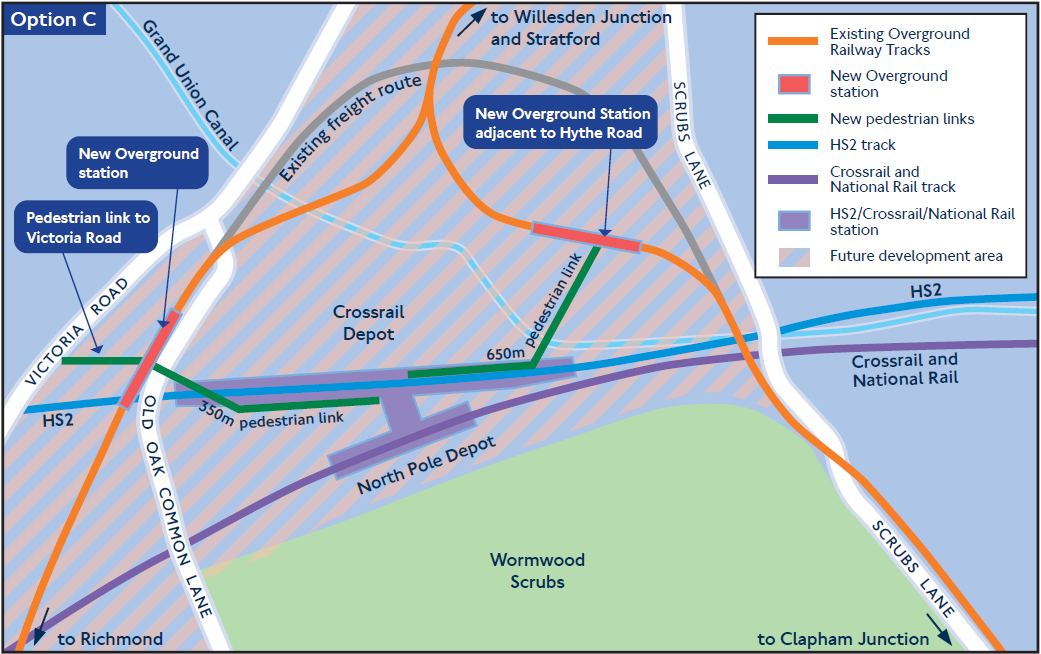
Option C Proposal At Old Oak Common
I wrote about this option in Should An Overground Station Be Built At Hythe Road?
Terry Farrell has said that there is no space between the rail lines to put the piling to support the homes, offices and other developments that will built over the top.
I also believe that the walking routes between the various stations will be far to long and tortuous.
The developers, Transport for London and the rail companies involved all seem to be planning their own parts in isolation.
It seems to echo what I documented in Searching For What Is Going To Happen On The East London Line After The Thameslink Programme Opens, where I was trying to find out how Thameslink will improve my journeys from Dalston Junction using the East London Line.
My correspondence on that issue, would seem to indicate that Thameslink and Transport for London don’t talk to each other and calmly go their own ways.
Someone needs to get a grip on all these big projects at a high level.

