Energy Security Boost After Centrica And Repsol Agree LNG Supply Deal
The title of this post, is the same as that of this press release from Centrica.
This is the sub-heading.
Centrica Energy and Repsol today announced the signing of a deal that will improve the UK’s energy security in the coming years.
These two paragraphs give more details of the deal.
The deal will see Centrica purchase 1 million tonnes of Liquified Natural Gas (LNG) shipments between 2025 and 2027. All of these cargoes are expected to be delivered to the Grain LNG import terminal in Kent.
The deal marks an additional move by Centrica to build further resilience in the UK’s energy security. It follows a 15 year, $8bn deal with Delfin Midstream in July 2023, a three-year supply agreement with Equinor that will heat 4.5m UK homes through to 2024 and the reopening and expansion of the Rough gas storage facility in October 2022 and June 2023 respectively. Rough now provides half of the UK’s total gas storage capacity with the potential to store over 50 billion cubic feet (bcf) of gas, enough to heat almost 10% of UK homes throughout winter.
Centrica do seem to be keeping us supplied with gas.
Two days ago, National Grid published this press release, which is entitled Grain LNG Signs New Deal With Venture Global Further Strengthening The Security Of Supply Of LNG To The United Kingdom.
This is the sub-heading.
Today (5 February), Grain LNG and Venture Global have announced the execution of a binding long-term terminal use agreement (TUA) enabling the regasification and sale of LNG from all of Venture Global’s LNG terminals in Louisiana, including CP2 LNG, subject to obtaining necessary federal permits.
These two paragraphs give more details of the deal.
Under the agreement, Venture Global will have the ability to access 3 million tonnes per annum (3MTPA) of LNG storage and regasification capacity at the Isle of Grain LNG receiving terminal for sixteen years beginning in 2029, equivalent of up to 5% of average UK gas demand.
This is the second agreement from Grain LNG’s competitive auction process which was launched in September 2023. The successful outcome of the auction further secures the future of Europe’s largest LNG import terminal into the mid 2040s.
Two big deals in the same week is not to be sneezed at and must be good for the UK’s energy security.
Grain LNG
The Grain LNG web site, greets you with this message.
Welcome To Europe’s Largest Liquified Natural Gas Terminal, Grain LNG
Grain LNG is the gateway connecting worldwide LNG to the European energy market, making a genuine difference to people’s lives. Find out all about our cutting-edge operations – showcasing our leadership in powering the future – and why Grain LNG is at the forefront of energy as we move towards net zero.
There is also a video.
This Google Map shows the location of Grain LNG on the Isle of Grain.
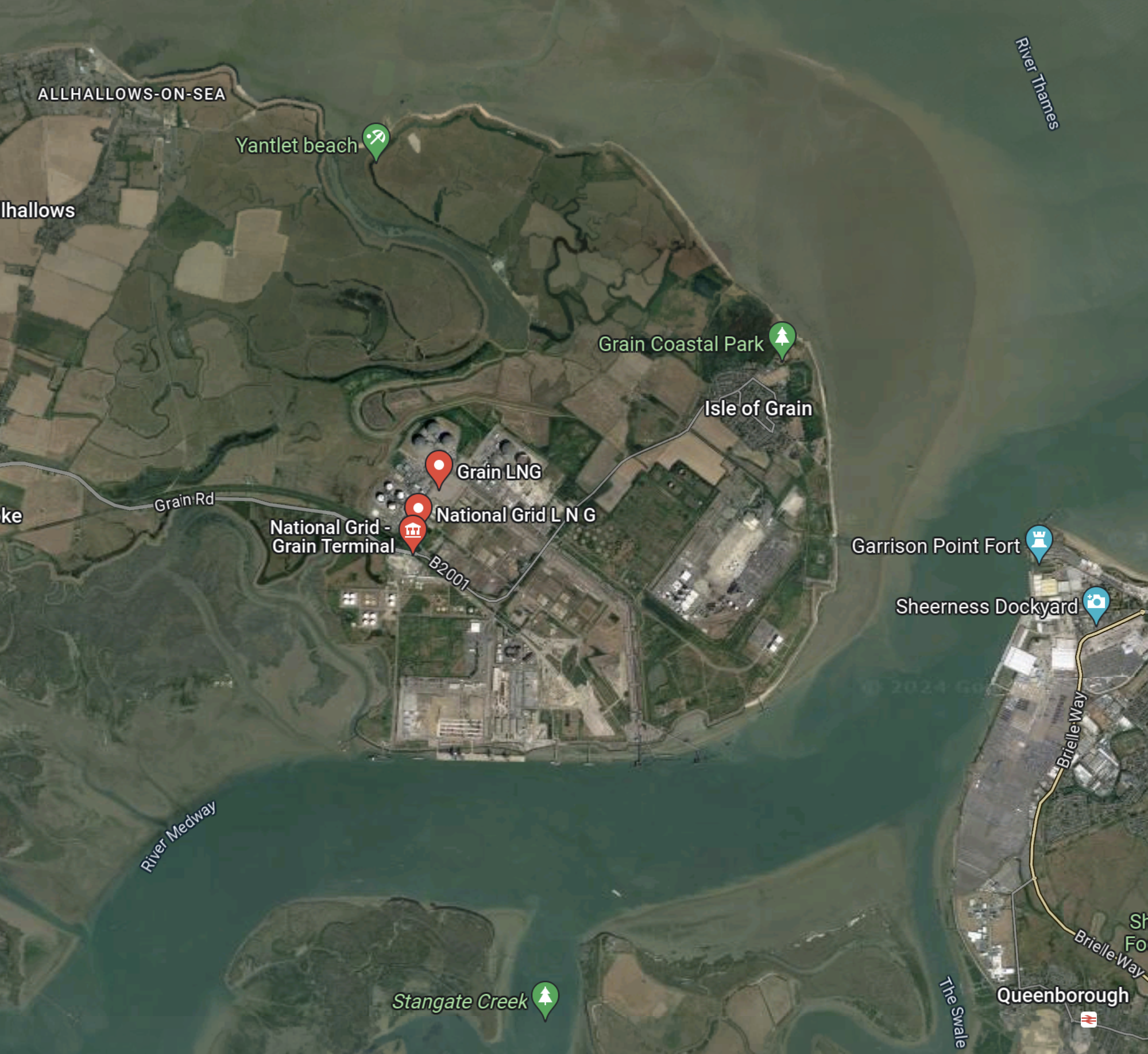
Note.
- The River Medway flows into the River Thames between the Isle of Grain on the left and the Isle of Sheppey on the right.
- From South to North, the red arrows indicate, the National Grid – Grain Terminal, National Grid L N G and Grain LNG.
There would appear to be space for expansion.
World’s First Semi-Submersible Floating Offshore Wind Farm Smashes Predictions
The title of this post, is the same as that of this article on offshoreWIND.biz.
This is the sub-heading.
WindFloat Atlantic, the world’s first semi-submersible floating offshore wind farm, has completed its third year in operation, closing in 2023 with an electricity production of 80 GWh.
These four paragraphs outline the performance of the wind farm.
Connected to the grid by the end of 2019 and fully commissioned in 2020, the floating offshore wind farm was developed by the Windplus consortium formed by Ocean Winds, a 50:50 joint venture between EDPR and ENGIE, Repsol, and Principle Power.
The pioneer wind farm consists of three platforms, each supporting one 8.4-MW Vestas turbine, which are anchored with chains to the seabed and connected to the onshore substation in the Portuguese municipality of Viana do Castelo through a 20-kilometre cable.
According to the project’s owners and operators, the 25 MW WindFloat Atlantic also closed in 2023 breaking more records with Storm Ciaran posing challenges with waves reaching a maximum height of 20 metres and wind gusts up to 139 kilometres per hour.
These conditions far surpassed the project’s previous records, demonstrating the readiness and robustness of the floating technology, even in extreme offshore conditions.
It would appear that this and the previous post; France’s First And Only Operational Floating Wind Turbine Gets Lifetime Extension, are not only indicating that floating wind power works, but that it works well in all types of conditions.
Spanish Consortium Forms For $4.4 Billion Green Hydrogen Investment
The title of this post, is the same as that of this article on Hydrogen Fuel News.
This paragraph outlines the project.
A thirty-three company consortium, called the Spanish Hydrogen Network (Shyne) will be investing into a spectrum of green hydrogen technologies, including the installation of 500 megawatts of renewable H2 capacity by 2025. From there, the capacity will increase to 2 gigawatts by 2030. This represents half of the Spanish government’s goal for the entire country by that year, which is 4 gigawatts of capacity.
The article says this about the creation of hydrogen hubs.
The green hydrogen project’s goal is to “generate an ecosystem that connects” three H2 hubs.
The goal of the project is to develop an ecosystem in which three planned industrial H2 hubs in the Murcia, Catalonia and Basque regions will be connected. The project is also meant to support the development of two new innovation hubs in Castile-La Mancha and Madrid and will target the development of solid-oxide electrolyzers and photoelectrocatalysis.
Note that photoelectrocatalysis is the direct production of hydrogen from solar energy.
 The Anonymous Widower