Would You Employ an Accountant Who Couldn’t Add Up?
One of the stories today is that the Nulabor government cocked up the rate of inflation, which meant that pensioners were underpaid to the collective tune of £80billion.
There is no excuse and mistakes like this by governments of all colours and competences are woven into the rich tapestry of history. Years ago, a colleague left to work for the Department of Trade and calculate the trade statistics. A few years later there was a serious mistake. I don’t think it was his fault, but because he worked there, we spotted it and had a bit of fun at his expense.
Whoever said, that there are lies, “damned lies and statistics” was right. Latest thinking says it was Charles Wentworth Dilke and not Mark Twain or Benjamin Disraeli. Although the phrase should probably be “lies, damned lies and government statistics”
The Mother of Statistics
After last night’s program, The Joy of Stats, it was good to see one of Florence Nightingale‘s coxcomb charts in the business pages of The Times in an article headed, Bloodied but largely unbowed, things are looking up for Toyota. The chart has been missed off the web edition.
She was so much more than the Lady with the Lamp.
She also had a massive input into Brunel’s design for the prefabricated hospital at Renkioi in the Crimea. Here’s an extract from Wikipedia.
Brunel was working on the Great Eastern amongst other projects, but accepted the task in February 1855 of designing and building the War Office requirement of a temporary, pre-fabricated hospital that could be shipped to Crimea and erected there. In 5 months he designed, built, and shipped pre-fabricated wood and canvas buildings, providing them complete with advice on transportation and positioning of the facilities. They were subsequently erected near Scutari Hospital, where Nightingale was based, in the malaria-free area of Renkioi.
His designs incorporated the necessities of hygiene: access to sanitation, ventilation, drainage, and even rudimentary temperature controls. They were feted as a great success, with some sources stating that of the approximately 1,300 patients treated in the Renkioi temporary hospital, there were only 50 deaths. In the Scutari hospital it replaced, deaths were said to be as many as 10 times this number. Nightingale referred to them as “those magnificent huts”. The practice of building hospitals from pre-fabricated modules survives today, with hospitals such as the Bristol Royal Infirmary being created in this manner.
Sad to say, we don’t solve problems in that way anymore. Today’s civil servants would never let two people like Nightingale and Brunel even talk to each other, as they would come up with something that made the civil servants all look to be the dunderheads they inevitably are.
Remember that it takes twelve civil servants to change a light bulb. One to actually change the bulb and eleven to do the paperwork.
Going to the Supermarket Past One of Your Heros’ Grave
I said in an earlier post that I preferred to use the Waitrose in the Barbican, as it is less-crowded and an easy bus ride home.
Today I took the bus to the supermarket and found that I could walk through Bunhill Fields to cut the corner off from Old Street. It is an old and famous cemetery, where such as Isaac Watts, John Bunyan, Eleanor Coade, Thomas Newcomen, Daniel Defoe and William Blake were laid to rest.
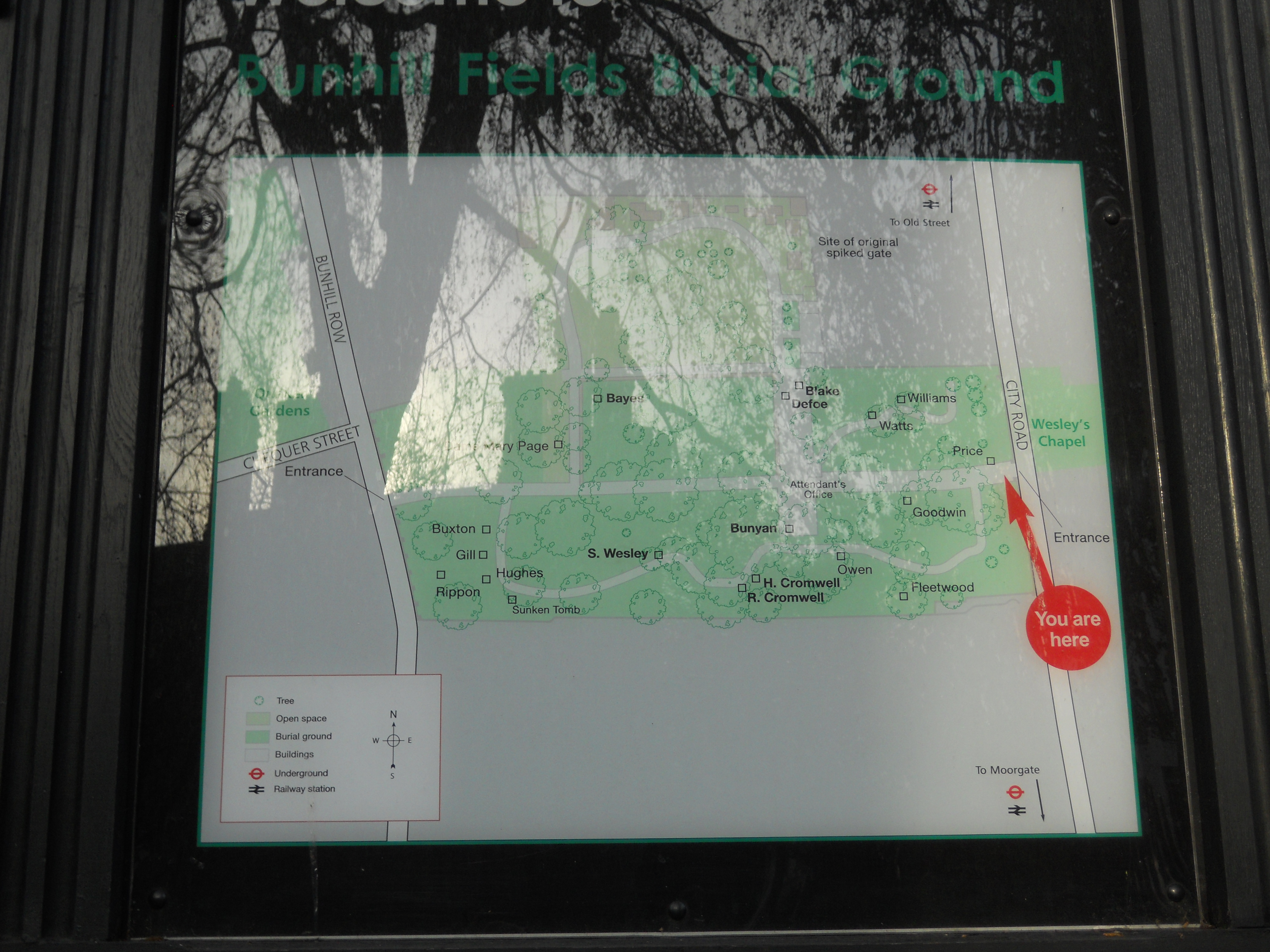
Bunhill Fields
It also contains the grave of a man, whose legacy touches us thousands of times every year, the Reverend Thomas Bayes. His grave is in this picture somewhere.
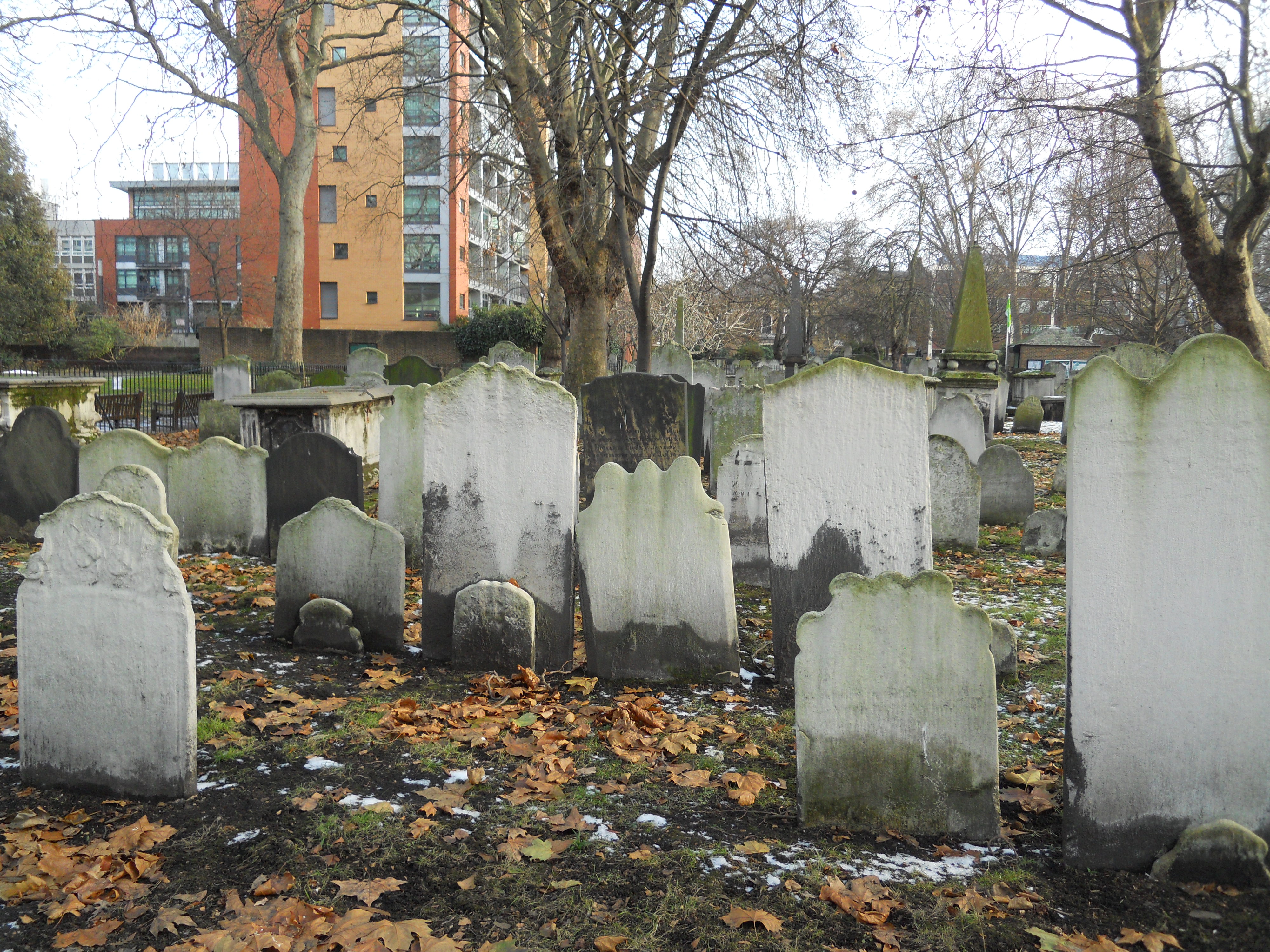
The Grave of Thomas Bayes
So why does Bayes touch us every day? His legacy is also totally positive as it is his thinking that is behind Bayesian spam filtering, used in all those programs that attempt to stop all of those rediculous e-mails we don’t want, getting to our computer.
But this is only one of a myriad set of applications of the work of Thomas Bayes. There aren’t many people, who’ve had such a beneficial effect on such a broad front, centuries after their death.
So when it comes to Great Britons, Bayes is in the first rank.
never has going to the supermarket for basic daily needs, been so interesting.
Fraud in Medical Research
Whilst thinking about homeopathy in the last post, the story of Andrew Wakefield was also in the news. If you type “Andrew Wakefield fraud” into Google, you get this story from Science-Based Medicine. Here is the first paragraph.
Pity poor Andrew Wakefield.
Actually, on second thought, Wakefield deserves no pity at all. After all, he is the man who almost single-handedly launched the scare over the MMR vaccine in Britain when he published his infamous Lancet paper in 1998 in which he claimed to have linked the MMR vaccine to regressive autism and inflammation of the colon, a study that was followed up four years later with a paper that claimed to have found the strain of attenuated measles virus in the MMR in the colons of autistic children by polymerase chain reaction (PCR). It would be one thing if these studies were sound science. If that were the case, then Wakefield’s work would have been very important and would have correctly cast doubt on the safety of the MMR. Unfortunately, they were not, and, indeed, most of the authors of the 1998 Lancet paper later withdrew their names from it.
Over the next decade, aided and abetted by useful idiots in the media, by British newspapers and other media that sensationalized the story, and the antivaccine movement, which hailed Wakefield as a hero, Wakefield managed to drive MMR vaccination rates in the U.K. below the level of herd immunity, from 93% to 75% (and as low as 50% in some parts of London). As a result Wakefield has been frequently sarcastically “thanked” for his leadership role in bringing the measles back to the U.K. to the point where, fourteen years after measles had been declared under control in the U.K., it was in 2008 declared endemic again.
David Gorski then goes on to show how badly Wakefield conducted his research. Read the whole article and the comments that follow it.
I am of an age, where it seemed in every class at school, there was a someone who had suffered the effects of polio. So to all of these antivaccine Fascists, I ask if they want to go back to those times. I also have friends and relatives, who were damaged by measles and/or mumps, who would have been saved by the MMR vaccine.
Wakefield’s badly conducted research and the fact that it was not properly checked before publishing in the Lancet has left a terrible legacy.
But there are two troubles with medical research!
Suppose, a doctor notices a link between symptom A and disease B, which is outside the normal scheme of things. If he publishes honestly, saying that this might be correct and can anybody shed light on what he has seen, many sufferers will accept what he says has gospel. Tabloid headlines will proclaim a new cure for cancer, when the doctor was just postulating something that might be useful. We see this all the time.
On the other hand, suppose this link goes totally against the established thinking. His research may well destroy the reputations of the great and good in the field. Would they allow his research to be published? Of course not. Horizon, made a programme about the messenger of the body, which turned out to be completely different to established thinking, some years ago. A lot of the programme was taken up discussing the problems of the researcher getting his ideas published.
To return to Wakefield. He definitely was helped by the bandwagon that developed after his research was published. But supposing he had been refused the publication, as his results were against established thinking. I’m with him there as I really hate censorship. But then his research was flawed and shouldn’t have been published.
Was it fraud?
Probably not in the established sense, but I feel Wakefield might have suffered from a fault very common in doctors. They have a theory and try and prove it. I am an engineer and if have a problem then I try and solve it. So if he was guilty of anything, I suspect it was not being honest with himself, his patients and his research. But we’ve all done that. I know I’ve made mistakes by using information in the wrong way. But my research hasn’t been nearly so important.
If fraud was just an isolated event in medical research, we should not be seriously worried, provided that research is properly reviewed and published.
But I have written a piece of software called Daisy.
One of the things it can do is to check the integrity of a set of numbers. A medical professor, showed me how to check a set of observations were consistent. All you do is look at the last digit and plot them as a simple histogram. If they are genuine numbers they will have one pattern and if they are some that have been made up, then they will have a different one.
The professor showed me some research where it was obvious that the numbers had been made to fit the theory.
Another isolated case?
No! A relative of someone I know was struck off for doing something similar.
So it goes on.
To avoid other cases like Wakefield, we need to make sure that all papers, and not just in the medical field, are thoroughly reviewed before publishing. This alone would make sure that researchers used the best methods and the most exacting standards. We should also have a system in place, that would not allow the suppressing of controversial research that would upset the status quo.
Thank Heaven for Duckworth-Lewis
England beat South Africa by the smallest of margins; one run. And that was by Duckworth-Lewis. Phew!
There is a serious point here though. Not about cricket but about statistics.
We should all know more about how to interpret statistics. It should be the fourth R taught at school; after reading, riting and rithmetic.
Is Publishing Statistics a Good Idea?
Statistics published today about heart operations show a very strong increase in success. This is despite warnings from the medical profession, that publishing statistics on success rates, would lead to conservative procedures.
This is a real result for openness.
I believe strongly that publishing information responsibly is always for the better. I think too that politicians are finally getting round to this belief, with David Cameron wanting all government and political expenses to be published on the Internet. He’s right, but he doesn’t go far enough.
What would I do?
The Health and Safety Executive has set a small precedent by publishing reasonably detailed lists of fatal incidents on their web site. But they don’t go far enough and the data is not published in a form that can easily be downloaded from the web site. This would enable analyses to be made to see if there are ways of increasing safety.
Obviously, databases of this type should be desensitised before they are put on line. For instance, I might be described as male, white, between 55 and 65 and living in St. Edmundsbury.
But suppose the following databases were available on-line and in a form such as Excel that was easily downloaded.
- Births by sex, post code, multiple birth etc.
- Deaths by sex, age, cause, smoker etc.
- Serious road accident by vehicle involved, post code, road type etc.
- Crime by type, post code, victim, clear up, sentence etc.
- Prisoner by sex, offence, age, prison etc.
- Illegal immigrant by country, sex etc.
This would remove much of the speculation beloved of the tabloid newspapers, who publish a statistic that proves their bigoted point of view.
The government and industry might like to try to keep hold of this data. They will cite confidentiality, security and other spurious reasons. However, as precedents are set, it will be extremely difficult to keep things confidential.
We will all benefit through access to these databases.
 The Anonymous Widower