A Beginner’s Guide On Opposing HS2
I found this here on Rail News.
Read it and enjoy.
As I’m a simple man, who prefers words of one syllable, my views on HS2 are as follows.
1. The best way to increase the capacity of our motorways is to move as much freight as possible off the roads onto the railways. As there are a limited number of freight paths on the East and West Coast Main Lines, one way to increase capacity would be to create a new high speed railway that is used by the high speed passenger trains from London to the Midlands, North and Scotland. Passenger trains would take HS2, thus releasing capacity on older lines for freight.
2. It is well known that speed attracts more passengers. At the moment there’s a lot of speculation about Norwich in Ninety. Every route from London has a time, that would attract passengers. Perhaps, it should be Birmingham in an hour, Cardiff and Manchester in two and Edinburgh in four. Speed will attract people to use the trains, hopefully freeing up the roads.
3. A lot of our older stations like Euston and Manchester Piccadilly need rebuilding, or are on cramped sites like Birmingham, Leeds and Newcastle, so building HS2 with a few well-connected and spacious stations may well make a better railway for every passenger. The network’s Victorian designers didn’t envisage the number and size of trains we are using today, let alone those that we will, in a few years time.
4. HS2 is making us think. In the past couple of months, George Osborne has laid out a plan for HS3 across the north of England from Liverpool and Manchester to Hull. The government has now announced that the existing line will be electrified as a priority. Would a politician have ever thought of this without HS2?
5. I also believe that HS2 should be freight enabled, so that at night, when the line won’t be busy, freight trains can be sneaked up and down the country. Network Rail are experimenting with using Euston in the middle of the night, as a distribution point for retail goods, so could we see that in cities like Birmingham, Leeds, Liverpool and Manchester?
6. I also think that HS2 could be the solution to how we get freight from London Gateway up to the North, if we built a tunnelled link from HS2 to HS1, This would also allow direct passenger and freight services between most of the UK and the Continent. Surely, it would be a better way to distribute Jaguars, Land-Rovers, Toyotas and Nissans all over the Continent and perhaps even further. That is just one example of probably many on how rail freight could be used.
7. I have my doubts about direct passenger services between say Manchester and Berlin, as for a journey of that length, the easyRyans of this would will always be a lot quicker and probably cheaper.
8. A properly linked up high speed rail system, connected to most parts of the country, will open up all sorts of possibilities.
9. Suppose the North Wales Coast line between Holyhead and Crewe was electrified and made into a full-size faster line, would this ease the problem of transporting freight and passengers to and from Ireland? At the present time it take nearly four hours to get to Holyhead from London, so with something like a Class 800 train, under three hours should be possible, even without the sections of HS2 north of Birmingham.
10. South Wales isn’t a problem from London and the South East, as by the end of this decade, Brunel’s Great Western will be making his ghost jump for joy, as trains speed along an electrified railway to Cardiff and South Wales as trains speed along at 225 kph. The line which, I’ve called HSW will probably change the way we think about high speed rail.
11. The main problem of South Wales is getting to Birmingham and the North. But this will probably be solved in the short term by the use of Class 800 running via Gloucester.
12. The Class 800 will have big part to play with HS2, as it will be used as a route extender, as I said in point 9, where it could be used to Holyhead.
Will This Become One Of The Iconic Photographs Of the Queen?
Last week, the Queen opened the new Reading station. It’s reported here on the BBC.
The picture of her sitting amongst Network Rail’s orange army, will surely become one of the most iconic photographs of the Queen.
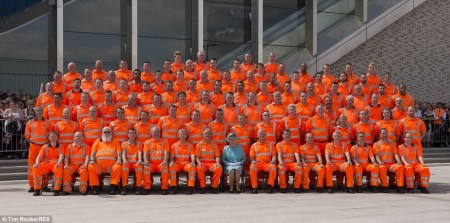
The Queen With The Orange Army
I wonder how many mantelpieces, it’s already sitting on.
Do These Strawberries Have Truck Or Rail Miles?
I was surprised that these strawberries were on sale in Sainsbury’s near me in London.

Do These Strawberries Have Truck Or Rail Miles?
I just wonder whether they came down from Scotland by truck or by train. Supermarket groups and other retailers are increasingly using trains. There’s an article here, which describes some developments in recent years, including how Tesco bring in fruit from Spain by train.
TfL Says Ready On The Northern Line Extension
This article from Global Rail News announces that Transport for London has now chosen their preferred contractor for the Northern Line Extension to Battersea.
Although it is starting later than Crossrail, the article says it could open before that rail line is fully complete.
2019 is looking to be a momentous year for new rail projects.
Is This A Case Of More With Less Electrification?
When asked in the House of Lords about the cost of extending Crossrail to Reading, Baroness Kramer, the Transport minister, said it would save £10million. It’s all reported here in New Civil Engineer. As it has been reported for some time Crossrail and the Great Western Main Line electrification will share some infrastructure like transformers, I don’t think the cost saving is unexpected.
Roll On Crossrail
I’ve recently been to Iceland for a few days holiday, which meant a trip to and from Heathrow.
For people like me in East London just to the North of the City, it is a boring and tedious journey.
Going out, I took the easy route for me, which is to take a 141 bus from virtually outside my house to Manor House station and then got the Piccadilly Line all the way to Heathrow. It gets you there but around thirty stops on the Underground isn’t quick at around an hour and a half.
Coming back, the flight was in a bit late and I decided to use Heathrow Express. My ticket cost me £13.80 with a Senior Railcard and is timed at 21:09, which as the Heathrow Express I got left Heathrow at 22:18 and arrived at Paddington at 22:36, says a lot for the speed of the Border Agency and the baggage handlers at the airport. From Paddington, I decided that as I was hungry and there is no good gluten-free restaurant at Paddington, that I would get a taxi. I got home just after 23:00, as although there were lots of taxis, the self loading cargo couldn’t get itself organised. As the taxi cost me £26, and although it might have been slightly quicker by about twenty minutes or so, each minute saved cost me a couple of pounds.
Next time, I’ll take the Underground.
In a few years time, I’ll probably use Crossrail. Heathrow to Whitechapel will take about 37 minutes according to their web site and from there to home is probably about 15 minutes now. So Crossrail should deliver a time of under an hour for a lot less money. Hopefully, it will be free as reports say that Freedom Passes will be able to be used to the Airport.
So on a brief look, it would appear that everybody in the City and East London will probably use Crossrail to get to Heathrow. Who in their right mind, would struggle to get to Paddington to get the Heathrow Express?
Incidentally, my taxi driver last night thought that Crossrail would be good for black cabs, as more people would use the train to get into London.
The one problem is that Terminal 5 at Heathrow is not on Crossrail. But looking at the various trains that are either are or will be connected to Heathrow and their routes, I would suspect that this will be rectified a few years after Crossrail opens.
There are various proposals that help to link Heathrow to the rail network.
The one that probably stands the highest chance of being built, is to link Terminal 5 to Reading to give rail access to the airport from the West of England and Wales. The BBC talks about it here.
If this one gets built would some Crossrail trains just go underneath Heathrow stopping at Heathrow Central, Terminal 4 and Terminal 5 in order before carrying on to Reading on the other side of the airport. At Reading, it could be a cross-platform interchange to fast trains to the west. Reading to Cardiff now takes just under a hundred minutes. When electrified and with new Class 801 trains, this could be reduced by about fifteen minutes or so. So if you add the short hop from Reading to Heathrow, the journey to Heathrow from Cardiff could be well under two hours. If the Class 801 could get to Heathrow, obviously the journey would be quicker too!
What Do The French Do For Commuter Trains?
The French equivalent to the Class 345 for Crossrail, also has a version built by Bombardier called the Z 50000 Francilien.
What probably shows more of this train is this excellent YouTube video.
Looking at the video and comparing the images with say travelling in a familiar Class 378 on the Overground, you notice several differences.
The biggest difference is that the French train is wider and taller in cross-section than the British train. This is due to the much more generous Continental loading gauge, which the designers of the train have used to their advantage.
Another big difference is getting into and out of the trains. On the Class 378 and probably the Class 345, it’s just a simple step across, but on the French train, an extra step emerges from the train and it’s a double step into the train. How would the French train cope with platform edge doors, like those that will be installed on Crossrail? I ask this question as European safety legislation insists on these in all stations in tunnels.
The Trains For Crossrail And Thameslink
London’s two new cross-town railways; Crossrail and Thameslink will both be fully opened around the end of this decade.
So it would seem logical that the two lines might share the same trains.
But it is not as simple as that!
All sorts of factors like delaying of projects, the slightly different natures of the two lines and the decision of Siemens, who won the contract for the Thameslink trains, to withdraw from Crossrail, because of a lack of capacity, mean that we now have two separate train fleets; Class 700 for Thameslink and Class 345 for Crossrail.
Although separate train fleets, it does look that the design philosophy of the two trains is very similar. Take this paragraph from the specification issued by Crossrail for their Class 345 trains.
Wide through gangways between carriages, and ample space in the passenger saloons and around the doors, will reduce passenger congestion while allowing room for those with heavy luggage or pushchairs.
From what I have read here on First Capital Connect’s web site, the Class 700 might be very similar.
So it would seem that four of London’s important new train fleets will be walk-through. In addition to the Class 345 and Class 700, the Overground’s Class 378 and the Underground’s S Stock are build to similar principles, although the latter two trains, probably expect more standing passengers.
One advantage of these trains is that they can be designed to line up with the platform edge, as the Class 378 generally do, which enables a simple step across the gap into or out of the train. At some stations, like Willesden Junction, on the Overground, the alignment is bad and you certainly notice the difference. So I will hope that the two new train classes line up with the platforms! As on Crossrail and Thameslink most stations will only be served by one type of train, I suspect that it could be possible.
In my view, if we are to have a step-free railway, then all station-train interfaces, should be a simple step across.
Another advantage of this type of train, is that you can walk inside the train to less-crowded areas or perhaps to your preferred door for exit at your destination. I do this regularly, when I take the short hop from Highbury and Islington to Dalston Junction stations on the Overground, as I get in at the front and get out at the back, due to the layout of the two stations.
This walk-through capability will be essential for Crossrail, where the trains and platforms will be 200 metres long. One of Crossrail’s engineers told me, that she felt some people might not like the trains because of their length and the long walks in stations. I don’t think regular users will mind so much, as they’ll develop a strategy that works for their journey. But will a tourist dragging a heavy case going from say Heathrow to Bond Street, be so happy after walking a long distance to get out the station.
The various proposals for new deep-level Underground trains seem to have through gangways like this proposal from Siemens.
So is a de facto standard for train design emerging, where trains have through gangways, flat floors and wide doors with no-gap step-across access?
I think it is and it will be to the benefit of all rail users, including the disabled and those pushing buggies or dragging heavy cases.
Looking at the pictures I took of Siemens Underground proposal, it seems the design fits such a standard!
A secondary advantage of this design is that it should tighten up stopping time at stations, thus making it easier for trains to keep to schedules.
More And Better Wi-Fi For Trains
There are reports like this one from the BBC, which say that a Network Rail fine is going to be used to improve wi-fi on trains.
I believe that Chiltern Railways have got wi-fi right, with free access on their Mainline trains to Birmingham. Virgin appear to be going the same way too.
So lets hope that in a few years all trains have free wi-fi in all classes!
I must admit that if GreaterAnglia had free wi-fi in all carriages, then I wouldn’t bother to book First Class when I go to football at Ipswich, which would save me money.
I would think that it could be a good marketing tool for train companies, as it might be the service that will tempt people out of their cars and onto the trains.
And if trains can be wi-fi enabled how about more buses. I had hoped that London’s new Routemasters would be enabled, but they are not.
 The Anonymous Widower