Borders Railway Tourist Impact Revealed
The title of this post is the same as this article on the BBC web site.
This is said.
New data has shown a “significant improvement” in tourism levels after the opening of the Borders Railway.
The Scottish Tourism Economic Assessment Monitor (STEAM) statistics compared the first half of 2016 to the same period the year before.
It is the first time in 10 years that every category saw improvement.
The company which produces STEAM data said the most likely source for the rise in tourism activity in the Borders and Midlothian was the railway.
Perhaps now the Department of Transport and the Treasury will believe that funding well-designed schemes is very much worthwhile.
Driver Only Train Operation In Yorkshire
One of my readers has just sent me this story from the Yorkshire Post, which is entitled Commuter chaos in Yorkshire after train driver leaves conductor behind.
No-one seems to have been hurt in this demonstration of Driver Only Operation, so perhaps as a matter of honour, the RMT should look at more efficient ways of train operation.
Worcester Parkway Station Given The Green Light
According to this article in the Worcester News, Worcester Parkway station has been given the green light by the Government.
Clearing of the site will start this winter.
This is another station project to be given the go-ahead, since I wrote Government Focuses On New Stations And Trains. So it could be that Chris Grayling has changed direction at the Department of Transport.
The Worcester News article gives more details of the station.
- New Class 800 trains will go direct on the Cotswold Line to Oxford and Paddington.
- Services between Gloucester and Birmingham will also stop.
- The station is close to Junction 7 of the M5.
- The station will have 500 parking spaces.
It should be noted that Worcester Foregate Street station is on a restricted site and has no parking and Worcester Shrub Hill station has only 121 spaces. I suspect that the two current stations don’t probably encourage mode shift from car to train by travellers.
The article says this about funding.
The majority of the budget for the scheme will be self-funded through station car park fees and access charges levied on the Train Operating Companies, along with £8.3 million from the Worcestershire Local Enterprise Partnership through the Government’s Growth Deal.
Worcestershire Local Enterprise Partnership is very hopeful that the new station will be good for the local economy and employment.
It certainly looks like it will improve the journey of commuters and travellers from the Worcester area to Birmingham and London.
I also wonder, if once the station is built, there will be opportunities for the train companies to use trains more efficiently and add extra services to and from Worcester. Could some of these inefficiencies release valuable development land in the centre of Worcester?
Worcester Parkway is not a normal station project reliant on a lot of local and central government funding, but one with several different ways of raising the finance.
Passengers At Cambridge Station
I found a reference to the passenger growth at Cambridge station, which is confirmed in Wikipedia.
In 2011/12 passengers at the station were around 9 million and in 2015/16 that had grown to around 11 million.
Consider.
- Cambridge North station opens in May this year.
- Thameslink will start services to Cambridge from all over London in 2018.
- Greater Anglia will be increasing capacity and frequency to Bury St. Edmunds, Colchester, Ipswich, Norwich, Peterborough and Stansted Airport.
So what will be the traffic in say 2020?
After The Robin Hood Line Will Nottingham See The Maid Marian Line?
This article in the Nottingham Post is entitled Hopes HS2 could see ‘Maid Marian Line’ opened to passengers.
There is a freight only line between Kirkby-in-Ashfield station on the Robin Hood Line and Pye Bridge on the Erewash Valley Line.
The proposal would allow trains to go between Kirkby-in-Ashfield via Pinxton and Selston to Langley Mill and Ilkeston and then on to Nottingham.
I’ve been here before in September 2015 in a post called Expanding The Robin Hood Line.
But the new baby elephant in the room is the new Ilkeston station, which hopefully opens on the 2nd of April 2017.
Given Chris Grayling’s thoughts, that I wrote about in Government Focuses On New Stations And Trains, could it be that if extra trains can be found, that to provide a second train per hour between Nottingham and Ilkeston, a second route to Kirkby-in-Ashfield and on to to Mansfield and Worksop, is opened up the Erewash Valley Line.
The route could even terminate on the proposed extension of the Robin Hood Line to Ollerton.
The route from Nottingham to Ollerton would be.
- Nottingham
- Toton for HS2
- Ilkeston
- Langley Mill
- Selston – New station
- Pinxton- New station
- Kirkby-in-Ashfield
- Sutton Parkway
- Mansfield
- Mansfield Woodhouse
- Shirebrook
- Warsop- New station
- Edwinstowe – New station
- Ollerton – New station
I think it is likely that this route could be developed.
- The track is all there and is used by freight trains and/or for driver training.
- An hourly service on this route would mean additional services for many of the stations on the route.
- The only problem would be finding some suitable diesel trains for the route.
- It could probably be trialled to Mansfield or with a simple station at Ollerton.
- The track from Ollerton appears to be intact all the way to Lincoln.
But the clincher is that it would provide connectivity for HS2 all the way from Worksop and Mansfield to Lincoln and Grimsby.
HS2 is needed, but we must make sure that the benefits of the line are spread to all parts of the country.
If this route to Lincoln could be developed as a 100 mph line, the time from Lincoln to London with a change to HS2 at Toton could be likely to be under two hours.
In Government Focuses On New Stations And Trains, Chris Grayling mentioned the route from Grimsby to Sheffield. Surely creating this route from Lincoln to Toton via Ollerton for HS2, is what really improves train transport in North Lincolnshire.
Government Focuses On New Stations And Trains
This is the title of an article in Rail Magazine.
This is the opening paragraph.
Passenger numbers rising fast, new stations, improved facilities and new trains are the result of policies followed by the current Government and not what Labour wants to follow, claims Secretary of State for Transport Chris Grayling.
As an example about what is needed Gayling talks about the Cleethorpres to Sheffield Line.
It is an interesting insight to some of Mr. Grayling’s thinking.
But I agree we need more stations and trains.
I also feel that wit the right innovation and design, we may be able to provide services in places that previously have been thought not to be viable..
Lothbury
In Taxis And Bank Junction, I mentioned that the Northern City Line was originally authorised to Lothbury station .
These pictures were taken at the junction of Lothbury, Moorgate and Prine’s Street.




It strikes me, that a station here would have been a good Edwardian addition.
This map from carto.metro.free.fr shows the lines North of Bank station.

The interesting thing is the dates on the lines.
- Northern Line – 25/02/1900
- Central Line – 28/07/1912
As the Northern City Line opened in 1904, there would have been a lot of construction going on in the area.
Around 1913, plans were made to connect the Northern City Line with the nearby Waterloo and City Line.
The Bank of England Building is relatively modern dating from the 1920s.
So probably all of this building meant that the extension to Lothbury just got in the way.
But interestingly note, how the two lines of the Northern Line cross over in probably the area where the new station would have gone. This would surely have made more tunnelling difficult.
So was it just too complicated as well?
I don’t know!
But it is probably true to say that if we wanted to extend the line today, we could probably do it.
Especially, as the Northern Line tunnels are being realigned when Bank station is rebuilt in the next few years.
But I doubt we will do it, as the new massive Moorgate-Liverpool Street for Crossrail will finally give the Northern City Line, the connectivity it needs.
Hastings Station
Hastings station was only built in 2004 and it is effectively a new building on the existing platforms, which have been made step-free.


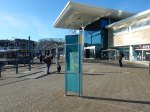


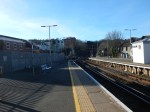
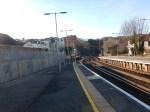
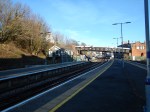
What surprised me though, was that trains going East are still controlled by semaphore signals, although there appeared to be new LED signals at the Western end of the station.
I wanted to go back via East Croydon and unfortunately, I just missed that train, so as there is only one direct train per hour (tph), I had to fiddle about and go via Eastbourne and Brighton.
In an ideal world, there would be four tph at all stations on the line between Ashford and Brighton, with stations like Hastings, St. Leonards and Eastbourne having better direct services to London.
The current services on both the East Coastway and West Coastway Lines seem to be designed to discourage passengers to turn-up-and-go.
If you look at the Off Peak services through the Medway towns from Gravesend to Gillingham, it is four tph, whereas Hastings to Brighton is only two tph.
But then Southern seem to have a very focused business model, where passengers are someway down the list!
St. Leonard’s Warrior Square Station
I’d never been to St. Leonard’s Warrior Square station, but I went today to enjoy a walk in the sun.
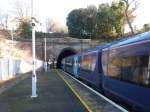
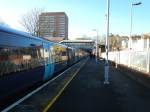

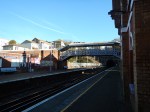
-

- St. Leonard’s Warrior Square Station
The station is a fairly simple affair, with unusually tunnels at both ends of the station. According to Wikipedia, this means that the number of carriages that have access to the platforms is restricted.
This oogle Map shows the station, with the tunnel portals clearly visible.
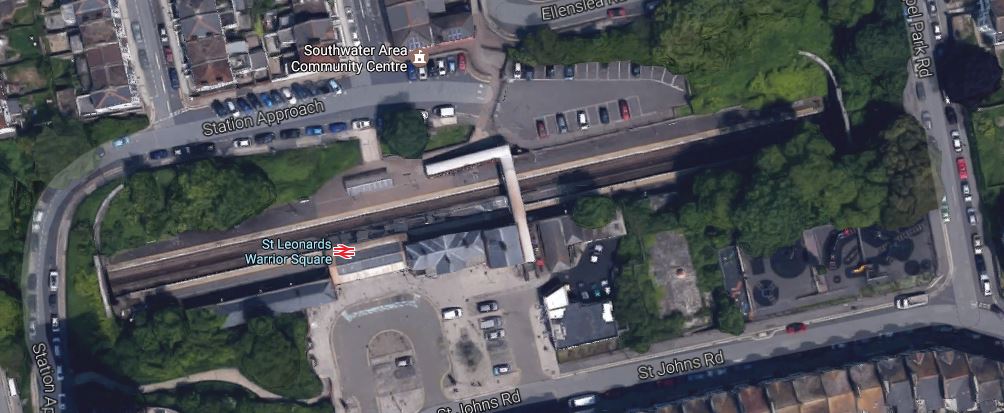
Although, the bridge across the tracks is not step-free, it has an unusually low number of steps on each side.
As the main Hasting station is new and step-free, I suspect this station will not be updated for step-free access, unless a developer had a plan to create a new station and make a lot of money with perhaps an appropriate over-site development.
 The Anonymous Widower