We tried Lumo’s New Train Offering Direct Route From London To A historic UK City For Less Than £30
The title of this post, is the same as that of this article on GB News.
This is the sub-heading.
GB News boarded Lumo’s brand-new route between London Euston and Stirling
These are the first two paragraphs.
Lumo’s new direct service between London Euston and Stirling launched just months ago, and it is already regularly selling out services.
We stepped on board one of the recently refurbished trains to see what the six-hour journey to the historic Scottish city was like.
Three things surprised me about the review.
- It is very upbeat, which surprised me, as GB News is often very critical.
- It didn’t mention Lumo’s misbehaving toilets.
- But it did say that the trolley came around regularly for anyone getting on at a later stop or needing a second coffee.
It also said, that the route is already proving incredibly popular.
But you’d hope that would be the case, if they’d chosen the route with care.
I have some thoughts about the route.
Stirling Station Is Well Connected
The Wikipedia entry for Stirling station lists these services.
Trains operate north to Dunblane (three trains per hour), to Perth, Dundee and Aberdeen (hourly), Inverness (four trains per day), south west to Glasgow Queen Street (three trains per hour), and east to Edinburgh Waverley (half-hourly). The service to Alloa and Dunfermline was withdrawn in October 1968, but the reopening of the Stirling-Alloa-Kincardine rail link partially restored that service with an hourly service from Glasgow to Alloa as an extension of the Croy Line services. This utilises the existing DMU from Glasgow, which previously spent considerable time in one of the bay platforms at Stirling with engines idling, but now utilises the layover time to make the return trip to & from Alloa.
It makes the city a good base for exploring Scotland.
Stirling Station Is Surrounded By Hotels
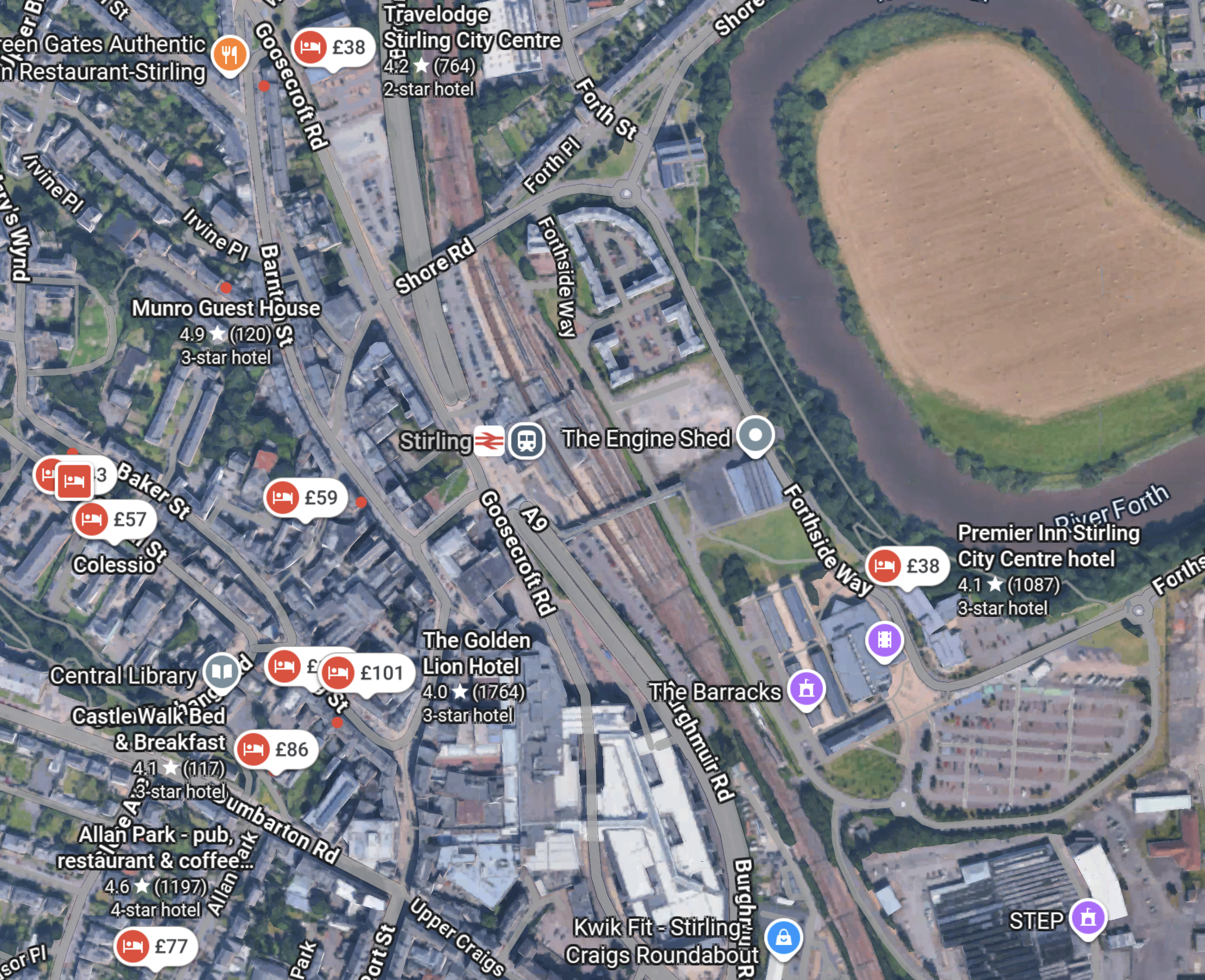
This Google Map shows the station and a few hotels.
Note.
- There are nine hotels on this map.
- There is a Premier Inn and a Travelodge for £38 per night.
- There is also a Vue cinema.
It reinforces, what I said earlier about the city being a good base for exploring Scotland.
Lumo Has Increased The Number of Direct Services To London From One To Five!
Prior to Lumo commencing services a few weeks ago, Stirling only had one train per day (tpd) to and from London.
Now there are five!
That surely can only have positive effects for Stirling.
Will Lumo Have Any Impact On The Economy Of Stirling?
I asked Google AI, the question in the title of this section and received this reply.
Lumo’s direct, low-cost rail service connecting Stirling to London Euston, which launched on May 25, 2026, is boosting the local economy by increasing tourism, encouraging business investment, and offering four daily return trips with fares starting at £29.90.
Economic Benefits
Tourism Growth: Affordable ticket prices from Lumo make it easier and cheaper for visitors from England to travel directly to historical sites like Stirling Castle.
Business and Investment: Four daily return trains improve connectivity for local companies, supporting inward investment and commercial links with London.
Job Creation: The route expansion has added around 100 new roles within the rail and supply chain sectors.
Sustainable Travel: Providing a budget-friendly rail alternative helps shift travelers away from higher-emission car and air journeys.
It looks like Lumo will be good for Stirling.
Larbert, Greenfaulds And Whifflet Get Direct Services To London And England
These three stations to the East of Glasgow will get four directtpd to and from London and intermediate stations.
These services will be the first direct services to the capital for these three stations.
Motherwell and Lockerbie Get Four Extra Direct Services To London And England
Motherwell has eleven tpd to London, but Lockerbie has only two, with one on Sundays.
Lumo’s extra four tpd will probably more important at Lockerbie, than Motherwell.
Calls At English Stations
These are the number of calls at English stations.
- Carlisle – 4 tpd
- Preston – 4 tpd
- Crewe – 2 tpd, 4 tpd on Saturday
- Nuneaton – 4 tpd
- Milton Keynes Central – 4 tpd
Note.
- Effectively, 4 tpd seem to stop at all stations, with two not stopping at Crewe.
- As 4 tpd stop at all Scottish stations, this could be a useful direct service for many.
- When the unions sort out their differences, Milton Keynes Central could be a useful interchange to the East-West Rail for Oxford, Universal Studios Bedford, Bedford and Cambridge.
- Nuneaton could be a useful interchange for CrossCountry for Birmingham, Leicester, Peterborough, Ely, Cambridge and Stansted Airport.
- Crewe and Preston could be a useful interchanges for Liverpool, Manchester and Blackpool.
- Carlisle could be a useful interchange for the Northernmost parts of England.
It is a very well connected service.
Eurostar And Deutsche Bahn Advance Plans For Direct London to Germany High-Speed Trains
The title of this post, is the same as that, of this article on Global Railway Review.
This is the sub-heading.
Eurostar and Deutsche Bahn have signed an MoU to pursue direct high-speed trains linking London with Cologne and Frankfurt from early 2030s
These three paragraph add some extra details.
Eurostar and Deutsche Bahn (DB) have formally begun work on establishing a direct high-speed train link between London and Germany after signing a Memorandum of Understanding (MoU) in early December. The development aims to introduce non-stop long-distance passenger services between the UK and major German cities including Cologne and Frankfurt, potentially from the early 2030s.
The service would cut journey times to around four hours between London and Cologne and just over five hours to Frankfurt, delivering a direct city centre-to-city centre connection with no interchange. The routes would use Eurostar’s forthcoming Celestia fleet, a double-deck high-speed train offering 20% additional capacity and up to 50% energy savings.
This announcement comes just over a month after the Office of Rail and Road (ORR) approved Virgin Trains’ access to the Temple Mills International depot in East London, adding fresh momentum to plans for new cross-border services through the Channel Tunnel.
These are my further thoughts.
Is There A Brussels And Frankfurt High Speed Line?
I asked Google AI, the question in the title of this section and received this reply.
Yes, direct high-speed trains run between Brussels and Frankfurt. The journey takes about 3 hours and 20 minutes, operated by Deutsche Bahn using ICE (Intercity Express) trains.
Route and Service Details
Train Type: German ICE high-speed trains.
Travel Time: Fastest trips take roughly 3 hours and 19 minutes.
Frequency: Around 7 direct trains run each day.
Key Stops: Liège-Guillemins, Aachen Hbf, and Cologne (Köln) Hbf.
Note.
- It looks like the London and Brussels service is being extended to Frankfurt.
- There doesn’t seem to be much new infrastructure.
- Eurostar currently takes seven minutes under two hours between London and Brussels.
Using the same Celestia trains by both Eurostar and Deutsche Bahn surely makes sense operationally.
Do German High Speed Trains Run Between Frankfurt And Berlin?
I asked Google AI, the question in the title of this section and received this reply.
Yes, German high-speed ICE (Intercity Express) trains run direct routes between Frankfurt (Main) Hauptbahnhof and Berlin Hauptbahnhof. The fastest non-stop services take about 3 hours and 43 minutes, reaching speeds up to 300 km/h (186 mph) over a distance of roughly 262 miles (422 km).
Route and Schedule Details
Frequency: Direct trains run hourly or more during peak times, with dozens of daily departures.
Speed/Type: Operated by Deutsche Bahn, standard ICE trains and select high-speed ICE Sprinter services manage the corridor.
Stops: Many services run non-stop or make brief stops at major hubs like Erfurt or Halle depending on the specific schedule.
Note.
- A London and Berlin service would only require one change of train at Frankfurt.
- There doesn’t seem to be much new infrastructure.
With a good cross-platform interchange in Frankfurt, I estimate that the journey could be slightly less than nine hours.
Onward To Warsaw And Beyond
This is the first paragraph of the Wikipedia entry for Rail Baltica.
Rail Baltica is an under-construction rail infrastructure project that is intended to integrate the Baltic states in the European rail network. The project envisages a continuous rail link for passenger and freight services with stations from Tallinn (Estonia) to Warsaw (Poland), via Pärnu (Estonia), Riga (Latvia) and Kaunas (Lithuania), with two branches extending from the main line towards Riga International Airport and Vilnius (Lithuania). Its total length in the Baltic states is 870 kilometres (540 mi), with 213 kilometres (132 mi) in Estonia, 265 kilometres (165 mi) in Latvia, and 392 kilometres (244 mi) in Lithuania.
It is an ambitious project.
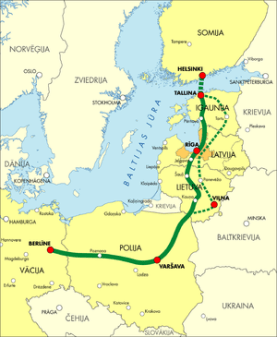
This map shows the routes.
Note.
- I believe that the map is in Latvian.
- Rail Baltica is shown as starting from Berlin in Germany.
- A possible extension to Helsinki is shown, which would require a tunnel.
- Ukraine is shown in the South-East corner of the map.
- Part of Belarus is above Ukraine, with part of Russia above it.
If Ukraine joins the EU, then I’m certain that there could be a Warsaw-Kiev branch.
When Will Rail Baltica Be Open Between Warsaw and Tallinn?
I asked Google AI, the question in the title of this section and received this reply.
The Rail Baltica high-speed line between Warsaw and Tallinn is scheduled for an initial operational opening by 2030. According to the European Commission’s phased milestones, a functional single-track, electrified connection from Tallinn through Latvia and Lithuania down to the Polish border will be completed by 2030, enabling initial passenger services.
Project Timeline & Phasing
2030 Target: Completion of Phase 1, providing a continuous single-track operational line across the Baltic states connecting to Poland.
Full Buildout (Double-Track): Full expansion to a double-track network will continue past 2030, dependent on subsequent funding availability.
Public Sentiment: Opinions on the r/BalticStates subreddit are mixed, with some observers skeptical about meeting the tight 2030 deadline due to previous setbacks, while others note visible construction acceleration driven by EU oversight.
Expected Travel Benefits
Travel Time: Reduces the journey between Tallinn and Warsaw to just over 6 hours.
I would certainly love to be able to ride a train from London St. Pancras to Tallinn.
Putin Won’t Like It!
He probably believes that all railways East of Berlin should be Russian gauge.
But what are the odds, he has an untimely accident?
Conclusion
I believe that if Eurostar to Frankfurt can create a rail route between the UK and Finland and the Baltic States, it will create large amounts of growth in tourism all over Europe.
There are also two projects with similar completion dates.
- Eurostar to Germany aims to introduce non-stop long-distance passenger services between the UK and major German cities including Cologne and Frankfurt, potentially from the early 2030s.
- Completion of Phase 1 of Rail Baltica, providing a continuous single-track operational line across the Baltic states connecting to Poland has a 2030 target.
I believe competition between the two groups will mean both are on time.
On The Bonnie, Bonnie Banks o’ Loch Lomon’
I couldn’t resist using the first line of one of the most famous Scottish traditional songs, as the title of this post.
But a very significant power station project, is to be undertaken in the area.
These are the opening few sentences of the Wikipedia entry for the Loch Sloy Hydro-Electric Scheme.
The Loch Sloy Hydro-Electric Scheme is a hydro-electric facility situated between Loch Sloy and Inveruglas on the west bank of Loch Lomond in Scotland. It is also within the Arrochar Alps. The site was originally suggested as the location of a huge pumped-storage scheme in 1936 by Edward MacColl, but this was rejected as being uneconomic. After the North of Scotland Hydro-Electric Board was created in 1943, it became the first of their proposed schemes.
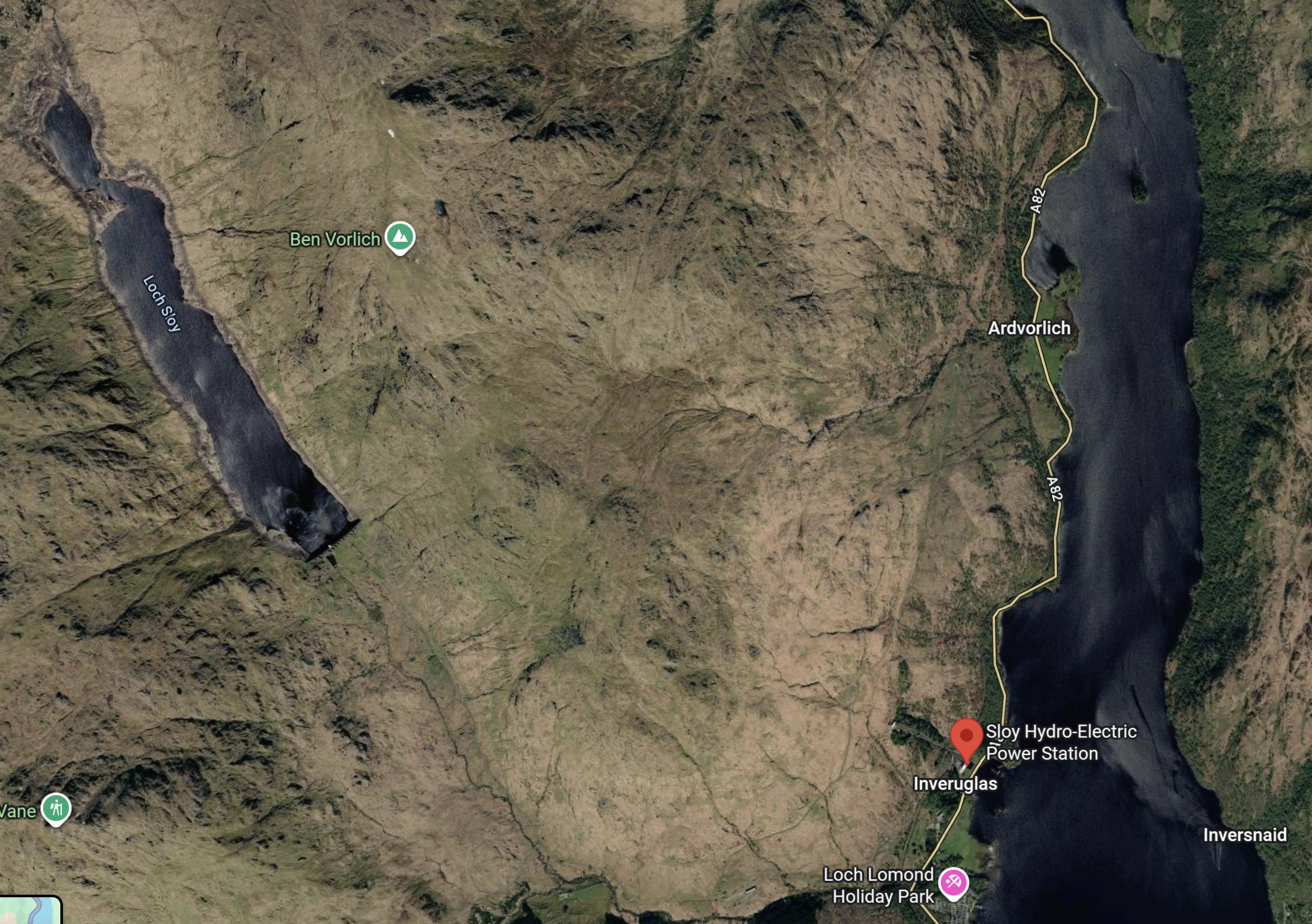
This Google Map shows Loch Lomond and Loch Sloy.
Note.
- Loch Sloy is in the North-West corner of the map.
- Loch Lomond is on the Eastern side of the map.
- The red arrow indicates the main buildings of the LochSloy Hydro-Electric Power Station.
- Loch Sloy is eight-hundred feet above Loch Lomond.
- The total generating capacity of the power station is 152.5 MW.
The facility is operated by Scottish and Southern Energy, and is normally in standby mode, ready to generate electricity to meet sudden peaks in demand. It can reach full capacity within 5 minutes from a standing start.
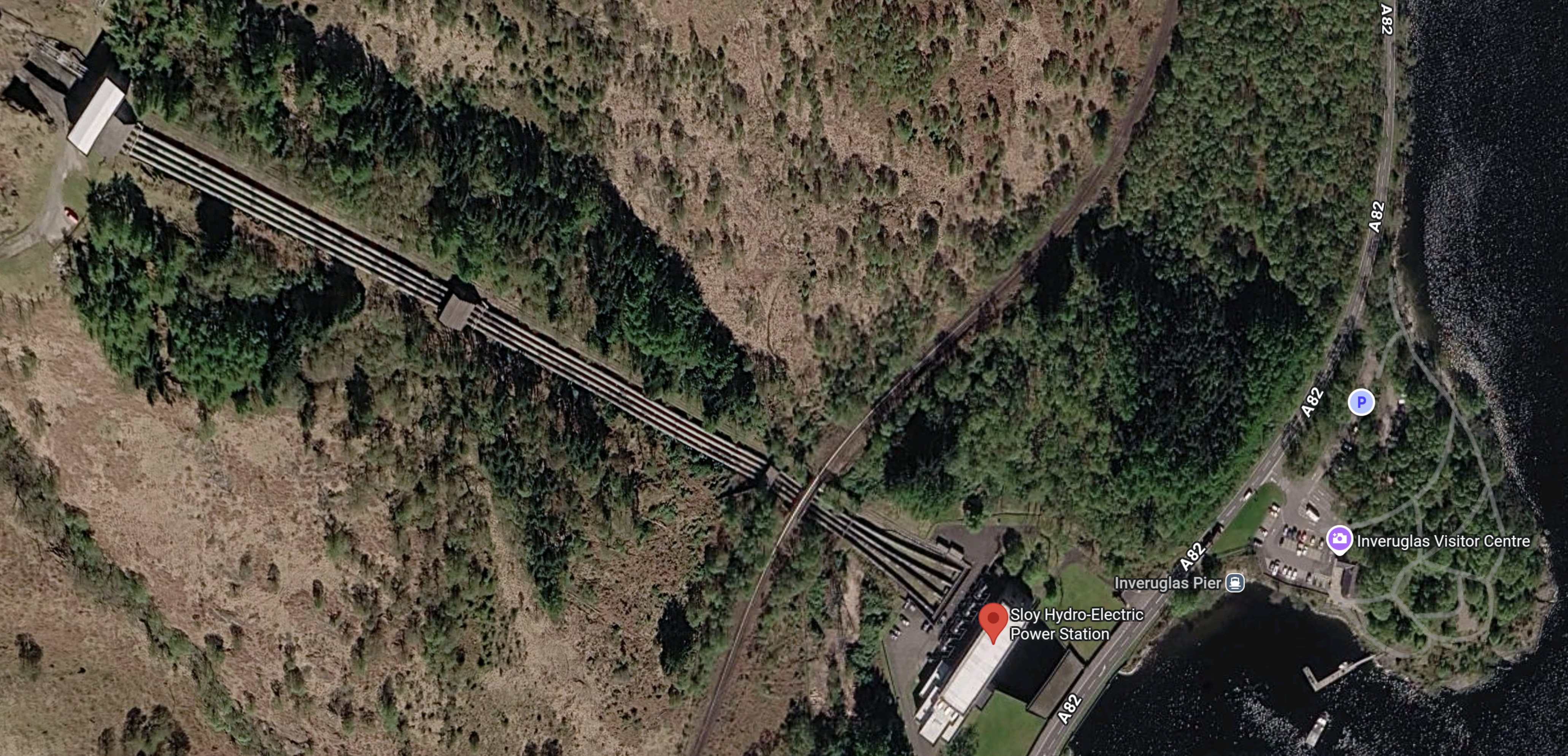
This second Google Map shows the power station to a larger scale.
Note.
- Loch Sloy is to the North-West of the North-West corner of the map.
- Loch Lomond is on the Eastern side of the map.
- The red arrow indicates the main buildings of the Loch Sloy Hydro-Electric Power Station.
- The four pipes carry water from Loch Sloy to the actual power station.
- The single-track West Highland Line crosses over the four pipes at their South-Eastern end.
The design of Loch Sloy Hydro-Electric Power Station is typical of many hydro-electric stations all over the world.
This third map is an OpenRailwayMap of the area.
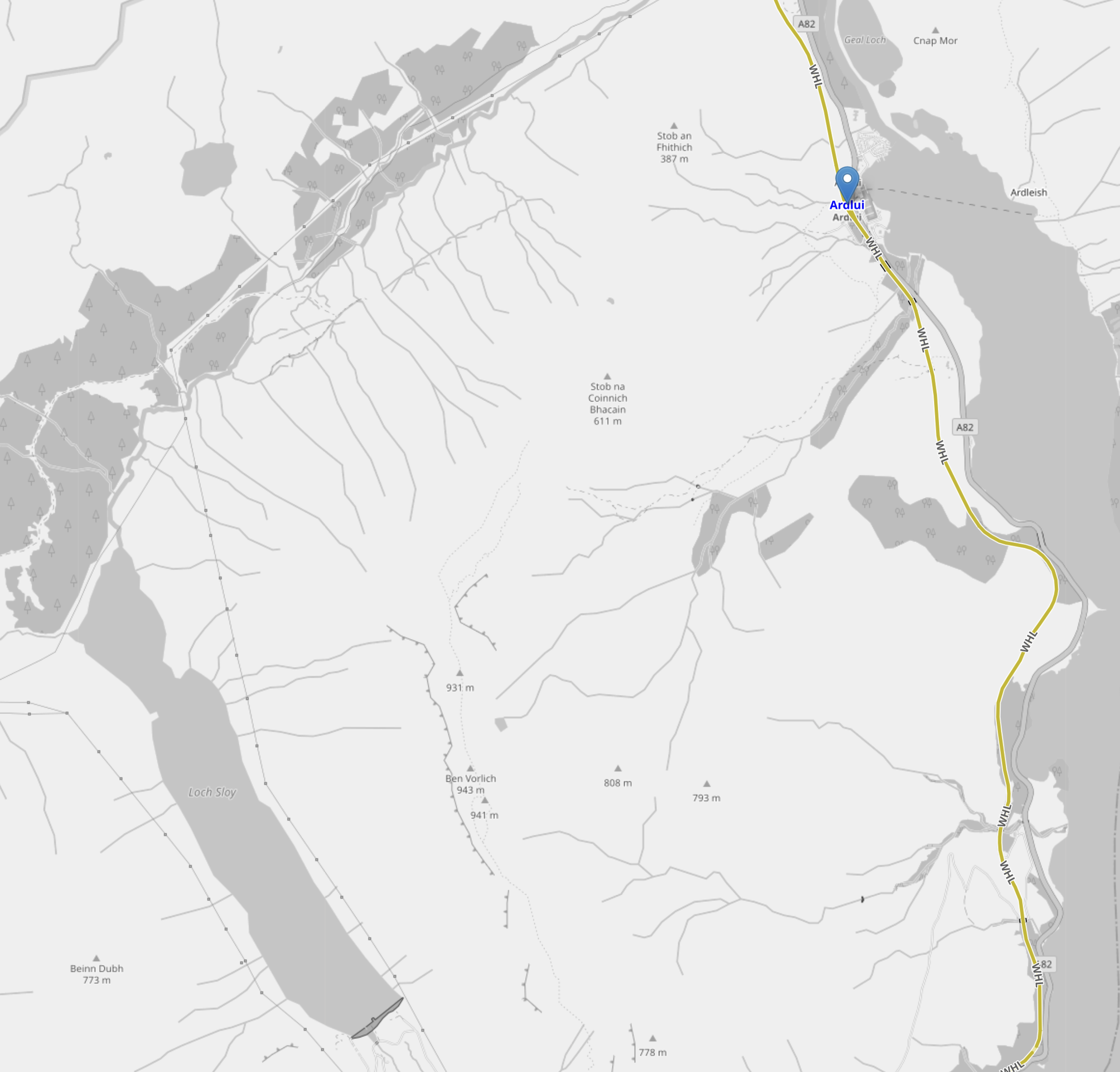
Note.
- Loch Sloy is on the Western side of the map.
- Loch Lomond is on the Eastern side of the map.
- The yellow track is the single-track West Highland Line between Glasgow and Mallaig via Fort William
- The blue arrow indicates Ardlui station.
The railway goes close to the power station.
A Platinum Celebration for Sloy Power Station!
The title of this section is the same as this must-read web page on the SSE web site, which dates from 2020.
Sloy Power Station Development Plans
This second must read web page on the SSE web site is entitled Sloy Power Station.
This is the sub-heading.
We’re Proposing To Convert Our Iconic 1950s Hydro Station To Pumped Storage Hydro
This is the introduction to the development.
In April 2025, we submitted a planning application to the Scottish Government to convert the iconic Sloy Power Station into a pumped storage hydro scheme.
Our proposals would bolster energy security and help provide the large-scale and flexible renewable energy back-up needed in a future UK net zero power system, helping meet the UK Government’s ambition of Clean Power by 2030.
If approved for delivery, the converted Sloy scheme would be capable of delivering up to 16GWh of long-duration electricity storage capacity.
It could provide firm, flexible renewable energy for up to 100 hours non-stop.
It appears that the upgraded power station will effectively become a 160 MW/16 GWh long duration energy store.
Currently, the UK’s largest pumped storage power station is the 1727 MW/9.1 GWh Electric Mountain in North Wales.
The updated Sloy power station will have less output, but more storage capacity, than Electric Mountain.
Should There Be A Railway Station At Loch Sloy Power Station?
Google AI gives this answer in reply to “Loch Sloy Railway Station”.
There was never a permanent public railway station called Loch Sloy, but temporary private platforms like Inveruglas railway station and Faslane Platform railway station served the area. These stops were built in 1945 by the London and North Eastern Railway (LNER) to haul materials and workers—including prisoners of war—for the construction of the Loch Sloy Hydro-Electric Scheme.
Note.
- Surely, similar reasons to those in 1945 could apply to the development of the power station. Materials and workers could be brought in by rail.
- Given, the power station’s historic significance, I believe that it could become a tourist attraction and/or education centre.It could be a stop for the Caledonian Sleeper.
I believe that as time passes, the power station’s historic significance will increase.
Are There Any Other Hydro Power Stations, That Can Be Upgraded To Pumped Storage Hydro?
Google AI can’t find anything at present.
Does Scotland Have A Plan To Build A Railway With Invisible Electrification?
There is an article in Rail Technology Magazine, which is entitled £20m Upgrade Secures Future Of Scotland’s First Electrified Railway.
This is the sub-heading.
A £20 million investment is underway to renew overhead power infrastructure on Scotland’s original electrified railway, safeguarding one of the country’s most operationally critical commuter networks for decades to come.
These two paragraphs give more details.
The programme focuses on key sections of the North Clyde lines, which operate from Helensburgh, Balloch and Milngavie through Glasgow’s west end and low‑level stations. As the busiest suburban railway outside London, the corridor plays a pivotal role in keeping Scotland’s wider rail network moving.
First electrified in 1960, the North Clyde routes marked the beginning of modern rail travel in Scotland. More than six decades on, that early investment continues to influence today’s network, underpinning electric services on routes including East Kilbride and Barrhead, with further electrification projects progressing across Fife and the Scottish Borders.
Surely at over 65-years-old, the electrification needs pensioning off and replacing with the best that the mid-2020s can provide.
This OpenRailwayMap shows the 1960s electrification.
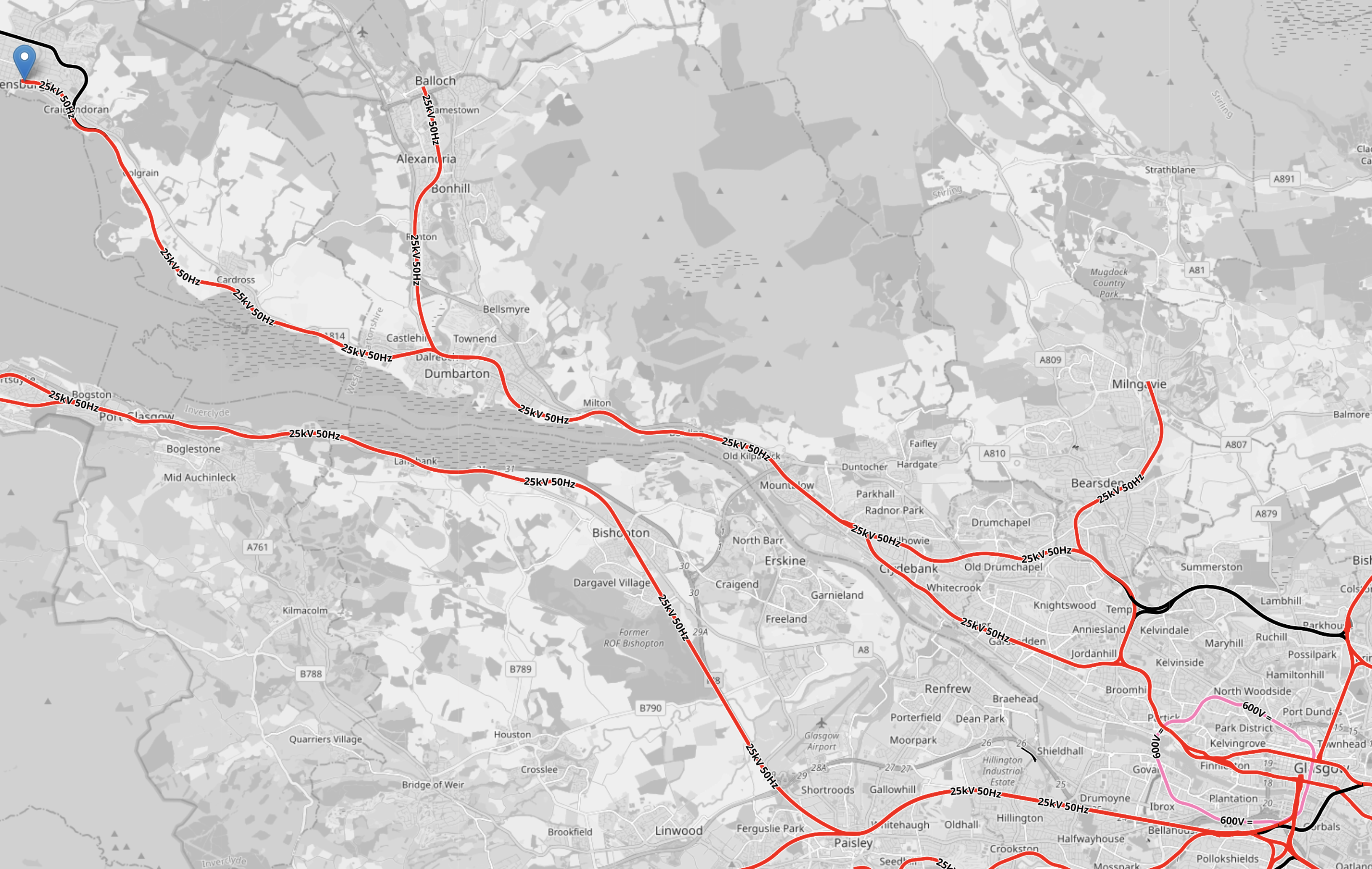
Note.
- The red tracks are electrified with 25 KVAC overhead electrification.
- The black tracks are not electrified.
- Helensburgh Central station is in the North-West corner of the map and marked with a blue arrow.
- The City of Glasgow is in the South-East corner of the map.
- The branch going North in the middle of the map terminated at Balloch station.
- Milngavie station is the terminus of the branch going North from the Glasgow area.
- The circular pink track is the Glasgow Underground.
I wonder if this is the start of a cunning Scottish electrification extension , that has been designed by Baldrick’s Scottish cousin?
Onward From Helensburgh
This OpenRailwayMap shows the tracks North of Helensburgh.
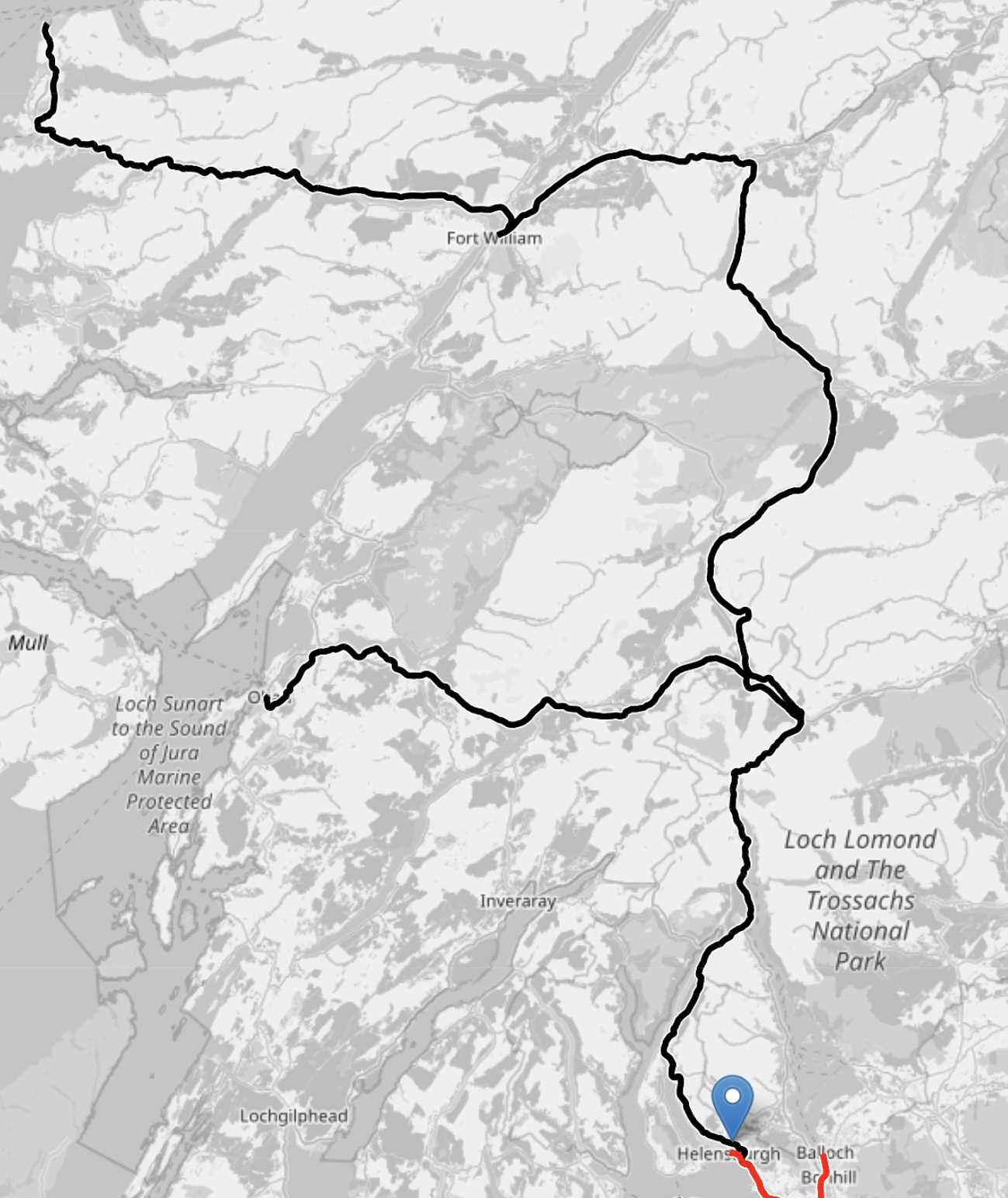
Note.
- The red tracks are electrified with 25 KVAC overhead electrification.
- The black tracks are not electrified.
- Helensburgh Upper station is in the South-East corner of the map and marked with a blue arrow.
- The two electrified lines from Glasgow to Helensburgh Central and Balloch stations are just visible in red.
- Oban station is at the Western end of the first branch line going North.
- Mallaig station is at the Western end of the first branch line going North.
- Helensburgh Upper and Oban stations are 76.1 miles apart.
- Mallaig station is at the Western end of the second branch line going North.
- Helensburgh Upper and Mallaig stations are 137.5 miles apart.
- The Mallaig branch also goes through Fort William station.
- Helensburgh Upper and Fort William stations are 97.4 miles apart.
- There is a Caledonian Sleeper that runs both ways between Helensburgh Upper and Fort William stations, which is hauled by a Class 66 diesel locomotive.
- There also appear to be paths for MOD trains hauled by GB RailFreight.
I feel that at some point in the next ten years, battery-electric trains or hydrogen locomotives, will be taking passengers and/or cargo to Cruachan, Fort William, Mallaig and Oban.
- Battery-electric trains and battery locomotives will charge their batteries between Helensburgh Upper and Glasgow at the Southern end of the route.
- Battery-electric trains and battery locomotives will charge their batteries at terminal stations at the Northern end of the route, using offshore wind power.
- Hydrogen trains and locomotives would probably fill up in the Glasgow area.
It could be a zero-carbon line. What would be the effect of a zero-carbon line on tourism?
Could Class 99 Locomotives Be Used On The Caledonian Sleeper?
Ever since the Class 99 locomotive was announced, there has been speculation, that these powerful bi-mode locomotives could handle the routes without an engine change.
I asked Google AI the question in the title of this section and received this reply.
Yes, Class 99 locomotives could eventually be used on the Caledonian Sleeper, as the bi-mode locomotives were designed with potential passenger use in mind. However, the standard Class 99 models cannot currently pull the sleeper trains off-the-shelf and would require specific modifications to do so.
The main factors influencing their deployment on the route include:
Equipment Needs: To haul sleeper carriages, the locomotives must be fitted with Electric Train Supply (ETS/ETH) to power lighting, heating, and air conditioning, as well as specific Dellner couplers to mate with the modern Mk5 carriages.
Sub-Class Fleet Order: While GB Railfreight (GBRf) ordered 30 Class 99s, the standard versions have a top speed of 75 mph (intended strictly for freight).
A specific sub-class (the 99/4) has been proposed to include passenger-standard acceleration, higher speeds of 100 mph to fit into existing timetable paths, and the required ETS equipment.
Bi-Mode Flexibility: Because they operate as bi-mode (using 25kV overhead electric wires and an onboard diesel engine), Class 99s could potentially run the entire route—from London to the Scottish Highlands—without requiring a locomotive change at electrified/non-electrified boundaries.
In Cummins Fuel-Agnostic X Series Platform, there is a Cummins video, which explains their philosophy of building engines that can run on diesel, hydrogen or natural gas.
With those engines, Class 99 locomotives could take the Caledonian Sleeper, or any other luxury or heavy freight train for that matter, anywhere.
‘I Get To Work On The Most Scenic Railway Line In The World’
The title of this post, is the same as that of this article on the BBC. It is a quote from someone in the BBC article.
This is the sub-heading.
Have you heard the one about the railway line that was threatened with closure, so lots of people started using it and it was saved?
These three opening paragraphs add some detail to the story.
Welcome to the Settle to Carlisle line, the quirky steel road through some of Britain’s most magnificent countryside.
The line starts in Leeds and passes through Shipley and Skipton, but it is the section between North Yorkshire and Cumbria that is world-famous for its views.
Heading north from Settle, the peak of Pen-y-Ghent soon looms large, with Whernside and Ingleborough following a few miles later.
The saving of the line in the 1980s, is one of those classic British tales of a fight against bureaucracy, which like all these tales involved a dog, who gets a heroic mention in the BBC article.
In the next few sections, I will detail how improvements to the rail infrastructure between Bradford, Carlisle, Lancaster, Leeds have gradually developed the rail infrastructure, so that the Settle and Carlisle Line can play an increasing part in improving the economic outlook for a large area of England.
Is The Settle And Carlisle Line In Good Condition?
Google AI gives this answer to the question in the title of this section.
Yes, the Settle-Carlisle line is in good, operational condition and is considered a vital, well-maintained part of the National Rail network.
Despite a history of threatened closures and past structural issues, major investments have secured its future, and it currently carries over 1.2 million passengers a year.
Here is the current status of the line as of early 2026:
Infrastructure Condition: Following significant repairs, including a major £2.1 million project on the Ribblehead Viaduct completed in 2021 and extensive work at Eden Brows (2017), the line’s 14 tunnels and 22 viaducts are in good condition.
Active Usage: It is regularly used by Northern passenger services and is a designated diversionary route for mainline express trains when the West Coast Main Line is closed.
Operational Status: The line is fully operational, featuring regular commuter services, tourist trains, and steam heritage charter trains.
Safety & Upgrades: While it is a historic line, the infrastructure is deemed safe.
Occasional, isolated issues (like the 2022 freight derailment near Carlisle) have been managed with swift repairs.As of early 2026, the line is heavily used, with special passenger services and 150th-anniversary celebrations planned.
It’s probably in better condition, than many houses in the UK.
What Is The Operating Speed Of The Settle And Carlisle Line?
Google AI gives this answer to the question in the title of this section.
The Settle and Carlisle Line generally operates at a maximum speed of 60 mph/97 km/h.
While historically faster, this 60 mph limit is standard for modern passenger and freight services on the route.
Usage Examples and ContextPassenger Services: Northern Rail and various chartered services, including the scenic “Staycation Express” HST 125, operate along the route.
Freight: The line is used for heavy freight, including oil, timber, and cement trains.
Diversions: The line is frequently used as a, albeit slower, alternative route (approx. 2.5 hours for Leeds-Carlisle) during major West Coast Main Line (WCML) closures.
Scenic Tourism: The line is renowned as one of England’s most scenic, carrying over a million travelers annually, with notable sights like the Ribblehead Viaduct.
The Settle And Carlisle Line Is Well Connected To The Rail Network At The Northern End
This OpenRailwayMap shows how the line connects to the West Coast Main Line and the Tyne Valley Line, to the South of Carlisle.
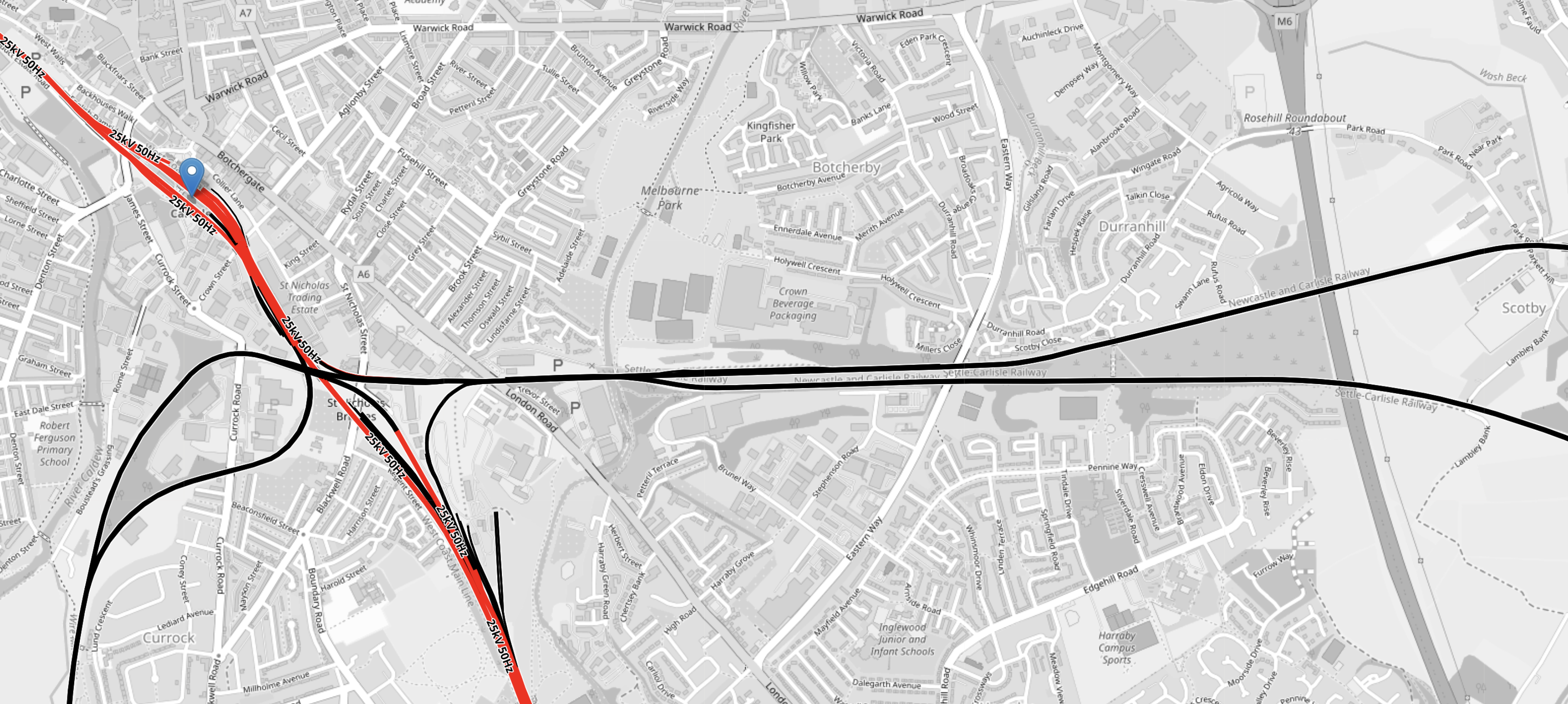
Note.
- Electrified lines are shown in red and lines shown in black are not electrified.
- The electrified West Coast Main Line runs diagonally across the South-West corner of the map.
- The blue arrow on this line, indicates Carlisle station.
- The Northernmost of the two black cross lines is the Tyne Valley Line between Carlisle and Newcastle.
- The Southernmost of the two black cross lines is the Settle And Carlisle Line, which goes South to Settle, Bradford Forster Square, Leeds and Settle stations.
- The line going South-West joins the Cumbrian Coast Line, which joins the West Coast Main Line at Carnforth.
It does appear that the junction South of Carlisle is very comprehensive and allows very flexible routing.
The Settle And Carlisle Line Is Well Connected To The Rail Network At The Southern End
This OpenRailwayMap shows how the line connects to the West Coast Main Line and the Tyne Valley Line, to the North of Skipton.
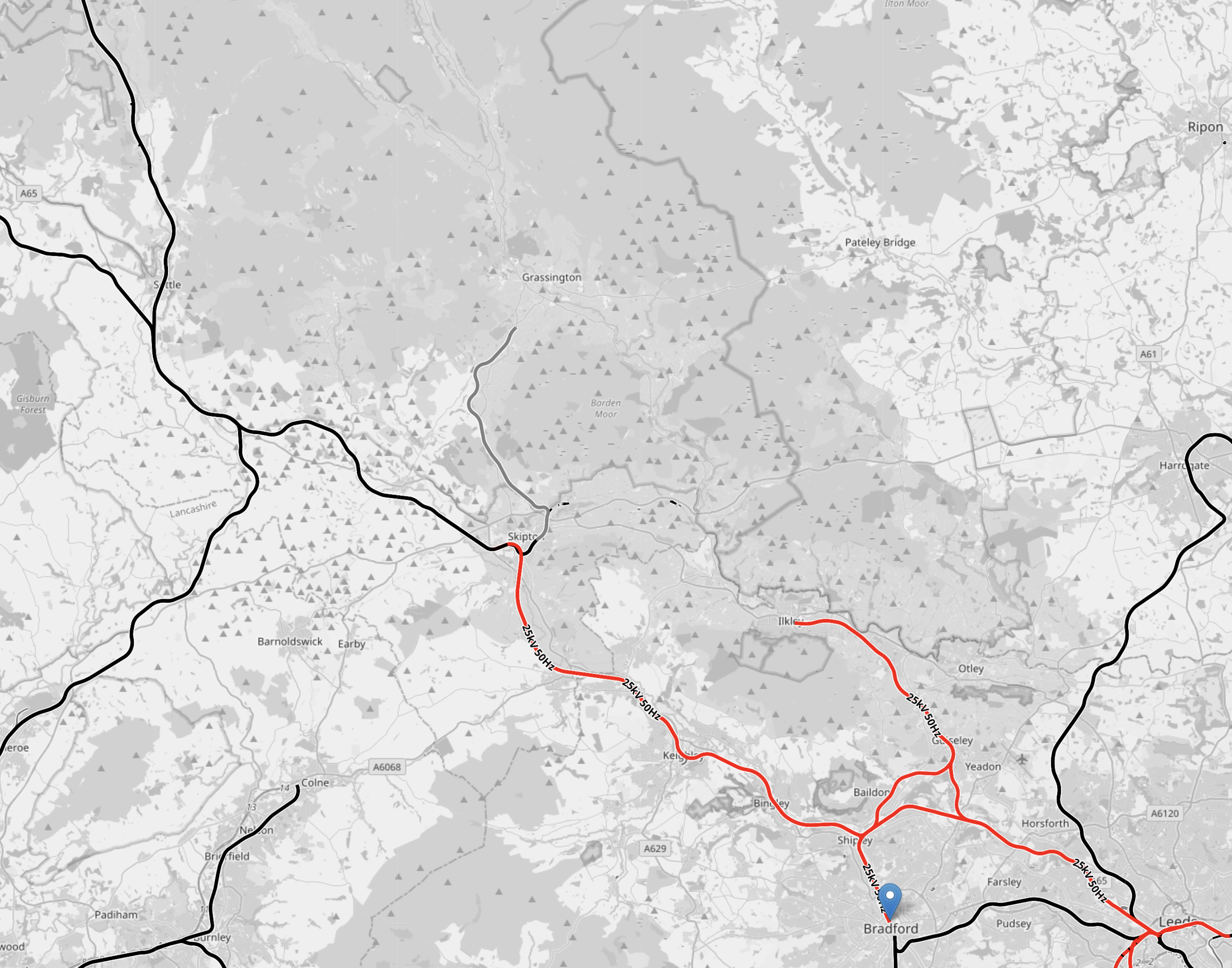
Note.
- Electrified lines are shown in red and lines shown in black are not electrified.
- The blue arrow on this line, indicates Bradford Forster Square station.
- The fully-electrified Leeds station is in the South-East corner of the map. You can just pick out the ee of the name.
- The electrified Leeds-Bradford Line connects Bradford Forster Square and Leeds station via Shipley station and its triangular junction.
- The electrification continues in a North-Westerly direction as far as Skipton, where the red track stops.
- Electric intercity trains can run from London to Leeds, Bradford Forster Square and Skipton.
- Self-powered intercity trains can also run from London to Harrogate, which is on the line without electrification, that runs North from Leeds.
- Leeds receives a London service of two trains per hour (tph).
- Bradford Forster Square station receives a London service of one train per two hours (tp2h) via Leeds.
- Harrogate station receives a London service of 1 tp2h via Leeds.
- Skipton station receives a London service of one train per day (tpd) via Leeds.
The Leeds-Bradford area gets a frequent service to London and the South.
This OpenRailwayMap shows how the Settle and Carlisle Line connects to the electrification at Skipton.
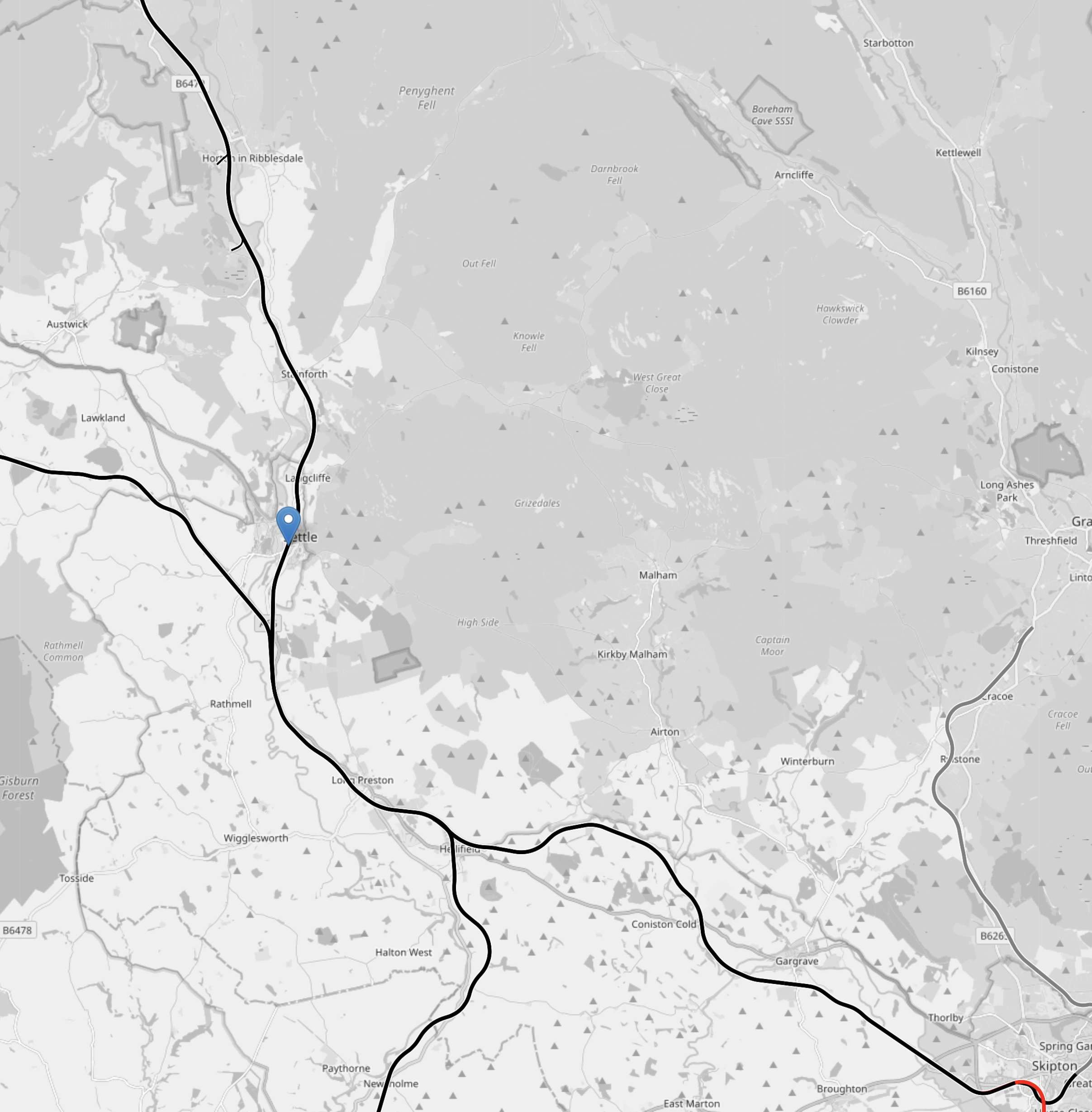
Note.
- Electrified lines are shown in red and lines shown in black are not electrified.
- The only electrified lines on the map are at Skipton station in the South-East corner of the map.
- The blue arrow on this line, indicates Settle station.
- Skipton and Settle stations are 15.2 miles apart.
- Settle and Carlisle are 71.5 miles apart.
To bridge the gap in the electrification between Carlisle and Skipton, trains will need to be able to run 86.7 miles on their own power.
Bridging The Carlisle And Skipton Gap
But once the train gets to Carlisle or Skipton, the train will have the luxury of 25 KVAC overhead electrification to both power the train and charge any batteries.
In my opinion, there are three intercity trains coming into service, that could handle an 86.7 mile gap in electrification.
- East Midland Railways’s Class 810 train, which is a diesel bi-mode with lots of power, which is described in this Wikipedia entry.
- LNER’s Class 802 trains, which currently is a diesel bi-mode, that Hitachi could convert into a Hitachi Intercity Battery Train, which is described on this Hitachi web site.
- LNER’s Class 897 trains, which is a diesel tri-mode, that CAF are building in Spain and Wales, which is described in this Wikipedia entry.
In How Far Will A Hitachi Intercity Battery Train Travel Without Using The Electrification?, I answer the question for both Hitachi and CAF trains.
Surprisingly, I got the answer of a range of 120 miles for both the Hitachi and CAF trains. But could it be that Network Rail and the train companies wanted a range of 120 miles to electrify the UK rail network and so a 120 mile battery range was in the specification.
My estimate of 120 miles for Hitachi’s trains, was also confirmed by the company.
Bridging The Gaps
Some other distances, where gaps must be bridged include.
- Sheffield and South Wigston – 69.4 miles
- Holyhead and Chester – 84.4 miles
- Exeter and Basingstoke – 124,3 miles
- Fishguard Harbour and Cardiff Central – 119.1 miles
- Aberystwyth and Shrewsbury – 81.5 miles
- Bristol Temple Meads and Newbury – 70.8 miles
- Inverness and Aberdeen – 108.3 miles
- Carlisle and Glasgow Central via Dumfries – 115.9 miles
- Hereford to Didcot Junction – 96.9 miles
120 miles could be a good fit.
Could it be that that distance was the range of a steam locomotive on a full load of water?
The Updating Of Bradford Forster Square Station
This is now a four-platform station, with two platforms able to take a pair of 5-car Hitachi or the new CAF 10-car Class 397 trains.
In Bradford Forster Square Station – 20th May 2025, I describe and show pictures of the updated station.
Bradford Forster Square station now gets seven trains per day to and from London King’s Cross via Leeds.
This article on the BBC, which is entitled New Platform’s Opening Gives Bradford More Trains has this sub-heading.
A new £35m platform at Bradford’s Forster Square Station has opened – boosting rail services in the city
£35million seems a lot of money to spend to just increase the number of services between King’s Cross and Bradford, even though 2025 was the year that Bradford was UK City of Culture, but there may be valid reasons to create a new route between London and Scotland, using the Settle and Carlisle Line.
- The Settle and Carlisle Line is one of the UK’s most famous scenic routes with 20 viaducts, 14 tunnels and countless beautiful vistas along its 72 mile track.
- You put the Mona Lisa on display, not in a store.
- LNER now has battery-electric bi-mode trains, with CAF tri-mode trains due to enter service in 2028, that can both handle the 86.7 mile gap in the electrification in silence.
- The CAF trains have extra diesel power, about which CAF is not disclosing much. This to me, suggests some innovative use.
- There appear to be no flights between Leeds/Bradford Airport and Scotland.
- There appear to be no direct trains between Glasgow and West Yorkshire.
- A direct train between Glasgow and Leeds and Bradford Forster Square would add additional connectivity between Scotland and Yorkshire.
- With the cancellation of High Speed Two, we need more train paths between London and Scotland.
- Decarbonisation of aviation is difficult, but replacing fossil-fueled planes with zero-carbon trains is easier.
- A single Class 897 train can carry 569 seated passengers, which is about 3.5 times the capacity of a single Airbus A320.
- The proposed Leeds Metro would bring passengers to the new service.
- Leeds and Bradford could see an upturn in tourism.
I also think the line will not be lightly used due to its iconic status.
How Would A Leeds/Bradford And Scotland Service Call At Bradford Forster Square Station?
- Bradford Forster Square station now gets seven trains per day to and from London King’s Cross via Stevenage, Newark Northgate, Doncaster, Wakefield Westgate, Leeds and Shipley.
- There is one fewer train on Sunday.
- There is a triangular junction at Shipley station, which connects the three electrified lines to Leeds, Bradford Forster Square and Skipton.
This OpenRailwayMap shows Shipley station and the triangular junction.
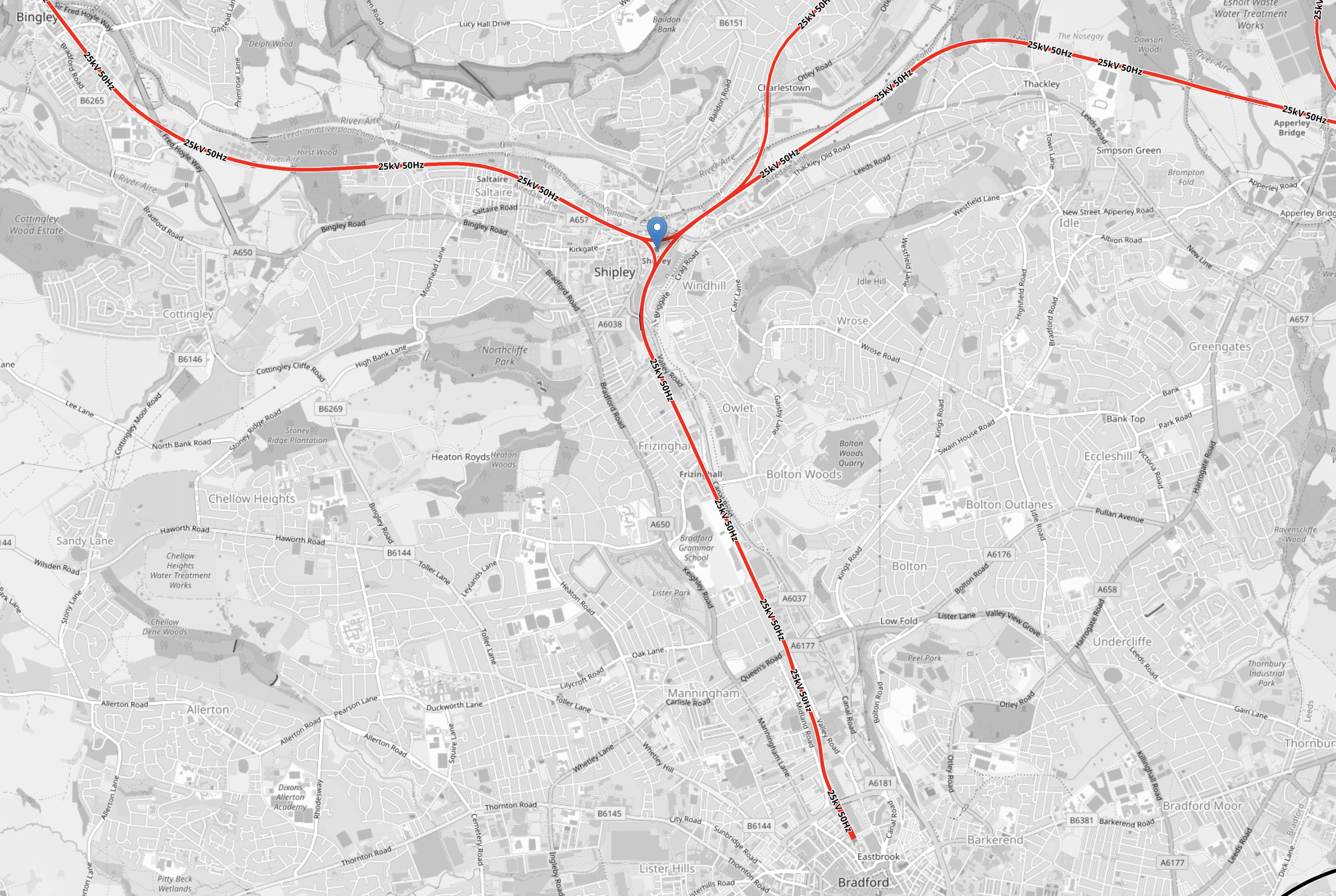
Note.
- All rail lines are electrified and shown in red.
- The blue arrow on this line, indicates Shipley station.
- Shipley station appears to be in the middle of the junction.
- The line going East connects to Leeds station.
- The line going South connects to Bradford Forster Square station, which is at the end of the line.
- The line going West connects to Skipton station and the Settle and Carlisle Line.
Trains returning to London would reverse out of Bradford Forster Square station and take the Eastern route through Shipley and Leeds back to London.
- An appropriate number of trains for Carlisle and Scotland, could surely just reverse out of the station and take the Western route through Skipton station and go on to the Settle and Carlisle Line.
- The trains would call at Wakefield Westgate, Leeds, Shipley, Bradford Forster Square and Skipton stations in the Leeds/Bradford conurbation.
- Other stations could be added to the route if required.
- The trains would effectively reverse direction in their call at Bradford Forster Square station.
- Going North the trains might check their battery levels in Bradford Forster Square station and use a fast-charger if necessary.
- Going South, there would be no need for charging, as the route South from Bradford Forster Square station, is already fully-electrified.
- Would the operator, use this longer stop to replace the crew with a fresh one?
It could be a simple and efficient way to run a London and Scotland service via the Settle and Carlisle Line.
What About Hull, Sheffield And York?
I’m asking this question, as Yorkshire is a large county and this article has only mentioned a few places, where people live and might need to go to London or Scotland.
In February, I wrote Northern Launches New Yorkshire Flyer Fast Service Between Leeds And Sheffield.
I’m fairly sure that Hull, York and other cities and large towns in Yorkshire already have a good regional service to Bradford Forster Square or Leeds station, which will give a good connection to the new service.
Could Dumfries Be Served By Using The Glasgow South Western Line?
This OpenRailwayMap shows the Southern part of the Glasgow South Western Line.
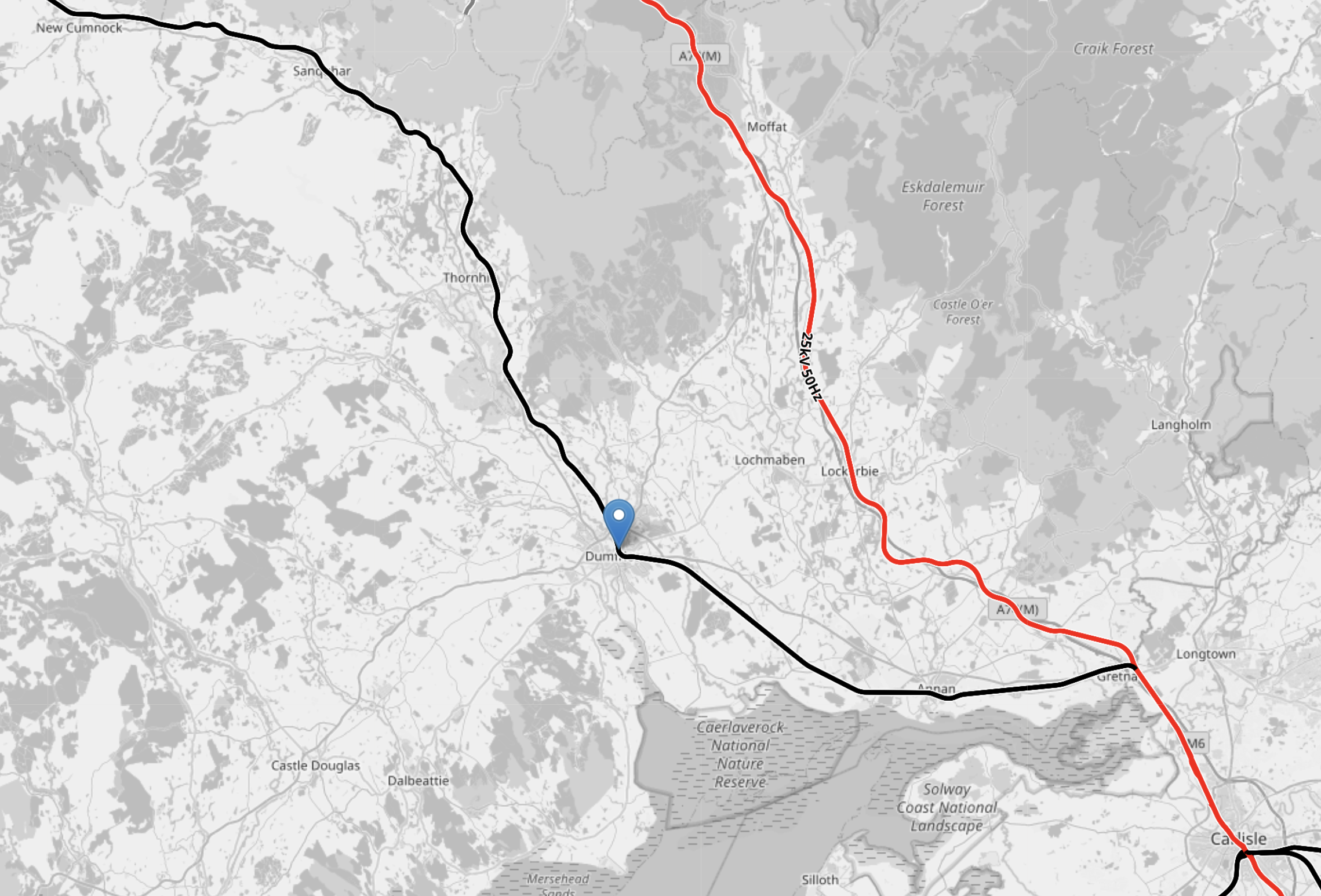
Note.
- Electrified lines are shown in red and lines shown in black are not electrified.
- The blue arrow on the black track, indicates Dumfries station on the Glasgow South Western Line.
- The red track is the West Coast Main Line.
- Carlisle is in the South-East corner of the map.
- Carlisle and Glasgow Central via Dumfries is 115.9 miles
- The Thames-Clyde Express, ran on this route until 1974.
- According to the Wikipedia entry for the Thames-Clyde Express, the train called at Dumfries and Kilmarnock stations.
From this brief look it appears that the new service could include Dumfries and should be able to serve the town on battery power.
Is More Capacity Needed On The West Coast Main Line Between Carlisle And Glasgow?
I asked Google AI, this question, to see if there is capacity.
This was the answer I received.
Yes, increased capacity and infrastructure enhancements are required on the West Coast Main Line (WCML) between Carlisle and Glasgow, as the line is currently full and unable to meet modern, growing passenger and freight demands.
Upgrades are necessary to tackle aging infrastructure, bottlenecks, and the need for more frequent services.
Key Aspects of the Need for Capacity:Full Capacity: The WCML is essentially full, with little space left for growth, despite 75 million passengers using it annually.
Freight and Passenger Growth: Passenger numbers are expected to double by 2050, and the line is a crucial artery for Anglo-Scottish freight.
Infrastructure Age: The northern section is undergoing its largest upgrade in half a century to address reliability issues.
Performance Bottlenecks: Specific locations, such as those north of Carlisle, require signaling and track improvements to prevent delays.
Proposed Upgrades: Current initiatives include a £400m investment until March 2029 for upgrades, including signalling and track renewals, though these are largely to boost reliability rather than provide a massive increase in capacity.
It looks to me, that a bit of a redesign and some use of battery trains on the Glasgow South Western Line, might squeeze a few more trains into the route.
Could A Feeder Network Of Local Trains Be Developed For HS2 At Macclesfield Station?
Macclesfield station is one of the less important stations that will be served by High Speed Two.
I visited in July 2020 and afterwards wrote Macclesfield Station And High Speed Two.
This OpenRailwayMap shows the railway network around Macclesfield.
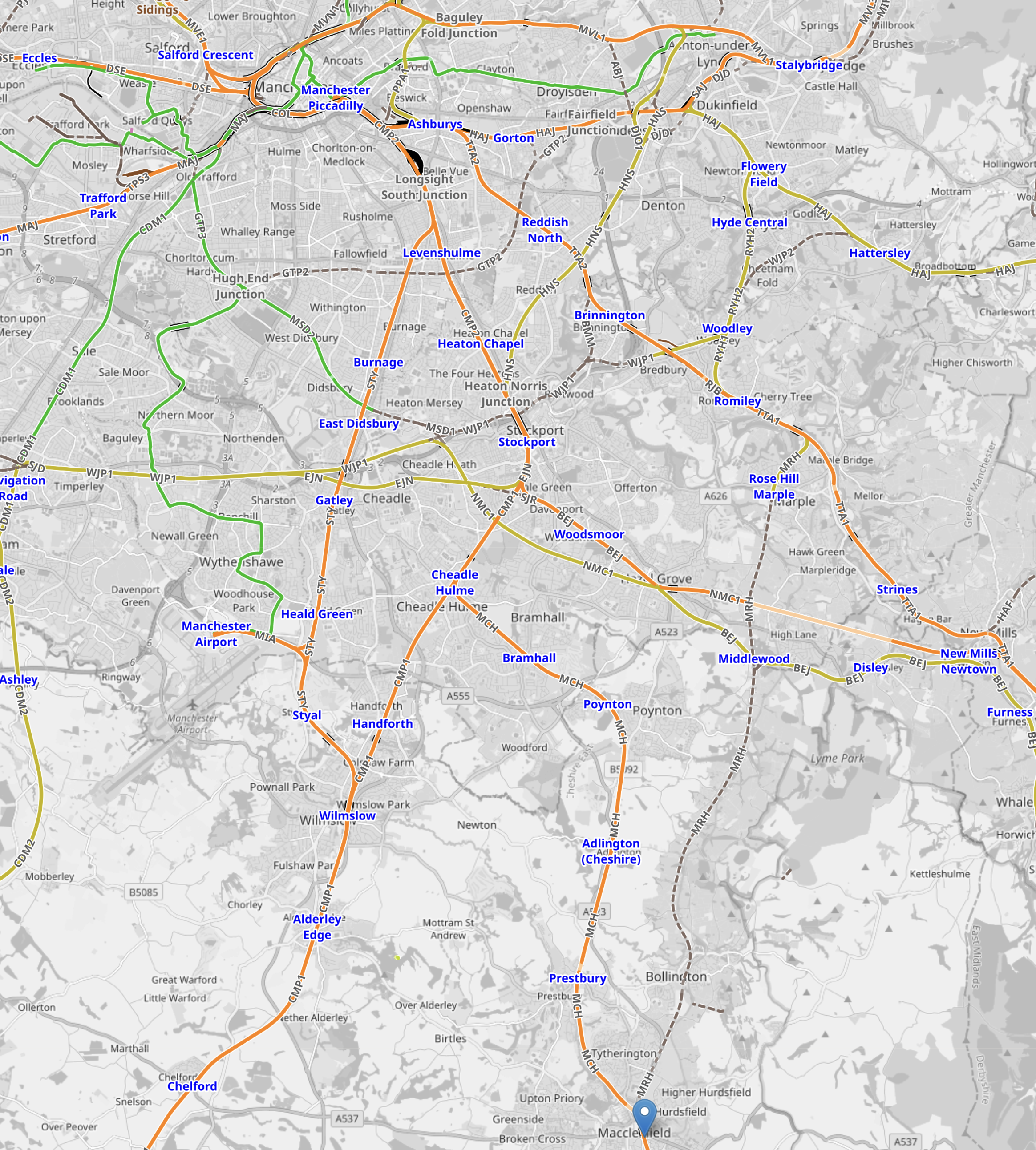
Note.
- Manchester Piccadilly station is at the top of the map .
- The station is surrounded by the green tracks of the Manchester Metrolink.
- Macclesfield station is at the bottom of the map and indicated by a blue arrow.
The West Coast Main Line can be followed North as it threads through Prestbury, Adlington (Cheshire), Poynton, Bramhall, Cheadle Hulme, Stockport, Heaton Chapel, Levenshulme and Ashburys on its way to Manchester Piccadilly.
This summary from the Wikipedia entry for the station outlines the services at the station.
Macclesfield is served by three train operating companies: Avanti West Coast, CrossCountry and Northern Trains.
Northbound to Stockport and Manchester Piccadilly, Avanti West Coast and Northern operate hourly services, with some peak time extras, and CrossCountry runs two services an hour.
Southbound, there are also four trains per hour: one stopping service to Stoke-on-Trent, operated by Northern Trains; one inter-city service to London Euston, operated by Avanti West Coast; one to Bournemouth, via Birmingham New Street and Reading; and one to Bristol Temple Meads, both operated by CrossCountry.
Sunday services are similar, but the local stopping service operated by Northern Trains no longer runs on Sunday, with rail replacement bus services operating between Stockport and Stoke-on-Trent.
It is not as busy a station, as the map suggests it is.
Searching in detail, I found these local trains.
- CrossCountry – 1 – tph – Manchester Piccadilly and Bournemouth via Stockport, Macclesfield, Stoke-on-Trent and Stafford
- CrossCountry – 1 – tph – Manchester Piccadilly and Bristol Temple Meads via Stockport, Macclesfield, Stoke-on-Trent and Stafford
- Northern – 1 tph – Manchester Piccadilly and Stoke-on-Trent via Stockport, Cheadle Hulme, Bramhall, Poynton, Adlington, Prestbury, Macclesfield, Congleton and Kidsgrove
Three trains per hour is not many.
The train and bus network from Macclesfield station needs to be developed, so travellers can make full use of HS2.
This second OpenRailwayMap shows the railway network to the East of Macclesfield.
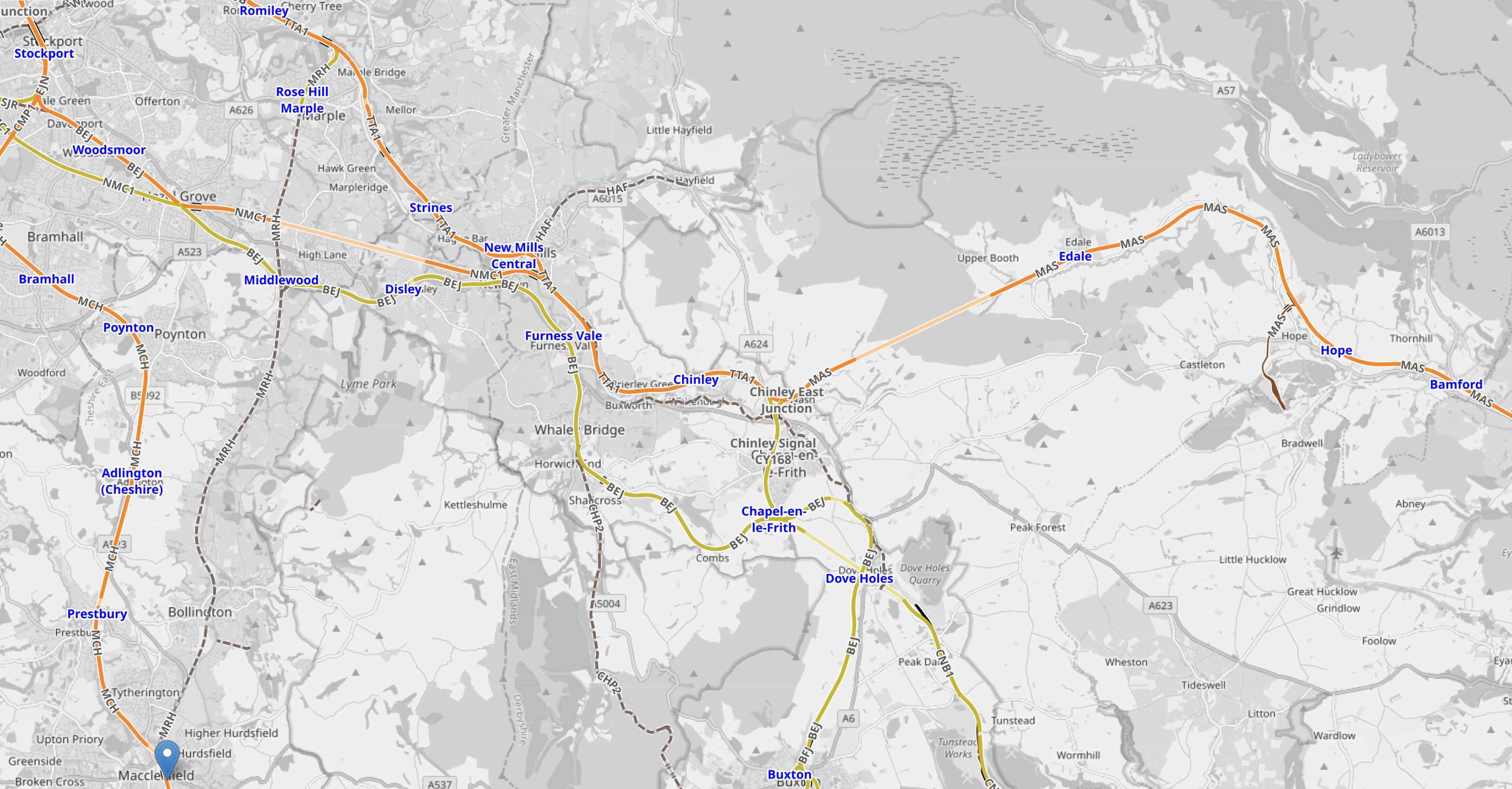
Note.
- Macclesfield is in the South-West corner of the map.
- Stockport is in the North-West corner of the map.
- The orange track that stretches across the map is the busy Hope Valley Line, which is an important passenger route between Manchester and Sheffield and an important freight route for the quarry products of the Peak District to the South.
- The Buxton Line comes South from the Hope Valley Line to Chapel-en-le-Frith, Dove Holes and Buxton.
I believe a strong case can be made to link the area to the East of Macclesfield to HS2.
These points must be considered, when designing a road transport network to feed travellers from the East of Macclesfield.
Bakewell
Bakewell is the largest settlement and only town within the boundaries of the Peak District National Park.
I believe that travellers to Bakewell, would use a quality transport network to HS2 at Macclesfield.
Buxton
These are facts from Buxton’s Wikipedia entry.
- Buxton is a spa town of 20,000 people.
- It is England’s highest market town, sited at some 1,000 feet (300 m) above sea level.
- The University of Derby is a noted employer.
- Tourism is a major industry, with over a million visitors to Buxton each year.
- The Buxton Line connects Buxton to Stockport and Manchester Piccadilly.
I believe that travellers to Buxton, would use a quality transport network to HS2 at Macclesfield.
The Cat And Fiddle Inn
The road between Macclesfield and Buxton passes the famous Cat and Fiddle Inn.
This is the first paragraph of the Wikipedia entry for the public house.
The Cat and Fiddle Inn is a former public house in the English Peak District, close to the border between Cheshire and Derbyshire. It sits on the A537 road from Macclesfield to Buxton, which runs across a high and remote area of moorland. A section of the road is known as the “Cat and Fiddle Road” after the inn. The building is some 1,689 feet (515 m) above sea level, and it was the second-highest public house in Britain before it closed in 2015 (the Tan Hill Inn in Yorkshire is slightly higher). In 2020, it reopened as a distillery, shop and bar.
I visited it once in the 1960s with my future wife and two friends.
These roads in the Peak District will be challenging roads for modern electric buses.
Chatsworth House
I have never been to Chatsworth House and no very little about the house and its history.
So I asked Google AI,”Is Chatsworth House A Major Tourist Attraction?” and received this reply.
Yes, Chatsworth House is a major tourist attraction, frequently cited as one of the UK’s most popular country houses and a top destination in the Peak District. Located in Derbyshire, it draws hundreds of thousands of visitors annually to explore its historic house, 105-acre garden, farmyard, and massive parkland.
Key Reasons for Its Status:
Cultural Significance: As the home of the Cavendish family since 1549, it holds significant art collections (Old Masters, modern sculpture, Egyptian artifacts).
“Palace of the Peak”: Known for its grand interiors, including the Painted Hall and Sketch Galleries.
Famous Grounds: Features a 105-acre garden with a maze, cascading water features, and the impressive Emperor Fountain.
Media Appearance: Known as the real-life Pemberley from the 2005 Pride & Prejudice film.
Family Activities: The estate includes a popular farmyard and adventure playground.
Chatsworth is often ranked as a favorite stately home in Britain and is a key visitor attraction in the East Midlands region.
As with Buxton, I believe that travellers to Chatsworth House, would use a quality transport network to HS2 at Macclesfield.
Chesterfield Station
Chesterfield station is a major station on the Midland Main Line, close to the East side of the Peak District.
Chesterfield station is the following distances from these towns and attractions.
- Bakewell – 12-13 miles
- Buxton – 24-25 miles
- Chatsworth House – 12 miles
- Macclesfield – 35-40 miles
Chesterfield has no direct rail connection to any of these towns, but I think you can get to Buxton with changes at Sheffield and Hazel Grove.
The Wikipedia entry for Chesterfield station gives this description of services at the station.
Chesterfield is served by three train operating companies:
- East Midlands Railway operates regular inter-city services on the Midland Main Line between Sheffield and London St Pancras, via Derby and Leicester; this includes the 07:45 southbound departure, the Master Cutler. It also runs a route between Liverpool and Norwich, via Manchester Piccadilly and Nottingham.
- Northern Trains runs an hourly service between Nottingham and Leeds.
- CrossCountry operates a regular service between Sheffield and Derby; trains continue on to a variety of final destinations including Glasgow Central, Edinburgh Waverley, Plymouth, Reading, Southampton Central and Bristol Temple Meads.
There are typically 12 passenger trains per hour passing through the station on weekdays (six in each direction), with ten of those calling.
I believe that if a transport network is developed to the East of Macclesfield, it should call at Chesterfield station.
Dore & Totley Station
Dore &Totley station is the nearest station to Sheffield at the Sheffield end of the Hope Valley Line.
I wrote about the station in Dore & Totley Station – 1st April 2025 and after a sympathetic restoration, it is now a superb step-free station.
These pictures give a flavour of the station.
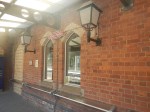


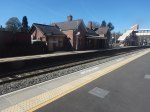
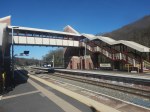
The second picture, appears to show a pair of bus stops on the main road.
If these aren’t considered adequate, I’m sure space could be found in the car park for a bus stop with level access to the station.
Hazel Grove Station
Hazel Grove station is the nearest station to Stockport at the Manchester end of the Hope Valley Line.
I wrote about the station in Hazel Grove Station and it is a rather ordinary station with car parking and step-free access.
Passengers can also change trains for the Buxton Line.
HS2 Day Trips
Toyota’s Trial Of Hydrogen Buses In The Peak District
To find out more of this, I typed the title of this section into Google AI, and received this answer.
Toyota conducted a two-week trial of hydrogen fuel cell buses in the Peak District National Park in September 2022 to promote sustainable tourism and reduce carbon emissions. Using CaetanoBus H2.City Gold vehicles, the trial aimed to connect key tourist sites without relying on private cars. This initiative supports a long-term goal of launching the “Peak Express” service by 2025.
Key Details of the Peak District Hydrogen Bus Trial
Purpose: The trial was designed to reduce the high reliance on cars (85% of visitors) in the national park, aiming to cut emissions by 3.6 million kg a year once fully operational.
Vehicles: The trial used hydrogen fuel cell electric buses manufactured by CaetanoBus, which is part of Toyota’s European partner network. These buses provide a range of up to 200 kilometers and can be refueled in 10-15 minutes.
Route: The hydrogen buses operated in and around the Peak District, connecting major spots including Chesterfield railway station and Chatsworth.
The “Peak Express” Initiative: Led by the Gateway at Peak development, this project plans a full service by 2025 to offer sustainable transport options.
Multi-technology Strategy: Toyota is testing both hydrogen fuel cell electric vehicles (FCEV) and battery electric vehicles (BEV) to determine which is most suitable for different types of journeys.
The trial was part of a larger push to test hydrogen infrastructure, with long-term plans to create multiple hubs around the Peak District National Park boundary.
The experience from my trip to Gatwick, that I described in Sutton Station To Gatwick Airport By Hydrogen-Powered Bus, has convinced me, that where bus and hills are involved, you need to have hydrogen buses, as they torque the torque.
Conclusion
I believe that the Peak District and Toyota are on the right track, but I strongly believe that any buses ferrying passengers around the Peak District, need the extra torque that hydrogen will provide.
The bus also must be large enough.
I also wonder, if as the service will be serving Chatsworth, that a hydrogen-powered coach might be a better choice of vehicle.
Hydrogen-Powered Coaches
The first hydrogen-powered coaches will becoming into service this year.
- Mercedes and Wrightbus have both said they will launch vehicles.
- Two and three-axle models have been talked about.
- Ranges of a thousand kilometres on a single tank of hydrogen seem to have been promised.
- Typical load will be about eighty passengers, which will include wheelchairs.
- Like the bus between Sutton station and Gatwick Airport, they will be mouse-quiet.
I believe they will become a valuable part of the public transport network.
- Running long distance coach services.
- Extending long-distance rail services.
- Running special services over long distances, like those for football supporters.
- Running rail replacement bus services for rail companies.
I can’t wait to have my first ride.
Could A Feeder Network Of Local Trains Be Developed For HS2 At Lancaster Station?
Lancaster station is one of the less important stations that will be served by High Speed Two.
I visited in May 2025 and afterwards wrote Lancaster Station – 23rd May 2025.
This OpenRailwayMap shows the railway network around Lancaster.
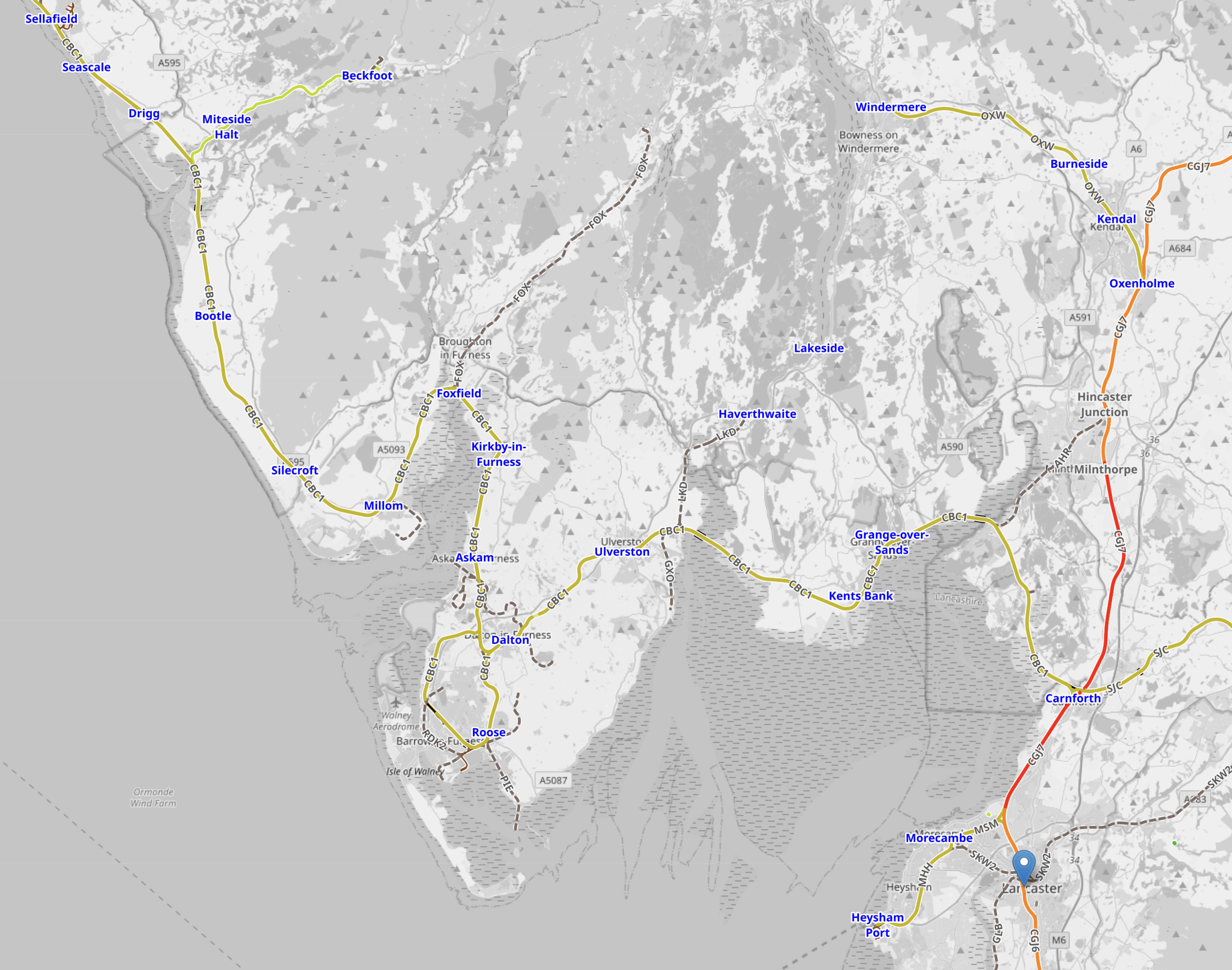
Note.
- The red track on the East side of the map is the electrified West Coast Main Line.
- The location of Lancaster station is indicated by a blue arrow.
- Morecambe, where the Eden Project North is being developed and the important port of Heysham are on the coast to the West of Lancaster.
- Oxenholme station is towards the North-East corner of the map, on the main line.
- The Windermere branch connects to the main line at Oxenholme station.
- HS2 will use the West Coast Main Line and call at Lancaster and Oxenholme.
North of Oxenholme, HS2 calls at Penrith and Carlisle, before going on to Glasgow and Scotland.
West of the main line, the map is dominated by the waters of Morecambe Bay, which in recent decades has produced a lot of our gas, but is now transitioning to an area, that will produce a few gigawatts of wind power.
North of Morecambe Bay, there is the Lake District, with the shipbuilding at Barrow and the nuclear waste processing at Sellafield on the coast.
It is an important area of England, where there is a lot going on!
Tying it all together is the yellow ribbon of the Cumbrian Coast Line, which connects Carnforth and Carlisle on an hourly basis.
- The service calls at Grange-over-Sands, Barrow-in-Furness, Millom, Ravenglass, Drigg, Seascale, Sellafield, St Bees, Whitehaven, Workington, Maryport, Aspatria, Wigton and other places.
- Four services a day link Carlisle and Lancaster stations.
- Carlisle and Lancaster stations are 120.5 miles apart via the coast and according to Google AI, the journey takes between three and three-and-a-half hours.
- In From Barrow-in-Furness To Ravenglass, From Ravenglass to Sellafield and From Sellafield To Carlisle, there are some images, that give a flavour of the route.
This is a route, that is worth decarbonising.
Consider.
- There is a couple of gigawatt of wind power in the bay to charge any batteries with green electricity or make green hydrogen.
- There is a project called BARROW GREEN HYDROGEN, which is located in Barrow-in-Furness.
- Both hydrogen and battery-powered trains could handle the hundred and twenty miles of the Cumbrian Coast Line.
- A zero-carbon train running silently round the Lake District could be a tourist attraction in its own right.
- Hydrogen-powered buses could provide the local transport.
Given the scenery and the closeness to the Lake District and High Speed Two, I suspect that major train manufacturers like Alstom, CAF and Siemens will be keen to bid.
Treasures Found On HS2 Route Stored In Secret Warehouse
The title of this post is the same as that of this article on the BBC.
This is the sub-heading.
Treasures unearthed by hundreds of archaeologists during the ongoing construction of the controversial HS2 train line have been shown exclusively to the BBC.
These three paragraphs add detail to the story.
The 450,000 objects, which are being held in a secret warehouse, include a possible Roman gladiator’s tag, a hand axe that may be more than 40,000 years old and 19th Century gold dentures.
It is an “unprecedented” amount and array of items, which will yield new insights into Britain’s past, says the Centre for British Archaeology.
Major building developments in the UK need land to be assessed by archaeologists as part of the planning process, to protect heritage sites.
Crossrail also collected a lot of artefacts in an archaeology programme, that I wrote about in Bison to Bedlam or How To Make Friends.
Typing “TransPennine Route Archaeology” into Google AI gave this answer.
AI Overview
Archaeological investigations for the Trans-Pennine upgrades are split into two major, parallel projects: the A66 Northern Trans-Pennine road project and the Transpennine Route Upgrade (TRU) rail project. Both have revealed significant historical, archaeological, and industrial remains.
A66 Northern Trans-Pennine Upgrade (Road)
As part of the A66 upgrade between Penrith and Scotch Corner, Oxford Cotswold Archaeology (OCA) is conducting extensive excavations.
Key Finds: Archaeologists have identified prehistoric settlements, Neolithic stone axes, and evidence of a 60-meter-wide posthole structure.
Roman Discovery: A major Roman vicus (settlement) and the original Roman road have been uncovered, revealing a “grid of Roman field systems and ditches” near Brough.
Locations: Key sites include Brougham, Brough, Kirkby Thore, and Crackenthorpe.
Significance: These findings illustrate the area’s long-distance connection, trade, and culture from prehistoric through Roman times.
Transpennine Route Upgrade (Rail)
This project, involving Network Rail and ASWYAS (Archaeological Services WYAS), is upgrading the railway between Manchester, Huddersfield, Leeds, and York.
172-Year-Old Railway Siding: A mid-19th-century railway siding was uncovered at Hillhouse Sidings in Huddersfield, revealing two turntables and brick-built engine sheds.
Roman Settlement (Ravensthorpe): Excavations at Ravensthorpe (for a new station) uncovered a large, hexagonal-shaped feature thought to be an Iron Age or Roman-British enclosure, featuring ceramics, glass, and animal bones.
Mirfield Viaduct: An investigation of the Grade II-listed Mirfield Viaduct (built 1836-1839) was conducted to record its structure before upgrade works.It could be a very large exhibition in the North, if High Speed Two and the two Transpennine Route Upgrades were combined in a single exhibition.
I asked Google AI, what is the largest exhibition centre in Yorkshire and received this answer.
The largest exhibition sites in Yorkshire are concentrated in Harrogate, anchored by the Great Yorkshire Event Centre and the Harrogate Convention Centre. These venues offer a combined total of over 10,000 square meters of exhibition space, accommodating major national events, conferences, and large-scale outdoor exhibitions.
I suspect Leeds, Manchester and Sheffield could have other ideas.
Rail Agreement Signed ‘Subject To Value For Money’
The title of this post, is the same as that of this article on the BBC.
This is the sub heading.
An agreement to reopen a regional rail line has been signed by the transport secretary, subject to the assurance that it delivers good value for money.
These three paragraphs add detail to the story.
Further development work on the Leamside Line, which runs from Pelaw in Gateshead to Tursdale in County Durham, is set to progress as part of the Northern Powerhouse Rail (NPR) initiative.
Regional politicians said the line could provide train links for 100,000 people in the north-east of England, after it closed to passengers in the 1960s.
The document stated the government would ensure resources were available for the Leamside Line reopening “subject to agreement of that business case and assurance that this delivers good value for money”.
Note.
- There is an excellent map in the BBC article.
- It looks like there will be at least five new or refurbished stations at Ferryhill, Sincliffe, Belmont, West Rainton and Penshaw.
- Belmont appears to have an alternative name of Durham Parkway, so will it be a Park-and-Ride for the area?
- There will be an alternative path for freight trains between Newcastle and York.
- In New Direct Rail Link To Seaham: How This Picturesque Seaside Town Will Connect To London Starting December 2025, I described Seaham’s new link to London, courtesy of Grand Central Trains.
- In Arriva Group Invests In New Battery Hybrid Train Fleet In Boost To UK Rail Industry, I talked about Grand Central’s new trains, which should be in service by 2028 to Seaham and Sunderland.
- It was in June 2020, that I wrote about Boris Johnson making a speech about the Leamside Line in Boris Johnson Backs Station Opening Which Could See Metro Link To County Durham.
This important link has been a long time coming.
Will The Rail Improvements Between London and The North East Create More Tourism?
Consider.
- The digital signalling will create more paths for trains between London and the North East.
- Journey times will come down to generally below three hours.
- There is a lot of excellent walking in the area.
- The North-East doesn’t just host top-class football and athletics.
- A trip could be combined with a day-trip to Edinburgh, Glasgow or the Scottish Borders.
- I have met Americans, who’ve started their holiday in Europe, in Edinburgh and worked their way down via York and London to Paris by train, and then flown back non-stop to the United States.
As I’ve spent a couple of enjoyable weekends in Newcastle and Sunderland, I don’t see why the area can’t attract tourists.
Should The East Coast Main Line Be Renamed?
Consider.
- It is one of the oldest long-distance main lines in the world.
- It links two of the UK’s capitals.
- It is 331 miles long, which is covered in four and a half hours.
- There are some of the world’s best hotels at either end.
- There is good shopping at either end.
- There is no Trump hotel in London or Edinburgh.
Perhaps, it should be called High Speed East Coast?
New Direct Rail Link To Seaham: How This Picturesque Seaside Town Will Connect To London Starting December 2025
The title of this post is the same as that of this article on Travel and Tour World.
This is the first paragraph.
Starting December 2025, the picturesque seaside town of Seaham in County Durham will become even more accessible with a new direct rail link to London. This marks an exciting chapter in the town’s history, as Seaham’s first direct rail service will make it easier for tourists and business travelers alike to visit this charming coastal destination. Known for its stunning clifftop vistas, rocky beaches, and no fewer than 10 fish and chip shops, Seaham is already a popular spot for day-trippers, and this new rail service will only add to its appeal.
This section in the Wikipedia entry for Seaham station, gives the current rail services from the town.
As of the May 2021 timetable change, the station is served by an hourly service between Newcastle and Middlesbrough. Most trains continue to Hexham (or Carlisle on Sunday) and Nunthorpe. Two trains per day (three on Sunday) continue to Whitby. All services are operated by Northern Trains.
With Grand Central trains, serving Seaham four times per day in each direction, Seaham could be a very convenient place to explore the North-East of England.
If the timing of the services is right, Seaham could also become popular with visiting football fans at Middlesbrough, Newcastle and Sunderland, wanting to combine an away match with a weekend away.
This Google Map shows the town.
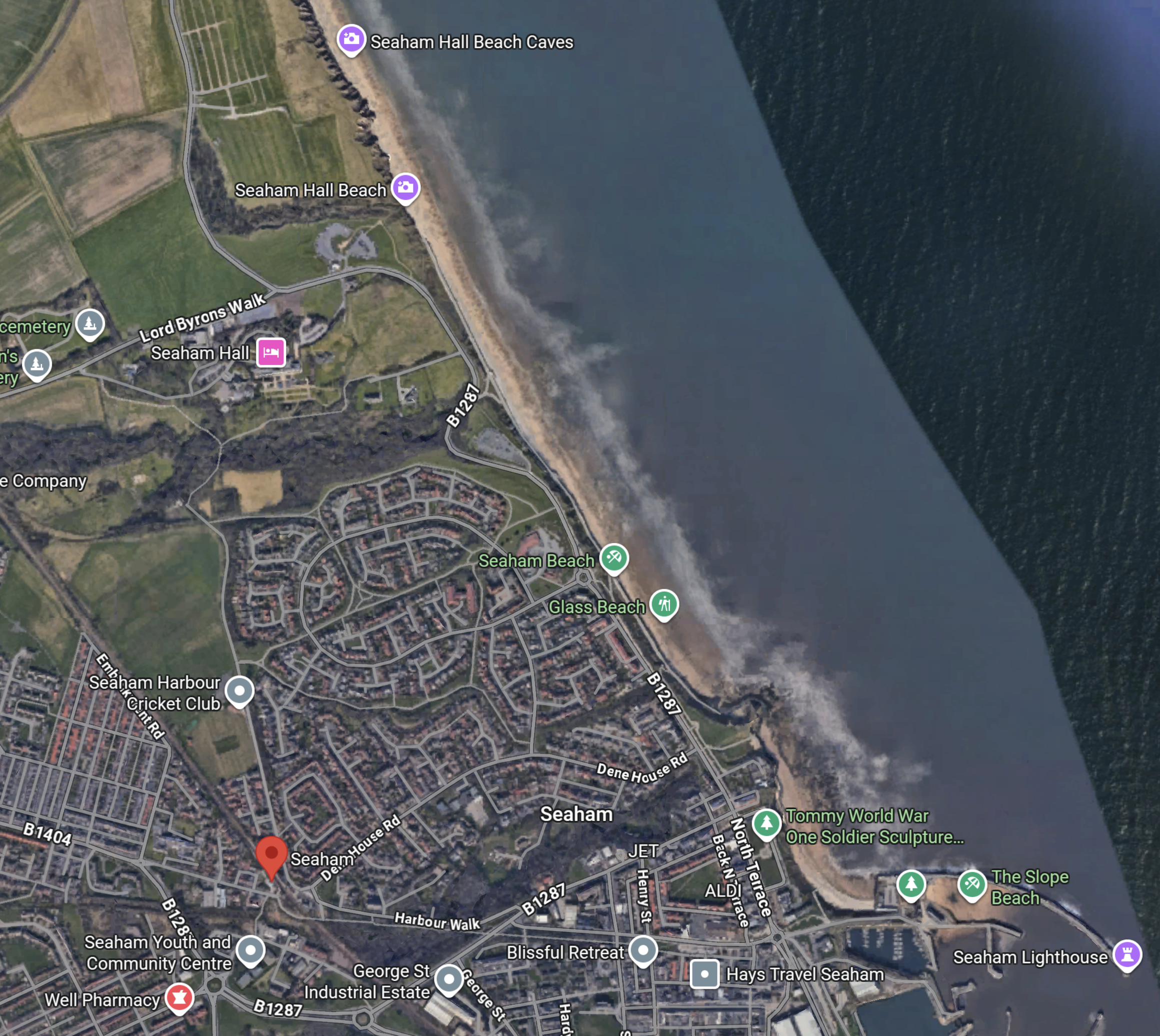
Note.
- The station is indicated by the red arrow.
- Beaches stretch along the town.
- There is a port with a lighthouse.
- There is even a 5-star hotel; Seaham Hall on Lord Byron’s Walk. The hotel has 21 suites and a spa.
- I can certainly see the hotel having a zero-carbon mini-bus meeting all eight Grand Central Trains.
I don’t think Grand Central Trains will be short of passengers on this route. Especially as from 2028, they will serving the town with new Hitachi battery-electric trains.
Conclusion
How many other towns in the UK could benefit from a four trains per day service to London?

