Are The Electrification Gantries Going In The Middle At Horwich Parkway Station?
Traditionally, when a line is electrified in the UK, either a gantry or a wire is put over all the lines and supported on both sides of the track.
So I was surprised to see these circular structures between the tracks at Horwich Parkway station.


I thought at first, that they were drainage access points, but Network Rail’s are usually rectangular and often covered with a blue grating during construction.
I suspect that the substantial road bridge and possibly the footbridge will be used as supports for the overhead lines, so it would mean that if a substantial gantry was placed at the Northern end of the station, a few central masts would probably give enough support to the catenary, as it passed through the station.
It is possibly significant that there is no circular structure under the footbridge, despite being about the right place in a sequence of structures. If they were to do with drainage, you would still need drainage under the bridge, but if they are for electrification, then the footbridge could be used for support of the overhead wires.
This is a Google Map of the station, with the ends of the platforms in the South East corner.
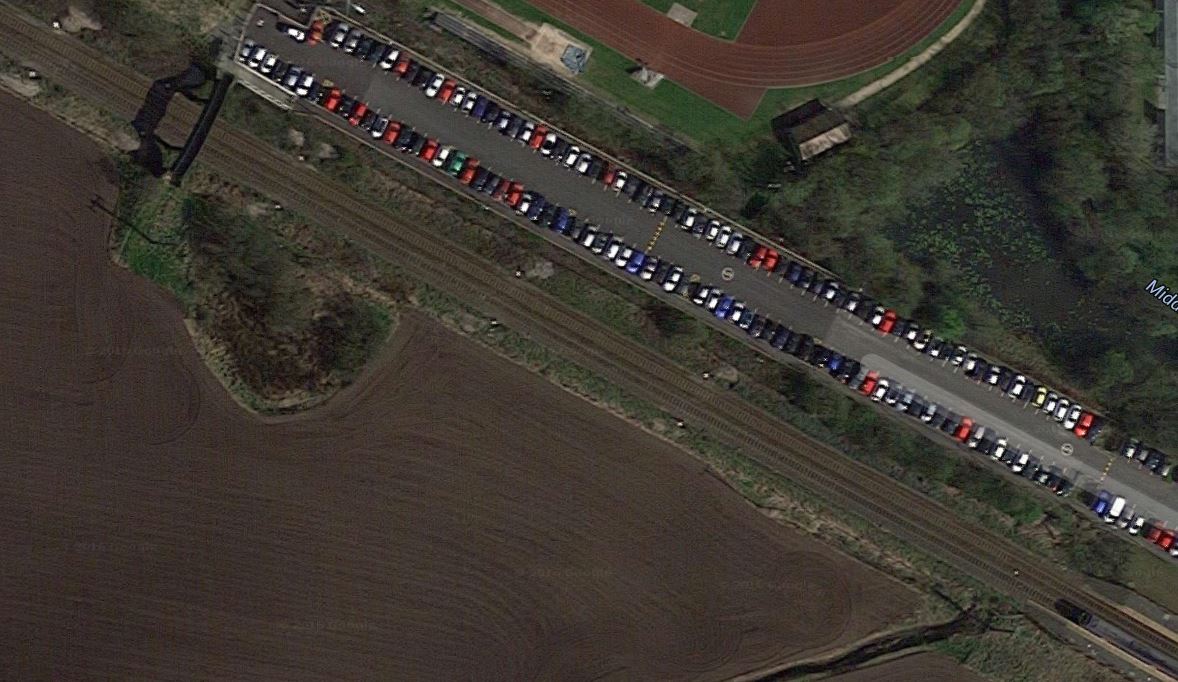
Horwich Parkway Station
Note the five pairs of white spots along the line, one pair of which is in the shadow of the footbridge.
If you can’t see them click the image and show it in your browser.
Could the white dots be concrete piles for the electrification? As I left Horwich Parkway station, I noticed some piles to the South of the station and they were uncovered, showing white concrete.
Just in front of the train in the station, it is possible to see another white dot between the tracks. A circular structure is also visible in the pictures of the station.
It would also appear that one set of foundations are missing between the single dot and the pairs along the line. Could this be, because a substantial gantry is being erected here, to support the catenary at the Northern end of the station?
So it would appear that masts could be used in the centre at Horwich Parkway station, but after An Hour In Farnworth, I am rather dubious that a similar technique could be used at Farnworth station.
Dagenham Dock Railway Station
After visiting the Land Of The Giants, my EL2 bus went through the industrial area to Dagenham Dock station.




A few points.
- The area is rather bleak.
- From the station I caught one of the two trains per hour into London.
- Dagenham Dock and the other two stations of Renwick Road and Barking Riverside will need to have a decent bus connection.
It certainly needs substantial improvement.
Glasgow Subway Orders New Trains From Stadler
This article in Global Rail News is entitled New trains for Glasgow Subway. This is said.
Stadler Bussnang AG and Ansaldo STS have won the contract to supply Glasgow Subway with its first new trains for almost 40 years.
Strathclyde Partnership for Transport (SPT) has today (March 4) released images of the new driverless trains, having awarded the £200 million contract.
Stadler is a Swiss manufacturer of rail vehicles, that is not very well known in the UK. Although, some of their products have been sold to run here.
- Six Variobahn trams run on London Tramlink.
- Thirty-two Class 68 diesel locomotives have been delivered or are on order from Vossloh, which since 2015 has been a subsidiary of Stadler. Six are used by Chiltern Railways.
- Ten Class 88 electro-diesel locomotives have also been ordered from Vossloh.
The trams are very much a standard product, but the locomotives are unusual in that they have been specially built for the UK’s restrictive loading gauge. Wikipedia says this about the company.
Stadler Rail is also focused on niche products and is one of the last European manufacturers of rack railway rolling stock.
Look at the products they make and quite a few are not mainstream.
So as the Glasgow subway is small and to an unusual gauge and size, it is not very surprising that Stadler are involved in producing the new trains.
I don’t think that this will be the last order we’ll see for Stadler products in the UK.
This article from the Railway Gazette is entitled Stadler Rail switches its focus from east to west. This is said.
Swiss rolling stock manufacturer Stadler Rail has announced plans to shift the focus of its growth plans away from the CIS and Middle East markets and towards the UK and the USA.
On June 19 Stadler said the Swiss national bank’s decision to uncouple the franc from the euro in January had brought a sudden 20% increase in the price of its products, which was ‘negatively impacting’ the company. Meanwhile, planned expansion into the CIS market has been ‘halted’ by the weak rouble and sanctions on Russia. Stadler has also ‘fallen well behind expectations’ in the Arab market.
With all the new rail franchises starting in the next few years, I think we’ll see some orders. Certainly with all its expansion plans Tramlink will need a few more trams and if the Class 68/88 locomotives are successful, then other companies might purchase some more.
One very large niche order are new cars for the Docklands Light Railway.
But I also think we’ll see a few Stadler Flirts in the UK, as they seem to be selling well.
Does London Need To Get A Grip On Rail Connectivity?
This article in the Standard has a title of Old Oak Common regeneration scheme ‘risks being London’s worst cock-up in 50 years’. This is the first three paragraphs.
Boris Johnson’s flagship regeneration scheme at Old Oak Common is in danger of turning into London’s “worst cock-up in 50 years”, a leading government adviser warned today.
Urban planner Sir Terry Farrell said the £10 billion development, the biggest in Britain, is heading for disaster because of the rush to finish Crossrail.
He blamed politicians for ducking key decisions and said the Mayor was partly responsible for a shortsighted “pass the parcel” approach. Sir Terry said: “If a tenth of the energy he put into the Boris island airport idea had gone into Old Oak Common I feel sure it would have happened without a problem.”
Old Oak Common is going to be a major development of 25,000 homes and 55,000 jobs created over the next fifteen years. A major transport hub will be created at Old Oak Common station will be created, linking some or all of the following lines together.
- Bakerloo Line
- Central Line
- Crossrail
- Dudding Hill Line
- Great Western Main Line
- HS2
- North London Line
- Watford DC Line
- West Coast Main Line
- West London Line
This map shows the plans for Option C of TRfL’s Old Oak Common proposals.
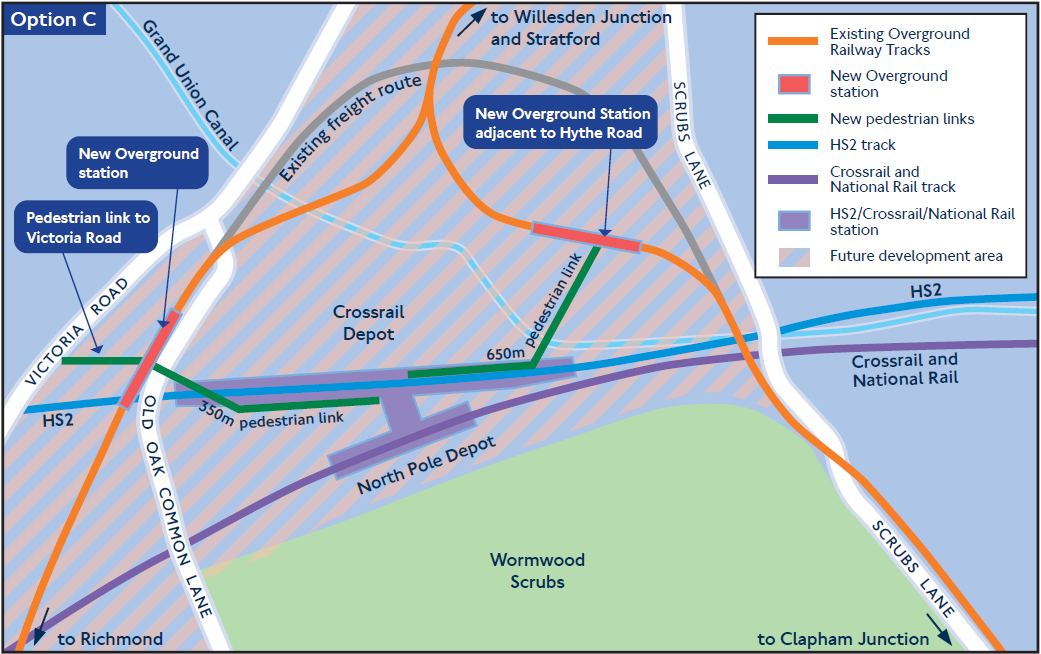
Option C Proposal At Old Oak Common
I wrote about this option in Should An Overground Station Be Built At Hythe Road?
Terry Farrell has said that there is no space between the rail lines to put the piling to support the homes, offices and other developments that will built over the top.
I also believe that the walking routes between the various stations will be far to long and tortuous.
The developers, Transport for London and the rail companies involved all seem to be planning their own parts in isolation.
It seems to echo what I documented in Searching For What Is Going To Happen On The East London Line After The Thameslink Programme Opens, where I was trying to find out how Thameslink will improve my journeys from Dalston Junction using the East London Line.
My correspondence on that issue, would seem to indicate that Thameslink and Transport for London don’t talk to each other and calmly go their own ways.
Someone needs to get a grip on all these big projects at a high level.
How Will Crossrail Fit Into Heathrow?
With all the unnecessary arguments going on about Crossrail and access to Heathrow Airport, that I wrote about in Heathrow Express And Crossrail, I thought it would be an idea to look at the layout of the rail lines at the airport. This rail map from carto.metro.free.fr, shows the lines as they are now.

Heathrow Rail Lines
Look at the Crossrail web site page for Heathrow and this is said.
Crossrail will provide four trains per hour in each direction between central London and Heathrow Airport (Terminals 2 & 3 and Terminal 4), replacing the two trains per hour Heathrow Connect. Crossrail services to and from the airport will call at local stations into central London.
To match the train service with passenger demand at particular stations, and to achieve shorter journey times for longer distance passengers, trains will not usually call at all stations.
The Heathrow Express will continue to operate as prior to the construction of Crossrail but we will replace the Heathrow Connect overground service with a more frequent service that stops at other stations on the way to Paddington.
So it would appear that Crossrail will use the two platforms at the Terminal Four station, as a terminus. Is that enough platforms?
Passengers for Terminal Five will have to change trains at Heathrow Central station.
It’s certainly not the best way to design a railway.
In a real world where passengers come first, Heathrow Express would be confined to history and two Crossrail trains per hour would go to each of Terminal Four and Terminal Five.
As I write this post, this article on Global Rail News has just been published. It has a title of Heathrow Express fleet out of service for “foreseeable future”.
So perhaps the trains are imposing a solution to the problem and leaving the paths open for a sensible Crossrail-only solution.
Many would pay serious money to be a fly on the wall at the meeting between Heathrow Airport, Transport for London, the Mayor of London, the Office of Rail Regulation and perhaps a couple of heavyweight government ministers, when the solution to Crossrail’s access to Heathrow is sorted.
The Piccadilly Line And Heathrow
I’ve just looked at the map again and it prompted me to look at the Piccadilly Line At Heathrow.
Note how the Piccadilly Line starts from Hatton Cross station calls at the single platform Terminal Four station and then curves in a single-track loop before it arrives at the station for Terminals 1, 2 and 3.
This must be the simplest way to create a the end of an Underground line, if you can just keep digging.
A few years earlier, a similar tunnel was dug in Liverpool to link the Wirral Line to the city centre, when Merseyrail was created.
Both tunnels are single unidirectional lines running clockwise.
A similar layout could be used to take the Victoria Line to Herne Hill, as I wrote about in Will The Victoria Line Go To Herne Hill?
The Piccadilly Line And Heathrow After Crossrail
Some might question if it is still necessary to have the Piccadilly Line run to Heathrow after Crossrail has been built.
But consider the following.
- The upgrade of the Piccadilly Line with new signalling and new trains, will bring an increase in capacity and faster times from Central London to the Airport.
- For large numbers of people living along the route of the Piccadilly Line or just one change away from it, it will still be the easiest way to get to Heathrow.
- The Piccadilly Line will be the only line other than Heathrow Express, that serves all five terminals.
- There will certainly be contactless ticketing to Heathrow, if you use the Piccadilly Line.
- If politics stop the use of Freedom Passes to Heathrow on Crossrail, it will probably be available on the Piccadilly Line.
I also think, that there is scope for sorting out the western ends of the Piccadilly Line to improve connectivity in the area.
Slough Borough Council have already proposed extending the Piccadilly Line from Terminal 5 to Slough.
If you look at the route of the Piccadilly Line westward from South Kensington station, the line seems to cross several important rail lines without any interchange.
As an example this is the area centred on the old Earls Court Exhibition Centre, which is now being developed as housing.
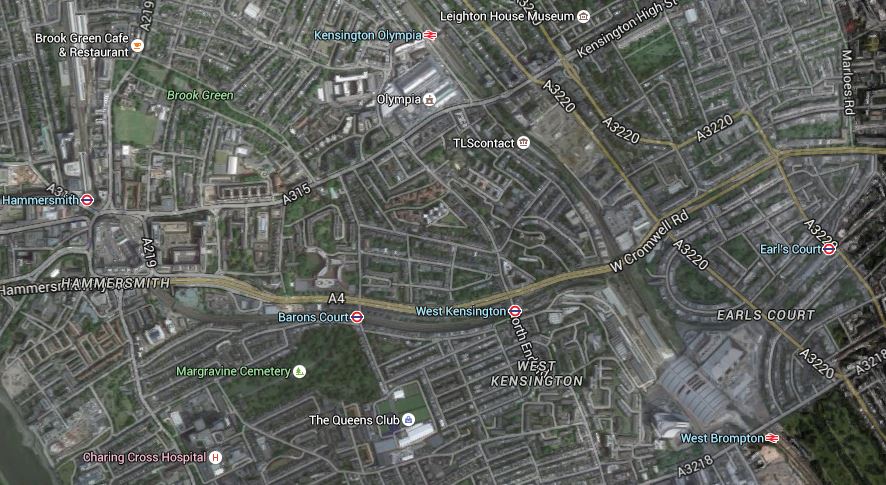
Around Earl’s Court
I think there’s scope for a better station at Earl’s Court on the Piccadilly Line, that connects with the West London Line.
Unless of course, the development is so upmarket, the residents wouldn’t be seen dead in trains. But developers have told me that in London, good stations improve marketability.
An improved station here would give good connections between Heathrow and South London and especially to Clapham Junction and East Croydon stations.
Other possibilities would be to connect the Piccadilly Line to the North London Line and a reinstated Brentford Branch.
I can’t believe that if Transport for London spend millions on new signalling and trains on the line, that they won’t do some other improvements.
Heathrow Express In Trouble
I have used it occasionally, but I don’t use Heathrow Express much, as it is very overpriced and terminates in London at the difficult-to-access Paddington station.
So to go to and from Heathrow, I usually use the Piccadilly Line. Cramped and slow it might be, but when going, I can take a bus to the convenient Manor House station, get a seat and read all the way to the airport for free.
Coming back from the airport, depending on the time, I use a variety of routes. The last time, I swapped to the District and then used the East London Line to get to my nearest station at Dalston Junction and two stops on a frequent bus home.
This report on the BBC web site is entitled ‘Crack’ in train forces Heathrow Express to replace stock and tells how the Cl;ass 332 trains have been withdrawn for checks.
They’ve probably developed the crack due to the overweight passengers with their overweight luggage, who are on expenses, so they can afford Heathrow Express.
So what have Heathrow Express done to get round the problem of no trains?
They’ve taken the Class 360 trains used on Heathrow Connect, thus removing the only affordable way for a lot of passengers and airport workers to get to Heathrow, unless they use the 140 bus.
I’ve just looked at how you get from Hayes and Harlington station to Heathrow this morning and the National Rail Journey Planner, is telling everybody to get a train into Paddington and then get Heathrow Express.
Taxi and mini-cab drivers must be laughing all the way to the bank.
It all goes to show how the Heathrow Express/Connect service is good and expensive when it’s working, but totally useless when there is a problem.
It could be thought that Crossrail will solve the problem.
At present there are four Heathrow Express and two Heathrow Connect services an hour between Paddington and the Airport. I think that Crossrail will still provide four much larger trains an hour to Paddington and additionally another four trains through London to Shenfield or Abbey Wood.
That could be a tripling of capacity between Heathrow and Central London. And unless it is convenient for you, you don’t have to change to the Underground, a bus or a taxi at Paddington.
I shall take a direct train between Whitechapel and Heathrow, if I need to get to the airport.
But will I be able to?
This article in Rail Magazine is entitled ORR consults on Heathrow Spur access charges and reports on the ongoing row between Heathrow and everybody else, about letting Crossrail trains use the spur into Heathrow Airport.
Consider the following.
- Heathrow desperately wants to build a third runway, which is opposed by nearly all Londoners.
- UK taxpayers are paying for the upgrading of the link between the Heathrow Spur and the Great Western Main Line.
- Crossrail will bring a massive increase in capacity to the airport.
- Heathrow Express only serves Paddington, which ironically is on Crossrail.
- Londoners generally don’t like Heathrow and rarely use Heathrow Express.
- Gatwick is getting two affordable world-class links into London.
- Boris Johnson has said that Freedom Pass holders will be able to use Crossrail to the Airport for free.
On top of all that, the current disruption to rail services has occurred at just the right time, when the ORR are calling Heathrow to act in the best interest of travellers to the airport.
I’m sure another rail company will welcome the chance to use Heathrow Express’s Class 332 trains, even with a few cracks, when the service is closed in a few years time.
Electrification Delays On The Great Western Railway Must Be Serious
This article in Rail Magazine is entitled GWR and DfT discuss ‘revised plan’ after electrification delays and it talks about what is to be done to get a decent passenger service running on the Great Western Railway, despite all of the delays to the electrification program.
If you want to know more of the problem this article on the BBC web site from July 2015 is an excellent summary.
- The under-performance of the High Output Plant System, a factory train made up of 23 vehicles, has, according to rail observers, made a big contribution to Network Rail falling at least a year behind schedule.
- The whole electrification project for the Great Western line was really based on the High Output train because of the amount of work it could do so much more quickly,
- Engineering insiders told the BBC that a newly designed wiring system did not match the specification of the holes the Hops train was designed to dig and that a new design of pile-tubes hammered into the ground to house the thousands of electrification masts – went in too deep after ground surveys were missed.
- Even where the Hops train has managed to dig holes, it has damaged existing signalling cables.
- Network Rail is short on experienced engineers and experienced operators – people who know how to run a railway.
- It was decided by the Department for Transport that the new trains will be 26m long per vehicle and our railways are built for 23m long,
I don’t think I’ve ever seen such a badly-designed and executed project in my long years on the dark fringes of project management.
So now it is sucking engineers and resources out of every other electrification project in the UK!
For instance, on my local electrification of the Gospel Oak to Barking Line, nothing much seems to have happened for the last few weeks.
I had to have a quiet chuckle, when I read this last paragraph in the Rail Magazine article.
GWR has tested short-formation High Speed Trains, and these could potentially be used on longer-distance services currently operated by multiple units, such as Cardiff-Portsmouth and Exeter-Penzance. They could also be used on some of the longer branch lines in the South West, such as Par-Newquay and Exeter-Barnstaple, although neither GWR nor the DfT would confirm this. A potential additional order for bi-mode AT300 hybrid trains could also be under consideration.
Terry Miller’s wonderful stop-gap design of the 1970s; the High Speed Train, is coming to the rescue again.
But then very serious problems, need the most serious of solutions!
I’m not running Network Rail and I’m not the Transport Minister, but in my view, it is now time to think extremely radically.
- Electrify as far as possible from London and run Class 387 trains or dependable-but-ugly Class 319 trains where you can.
- Run services to Bedwyn, Newbury, Oxford and the various branches East of Didcot using IPEMU variants of Class 387 trains.
- Replace as many HSTs on the East Coast Main Line as possible with new Class 800/801 trains and deploy Miller’s Masterpieces to the Great Western.
- Build new Class 800 electro diesel trains, instead of Class 801 electric trains and use them on the routes of TransPennine and Hull Trains.
We have been lucky with our train purchases and development.
- Class 800 and Class 801 are identical except for the diesel engines.
- Class 700 trains are being delivered to release Thameslink’s Class 387 and Class 319 trains.
- There are fifty or so Class 387 trains, that could be converted into IPEMUs, which would have a sixty mile range on batteries.
- Bombardier could probably build a few more Class 387 trains, alongside the Aventras.
I think that many places will get different and probably better and bigger trains, but not everyone will get the expected new electric trains.
Small-Scale Connectivity To Crossrail
I live about twenty-five minutes from my nearest Crossrail station at Moorgate on a 141 bus and as I walked around today, I just wondered what will be the best way to access London’s new East-West rail line when it opens in a few years time.
So what do I mean by small-scale connectivity?
I think it is best defined as any method that isn’t more than perhaps ten stations on heavy rail, light rail, the Underground or trams.
And of course, you might substitute Thameslink for Crossrail! Or if you don’t live in London, it could be your major cross-city line.
So in my case, the following would be small-scale connectivity to Crossrail.
- Walking
- Cycling
- Car
- Taxi
- Bus
I do have a heavy rail link to Crossrail in the form of the East London Line between Dalston Junction and Whitechapel, so that will be included as it is only a short stretch of line of four stations.
These are the methods available to me in Dalston.
Walking
For good connectivity, the walking routes around a station should be properly mapped and signposted on a physical wayfinding system, like Legible London used all over the capital.
I also think it is essential that a common format is used, along a line.
So this probably means that London will decide how walking maps and signposts at Crossrail stations in Essex and Berkshire will look.
Will that be acceptable to towns and cities, that have called in consultants to design their ideal wayfinding system?
One problem with wayfinding systems, is that in some places the locals who know the city or area well, say they don’t need the system and think it a waste of money.
You also have the problem in areas with more than one local authority, that each go their own way, rather than agree on a common system.
Remember too, that London is so large, that the average resident finds themselves regularly in an area of the city they don’t know. So Londoners on the whole are very pro-Legible London.
I feel that we need to impose the same wayfinding system all over the UK.
Cycling
Just as there should be good walking routes to a station, the cycling routes should be obvious and well-signposted.
And if bikes are provided for hire at the station, the payment system must be compatible with London’s.
Perhaps we need a nationwide bike hire system?
Car
Many people will want to drive to their local Crossrail station and park their car before they get the train.
i have a feeling that when Crossrail opens, the biggest complaint will be the lack of car parking at stations.
Taxi
For about the last three months, I’ve been suffering badly from plantar fasciitis and because of the limited mobility, it gives me at times, I now feel very strongly that every Crossrail station, should have a proper black taxi rank.
Recently Transport for London have announced that one of my local stations; Highbury and Islington, is going to have a taxi rank. I have yet to find a taxi driver who is against the idea and I believe this could be a winner for both passengers and black cab drivers.
Bus
Every London rail and tube station is a bus hub with its own spider map, which details all of the buses and their routes from the area. This is my lovcal bus spider map for Dalston.
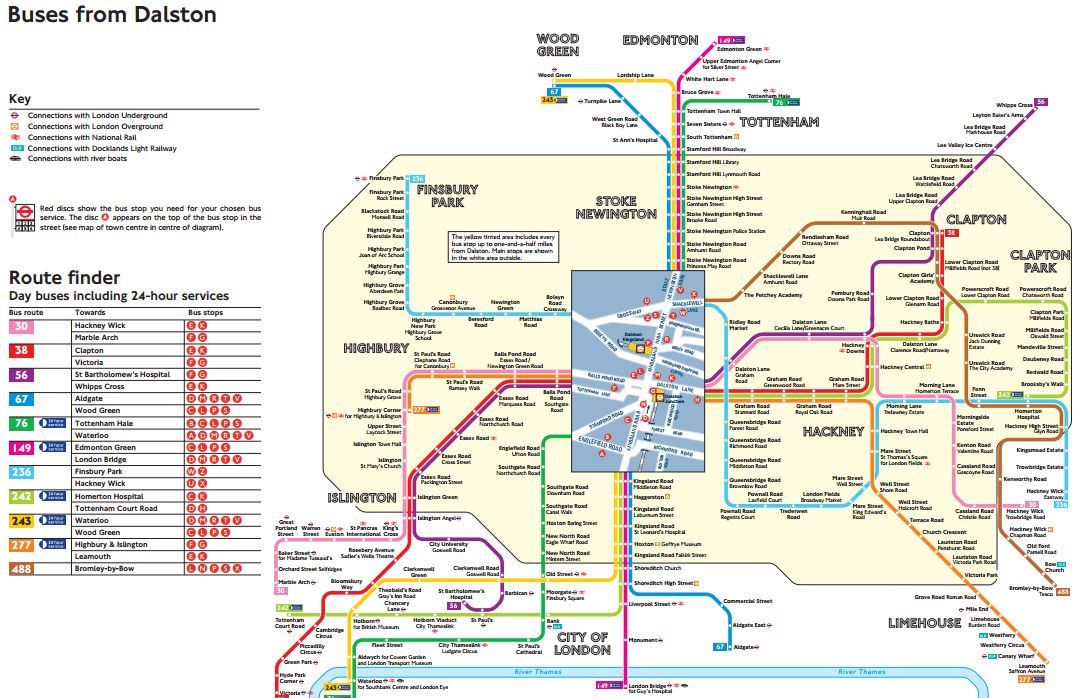
Dalston Bus Spider Map
Venture outside of London and in many places, bus mapping is often missing or very bad to give it the benefit of the doubt.
As with walking maps, local authorities outside of London with a Crossrail station, will have to adopt London’s system.
Other Rail Lines
Crossrail does connect to quite a number of heavy rail, Underground and Overground Lines.
- Bakerloo Line
- Central Line
- Circle Line
- District Line
- East London Line
- Great Eastern Main Line
- Great Western Main Line
- HS1 – After extension to Gravesend
- HS2 – After Old Oak Common
- Jubilee Line
- Metropolitan Line
- North Kent Line
- Northern Line
- Northern City Line
- North London Line
- Thameslink
- West Anglia Main Line
- West Coast Main Line – After extension to West Coast Main Line
- West London Line
I have included links to extensions to Gravesend and the West Coast Main Line and Old Oak Common in this list.
Small Branch Lines
But it also connects with several smaller branch lines or perhaps in the future, some tram and light rail lines.
- Abbey Line – After extension to West Coast Main Line
- Brentford Branch Line
- Croxley Rail Link – After extension to West Coast Main Line
- Greenford Branch Line
- Henley Branch Line
- Marlow Branch Line
- New North Main Line
- Reading to Basingstoke Line
- Romford to Upminster Line
- Shenfield to Southend Line
- Slough to Windsor and Eton Line
- Staines and West Drayton Railway
- Waterloo to Reading Line
I believe that Local Authorities will develop these smaller lines and create others to maximise their benefit from Crossrail,
A Metro In The East
The two lines that I think have the most likely chance of being developed, are the Romford to Upminster and Shenfield to Southend Lines.
- The main line rail company; c2c, is very ambitious.
- In the next couple of decades, South East Essex will be an important economic growth area.
- Better links are needed to Southend Airport and the London Gateway.
- There is substantial development of jobs, housing and leisure opportunities in the areas the lines serve.
- Give the people of Essex an opportunity and they embrace it fully.
I wouldn’t be surprised to see a substantial metro network created in the area, based on Billericay, Shenfield, Southend and Thurrock.
A Metro In The West
If a metro network can be successfully developed at the eastern end of Crossrail, is there the potential of creating something similar at the western end?
Consider.
- Heathrow dominates thinking in West London and feels that everybody should jump to its tune.
- Heathrow should wake up to the fact that it will never get a third runway, as London’s electorate will always vote to block this.
- There will always be a Heathrow, but in time, it will cease to dominate the air travel market in the UK, as it does now!
- Heathrow has very limited rail connections to Basingstoke, Reading and the West.
- If you look at the list of small branch lines, several are clustered around the western end of Crossrail, with its two hub stations of Slough and Reading.
A metro in the west could be developed based on hubs at Basingstoke, Heathrow, Slough and Reading. The Windsor Link Railway is surely thinking along those lines.
A Metro In The South East
Of all the stations on Crossrail, Abbey Wood is one of the most disappointing.
As a terminus for Crossrail, that connects to the North Kent Line and to services to South East London and the Dartford area, four platforms doesn’t seem enough, when you compare the station to the other terminals of Reading and Shenfield.
Transport for London have proposed that the Gospel Oak to Barking Line could cross the river to serve Abbey Wood and if this should happen, there must be opportunities to create another metro system based on Abbey Wood.
A Metro In The North
There are proposals to extend Crossrail to Milton Keynes from Old Oak Common.
This would surely, bring in the possibility of a network of local lines based on Watford.
- The Abbey Line is one of those difficult-to-run lines, that needs substantial improvement.
- The Croxley Rail Link could be expanded to serve Amersham.
- Local services on the West Coast Main Line and the Watford DC Line are very crowded.
This will only be developed once Crossrail serves Watford.
Conclusion
Crossrail in 2030, will be an entirely different line to that being created today.
West Ealing Station – 28th February 2016
Work is also progressing at West Ealing station, as these pictures show.


The bay platform for the Greenford Branch is also obvious and I wonder , what the eventual form, timetable and opening date for that line will be. In a section on the Future of the Greenford Branch, Wikipedia says this.
In 2017 Crossrail is due to begin using two of the four tracks of the Great Western Main Line and the Greenford service will terminate at West Ealing, rather than continue to Paddington, to obviate interference with Crossrail, and to create track capacity for increased services to Heathrow. In compensation the branch line service will increase from two to four trains per hour. Ealing Council desires to have the line connected to the south west to Clapham Junction via the West London Line, and to the north west to West Ruislip.
Of the various things said in this little section on Wikipedia, I think some might happen.
- Transport for London like fifteen minute interval turn-up-and-go services, so an increase in frequency to four trains per hour would be a serious possibility and make the line a good feeder service for Crossrail.
- Some have said that the branch will become part of the London Overground.
- I doubt the service will go past West Ealing, as that would interfere too much with the Crossrail service pattern.
- I don’t rule out, arranging schedules, stairs and lifts, so that the interchange between the two lines is an easy one, with the minimum of waiting time.
- If the Greenford Branch were to be extended past Greenford, it could create a link between Crossrail and Chiltern.
It would appear that Transport for London won’t get control of West Ealing station until perhaps some time in 2017, so I think it is unlikely, that Greenford Branch services will be changed before this happens.
I also think, that on their past record, Transport for London, might come up with something that is a lot better than any speculation can propose.
 The Anonymous Widower