Victoria Gets A Posh Umbrella
Manchester Victoria was a terrible station, with a difficult connection to Manchester Piccadilly. The connection improved with the Metrolink, but as they are now rebuilding Victoria, it’s got worse again. As I’m now familiar with the walking route, I was able to put a couple right about the way to go.
There must be something in the Manchester civic psyche, that likes to confuse people.
But Victoria seems to be getting on with its rebuilding, which includes a posh roof over everything and a new footbridge.
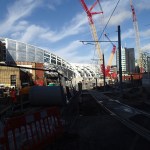
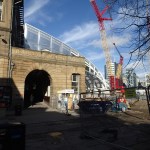

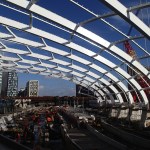
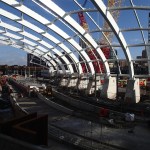
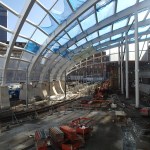
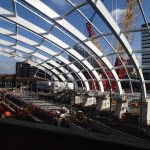
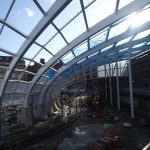
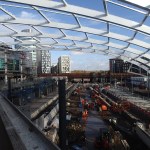


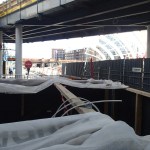
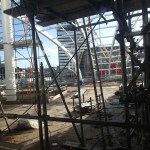
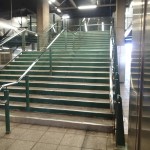
Unfortunately, the electrification to Liverpool Lime Street seems to be having problems and it will be some months before Class 319 electric trains are working the route, hopefully before next spring.
It does look to me, that when complete, anywhere on the tram routes in Manchester will have easy access to the electrified Trans-Pennine links at Manchester Victoria, which could become an architectural icon of the North. You’ll get the tram to Victoria and then totally under the new roof, you’ll go through the ticket gates and across the fully-accessible footbridges to the appropriate platform to await your train.
In addition, those who arrive from London and the South at Piccadilly and are perhaps going on to places like Burnley, Blackburn and Hebden Bridge from Victoria, will have a completely dry route, which is of course important in Manchester, using the trams. The trams must use contactless bank card tickerting though to be compatible with what other cities, like London, are doing.
This is Network Rail’s page on the £44million work.
I think everyone will agree that it’s all a bit different to the concrete crap that British Rail built forty to fifty years ago, like Euston and Manchester Piccadilly, when those with special access needs or advanced age didn’t exist, as everybody was adult and fit as a butcher’s dog.
I can remember meeting a friend in the newly-opened extension to Kings Cross station and looking with amazement at the structure that had been created.
Why shouldn’t other rail stations be given an added wow factor?
Especially now, when we have the architects, computers, techniques and materials to build them in an affordable manner. How many stations could be rebuilt using the same methods as New Cross Gate?
Good stations, like good clean electric trains, have one common problem. They are passenger magnets and very often attract so many extra paying passengers, that we have to expand the system.
I have a feeling that after they see the completed scheme, they’ll be wanting some of their other architectural disasters like Salford Crescent and Oxford Road stations, at least given the treatment that Network Rail have applied at Huyton.
Virgin’s Sub-Standard First Class
I usually travel First Class to football outside London.
First Class to Ipswich isn’t much, but it’s only a journey of a few minutes over an hour and they do throw in free and excellent wi-fi.
It doesn’t compare well with the new offering, I had a taste of, when I went to Cardiff on First Great Western. But the offering I got to Manchester from Virgin on my way to Blackpool was very poor.
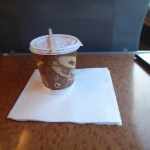

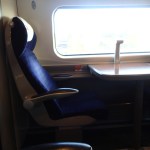
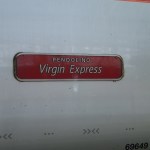
I had thought before I travelled, that I might upgrade to First Class on the way back for £15, but I didn’t bother.
Alan Williams in the November 2014 Edition of Modern Railways has a go at some First Class offerings, criticising seat allocation, bad views and catering amongst other things.
If companies are going to offer better travel for an extra price, they ought to do it right. It should include.
- Proper seat choice on the Internet. I think East Coast do this!
- At Seat Service with proper china
- A comprehensive snack offering to suit all tastes, including coeliacs and vegans
- Complimentary bottled water
- Free easy-to-access wi-fi.
- All seats should have a decent view, like Chiltern Railways offer to everyone on their Mainline service to Birmingham.
I think Virgin should question, whether they are offering the right service. I know it was a Saturday, but it was even inferior to East Midland Trains to Nottingham.
Crossrail Build A Temporary Station
Crossrail don’t seem to do rubbish, as these pictures of the temporary station at Abbey Wood show.
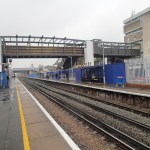
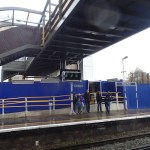
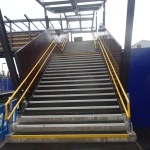
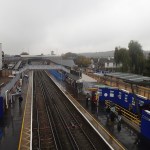
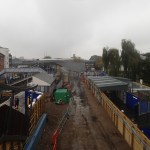
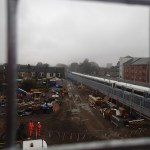


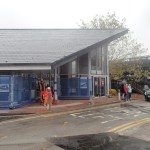

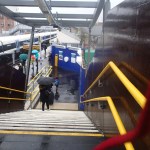
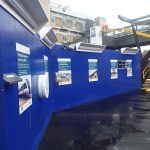
It will probably be better without the rain and when they have finished the lifts. But how many times have you seen lifts in a temporary building. I’ve only seen them once befire and that was at the site of Crossrail’s Custom House station.
The Trains Going North
Today, I went from East Croydon to Luton and then on to Bedford in two Class 319 electric trains.
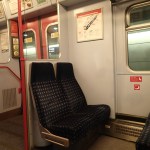
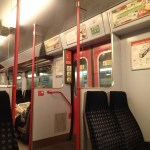
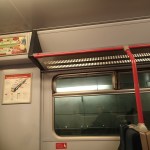
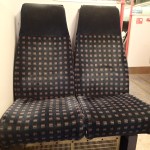
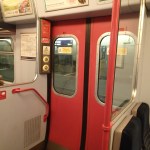

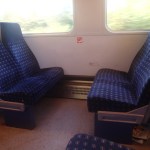
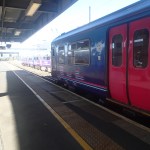

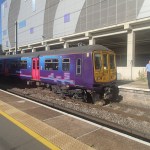
They were originally going to be fully refurbished, but now according to Wikipedia, the refurbishment will be more basic.
The cascaded trains will get a more basic refurbishment than previously proposed, which will include a new Passenger Information system, LED lighting, new seat covers and an internal and external repaint.
It will be interesting to see the trains in Lancashire. Certainly, the ones I rode today had a poor passenger information system and too much awful pink paint.
But the plus point is like all Mark 3-derived trains, they rode smoothly and quickly through the countryside, at speeds approaching their maximum of 100 mph.
GTR Create A Crisis Out Of A Little Local Difficulty
My Plan was simple. I intended to take a train down the East London Line to South Norwood and from there walk across the platform to hop one stop to East Croydon. At East Croydon, the idea was then to get a Thameslink Class 319 to Luton and Bedford, taking pictures along the route.
I should have known there were problems at Dalston Junction, as staff didn’t know where trains were to be routed. In the end my West Croydon train, which had been prematurely turned at the station, was sent off to Crystal Palace.
I spent about fifteen minutes at New Cross Gate changing from my train to a following West Croydon one. It sped to South Norwood, where I waited to try to get some pictures of the passengers crossing between southbound Overground and Southern trains.
The wait was in vain and I didn’t get my pictures and in the end took a train to East Croydon to get Thameslink.
At East Croydon, chaos was in full flow, with trains arriving randomly in opposite directions on the same platforms, and after nearly an hour, I managed to squeeze onto an extremely crowded Bedford train.
Eventually, the crush in the train eased and I got to Luton and Bedford in a Class 319 train.
The problem had all been caused by a serious signal fault at Clapham Junction. These happen, but it was GTR‘s response to the problem that failed so badly.
When I was waiting at South Norwood, there were no staff on the southbound platform and no information about what was going on.
At East Croydon, information was again minimal, but it probably didn’t help that the station is in the middle of a rebuilding.
GTR must get their act together.
Reading between the lines in this section on East Croydon station from Wikipedia, it seems that GTR aren’t the only ones, where East Croydon station is concerned.
The Rail Line Into London Gateway
I took this picture as my train to Stanford-le-hope passed the rail line into London Gateway.
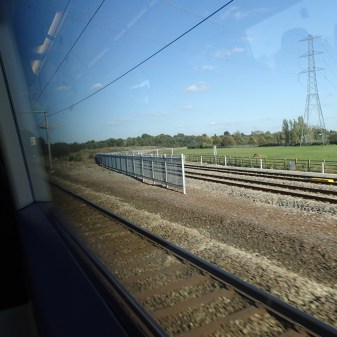
The Rail Line Into London Gateway
It shows the double-tracked rail line into the port.
I would assume it will be electrified, when the main routes through London, like the Gospel Oak to Barking Line, are also fitted with overhead wires, so that freight trains can use efficient electric haulage.
Before Overground – Emerson Park
A Charming Step-Free Station – Rating 9/10
This was definitely a case of saving the best to last.
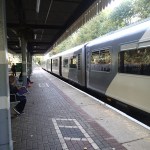
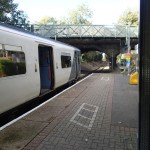

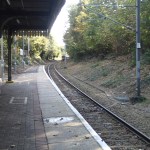
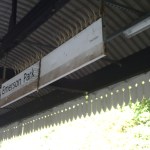
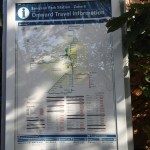
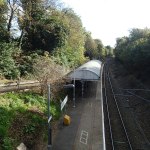
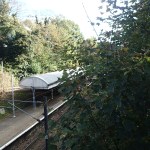
London Overground will love doing up this station, as all they’ve got to do is add paint, new signage and perhaps erect a little shed for the staff they promise will be on duty between the first and last trains.
The station has a rural feel and is on what could be described as a village High Street with a selection of shops and businesses. I walked a couple of hundred metres to a busy cafe and had a very pleasant cup of tea.
A Clean Train From Romford To Upminster
The last time, I travelled on the Romford to Upminster line, the train was a rather tired Class 315. Today’s train was a much smarter Class 317.
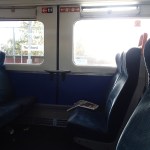
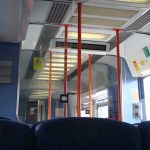
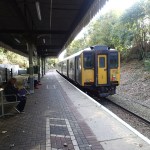
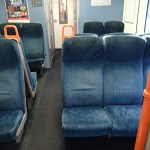
Perhaps someone from London Overground, bagged this one for when they takeover the service in May 2015. It certainly had lots of orange, but I think it might have been an old Stansted Express unit.
Can Any More Of London’s Smaller And Forgotten Railways Be Reused?
I ask this question, as last night and today, I got stuck in the City, because of monumental traffic jams due to roadworks and was thinking that perhaps the Waterloo and City Line might be extended North East from Bank to perhaps Liverpool Street and Shoreditch to create another route across the City. It would be good for me, as I would just go to Shoreditch High Street on the East London Line and then use the Waterloo and City to get to Waterloo.
Reading Wikipedia, I’m eighty years too late, as it says this under plans for the line in the 1930s.
In 1934 the London Passenger Transport Board (LPTB), operator of most of the London Underground system, proposed that the Waterloo & City should have a new intermediate station at Blackfriars, connecting with the District line station there. They further proposed that the Waterloo & City line should be extended to Liverpool Street station and Shoreditch, the trains there continuing over the East London Railway to New Cross and New Cross Gate. It is not clear whether the scheme had been costed, but nothing came of it.
It would probably be more difficult now to do anything sensible with this orphan line of the Underground.
A better plan would probably be to improve the trains and the station to a modern step-free standard and run at an increased frequency.
As the Central Line runs directly underneath the East London Line at Shoreditch High Street, it would seem logical that after Crossrail is completed, these two busy lines are connected.
But what of all the other smaller and forgotten railways in London. Can any be used to improve London’s transport system?
East London Line
The East London Line used to be a semi-detached part of the Metropolitan line, but is now been extended to be a very important part of the Overground.
It just shows how infrastructure can be reused successfully.
Transport for London are now talking about squeezing 24 trains per hour, up and down this line.
Greenford Branch Line
The Greenford Branch Line is one of the few remaining branch lines in the London area. Crossrail will see it cut back to a line from West Ealing to Greenford with four trains per hour.
Greenford itself is an unusual station, with two Central Line platforms on an island, that has a bay platform to accept the branch line trains. Platform sizes on the branch, mean that only two coach trains can be used.
According to Wikipedia, Ealoing council have proposed extending the line to West Ruislip in the North West and Clapham Junction in the South West.
I think it is true to say, that some very innovative thinking is needed to make something useful out of this line.
The only circumstances under which I can envisage anything radical happening, is if Chiltern Railways gets electrified and West Ruislip station gets rebuilt to allow the Greenford Branch to terminate there.
North London Line City Branch
Trains ran on the North London Line City Branch from Broad Street to Willesden Junction and onto Richmond.
Like the old East London Line the northern part of this line is part of the East London Line of the Overground.
I probably use the line at least half-a-dozen times a week.
Northern City Line
The Northern City Line used to be part of Underground, but since 1976 has been part of the suburban services to Welwyn Garden City, Letchworth and Hertford North.
The new franchise holder; Govia Thameslink Railway, has ambitious plans to replace the Class 313 trains on the line and extend the service hours. This document contains all the details on the new franchise.
Palace Gates Line
The Palace Gates Line ran from Seven Sisters to Palace Gates and I remember it well as a child, when I used to sit on ledgers in my father’s office in Station Road, Wood Green and watch the tank engines trundling up and down the line.
In my lifetime, it has probably never been viable as a working railway, but it seems that Crossrail 2 might run in tunnels along more or or less the same route, just as HS1 runs underneath the route of the North London Line. I suppose this might give construction advantages, if you want to sink something like a ventilation shaft down to the railway.
Romford to Upminster Line
The Romford to Upminster Line must be one of the smallest branch lines in the UK. It has just one track and three stations; Romford, Upminster and Emerson Park.
In some ways the surprising thing about the line, is that it has survived at all and has even been electrified.
But obviously, it is needed or has a very important politician living on the line, because it is being taken over by the London Overground in May 2015 and they’re even spending money on a brand-new train for the line.
After writing this I found that the Stourbridge Town branch line, is shorter with only two stations and claims to be the shortest branch line in Europe. But that line is not electrified and passengers are transported in Parry People Movers, which uniquely have flywheel drive!
As the operating speed on the Romford to Upminster line is just 30 mph, perhaps the company could come up with an appropriately-sized train for this line!
On the other hand if you read about the history of the line through Chafford Hundred Lakeside station, it says this.
The single track line through the area was opened in 1893 by the London, Tilbury and Southend Railway as part of a branch fromRomford to Grays via Upminster.
So perhaps, as the other part of the old branch serves the Lakeside Shopping Centre, it might be an idea to recreate the old branch line, as it would give this centre,Grays, Tilbury and possibly even London Gateway simple access to Crossrail. It would mean that the shopping centre would be just fifteen minutes away from Crossrail. The Shopping Line would get another attraction.
Conclusion
With the exception of the Greenford and Romford-Upminster branches, there doesn’t appear to be much scope for reusing any more of London’s old railway lines.
The New Age Of The Train
The Independent today has an article which talks about the proposed costs of building HS2. Buried in the text is this paragraph.
Tomorrow, George Osborne, the Chancellor, will announce plans for what has been dubbed HS3, a line across the Pennines that would act as a major economic boost to the North. Writing on page 42 today, the Shadow Chancellor, Ed Balls, and former Transport secretary Lord Adonis dismiss the promise as “pre-election posturing”.
I shall be awaiting what the Chancellor says with interest.
The problem of trains in the North has existed for years and so if the Labour Party was in government unchallenged for over ten years, what did Balls and Adonis do about the problem?
Since 2010, and the Coalition Government, the closet trainspotter, has signed off the first part of the improvement in the North, the Northern Hub and extended electrification in the area.
In my view this improvement across the Pennines is the most important rail project outside London.
It is worthwhile looking at the list of large rail projects that are scheduled for completion in the current decade.
Crossrail and Thameslink
Crossrail and Thameslink should always be thought of together, as they will have an important hub at Farringdon and will revolutionise travel across the wider South East and possibly further. So many journeys like Ipswich-Gatwick, Reading-Cambridge and Brighton-Heathrow will be easy journeys with a just a change or two.
Last night, I had an awful taxi journey back from the Gherkin, as roadworks meant that the whole area was gridlocked. The taxi driver was sceptical about trains, so I asked him, where he lived. As he said Goodmayes, I asked him how he got to Gatwick and he replied it was an awful drive of well over an hour. By train today it takes nearly an hour and a half, with two changes, although both are step-free at Stratford and London Bridge. After Crossrail/Thameslink is fully open the first leg to Farringdon will take 24 minutes and currently the Farrington-Gatwick link takes 50 minutes. But there is only one change at Farringdon and I suspect that trains on the Farringdon-Gatwick leg will be much more numerous and perhaps even quicker.
This sort of improvement will be delivered all over the South East.
But that is not the end of it!
Many towns and cities will be just a train ride away from a Crossrail or Thameslink terminus. Bristol, Norwich, Nottingham, York, to name just three, all have fast trains, that link to the network. So for many there will be no humping heavy cases across the Underground network to go to and from places like Heathrow, Gatwick, Brighton, Cambridge and the Thames Valley.
I think the only problem many passengers will have is choosing the best change to get to their destination. For instance with a journey from Nottingham to Gatwick or Brighton, would you change at Bedford, Luton or St. Pancras. I suspect it wouldn’t be the badly-designed St. Pancras. So if one of the others was just a simple walk across that would get the traffic.
Some main lines out of London and the areas they serve though, are not well-connected to Crossrail or Thameslink. If I go round London, the only major lines that come to mind are the West Coast Main Line and South Western Main Line. There are published ideas about taking Crossrail to Tring or Milton Keynes, which solves the problem of the former, but getting to Waterloo or Clapham Junction from Crossrail or Thameslink is a problem. But then Basingstoke to Reading is down to be electrified as part of the Electric Spine, so surely if this is done properly, this could mean Basingstoke was almost part of Crossrail.
Great Western Main Line Electrification
After Crossrail, the full modernisation of the Great Western Main Line is the next most expensive project at £5-billion.
It is comprehensive and includes resignalling and electrification of the line all the way to Swansea.
It will be interesting when both this project and Crossrail are complete how the passengers use the two lines to get to say Bristol and South Wales. I for one, might get my Crossrail train to Reading to pick up the Great Weatern there, if the interchange is easier.
I suspect too, that in the first few years of the next decade there are various tweaks to the Great Western/Crossrail interface.
Plans at present are for a lot of Crossrail trains to turnback at Paddington, but will train companies tend to run some of these trains past Reading to perhaps Oxford or Basingstoke.
It will all depend on what the passenger statistics throw up!
Northern Hub
Talk to most people, including many in the North, about the Northern Hub and they won’t have heard of it. Even if they’ve seen some of the related projects like Huyton station.
If Crossrail is unlocking tremendous potential for London’s rail network, then the Northern Hub should do the same for the Greater Manchester area. On a personal note, getting from London to places like Bolton, Burnley, Blackburn and Huddersfield should be a lot easier, but even from December 2015, the first tangible benefit of the Northern Hub should be seen, when faster electric trains between Liverpool and Manchester start to run. So they are 1980s-vintage Class 319 trains, but being Mark 3 coach-based, they should scrub-up well and be magnitudes better than Northern Rail’s scrapyard specials.
Electric Spine
If the Northern Hub is invisible, then the Electric Spine is even more so, although it is costed at £800-million.
It will have a big effect, as it creates an all-electric railway from Southampton to the Midlands and ultimately Sheffield, Doncaster and the North, which will enable more freight trains to travel up and down the spine of the country, helping to free up road space on the A34 and the motorways.
Midland Main Line Electrification
Th Midland Main Line electrification is effectively now part of the Electric Spine and the two proects should probably be treated as one large one.
East-West Rail Link
The East West Rail Link is the reinstatement of the old Varsity line between Oxford and Cambridge, via Bletchley and Bedford.
The Western section will be opened first and part of it will be in the Electric Spine. This section of the line will also be used by Chiltern’s new Oxford service, which according to this press release should be fully running by Spring 2016.
But the line’s main use will be probably be freight winding it’s way between Southampton and the West Coast and Midland Main Lines. In some way the East West Rail Link is a new section of the M25 for freight trains.
Cardiff Valley Lines
I explored the Cardiff Valley Lines on my recent trip to Cardiff. This £350-million project is a follow on to the Great Western Electrification. A good proportion of the track-work seems to have already been done.
Greater Bristol Metro
The Greater Bristol Metro is a proposal to upgrade all the local lines around Bristol. The upgrade is not as comprehensive as that in South Wales, but it should provide a substantial improvement to train services in the area.
Waverley Line
Like the East-West Rail Link, the Waverley Line or Borders Railway is another reinstatement of a line closed in the 1960s. I said in this post, that this line has more significance than anybody thinks. If it’s the success I think it will be, it could mean that we see more proposals for reopening lines turning from dreams to reality.
Class 88 Locomotive
I like to think I’m an innovative engineer and the Class 88 locomotive is the sort of idea I like. It is effectively an electric engine with an onboard diesel engine, so that it can work away from the wires if necessary.
I was talking to a freight locomotive driver yesterday and as an example, he said that they have to use diesels like Class 66 or Class 70 to take trains into Felixstowe, as they can’t put wires up in the port, due to cranes loading and unloading the trains.
But I do think that the concept of the Class 88, may well be well suited to the UK, where there are still a considerable number of places like Felixstowe, where there is no overhead wiring, but electric lines aren’t far away.
If the first engines delivered in the next few years, prove to be up to the work, I could see lots of Class 88s working the network.
Conclusions
It is a good time to be any sort of railway engineer!
But the public don’t seem to realise what is happening for the better! And in some places like South Wales, they still think it won’t happen!
There’s certainly an awful lot of taxpayers investment going in! Only time will tell, if it’s worth it!
 The Anonymous Widower