Could Modern Technology And Developments Improve the Abbey Line?
The Abbey Line runs between Watford Junction and St. Albans Abbey stations.
It has a few problems.
Frequency
The track layout means that trains generally run every forty-five minutes, which is not very passenger friendly.
The line needs at least a half-hourly service and it would appear from Wikipedia and other sources, that this could be achieved by re-instating the passing loop at Bricket Wood station.
Elderly Trains
West Midlands Trains have promised new trains for the line, to replace the current Class 319 train.
Although, these Class 319 trains are much better than their arge, as I said in A Very Smart Class 319 Train.
As West Midlands Trains, use these trains for services on the West Coast Main Line, it probably helps with staffing and maintenance.
But these trains are being replaced by five-car Class 730 trains. Will the shittle train be replaced by another Aventra?
Reliability
Search the Internet for “Abbey Line St. Albans” and you find news stories with headlines like these.
- No Abbey Flyer Trains Between St. Albans And Watford
- Abbey Line Breaks Down Again
- St. Albans Abbey Flyer Users Fund Raising To Improve Train Line
- No Trains On St Albans Abbey Flyer Line After Fault With Shut
It would appear that the Abbey Line has a reliability problem.
A Simple Solution
The simplest possible solution to improve the line with a half-hourly service would be as follows.
- Reinstate the passing loop at Bricket Wood station.
- Acquire a fleet of three Class 730 trains of an appropriate length.
This Google Map shows Bricket Wood station.
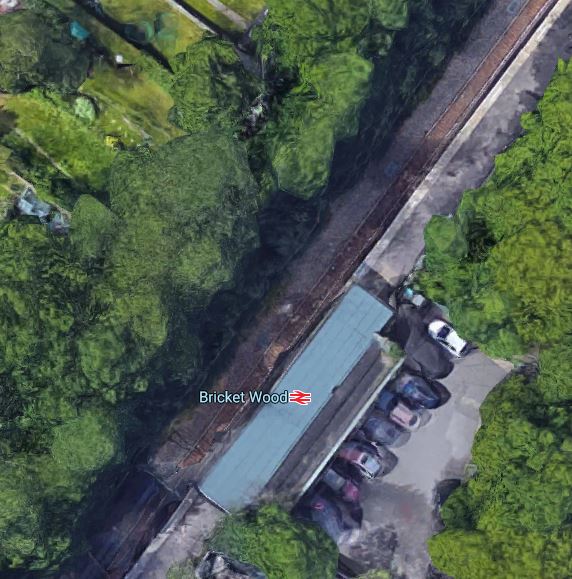
Note the single platform with a single track.
There would appear to be plenty of space for a passing loop on the opposite side to the platform..
The Class 730 trains are Bombardier Aventras and I believe strongly, that all Aventras have batteries. So surely this is just the place to be innovative, with the use of battery technology?
The loop would be built without electrification and the track layout would be such that two trains could easily pass using battery power. Pantographs would be raised and lowered as required.
Suppose the loop started in the middle of the platform and perhaps extended for two hundred metres in the Watford direction..
- The two trains would arrive at the station, with one on each side of the entry to the loop.
- The Watford-bound train, would switch to battery power in the station and use the loop to pass the other train to continue towards Watford.
- The Watford-bound train could either switch back to overhead power as soon as it regained the electrified track or wait until it is safely in the next station.
- When the line is clear, the St. Albans-bound train would continue on its way, using overhead power.
It might also be possible for trains to go towards St. Albans using the overhead power and towards Watford on battery power, with all changeovers of power source taking place at the terminal stations, where turn-round time will be several minutes.
These are some pictures of Bricket Wood station.
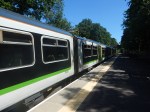
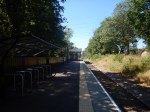
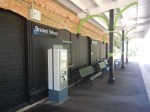



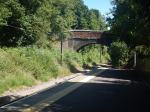

My only worry is that the platforms may only be big enough for six-car trains.
Perhaps, to avoid lengthening the platforms at Bricket Wood station, two three-car Class 730 trains could be used?
Use of the five-car trains would probably require electrification of the loop, a second platform and a footbridge, which would be a much more expensive solution.
A Class 769 Train Solution
The Class 769 train is a bi-mode version of the Class 319 train. So could these work the simple passing loop without electrification?
At four-cars, they may be short enough to work the route without building a second platform at Bricket Wood station.
But the solution would probably need the current platform to be extended to accommodate two trains.
They would use diesel power to go through the passing loop.
Passengers would effectively get a twice as frequent service, using similar trains to the current ones.
A Class 230 Train Solution
As West Midlands Trains are also using Class 230 trains on the Marston Vale Line, which can work on electric, diesel and battery power, I can’t see any reason, why these trains couldn’t be used on the Abbey Line.
They would use diesel or battery power to navigate the loop without electrification.
These trains are affordable, short in length and are designed for remote servicing, but is capacity and speed sufficient?
A Tram-Train Solution
The same Stadler tram-trains with batteries, that are being used on the South Wales Metro could also be used on the Abbey Line.
They would operate as trains, in the same ways as the Aventras, using batteries to navigate a passing loop without electrification.
This solution would have the disadvantage of West Midlands Trains introducing another type of train, but the tram-trains could go walkabout in Watford and/or St. Albans at the two ends of the route.
Under Past Proposals in the Wikipedia entry for the Abbey Line, this is said about a possible conversion to light rail.
In October 2009 Secretary of State for Transport Lord Adonis announced a plan to increase frequency on the line by allowing Hertfordshire County Council to lease the line from Network Rail and converting it to light rail from 2011. It was hoped that this would be possible for the same amount of subsidy the line received, as the new infrastructure required, such as a passing loop would be cheaper for light rail than heavy rail. Longer-term proposals envisaged extensions into Watford town centre via Clarendon Road and High Street, and St Albans city centre, possibly as far as St Albans City railway station, and possible re-instatement of the line to Hatfield.
This Google Map shows Watford Junction station
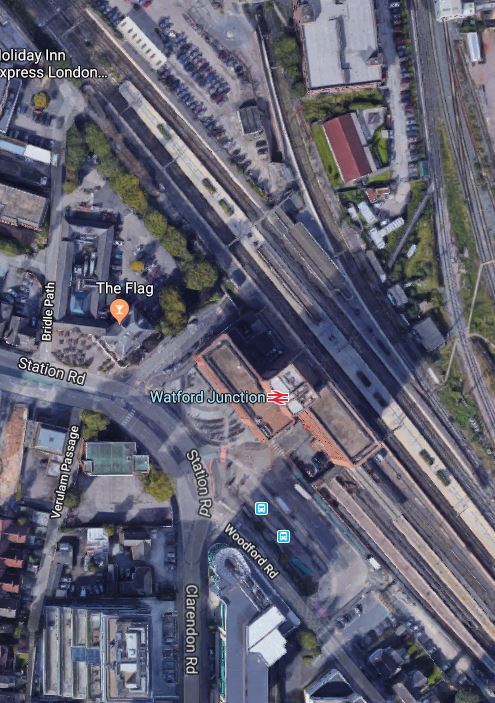
Note.
- The Abbey Line leaves the map in the North East corner.
- Clarendon Road runs South from the middle of the map.
I think it would be possible to build a bridge to take the trams over the railway.
There could even be a high-level platform for the tram-trains above the station with connections to the current heavy rail platforms.
What I have outlined here, is a classic use of a tram-train to allow trains on a heavy rail route, to extend to a town or city centre, by operating as trams.
Could Thr Abbey Line Be Linked To The Troubled Croxley Rail Link?
This map from carto.metro.free.fr shows the lines at Watford Junction.
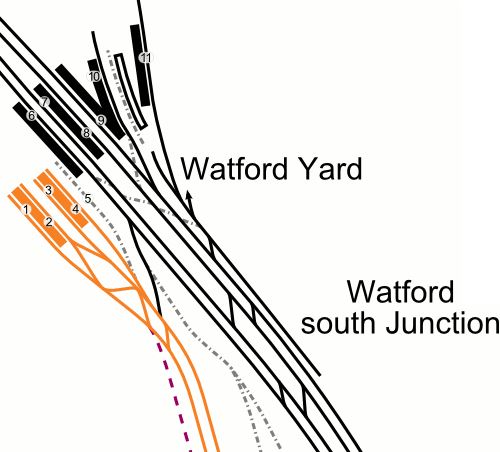
Note.
- The Abbey Line goes North from Platform 11.
- The lines shown in orange are the Watford DC Line of the London Overground, that go to London via Watford High Street station.
- The dotted purple line is the proposed route of the Croxley Rail Link.
I can’t find any references on the Internet to the possibility of a connection between the Abbey Line and the Croxley Rail Link.
I doubt that Metropolitan Line trains could go to St. Albans.
- They are too long at 133 metres.
- Extensive modifications to the track and platforms would be needed.
- They lack the batteries to navigate the proposed passing loop.
But Stadler’s tram-trains might be able to go to Croxley station.
- They are under forty metres long.
- They weigh under seventy tonnes, which could help in the bridge design.
- They could work the Abbey Line using the overhead power.
- Batteries would enable using the proposed passing loop at Bricket Wood station.
- I’m sure that Stadler’s innovative engineers could make their tram-trains run on third and London Underground rail electrification.
- Battery power could be used on some of the route between Watford High Street and Croxley stations.
I’m sure that after sorting out Cardiff Bay, Stadler’s engineers will welcome the challenge of Watford Junction.
Developments At Watford Junction Station
Over the last few years, there have been various plans about improving train services through Watford Junction station.
- It has been proposed that Crossrail is extended through the station.
- The Bakerloo Line will be extended and it has been proposed that it terminate at Watford Junction.
- West Midlands Trains will add extra services.
- How will HS2 affect services on the West Coast Main Line?
In addition there are plans for more car parking and other developments at the station.
It strkes me that there is a possibility that an innovative architect will come up with a striking scheme, that could enable bridges for trams across the West Coast Main Line.
Conclusion
There are various possibilities to improve the Abbey Line, brought about by recent innovations in the use of batteries on trains and tram-trains.
In all cases, the line gets a half-hourly frequency from new trains.
On the other hand, as with the Croxley Rail Link, there seems to be a lot of ideas and plans in Watford, but no real leadership to get anything built at an affordable cost!
Gibb Report – East Croydon – Milton Keynes Route Should Be Transferred To London Overground
The Gibb Report, says that the East Croydon – Milton Keynes route should be transferred to the London Overground.
By 2020 London will have two high-capacity and two medium-capacity cross-London heavy rail routes, backed up by several cross-London Underground Lines.
- Central Line – 30+ trains per hour (tph)
- District Line – 20+ tph
- Crossrail – 24 tph
- East London Line – 20 tph
- Jubilee Line – 30+ tph
- Metropolitan Line – 20+ tph
- Northern Line – 30+ tph
- North London Line – 16+ tph
- Piccadilly Line – 30+ tph
- Thameslink – 24 tph
- Victoria Line – 30+ tph
One line is missing from this list; the West London Line, which has a rather pathetic four tph between Clapham Junction and Willesden Junction stations.
Until Southern got embroiled in their Driver Only Operation dispute, there used to be a very useful one tph service between East Croydon and Milton Keynes Central stations.
The Gibb Report says this about the service.
I believe there is an option to transfer the East Croydon – Milton Keynes operation to TfL and it’s London Overground concession in 2018.
TfL may decide to change the service, for example by not running it north of Watford Junction, or running it to an alternative southern destination other than East Croydon. They could also develop the combined West London line service to better match available capacity to demand.
They would have a number of crewing and rolling stock options, but should be able to operate the service more efficiently than GTR in the longer term, without the involvement of Selhurst.
Selhurst TMD is the depot in South London, where the current Class 377 trains are based.
I think that this is a good proposal for the following reasons.
- As was seen on the Chingford Branch Line, London Overground have a reputation for making a good fist of taking over services that need improvement.
- As the Gibbs Report says, the combined West London Line service could be developed.
- I have net quite a few people, who use this West London Line route to get to and from events at Wembley stadium.
- The service could call at Old Oak Common station to connect to Crossrail and HS2.
- A variant of London Overground’s new Class 710 trains, could probably work the shortened route, as either four or eight-car trains.
- The Class 710 trains could be based at the convenient Willesden TMD, along with the rest of the fleet.
Being practical, a service of just two tph would give a train every ten minutes on the West London Line.
The Current Service
The current service is supposed to stop at the following stations.
- Bletchley
- Leighton Buzzard
- Tring, Berkhamsted
- Hemel Hempstead
- Watford Junction
- Harrow & Wealdstone
- Wembley Central
- Shepherd’s Bush
- Kensington (Olympia)
- West Brompton
- Imperial Wharf
- Clapham Junction
- Wandsworth Common
- Balham
- Streatham Common
- Norbury
- Thornton Heath
- Selhurst
Note.
- Stations between Watford Junction and Clapham Junction, already have a substantial Overground presence.
- London Overground already run three tph on the Watford DC Line between Euston and Watford Junction stations.
But would this be the ideal route?
The Northern Terminal
The West Coast Main Line is very busy and stations between Watford Junction and Milton Keynes are well-served by London Midland and Virgin Trains.
So would it be sensible to continue a slower local service North of Watford Junction?
It should also be remembered, that Southern introduced the original service to give better access to Gatwick Airport. Surely, this need is now satisfied by services from Clapham Junction and East Croydon.
As Watford Junction station probably has platform capacity, surely Watford Junction should be the Northern terminal
Could The Service Use The Watford DC Line?
If this were possible, this must surely give advantages, especially if Watford Junctio is the Northern terminal.
- Dual-voltage Class 710 trains could work the route.
- The service level on the Watford DC Line would be increased.
- There would be no problem accessing the bay platforms at Watford Junction station.
- There would be no requirement for any paths on the West Coast Main Line.
I think the answer to whether the Watford DC Line could be used at the present time is that trains going from the West London Line to Watford Junction must use the West Coast Main Line.
This map from carto.metro.free.fr shows the lines around Willesden Junction..
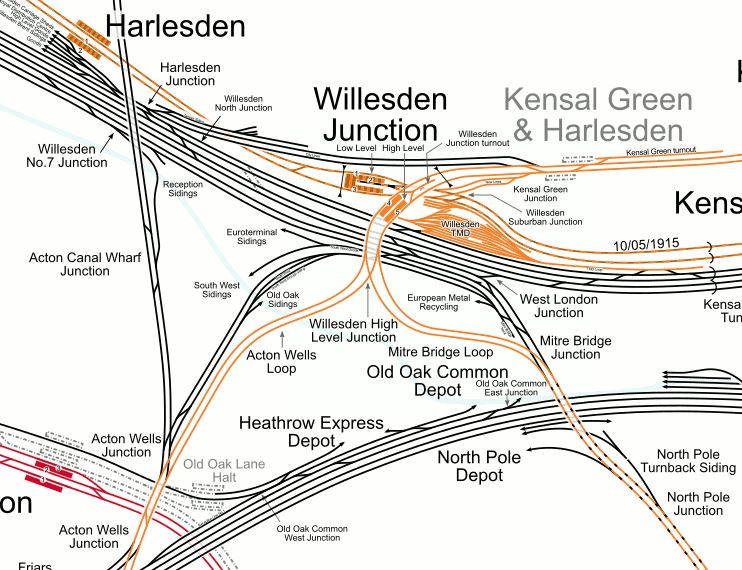
As it is all railway land, I suspect that the connection can be created.
The one problem, is that some of the Watford DC Line is shared with the Bakerloo Line.
But as the Bakerloo Line is being extended to the South and the Northern end will probably be improved, then surely creating an optimal solution to the Watford DC line, the Bakerloo Line and Overground services to Watford, makes a lot of sense.
The Southern Terminal
Various stations have merits and problems to be used as the Southern terminal for the service.
Clapham Junction
Clapham Junction would appear to have a strong case, but London Overground had enough problems squeezing in their current services.
As the station is now substantially step-free and has typically three tph to Gatwick Airport, Clapham Junction offers a good route to the airport.
Balham
Balham has been used as a terminal in the past and connects to the Northern Line. If redeveloped for Crossrail 2, it could be a possibility.
Steatham Common
Streatham Common could be developed as a major interchange and if this happens, then surely is is a possibility.
East Croydon
East Croydon would have a strong case, as it is a busy and well connected station, but there probably isn’t a suitable platform.
I think that any station South of East Croydon is probably too far.
My money would be on the new interchange station at Streatham Common, with Balham as an alternative.
Schedules And Trains
I estimate that a train doing a return journey between Watford Junction and Streatham Common would take under three hours, using the Watford DC Line. This would mean that three trains would be needed for an hourly service and six trains for a half-hourly service.
Conclusion
Transferring the East Croydon – Milton Keynes route to the London Overground looks feasible.
 The Anonymous Widower